Nuclear News Daily—5/11: Eden permit / DOT-MARAD / Framatome license
발행일
May 11, 2026
미리보기
In this issue: Eden files a construction permit, new maritime efforts from MARAD and the Department of Transportation, Framatome receives an NRC license to produce LEU+, and more. Upcoming events: The ANS Annual Conference is now only a few weeks awa...
도입부: In this issue: Eden files a construction permit, new maritime efforts from MARAD and the Department of Transportation, Framatome receives an NRC license to produce LEU+, and more.
Eden targets domestic medical radioisotope production
Eden Radioisotopes has filed a construction permit application with the Nuclear Regulatory Commission for a facility to produce medical radioisotopes, primarily molybdenum-99 and lutetium-177. Go deeper on Nuclear Newswire.
Sean Duffy and MARAD have launched an initiative to develop SMRs for commercial shipping. MARAD has released a RFI seeking industry input on its plans. DOT
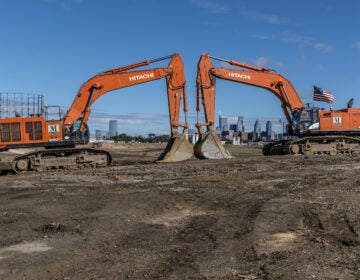
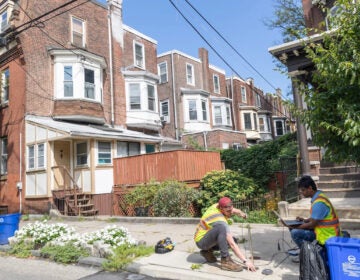
breaks ground on a $450M facility at the former PES refinery in Philadelphia to produce actinium-225 for cancer trials, promising 225 jobs and a 20-fold production increase by 2029. WHYY
project begins a key phase, moving 4.5 million kilograms of steel beams underground for neutrino detectors, marking progress toward its 2031 completion. Physics World
completes drilling at its Rocas uranium project in Saskatchewan and says three of four reconnaissance holes are showing strong indication for uranium mineralization. Yahoo Finance
hundreds of millions of dollars in funding have flowed into fusion start-ups around the world. Read a roundup on how companies have capitalized on that funding in the Financial Times (subscription required)
an MOU with server and AI infrastructure company SuperMicro to explore integrating the former’s microreactor systems with the latter’s data center infrastructure. Nano Nuclear
state collaboration for nuclear fuel recycling amid rising electricity demand. Challenges persist, but bipartisan support aims to tackle financial and policy hurdles for a nuclear sector revival. Utility Dive
halted Mihama-3 in Japan; no radioactive material was released. The reactor, which has operated for more than 40 years, awaits restart approval amid ongoing decommissioning of other units. Japan Today
at the pros and cons of nuclear power in the Middle East, stating that nuclear energy offers sustainable development but faces security and climate challenges. UN News
Framatome licensed to produce LEU+ fuel at its Richland plant
Framatome announced this week that its nuclear fuel manufacturing facility in Richland, Wash., has received Nuclear Regulatory Commission approval for a license amendment supporting fabrication of nuclear fuel with enrichment levels above 5 percent uranium-235, with manufacturing scheduled to begin in 2027. Go deeper on Nuclear Newswire.
Gov. Sherrill, PSEG CEO talk N.J. nuclear expansion
New Jersey’s two nuclear power plants, Hope Creek and Salem, may be joined by other nuclear facilities now that lawmakers have lifted the state’s de facto moratorium on new nuclear construction. Gov. Mikie Sherrill said state officials are eyeing sites for potential nuclear facilities. Executives at PSEG Nuclear welcome the news of the growing momentum for nuclear power in the state but cautioned it will take more than lifting a moratorium to make this feasible. Go deeper on Nuclear Newswire.
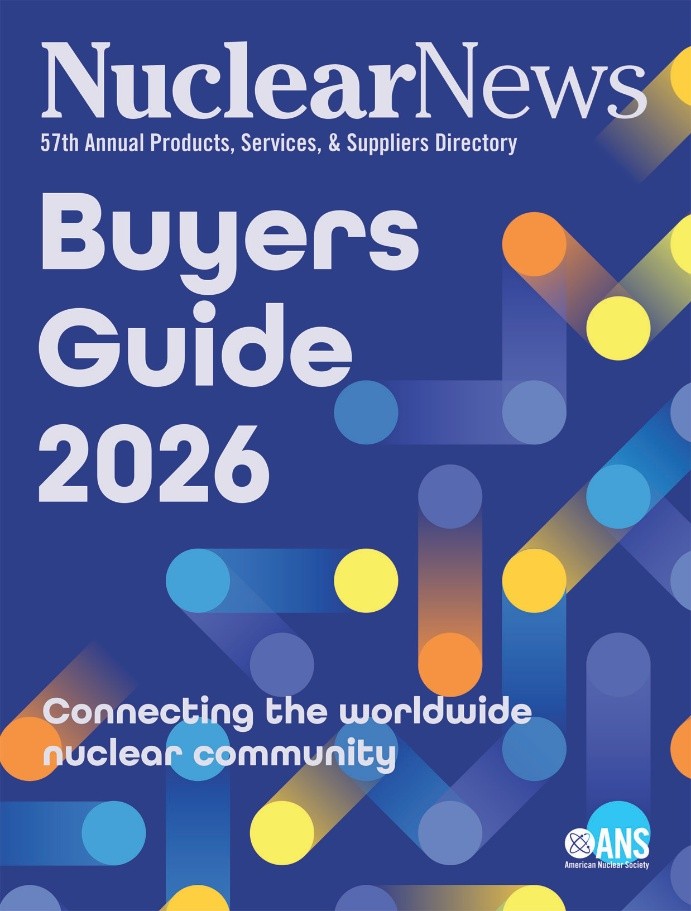
This year’s print edition of the Nuclear News Buyers Guide officially has been dropped in the mail and is on its way to ANS members now. The Buyers Guide is an annual directory that has been connecting every tier of nuclear suppliers with partners, customers, and the workforce since the 1960s—just as the commercial nuclear industry was truly gathering speed. Go deeper on Nuclear Newswire.
Virtual events: May 19—Nuclear Energy Launch Pad Industry Day. The National Reactor Innovation Center is hosting a virtual event to introduce the Nuclear Energy Launch Pad Initiative, promoting advanced nuclear technology with flexible frameworks at Idaho National Laboratory. Conferences: May 31–June 3—2026 ANS Annual Conference. This year’s Annual Conference is being held in Denver, Colo., and will feature two embedded topicals: Technology of Fusion Engineering (TOFE 2026) and Nuclear Fuels and Materials. August 2–5—U.S. Women in Nuclear 2026 National Conference. WIN 2026 will be held in Seattle, Wash., and will feature discussions on everything from next-gen fuel to licensing and regulatory reform. August 16–20—Global 2026. Global is a series of international conferences covering the full fuel cycle. This year’s conference in Chicago is sponsored by ANS’s Fuel Cycle & Waste Management Division. August 24–27—Nuclear Energy Conference and Expo (NECX 2026). The second annual NECX will take place in Dallas, Texas, and is jointly organized by ANS and NEI. Event: May 17—Tour of the NS Savannah. This open house will commemorate National Maritime Day. The Savannah acted as a nuclear-powered passenger and cargo ship from 1962 to 1970. Deadlines: May 15—Nominations are due for the 2026 Nuclear News 40 Under 40. Read more about the list on Nuclear Newswire. June 5—Applications are due for the 2027 ANS Congressional Fellowship. Fellows work on Capitol Hill for one year, contributing their nuclear expertise to a variety of policy issues. Read more on the program here.
미국 원자력학회(ANS)의 제57회 연간 구매자 가이드(Buyers Guide)가 인쇄본으로 발송되었으며, ANS 회원들에게 배포 중이다.
온라인 공급업체 데이터베이스는 2023년 5월 출시 이후 300만 회 이상의 조회 수를 기록하며 업계의 핵심 자료로 자리매김했다.
올해 인쇄본에는 미국 내 유틸리티 전체 목록, 에너지부 국립연구소 및 정화 부지 목록, 신규 건설 예정지 지도 등 세 가지 새로운 참고 섹션이 추가되었다.
---
올해 Nuclear News 구매자 가이드 인쇄본이 공식적으로 우편 발송되어 현재 미국 원자력학회(ANS, American Nuclear Society) 회원들에게 배달되고 있다. 구매자 가이드는 1960년대—상업용 원자력 산업이 본격적으로 속도를 내기 시작하던 시기—부터 원자력 공급업체의 모든 계층을 파트너, 고객, 그리고 인력과 연결해 온 연간 디렉토리이다.
인쇄본 및 디지털 자료: 구매자 가이드는 ANS 회원 및 Nuclear News 구독자만 열람할 수 있다. 또한 모든 ANS 회원은 ANS 웹사이트에서 다운로드할 수 있다.
이에 대응하는 온라인 공급업체 데이터베이스는 공개 접근이 가능하며, 수시로 업데이트되고 연중 이용할 수 있다. 이 데이터베이스는 2023년 5월 출시 이후 300만 회 이상의 조회 수를 기록하였으며, 폭넓은 접근성 덕분에 업계에서 중요하고 널리 활용되는 자료로 확고히 자리 잡았다.
온라인 구매자 가이드 공급업체 데이터베이스에는 원자력 분야의 모든 부문을 지원하는 500개 이상의 제품 및 서비스 카테고리에 걸쳐 634개 기업이 등록되어 있다.
올해의 새로운 내용: 올해 구매자 가이드 인쇄본에는 많은 독자들이 관심을 가질 세 가지 새로운 참고 섹션이 추가되었다:
미국 내 모든 유틸리티(공익기업)의 전체 목록(주요 운영 현황 및 허가 상태 정보 포함)
에너지부(DOE) 산하 국립연구소 및 정화 부지 목록
신규 건설 예정지/프로젝트가 강조 표시된 지도
Nuclear News는 올해 구매자 가이드에 참여한 57개 주요 공급업체(Featured Suppliers)—기본 등록에서 업그레이드하여 자사 사업을 가장 잘 나타내는 카테고리에 광고를 게재한 업체들—에 특별히 감사를 전한다.
구매자 가이드에 등록되지 않으셨나요? 구매자 가이드 등록에는 별도의 비용이 없다. 귀사가 아직 인쇄본 디렉토리나 온라인 데이터베이스에 등록되어 있지 않다면, ANS에서 무료로 기본 등록을 생성할 것을 초대한다.
---
AI 분석
미국 원자력학회(ANS)의 연간 구매자 가이드는 1960년대 상업용 원자력 산업의 태동기부터 공급망 연결을 지원해 온 오랜 전통의 업계 자료로, 올해로 57번째를 맞이한다. 특히 2023년 출시된 온라인 데이터베이스가 3년도 채 되지 않아 300만 조회 수를 넘어선 것은 원자력 산업 내 정보 접근 수요가 활발함을 보여준다. 올해 신설된 세 가지 참고 섹션—유틸리티 목록, 국립연구소 목록, 신규 건설 예정지 지도—은 미국 내 원자력 발전 확대에 대한 업계의 관심을 반영한다. 634개 기업이 500여 개 카테고리에 걸쳐 등록된 규모는 원자력 공급망의 다양성과 복잡성을 잘 나타낸다. 무료 기본 등록 제도를 통해 진입 장벽을 낮춘 점은 업계 전반의 참여를 독려하는 ANS의 개방적 정책 방향을 시사한다.
일본 중부 후쿠이현 소재 원자력 발전소 운영사는 고압 터빈 인근에서 증기가 누출되는 것을 발견한 금요일 오전 원자로 가동을 중단했다고 밝혔다.
간사이 전력(Kansai Electric Power Co.)에 따르면 해당 증기에는 방사성 물질이 포함되어 있지 않았으며 외부 환경에 미치는 영향도 없었다. 회사 측은 미하마(Mihama) 발전소 3호기의 재가동 시점에 대해 현재로서는 알 수 없다고 밝혔다.
누출은 금요일 오전 4시 10분경 감지되었다. 회사에 따르면 작업자들이 약 15분 후 원자로를 수동으로 정지시켰다.
2021년, 1976년 가동을 시작한 3호기는 2011년 후쿠시마 다이이치(Fukushima Daiichi) 원자력 복합 시설 사고 이후 새롭게 제정된 규정에 따라 일본에서 40년 이상 운전된 최초의 원자로가 되었다. 해당 규정은 원자로의 운전 기간을 40년으로 제한하고 있으나, 규제 당국의 승인을 받을 경우 최대 20년까지 연장이 허용된다.
중간 수명 개선 작업—주로 25~30년경에 이루어지는—중에 원자력 발전소의 많은 구성 요소들이 교체되어 운영 수명을 원래 설계 수명인 30~40년에서 60년, 심지어 80년까지 연장합니다. 연료는 18~24개월마다 교체되지만, 증기 발생기와 특수 펌프 같은 주요 구성 요소들은 더 긴 주기로 교체됩니다.
원자로 용기는 교체할 수 없으며 방사선으로 인해 취성이 생깁니다.
2 ( +2 / -0 )
#### 댓글을 남기려면 로그인하세요
#### 페이스북 이용자
재팬투데이에 로그인하거나 등록하려면 페이스북 계정을 사용하세요. 그렇게 하면 뉴스 알림을 받을 수 있는 이메일 초대장도 받게 됩니다.
일본 후쿠이현 미하마 원자력발전소 3호기에서 고압 터빈 인근 증기 누출이 발생해 수동으로 원자로가 정지되었으며, 방사성 물질의 누출은 없었다고 간사이전력이 밝혔다. 이 원자로는 1976년 가동을 시작해 2021년 40년 운영 기한을 초과한 첫 사례로, 후쿠시마 사고 이후 개정된 규정에 따라 최대 20년 연장 승인을 받아 운영 중이다. 이번 사고는 노후 원전의 안전성과 장기 운영의 리스크를 다시 한번 부각시키며, 일본의 에너지 정책—특히 노후 원전 재가동 방침—에 대한 사회적 논의를 촉발할 수 있다. 다행히 즉각적인 환경 피해는 없었으나, 재가동 시점이 불투명한 상황에서 전력 공급 안정성에 미칠 영향도 주목된다. 이 사례는 에너지 전환기에 놓인 일본이 원전 의존과 재생에너지 확대 사이에서 직면한 구조적 딜레마를 상징적으로 보여준다.
※ 이 글은 해외 원자력 바로알기를 위한 정보 전달을 목적으로 제공됩니다. 특정 기업이나 종목에 대한 투자 권유가 아니며, 모든 투자 판단과 그에 따른 책임은 투자자 본인에게 있습니다.
에덴 라디오이소토프스(Eden Radioisotopes)가 의료용 방사성동위원소, 주로 몰리브덴-99(Mo-99)와 루테튬-177(Lu-177) 생산을 위한 시설 건설 허가 신청서를 원자력규제위원회(NRC)에 제출했다.
미국은 수십 년간 진단 영상용 Mo-99의 안정적인 국내 공급원이 없었으며, 에덴은 이 공급망을 국내로 되돌리겠다는 목표를 제시했다.
에덴의 시설은 소형 비발전 개방 수조형 원자로를 사용하며, 글로벌 Mo-99 수요의 최대 50%를 공급할 수 있는 능력을 갖출 것으로 기대된다.
---
에덴 라디오이소토프스(Eden Radioisotopes)는 의료용 방사성동위원소, 주로 몰리브덴-99와 루테튬-177을 생산하기 위한 시설의 건설 허가 신청서를 원자력규제위원회(Nuclear Regulatory Commission)에 제출했다.
미국은 수십 년간 진단 영상용 Mo-99의 안정적인 국내 공급원을 갖추지 못했으며, 고수준 저농축 우라늄(HALEU) 타깃을 사용하여 동위원소를 생산하는 시설을 지원하기 위해 남아프리카공화국, 네덜란드, 벨기에의 인프라에 투자해왔다. 이들 원자로는 노후화되었으며, 수리를 위한 예상치 못한 가동 중단으로 인해 공급망에 차질이 빚어진 바 있다. 반감기가 66시간인 Mo-99는 비축이 불가능하다.
에덴 라디오이소토프스는 고수율 동위원소 생산에 최적화된 소형 비발전 개방 수조형 원자로 설계를 사용할 것을 제안하고 있다. 이 원자로는 저농축 우라늄을 사용하며 1.8 MWt로 운전된다. 에덴은 타깃 교체를 위한 휴지 시간을 활용하여 하루 22시간 운전할 계획이다.
에덴의 NRC 규제 참여 계획서에 따르면, 동 시설은 "핵분열 과정을 통해 Mo-99, 아이오딘-131(I-131), 제논-133(Xe-133)을 생산하고, 루테튬-177(Lu-177)과 같은 기타 동위원소는 중성자 활성화를 통해 생산할 것"이라고 명시되어 있다.
현지에서 타깃 제조 및 조사된 타깃으로부터 원하는 방사성동위원소를 분리하기 위한 핫셀 시설이 건설 중이다. 회사는 이 원자로에서 사용후핵연료가 발생하지 않으며, 우라늄의 90%는 추가 동위원소 생산을 위해 재활용될 것이라고 밝혔다.
에덴 라디오이소토프스의 최고경영자 캐리 프리먼(Carrie Freeman)은 "수십 년간 미국의 의료 시스템은 취약하고 해외에 의존하는 공급망의 처분에 맡겨져 왔습니다(즉, 공급망의 불안정성에 그대로 노출되어 왔습니다)"라며 "에덴은 이 역량을 영구적으로 국내로 되돌려—Mo-99 및 Lu-177의 국내 공급을 확립하고, 검증된 원자력 기술을 암과 심장 질환과의 싸움에 직접 투입할 것입니다"라고 말했다.
국내 공급: Lu-177과 Mo-99 모두 수입 의존에서 국내 공급으로 전환하면 미국 내 공급망 신뢰성이 향상된다. 그러나 Mo-99의 경우 추가적인 고려 사항이 있다. Mo-99를 생산 시설에서 의료 기관까지 운송하는 데 66시간이 걸린다면, 샘플이 도착했을 때 남아 있는 Mo-99의 양은 출발 시점의 절반에 불과하다. 이 때문에 생산지를 목적지와 물리적으로 가깝게 함으로써 운송 시간을 단축하는 국내 공급이 훨씬 더 효율적이다.
국내 경쟁: 미국은 하루 4만 건 이상의 의료 시술을 포함하여 세계 Mo-99 공급량의 절반을 소비한다. 에덴은 자사 시설이 이 동위원소의 "글로벌 수요의 최대 50%를 공급할 수 있는 위치"에 있게 될 것이라고 밝혔다.
에덴만이 국내 의료용 동위원소 생산 공백을 메우려는 유일한 기업은 아니다. 최근 에너지부(Department of Energy) 에너지 지배 금융 사무소(Office of Energy Dominance Financing)는 Mo-99 생산 시설을 건설 중인 핵융합 기업 샤인 테크놀로지스(Shine Technologies)에 최대 2억 6,300만 달러의 융자에 대한 조건부 약정을 발표했다.
에너지부에 따르면, 위스콘신주 제인스빌(Janesville, Wis.)에 위치한 샤인의 시설 크리살리스(Chrysalis)는 "미국 Mo-99 수요의 75% 이상을 초과하는 생산 능력"을 갖춘 고도 건설 단계에 있다. 샤인은 이미 기존 동위원소 시설에서 Lu-177을 생산하고 있다.
에덴의 배경: 에덴은 미국 정부가 의료용 동위원소의 임박한 부족을 인식했던 1990년대에 시작된 프로젝트로부터 샌디아 국립연구소(Sandia National Laboratories)에서 개발된 원자로 기술을 사용할 예정이다. 정부가 국제 수입 의존으로 방향을 전환했으나, 이는 특히 캐나다 초크리버(Chalk River)의 국립연구용 범용 원자로(National Research Universal reactor)가 가동을 중단한 이후 장기적 신뢰성을 입증하지 못했다. 에덴의 공동 창업자이자 최고운영책임자인 크리스 와그너(Chris Wagner)에 따르면, 에덴은 2019년 5명의 개인에 의해 설립되었으며 그 중 4명은 샌디아 출신이다. 와그너—당시 에덴의 최고경영자였던—는 2025년 Nuclear News와의 인터뷰에서 회사의 역사, 원자로, 그리고 미래 계획에 대해 자세히 이야기했다.
---
AI 분석
에덴 라디오이소토프스의 NRC 건설 허가 신청은 미국이 수십 년 만에 Mo-99 국내 공급망 구축에 본격적으로 나서고 있음을 보여주는 중요한 신호다. 66시간이라는 짧은 반감기를 가진 Mo-99의 특성상 국내 생산은 단순한 공급망 다변화를 넘어 실질적인 의료 효율성 향상을 의미한다. 샌디아 국립연구소의 기술을 기반으로 한 에덴의 접근 방식과 샤인 테크놀로지스의 크리살리스 시설 가동이 맞물리면서 미국 내 의료용 방사성동위원소 시장에 경쟁 구도가 형성되고 있다. 두 기업 모두 상업적 목표와 함께 공공 의료 인프라 강화라는 정책적 방향과 일치하며, 에너지부의 적극적인 금융 지원도 이를 뒷받침하고 있다. 이러한 흐름은 원자력 의학 분야에서 미국의 기술 주권 회복을 위한 장기적 전략의 일환으로 평가된다.
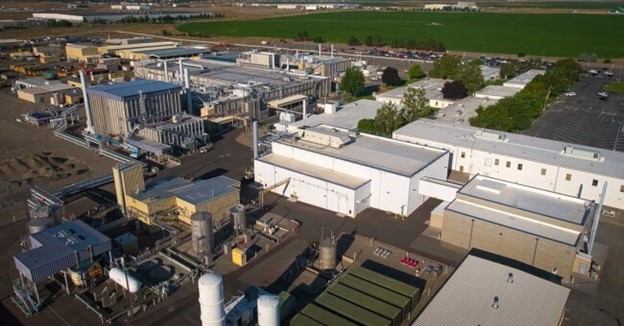
워싱턴주 리치랜드에 위치한 프라마톰(Framatome)의 핵연료 제조 시설. (사진: 프라마톰)
요약
카테고리: 현황
프라마톰(Framatome)이 미국 원자력규제위원회(NRC)로부터 우라늄-235 농축도 5% 초과 원자력 연료 제조를 위한 면허 개정 승인을 받았으며, 2027년부터 생산이 시작될 예정이다.
LEU+(저농축 우라늄 플러스)는 U-235 농축도 5~10% 사이의 우라늄으로, 고연소 연료 제조에 활용되며 기존 미국 원자력 함대의 경제성과 효율성을 높이는 데 기여할 것으로 기대된다.
영국의 유렌코 UK(Urenco UK)도 캐펀허스트(Capenhurst) 시설에서 LEU+ 생산 시험 가동에 성공하며 LEU+ 연료 공급망 구축이 국제적으로 가속화되고 있다.
---
프라마톰(Framatome)은 이번 주 워싱턴주 리치랜드에 위치한 자사의 원자력 연료 제조 시설이 우라늄-235 농축도 5% 초과 원자력 연료 제조를 지원하는 면허 개정에 대해 원자력규제위원회(NRC) 승인을 받았다고 발표했다. 제조는 2027년부터 시작될 예정이다.
프라마톰에 따르면, 이번 승인은 회사의 첨단 연료 관리(Advanced Fuel Management) 프로그램을 뒷받침한다. 이 프로그램은 더 높은 농축도의 우라늄 산화물 펠릿과, 더 높은 연료 연소율을 지원하는 첨단 코드 및 방법론을 포함하여 기존 미국 원자력 발전소에 원자력 연료 기술을 도입하는 데 초점을 맞추고 있다.
배경: 프라마톰(Framatome)은 2022년부터 리치랜드 시설을 개조해 저농축 우라늄 플러스(LEU+), 즉 U-235 농축도 5~10% 사이의 우라늄을 사용한 고연소 연료를 제조할 수 있도록 준비해 왔다.
회사 측에 따르면, 2027년 초 NRC와 함께 운영 준비 검토(Operational Readiness Review)가 예정되어 있으며, 이를 통해 개정된 면허 요건이 시설에 올바르게 이행되었는지 확인하게 된다. 검토가 승인되면 첫 번째 재장전 제조 캠페인을 위한 LEU+ 원료를 해당 시설에서 수령해 가공할 수 있게 된다.
프라마톰(Framatome)은 최근 NRC로부터 가압수형 원자로(PWR)용 고연소 연료에 관한 주제 보고서("High Burnup for Pressurized Water Reactors (PWRs)") 승인을 받았으며, 이는 자사의 가이아(GAIA) 및 HTP 연료 설계에 대한 연료 연소 한도 상향을 지원한다. 또한 프라마톰(Framatome)은 NRC가 U-235 농축도 5% 초과 운전 조건에 자사의 PWR 첨단 코드 및 방법론 체계 적용을 승인했다고 밝혔다. NRC는 또한 프라마톰(Framatome)이 미국 내에서 U-235 농축도 최대 8%의 신선 PWR 및 비등수형 원자로(BWR) 연료 집합체를 운반할 수 있도록 허용하는 면허 개정도 승인했다.
프라마톰(Framatome)의 LEU+ 연료 관련 작업은 미국 에너지부(Department of Energy)의 사고 내성 연료(Accident Tolerant Fuel) 프로그램의 지원을 받아왔다.
인용: "이번 승인은 더 높은 농축도의 연료 솔루션을 원자력 에너지 시장에 도입하는 다음 단계입니다"라고 프라마톰(Framatome)의 수석 부사장 리오넬 게프(Lionel Gaiffe)는 말했다. "기존 농축 수준을 넘어서고 고객들에게 경제적이고 부가가치 있는 솔루션을 제공함으로써 업계의 판도를 바꾸는 데(changing the landscape of the industry, 업계 전반의 구조적 변화를 이끄는 데) 점점 더 가까워지고 있습니다."
영국의 LEU+: 이번 주 초, 유렌코 UK(Urenco UK)는 영국 캐펀허스트(Capenhurst) 농축 시설에서 LEU+를 생산했다고 발표했다.
회사 측에 따르면, 이는 이 새로운 서비스의 첫 번째 시험 가동으로, 규제 준비 검토에서 긍정적인 피드백을 받은 후 영국 원자력 규제청(Office for Nuclear Regulation)의 허가를 받아 실시되었다.
유렌코(Urenco)에 따르면, 4월 27일부터 5월 1일까지 진행된 시험 가동에서 U-235 농축도 7%의 샘플 달성에 성공함으로써 캐펀허스트(Capenhurst) 시설의 LEU+ 생산 능력을 입증했다.
유렌코 UK(Urenco UK)는 조만간 영국에서 LEU+를 상업적으로 공급할 계획이며, 이는 뉴멕시코주 유렌코 USA(Urenco USA)의 국립 농축 시설(National Enrichment Facility)의 기존 역량을 보완할 것이라고 밝혔다. 유렌코 USA(Urenco USA)는 2025년 NRC로부터 LEU+ 생산 승인을 받은 바 있다.
회사 측은 LEU+가 이르면 2027년 초 제조업체에 운반되어 연료 주기의 다음 단계를 완료할 수 있을 것이라고 밝혔다.
---
AI 분석
이번 프라마톰(Framatome)의 NRC 면허 개정 승인은 미국 원자력 연료 공급망 고도화의 중요한 이정표로, LEU+ 연료가 기존 원자로의 경제성과 운전 유연성을 높이는 데 실질적으로 기여할 것임을 시사한다. LEU+ 연료는 고연소 특성 덕분에 연료 교체 주기를 늘리고 발전 비용을 낮출 수 있어, 탈탄소화를 목표로 하는 에너지 전환 시대에 원자력의 경쟁력 강화에 핵심적인 역할을 할 것으로 기대된다. 특히 영국 유렌코 UK(Urenco UK)의 LEU+ 첫 시험 생산 성공과 맞물려, 국제적인 LEU+ 공급망 구축이 가속화되고 있음을 보여주며 글로벌 원자력 연료 시장의 구조적 변화가 본격화되고 있다. 미국 에너지부의 사고 내성 연료(Accident Tolerant Fuel) 프로그램과의 연계는 이 기술이 안전성과 경제성을 동시에 추구하는 방향으로 개발되고 있음을 확인해 준다. 2027년 본격 생산을 앞두고 규제·기술·공급망 측면의 준비가 순조롭게 진행되고 있어, LEU+ 연료의 상용화가 예정대로 이루어질 가능성이 높아 보인다.
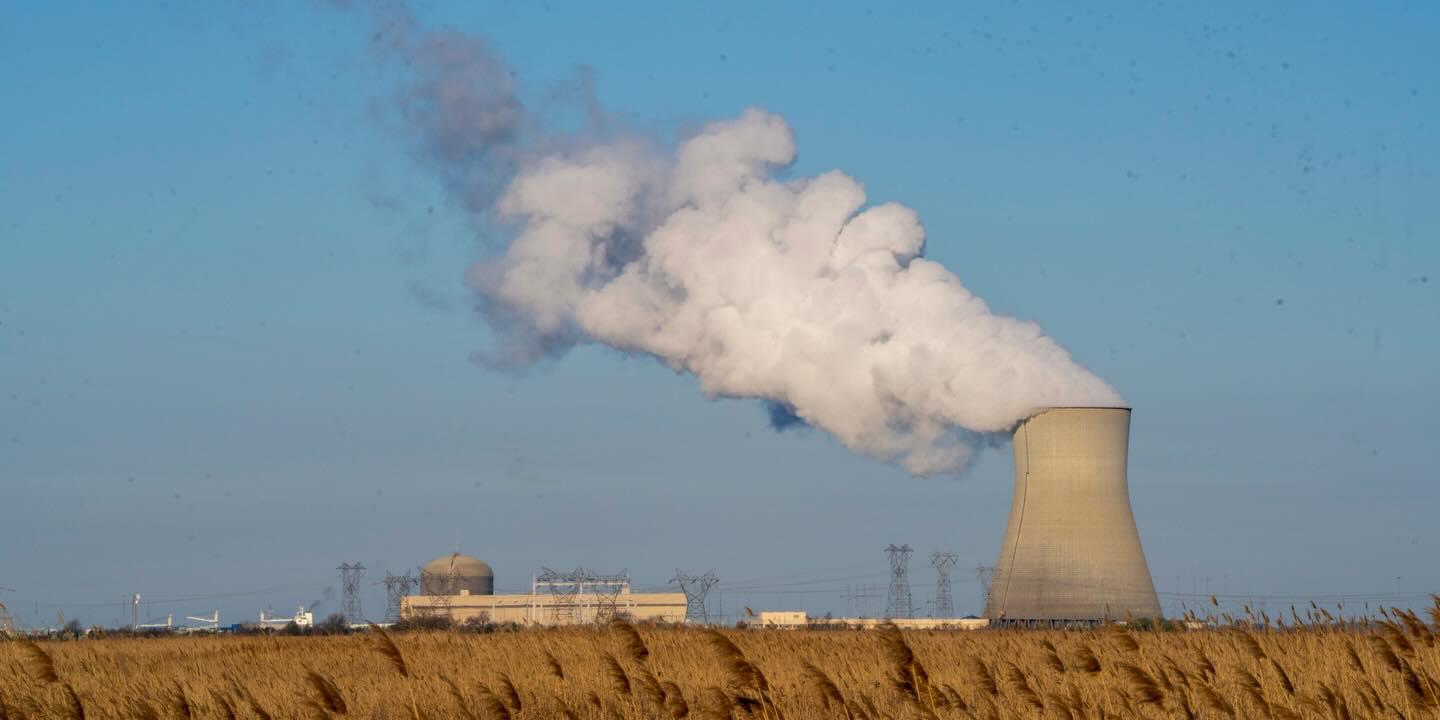
호프 크릭/세일럼 부지의 냉각탑. (사진: 미키 셰릴(Mikie Sherrill) 주지사실)
요약
카테고리: 원자력 정책
뉴저지주가 사실상의 신규 원자력 건설 모라토리엄을 해제함에 따라, 주 정부는 새로운 원자력 시설 부지를 검토하고 있으며, 세일럼 원전 인근 부지가 유력 후보로 거론되고 있다.
PSEG 뉴클리어(PSEG Nuclear) CEO 랄프 라로사(Ralph LaRossa)는 원자력 확장에 대한 긍정적인 분위기를 인정하면서도, 실현을 위해서는 모라토리엄 해제 이상의 연방 정부 재정 및 허가 지원이 필요하다고 강조했다.
PSEG는 세일럼 원전의 약 200MW 용량 증설 가능성을 확인했으며, 세일럼 1·2호기 및 호프 크릭의 운영 면허 갱신 신청도 추진 중으로, 승인 시 각각 2056년, 2060년, 2066년까지 운영이 연장된다.
---
뉴저지주의 두 원자력 발전소인 호프 크릭(Hope Creek)과 세일럼(Salem)은, 주 의회가 신규 원자력 건설에 대한 사실상의 모라토리엄을 해제한 이후 다른 원자력 시설들과 함께할 가능성이 생겼다.
미키 셰릴(Mikie Sherrill) 주지사는 주 정부 관리들이 잠재적인 원자력 시설 부지를 물색하고 있다고 밝혔다. 호프 크릭과 세일럼의 운영사인 PSEG 뉴클리어(PSEG Nuclear) 경영진은 주 내 원자력 발전에 대한 점증하는 모멘텀(추진력)을 환영하면서도, 모라토리엄 해제만으로는 실현 가능성을 담보할 수 없다고 경고했다.
뉴저지의 원자력 확장: 복수의 언론 매체에 따르면 뉴저지주 관리들은 세일럼 원전 인근 부지를 포함한 여러 장소를 검토하고 있다. NJ.com에 의하면, 해당 부지는 전국에서 신규 원자력 시설 건설이 사전 승인된 6개 부지 중 하나다. 셰릴(Sherrill) 주지사는 해당 언론에 "그곳에 원자로를 하나 더 건설할 것을 항상 예상해 왔다"고 말했다.
세일럼은 뉴저지주 핸콕스 브릿지(Hancocks Bridge)에서 호프 크릭과 같은 부지에 위치해 있다. 호프 크릭에는 1,172MWe급 비등수형 원자로(BWR) 1기가 있으며, 세일럼에는 1,146MWe급 1호기와 1,139MWe급 2호기, 두 기의 가압수형 원자로(PWR)가 있다. 두 시설을 합치면 주 전체 전력의 40% 이상을 생산한다.
화요일에 열린 PSEG 1분기 실적 발표 컨퍼런스 콜에서 CEO 랄프 라로사(Ralph LaRossa)는 PSEG가 완공된 항만, 숙련된 노동력 접근성, 기술적 역량을 갖춘 호프 크릭/세일럼 지역에서 신규 원자력 개발을 추진하기 위한 노력에 나서고 있다고 밝혔다.
"원자력은 어느 정도 추진력이 붙고 있는 분야 중 하나인 것 같습니다"라고 그는 컨퍼런스 콜에서 말했다.
라로사(LaRossa)는 주지사를 포함한 주 관리들로부터 광범위한 지지가 있다는 모든 징후가 보인다고 말했다. 모라토리엄을 해제한 S. 3870/A. 4528 법안 서명과 함께, 주 의회는 정부·산업·환경·노동 관계자들이 모여 새로운 원자력 사업을 검토하는 주(州) 원자력 태스크포스(Nuclear Task Force)를 창설했다.
이제 우려의 초점은 다른 곳으로 옮겨가고 있다고 라로사(LaRossa)는 말했다. 연방 정부가 원자력 산업 부활에 관심을 보이고 있지만, 과연 그것이 뉴저지에 대한 투자로 이어질 것인가?
"재정적 지원뿐만 아니라 허가 지원과 부지 지원도 확보해야 합니다"라고 라로사(LaRossa)는 말했다. "주지사로부터도 그런 이야기를 많이 들었으며, 그것이 뉴저지에서 간소화하고자 하는 것 중 하나입니다."
그는 이어 "연방 정부의 지원 없이 신규 원자력을 추진하는 주(州)는 없을 것이라고 봅니다"라고 덧붙였다.
화요일 실적 발표 콜에서 경영진은 세일럼이 약 200MW에 달하는 용량 증설 잠재력을 보유하고 있다고도 밝혔다. 또한 PSEG는 원자력규제위원회(NRC)가 세일럼의 두 PWR과 호프 크릭의 BWR에 대한 후속 면허 갱신(SLR) 신청을 승인할 것으로 기대하고 있다. 회사는 2024년 3월에 SLR 신청 의향서를 제출했다. NRC에 따르면 정식 신청서는 2027년 4월에서 6월 사이에 제출될 예정이다. 승인될 경우, 세일럼 1호기·2호기와 호프 크릭의 운영 면허는 각각 2056년, 2060년, 2066년까지 연장된다.
---
AI 분석
뉴저지주의 이번 움직임은 미국 내 원자력 르네상스(부활)의 흐름을 잘 보여주는 사례다. 세일럼 인근 부지가 전국 6개 사전 승인 부지 중 하나라는 점은 뉴저지의 지리적·규제적 이점을 부각시키며, 신규 원자력 시설 건설 논의에 실질적인 무게를 더한다. 그러나 PSEG CEO 라로사(LaRossa)가 강조했듯, 연방 정부의 재정적·행정적 지원 없이는 주(州) 차원의 의지만으로 실현하기 어렵다는 점이 핵심 과제로 남아 있다. 기존 세일럼 원전의 200MW 용량 증설 및 면허 갱신 추진은 신규 건설에 앞서 현 인프라를 최대한 활용하려는 전략적 접근으로 해석된다. 향후 연방-주 정부 간 협력 구도와 NRC 허가 절차의 진행 속도가 뉴저지 원자력 확장 계획의 현실화 여부를 결정짓는 핵심 변수가 될 것이다.
출처: Financial Times | URL: https://www.ft.com/content/a8a41287-441e-435b-a5c7-1a57075906a4
요약
카테고리: 기술
핵융합 발전 분야의 경쟁이 급격히 심화되고 있으며, 상업적 핵융합 에너지 실현을 향한 움직임이 가속화되고 있다.
해당 기사는 파이낸셜 타임스(Financial Times) 유료 구독 기사로, 전문 내용은 구독 후 열람 가능하다.
핵융합 기술은 차세대 청정에너지원으로 주목받고 있으며, 민간 및 공공 부문의 투자가 증가하는 추세다.
---
핵융합 발전 경쟁이 뜨거워지고 있다
이 기사의 전문을 보려면 구독이 필요합니다.
구독 옵션 안내
4주 동안 ₩1,000으로 무제한 이용
이후 월 ₩79,999. 모든 기기에서 FT 저널리즘에 대한 완전한 디지털 접근. 체험 기간 중 언제든지 취소 가능.
포함 내용:
글로벌 뉴스 및 분석
전문가 의견
Android 및 iOS용 FT 앱
First FT: 하루의 주요 뉴스
20개 이상의 큐레이션 뉴스레터
myFT로 주제 팔로우 및 알림 설정
FT 동영상 및 팟캐스트
매월 공유 가능한 추가 선물 기사 10편
Lex: FT의 대표 투자 칼럼
선도적 전문가의 프리미엄 뉴스레터 15개 이상
FT 디지털 에디션: 디지털화된 인쇄판
---
스탠다드 디지털
월 ₩49,999
모든 기기에서 FT 저널리즘에 대한 필수 디지털 접근. 1년 선불 결제 시 20% 할인.
포함 내용:
글로벌 뉴스 및 분석
전문가 의견
Android 및 iOS용 FT 앱
FT Edit: iOS 및 웹 접근
FirstFT: 하루의 주요 뉴스
20개 이상의 큐레이션 뉴스레터
myFT로 주제 팔로우 및 알림 설정
FT 동영상 및 팟캐스트
매월 공유 가능한 선물 기사 10편
---
프리미엄 디지털
완전한 구독
월 ₩79,999
업계 리더들의 전문 분석과 함께 FT 저널리즘에 대한 완전한 디지털 접근. 1년 선불 결제 시 20% 할인.
포함 내용:
글로벌 뉴스 및 분석
전문가 의견
Android 및 iOS용 FT 앱
FT Edit: iOS 및 웹 접근
FirstFT: 하루의 주요 뉴스
20개 이상의 큐레이션 뉴스레터
myFT로 주제 팔로우 및 알림 설정
FT 동영상 및 팟캐스트
매월 공유 가능한 선물 기사 20편
Lex: FT의 대표 투자 칼럼
선도적 전문가의 프리미엄 뉴스레터 15개 이상
FT 디지털 에디션: 디지털화된 인쇄판
---
프리미엄 & FT 위켄드 인쇄판
월 ₩79,000
토요일 FT 위켄드 신문 배달 및 완전한 디지털 접근.
포함 내용:
FT 위켄드 인쇄판 배달
프리미엄 디지털의 모든 기능
---
대학교 또는 소속 기관을 통해 이미 접근 권한이 있는지 확인하세요.
이용약관 적용.
---
AI 분석
이 기사의 제목 "핵융합 발전 경쟁이 뜨거워지고 있다"는 현재 핵융합 에너지 산업의 급격한 성장세를 함축적으로 표현하고 있다. 최근 수년간 민간 기업들이 핵융합 기술 개발에 수십억 달러를 투자하면서 경쟁이 본격화되고 있으며, 과거에는 수십 년 후의 기술로 여겨졌던 핵융합 발전이 2030년대 실현 가능성을 논하는 단계까지 왔다. 파이낸셜 타임스(Financial Times)가 이 주제를 다룬다는 것은 핵융합 에너지가 더 이상 순수 과학의 영역이 아니라 금융·투자 관점에서도 주목해야 할 산업으로 부상했음을 의미한다. 다만 이 기사는 유료 구독 장벽 뒤에 있어 전문 내용을 확인할 수 없었으며, 기사의 핵심 주장과 데이터를 온전히 분석하는 데 한계가 있다. 핵융합 산업에 관심 있는 독자라면 FT 구독을 통해 원문을 직접 확인하는 것을 권장한다.
---
출처: Financial Times
URL: https://www.ft.com/content/a8a41287-441e-435b-a5c7-1a57075906a4
※ 이 글은 해외 원자력 바로알기를 위한 정보 전달을 목적으로 제공됩니다. 특정 기업이나 종목에 대한 투자 권유가 아니며, 모든 투자 판단과 그에 따른 책임은 투자자 본인에게 있습니다.
한국어
NANO Nuclear, 첨단 핵에너지로 차세대 AI 데이터센터 구동을 위해 Supermicro와 전략적 MOU 체결
NANO Nuclear, 차세대 AI 데이터센터를 첨단 원자력 에너지로 공급하기 위해 Supermicro와 전략적 MOU 체결
_최첨단 마이크로원자로와 AI 서버 인프라 분야의 글로벌 선두 기업이 파트너십을 맺어 인공지능으로 인한 급증하는 에너지 수요에 대응한다._
뉴욕, 2026년 5월 6일 (GLOBE NEWSWIRE) — 청정 에너지 솔루션 개발에 주력하는 선도적인 첨단 원자력 마이크로 모듈형 원자로(MMR) 및 기술 기업 NANO Nuclear Energy Inc.(나스닥: NNE, 이하 "NANO Nuclear" 또는 "회사") 는 오늘 고성능·고효율 서버 및 AI 인프라 솔루션 분야의 글로벌 선두 기업인 Super Micro Computer, Inc.(슈퍼마이크로, "Supermicro")와 양해각서(MOU)를 체결했다고 발표했습니다.
이번 전략적 협력은 NANO Nuclear의 첨단 마이크로원자로 시스템과 Supermicro의 업계 선도적인 AI 서버 및 데이터센터 플랫폼의 통합을 모색하는 데 초점을 맞추고 있으며, 급격히 확장되는 인공지능 경제에 청정하고 안정적이며 확장 가능한 원자력 기반 솔루션을 제공하는 것을 목표로 합니다.
인공지능, 클라우드 컴퓨팅, 고성능 컴퓨팅의 폭발적인 성장은 전 세계 전력 수요를 전례 없는 수준으로 끌어올리고 있으며, 특히 지속적이고 고밀도의 안정적인 전력을 필요로 하는 데이터센터가 그 중심에 있습니다.
이번 MOU를 통해 NANO Nuclear와 Supermicro는 다음 기회를 함께 모색할 예정입니다:
NANO Nuclear의 마이크로원자로를 배치하여 데이터센터 전용 현장 원자력 전력을 공급. Supermicro의 AI 서버 랙, 냉각 시스템 및 인프라를 원자력 에너지 솔루션과 통합. 하이퍼스케일, 기업용 및 엣지 데이터센터 고객을 위한 공동 시장 진출 전략 개발. 자체 전력 공급이 가능한 그리드 독립형 AI 인프라의 새로운 유형 구현.
이번 협력은 AI 산업이 직면한 가장 시급한 과제인 기하급수적인 컴퓨팅 성장을 지속 가능한 방식으로 어떻게 감당할 것인가에 대한 공동 비전을 반영합니다.
_그림 1 – NANO Nuclear Energy Inc.가 원자력 에너지로 차세대 AI 데이터센터를 공급하기 위해 Supermicro와 전략적 MOU를 체결했습니다_
"Supermicro와의 이번 협력은 첨단 원자력 에너지와 AI 인프라라는 두 가지 혁신적인 기술의 강력한 융합을 의미합니다."라고 NANO Nuclear 회장 겸 사장 제이 유(Jay Yu)는 말했습니다. "AI 혁명은 근본적으로 에너지 문제이며, 원자력이 그 수요를 충족할 수 있는 유일한 확장 가능한 솔루션이라고 믿습니다. 세계 최고의 AI 서버 기술 공급업체 중 하나와 협력함으로써, 우리는 NANO Nuclear를 데이터센터가 그리드에 종속되지 않고 전용 현장 원자력 에너지 시스템으로 구동되는 새로운 패러다임의 최전선에 위치시키고 있습니다."
Supermicro는 전 세계 데이터센터, 클라우드 공급업체 및 기업 고객에게 첨단 서버, 스토리지, 네트워킹 시스템을 제공하는 엔드투엔드 그린 컴퓨팅 솔루션 분야의 세계 선도 기업 중 하나입니다.
Supermicro와의 파트너십을 통해 NANO Nuclear는 AI 인프라 구축의 최전선에 있는 기업과 직접 연계함으로써 다음을 확보합니다:
글로벌 데이터센터 고객 및 하이퍼스케일 운영자에 대한 접근. 최첨단 AI 하드웨어 생태계와의 통합 경로. 글로벌 경제에서 가장 빠르게 성장하는 부문 중 하나로의 진입 채널.
동시에 Supermicro는 NANO Nuclear의 차세대 원자력 전력 시스템에 접근함으로써 고객에게 컴퓨팅과 전력을 결합한 완전한 수직 통합형 솔루션을 제공할 수 있게 됩니다.
이번 MOU는 전 세계에서 향후 가장 큰 전력 소비처로 급부상하고 있는 AI 및 데이터센터 부문의 주요 에너지 공급업체로 자리매김하려는 NANO Nuclear의 전략에서 중요한 진전을 의미합니다.
그리드 제약이 심화되고 전력 가용성이 AI 배포의 제한 요인이 됨에 따라, NANO Nuclear의 마이크로원자로는 다음과 같은 매력적인 솔루션을 제공합니다:
그리드에 독립적인 24/7 기저 부하 전력. ESG 의무에 부합하는 탄소 없는 에너지. 데이터센터 캠퍼스를 위한 확장 가능한 배치. 신속한 설치 및 모듈식 확장.
이는 NANO Nuclear를 단순한 원자로 개발업체를 넘어 글로벌 AI 경제의 핵심 지원자로 자리매김하게 합니다.
"이것이 바로 미래가 나아가는 방향입니다. 컴퓨팅과 전력이 하나의 통합된 솔루션이 되는 것입니다." 라고 나노 뉴클리어(NANO Nuclear)의 최고경영자 제임스 워커(James Walker)는 말했다. "슈퍼마이크로(Supermicro)와 협력함으로써, 나노 뉴클리어는 세계에서 가장 빠르게 성장하고 가장 자본 집약적인 시장 중 하나의 중심으로 직접 발을 내딛고 있습니다. 이번 파트너십은 데이터 센터의 구축 및 전력 공급 방식을 재정의할 수 있는 하이퍼스케일 기회의 문을 열어줍니다."
양해각서(MOU)는 두 회사가 상호 영업 기회를 소개하고, 공동 배치를 협력하며, 다음 요소들을 결합한 통합 솔루션을 탐색하는 프레임워크를 제시합니다:
나노 뉴클리어(NANO Nuclear)의 마이크로 원자로, KRONOS MMR™ 에너지 시스템 포함. 슈퍼마이크로(Supermicro)의 서버 랙 및 AI 시스템. 냉각, 유지보수 및 수명주기 서비스.
두 회사는 공동으로 컴퓨팅 파워와 에너지 공급이 함께 개발되는 차세대 인프라 모델 구축을 목표로 합니다.
향후 전망 이번 MOU는 구속력이 없지만, 향후 확정적 계약 및 프로젝트별 협력을 위한 기반을 마련하며, 두 회사가 에너지와 인공지능의 빠르게 진화하는 교차점을 활용할 수 있도록 포지셔닝합니다.
전체 공식 보도자료 보기 ← 이전 게시물 다음 게시물 →
동의 관리
최상의 경험을 제공하기 위해, 저희는 쿠키와 같은 기술을 사용하여 기기 정보를 저장하거나 액세스합니다. 이러한 기술에 동의하면 이 사이트에서 탐색 행동이나 고유 ID와 같은 데이터를 처리할 수 있습니다. 동의하지 않거나 동의를 철회하면 특정 기능과 기능에 부정적인 영향을 미칠 수 있습니다.
기능 기능 항상 활성화
기술적 저장 또는 액세스는 구독자 또는 사용자가 명시적으로 요청한 특정 서비스의 사용을 가능하게 하거나, 전자 통신 네트워크를 통한 통신 전송을 수행하는 유일한 목적을 위해 엄격히 필요합니다.
환경 설정 환경 설정
기술적 저장 또는 액세스는 구독자 또는 사용자가 요청하지 않은 환경 설정을 저장하는 합법적인 목적을 위해 필요합니다.
통계 통계
기술적 저장 또는 액세스는 통계적 목적으로만 사용됩니다. 기술적 저장 또는 액세스는 익명의 통계적 목적으로만 사용됩니다. 소환장 없이, 인터넷 서비스 제공자의 자발적 준수 또는 제3자의 추가 기록 없이는 이 목적만을 위해 저장되거나 검색된 정보가 일반적으로 귀하를 식별하는 데 사용될 수 없습니다.
마케팅 마케팅
기술적 저장 또는 액세스는 광고를 보내거나 유사한 마케팅 목적으로 웹사이트 또는 여러 웹사이트에서 사용자를 추적하기 위한 사용자 프로필을 만드는 데 필요합니다.
NANO Nuclear Energy(나스닥: NNE)와 슈퍼마이크로컴퓨터(Supermicro)가 AI 데이터센터에 소형 원자로 기반 전력을 공급하기 위한 전략적 MOU를 체결한 것은 AI 인프라의 에너지 문제 해결에 있어 중요한 이정표다. AI·클라우드 컴퓨팅의 폭발적 성장으로 데이터센터의 전력 수요가 급증하는 가운데, 기존 전력망에 의존하지 않는 독립적 온사이트 원자력 발전이 현실적 대안으로 부상하고 있다. 이번 협약을 통해 양사는 마이크로원자로와 AI 서버 인프라를 통합한 수직 계열화된 솔루션, 즉 '컴퓨팅+전력'을 하나로 묶는 새로운 비즈니스 모델을 구축하려는 것으로, AI 경제를 뒷받침하는 에너지 공급 구조의 패러다임 전환을 예고한다. 탄소 배출 없이 24시간 안정적 전력을 공급할 수 있는 소형모듈원자로(MMR)의 특성은 ESG 요건을 충족하면서도 대규모 AI 연산 수요를 감당해야 하는 데이터센터 운영자들에게 매력적인 선택지가 될 수 있다. 다만 MOU 단계인 만큼 실제 원자로 개발·인허가·배치까지는 상당한 시간과 규제 과정이 남아 있으며, 이 협력이 구체적 성과로 이어질지는 향후 행보를 주목할 필요가 있다.
※ 이 글은 해외 원자력 바로알기를 위한 정보 전달을 목적으로 제공됩니다. 특정 기업이나 종목에 대한 투자 권유가 아니며, 모든 투자 판단과 그에 따른 책임은 투자자 본인에게 있습니다.
한국어
스탠다드 유라늄(Standard Uranium), 로카스(Rocas)에서 첫 번째 시추 프로그램 완료
스탠다드 유라늄(Standard Uranium), 로카스(Rocas)에서 첫 번째 시추 프로그램 완료
2026년 5월 6일 수요일 오후 10:35 (GMT+9) | Proactive
요약
카테고리: 현황
스탠다드 유라늄(Standard Uranium)이 서스캐처원(Saskatchewan) 로카스(Rocas) 프로젝트에서 4개 공 962미터의 첫 번째 시추 프로그램을 완료함
4개 시추공 중 3개에서 이상 방사능이 검출되었으며, 최고 수치 초당 650 카운트를 기록해 우라늄 광물화 가능성의 강력한 초기 지표를 확인
전 구간에서 열수 변질 및 탄소질·황화물 광물화가 확인되어 회사의 지질학적 모델이 입증됨
---
스탠다드 유라늄, 로카스 첫 시추 프로그램 완료
스탠다드 유라늄, 로카스 첫 시추 프로그램 완료 — Proactive는 Shutterstock에서 제공한 이미지를 사용합니다.
스탠다드 유라늄 주식회사(Standard Uranium Ltd, TSX-V:STND, OTCQB:STTDF, FRA:9SU0)는 수요일, 서스캐처원(Saskatchewan)에 위치한 로카스(Rocas) 우라늄 프로젝트에서의 시추 작업을 완료했다고 밝혔습니다. 4개의 탐사공 중 3개에서 이상 방사능이 검출되었으며, 회사는 이를 잠재적 우라늄 광물화의 강력한 초기 지표라고 평가했습니다.
이 소규모 탐사업체는 914번 고속도로를 따라 키 레이크(Key Lake) 광산 및 제련 시설에서 남서쪽으로 75킬로미터 떨어진 프로젝트 현장에서 4개 공을 통해 총 962미터를 시추했습니다.
4개의 시추공 중 3개에서 높은 방사능이 검출되었으며, 가장 강한 수치는 초당 650 카운트를 기록했습니다.
4개 모든 시추공에서 탄소질 암석과 황화물 광물화가 총 114미터에 걸쳐 교차 확인되었으며, 이는 회사의 지질학적 모델의 정확성을 입증했습니다.
이번 프로그램은 중력 탐사, 전자기 데이터 및 지표 샘플링을 통해 식별된 세 개의 목표 지역을 시험했습니다.
우라늄 형성의 핵심 조건인 열수 활동과 일치하는 변질암이 전 구간에 걸쳐 확인되었으며, 특히 발견 가능성이 높은 환경으로 평가되는 깊이 얕은 9미터의 단층대도 포함되어 있었습니다.
회사는 지구화학적 분석 결과가 아직 보류 중이라고 밝혔습니다.
"처음 4개의 기반암 교차점 중 3개에서 흑연질 구조와 이상 방사능으로 지구물리학적 모델을 검증한 것은 이번 1차 시추 프로그램에 있어 환상적인 성과입니다(첫 시도치고 매우 우수한 결과를 거뒀다는 의미). 열수 변질과 핵심 구조적 도관의 존재를 확인한 것 역시 중요한 발견 가능성을 강력하게 뒷받침합니다."
>
— 션 힐라크레(Sean Hillacre), 사장 겸 탐사 부사장
로카스(Rocas) 프로젝트는 콜렉티브 메탈스(Collective Metals)와의 3년 실적 취득(earn-in, 일정 투자 조건 달성 시 지분을 취득하는 방식) 옵션 계약 하에 운영되고 있습니다.
스탠다드 유라늄(Standard Uranium)과 콜렉티브 메탈스(Collective Metals)는 총 7.5킬로미터 전자기 회랑 중 남은 5킬로미터 구간에 대한 후속 탐사 및 체계적 시추를 계획하고 있으며, 추가적인 우라늄 트랩을 파악하기 위해 현재 목표 지역의 북쪽과 남쪽으로 지상 중력 및 전자기 커버리지를 확대할 계획입니다.
---
AI 분석
스탠다드 유라늄(Standard Uranium)의 이번 로카스(Rocas) 1차 시추 결과는 탐사 초기 단계로서는 긍정적인 성과로 평가할 수 있습니다. 4개 공 중 3개에서 이상 방사능이 검출되고, 열수 변질 및 탄소질 구조가 확인된 것은 서스캐처원(Saskatchewan) 애서배스카(Athabasca) 분지 인근 지역의 우라늄 광화 잠재력을 뒷받침합니다. 그러나 지구화학적 분석 결과가 아직 보류 중이므로 실제 우라늄 농도와 경제성 여부는 추후 데이터가 공개될 때까지 단정하기 어렵습니다. 7.5킬로미터 전자기 회랑에서 아직 5킬로미터가 미탐사 상태로 남아 있어 향후 추가 시추를 통한 발견 가능성이 상당히 열려 있습니다. 전 세계적으로 원자력 에너지 수요가 늘어나는 상황에서 캐나다 서스캐처원(Saskatchewan)의 우라늄 탐사 활동이 가속화되고 있는 점은 주목할 만한 흐름입니다.
빌 게이츠가 설립한 핵과학 기업 테라파워의 자회사 테라파워 아이소토프스가 필라델피아 전 에너지 솔루션 정유소 부지에 25만 평방피트 규모의 제조 시설을 착공했으며, 투자 규모는 4억 5천만 달러에 달함
이 시설에서는 암 표적 치료제로 연구 중인 희귀 방사성 동위원소 악티늄-225를 생산할 예정이며, 전 세계 생산량을 20배 늘릴 계획임
생산은 2029년에 시작될 예정이며, 이는 워싱턴주 에버렛의 소규모 실험실 생산을 대체하는 '플래그십' 제조 거점이 될 것임
_필라델피아 인근 지역이나 그 지역을 형성하는 시스템에 대해 궁금한 점이 있으신가요? PlanPhilly 기자들이 여러분의 이야기를 듣고 싶습니다! 질문을 보내시거나, 취재가 필요하다고 생각하시는 기사 아이디어를 제보해 주세요._
전 필라델피아 에너지 솔루션스(Philadelphia Energy Solutions) 정유 부지의 첫 번째 생명과학 입주 기업이 수요일, 25만 평방피트 규모의 맞춤형 제조 시설 착공식을 가졌다.
빌 게이츠(Bill Gates)가 설립한 원자력 과학 기업의 계열사인 테라파워 아이소토프스(TerraPower Isotopes)는 이 시설에 4억 5,000만 달러를 투자하여, 암의 표적 치료제로 임상 시험 중인 희귀 방사성 동위원소 악티늄-225를 제조할 계획이다.
테라파워 아이소토프스(TerraPower Isotopes) 사장 스콧 클라운치(Scott Claunch)는 "이 기업과 업계가 하고 있는 일이 암 치료 방식을 바꿀 수 있다고 믿는다"고 말했다. "오늘 착공하는 이 부지가 바로 세계가 필요로 하는 규모로 그것을 실현하는 방법입니다."
테라파워 아이소토프스(TerraPower Isotopes)는 이미 워싱턴주 에버렛(Everett)에 있는 연구소에서 소규모로 악티늄-225를 제조하고 있다. 회사 측은 소유자들이 "더 벨웨더 디스트릭트(The Bellwether District)"라고 부르는 이 부지가 해당 동위원소의 "주력" 제조 시설이 될 것이며, 이 물질의 전 세계 생산량을 "20배"로 늘릴 것이라고 밝혔다.
테라파워 아이소토프스(TerraPower Isotopes)는 2029년부터 이 전 정유 부지에서 생산을 시작할 계획이다.
악티늄-225는 아직 미국 식품의약국(FDA)의 상업적 암 치료 승인을 받지 못했지만, 유방암, 전립선암, 골수성 백혈병 등의 암 치료를 위한 임상 시험에서 테스트 중이다.
테라파워 아이소토프스(TerraPower Isotopes)는 클론치(Claunch)에 따르면, 붕괴 과정에서 약 20개의 클립 무게에 해당하는 방사성 토륨으로부터 악티늄-225를 추출할 예정이다. 이 토륨은 냉전 시대 잔여 우라늄으로 구성된 연방정부 재고에서 추출되며, 테네시주 오크 리지 국립연구소(Oak Ridge National Laboratory)에서 테라파워 아이소토프스 시설로 도로를 통해 운송된다.
미국 에너지부 국가동위원소개발센터에 따르면, 악티늄-225에 대한 전 세계적 수요는 증가하고 있으나 공급은 제한적이다. 클론치는 현재 전 세계에서 생산되는 악티늄-225의 양이 불과 모래알 몇 개에 불과하다고 말했다.
"[해당 시설이] 2029년에 가동되면, 우리는 전 세계 생산 능력을 20배 늘릴 것입니다"라고 클론치는 말했다. "모래알이 조금 더 늘어나는 셈이죠."
테라파워 아이소토프스는 악티늄-225를 제약 개발업체에 공급할 계획이며, 이 업체들은 해당 동위원소를 클론치가 환자 체내에서 GPS 시스템처럼 작동할 수 있다고 설명한 표적 분자에 부착할 것이다.
"그것이 질환이 있는 환자에게 주사되면, 최종 제품은 암세포에만 도달하여 암세포만을 파괴함으로써 인근 건강한 조직을 보존합니다"라고 그는 말했다.
클론치에 따르면 회사는 방사성 물질을 격리하고 기계식 팔을 통해 작업자가 안전하게 물질을 취급할 수 있는 챔버인 핫셀(hot cell)을 설치할 예정이다. 그는 동위원소 제조가 직원이나 인근 주민에게 건강 위험을 초래하지 않을 것이라고 말했다. 또한 회사는 펜실베이니아주의 방사선 보호 규정을 준수해야 한다.
"우리는 안전 장치와 격리 시스템을 갖추고 있어 현장 직원뿐만 아니라 일반 시민도 매우 잘 보호될 수 있도록 합니다"라고 클론치는 말했다.
테라파워 아이소토프스(TerraPower Isotopes)는 악티늄-225 제조 시설 부지로 전국 350곳을 검토했지만, 결국 필라델피아의 기반 시설, 지역 내 숙련된 인력, 그리고 연구 기관 및 제약 회사와의 인접성을 이유로 벨웨더 디스트릭트(The Bellwether District)를 최종 선택했다고 클란치(Claunch)는 밝혔다.
"[조시(Josh)] 샤피로 주지사 취임 이후, 우리는 이 같은 프로젝트를 유치하기 위한 노력에서 그 어느 때보다 공격적이고 경쟁력 있는 자세를 취해왔습니다 — 일자리를 창출하고, 지역 경제에 활력을 불어넣으며, 펜실베이니아가 비즈니스에 열린 주임을 세계에 알리는 프로젝트들입니다"라고 펜실베이니아 지역사회·경제개발부 장관 릭 시거(Rick Siger)가 말했다.
TerraPower Isotopes(빌 게이츠가 설립한 핵과학 기업의 일부)가 필라델피아 전 정유소 부지에 2억 5천만 달러 규모의 제조 시설 기공식을 진행했으며, 이는 희귀 방사성 동위원소인 악티늄-225의 대규모 생산을 위한 것이다. 악티늄-225는 유방암, 전립선암, 골수성 백혈병 등을 대상으로 한 표적 치료제로 임상시험 중인 물질로, 현재 전 세계 생산량이 모래알 몇 개에 불과할 만큼 극히 희소하다. 이 시설이 2029년 가동되면 악티늄-225의 전 세계 생산량을 20배 증가시킬 것으로 예상되며, 이는 암 치료 패러다임을 근본적으로 변화시킬 수 있는 잠재력을 지닌다. 핵 기술을 기반으로 한 방사성 의약품 산업의 성장 가능성을 보여주는 사례로, 냉전 시대 유산인 정부 보유 우라늄 재고를 의료 목적으로 전환한다는 점에서도 주목할 만하다.
※ 이 글은 해외 원자력 바로알기를 위한 정보 전달을 목적으로 제공됩니다. 특정 기업이나 종목에 대한 투자 권유가 아니며, 모든 투자 판단과 그에 따른 책임은 투자자 본인에게 있습니다.
33억 달러 규모의 심층 지하 중성미자 실험(DUNE-LBNF) 프로젝트에서 450만 킬로그램의 강철 빔을 지하로 이동하는 "핵심적 단계"가 시작되었다.
사우스다코타주 지하 1.6km에 위치한 샌퍼드 지하 연구시설에는 각각 1만 7,000톤의 액체 아르곤이 채워진 4개의 중성미자 감지기 탱크가 설치될 예정이다.
2031년 완공 예정인 DUNE-LBNF는 전례 없는 수준으로 중성미자의 특성과 중성미자-반중성미자 간 행동 차이를 연구할 것이다.
---
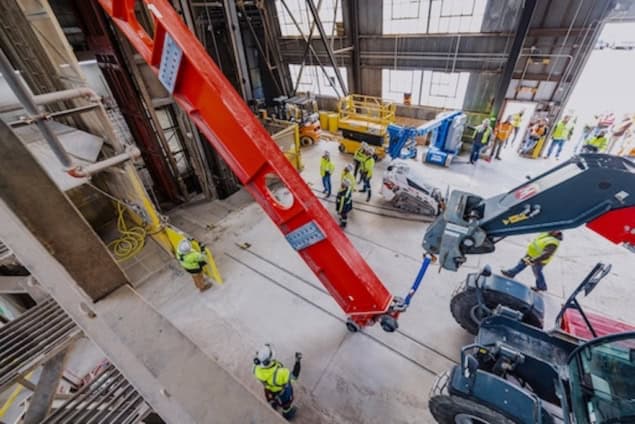
미국 중성미자 시설의 강철 빔 지하로 향하다: 약 450만 킬로그램의 강철 빔이 중성미자 감지기를 지지하기 위해 지하로 이동될 예정이다 (제공: 매튜 카푸스트(Matthew Kapust), SURF).
33억 달러 규모의 심층 지하 중성미자 실험-장기 기준선 중성미자 시설(DUNE-LBNF) 건설을 향한 "핵심적 단계"라고 관계자들이 부른 이 프로젝트에서, 차세대 중성미자 감지기를 위한 거대한 강철 빔 단지가 지하로 내려가기 시작했다.
어제 행사가 개최되었으며, CERN 사무총장 마크 톰슨(Mark Thomson)과 미국 에너지부(DOE) 과학 차관 다리오 길(Dario Gil) 등 고위 관계자들이 참석하여 DUNE의 감지기를 지지하는 데 사용될 450만 킬로그램의 강철 빔을 지하로 이동하는 작업의 시작을 기념했다.
2024년 2월, DUNE를 위한 두 개의 거대한 지하 공간에 대한 굴착 작업이 완료되었다. 사우스다코타주 샌퍼드 지하 연구시설 지하 1.6km에 위치한 이 공간들은 길이 약 150m에 7층 높이로, DUNE의 4개 중성미자 감지기 탱크를 수용하는 데 사용될 예정이다. 각 탱크에는 1만 7,000톤의 액체 아르곤이 채워지며 88K(약 -185°C)로 냉각된다.
2031년 완공되면, DUNE-LBNF는 전례 없는 수준으로 중성미자의 특성과 중성미자 및 반중성미자 간의 행동 차이를 연구하게 된다.
DUNE는 시카고 외곽에서 약 1,300km 떨어진 곳에 위치한 페르미랩의 가속기 단지에서 생성된 중성미자를 측정할 것이다.
CERN이 기여한 극저온 용기(크라이오스타트) 자재들은 이제 향후 몇 달 안에 지하로 이동하여 설치될 예정이다.
페르미랩 소장 노르베르트 홀트캄프(Norbert Holtkamp)는 "오늘은 사우스다코타에서 원거리 감지기 구조물을 개발하는 DUNE의 핵심적 단계가 시작되는 날을 의미합니다"라고 언급했다. "우리의 초점은 미국 에너지부, 우리나라, 그리고 전 세계를 위해 성공적으로 임무를 완수하기 위해 안전, 품질, 일정 순서대로 유지되고 있습니다."
AI 분석
DUNE-LBNF 프로젝트는 기초 물리학 연구에 있어 역사적인 전환점을 의미하며, 중성미자 연구 분야에서 전 세계적으로 가장 야심 찬 실험 중 하나로 평가된다. 중성미자와 반중성미자 간의 행동 차이 연구는 우주에 반물질보다 물질이 더 많이 존재하는 이유, 즉 물질-반물질 비대칭성을 설명하는 데 핵심적인 단서를 제공할 수 있다. 페르미랩에서 1,300km 떨어진 지하 1.6km 깊이에 설치되는 대규모 액체 아르곤 감지기는 현재까지 건설된 가장 정밀한 입자물리 탐지 장치 중 하나가 될 것이다. CERN과 미국 에너지부 등 국제 협력으로 진행되는 이 프로젝트는 글로벌 과학 협력의 모범 사례로, 2031년 완공 후 수십 년간 중성미자 물리학 연구의 핵심 시설로 자리매김할 전망이다. 강철 빔 지하 이동이라는 이번 이정표는 10년 가까이 지속된 설계·굴착 단계에서 본격적인 감지기 구축 단계로 진입했음을 상징한다.
---
출처: Physics World매체명: Physics World
URL: https://physicsworld.com/a/officials-hail-major-milestone-for-us-deep-underground-neutrino-experiment/
※ 이 글은 해외 원자력 바로알기를 위한 정보 전달을 목적으로 제공됩니다. 특정 기업이나 종목에 대한 투자 권유가 아니며, 모든 투자 판단과 그에 따른 책임은 투자자 본인에게 있습니다.
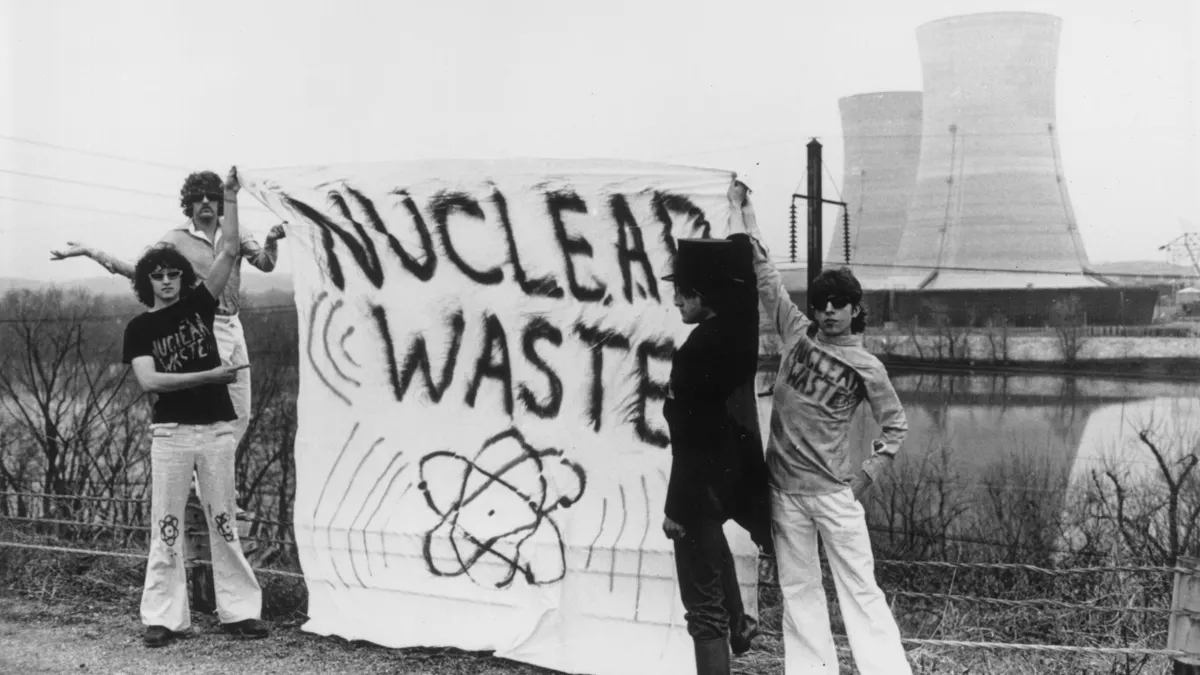
1979년 펜실베이니아주 해리스버그 인근 스리마일 아일랜드에서 원자력 반대 시위대 네 명이 '핵폐기물'이라고 적힌 현수막을 들고 서 있다. 수십 년간 주(州) 및 지역 사회의 반대로 인해 미국 내 약 95,000미터톤에 달하는 사용후 핵연료 처리 시도가 번번이 좌절되었다. Keystone/Hulton Archive/Getty Images via Getty Images
원자력 발전소에서 발생하는 방사성 폐기물 처리를 둘러싼 수십 년간의 교착 상태 끝에, 미국 에너지부(DOE)는 첨단 산업, 발전, 데이터 센터, 그리고 장기적인 일자리 창출을 약속하는 더 광범위한 노력의 일환으로 일부 주들이 사용후 핵연료를 수용하도록 설득할 수 있기를 기대하고 있다.
전력 수요 증가와 비화석 안정 전원에 대한 초당파적 관심을 배경으로 많은 주들이 긍정적인 반응을 보이고 있다. 프랑스가 오랫동안 해온 것처럼 핵연료를 재처리하고 재사용하는 것이 미국 원자력 부문 부활의 열쇠로 많은 이들에게 여겨지고 있다.
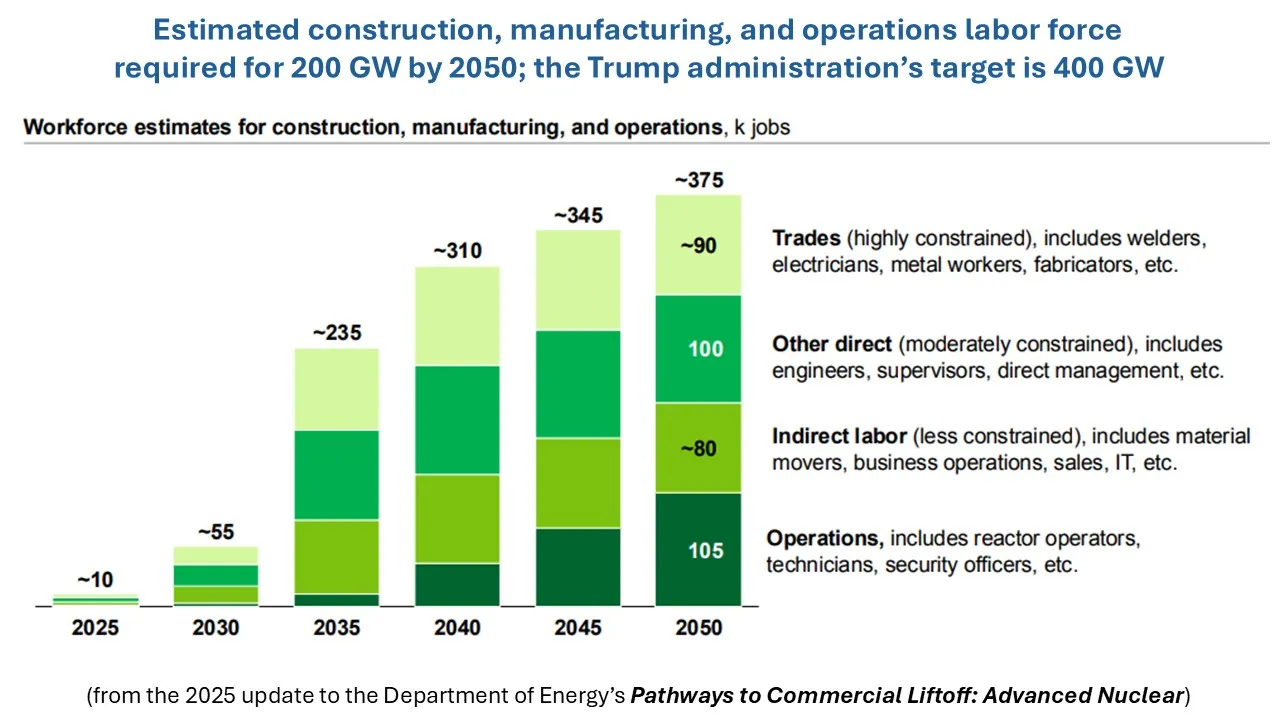
그러나 미국의 약 95,000미터톤에 달하는 사용후 핵연료에 대한 항구적인 해결책 마련을 번번이 좌절시켰던 재정적·정책적·현실적 난제들 중 상당수가 여전히 남아 있다. 연방 정부 관리들, 전력 계획 담당자들, 원자력 기술 업체들, 분석가들이 유틸리티 다이브(Utility Dive)에 밝힌 바에 따르면, 이는 급성장 중인 원자력 르네상스와 향후 20년간 약 300GW의 원자력 설비 용량 추가를 목표로 하는 트럼프 행정부의 야망을 가로막을 수 있다.
"원자로에서 전기를 공급받은 세대가 이 문제를 해결해야 하며, 짐을 미래로 떠넘겨서는 안 됩니다."
마누엘 C. 카마르고(Manuel C. Camargo)
서던 캘리포니아 에디슨(Southern California Edison) 해체 사업 수석 관리자
서던 캘리포니아 에디슨(SCE)의 해체 사업 수석 관리자인 마누엘 C. 카마르고(Manuel C. Camargo)는 에너지부가 명명한 "원자력 생애주기 혁신 캠퍼스" 구상과 에너지부의 협력적 접근 방식을 유틸리티가 지지한다고 밝혔다. SCE는 2013년 폐쇄된 샌 오노프레(San Onofre) 원자력 발전소를 소유하고 있으나, 사용후 핵연료가 부지 밖으로 반출될 때까지 해체 작업을 완료할 수 없다고 카마르고는 말했다.
그는 연방 정부가 폐기물 처리에 관한 "법적·계약적 의무를 이행"할 때까지 SCE가 부지 소유자인 해군에 임대료를 납부해야 한다고 덧붙였다. 그는 새로운 모든 노력에 있어 사용후 핵연료 저장 시설에 대한 안정적인 자금 지원 약속이 포함되기를 바란다고 말했다.
카마르고는 "사용후 핵연료 저장 문제 미해결이 '기하급수적인 전력 수요 증가'에 대응하기 위한 첨단 원자로 배치를 가로막을 수 있습니다"라며 "원자로에서 전기를 공급받은 세대가 이 문제를 해결해야 하며, 짐을 미래로 떠넘겨서는 안 됩니다"라고 말했다.
여기까지 오게 된 경위
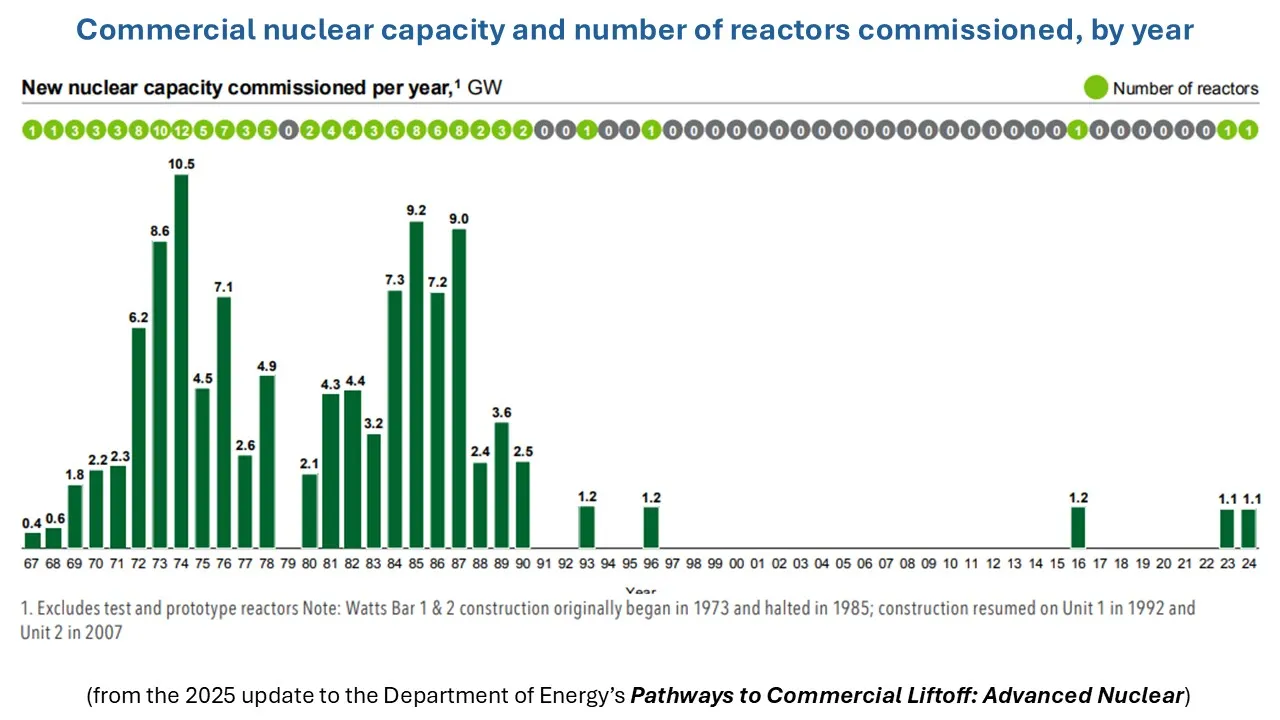
최초의 원자력 발전은 1957년 펜실베이니아주에서 시작되었으며, 면허 취득은 1970년대에 절정을 이루었다.
이들 발전소 부지에 방사성 폐기물이 쌓이면서 1980년대 안전에 대한 우려가 커지자, 정책 입안자들은 원자력규제위원회(Nuclear Regulatory Commission) 면허 요건을 강화하고 사용후 핵연료 저장 문제에 대응하기 시작했다.
1987년 로널드 레이건(Ronald Reagan)은 네바다주 유카 마운틴(Yucca Mountain)을 미국의 유일한 영구 지하 저장소 부지로 지정하는 법안에 서명했다. 그러나 이후 20년간 주(州) 및 지역 사회의 반대에 부딪혀 작업이 지연되다가, 2011년 오바마 행정부가 자금 지원을 끊음으로써 사실상 이 계획을 종료시켰다.
"법원은 의회가 자금을 배정하지 않았기 때문에 DOE에 행동을 명령할 수 없었습니다," 연합 결성을 돕고 옹호 단체인 거버멘털 스트래티지스(Governmental Strategies)를 설립한 팀 스미스(Tim Smith)가 회고했다. "하지만 법원은 계약의 부분적 위반과 소송 당사자들이 발생한 비용에 대한 권리를 인정했습니다."
사용후 핵연료가 전국적으로 연간 약 2,000 미터톤씩 누적됨에 따라 납세자의 부담도 함께 증가하고 있다.
2025년 현재, DOE가 법적 의무를 이행하지 못한 데 따른 납세자 부담액은 565억 달러에 달하며 계속 증가하고 있다고 민주당 마이크 레빈(Mike Levin, D-CA) 하원의원이 최근 하원 청문회에서 지적했다. 그는 또한 사용후 핵연료 해결 의원 모임(Spent Nuclear Fuel Solutions Caucus)을 포함한 초당파적 노력도 강조했다.
"트럼프 행정부가 원자력을 훨씬 더 많이 건설하겠다는 의도에 대해 현실적으로 봐야 합니다," 레빈 의원이 말했다. "핵연료 주기의 후반부를 해결하기 전까지는 새로운 원자력 발전 프로젝트를 입지 선정해서는 안 됩니다."
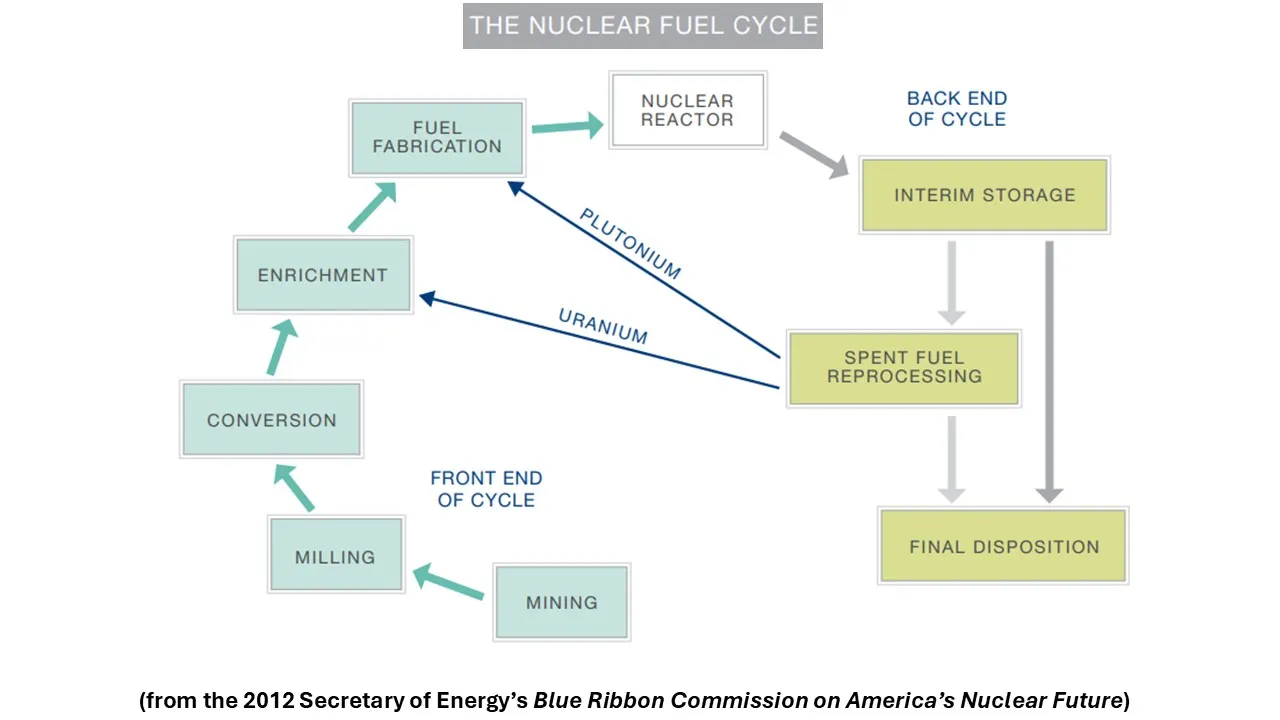
1월, DOE는 "원자력 라이프사이클 혁신 캠퍼스(Nuclear Lifecycle Innovation Campuses)의 잠재적 부지로 관심 있는 주(州)들의 의견을 구하는" 정보 요청서(RFI)를 발행했다. 이 캠퍼스들은 원자력 가치 사슬 전체를 한곳에 집약하고 지원하며, 안전하고 안보적이며 재정적으로 책임 있는 방식으로 사용후 핵물질을 관리하는 지속 가능한 경로를 탐색하는 통합적 원자력 생태계의 중심지가 될 것이다.
DOE는 이 캠퍼스들이 핵연료 제조, 농축, 원자력 연료 재처리 또는 재활용, 폐기물 처분 등의 기능을 "반드시" 지원해야 한다고 밝혔다. 또한 캠퍼스들은 "선진 원자로 배치, 전력 생산, 첨단 제조, 인접 데이터 센터 등의 기능을 추가적으로 지원할 수도 있다"고 했다.
각 주(州)는 "혁신 캠퍼스의 적절한 범위와 구체적인 자금 조달 구조"를 제안하도록 초청되었으며, 연방 지원은 "예산 배정과 법적 권한에 따라 목표 지향적이고 조건부이며 시한이 정해진 방식"으로 이루어지면서 민간 및 주(州) 자금을 우선시하는 데 중점을 두었다.
"DOE는 이 캠퍼스들이 신속하게 배치되어 2027년 시점에 초기 시설이 가동될 것으로 예상합니다"라고 RFI는 밝히고 있다.
주(州)들의 응답 마감일은 4월 1일이었다. 해당 부처는 어떤 제안을 선택할지 발표 시기를 아직 밝히지 않았다.
RFI에 대한 28개 주의 응답 중, 유타(Utah), 사우스캐롤라이나(South Carolina), 테네시(Tennessee), 워싱턴(Washington)이 상당한 관심을 표명했다고 원자력 뉴스와이어(Nuclear Newswire)가 4월 1일 보도했다. 전국 주 에너지 관계자 협회(National Association of State Energy Officials)를 통한 11개 주의 공동 응답은 개선 사항을 제안했다.
유타, 테네시, 아이다호, 네브래스카의 답변에는 공화당 주지사들이 잠재적인 민간 부문 파트너, 부지, 인력, 정책 지원 및 이해관계자 우려 사항을 기술한 서한이 포함되었다.
이는 네바다주의 유카 마운틴에 대한 역사적인 반대나, 텍사스와 뉴멕시코에서의 최근 반발과는 확연히 달랐다.
말라 모랄레스(Marla Morales)는 사용 후 핵연료 및 고준위 폐기물 담당 에너지부 직무대리 부차관보다. 그녀는 유틸리티 다이브(Utility Dive)와의 인터뷰에서 폐기물 저장과 원자력 부문 경제 성장 기회를 결합하는 것은 "게임 체인저"라고 밝혔다.
"각 주와 지역사회는 사용 후 핵연료에 대한 연방정부의 책임을 돕는 데 나선다면, 국내외 경제의 일원이 되고 세대를 아우르는 경제 성장, 일자리, 수익을 창출할 기회를 갖게 됩니다"라고 모랄레스는 말했다.
에너지부가 "사용 후 연료(spent fuel)"나 "폐기물(waste)" 대신 "사용 연료(used fuel)"라는 용어를 선호하는 것도 이러한 접근 방식을 반영한다고 그녀는 덧붙였다. 이 용어는 "고유 에너지의 90%를 여전히 보유한 자산"을 의미하기 때문이다.
1982년 법률에 따르면 "유카 마운틴은 여전히 법적으로 규정된 저장소"이지만, 크리스 라이트(Chris Wright) 에너지부 장관은 그것이 해결책이 아님을 분명히 했다고 모랄레스는 말했다.
nuclear, storage
Optional Caption
DOE. (2012). "Blue Ribbon Report" [pdf]. Retrieved from DOE.
사용 후 원자력 연료 저장 및 재처리에 대한 초당파적 지지
공화당과 민주당 행정부 모두 첨단 원자력 개발을 지원하기 위한 사용 후 핵연료 저장 및 재처리의 필요성을 인정해 왔다.
조 바이든(Joe Biden) 대통령 재임 중 에너지부가 발표한 보고서에 따르면, "원자력은 재생에너지를 보완하는 청정 안정 에너지원으로서 에너지 전환에 필수적인 역할을 한다." "미국은 최소 약 700~900GW의 추가 청정 안정 용량이 필요하며…원자력은 이를 대규모로 실현할 수 있는 몇 안 되는 검증된 선택지 중 하나다."
원자력 개발을 지원하기 위해 필요한 주요 변화 중 하나는 "연방 통합 임시 저장 및 처분 시설 부지 선정에 대한 동의 기반 접근 방식"이라고 보고서는 밝혔다.
도널드 트럼프(Donald Trump) 대통령은 기후 변화에 대한 우려를 비웃으면서도, 인공지능 데이터 센터와 첨단 제조업을 위한 원자력 확장을 위해 공격적인 계획을 추진해 왔다. 2025년 5월, 그는 에너지부에 국립연구소 외부에서 첨단 원자로 시범 프로젝트를 승인하도록 지시했으며, 현재 11개의 파일럿 사업이 진행 중이다.
사용 후 원자력 연료와 관련한 또 다른 호재로는 2028년부터 발효될 러시아산 우라늄 수입 연방 금지 조치가 있다. 이 조치는 폐쇄형 핵연료 주기로의 전환 또는 최소한 국내 원자력 연료 재활용 증가에 대한 압박을 높일 것이다.
nuclear, storage
Optional Caption
DOE. (2025). "Pathways" [pdf]. Retrieved from DOE.
'끊임없이 바뀌는 리더십과 불확실한 재원'
전력연구원(Electric Power Research Institute)의 사용 후 핵연료 및 고준위 폐기물 담당 선임 프로그램 매니저인 조지프 팔도우스키(Joseph Faldowski)는 "이론적으로 미국에 저장된 9만 5,000미터톤(metric ton)의 사용 후 핵연료 전량을 재처리할 수 있다"고 말했다.
하지만 그것은 "재처리 공정과 원자로 유형에 따라 달라진다"고 그는 인정했다.
원자력 발전으로 전력의 65% 이상을 생산하는 프랑스는 사용한 연료를 재처리 시설로 일상적으로 운반하여 모든 사용후 연료를 재처리한다고 팔도프스키(Faldowski)는 말했다. 국영 원자력 연료 회사인 오라노(Orano)에 따르면, 사용후 원자력 연료의 96%를 재사용하여 새로운 연료를 제조할 수 있다. 그러나 세계 최고 수준의 라아그(LaHague) 시설조차 55년의 운영 기간 동안 약 4만 미터톤만을 재처리했을 뿐이다.
기술적인 측면을 제외하더라도, 원자력 연료의 저장 및 재활용에 있어 가장 큰 실질적 과제 중 일부는 일정과 자금 조달과 관련이 있다.
에너지혁신개혁프로젝트(Energy Innovation Reform Project)와 원자력 스타트업 오클로(Oklo)가 사용후 원자력 연료의 상업적 재활용을 지지하기 위해 발표한 최근 보고서에 따르면, "미국의 과거 재활용 프로그램들은 비용이 많이 들었고 단명했다."
그러나 보고서는 "기술, 정책, 시장이 빠르게 발전했다"고 밝혔다.
영국 컬럼비아 대학교 공공정책 및 국제관계대학원(University of British Columbia's School of Public Policy and Global Affairs)의 지원을 받아 전 NRC 의장 앨리슨 맥팔레인(Allison MacFarlane)과 전 DOE 사용후 연료 담당 관리 레이크 H. 배럿(Lake H. Barrett)이 작성한 별도의 논문은, 원자력폐기물기금(Nuclear Waste Fund)>)이 수십 년 동안 의회에 의해 국가 부채를 상쇄하는 데 사용되어 왔으며 "원자력 폐기물 처리 솔루션 개발"에 사용하기 위해 "접근 불가"한 상태로 유지되고 있다고 지적했다.
"트럼프 행정부는 이 문제를 우선시한 점에서 인정받을 만하지만, [[FY2027] 이 프로그램에 대한 예산 요청액은 1억 200만 달러]()에 불과하다"고 스미스(Smith)는 말했다. "DOE는 부지, 기술 전문성, 정책 지원만 제공할 것이기 때문에 캠퍼스 개발을 위해서는 턱없이 부족하며, 민간 투자가 얼마나 가능한지도 불분명하다."
경제적 타당성의 다른 측면들도 DOE의 계획에 부담이 될 수 있다.
원자력 폐기물에 대한 시추 및 저장 서비스를 판매하는 딥 아이솔레이션(Deep Isolation)의 최고경영자 로드 발처(Rod Baltzer)는 미국 사용후 연료의 대부분이 "오래되고 냉각된" 상태로 "재처리하기에 경제성이 없을 수도 있다"고 말했다.
"이론적으로, 저장된 미국의 사용후 연료 9만 5천 미터톤 전체를 재처리할 수 있다."
조셉 팔도프스키(Joseph Faldowski)
전력연구소(Electric Power Research Institute) 사용후 연료 및 고준위 폐기물 담당 선임 프로그램 매니저
하원 세출위원회 위원으로서 레빈(Levin)은 "사용후 원자력 연료의 장기 관리 발전을 위해 2억 4,800만 달러 이상을 확보하는 데 도움을 주었다"고 밝혔다. "이 모든 것이 충분히 빠르게 진행되고 있지는 않지만, 우리는 추진력을 갖고 있으며 진전을 보고 있다."
DOE가 일부 혁신 캠퍼스를 2027년에 "가동"하고 싶다고 밝혔지만, 에너지부 장관 크리스 라이트(Chris Wright)는 4월 하원 세출위원회에서 정부가 이를 관리하기 위해 "단일 목적 법인(single purpose entity)"을 설립해야 할 수도 있다고 언급하며 이 사업의 장기적 성격을 인정했다.
맥팔레인(MacFarlane)과 배럿(Barrett)의 논문에 따르면, 단일 목적 법인은 미국 원자력 연료 사이클을 완성하는 핵심 요소 중 하나다.
"무엇보다 먼저, 미국은 해결책을 성공적으로 실행할 수 있는 기관이 필요하다"고 논문은 말했다. "분명해진 것은, 끊임없이 변화하는 리더십과 불확실한 자금 조달로 인해 심각하게 제약받는 정부 기관을 활용하는 것이 어렵다는 점이다."
거버먼트 스트래티지스(Government Strategies)의 스미스(Smith)도 이러한 견해에 동의했다.
"캐나다, 스웨덴, 핀란드는 이미 영구 폐기물 저장소를 설계하고 있는데, 이는 그들이 공공과의 대화 및 신뢰 구축을 위해 정부 외부의 조직을 설립했기 때문이다"라고 그는 말했다.
미국 에너지부(DOE)가 '핵 생애주기 혁신 캠퍼스(nuclear lifecycle innovation campuses)' 구상을 통해 수십 년간 해결되지 못한 사용후핵연료 문제를 새로운 방식으로 접근하고 있다. 이 계획은 주(州)들이 사용후핵연료를 수용하는 대가로 첨단산업, 데이터센터, 장기 일자리 창출 등의 혜택을 제공하는 협력 모델로, 핵연료 재활용을 통한 에너지 순환 가능성도 열어두고 있다. 그러나 미국이 약 95,000 메트릭톤의 사용후핵연료를 안고 있는 상황에서, 유카 마운틴 프로젝트 실패 등 과거 정책적·재정적 장애물들은 여전히 유효하며, 이해관계자들 사이에서도 신뢰 가능한 자금 조달과 법적 책임 이행이 선결 조건임을 강조하고 있다. 트럼프 행정부의 향후 20년 내 300GW 원자력 용량 추가 목표와 맞물려 사용후핵연료 해법은 미국의 원자력 르네상스 실현 여부를 가르는 핵심 변수가 될 것이다. 이 문제는 단순한 환경 문제를 넘어 에너지 안보와 전력 수요 급증에 대응하기 위한 국가 전략의 시험대로, 현세대가 책임지고 해결해야 할 세대 간 형평성의 문제이기도 하다.
※ 이 글은 해외 원자력 바로알기를 위한 정보 전달을 목적으로 제공됩니다. 특정 기업이나 종목에 대한 투자 권유가 아니며, 모든 투자 판단과 그에 따른 책임은 투자자 본인에게 있습니다.
현재 31개국의 416개 원자로가 전 세계 전력의 약 10%를 공급하고 있다. 또한 63개의 원자로가 건설 중이며, 소형 모듈 원자로(SMR)를 포함한 원자력 발전 도입을 검토하거나 계획 중인 국가가 약 60개국에 달한다.
이집트는 포괄적인 에너지 전략의 일환으로 원자력 발전에 적극적인 입장이다.
벤반 태양광 발전단지(Benban Solar Park)와 수에즈만 풍력 발전단지(Gulf of Suez Wind Farm)를 포함한 재생에너지 프로젝트와 함께, 이집트는 총 설비 용량 4,800메가와트의 엘 다바(El Dabaa) 원자력 발전소 완공을 앞두고 있다.
이집트 당국은 이를 통해 안정적이고 효율적인 에너지 시스템을 구축하고, 나아가 해외에 청정 전력을 판매할 수 있을 것으로 기대하고 있다.
유엔군축연구소(UNIDIR)의 연구원 알문타세르 알발라위(Almuntaser Albalawi)는 "중동·북아프리카 지역의 에너지 수요는 2000년부터 2024년까지 세 배로 증가했으며, AI와 경제 변환에 의해 앞으로도 계속 증가할 것입니다. 이 지역은 해수 담수화와 냉방에 대한 특수한 수요가 있어, 안정적인 에너지원에 대한 의존도가 더욱 절실합니다"라고 말한다.
이러한 모든 수요에도 불구하고, 중동의 지정학적 환경은 이 지역에서 원자력 에너지를 개발하고 운영하는 것의 안전성에 대한 의문을 제기한다.
프린스턴 대학교 선임 연구학자이자 과학·국제안보 프로그램(Science and Global Security Program) 공동 소장인 지아 미안(Zia Mian) 교수는 "원자력 발전소를 논할 때, 합리적인 시간 단위는 건설에서 폐로까지 약 75년에 걸친 생애 주기가 되어야 합니다"라고 주장한다.
"이 모든 논의는 핵심 질문을 중심으로 이루어져야 합니다. 지난 75년간 중동은 어떠했습니까?
"앞으로 어떻게 발전할 것으로 예상합니까?" 그는 1967년과 1973년의 아랍-이스라엘 전쟁, 1980년부터 1988년까지의 이란-이라크 전쟁, 이후 미국-이라크 전쟁과 시리아 내전을 언급하며 이렇게 묻는다.
"향후 75년이 지난 75년과 근본적으로 다를 것이라고 확신할 수 있습니까?"
안전과 정치적 고려 사항 외에도, 중동의 기후와 환경이 원자력 에너지 개발에 부적합하다는 우려도 있다.
2024년에 발표된 세계기상기구(WMO)의 첫 번째 _아랍 기후 현황 보고서_에 따르면, 중동은 세계 평균보다 두 배 빠른 속도로 온난화가 진행되고 있다.
이번 세기 말까지 기온이 섭씨 5도 상승할 수 있으며, 이는 원자력 발전소의 운영에 직접적인 영향을 미칠 것이다.
미안 교수는 "다시 말해, 중동은 사람이 야외에서 생활하기에 사실상 불가능한 지역이 될 것"이라고 말한다.
"또한 원자력 발전소의 열 교환 수요는 매우 크고, 냉각수 수요 역시 엄청납니다. 예를 들어, 사람들이 냉방을 위해 전기가 가장 필요한 매년 여름, 프랑스는 외부 기온이 너무 높아 원자력 발전소를 가동 중단해야 합니다."
하늘을 나는 양탄자? (실현 불가능한 꿈)
미안 교수에 따르면, 전력을 생산하는 가장 빠르고 저렴한 방법은 재생에너지다. "원자력 발전을 위해 10년을 기다리는 대신, 태양광이나 풍력으로 훨씬 낮은 비용으로 10년치 전력을 생산할 수 있습니다. 따라서 지출된 달러당 기후 효과 측면에서, 두 에너지원은 비교 자체가 불가능합니다.
"저는 이른바 '원자력 부흥'에 관한 많은 서사를 보아왔습니다. 이것은 사실 오래된 이야기입니다. 모든 세대가 같은 하늘을 나는 양탄자(실현 불가능한 꿈)를 팔려고 합니다. '내 원자로를 사면 내일은 황금시대'라는 식의 기술 결정론이야말로 최악입니다. 세상은 그런 식으로 돌아가지 않습니다. 정치, 사람, 시스템, 역사가 핵심입니다."
---
AI 분석
중동의 원자력 발전 논쟁은 단순한 에너지 정책을 넘어 지정학, 기후과학, 경제성이 복잡하게 얽힌 문제임을 보여준다. 아랍에미리트 바라카 발전소의 성공 사례는 원자력이 지역 에너지 안보에 기여할 수 있음을 입증하지만, 75년이라는 발전소 생애 주기 동안 중동의 정치적 안정성을 예측하기 어렵다는 점은 심각한 리스크 요인이다. 세계 평균의 2배 속도로 진행되는 온난화는 냉각수 확보와 발전소 운영 안정성 측면에서 구조적 취약점을 심화시킬 수 있다. 반면, 태양광·풍력 등 재생에너지가 비용과 속도 면에서 우위를 점하고 있다는 점을 감안하면, 원자력은 중동 에너지 믹스의 보완재로서 신중하게 접근할 필요가 있다. 궁극적으로 중동의 원자력 에너지 확대 여부는 기술적 가능성보다 정치적 안정성과 국제 비확산 체제의 신뢰성에 달려 있다.
---
출처
URL: https://news.un.org/en/story/2026/05/1167448
작성자: 릴링 황(Liling Huang)
매체명: UN News
※ 이 글은 해외 원자력 바로알기를 위한 정보 전달을 목적으로 제공됩니다. 특정 기업이나 종목에 대한 투자 권유가 아니며, 모든 투자 판단과 그에 따른 책임은 투자자 본인에게 있습니다.
국립원자로혁신센터(NRIC)가 원자력 에너지 런치패드 이니셔티브를 소개하는 가상 인더스트리 데이 행사를 개최한다.
런치패드 이니셔티브는 민간 산업의 첨단 원자력 기술 개발 및 도입을 가속화하기 위한 혁신 생태계를 구축하는 것을 목표로 한다.
INL(아이다호 국립연구소) 부지와 비연방 부지를 활용하는 두 가지 경로를 제공하며, 신청 요청서(RFA) 관련 정보가 공유될 예정이다.
---
국립원자로혁신센터(National Reactor Innovation Center)는 런치패드 이니셔티브, 그 범위 및 관련 신청 요청서(RFA)에 대해 관심 있는 프로그램 참가자들에게 안내하는 가상 원자력 에너지 런치패드 인더스트리 데이 행사를 주최합니다.
원자력 에너지 런치패드 이니셔티브 소개
원자력 에너지 런치패드 이니셔티브는 민간 산업의 첨단 원자력 기술의 신속한 개발과 도입을 촉진하기 위해 설계되었습니다. 2025년 6월에 수립된 에너지부(DOE)의 원자로 파일럿 프로그램과 2025년 8월에 출범한 연료 공급망 파일럿 프로그램의 성공을 바탕으로, 런치패드는 연방 부지와 비연방 부지 모두에서 유연한 기술 및 규제 프레임워크를 활용하여 첨단 원자력 기술 배치를 가속화하는 강력한 혁신 생태계를 구축합니다. 런치패드는 원자력 개발자들에게 두 가지 경로를 제공합니다: 아이다호 국립연구소(Idaho National Laboratory)에 위치한 런치패드 INL과 런치패드 USA입니다.
인더스트리 데이에 참석하시려면 링크를 통해 등록해 주세요. 전체 일정은 곧 게시될 예정입니다.
국립원자로혁신센터(NRIC)의 원자력 에너지 런치패드 이니셔티브는 미국 내 첨단 원자력 기술 상용화를 민간 주도로 가속화하려는 정책적 의지를 반영한다. 이 이니셔티브는 연방 부지(INL)와 비연방 부지를 동시에 활용하는 이중 경로 구조를 채택함으로써 개발자의 선택 폭을 넓히고 규제 유연성을 강조한다는 점에서 주목할 만하다. DOE의 기존 원자로 파일럿 프로그램 및 연료 공급망 파일럿 프로그램과의 연계성은 미국 정부가 원자력 기술 생태계를 체계적으로 구축하고 있음을 보여준다. 민간 기업 참여를 유도하기 위한 신청 요청서(RFA) 발행은 향후 선진 소형모듈원자로(SMR) 및 마이크로원자로 시장 형성에 중요한 계기가 될 수 있다. 이번 인더스트리 데이는 관련 기업들이 정책 방향과 사업 기회를 직접 파악할 수 있는 실질적인 창구로 기능할 것으로 보인다.
---
출처: https://nric.inl.gov/event/nuclear-energy-launch-pad-industry-day/
작성자: 미기재
매체명: 국립원자로혁신센터(NRIC) 공식 웹사이트
※ 이 글은 해외 원자력 바로알기를 위한 정보 전달을 목적으로 제공됩니다. 특정 기업이나 종목에 대한 투자 권유가 아니며, 모든 투자 판단과 그에 따른 책임은 투자자 본인에게 있습니다.
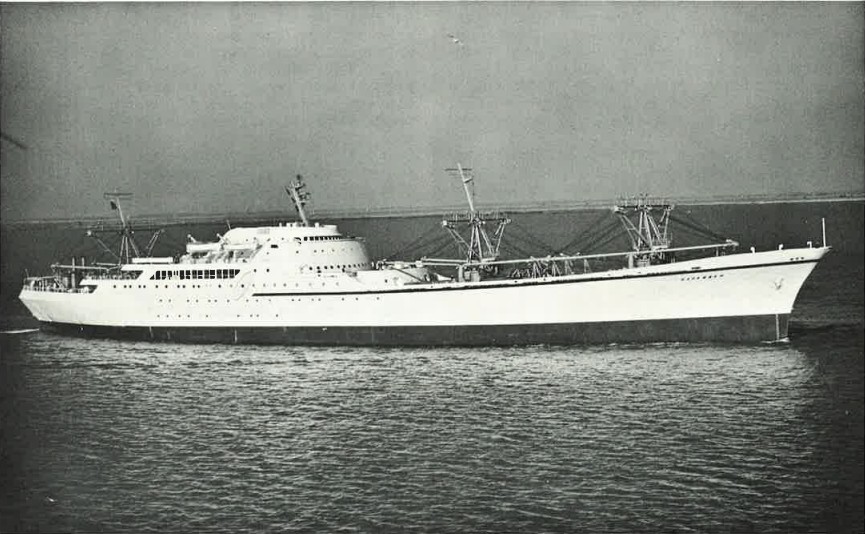
세계 최초의 원자력 화물-여객선 NS 사바나(Savannah)가 버지니아주 요크타운(Yorktown)에서 시운전을 위해 항해 중인 모습. (사진: Nuclear News, 1962년 5월호, 39페이지)
요약
카테고리: 역사
NS 사바나는 세계 최초의 원자력 화물-여객선으로, 2026년 5월 17일(일) 메릴랜드주 볼티모어에서 전국 해양의 날을 기념한 공개 행사가 열린다.
이번 행사에서는 그간 일반에 공개되지 않았던 선박의 격납 용기(원자로가 설치되었던 공간) 투어가 특별히 허용된다.
사바나는 현재 제염·해체(decommissioning) 과정이 마무리 단계에 있으며, 새로운 영구 보존지를 찾고 있다.
---
전국 해양의 날을 기념하여 메릴랜드주 볼티모어에서 오는 5월 17일(일) NS 사바나(Savannah) 공개 행사가 진행될 예정이다. 사바나는 1962년부터 1970년까지 여객 및 화물선으로 활약하며, 아이젠하워(Eisenhower) 대통령의 '평화를 위한 원자력(Atoms for Peace)' 프로그램의 부유하는 홍보대사(floating ambassador) 역할을 하였으며, 나아가 원자력의 안전하고 평화로운 이용을 전 세계에 알리는 역할을 담당하였다.
투어 안내:사바나는 원자력 역사에서 독보적인 유산을 지니고 있다. 여러 특별한 기록 중 하나로, 미국원자력학회(American Nuclear Society)가 1991년에 '원자력 역사 랜드마크(Nuclear Historic Landmark)'로 지정하였다.
선박은 오전 10시부터 오후 3시(동부 하절기 시간, EDT)까지 일반에 공개되며, 오전 11시 30분에는 기념식이 거행된다. 올해 행사에서 특히 주목할 점은, 그간 일반인의 출입이 제한되어 있던 격납 용기 내부를 방문객이 직접 둘러볼 수 있게 된 것이다. 이 공간에는 선박의 원자로—69MWt(이후 80MWt로 출력 상향)급 가압경수로(pressurized water reactor)로, 2개의 증기 발생기와 1차 냉각재 루프를 갖추고 있었다—가 설치되어 있었다.
사바나는 캔튼 해양 터미널(Canton Marine Terminal) 13번 부두에 정박할 예정이며, 이 부두에는 제2차 세계대전 중 건조된 2,700척 이상의 자유선(Liberty ships) 함대 중 현재까지 운항 가능한 마지막 생존 선박 중 하나인 SS 존 브라운(John Brown)도 함께 정박해 있다. 존 브라운 역시 5월 17일에 투어를 운영할 예정이다.
사바나는 현재 제염·해체 과정이 마무리 단계에 접어들면서 새로운 보존지를 찾고 있다. 올해 투어는 이 선박의 과거와 미래에 대해 더 깊이 알아볼 수 있는 소중한 기회가 될 것이다.
간략한 역사: 전국 해양의 날은 증기 동력 선박이 최초로 대서양 횡단에 성공한 역사적인 이정표를 기념하는 날로, 이 위업은 1819년 SS 사바나(Savannah)—NS 사바나의 이름이 유래된 바로 그 선박—에 의해 달성되었다.
아이젠하워(Dwight D. Eisenhower) 대통령은 역사적인 '평화를 위한 원자력' 연설을 한 지 1년 반 후인 1955년 4월, NS 사바나 프로젝트를 공식 발표하였다. 이 계획은 이듬해 의회의 승인을 받았으며, 6년 후 선박이 취항하였다. 운항 8년 동안 사바나는 국내 32개 항구와 해외 45개 항구를 방문하였다. 1968년에는 핵연료 교체(core shuffling)가 이루어져 새로운 연료 집합체 4개가 장착되었다. 이 선박은 1호 노심(Core I)과 1a호 노심(Core Ia)으로 45만 해리(nautical miles) 이상을 항해하며, 농축 우라늄 163파운드를 소비하였는데, 이는 벙커 C 중유(bunker C fuel oil) 2,860만 갤런에 해당하는 에너지량이다.
AI 분석
NS 사바나는 냉전 시대 미국의 원자력 평화 이용 의지를 상징하는 역사적 유물로, 아이젠하워 대통령의 '평화를 위한 원자력' 구상이 실제 선박으로 구현된 사례다. 이 선박이 8년간 운항하며 77개국의 항구를 방문한 것은 원자력 기술의 국제적 홍보와 외교적 역할을 동시에 수행했음을 보여준다. 특히 이번 행사에서 처음으로 공개되는 격납 용기 내부는 초기 선박용 원자로 기술의 발전사를 직접 눈으로 확인할 수 있는 귀중한 기회를 제공한다. 제염·해체가 마무리되어 가는 시점에 열리는 이번 공개 행사는, 사바나의 미래 보존 방향에 대한 사회적 관심을 환기시키는 계기가 될 것으로 보인다. 원자력 역사 랜드마크로서의 사바나의 보존은 원자력 기술의 역사적 유산을 후대에 전달하는 데 있어 중요한 의미를 지닌다.
세계 최초의 원자력 화물-여객선 NS 사바나(Savannah)가 버지니아주 요크타운(Yorktown)에서 시운전을 위해 항해 중인 모습. (사진: Nuclear News, 1962년 5월호, 39페이지)
요약
카테고리: 역사
NS 사바나는 세계 최초의 원자력 화물-여객선으로, 2026년 5월 17일(일) 메릴랜드주 볼티모어에서 전국 해양의 날을 기념한 공개 행사가 열린다.
이번 행사에서는 그간 일반에 공개되지 않았던 선박의 격납 용기(원자로가 설치되었던 공간) 투어가 특별히 허용된다.
사바나는 현재 제염·해체(decommissioning) 과정이 마무리 단계에 있으며, 새로운 영구 보존지를 찾고 있다.
---
전국 해양의 날을 기념하여 메릴랜드주 볼티모어에서 오는 5월 17일(일) NS 사바나(Savannah) 공개 행사가 진행될 예정이다. 사바나는 1962년부터 1970년까지 여객 및 화물선으로 활약하며, 아이젠하워(Eisenhower) 대통령의 '평화를 위한 원자력(Atoms for Peace)' 프로그램의 부유하는 홍보대사(floating ambassador) 역할을 하였으며, 나아가 원자력의 안전하고 평화로운 이용을 전 세계에 알리는 역할을 담당하였다.
투어 안내:사바나는 원자력 역사에서 독보적인 유산을 지니고 있다. 여러 특별한 기록 중 하나로, 미국원자력학회(American Nuclear Society)가 1991년에 '원자력 역사 랜드마크(Nuclear Historic Landmark)'로 지정하였다.
선박은 오전 10시부터 오후 3시(동부 하절기 시간, EDT)까지 일반에 공개되며, 오전 11시 30분에는 기념식이 거행된다. 올해 행사에서 특히 주목할 점은, 그간 일반인의 출입이 제한되어 있던 격납 용기 내부를 방문객이 직접 둘러볼 수 있게 된 것이다. 이 공간에는 선박의 원자로—69MWt(이후 80MWt로 출력 상향)급 가압경수로(pressurized water reactor)로, 2개의 증기 발생기와 1차 냉각재 루프를 갖추고 있었다—가 설치되어 있었다.
사바나는 캔튼 해양 터미널(Canton Marine Terminal) 13번 부두에 정박할 예정이며, 이 부두에는 제2차 세계대전 중 건조된 2,700척 이상의 자유선(Liberty ships) 함대 중 현재까지 운항 가능한 마지막 생존 선박 중 하나인 SS 존 브라운(John Brown)도 함께 정박해 있다. 존 브라운 역시 5월 17일에 투어를 운영할 예정이다.
사바나는 현재 제염·해체 과정이 마무리 단계에 접어들면서 새로운 보존지를 찾고 있다. 올해 투어는 이 선박의 과거와 미래에 대해 더 깊이 알아볼 수 있는 소중한 기회가 될 것이다.
간략한 역사: 전국 해양의 날은 증기 동력 선박이 최초로 대서양 횡단에 성공한 역사적인 이정표를 기념하는 날로, 이 위업은 1819년 SS 사바나(Savannah)—NS 사바나의 이름이 유래된 바로 그 선박—에 의해 달성되었다.
아이젠하워(Dwight D. Eisenhower) 대통령은 역사적인 '평화를 위한 원자력' 연설을 한 지 1년 반 후인 1955년 4월, NS 사바나 프로젝트를 공식 발표하였다. 이 계획은 이듬해 의회의 승인을 받았으며, 6년 후 선박이 취항하였다. 운항 8년 동안 사바나는 국내 32개 항구와 해외 45개 항구를 방문하였다. 1968년에는 핵연료 교체(core shuffling)가 이루어져 새로운 연료 집합체 4개가 장착되었다. 이 선박은 1호 노심(Core I)과 1a호 노심(Core Ia)으로 45만 해리(nautical miles) 이상을 항해하며, 농축 우라늄 163파운드를 소비하였는데, 이는 벙커 C 중유(bunker C fuel oil) 2,860만 갤런에 해당하는 에너지량이다.
AI 분석
NS 사바나는 냉전 시대 미국의 원자력 평화 이용 의지를 상징하는 역사적 유물로, 아이젠하워 대통령의 '평화를 위한 원자력' 구상이 실제 선박으로 구현된 사례다. 이 선박이 8년간 운항하며 77개국의 항구를 방문한 것은 원자력 기술의 국제적 홍보와 외교적 역할을 동시에 수행했음을 보여준다. 특히 이번 행사에서 처음으로 공개되는 격납 용기 내부는 초기 선박용 원자로 기술의 발전사를 직접 눈으로 확인할 수 있는 귀중한 기회를 제공한다. 제염·해체가 마무리되어 가는 시점에 열리는 이번 공개 행사는, 사바나의 미래 보존 방향에 대한 사회적 관심을 환기시키는 계기가 될 것으로 보인다. 원자력 역사 랜드마크로서의 사바나의 보존은 원자력 기술의 역사적 유산을 후대에 전달하는 데 있어 중요한 의미를 지닌다.
Published: May 8, 2026, 7:19 AM
Source: Nuclear News
TL;DR
The 57th annual Nuclear News Buyers Guide has been mailed to ANS members and includes 634 companies across 500+ product and service categories
Three new reference sections added to this year's print edition: U.S.-based utilities list, Department of Energy national laboratories and cleanup sites, and a map of potential new build projects
The online supplier database is free and open access, generating over 3 million views since its May 2023 launch
---
Overview
This year's print edition of the _Nuclear News_ Buyers Guide officially has been dropped in the mail and is on its way to ANS members now. The Buyers Guide is an annual directory that has been connecting every tier of nuclear suppliers with partners, customers, and the workforce since the 1960s—just as the commercial nuclear industry was truly gathering speed.
Print and Digital Resources
The Buyers Guide is accessible only to ANS members and subscribers of _Nuclear News_. It is additionally available for download to all ANS members on the ANS website.
A corresponding online supplier database is open access, regularly updated, and available year-round. This database has generated more than 3 million views since its launch in May 2023, and its broad access has helped cement it as a critical and widely used resource in the industry.
In the online Buyers Guide supplier database, readers will find 634 companies listed across more than 500 categories of products and services that support every sector within the nuclear field.
New This Year
Three new reference sections of interest to many readers have been added to this year's print edition of the Buyers Guide:
A full list of all U.S.-based utilities (with key operating and license status information)
A list of the Department of Energy's national laboratories and cleanup sites
A map with potential new build sites/projects highlighted
_Nuclear News_ would like to give special thanks to the 57 Featured Suppliers in this year's Buyers Guide who upgraded their basic listings by placing an advertisement in the category that is most representative of their business.
Company Listing Information
There is no charge to be listed in the Buyers Guide. If your company does not yet appear in the print directory or online database, ANS invites you to create a basic listing free of charge.
---
AI Analysis
The 57th annual Buyers Guide represents a mature and well-established industry resource that continues to evolve with the nuclear sector's needs. The addition of three new reference sections—U.S. utilities, DoE facilities, and new build projects—reflects growing interest in nuclear expansion and infrastructure investment. The distinction between the premium print/members-only guide and the free, open-access online database demonstrates a strategic approach to serving both industry professionals and the broader public, with the database's 3+ million views since 2023 validating its importance as a neutral, authoritative supplier directory.
Nuclear reactor in central Japan halted after steam leak near turbine
Published: May 8, 2026
TL;DR
A reactor at the Mihama nuclear power plant in Fukui Prefecture was manually halted Friday morning after a steam leak was detected near a high-pressure turbine
The steam contained no radioactive material and had no impact on the external environment, according to Kansai Electric Power Co.
The No. 3 reactor, which began operations in 1976, is the first nuclear reactor in Japan to operate beyond 40 years under post-Fukushima safety regulations
Full Article
The Mihama nuclear power plant in Fukui Prefecture. Image: REUTERS file
Incident Details
The operator of a nuclear power plant in the central Japanese prefecture of Fukui said it halted its reactor Friday morning after discovering steam leaking from near a high-pressure turbine.
The steam did not contain radioactive material and there was no impact on the external environment, according to Kansai Electric Power Co. The utility said it cannot say when it will restart the No. 3 reactor at the Mihama plant.
The leak was detected around 4:10 a.m. Friday. Workers manually halted the reactor about 15 minutes later, according to the company.
Reactor Background
In 2021, the No. 3 unit, which began operations in 1976, became the first nuclear reactor in Japan to operate beyond 40 years under new rules set after the 2011 Fukushima Daiichi nuclear complex disaster. The regulations limit a reactor's service period to 40 years, but extensions of up to 20 years are permitted if approved by regulators.
Decommissioning work is proceeding for the two other aging reactors at the Mihama plant.
---
AI Analysis
This incident demonstrates the importance of robust safety monitoring systems at aging nuclear facilities. The Mihama plant's ability to detect and respond to the steam leak within 15 minutes, with no radioactive contamination, reflects the effectiveness of post-Fukushima safety protocols. While the incident itself posed no public health risk, it highlights the ongoing maintenance challenges for reactors operating beyond their original 40-year design life, underscoring the need for continued vigilance and component replacement programs as Japan navigates its energy transition.
English
Eden targets domestic medical radioisotope production-Nuclear Newswire
Eden targets domestic medical radioisotope production
May 8, 2026
TL;DR
Eden Radioisotopes filed a construction permit application with the NRC to build a facility producing medical radioisotopes, primarily molybdenum-99 (Mo-99) and lutetium-177 (Lu-177), addressing decades of reliance on unreliable foreign sources.
The facility will use a small, nonpower, open-pool reactor operating at 1.8 MWt with a hot cell for target fabrication and isotope separation, recycling 90% of uranium for additional production.
Eden expects to capture up to 50% of global Mo-99 demand, competing directly with Shine Technologies, which received a $263 million DOE loan for its own Mo-99 production facility.
Full Article
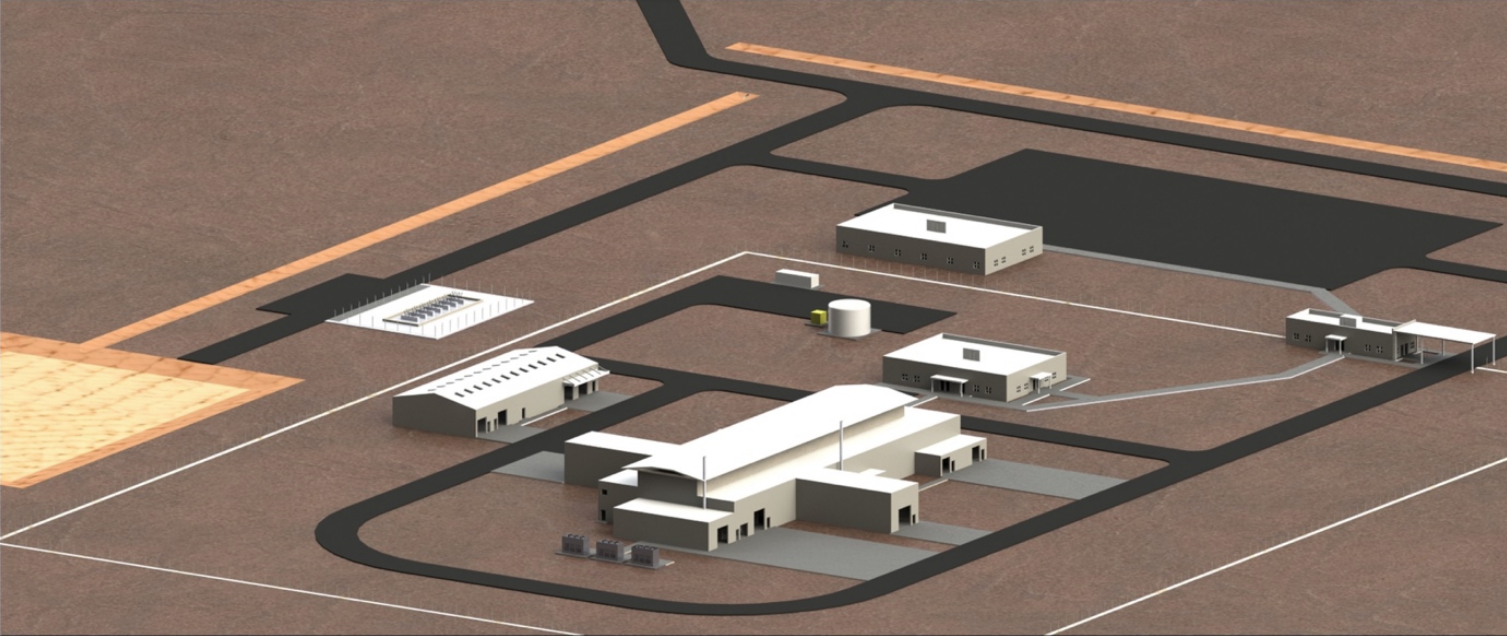
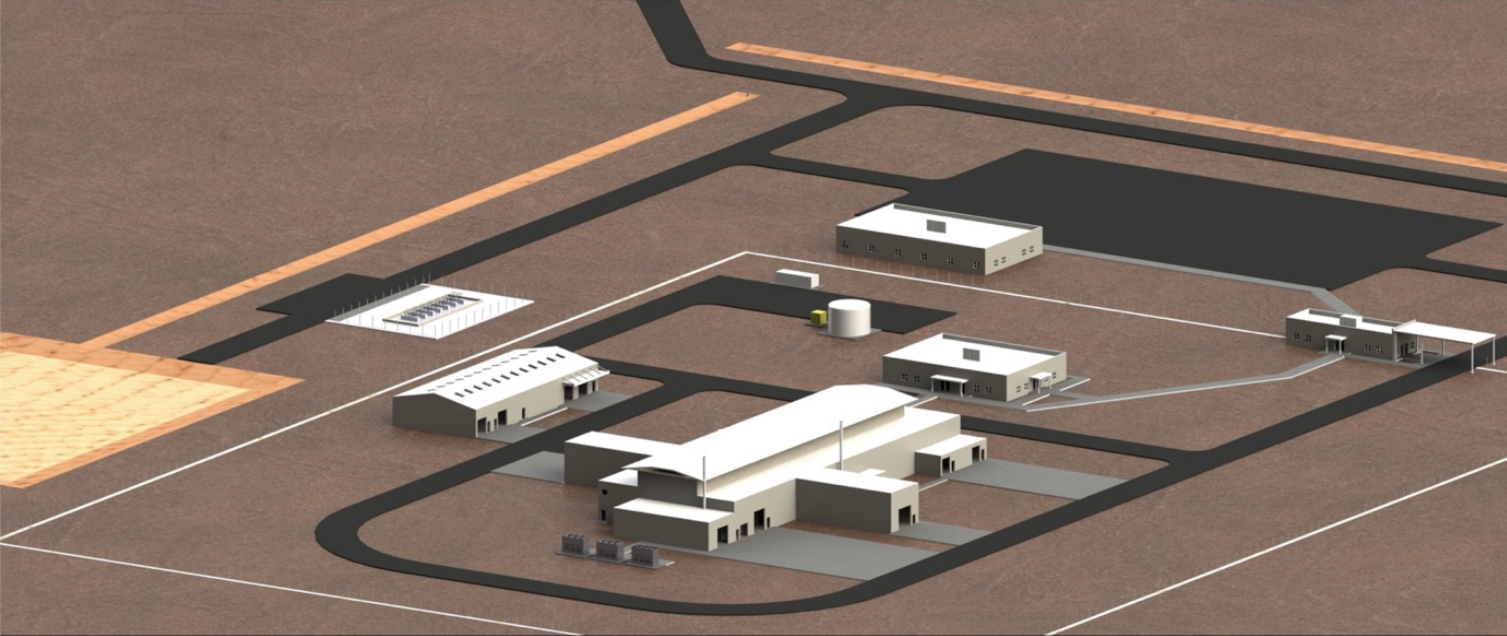
Eden isotope production complex site rendering. (Image: Eden)
Eden Radioisotopes has filed a construction permit application with the Nuclear Regulatory Commission for a facility to produce medical radioisotopes, primarily molybdenum-99 and lutetium-177.
The United States has lacked a reliable domestic source of Mo-99 for diagnostic imaging for decades, and has invested in infrastructure in South Africa, the Netherlands, and Belgium to assist facilities in producing the isotope using HALEU targets. These reactors are old, and there have been disruptions to the supply chain due to unplanned outages for repairs. With a 66-hour half-life, Mo-99 cannot be stockpiled.
Eden Radioisotopes proposes to use a small, nonpower, open-pool reactor design that is optimized for high-yield isotope production. The reactor will use low-enriched uranium and operate at 1.8 MWt. Eden expects to operate it for 22 hours per day, using the downtime to replace targets.
According to Eden's NRC regulatory engagement plan, its facility "will produce Mo-99, iodine-131 (I-131), and xenon-133 (Xe-133) through the fission process and other isotopes, such as Lu-177, through neutron activation."
A hot cell facility is being constructed for target fabrication and for separating the desired radioisotopes from irradiated targets on site. The reactor will generate no spent fuel, the company said, and 90 percent of the uranium will be recycled for additional isotope production.
"For decades, the American medical system has operated at the mercy of a fragile, foreign-dependent supply chain," said Carrie Freeman, CEO of Eden Radioisotopes. "Eden will permanently reshore this capability—establishing a domestic supply of Mo-99 and Lu-177 and bringing proven nuclear technology directly to the fight against cancer and heart disease."
Domestic supply
For both Lu-177 and Mo-99, shifting from reliance on imports to domestic supply improves supply chain reliability in the United States. But for Mo-99 there is an additional consideration. If it takes 66 hours to transport Mo-99 from the production facility to a clinic, there will be half as much Mo-99 in the sample when it arrives as there was when it was sent. This makes domestic supply far more efficient, reducing transportation time by bringing production physically closer to the destination.
Domestic competition
The United States consumes half of the world's supply of Mo-99, including through more than 40,000 medical procedures each day. Eden has said its facility will be "positioned to deliver up to 50 percent of global demand" for the isotope.
Eden isn't the only company seeking to fill the domestic medical isotope production gap. Recently, the Department of Energy's Office of Energy Dominance Financing issued a conditional commitment for a loan of up to $263 million to fusion company Shine Technologies, which is also constructing a facility to produce Mo-99.
According to the DOE, the Chrysalis, Shine's facility in Janesville, Wis., is at an advanced stage of construction with its "production capacity exceeding 75 percent of U.S. Mo-99 demand." Shine is already producing Lu-177 at its existing isotope facility.
Eden's background
Eden will be using reactor technology developed at Sandia National Laboratories from a project that originated in the 1990s when the U.S. government recognized an impending shortage of medical isotopes. While the government shifted to relying on international imports, that has not proven to offer long-term reliability, especially after the Canadian National Research Universal reactor at Chalk River was shut down. Eden was founded in 2019 by five individuals, four of whom came from Sandia, according to Chris Wagner, cofounder and chief operating officer of Eden. In a 2025 interview with Nuclear News, Wagner—who was, at the time, CEO of Eden—talked at length about the company's history, reactor, and plans for the future.
AI Analysis
Eden Radioisotopes' NRC permit application represents a significant step toward reshoring critical medical isotope production capabilities that the U.S. has outsourced for decades. The facility's design—using a small, optimized open-pool reactor with 90% uranium recycling—demonstrates a practical approach to achieving both domestic supply reliability and operational efficiency. With competing ventures like Shine Technologies also pursuing DOE backing, the medical radioisotope market is experiencing genuine competitive momentum to address a longstanding supply chain vulnerability that directly impacts thousands of daily medical procedures.
English
Framatome licensed to produce LEU+ fuel at its Richland plant-Nuclear Newswire
Framatome licensed to produce LEU+ fuel at its Richland plant
May 8, 2026
TL;DR
Framatome's Richland facility received NRC approval for a license amendment to manufacture nuclear fuel enriched above 5% uranium-235, with production starting in 2027
LEU+ (low-enriched uranium plus) fuel enriched between 5-10% U-235 enables higher fuel burnup, improving economics for existing reactors
Urenco UK also successfully produced LEU+ in trial runs, with both companies positioning to supply enriched fuel to fabricators by early 2027
Main Article
Framatome's fuel fabrication facility in Richland, Wash.
Framatome's fuel fabrication facility in Richland, Wash. (Photo: Framatome)
Framatome announced this week that its nuclear fuel manufacturing facility in Richland, Wash., has received Nuclear Regulatory Commission approval for a license amendment supporting fabrication of nuclear fuel with enrichment levels above 5 percent uranium-235, with manufacturing scheduled to begin in 2027.
According to Framatome, the approval supports the company's Advanced Fuel Management program, which focuses on bringing nuclear fuel technologies to the existing U.S. nuclear fleet, including uranium oxide pellets with higher enrichment levels and advanced codes and methodologies that support higher fuel burnups.
Background
Framatome has been making modifications to its Richland facility since 2022 to manufacture high-burnup fuel using low-enriched uranium plus (LEU+), which is uranium enriched to a level between 5 and 10 percent U-235.
An operational readiness review is scheduled with the NRC in early 2027 to confirm that the amended license requirements have been implemented at the facility, the company said. Approval of the review will allow receipt of the LEU+ material for processing at the site for the first reload manufacturing campaign.
Framatome recently received NRC approval of its topical report "High Burnup for Pressurized Water Reactors (PWRs)," which supports increased fuel burnup limits for the company's GAIA and HTP fuel designs. Additionally, Framatome said the NRC approved the application of its suite of PWR Advanced Codes and Methods to operating conditions with U-235 enrichments exceeding 5 percent. The NRC also approved a license amendment allowing Framatome to transport fresh PWR and boiling water reactor fuel assemblies within the U.S. with U-235 enrichments up to 8 percent U-235.
Framatome's work in LEU+ fuel has been supported by the Department of Energy's Accident Tolerant Fuel program.
Quote
"This approval is the next step in bringing fuel solutions with higher enrichment levels to the nuclear energy market," said Lionel Gaiffe, Framatome's senior executive vice president. "We are getting closer to changing the landscape of the industry by going beyond traditional enrichment levels and bringing economic and value-added solutions to our customers."
U.K. LEU+
Earlier this week, Urenco UK announced that it has produced LEU+ at its Capenhurst enrichment facility in England.
This was the first trial run of this new service, the company said, which was conducted following positive feedback from a regulatory readiness review and subsequent permission from the U.K.'s Office for Nuclear Regulation.
The trial, which ran from April 27 to May 1, achieved samples at 7 percent U-235, demonstrating Capenhurst's capability to produce LEU+, according to Urenco.
Urenco UK said it plans to make LEU+ commercially available from the United Kingdom in the near future, which will support existing capability from Urenco USA's National Enrichment Facility in New Mexico. Urenco USA received NRC approval to produce LEU+ in 2025.
LEU+ could be transported to fabricators as soon as early 2027 to complete the next stage of the fuel cycle, the company said.
AI Analysis
This announcement represents a significant milestone in advancing the economics and lifecycle of existing nuclear reactors through higher-enriched fuel technology. The parallel development of LEU+ capability across multiple vendors—both Framatome and Urenco—demonstrates growing industry momentum toward standardizing this fuel type. By enabling fuel enrichment between 5-10% U-235, these developments could extend reactor lifespans and improve competitiveness without requiring new reactor designs, making them critical for supporting the near-term expansion of nuclear capacity. The Department of Energy's backing of this initiative underscores its strategic importance to U.S. energy policy.
English
Gov. Sherrill, PSEG CEO talk N.J. nuclear expansion-Nuclear Newswire
Gov. Sherrill, PSEG CEO talk N.J. nuclear expansion
May 8, 2026
TL;DR
New Jersey's lawmakers lifted the state's moratorium on nuclear construction, opening possibilities for new nuclear facilities near Hope Creek and Salem
Gov. Sherrill and PSEG executives welcome the momentum but emphasize that federal support and streamlined permitting are essential for new nuclear development to succeed
PSEG expects nuclear licenses for Salem-1, Salem-2, and Hope Creek will be extended into 2056, 2060, and 2066 respectively, with potential capacity uprates
Article
Cooling towers at the Hope Creek/Salem site. (Photo: Gov. Mikie Sherrill's Office)
Gov. Mikie Sherrill said state officials are eyeing sites for potential nuclear facilities. Executives at PSEG Nuclear—the operators of Hope Creek and Salem—welcome the news of the growing momentum for nuclear power in the state but cautioned it will take more than lifting a moratorium to make this feasible.
Expansion in New Jersey
Multiple news outlets have reported that New Jersey officials are looking at sites, including land near Salem nuclear plant. According to NJ.com, it is one of only six sites in the country preapproved for new nuclear power facilities. Sherrill told the news outlet it was "always anticipated we'd build another nuclear reactor down there."
Salem is co-located with Hope Creek in Hancocks Bridge, N.J. Hope Creek is home to one 1,172-MWe boiling water reactor, while Salem houses two pressurized water reactors—the 1,146-MWe Unit 1 and the 1,139-MWe Unit 2. Combined, the facilities produce more than 40 percent of the state's electricity.
During PSEG's first-quarter earnings call Tuesday, CEO Ralph LaRossa said PSEG is engaging in efforts to advance new nuclear development in the Hope Creek/Salem area, which features a completed port, access to a skilled workforce, and technical capabilities.
"It looks like nuclear is one of those areas that there's some momentum," he said during the conference call.
All indications are there is broad support from state officials like the governor, said LaRossa. Along with the signing of S. 3870/A. 4528, which lifted the moratorium, lawmakers created a state Nuclear Task Force that will gather government, industry, environment, and labor officials together to explore new nuclear endeavors.
Concern now shifts elsewhere, LaRossa said. While the federal government has shown interest in revitalizing the nuclear power industry, will that translate to investment in New Jersey?
"You need to ensure that not only do you have some financial support, but that you have the permitting support and the siting support," LaRossa said. "I heard a lot of that from our governor, that's one of the things that they want to streamline here in New Jersey."
He added:
"I don't see any state taking on new nuclear without the support of the federal government."
On Tuesday's earnings call, executives also shared that Salem has a capacity uprate potential of nearly 200 MW. Additionally, PSEG expects the Nuclear Regulatory Commission will approve the subsequent license renewal applications for Salem's two PWRs and Hope Creek's BWR. The company submitted letters of intent to apply for SLR in March 2024. According to the NRC, the applications will be submitted between April and June 2027. If approved, the operating licenses for Salem-1 and -2 and Hope Creek would be extended into 2056, 2060, and 2066, respectively.
AI Analysis
New Jersey's lifting of its nuclear moratorium signals a transformative policy shift in the state's approach to decarbonization and energy security, moving away from decades-long opposition to new nuclear construction. The emphasis from both Gov. Sherrill and PSEG leadership on federal support and regulatory streamlining indicates that practical governance frameworks—not public sentiment or technological viability—now represent the primary challenge to nuclear expansion. With potential capacity uprates and extended operating licenses extending into the 2050s and 2060s, the Hope Creek and Salem facilities could serve as anchors for New Jersey's clean energy infrastructure for decades to come, provided sufficient federal investment and permitting support materializes.
I've read the file. The markdown content provided consists primarily of a Financial Times paywall/subscription page. The only actual article content present is the brief teaser: "The fusion power race is heating up"
According to the instructions to preserve the COMPLETE original article while removing "obvious website navigation, ads, cookie banners, and footer boilerplate," the subscription paywall section should be removed.
The issue: The file does not contain the full article content—only the paywall and a one-line teaser. I cannot create a complete formatted article, TL;DR, or AI Analysis without the actual article text.
To proceed, I need the complete article content that should appear between the paywall and the footer. The URL provided (https://www.ft.com/content/a8a41287-441e-435b-a5c7-1a57075906a4) appears to be behind a paywall, so the article text itself was not successfully scraped into this file.
Please provide the full article content so I can format it according to the specifications.
NANO Nuclear Signs Strategic MOU with Supermicro to Power the Next Generation of AI Data Centers with Advanced Nuclear Energy
Publish Date: May 6, 2026
TL;DR
NANO Nuclear Energy Inc. and Super Micro Computer, Inc. (Supermicro) have signed a Memorandum of Understanding to integrate advanced microreactors with AI server and data center platforms to power next-generation AI infrastructure.
The partnership aims to address unprecedented electricity demand from AI and cloud computing by deploying dedicated, on-site nuclear power for data centers that can operate grid-independently.
The collaboration combines NANO Nuclear's KRONOS MMR™ Energy System with Supermicro's leading AI hardware ecosystems to create a vertically integrated compute + power solution for hyperscale data center operators globally.
Overview
_Partnership combines cutting-edge microreactors with a global leader in AI server infrastructure to address surging energy demand from artificial intelligence._
New York, N.Y., May 06, 2026 — NANO Nuclear Energy Inc. (NASDAQ: NNE) ("NANO Nuclear" or "the Company"), a leading advanced nuclear micro modular reactor (MMR) and technology company focused on developing clean energy solutions, today announced it has entered into a Memorandum of Understanding (MOU) with Super Micro Computer, Inc. ("Supermicro"), a global leader in high-performance, high-efficiency server and AI infrastructure solutions.
Strategic Collaboration
This strategic collaboration is focused on exploring the integration of NANO Nuclear's advanced microreactor systems with Supermicro's industry-leading AI server and data center platforms, with the goal of delivering clean, reliable, and scalable nuclear-powered solutions for the rapidly expanding artificial intelligence economy.
The explosive growth of artificial intelligence, cloud computing, and high-performance computing is creating an unprecedented surge in global electricity demand, particularly from data centers that require constant, high-density, and reliable power.
Key Opportunities
Through this MOU, NANO Nuclear and Supermicro will explore opportunities to:
Deploy NANO Nuclear's microreactors to provide dedicated, on-site nuclear power for data centers.
Integrate Supermicro's AI server racks, cooling systems, and infrastructure with nuclear-powered energy solutions.
Develop joint go-to-market strategies for hyperscale, enterprise, and edge data center customers.
Enable a new class of self-powered, grid-independent AI infrastructure.
The collaboration reflects a shared vision to solve one of the most urgent challenges facing the AI industry: how to sustainably power exponential compute growth.
_Figure 1 – NANO Nuclear Energy Inc. Signs Strategic MOU with Supermicro to Power the Next Generation of AI Data Centers with Nuclear Energy_
Executive Perspectives
"This collaboration with Supermicro represents a powerful convergence of two transformative technologies: advanced nuclear energy and artificial intelligence infrastructure," said Jay Yu, Chairman and President of NANO Nuclear. "The AI revolution is fundamentally an energy challenge, and we believe nuclear power is the only scalable solution capable of meeting that demand. By working alongside one of the world's leading providers of AI server technology, we are positioning NANO Nuclear at the forefront of a new paradigm, where data centers are not constrained by the grid, but powered by dedicated, on-site nuclear energy systems."
Supermicro's Role and Benefits
Supermicro is one of the world's leading providers of end-to-end green computing solutions, delivering advanced server, storage, and networking systems for data centers, cloud providers, and enterprise customers globally.
By partnering with Supermicro, NANO Nuclear gains direct alignment with a company at the forefront of the AI infrastructure buildout, providing:
Access to global data center customers and hyperscale operators.
Integration pathways with state-of-the-art AI hardware ecosystems.
A channel into one of the fastest-growing sectors of the global economy.
At the same time, Supermicro gains access to NANO Nuclear's next-generation nuclear power systems, enabling it to offer customers a complete, vertically integrated solution: compute + power.
Market Positioning
This MOU represents a major step forward in NANO Nuclear's strategy to become a leading energy provider for the AI and data center sector, which is rapidly emerging as one of the largest future consumers of electricity globally.
As grid constraints intensify and power availability becomes a limiting factor for AI deployment, NANO Nuclear's microreactors offer a compelling solution:
24/7 baseload power independent of the grid.
Carbon-free energy aligned with ESG mandates.
Scalable deployment for data center campuses.
Rapid installation and modular expansion.
This positions NANO Nuclear not just as a reactor developer, but as a critical enabler of the global AI economy.
"This is exactly where the future is heading compute and power becoming a unified solution," said James Walker, Chief Executive Officer of NANO Nuclear. "By aligning with Supermicro, NANO Nuclear is stepping directly into the center of one of the fastest growing and most capital-intensive markets in the world. This partnership opens the door to hyperscale opportunities that could redefine how data centers are built and powered."
MOU Framework
The MOU outlines a framework under which both companies will mutually introduce sales opportunities, collaborate on joint deployments, and explore integrated solutions combining:
NANO Nuclear's microreactors including the KRONOS MMR™ Energy System.
Supermicro's server racks and AI systems.
Cooling, maintenance, and lifecycle services.
Together, the companies aim to create a next-generation infrastructure model where computing power and energy supply are developed in tandem.
Looking Ahead
While the MOU is non-binding, it establishes a foundation for future definitive agreements and project-specific collaborations, positioning both companies to capitalize on the rapidly evolving intersection of energy and artificial intelligence.
AI Analysis
This MOU represents a significant development in addressing the critical energy infrastructure challenges posed by rapid AI expansion. By combining NANO Nuclear's modular reactor technology with Supermicro's proven expertise in data center systems, the partnership positions both companies to capitalize on a massive market opportunity driven by intensifying grid constraints and corporate clean energy commitments. The focus on grid-independent, on-site nuclear power for data centers offers a pragmatic solution to the sustainability and scalability challenges facing hyperscale AI infrastructure. This collaboration signals growing industry recognition that advanced nuclear energy is not merely a long-term decarbonization strategy, but an immediate operational necessity for supporting exponential AI compute growth.
Standard Uranium wraps up inaugural drill program at Rocas
Published: Wednesday, May 6, 2026
TL;DR
Standard Uranium completed its inaugural 962-metre drill program at the Rocas uranium project in Saskatchewan, with three of four holes showing anomalous radioactivity peaking at 650 counts per second
All four drill holes intersected carbon-rich rocks and sulphide mineralization across 114 metres, confirming the company's geological model and presence of hydrothermal alteration * The company plans follow-up prospecting and systematic drilling along the remaining five kilometres of a 7.5-kilometre electromagnetic corridor to identify additional uranium exploration targets
Full Article
Standard Uranium wraps up inaugural drill program at RocasStandard Uranium Ltd (TSX-V:STND, OTCQB:STTDF, FRA:9SU0) said on Wednesday it has completed drilling at its Rocas uranium project in Saskatchewan, with results from three of four reconnaissance holes showing anomalous radioactivity that the company called a strong early indicator for potential uranium mineralization.
The junior explorer drilled 962 metres across four holes at the project, located 75 kilometres southwest of the Key Lake Mine and Mill facilities along Highway 914.
Three of four drill holes returned elevated radioactivity, with the strongest reading peaking at 650 counts per second.
All four holes intersected carbon-rich rocks and sulphide mineralization across a combined 114 metres, confirming the accuracy of the company's geological model.
The program tested three target areas identified using gravity surveys, electromagnetic data, and surface sampling.
Altered rock consistent with hydrothermal activity, a key condition for uranium formation, was present throughout, including a shallow 9-metre fault zone considered a particularly promising setting for a discovery.
Geochemical assay results are pending, the company said.
"Validating our geophysical model with graphitic structure and anomalous radioactivity in three of our first four basement intersections is a fantastic outcome for this first-pass drill program," said Sean Hillacre, president and vice president exploration. "Confirming the presence of hydrothermal alteration and key structural conduits also strongly supports the potential for a significant discovery."
The Rocas project is held under a three-year earn-in option agreement with Collective Metals.
Standard Uranium and Collective Metals are planning follow-up prospecting and systematic drilling along the remaining five kilometres of the 7.5-kilometre electromagnetic corridor, with plans to expand ground gravity and electromagnetic coverage north and south of current target areas to identify additional uranium traps.
AI Analysis
Standard Uranium's successful inaugural drill program at Rocas represents a promising early-stage exploration achievement in Saskatchewan's uranium district. The confirmation of anomalous radioactivity in 75% of the drill holes, combined with structural features and hydrothermal alteration, suggests the company's geological model is sound and justifies further exploration. The pending geochemical assay results will be critical in determining whether these positive geophysical indicators translate into actual economic uranium mineralization, making the next phase of systematic drilling along the electromagnetic corridor a logical and potentially rewarding follow-up.
Former Southwest Philly refinery site will become home to nuclear life science facility
TL;DR
TerraPower Isotopes is breaking ground on a 250,000-square-foot manufacturing facility at the former Philadelphia Energy Solutions refinery site in Southwest Philadelphia, with a $450 million investment
The facility will manufacture actinium-225, a rare radioactive isotope being tested as a targeted cancer treatment, with production expected to begin in 2029
Pennsylvania is providing $10 million in grants and significant tax incentives, and TerraPower has promised to create 225 full-time jobs and 500 temporary construction jobs at the site
Article
The first life sciences tenant at the former Philadelphia Energy Solutions refinery site broke ground Wednesday on a 250,000-square-foot custom manufacturing facility.
"I believe what this company and industry is doing can change the way that cancer is treated," said Scott Claunch, president of TerraPower Isotopes. "The site we're breaking ground on today is how we make it happen at the scale that the world needs."
TerraPower Isotopes already manufactures actinium-225 at a smaller scale at its lab in Everett, Washington. The company said the site, which the owners call "The Bellwether District", will be its "flagship" manufacturing facility for the isotope, and will increase worldwide production of the material "20-fold."
TerraPower Isotopes plans to start production at the former refinery site in 2029.
Harvesting a rare isotope from radioactive material
TerraPower Isotopes will harvest actinium-225 from an amount of radioactive thorium equivalent to the mass of about 20 paper clips during its decay process, Claunch said. The thorium is extracted from the federal government's inventory of uranium left over from the Cold War, and shipped on roadways from the U.S. Department of Energy's Oak Ridge National Laboratory in Tennessee to TerraPower Isotopes' facilities.
Demand is growing globally for actinium-225 but supply is limited, according to the U.S. Department of Energy's National Isotope Development Center. Claunch said currently, the amount of actinium-225 produced worldwide is equivalent to just a few grains of sand.
"When [the site] comes online in 2029, we will increase global production capacity by 20 times," Claunch said. "A few more grains of sand."
TerraPower Isotopes plans to ship its actinium-225 to drug developers that will attach the isotope to targeting molecules that Claunch said can act like GPS systems inside patients' bodies.
"That then gets injected into a patient who has disease, and that final product makes its way just to the cancer cell and destroys just the cancer cell, saving nearby healthy tissue," he said.
"We have safeguards in place, we have containment systems in place to make sure that our people, our personnel at the site, as well as the general public are very well protected," Claunch said.
Taxpayer-funded incentives and nearby research institutions lure company to Philly
TerraPower Isotopes considered 350 sites across the country for its actinium-225 manufacturing facility, but ultimately chose The Bellwether District because of Philadelphia's infrastructure, the skilled workforce in the area and the site's proximity to research institutions and pharmaceutical companies, Claunch said.
The Bellwether District is also part of the state's Permit Fast Track Program, which coordinates state agency review of projects to streamline the permitting process at specific sites.
"Under Gov. [Josh] Shapiro, we've been much more aggressive and competitive than ever in our efforts to win projects like this — projects that create jobs, that spark the regional economy and that tell the world that Pennsylvania is open for business," said Rick Siger, secretary of the Pennsylvania Department of Community and Economic Development.
TerraPower Isotopes has promised to create 225 full-time jobs, and another 500 temporary construction jobs at The Bellwether District site.
"The people that we employ in Philadelphia will live and work in Philadelphia," Claunch said.
AI Analysis
This article highlights a significant biotechnology investment in Southwest Philadelphia that converts a legacy industrial site into a cutting-edge isotope manufacturing facility. The project demonstrates how public incentives, proximity to research institutions, and regional infrastructure can attract high-value manufacturing, particularly in emerging fields like targeted cancer treatment. The 20-fold increase in global actinium-225 production represents a meaningful advancement in cancer treatment accessibility, though the technology itself remains in clinical trials, indicating the speculative nature of the investment alongside its innovative potential.
Officials Hail Major Milestone for US Deep Underground Neutrino Experiment
Published: May 8, 2026
TL;DR
A vast complex of 4.5 million kilograms of steel beams has begun moving underground to support the $3.3 billion DUNE-LBNF neutrino detector project in South Dakota
The project represents a pivotal construction phase, with completion expected in 2031 and will study neutrino properties in unprecedented detail
CERN-contributed cryostat materials are now being installed in underground caverns 1.6 km deep that will house four detector tanks filled with liquid argon
Main Article
Steel beam at US neutrino facilityHeading underground: Some 4.5 million kilograms of steel beams are set to be moved underground that will be used to hold neutrino detectors in place (Courtesy: Matthew Kapust, SURF).
An event was held yesterday – attended by senior officials including CERN director-general Mark Thomson and Dario Gil, undersecretary for science at the US Department of Energy (DOE) – to commemorate the start of moving 4.5 million kilograms of steel beams underground that will be used to hold DUNE's detectors in place.
Project Background
In February 2024, excavation work finished on two huge underground spaces for DUNE. Located 1.6 km underground at the Sanford Underground Research Facility in South Dakota and are some 150 m long and seven storeys tall, the spaces will be used to house DUNE's four neutrino detector tanks that are each filled with 17,000 tonnes of liquid argon and cooled to 88 K.
When complete in 2031, DUNE-LBNF will study the properties of neutrinos in unprecedented detail, as well as the differences in behaviour between neutrinos and antineutrinos.
Detector Operations
DUNE will measure the neutrinos that are generated by Fermilab's accelerator complex, which lies around 1300 km away just outside Chicago.
The cryostat materials, which have been contributed by the CERN, are now scheduled to be moved underground and installed in the next few months.
Director's Statement
"Today represents the start of a pivotal phase for DUNE, the development of the far detector structures in South Dakota," noted Fermilab director Norbert Holtkamp. "Our focus remains on safety, quality and schedule — in that order — to ensure we successfully deliver on behalf of the US Department of Energy, our nation and the world."
AI Analysis
This milestone represents a crucial advancement in international neutrino research, with the physical movement of infrastructure marking the transition from planning and excavation to active construction of detector systems. The participation of both CERN and US Department of Energy leadership underscores the global significance of DUNE-LBNF, positioning it as a critical facility for understanding fundamental particle physics. With completion targeted for 2031, the project's emphasis on safety and quality during this infrastructure installation phase is essential to ensuring the long-term success of what will be one of the world's premier neutrino observation facilities.
Will DOE's 'nuclear lifecycle innovation campuses' solve the US nuclear waste problem?
May 7, 2026
TL;DR
The DOE is proposing "nuclear lifecycle innovation campuses" to collaborate with states on taking in and potentially recycling used nuclear fuel, with several states responding positively
The U.S. faces significant financial, policy, and practical challenges with an estimated 95,000 metric tons of spent nuclear fuel and growing taxpayer liability ($56.5 billion in 2025)
Solving the spent fuel crisis is critical for the Trump administration's goal of adding 300 GW of nuclear capacity over the next two decades
An article from site logo
Deep Dive
Will DOE's 'nuclear lifecycle innovation campuses' solve the US nuclear waste problem?
The Department of Energy wants to collaborate with states that agree to take in and possibly recycle used nuclear fuel, and some have responded positively. But practical and policy challenges remain.
Four anti-nuclear power protestors stand holding a banner reading 'nuclear waste' on Three Mile Island near Harrisburg, Pa., in 1979. For decades, state and local opposition has stymied attempts to deal with the nation's estimated 95,000 metric tons of spent nuclear fuel. Keystone/Hulton Archive/Getty Images via Getty Images
Listen to the article 12 min
This audio is auto-generated. Please let us know if you have feedback.
After decades of stalemate over what to do with radioactive waste from nuclear power plants, the U.S. Department of Energy is hoping states can be convinced to take in some of that used fuel as part of a broader effort that could include advanced industries, power generation, data centers — and the promise of long-term jobs.
Many states have responded positively against a backdrop of rising demand for electricity and a bipartisan interest in non-fossil firm power. Recycling and reusing nuclear fuel – as France has done for years – is seen by many as key to reviving the U.S. nuclear sector.
But many of the same financial, policy and practical challenges remain that stymied previous efforts to find a lasting solution for the country's estimated 95,000 metric tons of spent nuclear fuel. That could impede a burgeoning nuclear renaissance and the Trump administration's ambition of adding some 300 GW of nuclear capacity over the next two decades, federal officials, utility planners, nuclear technology providers and analysts told Utility Dive.
"The generations who got electricity from the nuclear reactors should solve the problem and not kick the can down the road."
Manuel C. Camargo
Principal Manager, Decommissioning, Southern California Edison
Manuel C. Camargo, the principal manager of decommissioning for Southern California Edison, said the utility supports the idea of the DOE's "nuclear lifecycle innovation campuses," as the department is calling them, as well as the department's collaborative approach. SCE owns the San Onofre nuclear plant, which was retired in 2013, but decommissioning cannot be completed until the spent fuel is offsite, Camargo said.
In the meantime, SCE must pay rent to the Navy, which owns the land, until the federal government "delivers on its legal and contractual obligations" to dispose of the waste, he added. SCE would like to see a commitment to reliable funding for the spent fuel repositories as part of any new efforts, he said.
"Not solving spent fuel storage could impede deployment of advanced reactors" to help meet "exponential electricity demand growth," Camargo said. "The generations who got electricity from the nuclear reactors should solve the problem and not kick the can down the road."
How we got here
The first nuclear generation came online in Pennsylvania in 1957, and licensing peaked in the 1970s.
As radioactive waste accumulated at the sites of these power plants, concerns about safety in the 1980s led policymakers to tighten Nuclear Regulatory Commission licensing requirements and address the spent fuel storage question.
In 1987, Ronald Reagan signed legislation designating Yucca Mountain, Nevada, as the United States' sole site for a permanent depository deep underground. But work on it stalled over the next 20 years in the face of state and regional opposition, and in 2011, the Obama administration effectively terminated it through defunding.
"The court could not order DOE to act because Congress had not appropriated funds," recalled Tim Smith, who helped form the coalition and also founded the advocacy group Governmental Strategies. "But it acknowledged a partial breach of contract and the litigants' right to costs incurred."
As spent fuel accrues across the country by an estimated 2,000 metric tons per year, so too do taxpayer obligations.
In 2025, the taxpayer liability for DOE's failure to fulfill its legal obligation was $56.5 billion, and it continues to grow, Representative Mike Levin, D-CA, noted during a recent House hearing. He also emphasized bipartisan efforts to address the issue, including through the Spent Nuclear Fuel Solutions Caucus.
"We have to be realistic about the Trump administration's intention to build a lot more nuclear," Levin said. "We should not be siting new nuclear power projects until we fix the back end of the fuel cycle."
nuclear, storage
Optional Caption
DOE. (2025). "Pathways" [pdf]. Retrieved from DOE.
DOE's solution
In January, the DOE issued a request for information seeking "input from states interested in hosting potential Nuclear Lifecycle Innovation Campuses to anchor integrated, full‑cycle nuclear ecosystems that could co-locate and support the entire nuclear value chain while exploring durable pathways for managing used nuclear materials in a safe, secure, and fiscally responsible manner."
It said the campuses "must" support functions such as fuel fabrication, enrichment, nuclear fuel reprocessing or recycling and disposition of waste. They "could additionally support functions such as advanced reactor deployment, power generation, advanced manufacturing, and co‑located data centers."
States were invited to submit "their proposed appropriate scope of the Innovation Campuses and the specific funding structures," with emphasis on prioritizing private and state money while relying on "targeted, conditional, and time‑limited federal support, subject to the availability of appropriations and statutory authority."
"DOE envisions these campuses would be deployed quickly, with initial facilities online in the 2027 timeframe," the RFI says.
The deadline for states to respond was April 1. The department has not said when it will announce which* proposals it chooses.
nuclear waste
Optional Caption
DOE. (2025). "Pathways" [pdf]. Retrieved from DOE.
Of the 28 state responses to the RFI, Utah, South Carolina, Tennessee, and Washington signaled significant interest, the Nuclear Newswire reported April 1. A joint response from 11 states through the National Association of State Energy Officials suggested improvements.
Responses from Utah, Tennessee, Idaho and Nebraska included letters from their Republican governors describing potential private sector partners, sites, workforces, policy support and stakeholder concerns.
This was distinctly different from Nevada's historic resistance to Yucca Mountain and more recent pushback in Texas and New Mexico.
Marla Morales is DOE's acting deputy assistant secretary for spent fuel and high-level waste. In an interview with Utility Dive, she said pairing waste storage with nuclear sector economic growth opportunities was a "game-changer."
"States and communities have the opportunity to become part of the national and international economy and develop multi-generational economic growth, jobs and revenues if they are willing to help the federal government with its used fuel responsibility," Morales said.
The DOE's approach is reflected in its preference for the term "used fuel" over "spent fuel" or "waste" because it suggests "an asset that still holds 90% of its innate energy," she added.
"Yucca Mountain is still the codified repository" under the 1982 law, but Energy Secretary Chris Wright has made it clear it is not the solution, Morales said.
nuclear, storage
Optional Caption
DOE. (2012). "Blue Ribbon Report" [pdf]. Retrieved from DOE.
Bipartisan support for used nuclear fuel storage and recycling
Both Republican and Democratic administrations have acknowledged the need for spent fuel storage and recycling to support the development of advanced nuclear.
"Nuclear has an essential role in the energy transition as a clean firm complement to renewables," according to a report issued by the DOE under President Joe Biden. "The U.S. will need at least ~700–900 GW of additional clean firm capacity…[and] nuclear is one of the few proven options that could deliver this at scale."
Among the key changes needed to support nuclear development is "a consent-based approach to siting federal consolidated interim storage and disposal facilities," the report said.
While President Donald Trump has derided concerns about climate change, he has pushed an aggressive plan to expand nuclear power for artificial intelligence data centers and advanced manufacturing. In May 2025, he directed DOE to authorize advanced reactor demonstration projects outside of national labs, and 11 pilots are underway.
In March, the NRC issued its first commercial nuclear reactor construction permit in nearly 10 years to a subsidiary of Bill Gates' TerraPower for a 345-MW plant planned near the site of a retiring coal plant in Kemmerer, Wyoming.
Other tailwinds for used nuclear fuel include a federal ban on uranium imports from Russia set to take effect in 2028, which will increase pressure to move toward a closed fuel cycle, or at least increase nuclear fuel recycling domestically.
nuclear, storage
Optional Caption
DOE. (2025). "Pathways" [pdf]. Retrieved from DOE.
'Ever-changing leadership and uncertain funding'
"Theoretically, all 95,000 metric tons of stored U.S. used fuel could be reprocessed," said Joseph Faldowski, a senior program manager for used fuel and high level waste at the Electric Power Research Institute.
But it depends on "the reprocessing process and type of reactor," he acknowledged.
France, which generates more than 65% of its power from nuclear, routinely transports used fuel to reprocessing facilities where all its spent fuel is reprocessed, Faldowski said. According to Orano, the state-owned nuclear fuel company, 96% of spent nuclear fuel can be reused to manufacture new fuel. But even its world-leading LaHague facility has only reprocessed about 40,000 metric tons in 55 years of operation.
Technology aside, some of the biggest practical challenges to storing and recycling nuclear fuel have to do with the timelines and the financing.
"America's past recycling programs have been costly and short-lived," according to a recent report by the Energy Innovation Reform Project and nuclear startup Oklo that sought to make a case for commercial recycling of used nuclear fuel.
However, "technology, policy, and markets have evolved rapidly," it said.
A different paper funded by the University of British Columbia's School of Public Policy and Global Affairs and written by former NRC Chair Allison MacFarlane and former DOE official for spent fuel Lake H. Barrett said the Nuclear Waste Fund has been used for decades by Congress to offset the national debt and is kept "inaccessible" for use "to develop a nuclear waste disposal solution."
"The Trump administration deserves credit for prioritizing the issue, but [the [FY2027] budget request for this program is $102 million](https://www.energy.gov/documents/doe-fy-2027-budget-brief)," said Smith. "That is not nearly enough for development of the campuses, because DOE will only provide land, technical expertise, and policy support, and it is not clear what private investment is available."
Other aspects of economic viability may burden DOE's plans.
Much of the U.S. spent fuel is "old and cold" and "may not be economical to reprocess," said Rod Baltzer, CEO of Deep Isolation, which sells drilling and storage services for nuclear waste.
"Theoretically, all 95,000 metric tons of stored U.S. used fuel could be reprocessed."
Joseph Faldowski
Senior Program Manager for used fuel and high level waste at the Electric Power Research Institute
*
As a member of the House Appropriations Committee, Levin said he has "helped secure more than $248 million to advance long-term management of spent nuclear fuel," he said. "None of this is happening fast enough, but we have momentum and we are seeing progress."
And while the DOE has said it wants to see some of its innovation campuses "online" in 2027, Energy Secretary Chris Wright acknowledged the long-term nature of the commitment when he told the House Appropriations Committee in April that the government may need to form a "single purpose entity" to administer them.
A single purpose entity is one of the keys to closing the U.S. nuclear fuel cycle, according to the paper by MacFarlane and Barrett.
"First and foremost, the U.S. needs an entity that can successfully implement a solution," the paper said. "What has become clear is that using a government agency, severely constrained by ever-changing leadership and uncertain funding, is challenging."
Smith, of Government Strategies, echoed that sentiment.
"Canada, Sweden, and Finland are already designing permanent waste repositories because they set up organizations outside of government to dialogue and establish trust with the public," he said.
AI Analysis
The DOE's "nuclear lifecycle innovation campuses" represent a pragmatic shift toward addressing decades of nuclear waste gridlock by coupling waste management with broader regional economic benefits. This approach leverages growing bipartisan support for non-fossil energy and rising electricity demand to create incentives for states historically opposed to hosting nuclear facilities. However, the initiative's success hinges on overcoming the same fundamental obstacles—financial uncertainty, regulatory complexity, and public skepticism—that stalled previous efforts like Yucca Mountain. The proposal's link to fuel recycling and advanced reactor deployment positions nuclear waste management as critical infrastructure for the Trump administration's ambitious 300 GW capacity expansion, making resolution of storage challenges essential for nuclear sector revival. If implemented with reliable long-term funding commitments, this collaborative model could finally break the stalemate that has hindered the nuclear renaissance for over two decades.
The Middle East is advancing nuclear power projects to meet growing electricity demand, with the UAE's Barakah plant and Egypt's El Dabaa facility as key examples, while 33 countries committed to tripling nuclear capacity by 2050.
Security concerns persist due to the region's turbulent geopolitical history over the past 75 years, and climate challenges pose operational risks as the Middle East warms twice as fast as the global average.
Experts argue renewable energy offers faster, cheaper electricity generation compared to nuclear power, which requires a decade-long development timeline.
Full Article
As global electricity demand grows, so does the popularity of nuclear energy. In the Middle East, several countries are evaluating or advancing nuclear power projects, balancing weighty issues such as regional security, climatic conditions and international cooperation.
"Nuclear energy is at the intersection of energy demands, technological innovation, and the evolving security landscape. This creates a huge opportunity," says Shota Kamishima, Senior Coordination Officer at the International Atomic Energy Agency (IAEA).
Sustainable supply
"When developed properly, nuclear energy can support sustainable development, enhance energy resilience, and even serve as a platform for regional cooperation."
The revival of this power source, which took a hit after the 2011 Fukushima nuclear accident, was demonstrated at the 2023 UN Climate Change Conference, where nuclear energy was officially recognized as a low-emission technology whose promotion must be accelerated.
33 countries supported the goal of tripling their nuclear power capacity by 2050, including the United Arab Emirates, where the Barakah nuclear power plant meets about 25 per cent of the nation's domestic energy needs.
Currently, 416 nuclear reactors in 31 countries provide nearly 10 per cent of the world's electricity. Another 63 reactors are under construction, and about 60 countries are considering or planning to introduce nuclear power, including small modular reactors.
Egypt is bullish about nuclear power as part of its comprehensive energy strategy.
Alongside renewable energy projects, including the Benban Solar Park and the Gulf of Suez Wind Farm, the country is close to completing the El Dabaa nuclear power plant, which will have a total installed capacity of 4,800 megawatts.
The Egyptian authorities believe that this will help them to build a stable and efficient system that also enables them to sell clean electricity abroad.
"Energy demand in the Middle East and North Africa region has tripled from 2000 to 2024 and will continue to rise, driven by AI and economic transformation," says Almuntaser Albalawi, a researcher at the United Nations Institute for Disarmament Research (UNIDIR). "The region has a unique need for desalination and cooling, making the reliance on stable energy sources even more urgent."
Looking up inside the cooling tower of the Chernobyl Nuclear Power Plant in Pripyat, Ukraine.
Despite all of these demands, the geopolitical environment in the Middle East raises questions about the safety of developing and operating nuclear energy in the region.
"When we talk about a nuclear power plant, a reasonable unit of time should be its life cycle – about 75 years from construction to decommissioning," argues Professor Zia Mian, senior research scholar at Princeton University and co-director of the Science and Global Security Program.
>
"All of these discussions must revolve around a central question: What has the Middle East been like in the past 75 years?
>
"How do we expect it to develop in the future?" he asks, pointing to the Arab Israeli wars of 1967 and 1973, the Iran-Iraq war from 1980 to 1988, then the US-Iraq wars followed by the Syrian civil war.
>
"Are you willing to bet on that the next 75 years will be fundamentally different from the past 75 years?"
In addition to safety and political considerations, there are also concerns that the climate and environment for the development of nuclear energy are unsuitable in the Middle East.
According to the World Meteorological Organization's (WMO) first _State of the Arab Climate Report_ released in 2024, the Middle East is warming twice as fast as the global average.
By the end of this century, temperatures could rise by five degrees Celsius, directly affecting the operation of nuclear power plants.
"In other words," says Professor Mian, the Middle East will be virtually uninhabitable for people to live outdoors.
>
"Also, the heat exchange needs of nuclear power plants are extremely large, and their cooling water needs are also extremely large. Every summer, for example, when people need electricity most for cooling, France has to shut down nuclear power plants because the outside temperature is too high."
A flying carpet?
According to Professor Mian, the fastest and cheapest way to generate electricity is renewables.
"Instead of waiting 10 years for nuclear power, you can get a decade of solar or wind power at a fraction of the cost. Therefore, in terms of climate benefits for every dollar spent, the two are simply not comparable.
>
"I have seen many narratives of the so-called 'nuclear revival'," he says. "This is actually an old idea. Every generation tries to sell the same flying carpet. That kind of technological determinism of 'buy my reactor, tomorrow is the golden age' is the worst. The world doesn't work that way. Politics, people, systems and history are the key."
AI Analysis
This article presents a balanced examination of nuclear energy's role in the Middle East, highlighting both the compelling economic and energy security rationale for expansion and the substantial geopolitical and environmental obstacles. Professor Mian's emphasis on the 75-year lifecycle—positioning it against the region's documented conflicts—poses a fundamental question about the sustainability of major infrastructure investments in volatile regions. The climate data showing accelerating warming and water scarcity challenges directly contradicts the operational feasibility of cooling-intensive nuclear plants, suggesting renewable alternatives may be more strategically aligned with both the region's environmental constraints and accelerated development timelines. While the article acknowledges nuclear energy's low-emission benefits, it ultimately suggests that renewable energy offers a more pragmatic near-term solution for addressing the Middle East's rapidly growing electricity demand.
English
📅Upcoming nuclear events-Nuclear Energy Launch Pad Industry Day
The National Reactor Innovation Center is hosting a virtual Industry Day on May 19 from 9:00 a.m. to 12:00 p.m. (MDT) to introduce the Nuclear Energy Launch Pad initiative and its Request for Applications (RFA).
The Launch Pad program promotes rapid development and implementation of advanced nuclear technologies by private industry, building on the DOE's Reactor Pilot Program and Fuel Line Pilot Program, with two pathways: Launch Pad INL at Idaho National Laboratory and Launch Pad USA.
Interested participants can register for the virtual event, and the full agenda will be posted soon, with resources available for the RFA and contact information.
Nuclear Energy Launch Pad Initiative
The National Reactor Innovation Center is hosting a virtual Nuclear Energy Launch Pad Industry Day to inform interested program participants about the Launch Pad initiative, the scope and the associated Request for Applications (RFA).
About the Nuclear Energy Launch Pad Initiative
The Nuclear Energy Launch Pad initiative is designed to promote the rapid development of and implementation of advanced nuclear technologies by private industry. Building on the success of DOE's Reactor Pilot Program established in June 2025, and the Fuel Line Pilot Program, launched in August 2025, the Launch Pad creates a robust innovation ecosystem to accelerate advanced nuclear technology deployment using flexible technical and regulatory frameworks on both federal and non-federal lands. The Launch Pad offers two pathways for nuclear developers: Launch Pad INL, located at the Idaho National Laboratory; and Launch Pad USA.
Event Details
To attend the Industry Day, please register using the link. A full agenda will be posted soon.
The Nuclear Energy Launch Pad initiative represents a significant evolution in the Department of Energy's approach to commercializing advanced nuclear technologies, combining lessons from the Reactor Pilot Program and Fuel Line Pilot Program into a more comprehensive ecosystem. By offering flexible regulatory frameworks and both on-site (INL) and nationwide pathways, the program demonstrates a strategic commitment to reducing barriers for private sector nuclear innovation. The virtual Industry Day format and accessible registration process aim to broaden participation among diverse developers and stakeholders, potentially accelerating the timeline for next-generation nuclear technology deployment in the United States.
NS _Savannah_ Open House for National Maritime Day
Publish Date: April 29, 2026
TL;DR
The NS _Savannah_, the world's first nuclear cargo-passenger ship, will host an open house on May 17, 2026, in Baltimore, Maryland to commemorate National Maritime Day
Visitors will have the rare opportunity to tour the ship's previously off-limits containment vessel that once housed its 69-MWt pressurized water reactor
The ship served as a floating ambassador for President Eisenhower's Atoms for Peace program from 1962 to 1970, visiting 77 ports and traveling over 450,000 nautical miles
Main Article
The NS _Savannah_, the world's first nuclear cargo-passenger ship, en route to sea trials in Yorktown, Va. (Photo: Nuclear News, May 1962, p. 39)
On Sunday, May 17, in Baltimore, Md., there will be an open house on the NS _Savannah_ to commemorate National Maritime Day. The _Savannah_ acted as a passenger and cargo ship from 1962 to 1970, serving as a floating ambassador for President Eisenhower's Atoms for Peace program and, more broadly, for the safe and peaceful uses of nuclear power.
Tour Details
The _Savannah_ holds a unique legacy in nuclear history. One of its many distinctions is its designation as a Nuclear Historic Landmark, which the American Nuclear Society granted in 1991.
The ship will be open to the public from 10:00 a.m. to 3:00 p.m. (EDT), and a ceremony will be held at 11:30 a.m. Especially notable this year is the opportunity for visitors to tour the formerly off-limits containment vessel, which once housed the ship's reactor—a 69-MWt (later uprated to 80 MWt) pressurized water reactor with twin steam generators and primary coolant loops.
The _Savannah_ will be docked at Canton Marine Terminal's Pier 13—at the same pier as the SS _John Brown_, one of the last operating survivors from a fleet of over 2,700 Liberty ships built during World War II. The _John Brown_ will also be open for tours on May 17.
As its decommissioning process is coming to an end, _Savannah_ is now looking for a new home. This year's tour represents an opportunity to learn more about the ship's past and future.
National Maritime Day commemorates the first transatlantic voyage completed by a steam-powered vessel—a milestone achieved in 1819 by the SS _Savannah_ (the namesake of the NS _Savannah_).
A year and a half after his seminal "Atoms for Peace" speech, President Eisenhower announced the NS _Savannah_ project in April 1955. It was authorized by Congress the next year and was in service six years later. In its eight years of operation, the ship visited 32 domestic and 45 international ports. Its core was shuffled in 1968, and four new fuel elements were installed. The ship traveled more than 450,000 nautical miles on cores I and Ia, consuming 163 pounds of enriched uranium—the equivalent of 28,600,000 gallons of bunker C fuel oil.
AI Analysis
The NS _Savannah_ represents a fascinating chapter in nuclear history and Cold War diplomacy, embodying President Eisenhower's vision of nuclear energy as a transformative force for peaceful purposes. The ship's remarkable operational record—visiting 77 ports, traveling over 450,000 nautical miles, and safely operating a pressurized water reactor for eight years—stands as a testament to the maturity and reliability of early nuclear propulsion technology. The upcoming open house offers a rare public opportunity to inspect the reactor containment vessel, a historically significant piece of nuclear engineering that helped establish public confidence in nuclear safety during a critical period of development. This event highlights how nuclear vessels like the _Savannah_ served dual purposes as both functional maritime assets and educational ambassadors that advanced public understanding of nuclear power's potential benefits.
NS _Savannah_ Open House for National Maritime Day
Publish Date: April 29, 2026
TL;DR
The NS _Savannah_, the world's first nuclear cargo-passenger ship, will host an open house on May 17, 2026, in Baltimore, Maryland to commemorate National Maritime Day
Visitors will have the rare opportunity to tour the ship's previously off-limits containment vessel that once housed its 69-MWt pressurized water reactor
The ship served as a floating ambassador for President Eisenhower's Atoms for Peace program from 1962 to 1970, visiting 77 ports and traveling over 450,000 nautical miles
Main Article
The NS _Savannah_, the world's first nuclear cargo-passenger ship, en route to sea trials in Yorktown, Va. (Photo: Nuclear News, May 1962, p. 39)
On Sunday, May 17, in Baltimore, Md., there will be an open house on the NS _Savannah_ to commemorate National Maritime Day. The _Savannah_ acted as a passenger and cargo ship from 1962 to 1970, serving as a floating ambassador for President Eisenhower's Atoms for Peace program and, more broadly, for the safe and peaceful uses of nuclear power.
Tour Details
The _Savannah_ holds a unique legacy in nuclear history. One of its many distinctions is its designation as a Nuclear Historic Landmark, which the American Nuclear Society granted in 1991.
The ship will be open to the public from 10:00 a.m. to 3:00 p.m. (EDT), and a ceremony will be held at 11:30 a.m. Especially notable this year is the opportunity for visitors to tour the formerly off-limits containment vessel, which once housed the ship's reactor—a 69-MWt (later uprated to 80 MWt) pressurized water reactor with twin steam generators and primary coolant loops.
The _Savannah_ will be docked at Canton Marine Terminal's Pier 13—at the same pier as the SS _John Brown_, one of the last operating survivors from a fleet of over 2,700 Liberty ships built during World War II. The _John Brown_ will also be open for tours on May 17.
As its decommissioning process is coming to an end, _Savannah_ is now looking for a new home. This year's tour represents an opportunity to learn more about the ship's past and future.
National Maritime Day commemorates the first transatlantic voyage completed by a steam-powered vessel—a milestone achieved in 1819 by the SS _Savannah_ (the namesake of the NS _Savannah_).
A year and a half after his seminal "Atoms for Peace" speech, President Eisenhower announced the NS _Savannah_ project in April 1955. It was authorized by Congress the next year and was in service six years later. In its eight years of operation, the ship visited 32 domestic and 45 international ports. Its core was shuffled in 1968, and four new fuel elements were installed. The ship traveled more than 450,000 nautical miles on cores I and Ia, consuming 163 pounds of enriched uranium—the equivalent of 28,600,000 gallons of bunker C fuel oil.
AI Analysis
The NS _Savannah_ represents a fascinating chapter in nuclear history and Cold War diplomacy, embodying President Eisenhower's vision of nuclear energy as a transformative force for peaceful purposes. The ship's remarkable operational record—visiting 77 ports, traveling over 450,000 nautical miles, and safely operating a pressurized water reactor for eight years—stands as a testament to the maturity and reliability of early nuclear propulsion technology. The upcoming open house offers a rare public opportunity to inspect the reactor containment vessel, a historically significant piece of nuclear engineering that helped establish public confidence in nuclear safety during a critical period of development. This event highlights how nuclear vessels like the _Savannah_ served dual purposes as both functional maritime assets and educational ambassadors that advanced public understanding of nuclear power's potential benefits.