In this issue: The NRC proposes a new rule on microreactors, EDF will invest $117 million to bolster the nuclear supply chain, South Africa looks to build its nuclear workforce, and more. Trivia Tuesday: It’s Tuesday, which means nuclear trivia! The ...
도입부: In this issue: The NRC proposes a new rule on microreactors, EDF will invest $117 million to bolster the nuclear supply chain, South Africa looks to build its nuclear workforce, and more.
NRC introduces microreactor regulatory framework
The Nuclear Regulatory Commission has released a new licensing framework for microreactors and similar reactor designs that may provide a more suitable pathway for applicants with simpler technologies. The proposed rule—known as Part 57—is the latest to come out of the NRC’s rules review and overhaul stemming from the ADVANCE Act and 2025 nuclear-related executive orders. Go deeper on Nuclear Newswire.
is aging and under strain from increasing demand and must upgrade to sustain economic growth, manufacturing, and decarbonization goals; without upgrades, energy costs may rise, impacting affordability and competitiveness. New York Times
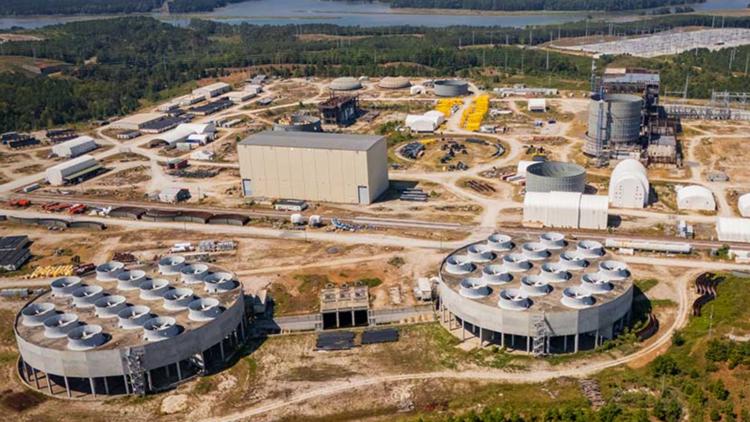
nearly $117M in a new factory operated by subsidiary Arabelle Solutions to manufacture parts for new nuclear projects, as France looks to build six new reactors over the coming decades. Reuters (subscription required)
will begin work on a DOE-funded, GAIN-backed feasibility study this year that will seek to determine whether a new nuclear project could be effectively integrated into the local power supply. Colorado Public Radio
of Molten Salt Solutions—a start-up working to produce “large quantities of isotopically-enriched lithium” for advanced fission and fusion power projects—talks about the near-term plans for his company. Power Magazine
, a Canada-based mining company, is considering a U.S. listing through a merger with a special purpose acquisition company this year. Reuters (subscription required)
Fusion research tackles fuel and instrumentation challenges
Three research groups are reporting fusion-related developments, including ongoing work toward spin-polarized fusion, a new plasma diagnostic tool heading to the National Ignition Facility, and a materials science project that could impact the design of inertial confinement fusion fuel targets. Go deeper on Nuclear Newswire.
Rolls-Royce–CEZ SMR project at Temelín moves forward
A newly signed contract between U.K.-based Rolls-Royce SMR and the ČEZ Group in the Czech Republic will allow for design work to begin on the planned small modular reactors at the Temelín nuclear power plant site in the Czech Republic. Go deeper on Nuclear Newswire.
NN Asks: What’s needed to get space nuclear off the ground?
For decades, the thrill of space exploration has ignited the imaginations of engineers, scientists, and innovators alike. The dream of expanding humanity’s reach beyond Earth continues to attract the brightest minds, fueling groundbreaking advancements. As we set our sights on missions that venture farther and last longer in the cosmos, one truth stands out: Nuclear technology is the key to unlocking these bold ambitions. Read Kate Kelly’s full answer on Nuclear Newswire.
The answer: In 1958, the USS Nautilus, the world’s first nuclear submarine, became the first ship to reach the North Pole. As the ship that birthed the nuclear navy, the Nautilus today maintains a legacy as one of the most important nuclear projects of the 20th century. A brief background: While the history of submersible vehicles goes surprisingly far back in history (see the USS Alligator of the American Civil War or even various, rudimentary designs all the way back in the Middle Ages), the Nautilus sought to solve the inherent issues of the diesel-electric systems used in the early 20th century. These designs were held back by a constant need to surface and recharge the vessel’s batteries—an issue that nuclear power was poised to make irrelevant. The Nautilus project was authorized by Congress in 1950. Work on a prototype reactor began in 1951 at the National Reactor Testing Station (which would go on, after many name changes, to become Idaho National Laboratory. On May 31, 1953, that prototype reactor was brought to power. In a matter of weeks, a 66-hour, full-power run of the reactor was successfully completed. According to an article in the May 1969 issue of Nuclear News, this first test was “equivalent to a nonstop underwater trip from Newfoundland to Ireland at top speed.” On January 21, 1954, the Nautilus was launched into the Thames River in Connecticut. Four years later, the ship and its crew successfully circumvented the polar ice cap, reaching the North Pole on August 3, 1958. Go deeper: Read more about the story of the Nautilus and the impact it had on the early days of U.S. nuclear development on Nuclear Newswire.
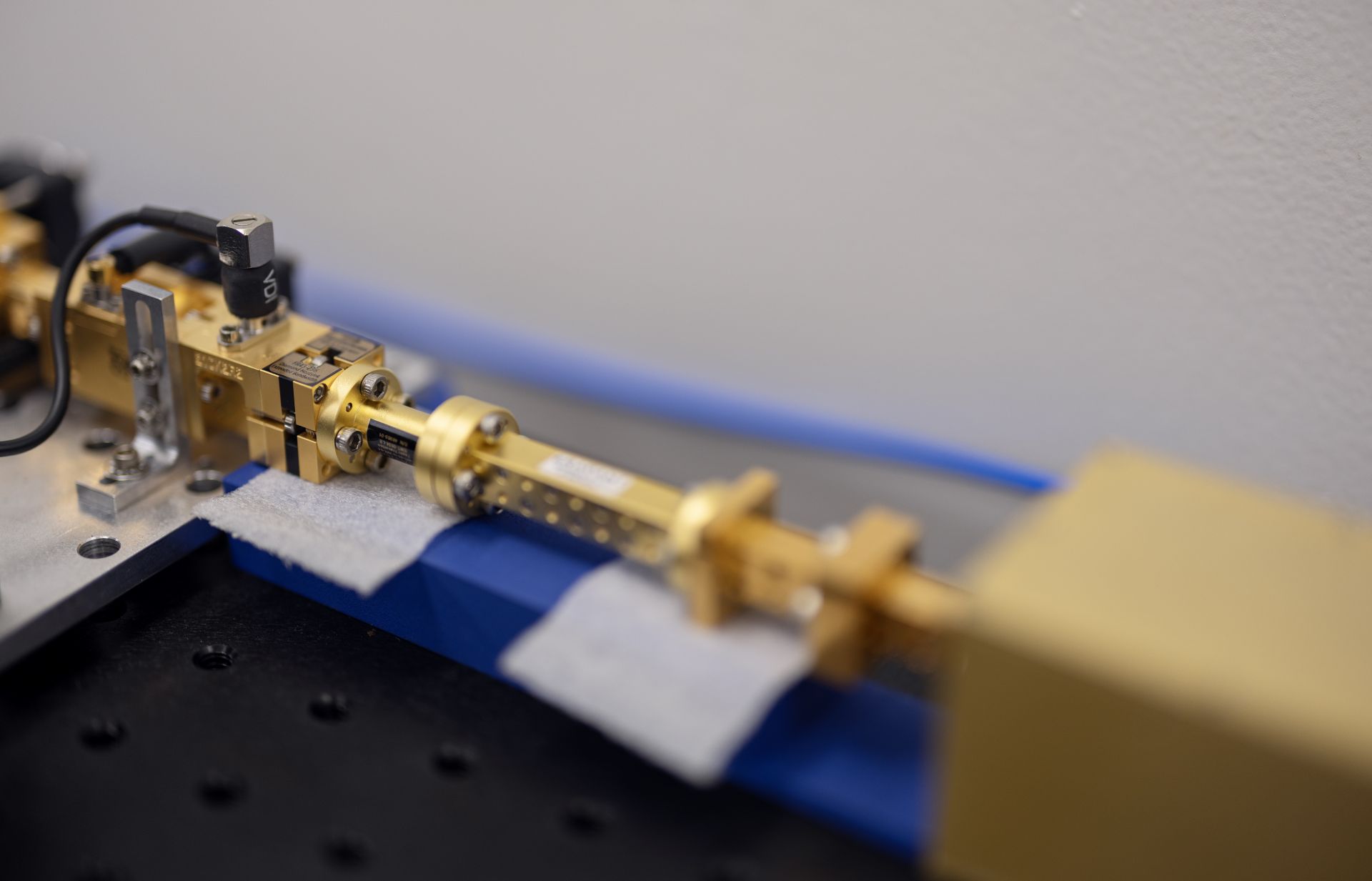
웨이브가이드(waveguide)가 마이크로파 발생기에서 생성된 라디오주파수 파동을 스핀 편극 핵융합 프로젝트에 사용될 리튬-중수소화물(lithium-deuteride) 펠릿으로 전달하는 데 도움을 준다. (사진: 에일린 데블린(Aileen Devlin)/제퍼슨 연구소(Jefferson Lab))
요약
카테고리: 기술
미국 에너지부(DOE) 핵융합 에너지과학 프로그램이 DIII-D 토카막 기반의 스핀 편극 핵융합(SPF) 프로젝트에 2차 연구비를 지원하며, 이론상 에너지 출력을 70~80% 향상시킬 수 있는 기술 개발이 진행 중이다.
연구진이 넓은 시야와 높은 분해능으로 핵융합 플라즈마 온도를 측정하는 다채널 X선 이미저(toroidal X-ray imager)를 개발해 국립점화시설(NIF)에 도입할 예정이다.
AI 기계학습 설계 최적화 알고리즘을 활용해 관성 봉입 핵융합 연료 표적의 미세 결함으로 인한 불안정성을 억제하는 재료 설계 기술이 실험으로 처음 검증되었다.
---
세 개의 연구 그룹이 핵융합 관련 성과를 발표했다. 스핀 편극 핵융합을 향한 지속적인 연구, 국립점화시설(National Ignition Facility)에 도입될 새로운 플라즈마 진단 도구, 그리고 관성 봉입 핵융합 연료 표적 설계에 영향을 미칠 수 있는 재료과학 프로젝트가 그 내용이다.
작은 연료로 훨씬 큰 불꽃을 (A little bit of fuel, a much bigger fire: 소량의 연료로 훨씬 큰 에너지를 얻는다는 의미): 미국 에너지부(Department of Energy)의 핵융합 에너지과학(Fusion Energy Sciences) 프로그램이 DIII-D 토카막을 중심으로 한 스핀 편극 핵융합(spin-polarized fusion, SPF) 프로젝트에 2차 연구비를 지원했다.
SPF의 핵심 원리는, 동위원소의 스핀이 자기장과 평행하게 정렬된 편극 핵융합 연료가 비편극 연료보다 핵융합으로 이어지는 충돌 가능성이 높다는 것이다. 이론적으로 이 방법은 시스템의 에너지 출력을 70~80% 향상시킬 잠재력이 있다.
"궁극적인 목표는 최소한의 재료로 에너지를 추출하는 것입니다," 연구를 이끌고 있는 토머스 제퍼슨 국립 가속기 시설(Thomas Jefferson National Accelerator Facility)의 물리학자 웨이 샹동(Xiangdong Wei)이 말했다. "올바른 정렬이 이루어지면, 소량의 연료로 훨씬 큰 불꽃을 만들 수 있고, 그 에너지를 다음 핵융합 반응에 활용할 수 있습니다."
이 아이디어는 1980년대부터 존재해 왔으나, 연료를 충분히 편극시키고 편극 상태가 충분히 오래 유지될 수 있도록 주입하는 시스템을 개발하는 것이 기술적으로 복잡했다. 이는 핵융합 반응 단면(fusion cross section)을 높여, 일정 밀도에서 시간당 반응 횟수를 증가시키기 위한 것이다.
연구팀은 이미 중수소(deuterium)와 헬륨-3(helium-3)을 편극, 저장, DIII-D 토카막에 주입할 수 있는 장비를 설계했다. 이제 2단계에 돌입하여 해당 장치의 프로토타입 제작 및 건설을 목표로 하고 있다.
플라즈마를 보다: _Review of Scientific Instruments_에 최근 게재된 논문에 따르면, 연구진은 넓은 시야와 높은 분해능으로 핵융합 플라즈마 온도를 측정하는 다채널 X선 이미저를 개발했다.
토로이달 X선 이미저(toroidal X-ray imager)라 불리는 이 장치는 검출기 내 거울에 서로 다른 대역폭을 가진 비주기적 다층 코팅을 적용하는 방식으로 작동한다. 이 나노스케일 층들은 플라즈마 온도 결정을 위해 8.7, 13, 17.5 keV를 중심으로 한 세 가지 X선 에너지 대역을 포착하도록 최적화되어 있다.
미국물리학회(American Institute of Physics)에 따르면, 이 장치는 단일 위치에서 세 가지 에너지 대역 모두를 측정할 수 있는 최초의 진단 도구다. 이 장치는 관성 봉입 핵융합 실험을 위해 국립점화시설(NIF)에 도입될 예정이다.
AI 설계로 미세 재료 결함의 영향을 무력화하다: 관성 봉입 핵융합은 리히트마이어-메시코프(Richtmyer-Meshkov, RM) 불안정성의 영향을 받을 수 있으며, 이는 연료 충전 튜브 표적이 충격을 받을 때 미세한 재료 결함 지점에서 불안정한 제트(jetting) 현상으로 이어진다.
_Physical Review Letters_에 게재된 논문에 설명된 바와 같이, 연구진은 기계학습 설계 최적화 알고리즘을 사용하여 젤라틴(gelatine)에 미세한 공동(void)을 어디에 추가할지 결정했다. 이 공동은 충격파의 에너지를 분산시켜 통상적으로 제트를 발생시키는 경계면에 도달하기 전에 에너지를 흡수했다.
이 아이디어는 핵융합에 적용되기 위해 구형 충전 튜브 설계로 확장될 필요가 있지만, 그 개념은 다양한 재료 연구 분야에도 활용될 수 있다.
"문제는 이러한 설계들이 시뮬레이션에서는 유망해 보이지만, 실제로 제조하고 실험적으로 검증하기가 매우 어렵다는 점입니다," 유럽 XFEL(European XFEL)의 계측 과학자이자 해당 논문의 공동 저자인 예르구스 스트루츠카(Jergus Strucka)가 말했다. "우리의 연구는 이러한 AI 최적화 구조물이 실제로 제작되어 실제 실험에서 연구될 수 있음을 처음으로 입증한 사례 중 하나입니다."
AI 분석
이번에 보고된 세 가지 핵융합 연구 성과는 핵융합 에너지 실현을 위한 다각적인 기술 접근이 동시에 진행되고 있음을 보여준다. 스핀 편극 핵융합 기술은 연료 효율을 근본적으로 향상시킬 수 있는 혁신적 개념으로, 2단계 프로토타입 개발에 진입함으로써 이론에서 실용화로 나아가는 중요한 전환점을 맞이하고 있다. 토로이달 X선 이미저의 개발은 플라즈마 진단 능력을 한 차원 높여 핵융합 실험의 정밀도와 이해도를 크게 향상시킬 것으로 기대된다. AI를 활용한 재료 설계 최적화는 관성 봉입 핵융합의 고질적인 불안정성 문제를 해결할 새로운 접근법을 제시하며, 시뮬레이션을 넘어 실험적 검증까지 달성했다는 점에서 의미가 크다. 이러한 성과들은 에너지원으로서의 핵융합 실현 가능성을 점차 높여가고 있으며, 미국 에너지부의 지속적인 투자가 연구의 가속화에 기여하고 있음을 보여준다.
Molten Salt Solutions의 CEO John Elling은 차세대 핵융합 및 핵분열 반응로에 필수적인 동위원소 농축 리튬-6의 산업적 대량 생산 기술을 개발 중이다.
반응로 설계에 비해 주목받지 못했던 핵연료 소재 공급망이 상용화의 핵심 병목 요인임을 지적하며, 이 "가능화 계층" 구축이 원자력 기술 발전의 선결 조건이라고 강조했다.
기존 수은 기반 공정을 대체할 환경적으로 허용 가능하고 비용 효율적인 대규모 리튬 동위원소 농축 공정 개발이 핵융합 에너지 상용화를 위해 시급한 과제로 제시되었다.
The POWER Interview: Solving the Problem of Fuel for Nuclear Reactors
미국 에너지부 원자력에너지국(U.S. Dept. of Energy's Office of Nuclear Energy)은 국내외 원자력 발전 개발에 있어 도전 과제로 떠오르는 여러 분야를 명확히 제시했습니다. 그 중에서도 가장 핵심적인 문제는 연료 개발을 반복 가능한 산업적 규모로 실현할 수 있는 프로세스를 구축하는 것으로, 이를 통해 프로젝트가 실증 단계를 넘어 상업 운전으로 나아갈 수 있어야 합니다.
존 엘링(John Elling) 박사는 차세대 원자력 및 핵융합 반응로용 소재를 개발하는 뉴멕시코 주 소재 기업 몰튼 솔트 솔루션즈(Molten Salt Solutions)의 CEO 겸 공동 창업자입니다. 이 그룹은 첨단 핵분열 및 핵융합 발전에 필수적인 동위원소 농축 리튬을 대량 생산하는 기술 개발에 매진하고 있다고 밝혔습니다. 몰튼 솔트 솔루션즈는 이른바 "독자적인 크로마토그래피 분리 및 질량 분석 기술[로] 효과적인 동위원소 농축을 가능하게 하며, 고유한 금속 염 합성을 통해 안전성과 비용 면에서 상당한 이점을 제공"한다고 자체 설명합니다.
_존 엘링(John Elling)_
연속 창업가인 엘링은 이전에 어쿠스틱 사이토메트리 시스템즈(Acoustic Cytometry Systems)와 메사 바이오텍(Mesa Biotech)을 창업하고 이끌었으며, 두 기업 모두 로스앨러모스 국립연구소(Los Alamos National Laboratory) 기술을 상업화하여 성공적인 인수합병을 이뤄냈습니다. 엘링은 로스앨러모스 국립연구소에서 기술 직원 및 방문 기업가로 활동한 경험을 바탕으로 국립연구소 혁신 기술의 라이선싱 및 확대에 폭넓은 전문성을 보유하고 있습니다. 그는 위스콘신 대학교(University of Wisconsin)에서 분석화학 박사 학위를, 뉴멕시코 대학교(University of New Mexico)에서 MBA를 취득했습니다.
엘링은 _POWER_와의 인터뷰에서 원자력 에너지 연료 개발에 연구자들이 집중해야 하는 이유와, 이를 통해 원자력 기술의 발전이 어떻게 가능한지에 대한 견해를 밝혔습니다.
_POWER: 원자력 에너지용 연료 개발에 관심을 갖게 된 계기는 무엇인가요?_엘링: 저는 원자력 분야의 대부분의 사람들과는 조금 다른 각도로 이 분야에 들어왔습니다. 제 배경은 분석화학인데, 반응로 설계를 목표로 한다면 보통 시작점이 되는 분야가 아닙니다.
하지만 시간이 지나면서, 핵융합과 차세대 핵분열을 포함한 많은 첨단 에너지 시스템들이 동일한 제약에 부딪히고 있다는 사실이 분명해졌습니다. 이 시스템들은 모두 첨단 소재 내 농축 동위원소를 대량으로 필요로 하는데, 오늘날 실질적으로 산업적 규모의 생산은 존재하지 않는 상황입니다.
반응로에 대한 관심은 많았는데, 그것은 당연한 일입니다. 반응로는 더 가시적이고, 솔직히 더 흥미롭습니다. 소재는 상대적으로 주목을 덜 받는 경향이 있습니다. 역사적으로, 그 부분은 나중에 문제로 드러나는 경우가 많았습니다.
제가 이 분야에 끌린 이유는 바로 그 기반이 되는 레이어를 연구할 기회가 있었기 때문입니다. 이 시스템들이 실증 단계를 넘어서려면, 실제로 존재하는 공급 기반이 필요합니다. 그것을 구축하는 일은 반응로를 짓는 것만큼 화려하지는 않지만, 반응로가 의미를 가지는지 여부를 결정하는 경우가 많습니다.
_POWER: 핵융합 에너지에 대한 기대가 높습니다. 귀사는 트리튬 연료 생산을 위한 리튬-6 부족이라는 "심각한" 광물 공급 격차가 있다고 밝혔습니다. 대규모 리튬 농축을 위한 귀사의 첨단 용매 교환 공정에 대해 좀 더 자세히 설명해 주시겠습니까?_엘링: 리튬 동위원소를 농축하는 것 자체가 특별히 어려운 일은 아닙니다. 방법은 여러 가지가 있습니다. 그러나 그것을 대규모로 실현하는 방법은 많지 않습니다.
미국 정부는 1960년대에 수은 기반 공정을 사용하여 이를 수행했는데, 당시에는 효과적이었지만, 지금 다시 도입하고 싶은 방식은 아닙니다. 현재의 과제는 확장 가능하면서도 환경적으로 수용 가능한 산업 공정을 구축하는 것입니다.
액액 추출(liquid-liquid extraction)은 표준적인 화학 공학 공정이며, 동위원소 선택적 시스템은 잘 알려져 있습니다. 문제는 이를 확장하려면 보통 매우 크고 다단계의 시스템이 필요하여 구축과 운영 비용이 많이 든다는 점입니다. 이 방식은 효과가 있고 여러 그룹이 추진하고 있지만, 비용 면에서 새로운 에너지 산업을 지탱할 수 있을지는 의문입니다.
우리는 다른 접근 방식을 택했습니다. 이 방식은 약 100배 더 효율적으로 확장되며 비용도 훨씬 저렴합니다. 우리의 접근 방식은 분리가 이루어지는 방식 자체를 재구상하는 것입니다. 우리는 단일 통합 시스템 내에서 여러 분리 단계가 이루어질 수 있는 연속 용매 교환 공정을 사용합니다. 실질적으로, 이는 기존 방식에 비해 자본 및 운영 비용을 수십 배 단위로 절감해 줍니다.
또한 확장을 더욱 모듈식으로 만들어 줍니다. 단일 대형 시설에 전적으로 투자하는 대신, 단계적으로 용량을 늘려나갈 수 있습니다. 이는 수요 곡선이 아직 입증 중인 기술들에 달려 있을 때 유용합니다.
근본적인 문제는 비교적 단순합니다. 핵융합이 실현된다면, 리튬-6가 제약 요인이 됩니다. 우리는 그것이 제약 요인이 되지 않도록 하기 위해 노력하고 있습니다.
_POWER: 현재 핵융합 시스템을 설계하는 기업들과 협력하고 있으신가요? 공급 계약을 체결한 기업이 있으신가요?_
엘링(Elling): 우리는 최근 가우스 퓨전(Gauss Fusion)과 타입 원 에너지(Type One Energy)와 공급 협약을 체결했다고 발표했습니다. 두 팀 모두 진지한 팀이며, 우리는 이 관계를 우리 자신과 더 넓은 생태계를 위한 중요한 발걸음으로 보고 있습니다. 이는 단순한 탐색적 관계가 아닙니다. 연료 공급 문제를 나중이 아닌 초기에 해결해야 한다는 점이 점점 더 인식되고 있음을 반영합니다.
목표는 대규모 배포에 앞서 협력 관계를 구축하여, 연료 가용성이 나중에 병목이 되는 대신 시스템 설계에 내재될 수 있도록 하는 것입니다. 단기적으로는 테스트와 검증을 위한 소재를 공급하고 있으며, 이는 필수적인 단계입니다. 개발자들은 원자로뿐만 아니라 그 뒤를 받치는 공급망에 대한 신뢰도 필요합니다.
더 넓게 보면, 이는 업계가 순수한 기술적 이정표를 넘어 산업적 준비 태세에 대한 질문으로 나아가기 시작했음을 시사하기도 합니다. 그 시점에서 리튬-6와 같은 원자재는 이론적 요소에서 핵심 제약 요인으로 변모하게 됩니다.
_POWER: 귀사의 공정에 대해 미국 연방 정부(아마도 국립 연구소를 통한) 지원을 모색하고 계신가요?_
리튬 동위원소 연구 자체는 NSF SBIR 프로그램과 일부 주(州) 차원의 지원을 통해 진행되었습니다. 이러한 파트너십은 우리가 비교적 빠르게 개념에서 실증 시스템으로 나아갈 수 있도록 해주었습니다.
우리는 추가적인 연방 지원을 모색하고 있으며, 지금은 실질적인 기회가 있습니다. 리튬-6는 방위산업과 상업 에너지 사이의 어색하지만 흥미로운 위치에 있습니다. 대부분의 프로그램은 여전히 어느 한쪽을 기준으로 구성되어 있습니다. 보다 조율된 이중 용도 접근 방식이 있다면, 초기 인프라 투자를 정당화하기가 더 쉬울 것입니다. 또한 핵융합이 확장됨에 따라 공급이 뒷받침될 것이라는 더 명확한 신호를 보내게 될 것인데, 이는 여전히 열린 질문입니다.
퓨처 벤처스(Future Ventures)는 실제로 초기에 우리에게 먼저 연락해 왔습니다. 그들은 이미 핵융합 분야를 살펴보는 데 시간을 투자했고, 리튬-6가 병목 요인이 될 가능성이 높다는 견해에 도달했습니다. 당시에는 이 문제에 집중하는 팀이 많지 않았기 때문에 대화가 빠르게 진행되었습니다.
그리고 이를 이끄는 것은 핵융합만이 아닙니다. 핵분열 쪽, 특히 용융염 원자로에서도 같은 역학이 나타납니다. 원자력이 나아가는 방향을 면밀히 살펴보면, 공급망 문제를 무시하기 어려워집니다.
_POWER: 몰튼 솔트 솔루션스(Molten Salt Solutions)의 다음 계획은 무엇인가요? 2030년까지 회사가 어떤 모습이 되기를 기대하시나요?_
엘링(Elling): 단기적으로는 상업 생산 능력 구축에 집중하고 있습니다. 수요는 이미 핵융합 개발자와 에너지부와 함께 첨단 핵분열 프로그램 양쪽에 걸쳐 현재 공급 계획을 앞서가고 있습니다.
2030년까지 리튬 농축은 생산 시설이 상당한 규모로 소재를 공급하는, 확장되고 확립된 사업이 되어야 합니다. 그 후에는 동일한 기반 공정을 활용하여 추가 동위원소로 영역을 확장하는 데 집중할 것입니다.
양자 컴퓨팅을 위한 실리콘-28, 의료 진단을 위한 탄소-13, 용융염 원자로를 위한 염소-37 등 공급이 제한되고 수요가 증가하고 있는 인접 시장이 다수 있습니다.
근본적인 아이디어는 이것이 플랫폼 기술이라는 것입니다. 리튬이 첫 번째 적용 사례이지만, 동일한 공정이 다양한 어려운 동위원소 분리로 확장됩니다. 우리가 구축하고 있는 것은 역사적으로 공급이 제한되어 온 소재를, 실질적인 상업적 배포를 지원하는 규모로 안정적으로 생산하는 방법입니다.
미국 에너지부가 핵연료 개발의 산업적 규모화를 핵심 과제로 지목한 가운데, Molten Salt Solutions의 CEO 존 엘링 박사는 차세대 핵융합 및 핵분열 반응로에 필수적인 동위원소 농축 소재 공급망 구축에 집중하고 있다. 특히 핵융합 연료인 삼중수소 생산에 필요한 리튬-6의 대규모 공급 부재라는 "핵심 광물 격차" 문제를 해결하기 위해, 기존 방식 대비 약 100배 더 효율적이고 비용이 저렴한 연속 용매 교환 공정 기술을 개발하고 있다는 점이 주목된다. 이 기사는 원자로 자체보다 연료와 소재 공급망이 원자력 상업화의 진정한 병목이라는 점을 부각시키며, 기술 시연 단계를 넘어 실질적인 상업 운영으로 나아가기 위한 인프라 구축의 중요성을 강조한다. 환경적으로 문제가 있었던 과거의 수은 기반 공정을 대체할 친환경적이고 확장 가능한 동위원소 농축 기술은 핵융합·핵분열 에너지 산업 전반의 상업화 가능성을 크게 좌우할 수 있다.
※ 이 글은 해외 원자력 바로알기를 위한 정보 전달을 목적으로 제공됩니다. 특정 기업이나 종목에 대한 투자 권유가 아니며, 모든 투자 판단과 그에 따른 책임은 투자자 본인에게 있습니다.
2026년 4월 27일, 오전 7:08 | Nuclear News | 케이트 켈리(Kate Kelly)
케이트 켈리(Kate Kelly)
요약
카테고리: 기술
우주 원자력 추진 및 전력 시스템의 발전을 위해 반응로, 전력 변환 효율, 고온 재료, 시험 인프라 등 다방면의 기술적 진보가 동시에 이루어져야 한다.
BWXT 어드밴스드 테크놀로지스(BWXT Advanced Technologies)는 NASA 마셜 우주비행센터(NASA's Marshall Space Flight Center)에서 100회 이상의 냉류 시험(cold-flow test)을 수행하는 등 정부 기관과의 긴밀한 협력을 통해 우주 원자력 기술을 발전시켜 왔다.
설계, 제조, 시험, 규제 경로, 보안 요건을 명확히 하는 통합 국가 로드맵이 투자를 조율하고 분산 혁신의 기회를 창출하는 데 핵심적 역할을 한다.
---
수십 년간 우주 탐사의 설렘은 엔지니어, 과학자, 혁신가들의 상상력에 불을 지펴왔다. 지구 너머로 인류의 영역을 확장하려는 꿈은 계속해서 최고의 인재들을 끌어모으며 획기적인 발전을 이끌고 있다. 더 멀리, 더 오래 지속되는 우주 임무를 목표로 하면서 한 가지 진실이 두드러진다: 원자력 기술이야말로 이러한 대담한 야망을 실현하는 열쇠라는 것이다. 그 영향은 단일 임무를 훨씬 뛰어넘어, 우주 탐사를 추진하는 데 그치지 않고 전체 원자력 생태계에 활력을 불어넣으며—전례 없는 기회의 시대에 혁신과 성장을 촉발하는—거대한 추진력을 만들어낸다.
이 추진력을 구축하고 유지하려면 여러 기술 분야에서 조율된 진보가 필요하다. 우주용 원자력 전력과 추진 시스템은 반응로뿐 아니라 전력 변환 효율, 열 배출, 고온 재료, 계측, 시험, 발사 환경 인증에 대한 투자와 함께 병행하여 성숙해야 한다. 이러한 기반 요소들을 발전시킴으로써 실행 가능한 임무의 범위가 넓어지고, 대학, 연구소, 산업 파트너들이 상호보완적인 방식으로 기여할 수 있게 된다.
이러한 노력들을 통합하는 국가적 프레임워크는 발전을 더욱 가속화할 것이다. 이미 수많은 연방 기관들이 중요한 역할을 담당하고 있으며, 설계, 제조, 시험, 규제 경로, 보안에 대한 요건을 명확히 하는 공동 장기 로드맵은 투자를 조율하고 분산 혁신의 기회를 더 많이 창출하는 데 도움이 될 것이다. 여기에는 특수 원자력 재료와 핵심 부품의 공급망 강화, 그리고 정부·학계·산업계 전반에 걸친 협력 연구개발 지원이 포함된다.
나는 정렬된 파트너십의 가치를 직접 목격해왔다. 지난 8년 동안 나는 NASA와 다른 미국 정부 기관들과 우주 원자력 이니셔티브에서 긴밀히 협력해왔으며, 여기에는 NASA 마셜 우주비행센터(NASA's Marshall Space Flight Center)에서 BWXT의 원자력 열추진 엔지니어링 시연 장치를 대상으로 한 100회 이상의 냉류 시험(cold-flow test)이 포함된다. 우주 원자력 분야에서의 우리 작업은 핵분열 표면 전력, 첨단 연료, 그리고 프로젝트 펠레(Project Pele)와 새롭게 부상하는 미 육군 야누스 프로그램(U.S. Army Janus Program)과 같은 지상용 소형 반응로(microreactor)의 발전과 직접적으로 연결되어 있다. 각각의 성과는 서로를 강화하며 더욱 탄탄한 미국 원자력 생태계에 기여한다.
미국이 지구-달 궤도(cislunar) 탐사, 심우주 임무, 우주 기반 국가 안보를 향해 나아가면서 원자력 추진과 전력의 중요성은 계속 커지고 있다. 이를 국가적 우선과제로 유지하고—체계적인 로드맵과 지속적인 투자, 그리고 강력한 인력으로 뒷받침되는—유망한 개념에서 운용 가능한 역량으로 전환하는 것이야말로 우리가 취할 수 있는 가장 중요한 조치다. 그 추진력을 가속화하는 것이 향후 수십 년간 우리의 리더십을 정의할 것이며, 우주 원자력을 실질적으로 궤도에 올리는 데 가장 핵심적인 일이다.
우주 원자력 기술은 단순한 우주 탐사 수단을 넘어 미국의 에너지·안보 생태계 전반을 강화하는 전략적 자산으로 부상하고 있다. 이 기고문은 기술 개발의 다각적 병행 투자와 국가 차원의 조율된 로드맵 수립이 시급함을 강조하며, 단편적 접근이 아닌 생태계적 사고를 촉구한다. BWXT의 냉류 시험 사례는 민간-정부 협력 모델이 구체적 성과를 낼 수 있음을 보여주는 실증 사례로, 향후 유사한 파트너십 확대의 근거를 제공한다. 지구-달 궤도 및 심우주 임무에 대한 관심이 높아지는 가운데, 원자력 추진 기술 없이는 이러한 임무의 실현이 사실상 불가능하다는 점에서 이 분야에 대한 투자는 선택이 아닌 필수로 인식되고 있다. 궁극적으로, 일관된 정책 지원과 민·관·학 협력 체계가 갖춰질 때 비로소 우주 원자력이 개념 단계를 넘어 실제 운용 역량으로 발전할 수 있다.
미국 원자력규제위원회(NRC)가 마이크로원자로를 위한 새로운 인허가 프레임워크인 '파트 57(Part 57)' 규칙을 제안했으며, 이를 통해 $37.6억~$118.4억의 비용 절감이 기대된다.
파트 57은 100MWe 이하의 소형·단순 원자로를 대상으로 하며, 인허가 및 배치 기간을 6~12개월로 단축하는 것을 목표로 한다.
이 프레임워크는 ADVANCE법 및 2025년 원자력 관련 행정명령에 따른 NRC의 규제 검토 및 개편 작업의 일환으로, 경수로(LWR) 기반 기술에서 벗어나는 첨단 원자로 설계를 지원한다.
---
원자력규제위원회(Nuclear Regulatory Commission, NRC)가 마이크로원자로 및 유사 원자로 설계에 대한 새로운 인허가 프레임워크를 공개했다. 이 프레임워크는 보다 단순한 기술을 보유한 신청자들에게 더욱 적합한 경로를 제공할 것으로 기대된다.
'파트 57(Part 57)'로 알려진 이 제안 규칙은 ADVANCE법과 2025년 원자력 관련 행정명령에 따른 NRC의 규칙 검토 및 전면 개편 작업의 최신 성과물이다. 또한 지난 3월 최종 확정된 파트 53(Part 53) 규칙과 같이, 경수로(LWR) 기술에서 벗어나 첨단 원자로 설계를 위해 개발된 최신 프레임워크이기도 하다.
NRC 위원장 호 니에(Ho Nieh)는 금요일에 다음과 같이 말했다. "우리는 안전성, 규모, 속도를 고려해 설계된 새로운 인허가 프레임워크를 개발하고 있으며, 파트 57이 그 대표적인 사례입니다."
마이크로원자로를 위한 설계: 제안된 규칙에는 다음과 같은 내용이 포함되어 있다:
동일한 원자로 군(플리트)에 대한 일괄 승인 요청.
새로운 원자로 운영에 대한 대체 설계 기준 및 프로그램의 적절한 활용 허용.
환경적 영향이 제한적인 프로젝트에 대한 환경 검토 간소화.
NRC 허가 취득 이전에 제한적인 건설 착수를 위한 경로 제공.
제안 규칙에 명시적으로 규정되어 있지는 않지만, 파트 57은 100MWe 이하의 원자로를 대상으로 한다고 니에 위원장은 밝혔다. (비교하자면, 소형모듈원자로(SMR)는 일반적으로 약 50MWe~300MWe의 용량을 가지는 것으로 알려져 있으며, NRC는 기가와트급 경수로(LWR)에 대해서도 다수의 인허가를 발급한 바 있다.)
대형 원자로의 평가에는 기술 및 부지에 대한 장기간의 검토가 필요하다. 마이크로원자로는 규모 면에서 그 반대편 극단에 위치한다.
니에 위원장은 "소형 기계이자 단순한 기계입니다. 그야말로 단순하고, 대량 인허가에 적합합니다"라고 말했다.
그는 또한 "우리는 안전 사례가 매우 단순한 설계를 다루고 있습니다. 시설에서 사고가 발생했을 때 작동해야 하는 복잡한 안전 장비가 많지 않은 설계입니다. 이는 정말로 매우 단순한 기계, 단순한 안전 시스템을 지향합니다"라고 덧붙였다.
NRC에 따르면, 파트 57은 기관과 산업계 전반에 걸쳐 $37.6억에서 $118.4억에 이르는 비용을 절감할 것으로 예상된다. 또한 NRC는 인허가 및 배치에 6~12개월이 소요될 것으로 전망하며, 이는 허가 및 인허가 일정을 크게 앞당기는 것이다.
전체적으로 이 프레임워크는 마이크로원자로의 이동성 여부 등 개발자들이 고객 수요를 충족하는 방식을 다루는 것을 목표로 한다. 새롭고 다양한 원자력 기술에 대한 수요가 있다면 NRC가 그 자리에 함께할 것이라고 니에 위원장은 말했다.
"과거에는 원자력 발전의 주된 수요가 기저 부하용 전력 유틸리티 발전기였습니다"라고 니에 위원장은 말했다. "이제 이 전체적인 환경이 완전히 달라졌습니다. 완전히 달라진 환경 덕분에 혁신가들이 새로운 설계를 들고 시장에 등장하고 있습니다 . . . 우리는 에너지 환경이 변화하는 만큼 우리의 프레임워크도 적응시키려 하고 있습니다."
추진 일정: NRC는 적어도 2020년부터 마이크로원자로 규제 및 정책 검토에 관여해 왔지만, 제안 규칙 작업은 ADVANCE법과 행정명령에 따라 지난해 본격적으로 시작되었다. 새로 설립될 첨단 원자로 사무소(Office of Advanced Reactors)를 이끌게 될 제러미 바우언(Jeremy Bowen)은 기술 직원들이 규칙 문안을 개발하는 데 약 6개월이 걸렸다고 밝혔다.
"의회의 방향 지침과 산업계와의 수년간의 상호작용으로부터 얻은 많은 혜택이 이 규칙에 담긴 내용을 구체화하는 데 도움이 되었습니다. 우리가 처음부터 시작한 것은 아닙니다. 시작하기도 전에 이미 많은 아이디어가 있었습니다"라고 바우언은 말했다.
NRC에 따르면, 파트 57은 잠정적으로 5월 6일 _연방관보(Federal Register)_ 에 게재될 예정이다. 기관은 제안 규칙에 대한 공청회를 조만간 개최할 예정이다.
---
AI 분석
NRC의 파트 57 제안 규칙은 급성장하는 마이크로원자로 시장에 대응하기 위한 규제 현대화의 중요한 이정표로 평가된다. 기존의 대형 원자로 중심의 복잡한 인허가 절차를 단순·소형 원자로에 맞게 간소화함으로써, 첨단 원자력 기술의 상업화 속도를 획기적으로 앞당길 수 있을 것으로 기대된다. 특히 6~12개월이라는 단축된 인허가 기간과 최대 $118.4억에 달하는 비용 절감 효과는 민간 투자 유치와 원자력 산업 생태계 활성화에 긍정적인 신호가 될 수 있다. 이 프레임워크는 AI 데이터센터, 원격 지역 에너지 공급, 군사 시설 등 다양한 분야에서 마이크로원자로 도입을 가속화할 수 있는 제도적 기반을 마련한다는 점에서 전략적 의미가 크다. 한편, 공청회와 연방관보 게재 이후 본격적인 이해관계자 의견 수렴 과정이 진행될 예정이어서, 최종 규칙이 확정되기까지는 추가적인 논의와 조정이 있을 것으로 예상된다.
해당 URL은 미국원자력학회(ANS) 회원 전용 콘텐츠로, 로그인 없이는 기사 본문에 접근할 수 없습니다.
페이지에는 실제 기사 내용이 없으며, 로그인 또는 계정 생성을 요구하는 인증 화면만 표시됩니다.
기사 원문을 보려면 ANS 회원 계정이 필요합니다.
---
로그인하거나 계정을 만들어 계속하세요.
로그인
이메일
비밀번호
비밀번호를 잊으셨나요?
[계정이 없으신가요?]
비밀번호 재설정
비밀번호 재설정에 도움이 필요하시면 사무소에 문의하시기 바랍니다.
이메일
괜찮습니다, 비밀번호가 기억났습니다.
---
AI 분석
이 URL(https://www.ans.org/members/nn/pdf/issue-2473/issuepage-55/#page=57)은 미국원자력학회(ANS)의 회원 전용 디지털 저널 페이지로 연결됩니다. 해당 콘텐츠는 로그인 인증 장벽 뒤에 있어, 추출된 마크다운에는 실제 기사 내용이 포함되지 않고 로그인 폼만 나타납니다. 원문 기사를 번역하려면 유효한 ANS 회원 자격이 필요합니다. 이처럼 페이월(paywall) 또는 회원 전용 콘텐츠는 공개적으로 접근 및 번역이 불가능합니다. 원자력 관련 정보에 접근하려면 ANS 회원 가입 또는 공개 배포 자료를 활용하는 것이 권장됩니다.
해당 URL은 미국원자력학회(ANS) 회원 전용 콘텐츠로, 로그인 없이는 기사 본문에 접근할 수 없습니다.
페이지에는 실제 기사 내용이 없으며, 로그인 또는 계정 생성을 요구하는 인증 화면만 표시됩니다.
기사 원문을 보려면 ANS 회원 계정이 필요합니다.
---
로그인하거나 계정을 만들어 계속하세요.
로그인
이메일
비밀번호
비밀번호를 잊으셨나요?
[계정이 없으신가요?]
비밀번호 재설정
비밀번호 재설정에 도움이 필요하시면 사무소에 문의하시기 바랍니다.
이메일
괜찮습니다, 비밀번호가 기억났습니다.
---
AI 분석
이 URL(https://www.ans.org/members/nn/pdf/issue-2473/issuepage-55/#page=57)은 미국원자력학회(ANS)의 회원 전용 디지털 저널 페이지로 연결됩니다. 해당 콘텐츠는 로그인 인증 장벽 뒤에 있어, 추출된 마크다운에는 실제 기사 내용이 포함되지 않고 로그인 폼만 나타납니다. 원문 기사를 번역하려면 유효한 ANS 회원 자격이 필요합니다. 이처럼 페이월(paywall) 또는 회원 전용 콘텐츠는 공개적으로 접근 및 번역이 불가능합니다. 원자력 관련 정보에 접근하려면 ANS 회원 가입 또는 공개 배포 자료를 활용하는 것이 권장됩니다.
2020년 8월 3일 | 폴 캔터와인(Paul Cantonwine) | Nuclear News
USS 노틸러스(Nautilus)호, 1965년경. 사진: 미국 해군
요약
카테고리: 역사
1958년 8월 3일, 원자력 잠수함 USS 노틸러스(Nautilus)호가 세계 최초로 북극점 수중 통과에 성공하며 역사적 이정표를 세웠다.
함장 윌리엄 R. 앤더슨(William R. Anderson)과 승무원들은 얼음 두께와 수심의 불확실성, 자기 북극으로 인한 항법 문제 등 수많은 미지의 위험에 맞섰다.
빙하 아래에서 조난될 경우 구조 가능성이 전혀 없었음에도 불구하고, 승무원들은 임무를 완수했다.
---
탈출구가 보이지 않는 상태로 얼음 밑에 갇히는 장면은 어느 관객이든 공포에 떨게 만드는(공포감을 불러일으키기에 충분한) 영화의 단골 소재다. 62년 전 북극 빙하를 돌파하며 1958년 8월 3일 북극점에 도달했을 때, 함장 윌리엄 R. 앤더슨(William R. Anderson)과 USS 노틸러스(Nautilus)호 승무원들도 분명 그러한 공포를 일부 느꼈을 것이다.
당시 노틸러스(Nautilus)호가 수중에서 거의 무한정 운항이 가능하다는 사실은 이미 알려져 있었지만, 이 같은 항행에는 수많은 미지의 요소들이 존재했다. 상대적인 얼음 두께와 수심의 관계가 불확실했고, 자기 북극(magnetic pole)으로 인해 새로운 항법 기술의 사용이 요구되었다. 얼음 아래에 갇히거나 길을 잃을 가능성은 매우 현실적이었으며, 구조는 기대할 수 없었다.
USS 노틸러스(Nautilus)호의 북극점 수중 통과는 원자력 기술이 군사 및 탐험 분야에서 갖는 혁명적 잠재력을 상징적으로 보여준 사건이다. 재래식 잠수함으로는 불가능했던 장거리 수중 항행을 원자력 추진이 실현시켰으며, 이는 냉전 시대 미국의 기술적 우위를 전 세계에 과시하는 계기가 되었다. 이 역사적 항행은 원자력의 평화적·군사적 활용 가능성을 동시에 증명하며, 이후 원자력 잠수함 기술 발전의 초석이 되었다. 또한 극한 환경에서의 원자력 추진 시스템의 신뢰성을 입증함으로써, 원자력 에너지에 대한 국제적 관심과 연구를 촉진하는 중요한 이정표가 되었다. 이 사건은 오늘날에도 원자력 기술의 역사에서 인간의 도전 정신과 기술 혁신이 만나는 상징적인 순간으로 기억되고 있다.
영국 기반 롤스로이스 SMR(Rolls-Royce SMR)과 체코 체즈 그룹(ČEZ Group)이 테멜린(Temelín) 원자력 발전소 부지에서의 소형 모듈 원자로(SMR) 설계 작업 착수를 위한 계약을 체결했다.
롤스로이스 SMR은 470MW 용량의 SMR을 체코에서 최대 3기가와트 규모로 배치할 계획이며, 이는 유럽 내 다른 어떤 SMR보다 앞선 규제 인증 진행 단계에 있다고 밝혔다.
롤스로이스 SMR은 프라하에 첫 체코 사무소를 개설했으며, 영국 웨일스 와일파(Wylfa) 부지에 이어 유럽 내 복수의 계약 약정을 보유한 유일한 SMR 기업이 됐다.
---
체코공화국의 체즈 그룹(ČEZ Group)과 영국 기반 롤스로이스 SMR(Rolls-Royce SMR) 간에 새로 체결된 계약을 통해, 체코 테멜린(Temelín) 원자력 발전소 부지에 계획된 소형 모듈 원자로에 대한 설계 작업이 시작될 수 있게 되었다. 두 회사는 체코에 최대 3기가와트(GW)의 신규 원자력 발전 용량을 배치하기를 희망하며, 동의(consents), 허가(permitting), 인허가(licensing) 준비 및 예비 인프라 활동을 계속 진행하고 SMR 부지 신청서를 개발하는 내용의 초기 작업 계약(early works contract)에 서명했다.
또한 롤스로이스 SMR은 프라하에 사무소를 개설했는데, 이는 체코공화국에서의 첫 번째 사무소다. 이 회사는 해당 사무소를 초기 작업 계약 지원과 첨단 원자로 배치를 위한 체즈(ČEZ)와의 파트너십에 활용할 예정이다.
470MW SMR: 체즈(ČEZ)의 주주이기도 한 롤스로이스(Rolls-Royce)와 체즈(ČEZ)는 앞서 테멜린(Temelín)의 SMR을 위한 지질 조사를 완료했다. 이미 재래식 원자력 발전소가 위치한 이 부지는 체코공화국에서 롤스로이스의 470MW SMR을 유치할 복수의 부지 중 첫 번째가 될 예정이다.
이 SMR들은 20년 이상 만에 영국에서 개발된 최초의 새로운 원자력 에너지 기술로, 회사 측은 "글로벌 에너지 위기에 대한 영국식 해법을 제공한다"고 밝혔다. 또한 각 유닛이 "최소 60년간 100만 가구에 전력을 공급할 수 있으며—이는 다른 어떤 SMR보다도 많은 양—기술 수준이 유럽의 어떤 규제 절차에서도 경쟁사보다 최대 18개월 앞서 있다"고 강조했다.
롤스로이스 SMR CEO 크리스 콜러턴(Chris Cholerton)은 새 계약이 "전략적 파트너이자 주주인 체즈(ČEZ)와 함께 추진될 테멜린(Temelín) 부지에서의 대규모 사업 프로그램을 가능하게 한다"고 말했다. 또한 영국과 체코에서의 계약 체결 및 약정이 마련됨으로써, "롤스로이스 SMR은 유럽에서 SMR 유닛 납품을 위한 복수의 계약 약정을 보유한 유일한 기업이 되었다"고 밝혔다.
이러한 다른 계약 약정에는 영국 북부 웨일스의 해체된 원자력 발전소 부지인 와일파(Wylfa)에서의 SMR 프로젝트를 위한 그레이트 브리티시 에너지-원자력(Great British Energy–Nuclear)과의 계약이 포함된다.
대형 원자력 발전소도 함께: 체즈(ČEZ) CEO 다니엘 베네슈(Daniel Beneš)는 자사와 체코가 에너지 공급을 위해 SMR과 기존 대형 원자력 발전소, 그리고 재생에너지 모두에 "기대를 걸고 있다"고 밝혔다. "체즈(ČEZ)와 롤스로이스 SMR(Rolls-Royce SMR) 간의 계약은 테멜린(Temelín)에서의 SMR 건설에 필요한 허가 발급을 위한 설계, 기술 및 인허가 문서 준비를 보장할 것입니다. 마찬가지로 중요한 것은 정부와의 양해각서(MOU)입니다. 정부 지원은 두코바니(Dukovany)의 신규 원자력 유닛 건설과 마찬가지로 이러한 대규모 프로젝트에 필수적입니다. 함께 우리는 투자자 모델과 가능한 자금 조달 방안 등을 논의할 것입니다."
롤스로이스 SMR(Rolls-Royce SMR)과의 파트너십 외에도, 체즈(ČEZ)는 두코바니(Dukovany) 원자력 발전소 부지 및 테멜린(Temelín)에서의 잠재적 신규 원자력 프로젝트를 위해 한국수력원자력(Korea Hydro & Nuclear Power)과도 협력하고 있다.
---
AI 분석
이번 계약은 유럽 SMR 시장에서 롤스로이스 SMR(Rolls-Royce SMR)의 선도적 입지를 공고히 하는 중요한 이정표다. 체코는 탈탄소화 목표 달성을 위해 원자력 에너지에 대한 의존도를 높이는 전략을 택하고 있으며, 테멜린(Temelín)과 두코바니(Dukovany) 두 부지에서 동시에 복수의 파트너와 협력하는 다변화된 접근을 취하고 있다. 롤스로이스 SMR(Rolls-Royce SMR)이 와일파(Wylfa)와 테멜린(Temelín) 모두에서 계약 약정을 확보함으로써, 유럽 내 SMR 인허가 경쟁에서 독보적인 위치를 차지하게 되었다는 점은 주목할 만하다. 다만, 실제 건설 및 상업 운전까지는 수십 년이 소요될 수 있으며, 정부 지원 모델과 자금 조달 방안에 대한 논의는 아직 진행 중이라는 점에서 향후 진전을 지속적으로 모니터링할 필요가 있다. 체즈(ČEZ)가 롤스로이스 SMR(Rolls-Royce SMR)의 주주이기도 하다는 점은 두 회사 간의 이해관계가 깊게 연계되어 있음을 시사한다.
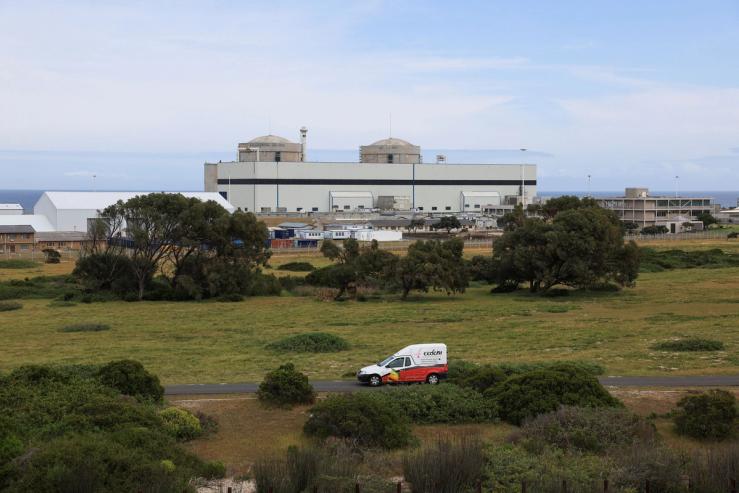
남아프리카공화국 케이프타운의 쿠베르그 원자력 발전소.케이프타운의 쿠베르그 원자력 발전소. 에사 알렉산더(Esa Alexander)/로이터.
포스트이메일왓츠앱링크 복사
세마포 아프리카 뉴스레터 구독: 빠르게 성장하는 대륙의 핵심 기사들. 지금 읽기.
이메일 주소 구독
이 기사에서:
제목 아이콘뉴스
제목 아이콘더 알아보기
제목 아이콘미국의 시각
제목 아이콘주목할 만한
제목 아이콘
뉴스
남아프리카공화국이 수십 년 만에 가장 야심찬 에너지 프로젝트로서 원자력 발전 용량을 확대하고 궁극적으로 국가 전력의 약 10분의 1을 공급하기 위한 인재 채용 활동의 일환으로, 해외에서 근무 중인 엔지니어들을 다시 불러들이고자 하고 있다.
이 계획은 숙련된 이민자와 남아프리카공화국 해외 교민, 특히 지난 10년간 바라카(Barakah) 원자력 발전소 건설 과정에서 많은 수의 현지 엔지니어를 채용한 아랍에미리트(UAE)에서 근무 중인 인력을 유치하는 것을 목표로 한다.
이는 남아프리카공화국의 전력망을 안정화하고 오랫동안 지속되어 온 석탄 의존도에서 벗어나기 위한 1,200억 달러 이상의 에너지 로드맵의 일부를 구성한다. 원자력 부문은 2039년까지 5,200MW의 신규 발전 용량 확보를 목표로 하며, 전력 인프라를 위한 태양광, 풍력, 가스의 대규모 확대를 포함하는 전략에서 가장 논란이 많은 축이다.
그러나 대륙 최대 규모의 에너지 프로젝트 중 하나를 추진해야 하는 전력 공기업 에스콤(Eskom)부터 에너지 규제 기관에 이르는 국영 기관들은 심각한 기술 인력 부족에 직면해 있다.
AD
이러한 긴박함은 지난주 의회에서 재차 강조되었는데, 국가원자력규제위원회(National Nuclear Regulator) CEO 디테보고 크고모(Ditebogo Kgomo)가 국회의원들에게 정부가 원자로 운영자, 안전 전문가 및 엔지니어링 컨설턴트를 확보하기 위해 광범위한 그물을 던지고 있다고 밝혔다.
"현재 우리가 보유한 168명은 확대된 프로그램과 관련된 업무를 수행하기에 충분하지 않습니다"라고 그녀는 말했다. 이 채용 활동은 현지 '인재 파이프라인'이 재건되는 동안 즉각적인 기술 지원을 제공하고, 남아프리카공화국 팀과 국제 전문가들 사이에 지식 이전의 다리를 놓기 위한 것이라고 크고모는 덧붙였다.
이 기사에서:
제목 아이콘뉴스
제목 아이콘더 알아보기
제목 아이콘미국의 시각
제목 아이콘주목할 만한
제목 아이콘
더 알아보기
2010년 남아프리카공화국에서 주요 원자력 에너지 프로젝트가 붕괴되면서 수천 명의 전문가들이 나라를 떠났다. 다수는 UAE로 향했고, 일부는 X-에너지(X-energy)와 같은 미국 기반 스타트업에 합류했다. 남아프리카공화국은 페블 베드 모듈 원자로(Pebble Bed Modular Reactor)에 90억 란드(약 5억 5,000만 달러) 이상을 쏟아부었고, 이 프로젝트는 한때 남아프리카공화국을 첨단 원자력 공학의 세계적 중심지로 만들었으나 지연과 비용 증가로 인해 결국 폐기되었다.
AD
남아프리카공화국의 원자력 발전 확대를 위한 이전 시도 역시 부패에 대한 우려가 커지면서 좌절되었다. 전직 대통령 제이컵 주마(Jacob Zuma) 행정부 시절, 러시아의 로사톰(Rosatom)과 연계된 9,600MW 규모의 계획이 의회 감독 절차를 우회했다는 이유로 법원에 의해 무산되었다.
원자력 역량 확충을 위한 새로운 움직임은 남아프리카공화국 원자력 프로그램이 현장에서 보다 구체적인 단계에 접어드는 시기와 맞물려 진행되고 있다. 에스콤(Eskom)은 최근 동케이프주에 위치한 타이스펀트(Thyspunt) 부지에 대한 환경영향 범위 결정 절차의 일환으로 신규 공개 청문회를 마무리했다. 타이스펀트는 남아프리카공화국 남부 해안선에 자리한 외딴 지역이다.
인근 마을 주민들은 지난주 지역 사회관에 모여 프로젝트 범위를 설명하는 컨설턴트들의 발표를 들었다. 이 발표에서는 프레토리아(Pretoria)가 전통적인 원자로 또는 건설 속도가 더 빠른 소형모듈원자로(SMR) 군집을 통해 5,200MW 규모의 발전소를 건설하는 방안이 제시되었다. 올해 초 국영 원자력 기업 넥사(NECSA)는 SMR 개발 파트너를 위한 국제 공모를 시작했다.
AD
환경영향평가에서 검토될 사항을 규정하는 초안 보고서에 따르면, 타이스펀트 건설 단계에서 1만 개 이상의 일자리가 창출될 것으로 추산되며, 엔지니어, 용접공, 프로젝트 관리자들이 사구, 습지, 거친 대서양 파도가 펼쳐진 미개발 지역으로 유입될 것으로 예상된다.
주민들은 어장, 문화유산 지역, 사구 생태계, 그리고 소규모 마을로 수천 명의 노동자가 유입될 때의 영향에 대한 우려를 제기했으며, 이는 공공의 반발이 프로젝트를 지연시킬 수 있음을 시사한다.
타이스펀트만이 검토 대상 부지는 아니다. 케이프타운 외곽의 기존 코이베르흐(Koeberg) 발전소 인근에 위치한 다위너폰테인(Duynefontein) 부지는 이미 환경 승인을 받았으며 부지 인허가 절차에서 더 앞서 있다. 그러나 현재 환경 단체들로부터 새로운 법적 이의 제기에 직면해 있으며, 이들은 해당 승인이 위법하고 구식 계획 데이터에 기반한다고 주장하고 있다.
Title icon
미국의 시각
새로운 갤럽(Gallup) 여론조사에 따르면 미국인들은 에너지 선호도를 재고하고 있다. 조사 결과, 대부분의 사람들이 여전히 태양광과 풍력을 지지하고 있음에도 불구하고 2021년 이후 태양광 및 풍력에 대한 지지율이 하락한 것으로 나타났다. 동시에 원자력은 수년 만에 가장 강력한 대중적 지지를 받고 있으며, 주요 에너지원 중 유일하게 지지율이 상승하고 있다.
여론조사는 미국 내 분열이 주로 정치적 성격을 띠고 있음을 보여준다. 민주당원들은 여전히 압도적으로 재생에너지를 지지하는 반면, 민주당원들은 원자력, 천연가스, 석유에 더 개방적인 태도를 보이고 있다. 그럼에도 불구하고 원자력은 양당 간 가장 근접한 수렴 지점으로, 인식 차이가 벌어지는 것이 아니라 좁혀지고 있는 드문 영역이다.
Title icon
주목할 사항
* 20개 이상의 아프리카 국가들이 대륙 전역에 걸쳐 6억 명의 사람들을 전력 부재 상태로 남겨두고 있는 전력 부족 문제를 해결하기 위해 원자력 발전을 적극적으로 검토하고 있다.
AI 분석
남아프리카공화국이 수십 년 만에 가장 야심찬 에너지 프로젝트로서 핵발전 용량을 2039년까지 5,200MW 확대하는 계획을 추진하면서, 국내 핵 전문 인력 부족이라는 심각한 도전에 직면해 있다. 2010년 핵에너지 프로젝트 붕괴 이후 수천 명의 전문가들이 UAE와 미국 등 해외로 떠났으며, 현재 국가핵규제기관은 168명의 인력만으로는 확대된 프로그램을 수행하기에 턱없이 부족하다는 점을 공식 인정했다. 이에 정부는 UAE에서 일하는 남아공 출신 엔지니어들을 중심으로 해외 인재를 적극적으로 유치하는 전략을 펼치고 있으며, 이는 단순한 인력 충원을 넘어 국제 전문가들과의 지식 이전 교두보를 마련하는 데도 목적이 있다. 이 핵에너지 계획은 태양광·풍력·가스 확대를 포함한 1,200억 달러 이상의 종합 에너지 로드맵의 일환이나, 환경 단체들의 법적 도전 등 가장 논쟁적인 부분으로 남아 있어 실현 가능성에 대한 내외부적 검증이 요구된다. 남아공의 사례는 원자력 산업에서 인적 역량의 지속적 유지가 얼마나 중요한지를 보여주는 동시에, 아프리카 대륙의 에너지 전환 과정에서 원자력의 역할이 새롭게 주목받고 있음을 시사한다.
※ 이 글은 해외 원자력 바로알기를 위한 정보 전달을 목적으로 제공됩니다. 특정 기업이나 종목에 대한 투자 권유가 아니며, 모든 투자 판단과 그에 따른 책임은 투자자 본인에게 있습니다.
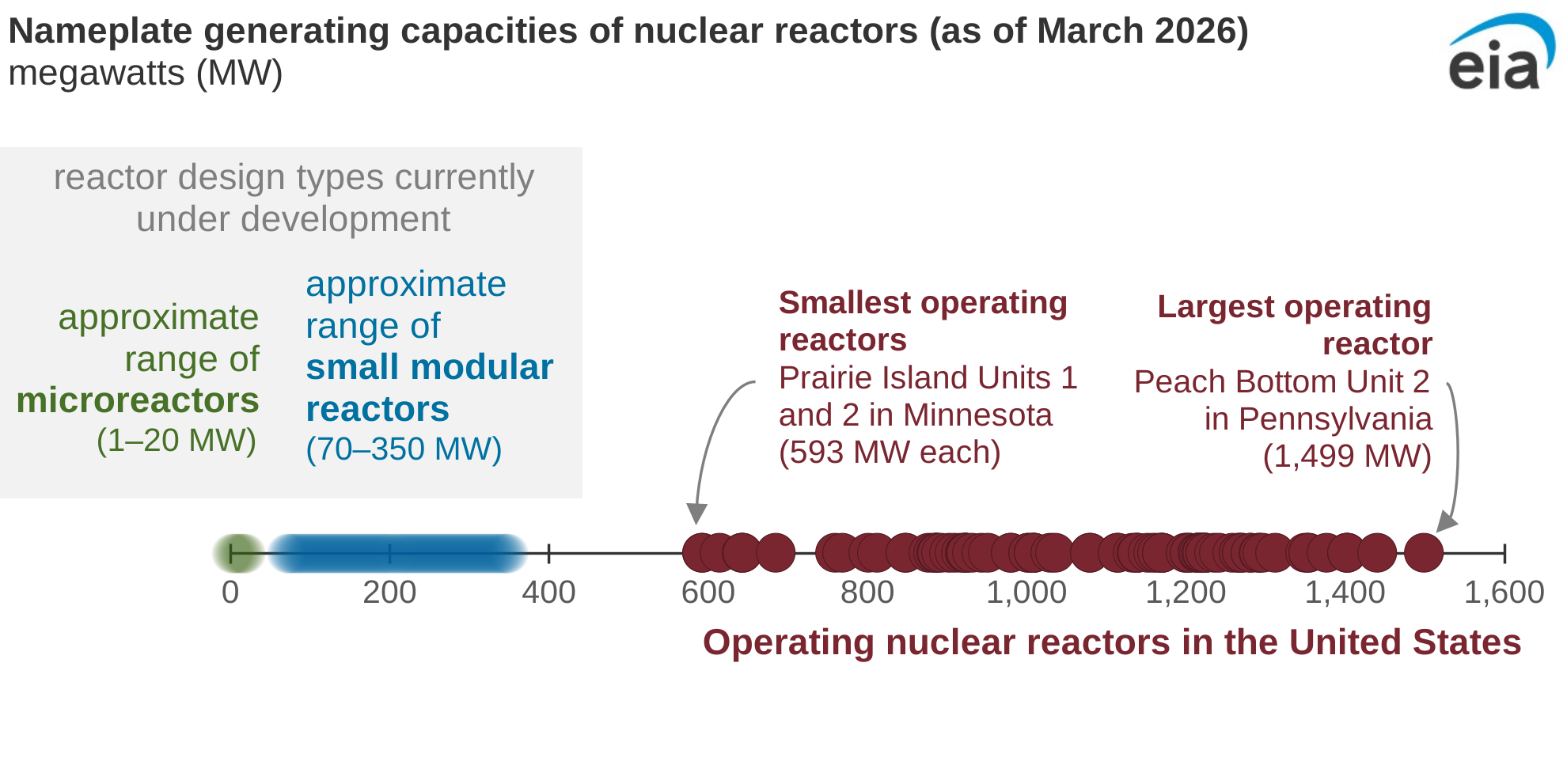
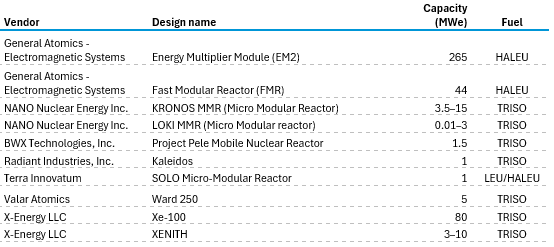
대형 원자력 설계의 발전 용량은 일반적으로 단위당 550메가와트(MW)에서 1,500MW 범위이며, SMR은 단위당 약 300MW 이하의 용량을 갖습니다. SMR의 주요 구성 요소는 모듈식 공장 조립 부품으로 설치를 위해 발전소 건설 현장으로 운송되며, 이를 통해 건설 기간을 단축할 수 있습니다. SMR의 하위 범주인 마이크로 원자로는 일반적으로 20MW 이하의 용량을 가지며 전력망의 일부로서, 전력망과 독립적으로, 또는 마이크로그리드의 일부로서 운영될 수 있습니다.
SMR과 마이크로 원자로는 전력망에 전력을 공급하는 것 외에도, 대형 발전소가 필요하지 않거나 대형 설비를 지원할 인프라가 부족한 지역에 전력을 공급할 수 있습니다. SMR은 AI, 데이터 센터, 또는 개발자가 전력망 연결을 원하지 않거나 필요로 하지 않을 수 있는 기타 산업 활동에 전력을 공급하기 위해 검토되고 있습니다. 또한 SMR은 높은 송배전 비용을 가진 외딴 지역과 지역사회에 서비스를 제공할 수 있습니다.
SMR 설계는 냉각재로 경수(輕水)를 사용하거나, 가스·액체 금속·용융염과 같은 비경수 냉각재를 사용할 수 있습니다. 여러 설계에서 고수준 저농축 우라늄(HALEU) 연료를 사용하는데, 이는 연쇄반응에서 에너지를 생성하는 주요 동위원소인 우라늄-235가 5% 이상 20% 미만으로 농축된 우라늄입니다. 고수준 저농축 우라늄(HALEU)은 현재 대부분의 원자로에서 사용되는 5% 미만의 저농축 우라늄 (LEU) 연료보다 높은 농축도를 가집니다. 높은 농축도는 높은 연소율을 가지며, 이는 효율과 성능을 향상시키고, 더 작은 원자로 설치 면적을 가능하게 하며, 사용후 핵연료 폐기물을 줄일 수 있습니다.
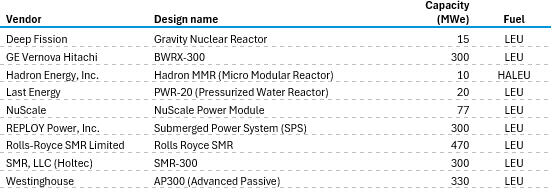
당사는 2026년 2월 기준 미국에서 개발 중인 상업용 SMR 및 마이크로 원자로 설계의 사양을 검토하여 다음과 같은 표를 작성하였습니다:
경수로(Light Water-Cooled Reactor)
경수로형 소형 모듈 원자로(SMR) 설계는 일반적으로 기존 대형 원자로 설계의 소형화 버전으로, 물속의 수소를 감속재로 사용하여 중성자를 감속시킴으로써 핵분열 반응이 일어날 가능성을 높입니다. 대부분의 경우 가압경수로(PWR)>)이며, 현재 미국 원자로에서 사용되는 저농축 우라늄 연료를 사용하고, 기존 전력망에 확장 가능한 기저부하 전력을 공급하기 위해 설계되었습니다.
light water-cooled reactors데이터 출처: 미국 원자력규제위원회(NRC), 에너지부, 각 기업 웹사이트
참고: MW=메가와트(전력); LEU=저농축 우라늄, 4.95% 미만으로 농축, 현재 미국에서 운영 중인 원자로의 표준; 고수준 저농축 우라늄(HALEU)=농축도 4.95% 초과 20% 미만
고온 가스 냉각 원자로
고온 가스 냉각 원자로(HTGR)는 감속재로 흑연을, 냉각재로 헬륨 가스를 사용합니다. HTGR은 매우 높은 온도에서 운전이 가능하여, 전기 분해 장치를 이용한 열화학 공정에 의한 수소 생산과 같이 고열 투입이 필요한 산업 공정 구동에 적합할 수 있습니다. 일부 HTGR은 고수준 저농축 우라늄(HALEU)을 사용하도록 설계되었으며, 다른 일부는 현재 원자력 연료의 임계값을 훨씬 초과하는 극한 온도에도 견딜 수 있도록 설계된 연료 구조인 삼중 구조 등방성(TRISO) 입자 연료를 사용하도록 설계되었습니다.
high-temperature gas reactors데이터 출처: 미국 원자력규제위원회(NRC)(U.S. Nuclear Regulatory Commission), 에너지부(Department of Energy), 각 기업 웹사이트
참고: MW=메가와트(전력); LEU=저농축 우라늄(Low-Enriched Uranium), 농축도 4.95% 미만으로 현재 미국 운전 원자로의 표준; HALEU=고수준 저농축 우라늄(High-Assay Low-Enriched Uranium)(농축도 4.95% 초과 20% 미만)
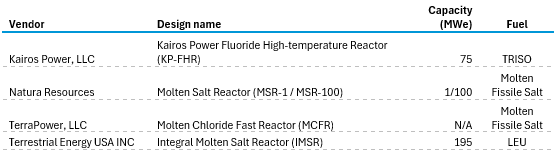
용융염 원자로
용융염 원자로(Molten Salt Reactor)(MSR) 설계는 원자로 연료 및/또는 냉각재로 용융염을 사용합니다. MSR은 일반적으로 핵연료를 용융염에 용해시키는 방식과 용융염을 냉각재로 사용하는 고체 연료 방식으로 분류됩니다. 용융염이 연료와 냉각재 역할을 동시에 수행할 경우, 우라늄이나 플루토늄과 같은 핵분열성 물질이 용융 불화물 또는 염화물 염 냉각재에 직접 용해됩니다. 이 원자로는 고온에서 작동하며, 고온가스냉각로(HTGR)와 마찬가지로 전력 생산 및 산업 공정용 열 생산에 활용될 수 있습니다.
molten salt reactors데이터 출처: 미국 원자력규제위원회(NRC), 에너지부 및 각 기업 웹사이트
참고: MW=메가와트 전력; LEU=현재 미국에서 운영 중인 원자로의 표준인 4.95% 미만으로 농축된 저농축 우라늄; TRISO=고수준 저농축 우라늄(HALEU)으로 제조된 삼중 구조 동위원소 입자 연료; 용융 핵분열성 염=우라늄 235, 우라늄 233 또는 플루토늄이 혼합된 용융염
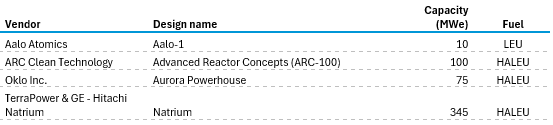
나트륨 냉각 원자로
나트륨 냉각 원자로(Sodium-cooled reactor) (SCR) 설계는 현재 운영 중인 원자력 발전소에서 일반적으로 사용되는 경수 대신 액체 금속(나트륨)을 냉각재로 사용합니다. 이러한 설계는 원자로가 더 높은 온도와 낮은 압력에서 운전될 수 있도록 하여 효율성을 향상시킬 가능성이 있습니다. 또한 원자로 용기 내에서 더 많은 비율의 연료를 사용하거나 연소할 수 있는 가능성도 있습니다.
sodium-cooled reactors데이터 출처: 미국 원자력규제위원회(NRC), 에너지부, 각 기업 웹사이트
참고: MWe=메가와트 전력; LEU=저농축 우라늄(농축도 4.95% 미만, 미국 현 운영 원자로의 표준); HALEU=고수준 저농축 우라늄(HALEU)(농축도 4.95% 초과); TRISO=고수준 저농축 우라늄(HALEU)으로 제조된 삼중 구조 동위원소 입자 연료
기타 설계
앞서 분류된 카테고리에 속하지 않는 설계를 보유한 공급업체들도 원자력규제위원회(NRC)와 사전 신청 활동을 진행하고 있습니다.
other designs자료 출처: 미국 원자력규제위원회(NRC), 에너지부 및 기업 웹사이트
주: MWe=메가와트 전력; LEU=저농축 우라늄(농축도 4.95% 미만, 미국 현재 가동 중인 원자로의 표준); HALEU=고수준 저농축 우라늄(HALEU)(농축도 4.95% 초과); TRISO=고수준 저농축 우라늄(HALEU)으로 제조된 삼중 구조 동위원소 입자 연료
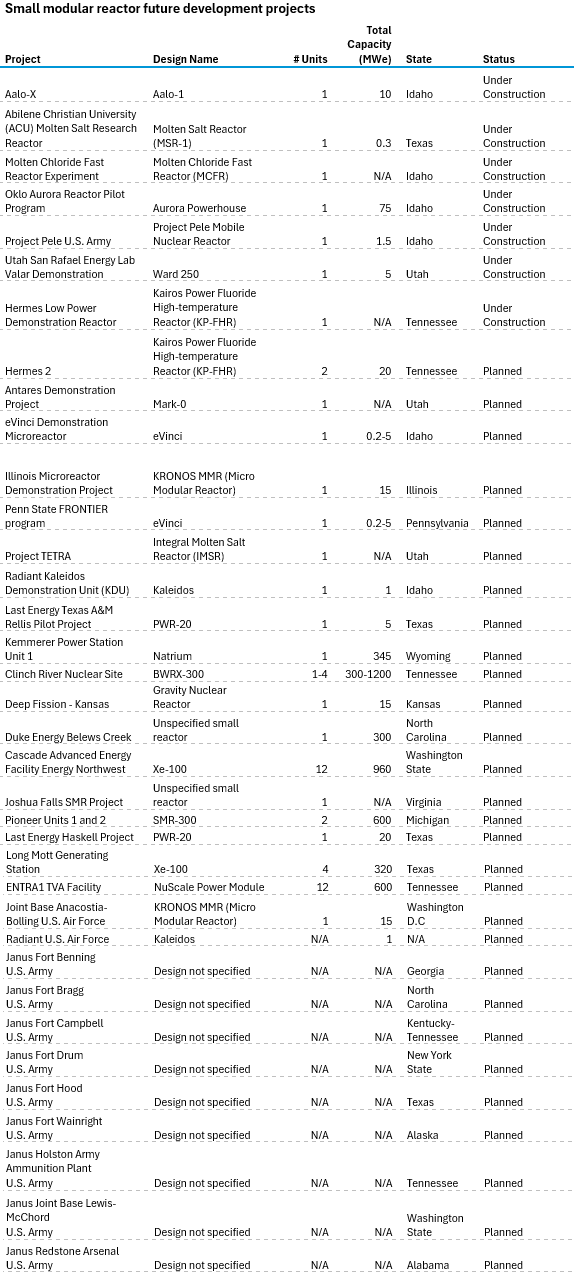
앞으로의 전망
국내 소형모듈원자로(SMR) 기술에 대한 연방정부의 지원이 확대되고 있다. 2025년 3월, 미국 에너지부(DOE)는 SMR 개발 촉진을 위해 9억 달러 규모의 연방 자금 지원 입찰을 재공고했다. 2025년 6월에는 DOE가 에너지 원자로 파일럿 프로그램을 발표했다. 이 프로그램은 국립연구소 외부 부지에서 부처가 승인한 선진 원자로 설계의 시험을 신속히 진행하는 것을 목표로 한다. 지원자들은 개별 파일럿 원자로 설계에 대한 자금 조달을 직접 책임지지만, 이 프로그램은 추가적인 민간 자금 유치를 지원하고 인허가를 위한 신속 처리 방식을 제공하고자 한다. DOE는 해당 프로그램에 다음 업체들을 선정했다: 아알로 어토믹스(Aalo Atomics Inc.); 앤태어리스 뉴클리어(Antares Nuclear, Inc.); 딥 피션(Deep Fission Inc.); 라스트 에너지(Last Energy Inc.); 오클로(Oklo Inc.); 나투라 리소시스(Natura Resources LLC); 레이디언트 인더스트리스(Radiant Industries Inc.); 테레스트리얼 에너지(Terrestrial Energy Inc.); 발라르 어토믹스(Valar Atomics Inc.).
야누스 프로그램의 다음 단계로, 육군부는 마이크로원자로 설치 후보지로 9개 기지를 선정했다. 해당 시설로는 포트 베닝(Fort Benning), 포트 브래그(Fort Bragg), 포트 캠벨(Fort Campbell), 포트 드럼(Fort Drum), 포트 후드(Fort Hood), 포트 웨인라이트(Fort Wainwright), 홀스턴 육군 탄약 공장(Holston Army Ammunition Plant), 조인트 베이스 루이스-맥코드(Joint Base Lewis-McChord), 레드스톤 아스널(Redstone Arsenal)이 포함된다.
공군부는 알래스카의 아이엘슨 공군기지(Eielson Air Force Base)에 최초의 원자력 마이크로원자로를 계획하고 있으며, 나트륨 냉각 오로라(Aurora) 설계 원자로의 업체로 오클로(Oklo, Inc.)를 선정해 파일럿 프로그램을 추진 중이다. 해당 프로젝트는 상업적으로 소유·운영되며, 2027년까지 1MW~5MW의 전력을 공급하는 것을 목표로 한다.
해군부는 1950년대부터 항공모함과 잠수함의 동력원으로 선진 원자로를 사용해 왔으며, 현재는 시설 전력 공급을 위한 상업용 현장 SMR 및 마이크로원자로 관련 제안서도 모집 중이다.
또한 파일럿 또는 실증 프로젝트로 현재 건설 중인 선진 원자로 설계 및 미래 개발 계획 프로젝트 목록도 정리했다.
looking ahead데이터 출처: 미국 원자력규제위원회(NRC), 에너지부, 전쟁부, 각 기업 웹사이트
미국 에너지정보청(EIA)의 이 보고서는 미국에서 개발 중인 소형 모듈형 원자로(SMR) 및 마이크로원자로의 현황을 심층적으로 분석한 자료로, 향후 에너지 지형에 중대한 변화를 예고하고 있다. 미국은 현재 약 98GW의 원자력 발전 용량을 운영하고 있으나, 높은 건설 비용과 복잡한 인허가 절차로 인해 수십 년간 신규 원전 건설이 미진했던 상황에서 SMR은 이러한 난관을 돌파할 대안으로 주목받고 있다. SMR은 모듈식 공장 생산 방식을 통해 건설 기간과 비용을 절감할 수 있으며, 300MW 이하의 소규모 설계 덕분에 AI 데이터센터, 산업시설, 원격 지역 등 대형 원전이 적합하지 않은 다양한 수요처에 전력을 공급할 수 있다는 점에서 활용 범위가 넓다. 특히 고농축 저농축우라늄(HALEU) 연료의 도입은 연소율 향상과 소형화를 동시에 가능하게 하여 효율성과 경제성을 높이는 핵심 기술로 부상하고 있다. 이 보고서는 SMR이 기후 변화 대응과 에너지 안보 강화라는 두 가지 과제를 동시에 해결할 수 있는 유망한 기술임을 시사하며, 관련 기술 및 정책 동향에 대한 지속적인 관심이 필요함을 강조한다.
※ 이 글은 해외 원자력 바로알기를 위한 정보 전달을 목적으로 제공됩니다. 특정 기업이나 종목에 대한 투자 권유가 아니며, 모든 투자 판단과 그에 따른 책임은 투자자 본인에게 있습니다.
한국어
VC 서머 원자력 발전소는 얼마나 안전한가? NRC, 4월 30일 젠킨스빌에서 공청회 개최
VC 서머 원자력 발전소는 얼마나 안전한가? NRC, 4월 30일 젠킨스빌에서 공청회 개최
요약
카테고리: 현황
원자력규제위원회(NRC)가 2025년 VC 서머 원자력 발전소 안전 성과 점검 결과를 발표하는 공청회를 2025년 4월 30일 사우스캐롤라이나 주 젠킨스빌에서 개최한다.
발전소는 터빈 구동 비상 급수 펌프의 유지보수 문제로 2025년 3분기부터 강화된 감독 하에 놓여 있으며, NRC는 추가 점검을 통해 원인 파악 및 재발 방지 조치의 효과를 확인할 예정이다.
공청회에서 주민들은 현장 상주 점검관을 포함한 NRC 점검관들에게 직접 질문할 수 있다.
---
사진 제공: SANTEE COOPER — 사우스캐롤라이나 주 젠킨스빌 소재 VC 서머 원자력 발전소
젠킨스빌, 사우스캐롤라이나 주 — 페어필드 카운티 소재 VC 서머 원자력 발전소 인근에 거주하는 주민들은 원자력규제위원회(Nuclear Regulatory Commission, NRC) 직원들이 주최하는 공청회에 참석해 볼 것을 권한다. 공청회는 목요일인 4월 30일에 열릴 예정이다.
발전소 점검을 담당하는 NRC 직원들은 도미니언 에너지 사우스캐롤라이나(Dominion Energy South Carolina)가 운영하는 1개 호기로 구성된 VC 서머의 2025년 안전 성과 점검 결과를 발표할 예정이다. 발표 후에는 질의응답 시간이 마련되어, 주민들이 현장에 상주하는 점검관을 포함한 NRC 점검관들에게 발전소에 관한 질문을 직접 할 수 있다.
최신 2025년 보고서에서 NRC는 VC 서머가 안전하게 운영되고 있다고 결론지었다. 다만, 발전소는 적절한 유지보수가 이루어지지 않은 터빈 구동 비상 급수 펌프 관련 문제로 인해 2025년 3분기부터 강화된 감독 체계 하에 놓여 있다. NRC 점검관들은 문제의 원인이 제대로 파악되었는지, 그리고 재발 방지를 위한 시정 조치가 실효성 있게 이루어지고 있는지를 확인하기 위해 추가 점검을 실시할 예정이다.
목요일 공청회는 오후 5시 30분부터 7시까지, 젠킨스빌 소재 레이크 몬티첼로 레크리에이션 센터(Lake Monticello Recreation Center, 7104 S.C. Highway 215 South)에서 열릴 예정이다.
VC 서머에 대한 연간 평가 서한과 향후 점검 계획은 NRC 웹사이트에서 확인할 수 있다. 현재 성과 정보는 NRC 웹사이트에서 분기별로 업데이트되어 제공된다.
---
AI 분석
VC 서머 원자력 발전소는 전반적으로 안전하게 운영되고 있으나, 터빈 구동 비상 급수 펌프의 유지보수 미흡 문제로 강화 감독 대상이 된 것은 주목할 필요가 있다. 비상 급수 펌프는 원자로 냉각에 핵심적인 안전 계통으로, 유지보수 소홀은 잠재적 위험 요소가 될 수 있다. NRC가 공청회를 통해 지역 주민들과 점검 결과를 공유하는 것은 규제 기관의 투명성 측면에서 긍정적인 조치다. 향후 추가 점검을 통해 시정 조치의 실효성이 확인될 경우, 발전소는 강화 감독에서 벗어날 가능성이 높다. 이번 사례는 원자력 발전소의 예방적 유지보수와 지속적인 안전 문화의 중요성을 다시 한번 상기시켜 준다.
미국 에너지부 오크리지 국립연구소(ORNL) 팀이 2026년 SME 오뱅 적층 제조 사례 연구상을 수상함
제조 시연 시설이 대형 적층 제조(LFAM) 기술을 활용해 차세대 원자로용 고정밀 금형을 제작하여 원전 건설 비용 절감 및 일정 단축에 기여
해당 프로젝트는 기술적 엄밀성, 산업 협력, 국가적 파급 효과를 인정받아 2026년 4월 14일 보스턴에서 열린 SME AM 어워즈 갈라에서 시상됨
대규모 3D 프린팅으로 정밀 금형 제작, 비용 절감 및 배치 가속화
게시일: 2026년 4월 22일
업데이트: 2026년 4월 22일
미국 에너지부 산하 오크리지 국립연구소(Oak Ridge National Laboratory)팀이 3D 프린팅의 뛰어난 실제 적용 사례를 인정하는 2026 SME 오빈 적층 제조 사례 연구상(SME Aubin Additive Manufacturing Case Study Award)을 수상했습니다.
에너지부 제조 시연 시설(Manufacturing Demonstration Facility)이 이 프로젝트를 주도했으며, 대형 적층 제조(LFAM)를 활용하여 첨단 원자력 원자로용 고정밀 금형을 제작했습니다. 이 연구는 미국 내 신규 원자력 발전소 건설 비용 절감 및 일정 단축에 기여할 수 있을 것으로 기대됩니다.
검은색 3D 프린팅 중공 금형
3D 프린팅 복합 금형이 콘크리트 구조물을 성형합니다. 출처: 에이미 스머먼 버게스(Amy Smotherman Burgess)/오크리지 국립연구소, 미국 에너지부
심사위원들은 이 프로젝트의 기술적 엄밀성, 산업 협력 및 국가적 영향 가능성을 높이 평가했습니다. 이 상은 2026년 4월 14일 매사추세츠주 보스턴에서 열린 SME AM 어워즈 및 TCT 어워즈 갈라에서 수여되었습니다.
원자력 반응로 건설의 가장 큰 장벽 극복: 건설
소형 모듈식 원자로(SMR)는 국가의 새로운 에너지 전략에서 핵심적인 역할을 담당하지만, 원자력 발전소 건설은 공사의 복잡성으로 인해 비용이 많이 들고 속도가 느릴 수 있다.
"건설은 선진 원자로에 있어 주요 병목 지점이었습니다," 복합재 혁신 그룹장이자 오크리지 국립연구소(ORNL) 프로젝트 책임자인 아흐메드 하센(Ahmed Hassen)이 말했다. "우리는 디지털 제조 기술이 엄격한 원자력 기준을 충족하면서도 일정을 몇 주씩 단축할 수 있음을 입증했습니다."
방사선 차폐에 사용되는 것과 같은 원자력 콘크리트 구조물은 일정 위험의 최대 60퍼센트를 차지할 수 있다. ORNL 팀은 메인 대학교(University of Maine), 카이로스 파워(Kairos Power), 그 밖의 산업 파트너들과 미국 전역에서 협력하여 복합재 거푸집을 개발하였으며, 대형 적층 제조(LFAM)를 사용해 카이로스 파워의 모듈식 원자로 차폐 구조물을 위한 대형 콘크리트 형틀을 제작했다.
카이로스 시스템은 저압으로 작동하므로, 콘크리트 구조물은 밀봉 기능이나 압력 등급을 충족할 필요가 없으며, 격납 기능을 수행하지 않는다.
거푸집은 바이오 차폐 강재 기둥과 방사선 차폐 벽 패널을 주조하는 데 사용되었다. 각 기둥의 크기는 약 가로 8피트, 세로 8피트, 높이 20피트였다. 일부 차폐 패널은 길이가 27피트에 달했으며, 복잡한 맞물림 이음부가 포함되어 부재 사이의 그라우팅 필요성을 줄이거나 없앴다.
엔지니어들은 디지털 컴퓨터 모델을 사용하여 거푸집을 설계했다. 부품은 섹션 단위로 출력된 후 정밀 가공 및 밀봉 처리되어 엄격한 공차를 충족했다. 주요 표면은 16분의 1인치의 정밀도를 달성했다. 또한 거푸집은 최대 12피트 높이에서 타설되는 습식 콘크리트의 강한 압력에서도 형태를 유지했다.
콘크리트 기둥과 인근에 있는 건설 작업자들
테네시주 카이로스 현장에서 거푸집으로 제작된 콘크리트 구조물. 출처: 에이미 스모더만 버게스(Amy Smotherman Burgess)/ORNL, 미국 에너지부
팀은 약 2주 만에 재사용 가능한 거푸집을 설계, 출력 및 납품했다. 모듈식 설계 덕분에 빠른 수정도 가능했다. 기존 강철 거푸집은 제작에 6~8주가 걸리며, 설계가 변경될 경우 수정이 어렵다.
출력된 복합재 거푸집은 카이로스 파워의 원자로 실증 프로그램을 위한 실물 크기 시험에 활용되었다. 거푸집은 강철보다 가벼우면서도 내구성이 뛰어나, 현장 작업자들이 다루기 더 쉬웠다. 팀은 바이오 차폐 기둥에 대해 4회의 주조 사이클을, 차폐 벽 패널에 대해 3회의 주조 사이클을 품질 저하 없이 완료했다.
현재 팀은 이 방식을 확대 적용하기 위해 미국의 주요 프리캐스트 제조업체와 협의 중이다. 광범위하게 채택될 경우, LFAM 툴링은 건설 속도를 높여 선진 원자로가 더 빠르고 저렴하게 가동되도록 도울 수 있다.
"이 프로젝트는 적층 제조가 단순한 시제품 제작에 그치지 않음을 보여줍니다," 하센이 말했다. "이는 국가 에너지 안보를 강화하기 위해 안전 필수 원자력 인프라를 구축하는 데 신뢰할 수 있고 반복 가능한 시스템이 될 수 있습니다."
수상자로는 오크리지 국립연구소(Oak Ridge National Laboratory)의 아흐메드 아라비 하센(Ahmed Arabi Hassen), 라이언 드호프(Ryan Dehoff), 소이단 오즈칸(Soydan Ozcan), 할릴 테키날프(Halil Tekinalp), 랜디 린드(Randy Lind), 타일러 스미스(Tyler Smith), 케빈 진(Kevin Zinn), 알렉스 로쉴리(Alex Roschli), 펌 킴(Pum Kim), 케이티 코펜헤이버(Katie Copenhaver), 셰리스 뱅크스턴(Sherith Bankston), 브리트니 로드리게스(Brittany Rodriguez), 데이비드 너탈(David Nuttal), 메인 대학교(University of Maine)의 수잔 맥케이(Susan MacKay), 웨슬리 비슨(Wesley Bisson), 스콧 톰린슨(Scott Tomlinson), 네이선 패슬러(Nathan Faessler), 카이로스 파워(Kairos Power)의 아흐메드 엘하탑(Ahmed Elhattab), 브라이언 송(Brian Song), 에드워드 블랜드포드(Edward Blandford), 그리고 버지니아주 시보드 서비스(Seaboard Services of Virginia, Inc.)의 킴 시버(Kim Seeber)가 포함된다.
이 연구는 에너지 및 산업을 위한 대형 적층 제조 분야에서 ORNL의 리더십을 보여주는 사례다. 해당 프로젝트는 미국 에너지부(DOE)의 첨단 소재 및 제조 기술 사무소(AMMTO)의 지원을 받았다. 이 프로젝트의 연구는 메인 대학교와의 SM2ART 프로그램의 일환으로 DOE의 지원을 받았다.
수상자 전체 명단:
오크리지 국립 연구소(Oak Ridge National Laboratory, ORNL), 제조 시연 시설(Manufacturing Demonstration Facility, MDF)
아흐메드 아라비 하센(Ahmed Arabi Hassen) – 복합재료 혁신 그룹 리더, 오크리지 국립 연구소 라이언 디호프(Ryan Dehoff) – 제조 시연 시설 소장, 오크리지 국립 연구소 소이단 오즈칸(Soydan Ozcan) – 지속 가능 제조 기술 그룹 리더, 오크리지 국립 연구소 할릴 테키날프(Halil Tekinalp) – 지속 가능 제조 부문 선임 연구개발 직원, 오크리지 국립 연구소 랜디 린드(Randy Lind) – 제조 부문 기술 전문가, 오크리지 국립 연구소 타일러 스미스(Tyler Smith) – 기술 준연구원, 오크리지 국립 연구소 케빈 진(Kevin Zinn) – 제조 부문 기술 직원, 오크리지 국립 연구소 알렉스 로슐리(Alex Roschli) – 연구개발 직원, 오크리지 국립 연구소 펌 킴(Pum Kim) – 선임 연구개발 직원, 오크리지 국립 연구소 케이티 코펜헤이버(Katie Copenhaver) – 지속 가능 제조 부문 연구개발 준연구원, 오크리지 국립 연구소 셰리스 뱅크스턴(Sherith Bankston) – 프로젝트 관리 직원, 오크리지 국립 연구소 브리트니 로드리게스(Brittany Rodriguez) – 첨단 고분자 복합재료 부문 기술 직원, 오크리지 국립 연구소 데이비드 너탈(David Nuttal) – 복합재료 혁신 그룹 기술 직원 컨설턴트, 오크리지 국립 연구소
메인 대학교(University of Maine, UMaine), 첨단 구조물 및 복합재료 센터(Advanced Structures & Composites Center, ASCC)
수전 맥케이(Susan MacKay) – 수석 재료 책임자, 첨단 구조물 및 복합재료 센터, 메인 대학교 웨슬리 비송(Wesley Bisson) – 적층 제조 운영 관리자, 첨단 구조물 및 복합재료 센터, 메인 대학교 스콧 톰린슨(Scott Tomlinson) – 구조 공학 및 적층 제조 응용 연구원, 첨단 구조물 및 복합재료 센터, 메인 대학교 네이선 패슬러(Nathan Faessler) – 재료 연구개발 부문 연구 엔지니어, 첨단 구조물 및 복합재료 센터, 메인 대학교
카이로스 파워(Kairos Power) (최종 사용자 / 상업적 배포 파트너)
아흐메드 엘하탑(Ahmed Elhattab) – 수석 엔지니어, 카이로스 파워 브라이언 송(Brian Song) – 토목 구조물 부문 이사, 카이로스 파워 에드워드 블랜드포드(Edward Blandford) – 최고 기술 책임자 겸 공동 창립자, 카이로스 파워 * 킴 시버(Kim Seeber) – 컨설턴트 및 버지니아주 시보드 서비시즈(Seaboard Services of Virginia, Inc.) 수석 부사장
MDF는 AMMTO의 지원을 받아 ORNL과 협력하여 미국 제조업의 혁신, 영감 부여 및 변혁을 촉진하는 전국적 협력 컨소시엄입니다. MDF와의 협력에 대해 자세히 알아보세요.
UT-배텔(UT-Battelle)은 미국 물리과학 분야 기초 연구를 위한 단일 최대 지원 기관인 에너지부(DOE) 과학국을 대신하여 ORNL을 운영합니다. DOE 과학국은 현 시대의 가장 시급한 과제들을 해결하기 위해 노력하고 있습니다. 자세한 정보는 energy.gov/science를 방문하시기 바랍니다.
오크리지 국립연구소(ORNL)팀이 대형 3D 프린팅 기술을 활용해 첨단 원자로용 고정밀 콘크리트 몰드를 제작함으로써 기존 철강 몰드 대비 제작 기간을 6~8주에서 약 2주로 대폭 단축하는 데 성공했다. 이는 원자력 발전소 건설의 핵심 병목 중 하나인 콘크리트 구조물 시공 일정 위험을 획기적으로 낮출 수 있는 기술적 전환점으로, 소형 모듈 원자로(SMR) 보급 확대에 직접적인 기여가 기대된다. 특히 Kairos Power의 모듈형 원자로 실증 프로그램에 실제 적용되어 방사선 차폐 구조물 제작에 성공했다는 점에서, 이 기술이 단순한 시제품 수준을 넘어 안전 핵심 인프라에 반복 적용 가능한 신뢰성을 검증했다는 의미가 크다. 미국 내 주요 프리캐스트 제조업체와의 확대 적용 논의가 진행 중인 만큼, 향후 원전 건설 비용 절감과 공기 단축에 광범위한 파급효과를 미칠 가능성이 높다. 이 성과는 제조업 디지털화가 에너지 안보 강화와 탈탄소화 목표 달성을 위한 원자력 르네상스를 가속할 수 있음을 잘 보여준다.
※ 이 글은 해외 원자력 바로알기를 위한 정보 전달을 목적으로 제공됩니다. 특정 기업이나 종목에 대한 투자 권유가 아니며, 모든 투자 판단과 그에 따른 책임은 투자자 본인에게 있습니다.
트럼프 행정부가 국가과학재단(NSF)을 감독하는 독립 자문기구인 국가과학위원회(National Science Board) 위원 전원을 해임했으며, 위원들은 금요일 저녁 이메일로 통보를 받았다.
NSF는 이미 10억 달러 이상 규모의 연구 보조금 1,500건 이상이 동결 또는 취소되고, 광범위한 정리해고로 직원의 약 3분의 1을 잃는 등 대대적인 혼란을 겪고 있다.
백악관은 2027 회계연도 예산안에서 NSF 예산을 50% 이상 삭감할 것을 제안했으며, 이는 과학계의 강한 반발을 사고 있다.
---
트럼프 행정부가 국가과학재단(National Science Foundation)을 감독하는 독립 자문기구인 국가과학위원회(National Science Board)의 위원 전원을 해임했다. 위원들은 금요일 저녁 이메일을 통해 해임 통보를 받았다.
이번 조치는 트럼프 행정부 들어 NSF에서 이어지는 일련의 격변 중 최근 것이다. 해당 기관은 지난해 10억 달러 이상에 달하는 1,500건 이상의 연구 보조금을 동결하거나 취소했다. 또한 광범위한 정리해고와 인원 감축으로 직원의 약 3분의 1을 잃었다.
트럼프(Donald Trump) 대통령이 첫 번째 임기 중 임명한 전 NSF 원장 세투라만 판차나탄(Sethuraman Panchanathan)은 2025년 4월 사임했다. 트럼프는 투자자이자 보건복지부(Department of Health and Human Services) 전직 관료인 짐 오닐(Jim O'Neill)을 후임으로 지명했다. 오닐은 아직 상원 인준 청문회에 출석하지 않았으며, 고급 과학 훈련이나 대형 연구기관 운영 경험이 부족하다는 이유로 과학계로부터 비판을 받고 있다.
백악관은 2027 회계연도 예산안에서 NSF 예산을 50% 이상 삭감할 것을 제안했다. 지난해에도 백악관은 유사한 삭감안을 제시했으나, 의회는 결국 이를 거부하고 1월에 통과시킨 세출법안에서 이를 반영하지 않았다.
---
AI 분석
이번 국가과학위원회 전원 해임은 트럼프 행정부의 과학·연구 분야에 대한 전방위적 구조조정의 일환으로, 미국 기초과학 연구 생태계에 심각한 불안정을 초래할 수 있다. NSF는 원자력을 포함한 첨단 에너지 기술 연구의 중요한 재원 공급원인 만큼, 예산 삭감과 자문기구 해체는 장기적으로 미국의 에너지·과학기술 경쟁력을 약화시킬 우려가 있다. 과학계는 행정부의 인사 정책이 정치적 고려에 의해 좌우되고 있다고 비판하며, 독립적 전문성을 갖춘 기관 수장의 필요성을 강조하고 있다. 의회가 이전에 유사한 예산 삭감안을 거부한 사례는 행정부와 입법부 사이의 긴장을 보여주며, 향후 NSF의 운영 방향은 의회의 태도에 따라 크게 달라질 것으로 보인다. 이러한 정책 불안정성은 미국 내 연구자 및 기관들의 장기 계획 수립을 어렵게 만들고 해외 두뇌 유출을 가속화할 가능성이 있다.
미국 전력망은 노후화된 인프라로 구성되어 있으며, AI 데이터센터 급증으로 인한 전력 수요 폭발에 대응하기 어려운 상태이다.
2020년 이후 미국 가정용 전기 요금이 30% 이상 상승했으며, 도매 전력 가격 상승으로 인해 앞으로도 계속 오를 전망이다.
15년간 정체되었던 미국 전력 수요가 다시 빠르게 증가하고 있어, 전력망 대규모 업그레이드 없이는 경제 성장과 기후 목표 달성이 어렵다.
이것은 미국 전력망의 근간입니다.
이 낡은 인프라는 광범위하게 뒤섞여 있으며, 우리의 필요에 점점 더 맞지 않게 되고 있습니다.
인공지능의 급격한 성장은 수백 개의 새로운 데이터 센터가 전기 요금과 전력망에 미칠 영향에 대한 우려를 자아내고 있습니다.
하지만 데이터 센터는 경각심을 불러일으키는 신호입니다. 수요 급증은 수십 년간 필요했던 전력망 투자를 이끌어낼 수 있습니다.
전압
매우 높음
높음
중간
낮음
계획 중인 데이터 센터
오피니언 게스트 에세이
전기의 시대,
미국은 준비가 되지 않았다
로빈슨 마이어(Robinson Meyer) 기고 그래픽: 사라 초도시(Sara Chodosh)
마이어 씨는 기고 오피니언 작가이자 기후변화를 전문으로 다루는 미디어 회사인 히트맵(Heatmap)의 창립 편집장입니다.
2026년 4월 27일
전체 기사 공유
1.2k
전기는 아마도 우리 시대에 가장 과소평가된 문제일 것입니다.
미국에서는 전등 스위치를 켤 때마다 즉각적으로 반응하는 전력망의 혜택을 누려왔습니다. 전력망은 대체로 기대대로 작동하며, 가정을 냉방하고 노트북과 휴대폰을 충전하며 생명 유지 장비를 가동합니다. 하지만 더 많은 것들을 전력망에 연결함에 따라, 전력망은 전례 없는 부담을 받게 될 것입니다. 미국 정치인들이 추구할 수 있는 거의 모든 경제적 목표 — 경제 성장, 제조업 부활, 기후변화 대응, 또는 단순히 생활비 절감 — 는 전기 시스템의 대대적인 업그레이드를 필요로 합니다.
최근 미국인들은 데이터 센터의 급증과 인공지능의 전력 수요에 집중하고 있습니다. 그러나 이는 사실 훨씬 더 큰 문제의 작은 부분에 불과합니다. 우리의 전력망은 너무 낡았고 전기 공급은 너무 부족합니다. 이 순간을 놓친다면, 우리는 더 비싸고 덜 안정적인 에너지와 더딘 경제 성장이라는 궁핍한 미래에 직면하게 될 것입니다. 최악의 시나리오에서는 미국인들이 전력망에서 완전히 이탈하여 모든 이들의 비용을 높이는 상황이 벌어질 수도 있습니다. 지금 당장 무언가가 바뀌어야 합니다.
전력망을 고치려면 먼저 그것을 이해해야 합니다. 시작점은 바로 전기 요금 고지서입니다.
전기 요금은 지난 5년간 급등했습니다
2000
2005
2010
2015
2020
2025
2
4
6
8
10
12
14
16
18 센트/킬로와트시
평균 소매 전기 요금
주거용 요금은 2020년 이후 30% 이상 상승했습니다
출처: 미국 에너지정보청
요금은 계속 오를 가능성이 높습니다. 지난 한 해 동안 도매 전기 요금 — 즉, 공익사업체와 대형 전기 소비자들이 일상적으로 전기를 사고팔 때 지불하는 가격 — 이 상승했습니다. 도매 요금 변동이 전기 요금 고지서에 반영되기까지는 수 년이 걸릴 수 있지만, 결국에는 반영될 것입니다.
전기는 이미 미국인들이 매년 지출하는 에너지 비용 중 두 번째로 큰 항목으로, 휘발유에 이어 2위입니다.
어느 정도의 인플레이션은 피할 수 없지만, 전기 인플레이션은 미국의 경제적·환경적 목표에 특히 해롭습니다. 신규 공장이나 사무용 건물과 같은 모든 종류의 대규모 기업 투자를 더 비싸게 만듭니다. 또한 전기 요금이 급등하고 예측 불가능하다고 느낄 때, 사람들이 대기 오염과 탄소 배출을 줄이는 전기차나 전기 가전제품으로의 전환을 망설이게 만들 수 있습니다.
우리의 새로운 전기 인플레이션 시대는 중요한 변화에 의해 촉발되고 있습니다. 10여 년 만에 처음으로, 미국의 전기 수요가 꾸준히 증가하고 있습니다. 미국 최대의 지역 전력 시장으로 중부 대서양 연안과 중서부 북부 지역을 포함하는 곳은 올여름 사상 최대 수요 기록을 세울 것으로 예상됩니다. 전국 전기 사용량도 사상 최고치를 기록할 가능성이 높습니다.
전기 수요가 다시 빠르게 증가하기 시작했습니다
2000
2005
2010
2015
2020
2025
-10
10
20
+30%
전기 판매량 변화
출처: 미국 에너지정보청
다시 말해, 미국인들은 역대 어느 때보다 많은 전기를 사용하려 하고 있습니다. 이것이 당연하게 들릴 수도 있지만 — 물론 미국의 전기 사용량은 해마다 증가하는 것이 맞지 않느냐고 — 사실 이는 매우 중요한 사안입니다. 왜냐고요? 부분적으로는 지난 15년이 전력 시스템에 있어 믿을 수 없을 만큼 이례적인 시기였기 때문입니다.
1세기 이상 동안, 전기 수요는 경제 성장 시기에 함께 증가했습니다. 19세기 말 전력망이 처음 등장한 시점부터 2000년대 중반까지, 미국의 전기 소비는 대체로 경제와 보조를 맞춰 성장했습니다.
그런데 2000년대 중후반, 이례적인 일이 벌어졌습니다. 미국의 전기 수요가 정체되기 시작한 것입니다. 이 둔화는 주로 2008년 금융위기의 여파 때문이 아니었습니다. 오히려 기술적인 이유였습니다. 미국인들이 보다 효율적인 전구를 채택하기 시작했는데 — 백열전구에서 형광등(CFL)과 LED로 전환하면서 — 갑자기 조명을 켜는 데 필요한 전기가 줄어들었습니다. 2010년대에 경제가 다시 성장 궤도에 올랐음에도, 이 전환으로 인한 엄청난 효율 향상이 전기 수요의 대폭 증가를 압도해버렸습니다.
이 절감액의 규모는 엄청났습니다.
2000
2005
2010
2015
2020
2025
2030
2035
2040
2045
2050
1
2
3
4
5 quadrillion BTU
주거용 전력 용도별 사용량
2000년대 초, 조명은 미국 가정에서 단일 최대 전력 사용 항목이었습니다. 2018년에 이르러, 에너지 효율적인 전구가 이 항목을 6위로 낮췄습니다.
에너지 예측가들은 향후 수십 년에 걸쳐 전기차가 주거용 전력 사용을 지배하게 될 것으로 예상하며, 이는 전체 전력 사용량 증가에 기여할 것입니다.
텍사스와 같은 일부 지역은 급격한 인구 증가와 경제 성장으로 인해 지난 20년간 전력 수요가 증가했습니다. 이 때문에 해당 지역의 전력망은 어떤 면에서는 다음 파도의 새로운 수요를 흡수할 준비가 더 잘 되어 있습니다. 하지만 여러 다른 지역에서는 LED 혁명의 종말로 인해 유틸리티 기업들이 새로운 시대에 적응해야 할 것입니다.
동시에, 물론 인공지능(A.I.)과 데이터 센터의 폭발적인 성장도 새로운 수요 급증을 이끌 것입니다.
조명은 약 2015년까지 상업 활동 전력 사용도 지배했습니다.
그러나 지금은 빠르게 변화하고 있습니다. 데이터 센터의 폭발적인 성장이 전력 사용을 사상 최고 수준으로 끌어올리는 데 기여할 것입니다.
이처럼 증가하는 수요는 향후 더 많은 발전 시설을 건설하지 않는 한 결국 더 높은 가격을 의미하게 될 것입니다.
그러나 이것이 전부가 아닙니다. 전기 수요와는 거의 관계없는 또 다른 고가격 요인이 있습니다. 바로 전력망 자체를 운영하고 유지하는 비용입니다.
전력망은 많은 사람들이 예상하는 방식으로 작동하지 않습니다. 오랫동안, 저는 전기 요금을 낼 때 대부분의 비용이 내가 방금 사용한 전기를 생산하는 데 쓰인다고 생각했습니다. 실제로는, 전력망 자체를 운영하고 유지하는 비용 — 장거리로 전기를 이동시키고, 가정과 기업에 전달하는 것 — 이 청구서 비용에서 점점 더 큰 비중을 차지하고 있습니다.
이러한 시스템 비용은 가격을 올릴 수 있고, 이는 다시 수요에 영향을 미칠 수 있습니다. 이것이 바로 팬데믹 이후 전력 수요가 가장 많이 증가한 주들 — 노스다코타와 뉴멕시코 같은 곳 — 에서 전기 가격이 가장 적게 오르고 심지어 하락하기도 한 이유입니다. 반면, 수요가 감소한 주들 — 캘리포니아와 메인 같은 곳 — 에서는 가격이 가장 많이 올랐습니다.
미국 대륙에는 단일 국가 전력망이 없습니다. 대신, 전기는 세 개의 지역 전력망을 통해 생산 및 송전되고, 수천 개의 지역 유틸리티 기업 중 하나에 의해 가정과 기업에 공급됩니다. 각 주는 기술적으로 자체 전력 시스템을 규제하지만, 실제로는 일부 주가 다른 주보다 훨씬 더 많은 권한을 갖고 있습니다.
2019년 이후, 일부 주에서는 지역 배전 시스템의 전신주와 전선 비용이 급증했습니다. 특히 캘리포니아와 남동부 지역은 배전망에 수십억 달러를 투자해야 했습니다.
자연재해가 이러한 비용 중 최악을 초래했습니다. 캘리포니아의 전력망이 지난 10년간 여러 치명적인 화재를 일으킨 후, 주는 미래의 화재를 예방하기 위해 지하 전선 매설, 기상 관측소 설치, 자동 차단 장비 구축이라는 비용이 많이 드는 작업을 시작했습니다. 한편 남부 지역은 극단적인 폭풍이 전력망의 광범위한 부분을 파괴한 후 재건해야 했습니다.
이러한 재해에 노출된 주들은 가정과 기업에 전력을 공급하는 최종 단계 배전 시스템을 재건해야 했습니다. 이는 시스템 비용을 증가시켰고, 이는 전기 비용을 높이고 주민들이 전체적으로 전력을 덜 사용하도록 만들었습니다.
그러나 모든 주가 곧 전력망의 상당 부분을 재건해야 할 것입니다. 미국의 배전 장비 상당 부분은 수십 년이 되었으며, 이제 곧 수명이 다할 시점에 가까워지고 있습니다. 또한 발전소에서 도시와 마을로 장거리 전력을 보내는 송전 시스템도 업그레이드하고 확장해야 할 것입니다.
물론, 전기 생산 비용이 오를 수도 있으며, 이는 전기 요금을 급등시키는 데 기여할 수 있습니다.
화석 연료인 천연가스 연소는 미국이 전기를 생산하는 주된 방식입니다. 러시아의 우크라이나 전면 침공 이후, 전 세계적으로 액화천연가스 가격이 급등했습니다. 다른 지역보다 선박으로 수입되는 액화천연가스에 더 많이 의존하는 뉴잉글랜드 지역도 전력 비용이 상승했습니다. 이란 전쟁의 결과로 액화천연가스 가격이 상승하면서 이러한 충격은 곧 다시 발생할 수 있습니다.
천연가스가 파이프라인을 통해 운반될 때 가격이 오른다면 — 아마도 급증하는 수출이 국내 가용 공급량을 초과하게 되어 — 미국 상당 부분의 전기 요금이 급등할 수 있다.
다시 말해, 전기 요금 인플레이션은 다양한 방식으로 발생할 수 있다. 때로는 시스템을 재건해야 할 필요가 있다. 때로는 연료 비용이 상승한다. 그리고 때로는 전력 수요가 단순히 공급을 초과하여, 더 많은 돈이 더 적은 전력을 쫓게 된다. 중부 대서양 연안과 중서부 북부와 같은 일부 지역에서는 데이터 센터 성장이 예상 공급 부족을 초래하고 전기 요금 상승을 부추겼다.
이러한 요금 인상은 다시 데이터 센터에 대한 반발을 부추겼다. 지역 차원에서 자발적으로 조직된 반대 운동이 전국의 수십 개 데이터 센터 프로젝트를 취소하거나 지연시키는 데 일조했다. 버몬트 주의 버니 샌더스(Bernie Sanders) 상원의원과 뉴욕 주의 알렉산드리아 오카시오코르테스(Alexandria Ocasio-Cortez) 하원의원은 급증하는 전력 수요를 억제하기 위해 부분적으로 모든 데이터 센터 건설에 대한 전국적 일시 중단을 제안했다.
이러한 데이터 센터에 대한 우려는 이해할 수 있다. 그러나 적어도 전력 시스템을 생각할 때, 우리는 미묘한 균형을 유지해야 한다. 전력 수요의 증가는 환영하되, 전기 요금 인플레이션은 늦춰야 한다. 반직관적으로 들릴 수 있지만, 대형 신규 전력 소비자가 전력망에 등장하면 때로는 다른 모든 이들의 전력 비용을 낮추는 데 도움이 될 수 있다. 그 이유는 그들이 워낙 많은 전력을 구매하기 때문에 시스템 비용의 훨씬 더 많은 부분을 충당할 수 있어, 전력 요금 상승을 억제할 수 있기 때문이다.
우리의 전기 위기에서 벗어날 방법이 있다. 정치인들은 우선 개별 데이터 센터를 반대하고 차단하는 것이 일부 경우에는 신중한 대응이 될 수 있지만, 더 깊은 문제를 해결하지는 못한다는 점을 인식해야 한다. 데이터 센터가 미국의 전력 사용량을 끌어올리고 있다는 점은 의심할 여지가 없다. 그러나 지난 1년간 데이터 센터들은 유틸리티 회사와 전력망에 대한 의존도가 훨씬 낮아졌다. 이는 많은 신규 데이터 센터들이 현재 대규모 현장 천연가스 발전소와 전력망 규모의 배터리 설비를 건설하고 있기 때문으로, 이를 통해 전력망에 정식으로 연결 승인을 받는 데 걸릴 수 있는 수년의 기간을 버틸 수 있게 된다.
다시 말해, 데이터 센터 건설은 전력망 자체와 어느 정도 독립적으로 진행되고 있다. 더불어 데이터 센터 개발사들은 민주당 정치인들과 지역 주민들이 프로젝트를 차단하기 더 어려운 선벨트 주(州)들로 몰려들고 있다.
우리는 두 개의 병렬 전력 시스템, 즉 데이터 센터가 사용하는 화석 연료 집약적인 전력망과 나머지 모든 사람들이 사용하는 노후화된 전력망이라는 구조를 원하지 않는다. 데이터 센터 건설을 차단함으로써 전력망 위기를 해결할 수 없기 때문에, 우리는 그 건설을 활용하여 전력망 전체를 개선하는 데 초점을 맞춰야 한다. 경제에서 가장 부유하고 혁신적인 일부 기업들이 새로운 발전소 건설에 투자하고 전력망 인프라를 개선하려는 의지를 갖고 있다. 이는 세대적 기회다.
이 기회를 잡으려면 우리의 지도자들에게 전략이 필요하다.
첫째, 지도자들은 전력망을 그것이 실제로 그러한 핵심 인프라로 취급해야 한다 — 성장을 위한 필수적인 플랫폼으로서 주간(州間) 고속도로 시스템에 버금가는 것으로. 하나의 우선순위는 우리나라의 많은 전력 시장을 관장하며 종종 그 역할에 심각하게 부적합한 회사들과 기관들을 개혁하는 것이어야 한다. 현재 전력망은 지역 유틸리티 회사들 자체가 계획하거나, 종종 유틸리티 이익에 의해 지배되는 지역 전력망 기관들이 계획하고 있다. 이는 종종 신규 발전소를 연결하는 데 너무 오랜 시간이 걸리고, 소비자들의 전기 요금을 낮출 수 있는 대규모 송전 프로젝트에 과소 투자하게 됨을 의미한다 — 하지만 그러한 투자는 또한 그들의 독점적 권력을 약화시킬 것이다. 이는 또한 독립 기업들이 전력 시스템의 미래에 대한 대규모 투자를 하지 못하게 막아, 기존 인프라의 유연성을 높일 수 있는 기회를 차단할 수 있다.
정부는 이러한 유틸리티 회사들이 전력망의 미래를 계획하는 데 지배적인 역할을 할 수 없도록 보장하는 데 새롭게 관심을 기울여야 한다. 이는 지역 전력망을 개혁하고 그 결정을 대중에게 더 투명하게 만드는 것을 포함할 수 있다. 전통적인 반독점 규정을 시행하는 것도 일부 압박을 완화할 수 있다. 영리 유틸리티 회사는 발전소와 그 발전소에 연료를 공급하는 인프라를 동시에 소유해서는 안 된다.
다음으로, 우리의 필요를 충족시키기 위해 더 많은 전기가 필요하다는 점을 인식해야 합니다. 의회는 정부와 기업들이 새로운 태양광 발전소, 풍력 발전소, 송전선을 더 쉽게 건설할 수 있도록 올해 반드시 허가 개혁을 통과시켜야 합니다. 의회는 대통령이 이미 승인된 에너지 프로젝트를 차단할 수 있는 권한을 박탈하고, 트럼프(Trump) 대통령의 모든 신규 재생에너지에 대한 사실상의 차단을 종식시켜야 합니다.
주정부와 연방정부는 또한 우리의 전력망을 옭아매는 희소성의 덫에서 벗어나기 위해 협력해야 합니다. 현재 전력망에 대한 모든 투자 비용은 주로 전기 고객들이 전기 요금을 통해 부담합니다. 만약 전력 회사가 저렴하고 청정한 전기를 과잉 생산하는 대형 발전소를 새로 건설한다면, 도매 전력이 저렴해지더라도 단기적으로는 그 투자 비용을 "상환"하는 과정에서 요금이 내리는 것이 아니라 오르게 됩니다.
정부는 이러한 비용의 일부를 직접 부담함으로써 도움을 줄 수 있습니다. 정치인들은 대규모 원자력 발전소를 반복 가능하고 공공 비용으로 규모 있게 건설하려는 노력을 추진해야 합니다. 원자력은 초당파적 지지를 받고 탄소를 배출하지 않기 때문에 이 투자에 특히 적합한 후보입니다. 트럼프 행정부와 뉴욕주지사 캐시 호컬(Kathy Hochul)은 새로운 원자로 건설을 위한 초기 노력을 추진하고 있습니다. 에너지부는 테네시 밸리 청(Tennessee Valley Authority)이나 연방 전력청과 같은 다른 공공 기관들이 자체 프로젝트를 건설할 수 있도록 지원하는 방안을 검토해야 합니다.
데이터 센터와 관련해서는, 단기적으로 이들이 전력망을 압도하지 못하도록 막으면서 동시에 그 규모와 크기를 활용하여 장기적으로 필요한 인프라 구축을 돕는 즉각적인 전술을 채택할 수 있습니다.
트럼프 대통령은 테크 기업들에게 자신들의 전력 수요가 전력망을 압도하지 않겠다고 맹세하는 자발적이고 구속력 없는 납세자 보호 서약에 서명할 것을 요청했습니다. 대신 테크 기업들은 국가 전력망 현대화 기금에 기여함으로써 전력망의 장기적 개선 자금을 조달하도록 의무화되어야 합니다. 이 기금은 대규모 새 송전선을 건설하거나 차세대 전력 설비를 대량 구매하는 데 사용될 수 있습니다. 또한 지역 단위의 배터리를 설치하고, 가정에서 전력 사용을 더 유연하게 할 수 있도록 인센티브를 제공하는 프로그램을 운영하며, 기존 전선과 설비가 더 많은 전력을 감당할 수 있도록 집중적으로 개선하는 데도 활용될 수 있습니다.
마지막으로, 정부는 전기를 생산하는 곳에서 필요한 곳으로 이동시키기 위해 전국에 걸친 장거리 고압 송전망을 구축할 수 있는 새로운 연방 전력망 기관을 설립해야 합니다. 이 새로운 기관은 지역 및 전력 회사의 반대를 극복하고 최대한 많은 미국인들에게 가장 저렴한 전력을 공급할 수 있는 권한을 부여받아야 합니다. 이 전력망 기관은 이미 행정 권한만으로도 설립이 가능할 수 있으나, 의회가 이를 별도로 승인할 수도 있습니다. 또한 새로운 전력망 기금을 통해 부분적으로 재원을 조달할 수도 있습니다.
이 프로젝트는 모든 미국인의 전력 비용을 낮게 유지하는 데 도움이 될 것이며, 대규모 데이터 센터 확장으로 어려움을 겪고 있는 농촌 및 외곽 지역의 부담을 줄이는 동시에 국가 전체 경제가 태양광, 풍력, 배터리 전력의 진정한 혜택을 누릴 수 있게 해줄 것입니다.
대부분의 미국인이 매일 사용하는 120년 된 기계는 많지 않습니다. 하지만 전력망이 바로 그 중 하나입니다. 우리의 지도자들에게는 이 노후화되었지만 필수적인 시스템을 앞으로 100년의 성장을 위해 재건할 드문 기회가 주어져 있습니다.
방법론
송전선 데이터는 국토 인프라 기반 데이터(Homeland Infrastructure Foundation-Level Data)에서 가져온 것으로, 2024년에 마지막으로 공개 업데이트되었습니다. 데이터 센터 위치는 클린뷰(Cleanview)의 자료로, 1GW 이상의 데이터 센터만 포함합니다.
용도별 에너지 소비 데이터는 미국 에너지정보청(U.S. Energy Information Administration)에서 가져온 것입니다. 단일 용도 범주만 포함하며 "기타 용도"는 제외됩니다.
이 기사의 이전 버전에서 용도별 주거용 및 상업용 전기 소비량을 나타내는 차트의 y축 레이블이 잘못 표기되었습니다. 해당 수치는 쿼드릴리언 BTU/kWh가 아닌 쿼드릴리언 BTU를 나타냅니다. 차트가 수정되었습니다.
AI 분석
미국의 전력망은 수십 년간 노후화되어 왔으며, 급증하는 전력 수요에 대응하기 어려운 상태에 놓여 있다. AI 데이터센터 확산은 이 문제를 수면 위로 끌어올리는 계기가 되었지만, 실제로는 전기차, 제조업 부활, 기후변화 대응 등 미국의 모든 경제·환경 목표가 전력 인프라 대규모 투자를 필요로 한다는 더 큰 구조적 문제의 일부에 불과하다. 2020년 이후 소매 전기요금이 30% 이상 상승하는 등 전기 인플레이션은 기업 투자 비용을 높이고 전기차·전기기기 전환 의지를 약화시켜 경제·환경적 목표 달성을 동시에 저해하고 있다. 15년간의 수요 정체를 깨고 전력 수요가 사상 최고치를 향해 치솟는 현 시점에서, 노후 전력망에 대한 즉각적인 대규모 투자 없이는 에너지 비용 상승과 공급 불안정으로 인한 경제 성장 둔화가 불가피할 것이라는 경고가 담겨 있다.
※ 이 글은 해외 원자력 바로알기를 위한 정보 전달을 목적으로 제공됩니다. 특정 기업이나 종목에 대한 투자 권유가 아니며, 모든 투자 판단과 그에 따른 책임은 투자자 본인에게 있습니다.
English
Fusion research tackles fuel and instrumentation challenges-Nuclear Newswire
Fusion research tackles fuel and instrumentation challenges
April 27, 2026
TL;DR
Three research groups report fusion developments including spin-polarized fusion progress on the DIII-D tokamak, a new X-ray plasma diagnostic tool for the National Ignition Facility, and AI-optimized materials design to prevent instabilities in fusion fuel targets
Spin-polarized fusion could potentially boost energy output by 70-80% by aligning fuel isotope spins with the magnetic field, with phase II now beginning to prototype and construct the required equipment
Machine learning design optimization has enabled researchers to create AI-optimized structures with microscopic voids that can be successfully manufactured and experimentally tested, demonstrating a path forward for complex fusion-relevant designs
Full Article
A waveguide helps carry radiofrequency waves created by the microwave generator to the lithium-deuteride pellets that will be used in the spin-polarized fusion project. (Photo: Aileen Devlin/Jefferson Lab)
Three research groups are reporting fusion-related developments, including ongoing work toward spin-polarized fusion, a new plasma diagnostic tool heading to the National Ignition Facility, and a materials science project that could impact the design of inertial confinement fusion fuel targets.
A little bit of fuel, a much bigger fire
The Department of Energy's Fusion Energy Sciences program has awarded a second round of funding to a spin-polarized fusion (SPF) project centered on the DIII-D tokamak.
The basis of SPF is the idea that polarized fusion fuel, where the isotopes' spin is aligned parallel to the magnetic field, has a higher likelihood of the collisions that lead to fusion than unpolarized fuel. Theoretically, this method has the potential to boost the system's energy output by 70 percent–80 percent.
The ultimate goal is being able to harvest energy using the minimum amount of material. With the right alignment, a little bit of fuel can produce a much bigger fire, and you can use that energy for the next round of fusion.
— Xiangdong Wei, a physicist at Thomas Jefferson National Accelerator Facility
This idea has been around since the 1980s, but it has been technically complicated to develop a system that sufficiently polarizes the fuel and injects it in such a way where it stays polarized for long enough to increase the fusion cross section, boosting the number of reactions per time at a given density.
The team has already designed equipment that can polarize, store, and inject deuterium and helium-3 into the DIII-D tokamak. Now they are beginning phase II, aiming to prototype and construct the devices.
Seeing the plasma
As recently published in _Review of Scientific Instruments_, researchers have developed a multichannel X-ray imager that measures fusion-plasma temperatures with a large field of view and a high resolution.
Called the toroidal X-ray imager, the device works by using aperiodic multilayer coatings with different bandwidths on the mirrors in its detectors. These nanoscale layers are optimized to capture three distinct X-ray energy bands centered at 8.7, 13, and 17.5 keV for determining the plasma temperature.
According to the American Institute of Physics, the device is the first diagnostic tool capable of measuring all three energy bands at a single location. It will be headed to NIF for inertial confinement fusion experiments.
AI design neutralizes effect of tiny material defects
Inertial confinement fusion can be impacted by Richtmyer-Meshkov (RM) instabilities, resulting in unstable jetting at points of tiny material defects when the fuel fill tube targets are hit.
As described in a _Physical Review Letters_ paper, researchers used a machine-learning design optimization algorithm to determine where to add microscopic voids to a gelatine, which dispersed energy from a shock wave before it could reach the interface that typically produces jets.
The idea would need to be extended to the design of spherical fill tubes to be applied to fusion, but the concept could also be used across a range of other materials research applications.
The challenge is that while these designs look promising in simulations, they are often extremely difficult to manufacture and experimentally test. Our work is one of the first demonstrations that such AI-optimized structures can actually be built and studied in real experiments.
— Jergus Strucka, an instrument scientist at European XFEL and one of the study authors
AI Analysis
This article showcases three converging advances in fusion energy that address fundamental technical barriers from different angles. The spin-polarized fusion project represents optimization of proven tokamak technology through fundamental physics insights, with the team now moving into critical hardware prototyping phases that will demonstrate viability. The toroidal X-ray imager represents essential progress in plasma diagnostics, providing unprecedented simultaneous measurement of temperature bands—a capability that directly advances the ability to validate fusion performance in real-time. Most significantly, the application of AI-driven design optimization to solve manufacturing constraints in materials science marks a paradigm shift for fusion engineering, moving beyond purely theoretical solutions to experimentally validated designs that can actually be built. Together, these developments suggest the fusion field is entering a more mature phase where systematic engineering solutions are complementing foundational physics breakthroughs.
The POWER Interview: Solving the Problem of Fuel for Nuclear Reactors
Published: April 2026
TL;DR
Molten Salt Solutions is developing industrial-scale lithium-6 enrichment technology crucial for fusion and advanced fission reactors, addressing a critical gap in the nuclear fuel supply chain
The company has announced supply agreements with Gauss Fusion and Type One Energy, reflecting growing industry recognition that fuel supply must be integrated into reactor design from the start
By 2030, the company aims to establish lithium enrichment as a scaled commercial business and expand into other isotope separations using the same platform technology
---
The POWER Interview: Solving the Problem of Fuel for Nuclear Reactors
Overview
The U.S. Dept. of Energy's Office of Nuclear Energy has spelled out several areas that present challenges to domestic and global development of nuclear power. Chief among those issues is building a process that enables fuel development on a repeatable, industrial scale, so that projects can move beyond the demonstration phase to commercial operation.
Dr. John Elling is CEO and co-founder of Molten Salt Solutions, a New Mexico company developing materials for next-generation nuclear and fusion reactors. The group has said its work involves creating technology for producing large quantities of isotopically-enriched lithium, which will be necessary for advanced fission and fusion power. Molten Salt Solutions has what it calls "proprietary chromatography separation and mass spectrometry technologies [that] enable effective isotope enrichment, while our unique metal salt syntheses provide significant safety and cost advantages."
_John Elling_
Elling, a serial entrepreneur, previously founded and led Acoustic Cytometry Systems and Mesa Biotech, companies that each commercialized Los Alamos National Laboratory technologies and achieved successful acquisitions. Elling has extensive expertise in licensing and scaling national lab innovations, with experience as both a technical staff member and visiting entrepreneur at Los Alamos. He holds a Ph.D. in Analytical Chemistry from the University of Wisconsin, and an MBA from the University of New Mexico.
Elling provided _POWER_ with his thoughts on why researchers should focus on development of fuels for nuclear energy, to enable the subsequent advancement of nuclear power technologies.
The Interview
_POWER: What sparked your interest in developing fuel for nuclear energy?_
I came into this from a slightly different angle than most people in nuclear. My background is in analytical chemistry, which is not usually where you start if your goal is to design a reactor.
>
Over time, though, it became clear that a lot of advanced energy systems, both fusion and next-generation fission, were running into the same constraint. They are all going to need large amounts of enriched isotopes in advanced materials, and there is essentially no industrial-scale production today.
>
There has been a lot of attention on reactors, which makes sense. They are more visible and, frankly, more exciting. The materials tend to get less attention. Historically, that part shows up later as a problem.
>
What drew me in was the opportunity to work on that enabling layer. If these systems are going to move beyond demonstrations, they need a supply base that actually exists. Building that is not as glamorous as building a reactor, but it tends to determine whether the reactor matters.
_POWER: There's excitement around fusion energy. Your group has said there's a "critical" minerals gap, specifically a lack of lithium-6 to produce tritium fuel. Can you provide some detail about your company's advanced solvent exchange process for large-scale lithium enrichment?_
Enriching lithium isotopes is not especially hard. There are many ways to do it. There are not many ways to do it at scale.
>
The U.S. government did this in the 1960s using a mercury-based process, which worked, but is not something anyone wants to bring back. The challenge now is to build an industrial process that is both scalable and environmentally acceptable.
>
Liquid-liquid extraction is a standard chemical engineering process, and isotope-selective systems are well understood. The issue is that scaling them typically requires very large, multi-stage systems that are expensive to build and operate. That approach works, and several groups are pursuing it, but it is hard to see it supporting a new energy industry on cost.
>
We took a different approach. It scales about 100 times better and costs a lot less. Our approach is to rethink how that separation happens. We use a continuous solvent exchange process that allows many separation steps to occur within a single integrated system. In practical terms, that reduces capital and operating costs by orders of magnitude compared to conventional setups.
>
It also makes scaling more modular. Instead of committing to a single large facility, you can add capacity incrementally. That is useful when your demand curve depends on technologies that are still proving themselves.
>
The underlying issue is fairly simple. If fusion works, lithium-6 becomes a constraint. We are trying to make sure it does not become the constraint.
_POWER: Are you working with any companies currently designing fusion systems? Do you have any supply contracts with companies?_
We recently announced supply agreements with Gauss Fusion and Type One Energy. Both are serious teams, and we see those relationships as an important step for us and for the broader ecosystem. These are not just exploratory relationships. They reflect a growing recognition that fuel supply needs to be addressed early, not after the fact.
>
The goal is to align ahead of large-scale deployment so that fuel availability is built into system design, instead of becoming a bottleneck later. In the near term, we are supplying material for testing and validation, which is a necessary step. Developers need confidence not just in the reactor, but in the supply chain behind it.
>
More broadly, it also suggests the industry is starting to move past purely technical milestones and into questions of industrial readiness. At that point, inputs like lithium-6 stop being theoretical and start becoming gating factors.
_POWER: Are you seeking U.S. federal government support (perhaps through national labs) for your process?_
Our core processing technology has been developed in collaboration with Los Alamos National Laboratory. They have their own set of difficult purification problems, so there is a natural overlap.
>
The lithium isotope work itself has been supported through NSF SBIR programs, along with some state-level support. Those partnerships helped us move from concept to a demonstrated system relatively quickly.
>
We are looking for additional federal support, and there is a real opportunity right now. Lithium-6 sits in an awkward but interesting place between defense and commercial energy. Most programs are still structured around one or the other. If there were a more coordinated, dual-use approach, it would make it easier to justify early infrastructure investment. It would also send a clearer signal that supply will be there as fusion scales, which is still an open question.
_POWER: Who are some of the investors in your company?_
We have raised from Future Ventures and True Ventures, along with non-dilutive funding through grants and government contracts.
>
Future Ventures actually reached out to us early on. They had already spent time looking at fusion and came to the view that lithium-6 was likely to be a bottleneck. At the time, there were not many teams focused on it, so that conversation moved quickly.
>
And it is not just fusion driving that. You see the same dynamic on the fission side, particularly with molten salt reactors. Once you look closely at where nuclear is going, the supply chain piece becomes hard to ignore.
_POWER: What's next for Molten Salt Solutions? Where do you see the company by 2030?_
In the near term, the focus is on building commercial capacity. Demand is already ahead of our current supply plans, across both fusion developers and advanced fission programs working with the Department of Energy.
>
By 2030, lithium enrichment should be a scaled, established business with production facilities delivering material in meaningful volumes. From there, the focus is on expanding into additional isotopes using the same underlying process.
>
There are a number of adjacent markets where supply is constrained and demand is growing, including silicon-28 for quantum computing, carbon-13 for medical diagnostics, and chlorine-37 for molten salt reactors.
>
The underlying idea is that this is a platform technology. Lithium is the first application, but the same process extends to a range of difficult isotope separations. What we are building is a way to reliably produce materials that have historically been constrained, at a scale that supports real commercial deployment.
This interview highlights a critical but often overlooked bottleneck in the nuclear energy supply chain: the availability of specialized isotopes like lithium-6 at industrial scale. Rather than focusing solely on reactor design, Elling's work addresses the foundational infrastructure needed to support both fusion and advanced fission deployment, recognizing that technical breakthroughs mean little without a reliable supply base. The company's recent supply agreements with fusion developers like Gauss Fusion and Type One Energy signal an important industry shift toward integrating fuel supply planning into reactor design from the outset. With growing federal interest in dual-use technology development and a platform approach extensible to other isotope separations, Molten Salt Solutions appears positioned to address a recurring constraint across multiple advanced nuclear technologies.
English
NN Asks: What’s needed to get space nuclear off the ground?-Nuclear Newswire
What's Needed to Get Space Nuclear Off the Ground?
Published: April 27, 2026
TL;DR
Nuclear technology is essential for advancing humanity's space exploration ambitions, particularly for powering and propelling missions that venture farther and last longer in the cosmos.
Success requires coordinated progress across multiple technical fronts—including reactor development, power conversion, materials science, and testing—supported by a national framework and long-term roadmap.
A coherent strategy with sustained investment, strengthened supply chains, and collaborative partnerships across government, academia, and industry is critical to transitioning space nuclear from promising concepts to operational capability.
Full Article
For decades, the thrill of space exploration has ignited the imaginations of engineers, scientists, and innovators alike. The dream of expanding humanity's reach beyond Earth continues to attract the brightest minds, fueling groundbreaking advancements. As we set our sights on missions that venture farther and last longer in the cosmos, one truth stands out: Nuclear technology is the key to unlocking these bold ambitions. Its impact goes far beyond any single mission, driving a surge of momentum that not only propels space exploration but also energizes the entire nuclear ecosystem—sparking innovation and growth in an era of unprecedented opportunity.
Building and sustaining that momentum depends on coordinated progress across multiple technical fronts. Nuclear power and propulsion for space must mature in parallel, with investment in reactors as well as power conversion efficiency, heat rejection, high-temperature materials, instrumentation, testing, and launch-environment qualification. Advancing these building blocks broadens the range of viable missions and encourages universities, laboratories, and industry partners to contribute in complementary ways.
A national framework that brings these efforts together would further accelerate progress. Numerous federal agencies already play important roles, and a shared long-term road map—one that clarifies requirements for design, manufacturing, testing, regulatory pathways, and security—would help align investments and create more opportunities for distributed innovation. This includes strengthening supply chains for special nuclear materials and critical components, and supporting collaborative research and development across government, academia, and industry.
I've seen the value of aligned partnerships firsthand. Over the past eight years, I have worked closely with NASA and other U.S. government agencies on space nuclear initiatives, including more than 100 cold-flow tests on BWXT's nuclear thermal propulsion engineering demonstration unit at NASA's Marshall Space Flight Center. Our work in space nuclear connects directly to advances in fission surface power, advanced fuels, and terrestrial microreactors such as Project Pele and the emerging U.S. Army Janus Program. Each reinforces the others and contributes to a more resilient U.S. nuclear ecosystem.
As the United States looks toward cislunar exploration, deep-space missions, and space-enabled national security, the importance of nuclear propulsion and power continues to grow. Ensuring it remains a national priority—supported by a coherent road map and sustained investment and a strong workforce—is the most important step we can take to move from promising concepts to operational capability. Accelerating that momentum will define our leadership for decades to come and is most essential to getting space nuclear off the ground.
---
About the Author
Kate Kelly (khkelly@bwxt.com) is president of BWXT Advanced Technologies, a subsidiary of BWX Technologies.
AI Analysis
This article presents a compelling case for nuclear technology as the cornerstone of advanced space exploration, grounded in practical experience from over eight years of collaborative work with NASA. The author effectively argues that success requires not just technological advancement but systemic coordination across government, academia, and industry—a recognition that space nuclear development cannot succeed in isolation. The emphasis on supply chain resilience and regulatory clarity reflects the real-world barriers to scaling nuclear space systems, suggesting that policy alignment may be as important as engineering innovation. The mention of terrestrial applications like Project Pele and the Army Janus Program highlights how space nuclear investment can strengthen the broader nuclear ecosystem, creating broader economic and strategic benefits beyond space exploration alone.
The NRC has released Part 57, a new licensing framework designed specifically for microreactors (≤100 MWe) that aims to streamline regulation, reduce costs by $3.76-11.84 billion, and accelerate licensing timelines to 6-12 months.
Part 57 includes provisions for fleet licensing, alternative design standards, streamlined environmental reviews, and limited pre-permitting construction to facilitate faster deployment of microreactor technology.
The framework reflects the NRC's shift toward developing simpler regulatory pathways for advanced reactor designs beyond traditional light water reactors, addressing emerging energy market needs.
Article
NRC Logo
The Nuclear Regulatory Commission has released a new licensing framework for microreactors and similar reactor designs that may provide a more suitable pathway for applicants with simpler technologies.
The proposed rule—known as Part 57—is the latest to come out of the NRC's rules review and overhaul stemming from the ADVANCE Act and 2025 nuclear-related executive orders. It is also the latest framework developed for advanced reactor designs shifting away from light water reactor technology, such as the Part 53 rule finalized in March.
"We are developing new licensing frameworks that are designed for safety, scale, and speed—Part 57 is one of those examples," NRC Chairman Ho Nieh said on Friday.
Made for microreactors
The proposed rule includes language to do the following:
Request approval of fleets of identical reactors.
Allow appropriate use of alternative design standards and programs for novel reactor operation.
Streamline environmental reviews of projects with limited environmental impacts.
Provide pathways for limited construction ahead of NRC permitting.
While the proposed rule doesn't spell it out, Part 57 is intended for reactors that are 100 MWe or smaller, Nieh said. (By comparison, a small modular reactor is commonly understood to have a capacity of around 50 MWe–300 MWe, and the NRC has licensed numerous gigawatt-scale LWRs.)
Evaluating a large reactor requires lengthy reviews of technology and siting. Microreactors are at the opposite end of the spectrum, by size.
"They're small machines, they're simple machines. They're just simple and conducive to higher-volume licensing," Nieh said.
"We are looking at designs here that have very simple safety cases, where there's not a lot of complex safety equipment that needs to activate during an event that would occur in a facility," he added. "This is really geared toward very simple machines, simple safety systems."
According to the NRC, Part 57 will save the agency and industry anywhere from $3.76 billion to $11.84 billion. Furthermore, the NRC projects licensing and deployment to take 6–12 months, accelerating the timeline for permitting and licensing.
Overall, the framework aims to address how developers want to meet customer needs, such as whether a microreactor will be mobile or stationary. If there's a need for new and different nuclear technology, the NRC wants to be there, said Nieh.
"It used to be the main need for nuclear power was baseload electric utility generators," said Nieh. "Now, this whole landscape is completely different. Because of this completely different landscape, innovators are coming to the market with new designs . . . We're trying to adapt our frameworks as the energy landscape adapts."
The timeline
While the NRC has been engaged in microreactor regulation and policy considerations since at least 2020, work began on the proposed rule last year, following the ADVANCE Act and executive orders. Jeremy Bowen, who will head the newly created Office of Advanced Reactors, said technical staff took about six months to develop the rule language.
"A lot of benefit of interactions over the past several years, both with direction from Congress and the interactions from the industry, have allowed us to inform what has gone into the rule," said Bowen. "It's not like we were starting from scratch; we had a lot of ideas before we even started."
According to the NRC, Part 57 is tentatively scheduled to be published in the Federal Register on May 6. The agency intends to hold a public meeting on the proposed rule soon.
AI Analysis
Part 57 represents a significant regulatory milestone in advancing the commercialization of microreactor technology, reflecting the NRC's strategic recognition that different reactor technologies warrant appropriately scaled licensing frameworks. The projected cost savings and accelerated timelines (6-12 months) address a critical barrier to microreactor deployment, particularly for emerging use cases beyond traditional grid-connected power generation. By emphasizing the "simple machines, simple safety systems" principle, the framework acknowledges that microreactors' inherent design characteristics allow for fundamentally different regulatory approaches without compromising safety oversight. This initiative demonstrates how regulatory bodies can evolve to support innovation while maintaining robust safety standards, potentially unlocking deployment of microreactors for distributed energy applications, industrial heat, and remote locations where traditional nuclear infrastructure is impractical.
I cannot complete this request. The file contains instructions asking me to format an article, but the "markdown content" provided is only a login form from the ANS website—not an actual article.
The URL points to a member-only PDF that requires authentication, and the provided content contains only navigation links and login fields, not article text, title, or publication date.
To proceed, I would need:
Actual article content with a title and body text
A publish date (if available)
The article text itself (not a login page)
Please provide the actual article content you'd like me to format.
I cannot complete this request. The file contains instructions asking me to format an article, but the "markdown content" provided is only a login form from the ANS website—not an actual article.
The URL points to a member-only PDF that requires authentication, and the provided content contains only navigation links and login fields, not article text, title, or publication date.
To proceed, I would need:
Actual article content with a title and body text
A publish date (if available)
The article text itself (not a login page)
Please provide the actual article content you'd like me to format.
62 years ago today: The USS _Nautilus_ passes under the North Pole
Published: August 3, 2020
Source: Nuclear News | Author: Paul Cantonwine
TL;DR
The USS _Nautilus_ became the first submarine to pass under the North Pole on August 3, 1958, under the command of Cmdr. William R. Anderson
The mission involved significant unknowns including ice thickness variations, water depth uncertainty, and required new magnetic pole navigation technology
The crew faced a very real possibility of becoming trapped under the ice with no rescue options, making this a historic achievement of exceptional courage and technical skill
Full Article
USS Nautilus submarine
_USS Nautilus_, circa 1965. Photo: U.S. Navy
Being stuck under the ice with no obvious exit route is a classic movie scene that is guaranteed to instill fear in any audience. There is no doubt that Cmdr. William R. Anderson and the crew of the USS _Nautilus_ must have felt some of this fear when they circumvented the polar ice cap 62 years ago, reaching the North Pole on August 3, 1958.
Although it was already known that the _Nautilus_ could operate almost indefinitely underwater, there were many unknowns for such a trip. There was uncertainty in the relative ice thickness to water depth, and the magnetic pole required the use of new navigation technology. Being trapped or lost under the ice was a very real possibility, and there would be no rescue.
AI Analysis
The USS _Nautilus_'s historic passage under the North Pole in 1958 exemplifies the convergence of nuclear technology advancement and human courage in exploration. The mission's success despite the absence of proven routes, uncharted water depths, and the inability to ensure rescue demonstrated the submarine's revolutionary capabilities. This achievement marked a significant milestone in Cold War-era technological prowess and expanded humanity's understanding of polar operations, establishing protocols that remain foundational to modern Arctic submarine exploration and research.
English
Rolls-Royce–CEZ SMR project at Temelín moves forward-Nuclear Newswire
Rolls-Royce–CEZ SMR project at Temelín moves forward
Published: April 27, 2026
TL;DR
Rolls-Royce SMR and ČEZ Group signed an early works contract to begin design and permitting work for small modular reactors at Temelín nuclear power plant in Czech Republic
The partnership aims to deploy up to 3 gigawatts of new nuclear capacity, with Rolls-Royce's 470-MW SMRs being the first new nuclear technology developed in the UK in over 20 years
Rolls-Royce SMR opened its first Czech office in Prague and is now the only company with multiple contractual commitments to deliver SMR units across Europe
Overview
A newly signed contract between U.K.-based Rolls-Royce SMR and the ČEZ Group in the Czech Republic will allow for design work to begin on the planned small modular reactors at the Temelín nuclear power plant site in the Czech Republic. The companies, which hope to deploy as much as 3 gigawatts of new nuclear capacity in the country, signed an early works contract that will see them begin preparing for consents, permitting, and licensing and continuing preliminary infrastructure activities as they develop a site application for the SMRs.
In addition, Rolls-Royce SMR has opened an office in Prague—its first office in the Czech Republic. The company will use this location to support the early works contract and its partnership with ČEZ to deploy the advanced reactors.
470-MW SMRs
Rolls-Royce and ČEZ, which is a shareholder in the British firm, previously completed geological studies for the SMRs at Temelín. Already the site of a conventional nuclear power plant, it is intended to be the first of multiple sites in the Czech Republic to host Rolls-Royce's 470-MW SMRs.
Those SMRs are the first new nuclear energy technology developed in the United Kingdom in more than 20 years, "providing a British solution to a global energy crisis," the company said, noting that each unit can provide enough electricity "to power a million homes for at least 60 years—more than any other SMR", and that the technology is "up to eighteen months ahead of competitors in any European regulatory process."
Rolls-Royce SMR CEO Chris Cholerton said that the new contract "unlocks a significant program of work at the Temelín site, which will be delivered alongside our strategic partner and shareholder, ČEZ." He also noted that, with the signing and contractual commitments in place in the U.K. and the Czech Republic, "Rolls-Royce SMR becomes the only company with multiple contractual commitments to deliver SMR units in Europe."
Those other contractual commitments include one with Great British Energy–Nuclear for an SMR project at the site of the decommissioned nuclear power plant in Wylfa, in northern Wales.
Large nuclear plants, too
ČEZ CEO Daniel Beneš noted that his company and country "are counting on" both SMRs and traditional nuclear power plants and renewables to provide energy.
The contract between ČEZ and Rolls-Royce SMR will ensure the preparation of the design, technical, and licensing documentation necessary for the issuance of the necessary permits for the construction of the SMR in Temelín. Equally important is the memorandum of understanding with the government. Government support is essential for such a large project, just as it is for the construction of the new nuclear units at Dukovany. Together, we will address, among other things, the investor model and possible sources of financing.
In addition to its partnership with Rolls-Royce SMR, ČEZ is working with Korea Hydro & Nuclear Power on potential new nuclear projects at the Dukovany nuclear power plant site and at Temelín.
AI Analysis
This contract represents a significant milestone for small modular reactor deployment in Europe, positioning Rolls-Royce as a leading player in the SMR sector with confirmed commitments across multiple countries. The Czech Republic's diversified energy strategy—combining SMRs, traditional nuclear, and renewables—demonstrates a pragmatic approach to energy security and decarbonization. Government support and the established partnership with ČEZ as a shareholder strengthen the project's viability, particularly given the regulatory complexity and capital requirements typical of nuclear infrastructure development.
South Africa hunts for nuclear talent abroad as new reactor plans advance
Published: April 27, 2026, 7:53am EDT
TL;DR
South Africa is launching a major recruitment drive to attract nuclear engineers from abroad, especially from the UAE, as it pursues an ambitious plan to build 5,200 MW of nuclear capacity by 2039
The National Nuclear Regulator cited a severe skills shortage, with only 168 current staff insufficient for the expanded nuclear program, necessitating knowledge transfer from international specialists
Two primary sites are under development (Thyspunt and Duynefontein), though the projects face environmental and legal challenges from resident concerns and court challenges
The News
South Africa is hoping to lure back engineers working abroad as part of a recruitment drive to ramp up nuclear power capacity and ultimately supply about a tenth of the nation's electricity, the country's most ambitious energy project in decades.
The plan aims to attract skilled migrants and South African expatriates, especially those working in the United Arab Emirates, which hired large numbers of local engineers during the build-out of its Barakah Nuclear Plant over the last decade.
It forms part of a $120 billion-plus energy roadmap aimed at stabilizing South Africa's electricity grid and transitioning away from the nation's longstanding reliance on coal. The nuclear component, targeting 5,200 MW of new generation capacity by 2039 — is the most contested pillar of a strategy that includes a major expansion in solar, wind and gas to power infrastructure.
But state-owned entities — from power utility Eskom to energy regulators — tasked with pulling off one of the most sweeping energy projects on the continent are facing a severe shortage of skills.
The urgency was underscored in parliament last week, where the National Nuclear Regulator CEO Ditebogo Kgomo told lawmakers that the government was casting a wide net to source reactor operators, safety specialists, and engineering consultants.
"The 168 people we currently have are not enough to be able to undertake the work related to the expanded program," she said.
This recruitment drive is designed to provide immediate technical support while local "talent pipelines" are rebuilt, Kgomo added, creating a knowledge transfer bridge between South African teams and international specialists.
Know More
The collapse of a major nuclear energy project in South Africa in 2010 saw thousands of specialists leave the country. Many went to the UAE, while others joined US-based startups like X-energy. The country had poured more than 9 billion rand ($550 million) into the Pebble Bed Modular Reactor, which briefly made South Africa one of the global centers for advanced nuclear engineering before the project was shelved due to delays and rising costs.
South Africa's earlier attempt to scale up nuclear power was also stymied because of growing concerns over corruption. Under former President Jacob Zuma's administration, a 9,600 MW plan tied to Russia's Rosatom was struck down by the courts for bypassing parliamentary oversight.
The new push to expand nuclear skills is unfolding just as South Africa's nuclear program enters a more concrete phase on the ground: Eskom recently wrapped up a fresh round of public hearings in the Eastern Cape as part of the environmental impact scoping process for the Thyspunt site — a remote stretch of South Africa's southern coastline.
Residents in nearby towns packed into community halls last week as consultants presented the project scope, which lays out Pretoria's option to build the 5,200 MW plant through either traditional reactors or a fleet of small modular reactors (SMRs) that are faster to build. Earlier this year, the state-owned nuclear corporation, NECSA, launched an international search for SMR development partners.
The draft report setting out what will be scrutinized in the environmental impact assessment estimates that the construction phase at Thyspunt could create more than 10,000 jobs, drawing engineers, welders, and project managers into an undeveloped landscape of dunes, wetlands, and rough Atlantic surf.
Residents raised concerns about fishing grounds, heritage sites, dune systems, and the impact of thousands of workers arriving in small towns, a sign that public resistance could slow the project.
Thyspunt is not the only site in play. Another site at Duynefontein, near the existing Koeberg plant outside Cape Town, was already granted environmental authorization and is further along in the site licensing process. But it is now facing a fresh court challenge from environmental groups, who argue that the authorization is unlawful and based on outdated planning data.
The View From THE US
Americans are rethinking their energy preferences, according to a new Gallup poll. It showed that support for solar and wind dipped since 2021, even though most people still back them. At the same time, nuclear power is enjoying its strongest public support in years, making it the only major energy source gaining ground.
The divide in the US is mostly political, the poll showed, with Democrats still overwhelmingly favoring renewables, while Republicans are more open to nuclear, natural gas, and oil. Even so, nuclear is the closest point of convergence between the two parties — a rare area where attitudes are narrowing rather than widening.
Notable
More than 20 African countries are actively exploring nuclear power to address an electricity deficit that leaves 600 million people without power across the continent.
AI Analysis
South Africa's recruitment drive represents a pragmatic response to a critical infrastructure challenge, leveraging its historical expertise and geographic proximity to successful nuclear programs like the UAE's. The initiative addresses a genuine capability gap created by the 2010 project collapse, while the concurrent environmental and legal challenges at both proposed sites suggest that technical capacity alone won't determine success. The alignment between South Africa's nuclear ambitions and growing US public support for nuclear energy may create favorable international conditions for knowledge transfer and investment, though local resistance and regulatory hurdles remain significant obstacles to project timelines.
Small Modular Reactors and Microreactors Under Development in the United States
Published: April 27, 2026
TL;DR
The U.S. is developing various Small Modular Reactor (SMR) and microreactor designs with capacities of 300 MW or less, aimed at reducing capital costs and improving siting flexibility compared to traditional large nuclear plants (550-1,500 MW).
Multiple reactor types are under development, including light water-cooled, high-temperature gas, molten salt, sodium-cooled reactors, and other advanced designs, many using HALEU fuel for improved efficiency.
The U.S. military, federal government, and private vendors are actively pursuing deployment, with federal funding of $900 million, the Energy Reactor Pilot Program, and military initiatives like the Janus Program targeting installation at multiple bases.
The generating capacity of a large-scale nuclear design typically ranges between 550 megawatts (MW) and 1,500 MW per unit; SMRs have a capacity of about 300 MW per unit or less. The main components of SMRs are modular, factory-assembled parts shipped to the plant construction site for installation, which could reduce construction times. Microreactors, a subset of SMRs, generally have a capacity of 20 MW or less and can operate as part of the electric grid, independently from the electric grid, or as part of a microgrid.
Aside from providing electricity to a power grid, SMRs and microreactors could provide power for applications where large plants are not needed or for sites that lack the infrastructure to support a large unit. SMRs are under consideration for powering AI, data centers, or other industrial activities where developers may not want or need to connect to the grid. SMRs could also service remote areas and communities that have high transmission and distribution costs.
SMR designs may employ light water as a coolant or other non-light water coolants such as gas, liquid metal, or molten salt. Several designs use high-assay low-enriched uranium (HALEU) fuel, which is uranium enriched between 5% and under 20% uranium-235, the main isotope that produces energy during a chain reaction. HALEU is more highly enriched than the sub 5% low-enriched uranium (LEU) fuel currently used in most nuclear reactors. The higher enrichment has a higher burn-up rate, which could improve efficiency and performance, allow smaller reactor footprints, and reduce spent fuel waste.
We reviewed specifications for commercial SMR and microreactor designs under development in the United States as of February 2026 and have compiled the following tables:
nameplate generating capacities of nuclear reactors
---
Light Water-Cooled Reactors
Light water-cooled SMR designs are typically smaller versions of existing large reactor designs that use the hydrogen in water as a moderator, which slows down neutrons to increase the likelihood of a fission event. In most cases, they are pressurized water reactors), use the type of low-enriched uranium fuel used in U.S. reactors today, and are intended to provide scalable baseload electricity to a traditional power grid.
light water-cooled reactors
---
High-Temperature Gas Reactors
High-temperature gas reactor (HTGR) designs use graphite as a moderator and helium gas as a coolant. HTGRs are capable of operating at very high temperatures, which could make them suitable for powering industrial processes that require high heat inputs, such as thermochemical processes using electrolyzers for hydrogen production. Some HTGRs are designed to use HALEU and others are designed to use Tristructural Isotropic (TRISO) particle fuel, a fuel structure designed to be highly durable and withstand extreme temperatures that are well beyond the threshold of current nuclear fuels.
high-temperature gas reactors
---
Molten Salt Reactors
Molten Salt Reactor (MSR) designs use molten salts to serve as the reactor fuel and/or coolant. MSRs can generally be categorized as either a reactor with nuclear fuel dissolved in a molten salt or as a reactor using solid fuel with molten salt used as a coolant. When molten salts act as both fuel and coolant, a fissile material, such as uranium or plutonium, is dissolved directly into a molten fluoride or chloride salt coolant. They operate at high temperatures, and, like HTGRs, they can be used for electricity generation and heat generation for industrial processes.
molten salt reactors
---
Sodium-Cooled Reactors
Sodium-cooled reactor (SCR) designs use liquid metal (sodium) as a coolant instead of light water that is typically used in operating nuclear reactors. These designs allow the reactor to operate at higher temperatures and lower pressures, potentially improving efficiency. They also potentially allow for a greater portion of the fuel to be used, or burned, inside the reactor vessel.
sodium-cooled reactors
---
Other Designs
Vendors with designs not readily classified in the preceding categories are also engaged in pre-application activities with the Nuclear Regulatory Commission (NRC).
other designs
---
Looking Ahead
Federal government support for domestic SMR technology has increased. In March 2025, U.S. Department of Energy (DOE) reissued a tender for $900 million in federal funding to promote SMR development. In June 2025 DOE announced the Energy Reactor Pilot Program. The program aims to expedite the testing of advanced reactor designs authorized by the Department at sites that are located outside of the national laboratories. Applicants are responsible for funding their individual pilot reactor designs, but the program is intended to support further private funding and provide a fast-track approach to licensing. DOE has selected the following vendors for the program: Aalo Atomics Inc.; Antares Nuclear, Inc.; Deep Fission Inc.; Last Energy Inc.; Oklo Inc.; Natura Resources LLC; Radiant Industries Inc.; Terrestrial Energy Inc.; and Valar Atomics Inc.
The U.S. military is in the process of adopting commercial microreactors. In 2024, the Defense Innovation Unit with the Department of the Army and the Department of the Air Force launched the Advanced Nuclear Power for Installations program.
In April 2025, the following eligible vendors were named for the program: Antares Nuclear, Inc.; BWXT Advanced Technologies LLC; General Atomics Electromagnetic Systems; Kairos Power LLC; Oklo Inc.; Radiant Industries Inc.; Westinghouse Government Services; and X-Energy, LLC.
In October 2025, the Department of the Army announced the launch of the Janus Program, aimed at building microreactors. The Janus Program will build upon Project Pele, a transportable nuclear reactor intended for electricity production. The DOE laboratory, which worked on Project Pele, will also be working on the Janus Program.
As part of next steps for the Janus Program, the Department of the Army has selected nine bases to possibly site microreactors. These installations include Fort Benning, Fort Bragg, Fort Campbell, Fort Drum, Fort Hood, Fort Wainwright, Holston Army Ammunition Plant, Joint Base Lewis-McChord, and Redstone Arsenal.
The Department of the Air Force is planning its first nuclear microreactor at Eielson Air Force Base in Alaska, in a pilot program with Oklo, Inc., selected as the vendor for their sodium-cooled Aurora design reactor. The project will be commercially owned and operated and aims to deliver 1 MW to 5 MW of electricity by 2027.
The Department of the Navy has used advanced nuclear reactors to power aircraft carriers and submarines since the 1950s but is also soliciting offers for commercial on-site SMRs and microreactors to power its installations.
We have also compiled a list of advanced nuclear reactor designs currently under construction as pilots or demonstration projects as well as planned projects for future development.
looking ahead
---
Lastly, the DOE Fuel Line Pilot Program supports the Energy Reactor Pilot Program and establishes a domestic nuclear fuel supply chain for testing new reactors. The program uses the DOE authorization process to build and operate nuclear fuel production and to provide a fast-tracked approach to commercial licensing.
---
AI Analysis
This comprehensive overview demonstrates the significant momentum behind SMR and microreactor development in the United States, driven by both federal investment and military adoption. The diversity of reactor designs—from light water-cooled to molten salt and sodium-cooled variants—shows industry-wide innovation aimed at overcoming traditional nuclear power's capital cost and deployment barriers. The convergence of DOE funding programs, military initiatives across Army, Navy, and Air Force, and private vendor participation suggests these technologies are transitioning from developmental stages toward practical deployment, with potential near-term implementations at military installations and for industrial applications like data centers. The use of HALEU fuel in multiple designs and the deployment timelines (such as the Air Force's 2027 target at Eielson AFB) indicate that SMRs and microreactors could become a material component of U.S. energy infrastructure within the next few years, particularly for decarbonization and energy resilience goals.
How safe is VC Summer Nuclear Plant? NRC to hold public meeting April 30 in Jenkinsville
TL;DR
The Nuclear Regulatory Commission is holding a public meeting on April 30, 2025, to present 2025 safety performance findings for VC Summer Nuclear Plant in Jenkinsville, South Carolina
Despite increased oversight since Q3 2025 due to a turbine-driven emergency feedwater pump maintenance issue, the NRC concluded the plant operated safely
Residents can attend the meeting at Lake Monticello Recreation Center (5:30-7 p.m.) to ask inspectors questions about plant safety and ongoing inspections
Public Meeting Notice
Residents living near the VC Summer Nuclear Power Plant in Fairfield County might want to attend a public meeting being hosted by staff of the Nuclear Regulatory Commission (NRC) on Thursday, April 30.
NRC Safety Inspection Presentation
NRC employees are responsible for plant inspections and will be presenting their findings of the 2025 safety performance of VC Summer, which has one unit operated by Dominion Energy South Carolina. The presentation will be followed by a question and answer session where the public can ask inspectors, including the resident inspectors based full-time at the site, about the plant.
Safety Status and Oversight
In the latest 2025 report, NRC concluded VC Summer operated safely even though the plant has been under increased oversight since the third quarter of 2025 due to an issue involving the turbine-driven emergency feedwater pump that was not properly maintained. NRC inspectors will conduct additional inspections to confirm the causes are understood and corrective actions are effective in preventing recurrence.
Meeting Details
Thursday's meeting is scheduled for 5:30-7 p.m. at the Lake Monticello Recreation Center, 7104 S.C. Highway 215 South, in Jenkinsville.
Additional Resources
The annual assessment letter for V.C. Summer, including upcoming inspection plans, is available on the NRC website. Current performance information is available on the NRC website and updated quarterly.
VC Summer Nuclear Plant in Jenkinsville, SC
AI Analysis
This article highlights an important public engagement initiative by the NRC to address community concerns about nuclear plant safety. The April 30 meeting provides a valuable opportunity for residents to directly engage with regulatory inspectors and understand the oversight mechanisms in place. While the plant has been under increased scrutiny due to maintenance issues with critical safety equipment, the NRC's continued operation approval and commitment to additional inspections suggest that safety protocols are functioning as designed. The transparent communication about both the issue and the remediation efforts reflects the regulatory framework's accountability to local communities.
Large-Scale 3D Printing Creates Precision Molds, Lowering Cost and Speeding Deployment
Published: April 22, 2026
TL;DR
Oak Ridge National Laboratory won the 2026 SME Aubin Additive Manufacturing Case Study Award for developing large-format additive manufacturing (LFAM) techniques to create precision molds for advanced nuclear reactors
Using 3D-printed composite molds instead of traditional steel molds reduced production time from 6-8 weeks to about 2 weeks while meeting strict nuclear safety standards
The innovative approach could significantly accelerate nuclear plant construction and lower costs, with discussions underway to scale the technology with major U.S. precast manufacturers
Introduction
A team from the Department of Energy's Oak Ridge National Laboratory has won the 2026 SME Aubin Additive Manufacturing Case Study Award, which recognizes outstanding real-world applications of 3D printing.
DOE's Manufacturing Demonstration Facility led the effort, using large-format additive manufacturing (LFAM) to create high-precision molds for advanced nuclear reactors. The work could help lower costs and shorten timelines for building new nuclear plants in the United States.
A black 3D-printed hollow moldA 3D-printed composite mold shapes concrete structures. Credit: Amy Smotherman Burgess/ORNL, U.S. Dept. of Energy
Judges cited the project's technical rigor, industry collaboration, and potential national impact. The award was presented at the SME AM Awards and TCT Awards Gala on April 14, 2026, in Boston, Massachusetts.
Tackling One of the Biggest Barriers to Nuclear Reactors: Construction
Small modular reactors (SMRs) are a key part of the nation's new energy strategy, but building nuclear plants can be expensive and slow due to the complexity of their construction.
"Construction has been a major bottleneck for advanced reactors," said Ahmed Hassen, group leader for composites innovation and the ORNL project lead. "We showed that digital manufacturing can cut weeks off the schedule while meeting strict nuclear standards."
Nuclear concrete structures, such as those used for radiation shielding, can account for up to 60 percent of schedule risk. The ORNL team worked with the University of Maine, Kairos Power, and other industry partners across the United States to develop composite molds, using LFAM to produce large concrete forms for Kairos Power's modular reactor shielding structures.
The Kairos system operates at low pressure, so the concrete structures don't need to be airtight or pressure rated, as they do not serve a containment function.
The molds were used to cast bio-shield strongback columns and radiation shielding wall panels. Each column measured about 8 feet by 8 feet by 20 feet. Some shielding panels were 27 feet long and included complex interlocking joints, reducing or eliminating the need for grout between pieces.
Engineers designed the molds using digital computer models. The parts were printed in sections, then machined and sealed to meet tight tolerances. Critical surfaces achieved a precision of one-sixteenth of an inch. The molds also held their shape under the heavy pressure of wet concrete poured at heights of up to 12 feet.
Concrete pillars with construction works nearbyA concrete structure made from a mold at the Kairos site in Tennessee. Credit: Amy Smotherman Burgess/ORNL, U.S. Dept. of Energy
The team designed, printed, and delivered reusable molds in about two weeks. The modular design also allowed quick updates. Traditional steel molds can take six to eight weeks to build and are difficult to change if designs shift.
The printed composite molds were used in full-scale tests for Kairos Power's reactor demonstration program. The molds were durable yet lighter than steel, making them easier for crews to handle in the field. The team completed four casting cycles for the bio-shield columns and three cycles for shielding wall panels without measurable loss of quality.
The team is now in discussions with a major U.S. precast manufacturer to scale up the approach. If widely adopted, LFAM tooling could speed construction, helping advanced reactors come online sooner and at lower cost.
"This project shows that additive manufacturing is not just for prototypes," Hassen said. "It can be a reliable, repeatable system for building safety-critical nuclear infrastructure to strengthen the country's energy security."
Award Winners
Award winners include Ahmed Arabi Hassen, Ryan Dehoff, Soydan Ozcan, Halil Tekinalp, Randy Lind, Tyler Smith, Kevin Zinn, Alex Roschli, Pum Kim, Katie Copenhaver, Sherith Bankston, Brittany Rodriguez and David Nuttal of Oak Ridge National Laboratory, Susan MacKay, Wesley Bisson, Scott Tomlinson, and Nathan Faessler of University of Maine, Ahmed Elhattab, Brian Song, and Edward Blandford of Kairos Power, and Kim Seeber of Seaboard Services of Virginia, Inc.
The work is an example of ORNL's leadership in large-scale additive manufacturing for energy and industry. The project was funded by DOE's Advanced Materials and Manufacturing Technologies Office (AMMTO). Research for this project was sponsored by DOE as part of the SM2ART Program with the University of Maine.
Oak Ridge National Laboratory (ORNL), Manufacturing Demonstration Facility (MDF)
Ahmed Arabi Hassen – Group Leader, Composites Innovation Group, Oak Ridge National Laboratory
Ryan Dehoff – Director, Manufacturing Demonstration Facility, Oak Ridge National Laboratory
Soydan Ozcan – Group Leader, Sustainable Manufacturing Technology, Oak Ridge National Laboratory
Halil Tekinalp – Senior R&D Staff Member, Sustainable Manufacturing, Oak Ridge National Laboratory
Randy Lind – Technical Professional, Manufacturing, Oak Ridge National Laboratory
Tyler Smith – Technical Associate Staff Member, Oak Ridge National Laboratory
Kevin Zinn – Technical Staff Member, Manufacturing, Oak Ridge National Laboratory
Alex Roschli – R&D Staff, Oak Ridge National Laboratory
Pum Kim – Senior R&D Staff, Oak Ridge National Laboratory
Katie Copenhaver – R&D Associate Staff Member, Sustainable Manufacturing, Oak Ridge National Laboratory
Sherith Bankston – Project Management Staff Member, Oak Ridge National Laboratory
Brittany Rodriguez – Technical Staff, Advanced Polymer Composites, Oak Ridge National Laboratory
David Nuttal – Technical Staff Consultant, Composites Innovation Group, Oak Ridge National Laboratory
University of Maine (UMaine), Advanced Structures & Composites Center (ASCC)
Susan MacKay – Chief Materials Officer, Advanced Structures & Composites Center, University of Maine
Wesley Bisson – Additive Manufacturing Operations Manager, Advanced Structures & Composites Center, University of Maine
Scott Tomlinson – Researcher, Structural Engineering and AM Applications, Advanced Structures & Composites Center, University of Maine
Nathan Faessler – Research Engineer, Materials R&D, Advanced Structures & Composites Center, University of Maine
Kairos Power (End User / Commercial Deployment Partner)
Ahmed Elhattab – Principal Engineer, Kairos Power
Brian Song – Director, Civil Structures, Kairos Power
Edward Blandford – Chief Technology Officer and Co-Founder, Kairos Power
Kim Seeber – Consultant and SR. VP at Seaboard Services of Virginia, Inc.
The MDF, supported by AMMTO, is a nationwide consortium of collaborators working with ORNL to innovate, inspire and catalyze the transformation of U.S. manufacturing. Learn more about working with the MDF.
UT-Battelle manages ORNL for DOE's Office of Science, the single largest supporter of basic research in the physical sciences in the United States. DOE's Office of Science is working to address some of the most pressing challenges of our time. For more information, visit energy.gov/science.
AI Analysis
This project demonstrates a transformative application of additive manufacturing in nuclear infrastructure, addressing one of the industry's most significant pain points—construction timeline and cost. By reducing mold fabrication from 6-8 weeks to approximately 2 weeks while maintaining nuclear-grade precision standards, LFAM technology provides a compelling pathway to accelerate the deployment of small modular reactors across the United States. The collaborative approach involving national laboratories, academic institutions, and commercial partners (ORNL, University of Maine, and Kairos Power) exemplifies how public-private partnerships can drive innovation in critical energy infrastructure. With discussions underway to scale this technology through major U.S. precast manufacturers, this breakthrough could catalyze wider adoption of advanced nuclear reactors, contributing meaningfully to the nation's energy security and decarbonization goals.
The Trump administration has fired all members of the National Science Board, an independent advisory body overseeing the NSF
The agency has already frozen/canceled over 1,500 research grants worth $1 billion+ and lost about a third of its employees
The White House is proposing to cut NSF funding by more than 50% for fiscal 2027, similar to cuts Congress rejected last year
Article
The Trump administration has fired every member of the National Science Board, an independent advisory body that oversees the National Science Foundation. Members received notice Friday evening by email.
The move is the latest shakeup at NSF under the Trump administration. The agency last year froze or canceled more than 1,500 research grants constituting over $1 billion in funding. It also lost around a third of its employees amid widespread layoffs and staff reductions.
Former NSF Director Sethuraman Panchanathan, who was appointed by President Donald Trump during his first term, resigned in April 2025. Trump has nominated Jim O'Neill, an investor and former official at the Department of Health and Human Services. O'Neill has not yet appeared before Congress for a confirmation hearing, but his appointment has been criticized by members of the scientific community because they say he lacks advanced scientific training or experience managing a large research institution.
The White House has proposed cutting NSF's funding by more than 50 percent in its budget request for fiscal 2027. Last year, the White House called for similar cuts, which Congress ultimately rejected in the spending bill it passed in January.
AI Analysis
The systematic dismantling of NSF oversight structures and research funding represents a significant shift in federal science policy. The removal of the advisory board—which historically provided independent expert guidance—combined with unprecedented grant cancellations and staff reductions suggests a fundamental restructuring of how the U.S. approaches publicly-funded research. The nomination of O'Neill, whose background lacks traditional scientific credentials, further indicates a departure from consensus-driven scientific leadership, raising concerns about the future direction of American basic research competitiveness.
It's the Age of Electricity and America Isn't Ready
April 27, 2026
TL;DR
The U.S. electrical grid is aging and increasingly unable to handle rising demand from AI data centers, electric vehicles, and economic growth
Electricity prices have risen over 30% since 2020, with wholesale prices continuing to climb as demand outpaces supply
Without significant grid infrastructure upgrades, America risks more expensive energy, reduced reliability, and slower economic growth
This is the backbone of America's electrical grid.
It is a sprawling patchwork of dated infrastructure, increasingly unsuited to our needs.
Artificial intelligence's rapid growth is stoking concerns about the impact hundreds of new data centers could have on electricity prices and the grid.
But data centers are a wake-up call. A surge in demand could fuel the kind of investment that the grid has needed for decades.
Voltage
Very high
High
Medium
Low
Planned data center
---
It's the Age of Electricity and America Isn't Ready
By Robinson Meyer Graphics by Sara Chodosh
Mr. Meyer is a contributing Opinion writer and the founding executive editor of Heatmap, a media company focused on climate change.
April 27, 2026
Electricity is perhaps the most underrated issue of our time.
In the United States, we have been blessed with a power grid that instantly responds whenever you flick on the lights. It works mostly as expected, cooling our homes, charging our laptops and phones, running life-saving equipment. But as we plug more things into the grid, it will come under unprecedented strain. Virtually every economic goal that American politicians might strive for — growing the economy, reinvigorating the manufacturing sector, fighting climate change or just making life more affordable — will require big upgrades to the electricity system.
Lately Americans have become fixated on the explosion in data centers and the power needs of artificial intelligence. That is actually a small part of a much bigger problem. Our grid is too old and our supply of electricity too small. If we don't meet this moment, we will face an impoverished future of more expensive, less reliable energy, and slower economic growth. In a worst-case scenario, we could see Americans defect from the grid entirely, raising costs for everyone. Something needs to change now.
If you want to fix the grid, you first have to understand it. The place to start is your electricity bill.
Electricity prices have shot up over the last five years
[Chart: Average retail electricity price from 2000-2025, showing increase from ~2 cents to ~18 cents per kilowatt hour. Residential prices have risen by more than 30 percent since 2020. Source: U.S. Energy Information Administration]
The price will likely keep rising. Over the past year, wholesale electricity prices — that's what utilities and big electricity customers pay to buy and sell electricity on a day-to-day basis — have gone up. While it can take years for those wholesale price changes to show up in your power bill, they will eventually.
Electricity is already the second biggest energy expense on average that Americans pay each year, second only to gasoline.
While some inflation is unavoidable, electricity inflation is particularly harmful to America's economic and environmental goals. It makes any kind of big business investment — such as a new factory or office building — more costly. And when people feel as if their electricity rates are surging and unpredictable, it can discourage them from switching to electric vehicles or electric appliances that cut air pollution and carbon emissions.
Our new age of electricity inflation is driven by an important change: For the first time in more than a decade, American electricity demand is steadily growing. The country's largest regional power market, which covers the Mid-Atlantic and upper Midwest, is likely to set a new all-time demand record this summer. National electricity use will also likely set an all-time high.
Electricity demand has started rising faster again
[Chart: Change in electricity sales from 2000-2025, showing growth of approximately +30%. Source: U.S. Energy Information Administration]
In other words, Americans may be about to use more electricity than they ever have. This might sound obvious — of course U.S. electricity use grows year over year — but it is actually a really big deal. Why? Partly because the past 15 years have been an incredibly anomalous time for the power system.
For more than a century, electricity demand rose during periods of economic growth. From the power grid's inception in the late 19th century to the mid-2000s, America's hunger for electricity grew more or less in pace with the economy.
Then, in the mid to late 2000s, something unusual happened: America's electricity demand stagnated. This slowdown wasn't chiefly because of the aftermath of the 2008 financial crisis. Instead, it was technological: Americans adopted more efficient lightbulbs — switching to compact fluorescent lights and LEDs from incandescent lightbulbs — and suddenly needed less electricity to run them. Even as the economy shifted back into growth mode in the 2010s, the huge efficiency gains from this transition overwhelmed big increases in electricity demand.
The amount of these savings has been enormous.
[Chart: Residential electricity by use from 2000-2050, measured in quadrillion BTU. Around 2000, lighting was the single largest use of electricity in American homes. By 2018, energy-efficient lightbulbs had shrunk the category to sixth place. Energy forecasters expect that electric vehicles will come to dominate residential power use over the next few decades, contributing to an increase in overall electricity use.]
Some parts of the country, such as Texas, have seen electricity demand rise anyway during the past 20 years, thanks to a booming population and economic growth. Because of this, their grids are in some ways better prepared to absorb the next wave of new demand. But in many other places, the end of the LED revolution will force utilities to adapt to a new era.
At the same time, there is, of course, the explosive growth of A.I. and data centers, which will drive a new surge of demand as well.
Lighting also dominated commercial activity use until about 2015.
But it's now changing fast. The explosive growth of data centers will help drive electricity use higher than ever.
All of this rising demand will eventually mean higher prices unless we build more power generation in the years to come.
But that is not the whole story. There is another driver of high prices that has little to do with electrical demand. It is the cost of operating and fixing the power grid itself.
The power grid does not work in the way that many people expect. For a long time, when I paid my power bill, I assumed that most of my payment went to generating the electricity I had just used. In fact, the cost of operating and maintaining the power grid itself — moving electricity over long distances, then delivering it to homes and businesses — makes up a growing share of bill costs.
These system costs can raise prices, which can then drive demand. This is why states that have seen electricity demand grow the most since the pandemic — such as North Dakota and New Mexico — have seen their electrical prices grow the least and sometimes even decline. Meanwhile, the states where demand dropped — such as California and Maine — saw their prices grow the most.
In recent years, higher demand has not necessarily led to higher prices
[Chart note: Change is from 2019 to 2025. Source: Lawrence Berkeley National Laboratory's DEPTH Tool]
The continental United States does not have a single national power grid; instead, electricity is generated and transmitted through three regional grids, then delivered to homes and businesses by one of several thousand local utilities. Each state technically regulates its own electricity system; in practice, some have much more authority to do so than others.
Since 2019, the cost of the poles and wires in the local distribution system has ballooned in some states. In particular, California and the southeast have had to invest billions in their distribution grid.
Utilities are spending less on creating electricity and more on moving it around
2005
2010
2015
2020
$50
$100
$150
$200
$250 billion
Spending by electric utilities
Note: Only includes investor-owned utilities. Source: Lawrence Berkeley National Laboratory, The Brattle Group.
Natural disasters have driven the worst of these costs. After California's power grid ignited several deadly fires in the last decade, the state undertook a costly process to lay underground lines, install weather stations and build automatic shut-off equipment to prevent future blazes. The South, meanwhile, has had to rebuild parts of its grid after extreme storms destroyed large swaths of it.
These disaster-exposed states had to rebuild the last-mile distribution system that delivers power to homes and businesses. That increased their system costs, which drove up the cost of electricity and pushed their residents to use less power overall.
But every state will have to rebuild swaths of its grid soon. Much of America's distribution equipment is decades old and would be nearing the end of its life around now anyway. We will also need to upgrade and expand the transmission system, which sends electricity over long distances from power plants to towns and cities.
Of course, sometimes the cost of generating electricity can go up, too, and will help spike power bills.
Burning natural gas, a fossil fuel, is the primary way that America generates electricity. After Russia's full-scale invasion of Ukraine, liquefied natural gas prices surged around the world. New England, which relies more on liquefied natural gas imported by ship than other parts of the country, saw its power costs increase, too. These convulsions could happen again soon, with liquefied natural gas prices rising as a consequence of the war in Iran.
If natural gas moved by pipeline were to get more expensive — thanks, perhaps, to booming exports outstripping the country's available supply — much of the country could see its electricity prices spike.
The East Coast and the South are vulnerable to shifts in the price of natural gas
Electricity inflation, in other words, can happen in many ways. Sometimes the system needs to be rebuilt. Sometimes fuel costs rise. And sometimes electricity demand simply exceeds supply, forcing more money to chase less electricity. In some parts of the country, such as the Mid-Atlantic and the upper Midwest, data center growth has driven projected supply shortfalls and helped to drive up electricity prices.
These price increases have in turn helped fuel a backlash to data centers. At the local level, self-organized pushback has helped cancel or stall dozens of data center projects nationwide. Senator Bernie Sanders of Vermont and Representative Alexandria Ocasio-Cortez of New York have proposed a national pause on all data center construction in part to stem growing electricity demand.
The concern around these data centers is understandable. But at least when thinking about the power system, we need to walk a fine line: We should welcome the growth of electricity demand,__ but seek to slow __ electricity inflation _._ Although it sounds counterintuitive, when a big new electricity customer shows up on the grid, it can sometimes help keep power costs down for everyone else, because it buys so much power that it can cover much more of the system's costs, keeping a lid on rising power rates.
There's a way out of our electricity crisis. Politicians should begin by recognizing that fighting and blocking individual data centers, while prudent in some cases, will not solve the deeper problems. There's no question that data centers are pushing up America's electricity use. But over the past year, data centers have become far less dependent on utilities and the power grid. That's because many new data centers are now constructing huge on-site natural gas power plants and grid-scale battery installations, which will allow them to wait out the years that it might take for them to get approval to connect to the grid proper.
The data center buildout, in other words, is happening somewhat independent of the grid itself. Additionally, data center developers are flocking to Sun Belt states where it's harder for Democratic politicians — and local residents — to block a project.
We should not want a system of two parallel power systems: a fossil-fuel-intensive grid used by data centers, and an aging one used by everyone else. Since we can't solve the grid crisis by blocking the data center buildout, we should focus on harnessing that buildout to improve the power grid overall. Some of the economy's richest and most innovative companies are willing to invest in new power plants and improve the grid's infrastructure. That is a generational opportunity.
To seize it, our leaders need a strategy.
First, leaders should treat the grid as the critical infrastructure it is — on par with the interstate highway system as an essential platform for growth. One priority should be reforming the companies and organizations that govern many of our country's power markets and are often woefully unfit for the task. Right now, the grid is planned either by local utilities themselves or by regional grid authorities that are often dominated by utility interests. Often that means they take too long to hook up new power plants and underinvest in large-scale transmission projects that would cut electricity costs for consumers — but that would also undercut their monopoly power. It can also keep independent companies from making big investments in the power system's future, which could increase the existing infrastructure's flexibility.
The government should take a renewed interest in ensuring that these utilities cannot dominate planning the future of the grid. This may involve reforming regional grids and making their decisions more transparent to the public. Enforcing traditional antitrust rules may also relieve some pressure: A for-profit utility should not be allowed to own both a power plant and the infrastructure that delivers fuel to that power plant.
Next, recognize that we will simply need more electricity to meet our needs. Congress must pass permitting reform this year to make it easier for governments and companies to build new solar farms, wind farms and power lines. It needs to yank authority from the president to block energy projects that have already been approved and end President Trump's de facto block on all new renewables.
States and the federal government should also work together to escape the scarcity trap that ensnares our grid. Right now, any investment in the grid is borne mainly by electricity customers through their power bills. If your utility builds a big new power plant that generates an excess of cheap, clean electricity, then your bills will go up, not down, in the short term, as you "pay off" that investment — even if wholesale power gets cheaper.
The government can help by stepping up and covering some of these costs directly. Politicians should pursue efforts to build new large-scale nuclear power plants at scale, in a repeatable way, and at public expense. Nuclear is an especially good candidate for this investment because it has bipartisan support and generates no carbon emissions. The Trump administration and Gov. Kathy Hochul of New York have pursued early efforts to build new nuclear reactors; the Department of Energy should consider helping other public entities such as the Tennessee Valley Authority or the federal power authorities to build their own projects.
As for data centers, we can adopt some immediate tactics to keep them from overwhelming the grid, while using their size and scale to help build the infrastructure we need for the long term.
Mr. Trump has asked tech companies to sign a voluntary, toothless Ratepayer Protection Pledge swearing their power needs won't overwhelm the grid. Tech companies should instead be made to finance long-term improvements to the grid by contributing to a national grid modernization fund. This fund could then build new large-scale power lines or buy next-generation power equipment in bulk. It could also build batteries at the neighborhood level, set up programs that pay households to be more flexible with their power use and make targeted improvements so that our existing wires and equipment can handle more power.
Lastly, the government should establish a new federal grid authority that can build a long-distance, high-voltage transmission grid across the country to move electricity to the places that need it from the places that produce it. This new institution should be empowered to overcome local and utility opposition to procure the cheapest power for the greatest number of Americans. This grid authority might already be possible to form through executive authority alone, although Congress could also authorize such an effort. It could also partly be funded by the new grid fund.
This project would help keep power costs low for every American, reducing strains in those rural and exurban areas suffering from the biggest data center expansions while allowing the whole country's economy to benefit from the true blessing of solar, wind and battery power.
There aren't many 120-year-old machines that most Americans use every day — but the power grid is one of them. Our leaders have a rare opportunity to rejuvenate this aging but essential system for another century of growth.
Methodology
Transmission line data is from the Homeland Infrastructure Foundation-Level Data, which was last publicly updated in 2024. Data center locations are from Cleanview and include only data centers 1 GW and larger.
Energy consumption by use data is from the U.S. Energy Information Administration. It includes only single-use categories and excludes "other uses."
Robinson Meyer is a contributing Opinion writer and the founding executive editor of Heatmap, a media company focused on climate change.
The Times is committed to publishing a diversity of letters to the editor. We'd like to hear what you think about this or any of our articles. Here are some tips. And here's our email: letters@nytimes.com.
Follow the New York Times Opinion section on Facebook, Instagram, TikTok, WhatsApp, X and Threads.
Correction:
April 27, 2026
An earlier version of this article used an incorrect label on the y-axis of charts depicting residential and commercial electricity by use. They indicate quadrillion BTU, not quadrillion BTU/kWh. The charts have been corrected.
AI Analysis
America's electricity grid faces a critical infrastructure crisis as demand surges after 15 years of stagnation, driven by AI data centers, electrification goals, and economic growth needs. The essay underscores that aging infrastructure combined with rising electricity prices (up 30% since 2020) threatens economic competitiveness and climate transition efforts, making grid modernization essential rather than optional. The escalating demand for power—particularly from data centers—serves as a wake-up call that could catalyze long-overdue investments in grid capacity and reliability. Without significant infrastructure upgrades, the U.S. risks facing more expensive, unreliable energy, slower economic growth, and potential defection from the grid entirely, which would further undermine affordability and environmental progress. Meyer's analysis suggests that addressing electricity as a foundational infrastructure challenge is key to achieving broader economic and climate goals.