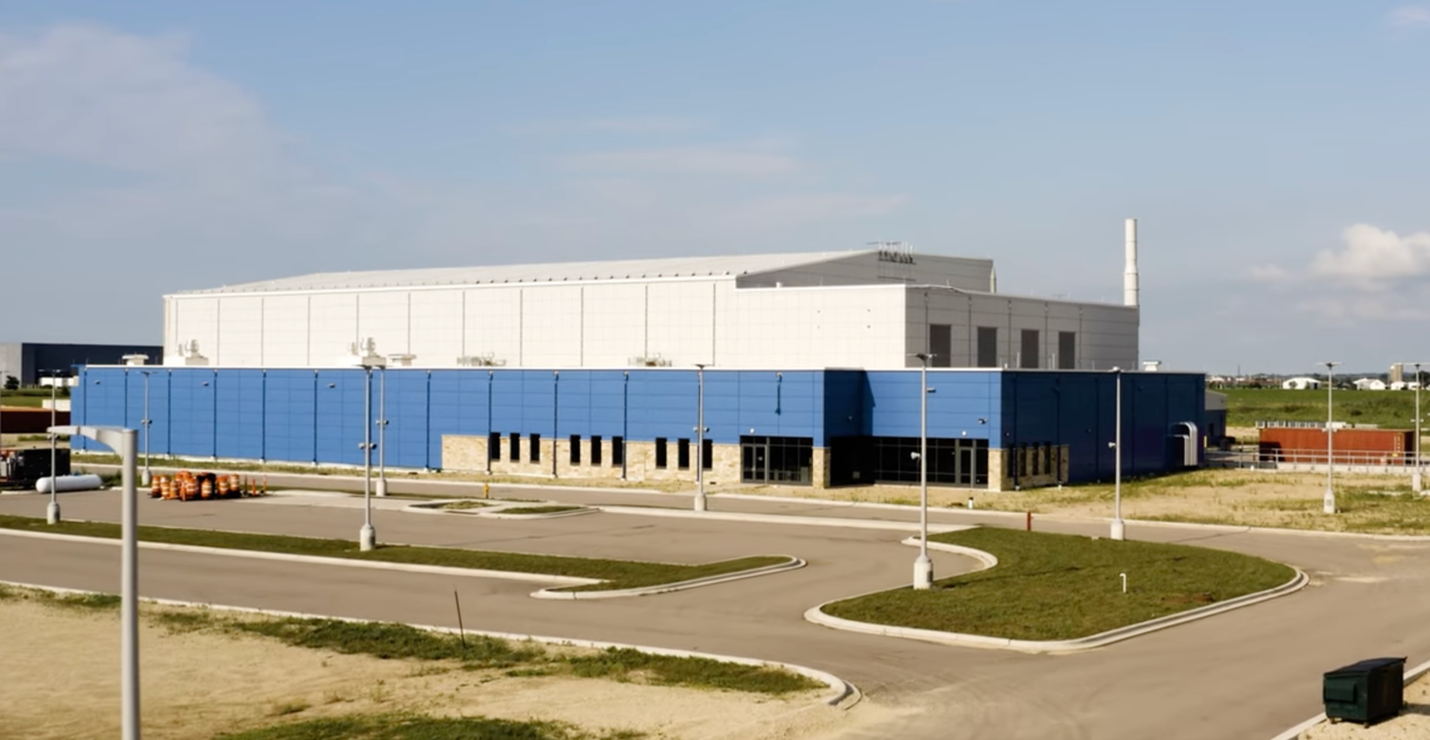
In this issue: The details of ARPA-E’s funding, updates on the NRC’s plans for FOF inspections and the aircraft impact rule, Shine receives a DOE loan, and more. Feature Friday: Today’s feature, from the April 2026 issue of Nuclear News, is by Jonath...
도입부: In this issue: The details of ARPA-E’s funding, updates on the NRC’s plans for FOF inspections and the aircraft impact rule, Shine receives a DOE loan, and more.
Task force charts growing interest in civilian maritime nuclear applications
Over the past 50 years, there has been little momentum around U.S. civilian maritime nuclear power—but that trend is beginning to change. Ports, shipping companies, and coastal and other waterway communities are looking for ways to not only decarbonize but also build energy resilience, and the reality is that there are few scalable zero-carbon options other than nuclear energy. The American Nuclear Society recognizes the opportunity and challenges associated with the advancement of nuclear maritime applications. In 2025, the Operations and Power Division (OPD) of ANS initiated a Civilian Nuclear Maritime Task Force (ANS Maritime Task Force) to act as convener of Society members and participants to integrate into the process of advancing international codes and standards, regulatory harmonization, workforce development, and public policy engagement. The challenges: There are a wide array of issues to overcome before the broad deployment of commercial maritime nuclear technologies can be achieved, including: How emergency planning zones (EPZs) and emergency response responsibilities are defined for mobile or port-adjacent nuclear assets; What the practical emergency response apparatus looks like across operators, ports, and jurisdictions; The establishment of robust training pipelines that bridge the commercial nuclear, naval nuclear, shipbuilding, and advanced manufacturing sectors. Go deeper: Of course, these challenges also represent chances for new innovation, and they are the focus of the ANS Maritime Task Force’s current efforts. To learn more about the work that the group is doing, read Stephens and Adeyeye’s full feature on Nuclear NewsWire.
and Defense Secretary Pete Hegseth talk about the U.S.’s near-term plans for an estimated 970 pounds of high-enriched uranium in Iran. New York Times (subscription required)
have been chosen for nuclear microreactors to bolster mission continuity and national security through the Advanced Nuclear Power for Installations program. U.S. Air Force
is considering Seabrook as a site for a Nuclear Lifecycle Innovation Campus, as the state aims to enhance grid stability and lower costs. New Hampshire Bulletin
signed a bill to lower utility costs by incentivizing nuclear energy development in Kentucky, aiming to replace old coal plants and create jobs in the process. WSAZ
of the nine companies in the DOE’s Reactor Pilot Program, Natura Resources, is in INPO’s program for reactor suppliers. The organization is currently dealing with incorporating industry newcomers into its voluntary programs. E&E News
at Uranium Energy Corp’s Burke Hollow in situ recovery site in Texas. According to the company, Burke Hollow is the largest ISR uranium discovery in the U.S. in the past decade. World Nuclear News
moves to extend the lifespan of the four units at Dukovany NPP by 20 years. The reactors are now slated to run until 2065–2067. Reuters (subscription required)
Ampera is developing what it describes as a subcritical thorium breeder microreactor. It aims to complete a nonfueled prototype by the end of the year. Power Magazine
NRC moves forward with sunset of aircraft impact assessment rule
The Nuclear Regulatory Commission has sunset its aircraft impact assessment rule for 2027, as NRC staff have addressed several of the public comments considered “significant and adverse” that prompted the agency this past winter to temporarily delay the sunsetting move. Go deeper on Nuclear NewsWire.
ARPA-E commits $135 million for fusion commercialization
The Advanced Research Projects Agency–Energy (ARPA-E) announced earlier this week its largest concentrated investment in fusion technology so far, committing $135 million over the next 18 months to fund projects that develop and commercialize fusion technologies. Go deeper on Nuclear NewsWire.
NRC approves overhaul of FOF inspections, baseline security programs
The security drills held at commercial nuclear power plants as part of the Force-on-Force inspection program will no longer be led by the Nuclear Regulatory Commission. Following a 2028 phaseout, drills will be led by the licensee, with the NRC observing. Go deeper on Nuclear NewsWire.
Shine receives $263M conditional DOE loan to complete isotope facility
Fusion technology company Shine has been issued a conditional commitment for a loan of up to $263 million by the Department of Energy’s Office of Energy Dominance Financing to support the construction of the company’s medical isotope production facility in Janesville, Wis. Go deeper on Nuclear NewsWire.
Texas has opened $350 million in state funding to “ensure the development of advanced nuclear energy and associated technologies,” along with the “development of an advanced nuclear energy supply chain and associated manufacturing capacity.” Go deeper on Nuclear NewsWire.
TVA CEO Don Moul announces retirement—Knox News Report finds over 200 issues in construction of Chinese NPPs—Kyodo News DOE-NE awards $49M for nuclear workforce development—DOE Proposed FY 2027 DOE, NRC budgets ask for less—Nuclear NewsWire NRC proposed rule for licensing reactors authorized by DOE, DOD—Nuclear NewsWire
미국 첨단연구프로젝트청-에너지(ARPA-E)가 향후 18개월간 핵융합 기술 개발 및 상용화를 위해 1억 3,500만 달러를 투자하겠다고 발표했으며, 이는 2014년 이후 누적 투자액을 2배로 늘리는 규모다.
백악관의 2027 회계연도 예산안이 에너지부 핵융합 예산을 삭감하는 상황에서, ARPA-E는 반대로 투자를 확대해 엇갈린 정책 신호를 보내고 있다.
ARPA-E의 기존 핵융합 투자는 민간 후속 투자 15억 달러 이상을 유치하는 성과를 거뒀으며, 여러 핵융합 기업의 탄생으로 이어졌다.
---
어제, 첨단연구프로젝트청-에너지(Advanced Research Projects Agency–Energy, ARPA-E)는 핵융합 기술 분야에서 지금까지 가장 큰 규모의 집중 투자를 발표하며, 핵융합 기술의 개발 및 상용화를 위한 프로젝트에 향후 18개월 동안 1억 3,500만 달러를 투입하겠다고 밝혔다.
이 기관은 2014년 ALPHA 프로그램 출범과 함께 핵융합 프로젝트에 대한 지원을 시작한 이래, 상업용 핵융합 분야에 약 1억 3,400만 달러를 투자했다고 밝혔다. 따라서 앞으로 18개월간의 투자는 기관의 핵융합 분야 누적 투자액을 두 배로 늘리는 셈이다.
이번 자금은 핵융합의 가장 어려운 기술적 장벽을 타깃으로 하는 여러 프로그램에 분산 지원될 예정이다. ARPA-E는 효율적이고 저비용의 플라스마 가열 및 구동 시스템, 고급 연료와 새로운 연료 주입 기술, 차세대 펄스 전력 및 전력 변환 시스템, 그리고 혁신적인 발전소 설계 및 부품을 핵심 중점 분야로 제시하며, 발전소 비용 절감, 출력 향상, 핵융합 연료 사이클 단순화, 발전소 부지 면적 축소, 발전소 설계 및 부품의 내구성과 경제적 경쟁력 향상을 목표로 하고 있다.
"핵융합이 가능한지에 대한 의문은 더 이상 없습니다. 이제 문제는 얼마나 빨리 핵융합 발전을 전력망에 연결하느냐, 그리고 미국이 그 성과를 이끌 수 있느냐입니다." ARPA-E 국장 코너 프로차스카(Conner Prochaska)가 말했다. "ARPA-E는 급진적인 아이디어에 과감히 투자하고 혁신적인 공급망을 구축함으로써 미국의 핵융합 발전 산업을 일궈왔습니다. 오늘의 발표는 우리가 그 우위를 더욱 강화해 나가는 방식입니다. 우리는 핵융합 발전과 상업적으로 실현 가능한 시스템 사이에 가로놓인 가장 어려운 기술적 병목 지점을 정면 돌파할 것입니다. 지금 이 순간이 바로 그것을 요구하기 때문입니다."
엇갈린 신호: 이번 발표는 백악관의 2027 회계연도 예산안에 이어 나온 것으로, 해당 예산안은 에너지부 과학국의 핵융합 에너지 과학 이니셔티브 예산을 5,000만 달러(6%) 삭감할 것을 요청하고 있다.
"한 부처는 예산을 늘리면서 다른 부처는 삭감하는 것은 중국보다 먼저 상업용 핵융합을 달성하기 위한 방법이 아닙니다." 핵융합산업협회(Fusion Industry Association) 대표 앤드루 홀랜드(Andrew Holland)가 _Axios_에 밝히며, 중국이 핵융합 분야에 최소 65억 달러를 투자하고 있다는 보도를 언급했다.
또한 해당 예산안은 ARPA-E 전체 예산을 1억 5,000만 달러(43%) 삭감하고, 에너지부 원자력에너지국(DOE Office of Nuclear Energy) 예산을 1억 5,100만 달러(9%) 삭감하는 한편, 신설되는 핵융합국(Office of Fusion)에 1,000만 달러를 배정할 것을 요청하고 있다.
민간 투자 유치: ARPA-E는 아직 검증되지 않은 기술을 개발해 이후 민간 투자를 유치하는 것을 목표로 하고 있다. 기관에 따르면, ARPA-E의 투자는 미국의 "기술, 인재, 공급망 역량의 생태계" 구축에 기여했다. 잡 에너지(Zap Energy), 레알타 퓨전(Realta Fusion), 테아 에너지(Thea Energy), 타입 원 에너지(Type One Energy) 등이 ARPA-E 지원 프로젝트에서 탄생한 핵융합 기업들이다. 기관은 자사의 핵융합 투자가 민간 후속 투자 15억 달러 이상을 유치했다고 밝혔다.
"민간 자본은 이미 눈에 보이는 것을 확장하고, ARPA-E는 시장이 아직 가격을 매기거나 예측할 수 없는 것에 투자합니다(즉, 검증되지 않았지만 잠재력 있는 분야에 선제 투자한다는 의미)." 프로차스카가 _Latitude Media_에 말했다. "벤처 캐피털은 기업이 제품을 만들도록 자금을 지원하지, 그 이정표에 도달하는 데 필요한 근본적인 과학적 도전을 해결하는 데는 자금을 지원하지 않습니다."
최근 지원 현황: 2024년, ARPA-E는 '핵융합 제1벽 재료의 중앙 집중적 지식 통합을 통한 강화·내구성 창출(Creating Hardened And Durable Fusion First Wall Incorporating Centralized Knowledge, CHADWICK)' 프로그램을 출범시켰으며, 핵융합 발전소의 40년 설계 수명 동안 성능을 유지할 수 있는 제1벽(first-wall) 재료를 연구하는 13개 프로젝트에 2,500만 달러 이상을 지원했다.
---
AI 분석
ARPA-E의 이번 1억 3,500만 달러 투자 발표는 미국 핵융합 정책의 내부 모순을 선명하게 드러낸다. 같은 정부 내에서 ARPA-E는 핵융합 투자를 두 배로 늘리는 반면, 백악관 예산안은 ARPA-E 자체 예산을 43% 삭감하고 에너지부 핵융합 예산도 줄이도록 요청하고 있어, 일관된 국가 전략의 부재가 우려된다. 중국이 65억 달러 이상을 핵융합에 투입하는 상황에서 이러한 정책 불일치는 미국의 전략적 경쟁력을 약화시킬 수 있다는 업계의 경고가 주목된다. 한편 ARPA-E가 기존 투자를 통해 15억 달러 이상의 민간 자본을 유치한 성과는 공공 투자의 촉매 효과를 잘 보여주며, 이번 투자가 플라스마 가열, 고급 연료, 차세대 발전소 설계 등 상용화의 핵심 기술 장벽에 집중하고 있다는 점에서 단순한 연구 지원을 넘어 산업 생태계 전반을 육성하려는 전략적 의도가 엿보인다. 핵융합 상용화 경쟁에서 미국이 주도권을 유지하기 위해서는 부처 간 정책 조율과 지속적인 투자 의지가 필수적이다.
올킬루오토, 핀란드 (AP) — 버튼을 누르자, 엘리베이터가 수백 미터를 순식간에 내려가 온칼로(Onkalo)의 어두운 심연 속으로 사라졌다.
지질학자 투오마스 페레(Tuomas Pere)는 인공 터널의 미로를 자동차로 헤쳐나가며 중얼거렸다. "지금 우리는 지하 약 430미터(1,411피트) 지점에 있습니다. 19억 년 된 기반암을 통과하고 있습니다."
수십 년에 걸친 건설 끝에, 세계 최초의 사용후 핵연료 영구 처분 시설이 핀란드에서 가동을 앞두고 있으며, 수십 톤에 달하는 위험한 방사성 폐기물의 최종 안식처가 될 예정이다.
핀란드어로 "동굴"을 의미하는 온칼로(Onkalo) 건설은 2004년 서부 해안에서 시작되었다. 울창한 숲속의 외딴 섬 올킬루오토(Olkiluoto)에 자리잡고 있으며, 가장 가까운 도시는 내륙으로 약 15킬로미터(9.3마일) 떨어진 에우라요키(Eurajoki)로, 약 9,000명의 주민이 살고 있다. 이 중 많은 이들이 원자력 발전소나 저장 시설에서 근무한다.
Olkiluoto Nuclear Power Plant seen on the island of Olkiluoto, Finland, Tuesday, Feb. 24, 2026. \(AP Photo/James Brooks\)
핀란드 올킬루오토(Olkiluoto) 섬에 위치한 올킬루오토 원자력 발전소, 2026년 2월 24일 화요일 촬영. (AP 사진/제임스 브룩스(James Brooks))
10억 유로(12억 달러) 규모의 이 프로젝트는 조만간 운영 개시될 것으로 예상되며, 당국은 수개월 내에 허가를 승인할 것으로 전망된다.
현재 전 세계 어디에도 상업용 원자력 폐기물을 위한 영구 지하 처분 시설이 운영 중인 곳은 없다. 스웨덴은 지난해 스톡홀름에서 북쪽으로 약 150킬로미터 떨어진 포스마르크(Forsmark)에 저장소 건설을 시작했지만, 2030년대 후반까지는 개장이 어려울 것으로 보인다. 프랑스의 시제오(Cigéo) 프로젝트는 아직 건설을 시작하지 못했으며 반대에 부딪혀 왔다.
온칼로(Onkalo) 시설은 2120년대까지 운영된 후 영구적으로 봉인될 예정이다.
'불확실성이 존재한다'
그러나 미국의 비영리 단체인 우려하는 과학자 연합(Union of Concerned Scientists)의 원자력 안전 담당 이사 에드윈 라이먼(Edwin Lyman)은 원자력 폐기물의 지질학적 처분에는 여전히 "불확실성"이 가득하다고 경고했다.
"원자력 폐기물 처분에 대한 제 견해는, 좋은 선택지가 없다는 것입니다. 하지만 가장 덜 나쁜 선택지를 찾는 것이 중요하며, 지질학적 처분은 일반적으로 여러 나쁜 선택지들 가운데 가장 덜 나쁜 선택지가 될 것입니다"라고 그는 말했다.
라이먼(Lyman)은 사용후 핵연료를 담은 구리 캐니스터가 결국에는 부식될 것이며, 그 속도에 대해서는 과학계 내에서도 다양한 의견이 있다고 말했다.
"그 과정이 매우 느려서 대부분의 방사성 물질이 그때까지 붕괴될 것이라는 희망이 있습니다. 하지만 다시 말하지만, 불확실성이 존재합니다"라고 그는 말했다.
그럼에도 불구하고, 라이먼(Lyman)은 사용후 핵연료를 지하 깊은 곳에 영구적으로 저장하는 것이 "지구 표면에 영원히 방치하는 것"보다 낫다고 말했는데, 지상에 보관된 원자력 물질은 "파괴 행위에 취약하기" 때문이라고 했다.
"사용후 연료가 원자로에서 방출된 후 수십 년 동안은 방사능이 너무 강해 운반과 재처리가 매우 어렵습니다"라고 라이먼(Lyman)은 말했다. 하지만 결국에는 주요 방사성 성분이 붕괴되어 취급이 덜 위험해질 것이라고 그는 덧붙였다.
"따라서 시간이 지남에 따라 플루토늄은 테러리스트나 이를 이용하려는 국가에 더 접근하기 쉬워집니다"라고 그는 말하며, 테러리스트나 국가가 이론적으로 해당 물질을 핵폭탄에 사용할 수 있는 유일한 방법은 "외부 재처리 능력"을 보유했을 경우라고 덧붙였다.
재처리 과정에서 사용후 핵연료는 분리되어 우라늄과 플루토늄을 회수하고, 이를 새로운 연료로 재활용합니다. 이 과정은 분리된 플루토늄이 잠재적으로 핵무기 제조에 전용될 수 있기 때문에 핵 확산 위험도 수반합니다.
전반적으로, 원자력 폐기물 저장소와 관련된 위험은 주로 "미래 세대"에 영향을 미칠 것이라고 라이먼(Lyman)은 결론지었습니다.
이 과제를 해결하기 위해, 원자력 기호학이라고 불리는 학제간 연구 분야가 수립되었으며, 이는 지금으로부터 1만 년 후의 인류—혹은 원자력 폐기물이 더 이상 위험하지 않아지기까지 수십만 년이 걸린다는 점을 감안하면 그보다 훨씬 더 먼 미래—가 이해할 수 있는 원자력 폐기물 저장소에 대한 경고 표시를 개발하는 방법을 연구합니다.
참고로: 최초의 인류는 약 30만 년 전에 살았습니다. 최초의 문자 체계는 대략 5,200년에서 5,400년 전 메소포타미아에서 개발되었습니다. 영국의 스톤헨지는 약 5,000년 된 반면, 이집트의 기자 피라미드는 약 4,500년 된 것으로 추정됩니다.
A trial copper casing is placed at Posiva's encapsulation plant on the island of Olkiluoto, Finland, Tuesday, Feb. 24, 2026. \(AP Photo/James Brooks\)
A trial copper casing is placed at Posiva's encapsulation plant on the island of Olkiluoto, Finland, Tuesday, Feb. 24, 2026. (AP Photo/James Brooks)
A trial copper casing is placed at Posiva's encapsulation plant on the island of Olkiluoto, Finland, Tuesday, Feb. 24, 2026. \(AP Photo/James Brooks\)
A trial copper casing is placed at Posiva's encapsulation plant on the island of Olkiluoto, Finland, Tuesday, Feb. 24, 2026. (AP Photo/James Brooks)
오스트리아 예술가이자 발명가인 마르틴 쿤체(Martin Kunze)는 파리에 본부를 둔 경제협력개발기구(OECD) 산하 원자력 에너지 기구(Nuclear Energy Agency)에서 장기 정보 보존에 관한 전문가 그룹을 이끌어 왔다. 그는 "원자력 메시지"라고 부르는 시스템을 개발했는데, 이는 단단한 유약 표면 아래 견고한 세라믹 판에 인쇄된 미래 세대를 위한 중요 정보다.
쿤체는 세라믹 판이 "저렴하고 매우 견고하며", 이상적으로는 처분장 주변 지역에 "대량으로" 매설되어야 할 뿐만 아니라 지역사회 내 모든 주택의 "기초부에도" 매설되어야 한다고 말했다. 목표는 해당 지역에 가능한 한 많은 세라믹 판을 배포하는 것이어야 한다.
핀란드 관리들은 온칼로(Onkalo) 원자력 처분장이 원자력 에너지 정책에 대한 핀란드의 장기적 접근 방식을 반영한다고 말한다.
1994년에 제정된 법률은 핀란드에서 발생한 방사성 폐기물을 국내에서 처리, 저장 및 영구 처분하도록 요구했다.
"당시에는… 일부 폐기물이 여전히 수출되고 있었지만, 우리는 스스로 처리하기를 원했습니다," 사리 물탈라(Sari Multala) 핀란드 환경부 장관이 말했다. "우리는 또한 많은 다른 나라들과 달리 결정을 고수합니다."
물탈라 장관은 결국 다른 나라로부터 제한된 양의 핵폐기물을 받아들일 가능성을 배제하지 않았다. "소규모로는 국제 규제 기관이 허용하는 한 어떤 가능성이 있을 수 있습니다"라고 그녀는 말했다.
수십 년간의 건설 끝에, 사용후 핵연료를 영구적으로 처분하기 위한 세계 최초의 시설이 핀란드에서 가동을 시작할 예정이며, 수 톤의 위험한 방사성 폐기물의 영구 안치 장소가 될 것이다. 핀란드어로 "동굴"을 의미하는 온칼로(Onkalo)의 건설은 2004년 서해안에서 시작되었다. 울킬루오토(Olkiluoto) 섬의 외딴 곳에 위치하며, 울창한 산림 지역에 자리하고 있다. 가장 가까운 도시는 내륙으로 약 15킬로미터(9.3마일) 떨어진 에우라요키(Eurajoki)로, 약 9,000명의 주민이 거주한다. 많은 주민들이 발전소나 저장 시설에서 일한다. (AP 영상: 제임스 브룩스(James Brooks))
핀란드의 온칼로(Onkalo) 시설은 세계 최초의 영구 핵폐기물 처분장으로, 수십 년간의 건설 끝에 드디어 운영을 시작할 예정이라는 점에서 원자력 에너지 역사에서 획기적인 이정표를 의미한다. 19억 년 된 암반층 지하 430미터에 위치한 이 시설은 수천 년에 걸쳐 방사성 폐기물을 안전하게 격리할 수 있는 지질학적 안정성을 갖추고 있어, 사용후핵연료 처분의 기술적 실현 가능성을 실증하는 최초의 사례가 된다. 이 시설의 성공적인 운영은 전 세계 원자력 발전국들이 직면한 핵폐기물 처분 문제에 대한 해결책을 제시하며, 심층 지질처분 방식이 국제적 표준으로 자리잡는 데 중요한 선례가 될 것이다. 핀란드가 이 분야에서 선도적인 역할을 맡게 됨으로써, 다른 국가들이 자국의 핵폐기물 처분 계획을 수립하고 추진하는 데 있어 실질적인 참고 모델이 제공된다. 온칼로 프로젝트는 단순한 공학적 성취를 넘어, 현 세대가 미래 세대에게 안전한 환경을 물려줄 책임을 다하는 윤리적 실천이기도 하다.
※ 이 글은 해외 원자력 바로알기를 위한 정보 전달을 목적으로 제공됩니다. 특정 기업이나 종목에 대한 투자 권유가 아니며, 모든 투자 판단과 그에 따른 책임은 투자자 본인에게 있습니다.
한국어
베시어(Beshear) 주지사, 원자력 에너지를 통한 공공요금 인하를 목표로 하는 법안에 서명
베시어(Beshear) 주지사, 원자력 에너지를 통한 공공요금 인하를 목표로 하는 법안에 서명
2026년 4월 10일
요약
카테고리: 원자력 정책
켄터키(Kentucky) 주지사 앤디 베시어(Andy Beshear)가 원자력 발전 기업 유치를 통해 공공요금을 낮추기 위한 법안 SB 57에 서명했다.
해당 법안은 구형 석탄 발전소 부지에 원자력 발전소를 건설하는 방안을 추진하며, 동부 켄터키 지역에 일자리 창출과 전기요금 인하 효과가 기대된다.
원자력 발전소 전환 시 건설 비용 최대 35% 절감과 650개 이상의 영구적 일자리 창출이 가능하다는 미국 에너지부 보고서가 근거로 제시되었다.
---
파이크 카운티(Pike County), 켄터키(Ky.) (WSAZ) - 수요일, 켄터키 주지사 앤디 베시어(Andy Beshear)는 원자력 발전 기업의 주내 유치를 장려함으로써 공공요금을 낮추기 위한 목적의 법안에 서명했다.
SB 57은 켄터키 내 원자력 에너지 개발을 촉진하기 위한 '원자력 원자로 부지 준비 시범 프로그램(Nuclear Reactor Site Readiness Pilot Program)'을 신설한다. 지지자들은 이 계획이 장기적으로 켄터키 주민들의 공공요금을 낮출 것이라고 말한다.
법안 공동 발의자 중 한 명인 필립 휠러(Phillip Wheeler) 주 상원의원(공화당, 파이크 카운티)은 WSAZ에 동부 켄터키의 구형 석탄 발전소 부지에 원자력 발전소를 세우고 싶다고 밝히며, 이 프로젝트가 해당 지역에 일자리와 공공요금 인하를 가져올 것이라고 말했다.
"일부 석탄 발전소를 원자력 발전소로 대체할 수 있다면, 동부 켄터키에 일자리를 제공하면서 동시에 더 저렴하고 안정적인 전력을 공급하는 방법이 될 것이라고 생각합니다," 라고 그는 말했다.
"기반 시설이 갖춰진 일부 석탄 발전소들이 폐쇄될 시점에, 그 자리에 원자력 발전소를 설치하면 발전소 건설 비용을 최대 30%까지 절감하면서도 절실히 필요로 하는 지역에 수백 개의 고임금 일자리를 제공할 수 있습니다," 라고 휠러(Wheeler)는 자신이 읽은 연구를 인용하며 덧붙였다.
미국 에너지부의 보고서에 따르면, "신규 원자력 발전소는 폐쇄된 석탄 발전소의 기존 부지 자산을 얼마나 재활용할 수 있느냐에 따라 건설 비용을 최대 35%까지 절감할 수 있다."
같은 보고서는 "신설 원자력 발전소와 관련하여 해당 지역의 고용이 발전소, 공급망, 주변 지역사회에 걸쳐 650개 이상의 영구적 일자리 형태로 증가할 수 있다"고 밝혔으며, 원자력 분야 일자리의 임금은 다른 에너지 분야 일자리보다 50% 높다고 나타났다.
휠러(Wheeler)는 또한 원자력이 다른 에너지원보다 효율적인 것으로 간주되어 비용 절감에 기여하며, 과거에 비해 더 안전하게 생산할 수 있다고 언급했다.
"저는 이것이 동부 켄터키의 현대성에 대한 비전이라고 생각합니다," 라고 그는 WSAZ에 말했다. "많은 사람들이 동부 켄터키를 과거에 머물러 있는 곳으로 생각하고 싶어 합니다. 하지만 저는 이 법안의 가능성이 동부 켄터키가 빛나는 과거를 가졌을 뿐만 아니라, 자랑스러운 미래, 즉 밝은 미래와 함께하는 자랑스러운 과거를 가질 수 있다는 것을 보여준다고 생각합니다."
다만 휠러(Wheeler)는 동부 켄터키 주민들의 높은 공공요금에 대한 잠재적 해결책이 실현되기까지는 수년이 걸릴 것이라고 말했다.
"저는 누구에게도 헛된 희망을 주고 싶지 않습니다. 이것은 하룻밤 사이에 문제를 해결할 수 있는 것이 아닙니다," 라고 그는 말했다. "하지만 이 법안이 하는 일은, 기반 시설을 갖추고 원자력에 투자하고자 하는 사람들에게 켄터키 연방이 협력할 준비가 된 곳이라는 것을 알리는 것입니다. 구체적으로는 이 원자로와 발전소 중 하나를 설치하기 위한 부지 준비 및 허가 비용 2,500만 달러의 최소 3분의 1을 부담할 의지가 있음을 표명함으로써 신뢰할 수 있는 인프라를 개발하는 데 함께하겠다는 것입니다."
휠러(Wheeler)에 따르면, 원자력 에너지는 에너지 비용을 낮추는 데 있어 퍼즐의 한 조각에 불과하다.
"저는 성공적인 경제 전략의 핵심이 다양한 옵션을 갖추는 것이라고 생각합니다," 라고 그는 말했다. "저는 태양광도, 풍력도, 석탄도, 가스도, 원자력도, 수력도 모두 지지합니다. 이 모든 것을 아우르는 전략(all of the above strategy, 특정 에너지원에 편중되지 않고 모든 선택지를 활용하는 접근법)이야말로 가장 안정적이고 저렴한 에너지 비용을 달성할 수 있는 방법입니다."
저작권 2026 WSAZ. 모든 권리 보유.
---
AI 분석
켄터키 주의 SB 57 법안 서명은 미국 중부 지역에서 원자력 에너지가 에너지 전환 정책의 핵심 수단으로 부상하고 있음을 보여준다. 특히 구형 석탄 발전소 부지를 원자력 발전소로 전환하는 전략은 기존 인프라를 활용하여 건설 비용을 절감하면서도 탄소 배출을 줄일 수 있는 실용적인 접근법으로 주목된다. 동부 켄터키처럼 석탄 산업 의존도가 높은 지역에서는 원자력으로의 전환이 경제적 활성화와 에너지 전환이라는 두 가지 목표를 동시에 달성하는 수단이 될 수 있다. 다만 법안 발의자 스스로도 인정했듯이, 실질적인 효과가 나타나기까지는 상당한 시간이 필요하며, 원자력 발전소 건설에 따른 규제, 안전, 비용 문제 등 해결해야 할 과제도 적지 않다. 이 법안은 원자력을 단일 해결책이 아닌 다양한 에너지 믹스(energy mix)의 일환으로 추진한다는 점에서, 장기적으로 에너지 안보와 경제성을 동시에 추구하는 균형 잡힌 전략으로 평가할 수 있다.
워싱턴 — 미국 에너지부(DOE) 원자력 에너지 사무소는 오늘 전국 원자력 안전 교육 프로그램 및 교육과정을 확대할 10개 대학 주도 프로젝트에 4,970만 달러 이상을 경쟁 방식으로 지원했습니다. 이번 지원은 국가 에너지 패권(energy dominance), 독립, 안보 달성을 위한 원자력 에너지 르네상스 가속화에 대한 트럼프(Trump) 대통령의 의지를 뒷받침합니다.
"원자력 에너지가 늘어난다는 것은 원자력 에너지 일자리가 늘어난다는 의미입니다," 라고 전략적 교차 현안 담당 대리 부차관보 미셸 스콧(Michelle Scott)이 말했습니다. "오늘의 지원은 차세대 원자력 에너지 종사자들이 최고 수준의 안전 기준을 증진하는 견고하고 엄격한 교육을 받을 수 있도록 보장하는 데 도움이 됩니다."
원자력 에너지 분야는 향후 25년간 전례 없는 일자리 성장이 예상됩니다. 원자력 발전소가 운영 면허 갱신을 통해 수명을 연장하는 가운데, 업계는 고령화 인력과 은퇴 문제에 직면해 있습니다. 국가의 증가하는 에너지 수요에 발맞추기 위해서는 경수로(light-water reactor) 함대의 장기적인 유지보수와 지속적인 운영이 계속해서 필요합니다.
원자력 에너지 산업의 숙련된 인력 수요 증가에 대응하기 위해, 에너지부(DOE)는 원자력 원자로 안전 교육 및 인력 개발 프로그램을 출범시켰습니다. 이 새로운 프로그램은 강화된 원자력 안전 교육과정 및 훈련의 개발, 시연 및 실행을 지원하기 위해 최대 1억 달러의 자금을 제공할 예정입니다. 모든 수혜자는 50%의 비용을 분담할 책임이 있습니다.
오늘의 지원 내역은 다음과 같습니다:
시연 및 실행
원자로 안전 교육 컨소시엄(CRεST, The Consortium for Reactor Safety Training)은 노스캐롤라이나 주립대학교(North Carolina State University)가 주도하며, 원자력에 대한 우려를 해소하고 경제적·환경적 이점을 부각하는 방식으로 지역사회를 원자력 에너지 논의에 참여시키는 전략을 개발할 예정입니다. (1,830만 달러)
원자력 인력 강화를 위한 오대호 파트너십(GLP, The Great Lakes Partnership to Enhance the Nuclear Workforce)은 톨레도 대학교(University of Toledo)가 주도하며, 경수로 인력을 위한 기존 안전 교육 파이프라인(pipeline, 체계적인 인력 공급 경로)을 강화하고, 원자력 분야에 자격을 갖춘 인재를 유치하며, 선진 원자로 개념에 맞는 교육과정을 현대화하고, 업계 공인 원자력 원자로 안전 자격증을 신설할 예정입니다. (1,920만 달러)
교육 수요 파악 및 교육과정 개발
펜실베이니아 주립대학교(Pennsylvania State University)는 산업 파트너가 식별한 원자력 업계 인력의 중요한 공백을 해소하기 위한 교육 수료 프로그램과 이에 상응하는 자격증 제도를 수립할 예정입니다. (200만 달러)
녹스빌 소재 테네시 대학교(University of Tennessee at Knoxville)는 업계 공인 교육 및 자격증을 지원하기 위한 교육과정 개발과 수업에 집중할 예정입니다. (200만 달러)
어바나-샴페인 소재 일리노이 대학교(University of Illinois, Urbana-Champaign)는 미래에 안전한 함대 운영을 보장하기 위한 독보적인 원자력 사이버 보안 교육 역량을 개발할 예정입니다. (150만 달러)
퍼듀 대학교(Purdue University)는 학생 및 전문가를 대상으로 원자력 품질 보증, 시스템 무결성 관리 및 원자로 안전 분석에 관한 새로운 학술 교육과정을 개발할 예정입니다. (160만 달러)
워싱턴 주립대학교(Washington State University)는 원자력 에너지 분야의 인력 공백 해소를 목표로 하는 '원자로 준비 교육 프로그램(Reactor Ready Training Program)' 교육 이니셔티브를 개발할 예정입니다. 이 프로그램은 워싱턴 주립대학교, 컬럼비아 베이신 칼리지(Columbia Basin College), 그리고 기타 주요 업계 관계자들과의 파트너십을 통해 원자력 발전소 운영, 안전 및 기타 산업 수요에 학생들을 준비시키는 교육과정을 개발할 것입니다. (140만 달러)
렌슬리어 폴리테크닉 인스티튜트(Rensselaer Polytechnic Institute)가 주도하는 RENEW 파트너십 프로그램(The RENEW partnership program)은 인력 교육 및 안전 교육을 강화하고, 혁신적인 교육 프로그램을 개발·제공하며, 원자력 산업에 대한 대중 인식을 제고할 예정입니다. (110만 달러)
네브래스카-링컨 대학교(University of Nebraska-Lincoln)는 원자력 공학 분야의 새로운 강좌를 개발하고 원자력 원자로 안전 분야의 업계 공인 자격증을 신설하는 것 외에도, 학생들에게 새로운 학습 및 인턴십 기회와 강화된 지역사회 봉사 활동을 제공할 예정입니다. (140만 달러)
메인 해양 아카데미(Maine Maritime Academy)는 '원자력 상선 선원 교육 훈련 센터(Center for Education and Training of the Nuclear Merchant Mariner)'를 설립할 예정이며, 여기에는 원자력 공학 기술 프로그램 개발, 국제해사기구(International Maritime Organization)가 승인하는 원자로 운영자 과정 설계, 그리고 부유식 원자력 발전소의 타당성 시연이 포함됩니다. (100만 달러)
이번 에너지부의 4,970만 달러 지원은 원자력 에너지 분야의 구조적 인력 위기에 대한 직접적인 정책적 대응으로 해석된다. 경수로의 수명 연장과 소형모듈원자로(SMR) 등 선진 원자로 기술 도입이 가속화되는 가운데, 기존 인력의 은퇴와 신규 인력 부족이라는 이중 과제를 해결하기 위해 대학 교육 생태계 전반에 걸친 체계적인 투자가 이루어지고 있다. 특히 사이버 보안, 부유식 원자력 발전, 지역사회 참여 전략 등 미래 지향적 분야를 포함함으로써, 단순한 운영 인력 양성을 넘어 원자력 산업의 다양한 수요에 대응하는 폭넓은 인재 파이프라인 구축을 목표로 하고 있다. 총 1억 달러 규모로 예정된 이 프로그램의 2차 지원 발표가 예고된 만큼, 미국의 원자력 인력 개발 정책은 향후 더욱 본격화될 전망이다.
원자력규제위원회(NRC)가 에너지부(DOE) 또는 국방부(DOD)의 승인을 받은 원자로 설계에 대해 상업용 면허 취득 간소화 경로를 마련하는 규칙을 제안했다.
행정명령 14300에 따라 NRC는 이미 DOE·DOD의 검토를 거친 원자로 설계에 대해 신속 경로를 수립해야 하며, NRC의 최종 결정권은 유지된다.
이 제안 규칙에 대한 공개 의견은 2026년 5월 4일까지 제출 가능하며, 4월 14일 공청회가 예정되어 있다.
---
에너지부(Department of Energy) 또는 국방부(Department of Defense)가 승인한 원자로 설계는, 신청자가 해당 기술을 민간 부문으로 확대하고자 할 경우, 원자력규제위원회(Nuclear Regulatory Commission, NRC)의 상업용 면허 절차를 보다 간소화된 경로로 통과할 수 있게 될 전망이다.
4월 2일 NRC가 도입한 제안 규칙은 "해당하는 경우, 원자로 신청자가 설계의 안전 기능을 입증하는 추가적인 수단을 규정을 통해 명시적으로 확립함으로써 NRC 면허 심사 효율성을 개선하고, 이를 통해 민간 원자력 에너지 기술의 안전하고 안정적인 활용과 보급에 기여할 것"이라고 밝혔다.
의미: NRC는 원자력에너지법(Atomic Energy Act)에 따라 상업용 원자로를 규제할 권한을 갖고 있으며, DOE와 DOD는 국방 원자력 시설이나 원자로 실증 프로젝트 등 비상업적 사업을 규제할 수 있다. 행정명령 14300은 NRC가 이미 DOE 또는 DOD의 검토를 거쳐 "안전하게 기능할 수 있는 능력을 입증"한 원자로 설계에 대한 신속 경로를 수립하도록 지시하고 있다. 연방관보 공고에 따르면
이 제안 규칙은 10 CFR 파트(Part) 50 및 53에 개정 조항을 추가하며, NRC 관계자들은 이를 통해 해당 목적을 달성할 수 있다고 밝혔다.
NRC 위원장 호 니에(Ho Nieh)는 오늘 오전 언론 통화에서 "이번 제안 규칙은 새로운 원자로의 안전한 배치를 가속화하기 위한 미국 정부의 효과적인 협력을 반영한다"고 말했다. "다른 연방 기관이 이미 힘든 작업을 마쳤다면(상당한 사전 검토를 완료했다면), NRC는 원자로 개발자들에게 처음부터 다시 시작하도록 요구하지 않을 것이다."
NRC 운영 집행이사 마이크 킹(Mike King)은 DOE의 원자로 시범 프로그램(Reactor Pilot Program) 참여자 중 일부가 DOE와 NRC에 배치된 12명의 NRC 직원들과의 기존 협의를 기반으로 상업용 면허를 취득하기를 원한다는 사실을 기관이 인지하고 있다고 밝혔다.
신청자가 NRC에 면허를 신청하고자 할 경우, 제안 규칙은 신청자가 다른 연방 기관 아래에서 수행한 모든 작업을 정리하여 해당 프로젝트가 NRC 요건과 일치함을 보여줄 것을 요구한다. 이는 신청자에게도 도움이 될 뿐 아니라, "NRC가 자체 심사를 가속화할 수 있게 해줄 것"이라고 킹은 말했다.
원자로 개발자와의 소통 필요성을 예상하여, NRC는 이미 공개적으로 이용 가능한 사전신청(preapplication) 프로세스를 통한 홍보 창구를 마련했다. 킹은 이 과정이 개발자들로 하여금 NRC와의 협력 방식, DOE 또는 DOD에 비해 NRC의 역할, 그리고 향후 예상 사항을 이해하는 데 도움이 된다고 설명했다.
관계자들은 이 경로를 통해 원자로 설계가 얼마나 신속하게 신속 심사를 받을 수 있을지는 프로젝트의 범위가 넓고 좁은 정도, DOE 시범 프로젝트가 비상 대비(emergency preparedness)와 같은 사항을 다루었는지 여부, 원자로가 새로운 지리적 위치로 이전하는지 여부 등 여러 요인에 달려 있다고 밝혔다.
"시범 프로젝트의 범위와, 해당 시범을 상업용 [원자로]로 전환하려 할 때 무엇이 새롭고 다른지에 따라 크게 달라질 것입니다"라고 킹은 말했다.
NRC의 역할: NRC의 독립성은, 다른 기관이 원자로 프로젝트에 더 큰 감독 권한을 갖는 인상을 줄 수 있는 행정명령(EO)과 관련된 최근 활동 전반에 걸쳐 의문시되어 왔으며, 이번 제안 규칙에서도 DOE와 DOD가 두드러지게 등장한다. 오늘 통화에서 니에 위원장은 이 제안 규칙에 해당하는 모든 심사에서 NRC가 최종 결정권을 가질 것이며, 이 과정에서 타 기관의 작업을 그대로 통과시키는 "고무도장 찍기(rubber stamping, 형식적 승인)"는 없을 것이라고 말했다.
"NRC는 이 과정을 통해 결정을 내리고 그 결정에 책임을 집니다"라고 그는 말했다. "다른 어떤 연방 기관도 NRC에게 어떤 결정을 내려야 하는지 말하지 않을 것입니다."
이는 NRC의 관리예산처(Office of Management and Budget, OMB) 참여 및 규칙 제정에도 적용된다. 니에 위원장은 OMB 프로세스를 통해 규칙을 제출하면 OMB가 규제 분석 등에 관한 의견과 질문으로 응답한다고 밝혔다. 그러나 NRC 관계자들은 이 분야의 기술 전문가이며, 그들의 "기술적 판단은 기관 간 검토를 통해서도 그 자체로 인정받는 경향이 있다"고 덧붙였다.
추가 정보: 제안 규칙에 대한 공개 의견은 2026년 5월 4일까지 regulations.gov를 방문하여 Docket ID NRC–2025–1503을 검색함으로써 제출할 수 있다. NRC 보도자료에 따르면 해당 규칙에 관한 공청회가 4월 14일에 개최될 예정이다.
NRC는 연방관보 공고 게재 시점에 규제 분석을 준비하지 않은 상태였다. 그러나 공고에는 "NRC는 신청서 작성 신청자와 신청서를 검토하는 NRC 양측 모두에게 비용 절감이 기대된다. . . . 이러한 절감은 DOE/DOD 검토의 NRC 요건 적용 가능성 및 신청자의 해당 적용 가능성 입증 능력, 이전 DOE/DOD 승인을 참조할 수 있는 신청서 수, 이전에 승인된 설계와의 잠재적 차이(예: 설계 변경 또는 부지 특수 요인)가 NRC 요건을 어떻게 충족하는지에 따라 달라질 것"이라고 명시되어 있다.
---
AI 분석
이번 NRC 제안 규칙은 DOE 및 DOD가 이미 검토·승인한 원자로 설계에 대해 상업용 면허 취득의 행정적 중복을 줄이려는 시도로, 미국 내 신규 원자력 기술 상용화를 가속화하기 위한 규제 현대화의 일환이다. 특히 DOE의 원자로 시범 프로그램에 참여 중인 소형모듈원자로(SMR) 및 차세대 원자로 개발자들에게 실질적인 혜택이 돌아갈 것으로 기대된다. 다만 NRC는 자체 독립성과 최종 결정권을 명시적으로 강조함으로써, 안전 규제의 형식화 우려를 불식시키고자 했다. 공개 의견 수렴 기간(~5월 4일)과 공청회(4월 14일)를 통해 업계, 시민사회, 전문가들의 다양한 의견이 수렴될 예정이며, 최종 규칙의 세부 내용은 이 과정을 통해 구체화될 전망이다. 이 규칙이 최종 확정될 경우, 연방 기관 간 협력 체계를 통해 원자력 기술의 민간 전환 경로가 보다 명확해질 것이다.
백악관은 DOE 원자력에너지국(Office of Nuclear Energy)에 FY 2027 예산으로 15억 달러를 요청했으며, 이는 전년 대비 약 9% 감소한 수치다.
NRC는 FY 2027 예산으로 8억 9,230만 달러를 요청했으며, 이는 FY 2026 확정 예산 대비 약 8% 감소한 수치로 인력도 7% 줄인다.
DOE 전체 예산은 539억 달러로 전년 대비 약 10% 증가했으며, 이 중 328억 달러가 국가핵안보국(NNSA)에 배정되어 원자력 안보 분야에 집중 투자된다.
---
백악관은 FY 2027 예산안에서 에너지부(Department of Energy, DOE) 원자력에너지국(Office of Nuclear Energy)에 15억 달러를 요청했으며, 이는 전년 대비 약 9% 감소한 수치다.
트럼프(Trump) 행정부의 이번 요청은 지난 금요일 공개된 예산안에 포함된 원자력 에너지 관련 여러 항목 중 하나다. 예산안은 아직 의회의 검토와 표결을 거쳐야 한다.
"이 예산안은 [DOE]가 미국 에너지 패권의 황금시대(golden era)를 열겠다는 약속을 이행하고, 국가에 이익이 되는 과학적 발전에 집중하며, 국가를 보호할 수 있도록 할 것입니다." — DOE 예산 개요 중에서
DOE: DOE 예산에서 원자력 에너지와 관련하여 주목할 만한 요청 사항은 다음과 같다:
국립원자로혁신센터(National Reactor Innovation Center, NRIC)를 포함한 선진원자로실증프로그램(Advanced Reactor Demonstration Program, ARDP)에 2억 2,600만 달러 배정. NRIC는 미국 국립연구소의 지원을 받아 신형 원자로를 시험·실증하는 임무를 맡고 있다. ARDP 배정액은 FY 2026 확정 예산 대비 약 16% 감소한 수치다.
연료주기 연구개발(R&D)에 2억 1,850만 달러 배정으로, FY 2026 확정 예산 대비 55% 감소한 수치다. 단, DOE는 이 R&D 예산 항목에서 삭감된 두 세부 항목—사용후핵연료처분 R&D 및 통합폐기물관리시스템—이 '사용후핵연료 및 고준위폐기물 처분'이라는 새 항목으로 재배정되었다고 설명했다.
석탄, 천연가스, 원자력 발전 설비 업그레이드를 포함한 "기저부하 전력(baseload power)의 신속한 생산 및 송전 지원" 활동에 35억 달러 배정. 이 중 전력국(Office of Electricity)에 2억 300만 달러, 적격 기저부하 발전 프로젝트를 위한 에너지패권금융국(Office of Energy Dominance Financing) 내 신용보조금으로 2억 달러가 포함된다.
아이다호 국립연구소(Idaho National Laboratory, INL) 시설 유지·운영에 3억 7,800만 달러 요청으로, FY 2026 확정 예산 대비 11% 증가한 수치다.
핵융합 분야 발전을 지원하는 신설 핵융합국(Office of Fusion) 운영을 위해 1,000만 달러 요청. DOE 예산 개요에 따르면, 이 기관은 "미국 주도의 선도적이고 경쟁력 있으며 강건한 핵융합 에너지 산업을 건설·혁신·성장시키고, 핵융합 에너지 상용화로 나아가는 핵심 경로상의 과학적·기술적 격차를 해소하기 위한 국가 전략을 수립하는 일련의 국가 우선과제를 부처 차원에서 선도할 것"이라고 밝혔다. 다만 이 예산안은 국내 핵융합 사업에 집중하기 위해 국제 핵융합 프로젝트인 ITER에 대한 기여금은 삭감했다.
NRC: 원자력규제위원회(Nuclear Regulatory Commission, NRC)는 FY 2027 예산으로 8억 9,230만 달러를 요청했으며, 이는 FY 2026 확정 예산 대비 약 8% 감소한 수치다. 상근직 환산 인원(full-time employee equivalents)은 2,606명으로 FY 2026 확정 예산 대비 7% 감소한다.
NRC 예산 요청 내역은 다음과 같다:
원자력 원자로 안전 프로그램에 4억 6,070만 달러 요청으로, 전년 대비 8.3% 감소한 수치다. NRC 예산 정당화 보고서에 따르면, "감소분은 일부 ADVANCE법(ADVANCE Act) 시행으로 인한 감독·인허가 활동의 효율화, 운영허가 갱신 신청 심사 관련 효율화 이행, 원자로 연구 활동 감축 등에 기인한다."
원자력 물질 및 폐기물 안전 프로그램에 1억 3,240만 달러 요청으로, FY 2026 확정 예산 대비 6.4% 감소한 수치다. 정당화 보고서에 따르면, "감소분은 일부 예상 업무량 변화 및 ADVANCE법 시행에서 비롯된 감독·인허가 활동의 효율화 등에 기인한다."
큰 그림: DOE의 FY 2027 전체 요청 예산은 539억 달러로 2026년 대비 약 10% 증가했다. DOE 예산의 주요 항목은 다음과 같다:
예산의 대부분인 328억 달러가 국가핵안보국(National Nuclear Security Administration, NNSA)에 배정되며, 이는 2026년 대비 12% 증가한 수치다.
아르곤(Argonne) 국립연구소 및 오크리지(Oak Ridge) 국립연구소에 AI 슈퍼컴퓨터 7대를 지원하기 위해 12억 달러 요청.
트럼프 행정부의 FY 2027 예산안은 DOE 원자력에너지국과 NRC 예산을 각각 약 9%, 8% 삭감하는 한편, DOE 전체 예산은 약 10% 증가시키는 양면적 성격을 띠고 있다. 특히 예산의 60% 이상이 국가핵안보국(NNSA)에 집중 배정된 점은 민간 원자력보다 핵 안보·방위 분야를 우선시하는 정책 기조를 반영한다. 선진원자로실증프로그램(ARDP) 예산 감축과 연료주기 R&D 대폭 삭감은 단기적으로 신형 원자로 개발 및 핵연료 기술 혁신에 영향을 줄 수 있으며, 국제 핵융합 프로젝트 ITER 기여금 삭감은 다자 협력에서 자국 중심 에너지 전략으로의 전환을 시사한다. 반면 신설 핵융합국 출범과 AI 슈퍼컴퓨터 투자는 첨단 기술 경쟁력 강화를 겨냥한 전략적 선택으로 해석된다.
중국 당국이 2011년부터 2024년 사이 전국 원자력 발전소에서 최소 200건의 시공 결함 또는 문제를 발견하고 업계에 안전 조치 강화를 지시했다.
미국 주요 원자력 기업 웨스팅하우스 일렉트릭(Westinghouse Electric Co.)이 개발한 차세대 원자로 AP1000의 주요 배관 설계 결함이 포함되어 있으며, 이로 인해 두 원전의 가동 개시가 수년씩 지연됐다.
일본 전문가들은 중국 원자력 발전소의 안전 관리 체계 및 해외 기술 이전 역량에 대한 심각한 우려를 표명하며, 일부 사례는 "상식을 벗어난" 수준이라고 경고했다.
---
베이징 - 중국 당국이 자국 원자력 발전소에서 2011년부터 2024년 사이 최소 200건의 시공 결함 또는 문제를 발견하고, 업계에 안전 조치 강화를 지시했다고 당국 보고서를 통해 밝혀졌다.
이러한 사례에는 미국 주요 원자력 기업 웨스팅하우스 일렉트릭(Westinghouse Electric Co.)이 개발한 차세대 원자로 AP1000의 배관 설계 관련 문제도 포함되어 있으며, 해당 원자로는 중국 내 두 곳의 원전 단지에 도입된 바 있다.
이번 사실 공개는 중국이 원자력 발전 용량을 빠르게 확대하는 시점에 이루어졌으며, 중국의 원자력 발전 용량은 2030년까지 세계 최대 규모가 될 것으로 예상된다.
일본의 한 원자력 전문가는 문제가 발견되지 않은 채 운전이 계속되었더라면 심각한 사고가 발생할 수 있었다고 경고하면서, 일부 사례는 "상식을 벗어난(beyond common sense, 일반적인 안전 기준으로는 이해하기 어려운)" 수준이라고 말했다.
중국 국가핵안전국(National Nuclear Safety Administration)의 보고서에 따르면, AP1000 가압수형 원자로를 도입한 저장(浙江)성 싼먼(三門) 원전과 산둥(山東)성 하이양(海陽) 원전의 주요 배관 시스템에서 두께 및 곡률 결함이 발견되었다.
해당 감독 기관은 운영 사업자에게 주요 배관 시스템의 사용 가능 여부를 검토하도록 요구했으며, 이로 인해 두 원전 시설의 완공이 상당히 지연됐다.
2013년 2월에는 동북부 랴오닝(遼寧)성 훙옌허(紅沿河) 원전에서 작업자들이 원자로 냉각수를 담는 예비 탱크의 비정상적인 변형을 발견했다.
원자력 안전 기관은 해당 시설의 운전이 설계도면을 따르지 않았다고 지적하며, 운영 관리자의 "안전 의식 결여"가 문제를 야기했다고 비판했다.
동남부 푸젠(福建)성 닝더(寧德) 원전에서는 2011년 9월부터 11월 사이 실시된 수압 시험 도중 증기 발생기 열전달관에서 누설이 감지됐다.
이후 유사한 문제가 다른 중국 원전 단지 네 곳에서도 발견됐다. 규제 기관은 운영 사업자들이 "경험 및 기술 능력이 부족했다"고 판단하며, 조사와 수리에 필요한 "방대한 인력과 자재를 낭비했다"고 비판했다.
보고서에는 또한 남부 광둥(廣東)성 타이산(台山) 원전의 한 시설에서 사용된 콘크리트 강도가 기준을 충족하지 못했다는 내용도 포함됐다.
푸젠성 푸칭(福清) 원전에서는 원자로 내부에 이물질이 잔류한 사례가 있었으며, 별도의 사건에서 작업자들이 운전 지침서를 무시하고 중요 장비를 손상시킨 것으로 문서에 기록됐다.
2011년 일본에서 대지진과 쓰나미로 인해 촉발된 후쿠시마(福島) 원자력 사고 이후, 중국 정부는 신규 원전 건설을 중단하고 안전 조치를 재검토했다.
2012년 신규 원전 건설이 재개된 이후, 중국은 2025년 말 기준 59기의 원자력 발전 유닛을 운영 중이다. 중국의 총 원자력 발전 용량은 미국과 프랑스에 이어 세계 3위를 기록하고 있다.
건설 중이거나 정부 승인을 받은 원전을 포함하면, 중국은 향후 100기 이상의 원자로를 보유하게 될 전망이다.
일본 비영리단체 원자력자료정보실(Citizens' Nuclear Information Center)의 공동 대표 마쓰쿠보 하지메(Hajime Matsukubo)는 중국의 원전 안전 관리 체계가 제대로 기능하고 있는지, 그리고 시설 건설 과정에서 필요한 지식과 경험이 충분히 축적되고 있는지에 대한 우려가 있다고 말했다.
"미국, 유럽, 일본의 상황과 비교했을 때, 중국의 원자력 발전소는 일반적으로 더 짧은 기간에, 더 낮은 비용으로 완공되는 것으로 알려져 있습니다"라고 그는 말했다.
"그렇기 때문에 공기(工期)를 맞추기 위해 작업자들이 공정을 대충 처리하는(cut corners, 절차나 기준을 무시하고 지름길을 택하는) 상황을 충분히 상상할 수 있습니다"라고 마쓰쿠보(Matsukubo)는 덧붙이며, 투명성 확보를 위해 베이징이 자국 원전에 관한 더 많은 정보를 공개할 것을 촉구했다.
원자력 에너지 정책에 정통한 도쿄 사사카와 평화재단(Sasakawa Peace Foundation)의 선임 연구원 고바야시 유키(Yuki Kobayashi)는 중국의 원전 시공 결함이 해외 기술 이전에 대한 베이징의 불충분한 역량과 관련이 있을 수 있다고 말했다.
이 기사는 중국의 급격한 원자력 발전 확대가 안전 관리 측면에서 심각한 취약점을 내포하고 있음을 보여준다. 특히 웨스팅하우스(Westinghouse)의 AP1000 설계를 도입한 발전소에서 기초적인 배관 결함이 발생했다는 점은, 해외 첨단 기술을 자국 현장에 적용하는 과정에서의 기술 흡수 역량 부족 문제를 시사한다. 200건 이상의 사례가 공식 보고서를 통해 드러났다는 사실은 중국 당국이 자체적으로 문제를 인식하고 있음을 의미하지만, 전문가들이 지적하듯 정보 투명성 부족은 외부에서의 독립적 안전 검증을 어렵게 만든다. 2030년까지 세계 최대 원자력 발전 용량을 목표로 하는 중국의 행보는 국제 원자력 안전 커뮤니티의 지속적인 관심과 협력 요구를 불러일으킬 것으로 보인다. 이 사안은 원자력 발전 확대 속도와 안전 관리 역량 사이의 균형이라는 전 세계적 과제를 다시금 환기시킨다.
미국 최대 공공 전력 기관인 테네시 밸리 오소리티(Tennessee Valley Authority, TVA)의 CEO 돈 물(Don Moul)이 2026년 7월 1일부로 은퇴한다고 발표했다.
트럼프 행정부가 TVA 직원 급여를 50만 달러로 상한선을 설정하는 방안을 추진하면서, 물의 연봉은 약 90% 삭감될 위기에 처해 있었다.
물의 재임 기간은 TVA 이사회가 의사결정 정족수를 충족하지 못해 9개월간 교착 상태에 빠지는 등 격동의 시기였으며, 오크리지(Oak Ridge) 클린치 리버(Clinch River) 원자력 부지의 소형 모듈 원자로(SMR) 프로젝트를 추진하는 임무도 맡았다.
---
미국 최대 공공 전력 기관인 테네시 밸리 오소리티(Tennessee Valley Authority, TVA)의 CEO가 7월 1일 은퇴할 예정이다. 2025년 4월 9일부터 CEO직을 맡아온 돈 물(Don Moul)은 4월 3일 이사회에 은퇴 의사를 통보하며, 연방 전력 공급 기관의 격동의 한 장을 마무리했다.
물은 2021년 TVA의 최고운영책임자(COO)로 입사했다. 2025년 4월, 전임 CEO 제프 라이어시(Jeff Lyash)가 은퇴한 후 TVA의 네 번째 CEO가 되었다. 그는 CEO 재임 중에도 운영 총괄 역할을 겸직했으며, 이로써 그는 TVA 현대사에서 가장 짧은 재임 기간을 기록한 CEO가 되었다.
TVA에 합류하기 전, 그는 유틸리티 업계에서 40년간 일하며 넥스트에라 에너지(NextEra Energy), 퍼스트 에너지 솔루션스(First Energy Solutions), 아메리칸 일렉트릭 파워 컴퍼니(American Electric Power Company), 퍼블릭 서비스 엔터프라이즈 그룹(Public Service Enterprise Group) 등에서 다양한 역할을 맡았다.
물은 비용 절감을 위한 기관 전체의 노력을 이끌었고, 오크리지(Oak Ridge) 클린치 리버(Clinch River) 원자력 부지에서 소형 모듈 원자로 프로젝트를 추진했다.
그는 이사회가 운영 정족수를 충족하지 못한 역사적인 9개월간의 교착 상태 동안 기관을 이끌었다. 이 정족수 부족은 도널드 트럼프(Donald Trump) 대통령이 전임 조 바이든(Joe Biden) 대통령이 임명한 여러 이사를 해임하면서 발생했다.
정족수 없이는 TVA가 원자력 프로그램에 대한 전략이나 장기 계획을 조정하거나, 전력 수요가 증가하는 시기에 요금을 조정할 수 없었다.
물이 TVA에 계속 남기로 했다면, 트럼프 행정부가 모든 TVA 직원의 급여를 50만 달러로 상한 설정하는 방안을 추진하면서 90%의 급여 삭감을 감수해야 했을 것이다. 연방 정부 최고 급여 수령자인 물은 2025년 TVA CEO로서 약 600만 달러를 받았다.
비슷한 규모의 남부 지역 전력 회사들과 과거의 TVA는 물이 받은 것보다 CEO에게 훨씬 더 많은 급여를 지급했다. 제프 라이어시(Jeff Lyash)는 TVA 최고경영자로 근무한 마지막 해에 1,000만 달러 이상을 받았다. 민영 기업 듀크 에너지(Duke Energy)의 최근 CEO 린 굿(Lynn Good)은 2024년 2,160만 달러를 받았고, 같은 해 서던 컴퍼니(Southern Company) CEO는 2,380만 달러를 받았다.
물의 급여를 공개적으로 비판하고 물의 삶을 "비참하게(miserable)" 만들겠다고 공언한 대통령은 물의 후임자를 직접 선택할 수 없다. TVA 이사회가 기관의 일상적인 운영을 이끌 인물을 선정한다.
그러나 트럼프는 TVA의 차기 최고경영자 선정을 담당하는 6명 중 4명을 임명했다: 아서 그레이엄(Arthur Graham), 미치 그레이브스(Mitch Graves), 제프 해구드(Jeff Hagood), 그리고 랜달 존스(Randall Jones). 나머지 두 명인 바비 클라인(Bobby Klein)과 웨이드 화이트(Wade White)는 바이든(Biden) 대통령의 추천으로 이사회에 임명되었다.
물은 CEO로 채용된 시점부터 트럼프 행정부와 그 우호 세력—테네시주 상원의원 마샤 블랙번(Marsha Blackburn)과 빌 해거티(Bill Hagerty) 포함—으로부터 기관의 리더십과 원자력 프로젝트 개발 속도에 대한 불만을 들었다.
TVA는 7개 주에 걸친 서비스 지역에서 1,000만 명의 고객에게 서비스를 제공한다. TVA는 1930년대 뉴딜(New Deal) 정책의 일환으로 연방 법률에 의해 설립되었다. TVA는 153개 지역 전력 회사에 판매하는 전력 외에도, 지역 경제 개발, 홍수 통제, 테네시강(Tennessee River) 항행 지원을 담당하고 있다.
---
AI 분석
TVA CEO 돈 물(Don Moul)의 은퇴는 트럼프 행정부의 연방 기관 급여 구조 개혁과 에너지 정책 노선 사이의 갈등이 낳은 직접적인 결과로 볼 수 있다. 트럼프 대통령이 급여 삭감과 함께 공개적으로 압박을 가한 것은 연방 공기업 경영진에 대한 이례적인 정치적 개입으로, 민간 전력 시장과의 급여 격차 문제를 수면 위로 올렸다. 물의 짧은 재임 기간 동안 TVA 이사회 정족수 부족이라는 전례 없는 교착 상태가 발생했으며, 이는 원자력 프로그램의 전략적 의사결정에 공백을 초래했다. 차기 CEO는 트럼프가 임명한 이사 4명이 주도하는 이사회에 의해 선정될 예정으로, 향후 TVA의 원자력 및 석탄 에너지 정책 방향이 크게 달라질 수 있다. 이번 사태는 공공 전력 기관의 경영 독립성과 정치적 영향력 사이의 균형이라는 중요한 거버넌스 문제를 제기하고 있다.
원자력규제위원회(NRC)는 2028년까지 기존 NRC 주도의 무력충돌(FOF) 훈련을 단계적으로 폐지하고, 이후에는 면허 보유자(licensee)가 훈련을 주도하는 방식으로 전환한다.
FOF 훈련의 연간 검사 시간이 287시간에서 149~170시간으로 감소하며, 훈련 결과에 사용되던 "효과적", "비효과적", "불확정" 등의 판정 용어도 폐지된다.
11개 보안 검사 절차(IP) 중 8개가 폐지되고, 새로운 "보안 운영" 및 "보안 성과" 절차로 통합되는 등 기본 보안 프로그램 전반에 걸친 개편이 이루어진다.
---
상업용 원자력 발전소에서 무력충돌(Force-on-Force, FOF) 검사 프로그램의 일환으로 실시되는 보안 훈련은 더 이상 원자력규제위원회(NRC)가 주도하지 않게 된다.
NRC 위원들은 금요일, NRC 직원들이 올해 초에 제안한 보안 프로그램의 대대적인 개편 권고안을 승인했다. 여기에는 2028년까지 NRC 주도의 훈련을 단계적으로 폐지하는 내용이 포함된다. 단계적 폐지 이후에는 면허 보유자가 훈련을 주도하고, NRC는 이를 관찰하는 역할을 맡게 된다.
NRC는 1991년부터 발전소에서 FOF 보안 검사를 실시해 왔다. 이 훈련은 해당 시설에 적용되는 설계 기준 위협에 부합하는 보안 위협 상황을 모의 실험한다. 이 프로그램은 새로운 검사 지침, 교훈, 위원회 지시 사항을 반영하기 위해 역사적으로 여러 차례 개정되어 왔다. 예를 들어, 2001년 9월 11일 테러 공격 이후 검사 주기가 8년에 한 번에서 3년에 한 번으로 변경되었다.
변경 사항:NRC 직원들의 2월 보고서는 FOF를 포함한 기관의 보안 기본 프로그램 변경을 권고했다. 개정안에 따르면, FOF 검사의 연간 시간은 287시간에서 149~170시간으로 줄어들게 된다.
보고서에 따르면, 면허 보유자들은 FOF 훈련에 더 많은 발언권을 원했다. 승인된 변경 사항은 면허 보유자들이 훈련을 직접 실시하도록 함으로써 이를 반영한다고, NRC 원자로 규제 사무소 대행 소장 제러미 그룸(Jeremy Groom)이 _Nuclear News_에 밝혔다.
"그렇다고 우리가 모든 통제권을 면허 보유자에게 넘기는 것은 아닙니다. 우리는 절대 그렇게 하지 않을 것입니다"라고 그룸(Groom)은 말했다. "우리는 여전히 안전 및 보안 규제 기관으로서의 역할을 해야 합니다. 우리가 하려는 것은 면허 보유자들이 훈련 방식에 의견을 제시할 수 있도록 하는 것입니다. NRC는 여전히 시설 내 훈련 목표물을 선정할 것이지만... 면허 보유자는 실제 계획 수립 및 훈련에서 이루어지는 일부 돌파(breaching) 상황에 대해 어느 정도 의견을 낼 수 있을 것입니다."
그는 이어서 말했다. "그들은 우리보다 자신들의 시설을 더 잘 알고 있습니다. 시설 구조를 잘 아는 만큼, 이번 변경으로 훈련 시나리오의 현실성이 실제로 높아질 것입니다."
FOF 변경 사항에는 훈련 결과를 판정하는 데 사용되던 레이블, 즉 "효과적(effective)", "비효과적(ineffective)", "불확정(indeterminate)"과 같은 용어를 제거하라는 NRC 직원의 권고도 포함된다. 이러한 용어를 제거하면 FOF 훈련 결과가 만들어내던 승패 중심의 사고방식이 사라질 것이라고 그룸(Groom)은 말했다.
"우리가 배운 것은, 결과 판정을 없애고 학습에 초점을 맞추면... 양측 모두 훈련 경험에서 무엇을 얻을 수 있는가를 진지하게 생각하게 되고, 아군이 이겼는지 또는 적대 세력이 시설 모의 공격에 성공했는지에 집착하지 않게 된다는 것입니다"라고 그는 말했다. "이것은 매우 긍정적인 영향을 미칠 것입니다."
현재 3년 주기가 2028년에 종료되면 더 중요한 변화들이 시행되겠지만, 그룸(Groom)은 훈련 결과 판정 및 점수 산정 방식 등의 영역에서 앞으로 몇 달 안에 전환이 시작될 것이라고 밝혔다.
기타 개정 사항: FOF 외에도 기본 보안 변경 사항에는 기존 11개의 보안 검사 절차(IP) 중 8개를 폐지하고, 기존 IP들의 위험도 높은 요소들을 통합한 "보안 운영(Security Operations)"과 "보안 성과(Security Performance)"라는 새로운 IP를 도입하는 내용이 포함된다. 폐지되는 IP 목록은 다음과 같다.
"출입 허가(Access Authorization)"
"출입 통제(Access Control)"
"장비 성능, 시험 및 유지보수(Equipment Performance, Testing, and Maintenance)"
"보호 전략 평가 및 성과 평가 프로그램(Protective Strategy Evaluation and Performance Evaluation Program)"
"보안 교육(Security Training)"
"직무 적합성 프로그램(Fitness-for-Duty Program)"
"보안 계획 변경(Security Plan Changes)"
"동력 원자로 목표물 집합 검토(Review of Power Reactor Target Sets)"
개정 사항에는 또한 물질 통제 및 회계 IP의 주기를 3년 단위에서 "필요 시"로 변경하고, 사이버보안 IP의 주기를 2년 단위에서 3년 단위로 변경하는 내용도 포함된다.
---
AI 분석
이번 NRC의 FOF 검사 프로그램 개편은 규제 기관의 역할을 직접 실행자에서 감독자로 전환하는 중요한 패러다임의 변화를 의미한다. 면허 보유자가 훈련을 주도하게 됨으로써 실제 시설 운영 지식을 훈련에 반영할 수 있어 현실성이 높아질 것으로 기대된다. 승패 판정 용어의 폐지는 훈련 문화를 경쟁에서 학습 중심으로 전환시켜, 보안 취약점을 더 솔직하게 식별하고 개선하는 데 기여할 수 있다. 연간 검사 시간의 대폭 감소(최대 41%)는 효율성 향상을 목표로 하지만, 충분한 보안 수준 유지 여부에 대한 지속적인 모니터링이 필요하다. 이번 개편은 원자력 산업계의 의견을 반영한 규제 현대화의 사례로, 향후 다른 규제 영역에도 유사한 방식의 변화가 이어질 가능성이 있다.
미국 원자력규제위원회(NRC)가 2027년을 목표로 항공기 충돌 영향 평가 규정(10 CFR 50.150)의 일몰을 확정하며, 조건부 일몰 시한을 2027년 4월 8일로 설정했다.
이 규정은 2009년 안전 강화책으로 도입되었으나, 소형 모듈 원자로(SMR) 및 비경수로형 첨단 원자로 확산이라는 새로운 원자력 산업 환경에서 비용 대비 효용성이 낮아졌다는 판단에 따라 폐지 수순을 밟게 되었다.
공항 보안 강화와 원자력 산업의 다양화로 인해 규정 제정 당시와 위협 환경이 크게 달라졌으며, NRC는 동 규정이 적절한 보호 유지에 필수적인 요건이 아니었음을 확인했다.
원자력규제위원회(NRC)는 항공기 충돌 영향 평가 규정의 일몰 시한을 2027년으로 확정했다. NRC 직원들이 지난 겨울 기관으로 하여금 일몰 절차를 일시 보류하게 만들었던 "중대하고 불리한(significant and adverse)" 것으로 판단된 다수의 공개 의견들을 검토하여 처리했기 때문이다.
이번 최종 규정은 수요일 연방관보(Federal Register)에 게재되었으며, 공개 의견 제출 과정에서 제기된 몇 가지 쟁점적 우려 사항을 반영했다. 최종 규정은 조건부 일몰 시한을 2027년 4월 8일로 설정했다. 단, "NRC가 해당 조항의 비용과 편익에 관한 국민 의견 수렴 기회를 제공하고 그 의견을 검토한 후, 종료 시한을 향후 5년 이내의 날짜로 연장해야 한다고 판단하는 경우"에는 연장이 가능하다.
배경: 지난 4월, 도널드 트럼프(Donald Trump) 대통령은 행정명령 14270호 "미국 에너지 해방을 위한 제로 기반 규제 예산(Zero-Based Regulatory Budgeting to Unleash American Energy)"에 서명했다. 이 행정명령은 NRC로 하여금 특정 규정들을 최장 5년 이내에 사실상 무효화하는 일몰 규정을 발령하도록 촉구했다. 이에 대응하여, NRC는 구식으로 판단되는 여러 규정에 조건부 일몰 시한을 삽입했다. 이 중 가장 주목을 받은 규정은 10 CFR 50.150, 즉 항공기 충돌 영향 평가 규정으로, 이 규정은 원자로 신청자들에게 대형 상업용 항공기가 시설에 충돌할 경우 원자로 노심의 냉각 기능이 유지되거나 격납 구조물이 온전히 보전될 수 있음을 보여주는 설계 특화 평가를 수행하도록 요구했다.
공개 의견: 항공기 충돌 영향 평가 규정과 관련하여 다수의 의견이 접수되었으며, 그 중 NRC가 추가 검토가 필요할 만큼 "중대하고 불리한" 것으로 판단한 의견이 6건이었다. 지난 1월, NRC는 10 CFR 50.150에 조건부 일몰 시한을 추가하는 개정안을 철회했고, 나머지 규정들은 예정대로 일몰 절차를 진행했다.
중대하고 불리한 것으로 판단된 우려 사항 중에는 해당 규정이 폐지될 경우 적절한 보호가 유지되지 않을 것이라는 지적이 포함되었다. 이에 대해 NRC 직원들은 10 CFR 50.150이 항공 위협 상황에서 원자력 시설의 안전을 유지하기 위해 필수적인 규정으로 간주된 적이 없다고 반박했다.
NRC 원자력 원자로 규제 사무국 직무대행 국장인 제러미 그룸(Jeremy Groom)은 Nuclear News와의 인터뷰에서 이렇게 말했다. "그 규정이 [2009년] 제정될 당시에는 안전 강화책으로 여겨졌지만, 안전 필수 요건으로 간주되지는 않았습니다. 적절한 보호를 위해 반드시 부과되어야 하는 요건이 아니었던 것입니다."
공개 의견에서 제기된 다른 쟁점 중에는, 이번 조치가 책임을 다른 규정으로 이전하는 것처럼 보인다는 우려도 있었다. 잠재적 상업용 항공기 충돌 및 그로 인한 화재·폭발의 영향을 "자연 현상"으로 인한 충격과 결합하는 방식에 대한 문제 제기였다. 그러나 NRC는 이 의견에 동의하지 않으며, 해당 규정은 단순한 자연 재해를 훨씬 넘어서는 범위를 다루고 있다고 주장했다.
2009년 대(vs.) 2026년: 항공기 충돌 영향 평가 규정이 채택된 2009년 당시, 미국 원자력 산업은 지금과는 다른 상황에 있었다. 당시 관심은 주로 대형 경수로(LWR) 설계에 집중되어 있었으며, 전력 회사들은 신규 원자로 건설에 선뜻 나서지 않으려 했다.
그러나 그룸과 최종 규정이 언급한 바와 같이, 상황은 달라졌다. NRC는 다수의 건설 허가 및 통합 면허 신청서를 접수했으며, 건설 허가, 운전 면허, 통합 면허 신청을 위한 신청자 및 예비 신청자들의 관심도 더욱 늘어났다. 나아가 원자로에 대한 관심은 소형 모듈 원자로(SMR) 및 첨단 비경수로(non-LWR) 방향으로 이동했으며, 이러한 노형들은 서로 다른 안전 및 보안 요건을 필요로 할 수 있다.
"많은 기업들이 다양한 신형 원자로를 검토하는 새로운 환경에서는, 해당 규정의 누적적 영향을 살펴봐야 합니다. 이제 그 비용을 정당화할 만한 가치가 없습니다"라고 그룸은 말했다. "안전 강화 효과가 비용을 상쇄하지 못합니다."
한편, 공항 및 항공기의 보안이 대폭 강화됨에 따라 "항공기 충돌 영향 평가 규정 제정 시 상정했던 극단적 시나리오들은 20년 전과 같은 수준이 아닙니다"라고 그룸은 덧붙였다.
AI 분석
이번 NRC의 결정은 트럼프 행정부의 규제 완화 기조와 원자력 산업의 구조적 변화가 맞물린 결과로 볼 수 있다. 2009년 도입된 항공기 충돌 영향 평가 규정은 9·11 테러 이후의 안전 강화 조치였으나, 이제는 SMR과 비경수로 기반의 차세대 원자로 확산이라는 새로운 패러다임 속에서 일률적 적용의 한계가 부각되고 있다. 규정 폐지에 대한 공개 의견 중 일부는 적절한 보호 유지에 대한 우려를 제기했지만, NRC는 해당 규정이 본래 안전 필수 요건이 아닌 강화책이었다는 점을 일관되게 강조했다. 조건부 일몰 조항의 도입은 규정 폐지의 영구성에 대한 사회적 우려를 일부 반영한 것으로, 5년 이내 연장 가능성을 열어두어 유연성을 확보한 점은 주목할 만하다. 장기적으로 이번 사례는 원자력 안전 규제가 기술 발전과 위협 환경의 변화에 따라 어떻게 진화해야 하는지에 대한 중요한 선례가 될 것으로 보인다.
실리콘밸리 핵스타트업 다수가 업계 자율 안전 감독 기관인 INPO(원자력발전운영연구소) 가입을 거부하며 원자력 안전 감시 체계에 대한 우려가 제기되고 있다.
DOE 선진 원자로 파일럿 프로그램 참여 9개 기업 중 단 1곳만 INPO 프로그램에 참여 중이며, NRC는 트럼프 백악관의 지시에 따라 규제 완화와 발전소 점검 축소를 추진하고 있다.
INPO는 1979년 스리마일섬 사고 이후 설립된 자율 기구로, 업계 전반의 안전 문화 공유와 상호 감독을 통해 미국 내 핵사고 재발을 방지해 왔으며, 전문가들은 신규 기업들의 불참이 산업 전체에 위험을 초래할 수 있다고 경고한다.
여러 원자력 에너지 스타트업들이 업계의 자발적 규제 기관 가입을 거부하고 있어, 발전소 안전 감독에 큰 변화가 올 수 있다.
원자력 운영 연구소(Institute of Nuclear Power Operations, INPO)는 1979년 스리마일 섬(Three Mile Island) 사고를 계기로 전력회사들이 설립한 기관으로, 정부 규제 기관의 역할을 보완하며 원자력 발전소의 안전을 감독한다. 현재 미국 내 원자력 발전소를 보유한 모든 전력회사가 회원으로 가입하여 INPO의 모범 관행을 따르고 있으며, 그 이후 미국에서는 원자력 사고가 발생하지 않았다.
원자력 규제위원회(Nuclear Regulatory Commission) 위원장 호 니에(Ho Nieh)는 POLITICO의 E&E 뉴스와의 인터뷰에서 "오늘날 존재하는 높은 수준의 안전성, 성능, 신뢰성은 INPO의 활동 덕분에 가능한 것입니다"라고 말했다. "INPO는 안전성과 신뢰성 측면에서 원자로 운영과 관련한 전력회사의 모든 성과를 평가하기 위해 매우 철저한 과정을 거치며, 이는 NRC가 하는 어떤 것보다도 훨씬 더 강도 높은 과정입니다."
그러나 이제 수십 개의 기업들, 그중 다수가 실리콘밸리 테크 기업가들이 창업한 곳들이, 혁신적인 원자로 기술을 상용화하려 하고 있다. 이들 스타트업 중 일부는 기존 원자력 발전 시설과는 다른 안전 문화를 가지고 있다. 에너지부(Department of Energy)의 신형 첨단 원자로 파일럿 프로그램에 참여 중인 9개 기업 가운데, INPO의 원자로 공급업체 프로그램에 참여하고 있는 곳은 나투라 리소스(Natura Resources) 단 한 곳뿐이다.
실리콘밸리 원자력 스타트업들의 이 같은 무관심은 INPO의 미래에 대한 핵심적인 의문을 제기한다.
니에 위원장은 "새로운 기술과 새로운 기업들이 등장함에 따라, 이들이 INPO에 참여할지 여부가 우리가 논의하고 있는 사안입니다"라고 말했다.
안전 문제를 둘러싼 논의가 이어지는 가운데, DOE의 첨단 원자로 파일럿 프로그램은 도널드 트럼프(Donald Trump) 대통령이 설정한 목표에 따라 7월 4일까지 핵분열 반응을 지속하는 것을 목표로 하고 있다. 백악관은 이 프로그램이 규제 개편과 함께 원자력 산업을 획기적으로 발전시키고 2050년까지 원자력 발전량을 4배로 늘리는 데 기여하기를 기대하고 있다.
백악관의 지시에 따라 NRC는 내부 변화를 추진하고 있으며, 여기에는 감독 자원의 축소와 인허가 업무의 강화가 포함된다. 니에 위원장은 발전소 점검 축소 계획을 포함한 여러 계획들을 정당화하면서, 업계 자체의 안전 문화가 매우 견고하다는 점을 근거로 들었다.
업계 컨설턴트이자 전직 NRC 관리인 스콧 모리스(Scott Morris)는 "실제로 NRC는 일부 규제 권한을, 말하자면, INPO에 위임했으며, 특히 운영 및 유지보수 교육 프로그램 분야에서 그렇습니다"라고 말했다. "NRC와 INPO는 중복되는 것이 아니라 상호 보완적입니다."
그러나 NRC 규정 준수가 원자력 부문에 의무적인 반면, INPO는 자발적 기관이다. 이 기관과 광범위한 정보 공유 체계는 하나의 사고가 모든 원자력 기업에 치명적인 결과를 초래할 수 있다는 전제 하에 설립되었다.
원자력 발전소에 대한 대중의 인식은 역사적으로 단일 사건에 의해 크게 영향을 받아왔다. 2011년 일본 후쿠시마(Fukushima) 원자력 사고는 많은 이들이 기대했던 미국의 원자력 르네상스를 중단시켰고, 독일의 원자력 발전 단계적 폐지—현재는 완료된—를 촉진했다.
INPO의 업계 전략 담당 부사장 제프 플레이스(Jeff Place)는 인터뷰에서 "더 큰 그림은, 원자력 커뮤니티가 전체적으로 하나로 뭉치지 않을 경우 산업 전체가 직면하게 될 위험입니다"라고 말했다.
#### '안전에 대한 포괄적 접근'
세계 원자력 발전소 협회(World Association of Nuclear Operators)와의 협력을 통해 INPO는 글로벌 운영 데이터를 수집하고 배포하여 회원 발전소에 운영 신뢰성을 높이는 데 중요한 교훈을 제공한다. INPO는 지속적인 데이터 모니터링과 정기적인 현장 방문을 통해 미국 내 모든 회원 시설이 엄격한 안전 및 신뢰성 기준을 충족하도록 하는 종합적인 감독 프로그램을 운영한다.
플레이스 부사장은 "전체 업계의 모든 회원사와 협력하기 때문에 우리는 모범 관행을 파악하고, 이를 다른 곳과 공유하여 그들이 따를 수 있도록 합니다"라고 말했다.
이러한 모범 관행은 매우 철저한 과정을 통해 도출된다.
원자력 컨설턴트 모리스는 "이는 매우, 매우, 매우, 매우 고도로 구조화되고, NRC가 하는 것을 훨씬 뛰어넘는 매우 포괄적인 안전 및 신뢰성 감독 방식입니다"라고 말했다.
이러한 엄격함은 결실을 맺었다.
플레이스 부사장은 "우리가 발견한 것은, 우리가 함께 협력하고 서로를 탁월함의 수준으로 끌어올릴 때, 직관에 반하는 것처럼 들릴 수 있지만, 실제로 비용이 낮아지는 것을 보게 된다는 것입니다"라고 덧붙였다.
1998년 매사추세츠 공과대학교(Massachusetts Institute of Technology)의 연구는 INPO 설립 19년 후 원자력 발전 시설에 미친 INPO의 영향을 모델링했다. 결과에 따르면 INPO의 활동은, 효율성보다는 표면적으로 안전을 위해 수행된 경우에도, 예상치 못한 가동 중단 감소와 최대 출력 운영 시간 증가로 이어진 것으로 나타났다.
"매우 간단한 스크램의 경우 발전소를 복구하는 데 약 1,000만 달러가 든다"고 플레이스(Place)는 말했다. 이는 원자로의 긴급 정지를 가리키는 것이다.
운영자들이 발전소의 가동 중단을 막을 수 있다면, 그것이 전력망에 필요한 전력을 공급하는 것이라고 그는 덧붙였다.
#### '아직 이르다'
그러나 오늘날의 원자력 원자로 개발자 모두가 INPO를 통한 그 수준의 협력의 필요성에 동의하는 것은 아니다.
"이 기관들은 사업체이며, 돈을 벌려고 한다"고 모리스(Morris)는 말했다. "그 기관의 수익에 직접 기여하지 않는 인프라는 무엇이든 의문을 받게 될 것이다."
모리스는 그 철학이 특히 신규 진입자들 사이에서 만연하다고 덧붙였다. 이들은 INPO로부터 효율성 및 신뢰성 혜택을 경험하지 못했으며, INPO를 추가적인 관료적 절차로 여길 가능성이 높다. 미국에서 원자력 원자로 건설을 검토 중인 수십 개의 기관 대부분은 이전에 원자로를 건설한 경험이 없다.
INPO의 현재 공급업체 프로그램에는 11개 원자로 벤더가 참여하고 있다. 여기에는 BWX 테크놀로지스(BWX Technologies), GE 버노바 히타치 원자력 에너지(GE Vernova Hitachi Nuclear Energy), 롤스로이스 SMR(Rolls-Royce SMR), 웨스팅하우스 일렉트릭(Westinghouse Electric Co.) 같은 기성 기업과 함께, 홀텍 SMR(Holtec SMR), 뉴스케일 파워(NuScale Power), 새스크파워(SaskPower), 테라파워(TerraPower), X-에너지(X-energy), 나투라 리소시스(Natura Resources), 어드밴스드 플로트(Advanced Float Co.) 같은 신흥 기업들도 포함된다.
"현재 7개 기업과 비밀유지협약(NDA)을 체결했으며, 5개 기업과는 초기 협의를 진행 중이다. 총합하면 신규 원자력 시장의 선두 기업 대다수를 대표한다"고 플레이스(Place)는 말했다. "우리가 아직 대화를 나누지 못한 일부 기업들 중에는 DOE 파일럿 프로젝트에 참여하는 원자로 벤더들이 포함되어 있다."
E&E 뉴스는 DOE 파일럿 프로그램에 참여하는 모든 기업에 연락을 취했다. 앤터레스 뉴클리어(Antares Nuclear)와 발라 아토믹스(Valar Atomics) 두 곳은 논평 요청에 응답하지 않았다. 래디언트 인더스트리스(Radiant Industries)와 테레스트리얼 에너지(Terrestrial Energy) 두 곳은 응답했지만, INPO 가입 여부에 대한 답변은 없었다.
오클로(Oklo)는 올해 안에 INPO 공급업체 프로그램에 가입하기를 희망한다고 밝혔다. 오클로(Oklo)는 MIT 출신 부부가 창업했으며, 오픈AI(OpenAI)의 샘 알트먼(Sam Altman)과 메타(Meta)의 지원을 받고 있다.
아알로 아토믹스(Aalo Atomics), 딥 피션(Deep Fission), 라스트 에너지(Last Energy) 모두 INPO 프로그램 가입을 약속하지는 않았지만, 가능성은 있다고 시사했다.
"INPO 모델을 소형 원자로에 적용하는 것은 신중한 검토가 필요한 문제들을 제기한다"고 아알로(Aalo)의 고문인 지미 글롯펠티(Jimmy Glotfelty)는 성명에서 밝혔다. "현재로서는 NRC가 상업용 마이크로 원자로에 대해 마련할 감독 절차를 더 잘 이해하기 전까지 INPO의 프레임워크를 따르겠다는 완전한 약속을 하기에는 아직 이르다. 그 사이에 우리는 INPO 및 기타 신뢰할 수 있는 업계 소식을 활용한 모범 사례를 계속 사용하여 안전과 운영 우수성에 집중할 것이다."
플레이스(Place)는 INPO가 오늘날 탐구되고 있는 소형 및 차세대 냉각 기술과는 다른 대형 재래식 원자로를 중심으로 발전해왔음을 인정하면서도, 중국에서 차세대 원자로를 가동하는 데 도움을 주었다고 언급했다.
"우리는 신규 원자력 발전소 자문위원회를 두고 있으며, [신규 진입자들]을 이 그룹에 초대하고 있다. 이 위원회는 그들이 필요로 하는 지원을 형성하고 우리의 운영 방식에 영향을 미치도록 돕기 위해 설립된 것이다"라고 그는 말했다.
중점 분야 중 하나는 훈련으로, 이는 전통적으로 유틸리티 기업이 담당해왔다. 하지만 많은 신규 원자로 개발자들이 직접 발전소를 소유하려 하면서, 운영 훈련을 위해 INPO의 지원을 요청하고 있다.
플레이스(Place)와 라스트 에너지(Last Energy) 같은 일부 기업들 모두 시간이 지남에 따라 협력이 증가할 것이라고 말했다. 원자로 건설을 희망하는 많은 기업들은 아직 설계만 존재하며, 전력을 생산하기까지 수년이 더 남아 있다.
도면이 전신주로 바뀌면서, 새로운 이해관계자들이 기업들에게 INPO와 협력하도록 압력을 가할 수 있다. 예를 들어, INPO의 엄격한 모범 사례는 보험사가 원자로 보장 여부와 보험료를 결정할 때 핵심 참고 자료로 활용된다.
"결론적으로, 국민은 이 발전소에서 안전하고 신뢰할 수 있는 전력이 생산되기를 기대할 것이다. 그것을 달성하는 방법은 여러 가지가 있으며, 우리는 도움이 될 수 있다고 믿는다"고 플레이스(Place)는 말했다.
AI 분석
이 기사는 미국 원자력 산업의 자율 안전 규제 기관인 INPO(원자력발전운영연구소)가 새로운 첨단 원자로 스타트업들로부터 외면받고 있다는 중요한 문제를 다루고 있다. 실리콘밸리 기업들이 주도하는 9개의 DOE 파일럿 프로그램 참여 기업 중 단 1개만이 INPO에 가입되어 있어, 기존 산업의 안전 문화와 신생 기업들 간의 간극이 뚜렷하게 드러나고 있다. INPO는 1979년 스리마일 아일랜드 사고 이후 설립되어 NRC의 법적 규제를 보완하는 역할을 해왔으며, 업계 전문가들은 오늘날의 높은 안전 기준이 INPO의 엄격한 자체 감독 덕분이라고 평가한다. 만약 신생 원자로 기업들이 INPO에 참여하지 않는다면, 단 한 번의 사고가 후쿠시마처럼 전체 원자력 산업에 치명적인 타격을 줄 수 있다는 우려가 크다. 이는 트럼프 행정부가 2050년까지 원자력을 4배로 확대하려는 야심찬 목표를 추진하는 시점에서, 안전 규제와 산업 성장 사이의 균형이라는 근본적인 과제를 제기하고 있다.
※ 이 글은 해외 원자력 바로알기를 위한 정보 전달을 목적으로 제공됩니다. 특정 기업이나 종목에 대한 투자 권유가 아니며, 모든 투자 판단과 그에 따른 책임은 투자자 본인에게 있습니다.
미국과 이란이 2주간 휴전에 합의했으나, 이란 내 고농축 우라늄 처리 문제는 여전히 미해결 상태로 남아 있다.
이란은 약 440킬로그램의 고농축 우라늄을 보유하고 있으며, 전문가들은 이 물질로 소수의 원자력 폭탄 제조가 가능하다고 분석한다.
이스라엘 전직 안보 관리들은 휴전이 우라늄 제거 합의 없이 2주를 넘길 경우를 우려하고 있으며, 이란이 북한 등 동맹국을 통해 원자력 무기를 획득할 가능성도 제기된다.
---
미국과 이란 관리들이 2주간의 휴전에 합의해 40일간의 전쟁이 일시 중단된 이후, 수요일에도 이란 내 고농축 우라늄의 운명은 여전히 불확실한 상태로 남아 있었다.
유엔 원자력 감시기구인 국제원자력기구(IAEA)는 2월 보고서에서 2025년 6월 기준 이란이 약 440킬로그램(약 970파운드)의 고농축 우라늄을 보유하고 있는 것으로 추정했다. 전문가들은 이 물질이 소수의 원자력 폭탄 개발에 사용될 수 있다고 말한다.
휴전 합의가 우라늄 문제를 다루지 않은 것으로 보이는 가운데, 이란과 미국은 파키스탄 중재자들이 양측에 향후 며칠 내 참석을 촉구하고 있는 회담에서 이 문제를 논의할 수도 있다.
도널드 트럼프(Donald Trump) 대통령은 이란이 원자력 무기를 획득하는 것을 막겠다고 공언해왔다. 수요일, 그는 소셜 미디어에 미국이 이란과 협력해 "원자력 '먼지'"를 파내겠다고 밝히며, 미국의 이란 원자력 시설 공습으로 인해 해당 물질이 깊이 매몰되어 있다고 말했다. 이 발언은 고농축 우라늄을 언급한 것으로 보인다.
이후 수요일에 피트 헤그세스(Pete Hegseth) 국방장관은 이란이 우라늄을 포기할 것이라고 말하면서도, 미국이 특수작전부대를 파견해 해당 물질을 확보할 수도 있다고 시사했다.
"필요하다면, 우리는 어떤 수단을 동원해서라도 할 수 있습니다"라고 그는 기자회견에서 말했다.
지난주, 트럼프 대통령은 고농축 우라늄이 이란 영토 내에 남아 있는 어떤 시나리오를 미국이 수용할 수도 있음을 시사했다.
백악관에서 한 발언에서 트럼프 대통령은 이란의 원자력 시설이 전쟁으로 너무 심하게 타격을 받아 "원자력 먼지에 접근하는 데" 몇 달이 걸릴 것이라고 말했다. 그는 미국이 해당 시설을 "집중적인 위성 감시" 하에 두고 있으며, 이란이 물질 추출을 시도할 경우 다시 타격하겠다고 말했다.
일부 이스라엘 전직 안보 관리들은 이스라엘이 고농축 우라늄 제거를 보장하는 합의 없이 휴전이 2주를 넘겨 지속될 가능성을 우려하고 있다고 밝혔다.
"이 우려는 존재합니다"라고 전직 이스라엘 군 관리인 에란 오르탈(Eran Ortal) 준장이 말했다.
다른 이스라엘 전직 안보 관리들은 트럼프 대통령이 휴전 기간 중 이란과 합의를 이룬다면, 그 합의가 우라늄 제거를 보장할 것이라는 확신을 표명했다. 이는 미국과 이스라엘 모두에게 최우선 과제이기 때문이다.
이란 지도부가 해당 물질에 대한 접근권을 상실하더라도, 이란이 북한과 같은 동맹국에 도움을 요청해 원자력 무기를 획득할 수 있다고 오르탈 장군은 지적했다.
"이란인들이 자신들의 정권을 보호할 수 있는 유일한 것이 원자력 무기라고 결정한다면, 특히 전쟁 중에 스스로를 방어할 능력이 없음이 드러난 이후, 그들은 440킬로그램을 넘어서는 경로를 갖고 있습니다"라고 그는 말했다.
"핵심 질문은"이라고 그는 덧붙였다, "'미국과 세계가 그들이 그 길을 걷는 것을 막으려는 의지가 얼마나 강할 것인가?'입니다."
---
AI 분석
이번 미-이란 휴전 합의는 40일간의 무력 충돌을 일시적으로 종식시켰지만, 핵심 쟁점인 이란의 고농축 우라늄 처리 문제를 명시적으로 해결하지 못한 채 불확실성을 남겼다. 트럼프 행정부는 "어떤 수단을 동원해서라도" 우라늄을 확보하겠다는 강경 입장을 취하면서도, 동시에 우라늄이 이란 영토에 머무는 시나리오도 암묵적으로 열어두는 모순적 태도를 보이고 있다. 이스라엘 측의 우려는 휴전이 공고화될 경우 이란이 시간을 벌어 북한 등 제3국을 통해 원자력 무기 개발 경로를 모색할 수 있다는 전략적 위험 인식을 반영한다. 440킬로그램의 고농축 우라늄 처리 문제는 향후 이란-미국 간 협상의 최대 쟁점이 될 것이며, 그 결과는 중동 지역의 원자력 비확산 질서에 중대한 영향을 미칠 것으로 보인다. 파키스탄의 중재 역할이 주목되는 가운데, 협상 테이블에서 우라늄 문제가 어떻게 다루어질지가 향후 지역 안보 구도를 결정할 핵심 변수가 될 것이다.
---
출처: https://www.nytimes.com/2026/04/08/world/middleeast/us-iran-ceasefire-uranium-nuclear-weapons.html
작성자: 아담 라스곤(Adam Rasgon)
매체명: The New York Times
※ 이 글은 해외 원자력 바로알기를 위한 정보 전달을 목적으로 제공됩니다. 특정 기업이나 종목에 대한 투자 권유가 아니며, 모든 투자 판단과 그에 따른 책임은 투자자 본인에게 있습니다.
우라늄 에너지 코프(Uranium Energy Corp)의 텍사스주 버크 할로(Burke Hollow) 프로젝트가 생산을 시작하며, 10년 만에 처음으로 미국에서 새로운 현지 용해 회수(ISR) 작업이 가동되었습니다.
버크 할로는 지난 10년간 미국에서 가장 큰 ISR 우라늄 발견지로, 약 2만 에이커(8,000헥타르 이상)의 부지에 측정·지시 범주 U3O8 6,155,000파운드 및 추정 자원 U3O8 4,883,000파운드를 보유하고 있습니다.
텍사스 환경품질위원회(TCEQ)의 최종 승인 이후 생산이 가능해졌으며, UEC는 2027년 루드먼(Ludeman) ISR 프로젝트 가동을 계획하는 등 확장 가능한 다면적 플랫폼을 구축 중입니다.
---
Share on socials
우라늄 에너지 코프(Uranium Energy Corp)의 텍사스주 버크 할로(Burke Hollow)는 10년 만에 미국에서 처음으로 새롭게 가동을 시작한 현지 용해 회수(ISR, In-situ Recovery) 작업입니다.
Production begins at US uranium project_99627.jpg) 버크 할로 (이미지: CNW Group/Uranium Energy Corp)
현지 용해 회수(ISR, In-situ recovery)는 우물을 통해 우라늄을 용해하고 회수하는 채굴 방법입니다. 현지 침출(In-situ leaching)이라고도 불립니다. 착화제를 강화한 지하수, 그리고 종종 산화제(예: 기체 산소)를 광체에 주입하여 사암 모암에서 우라늄을 용해시킵니다. 우라늄을 함유한 용액은 회수되어 옐로케이크(yellowcake, 우라늄 산화물 농축물)로 처리됩니다.
우라늄 에너지 코프(UEC)는 텍사스 남부와 와이오밍에 중앙 처리 시설을 '허브(hub)'로 하고 여러 ISR 우라늄 프로젝트를 '스포크(spoke, 허브를 중심으로 방사형으로 연결된 지선)'로 하는 두 개의 ISR 허브 앤드 스포크 플랫폼을 운영하고 있습니다. 버크 할로의 생산물은 연간 최대 400만 파운드의 우라늄을 생산할 수 있도록 허가된 홉슨 중앙 처리 시설(Hobson Central Processing Plant)에서 처리될 예정입니다.
UEC 사장 겸 CEO 아미르 아드나니(Amir Adnani)는 "버크 할로의 가동 시작은 UEC에 있어 중요한 성과로, 2012년 초기 발견부터 2026년 생산까지 프로젝트를 발전시킨 결과입니다"라고 말했습니다. "현재 두 개의 ISR 작업이 생산 중이며, 2027년 가동을 계획하고 있는 루드먼(Ludeman) ISR 프로젝트와 함께, 우리는 미국 최대 우라늄 자원 기반을 바탕으로 확장 가능하고 다면적인 플랫폼을 구축하고 있습니다."
UEC에 따르면, 버크 할로는 지난 10년간 미국에서 가장 큰 ISR 우라늄 발견지로, 상당한 장기 개발 잠재력을 보유하고 있습니다. 약 2만 에이커(8,000헥타르 이상)에 달하는 부지 중 현재까지 탐사된 면적은 절반 정도에 불과합니다. 현재 해당 프로젝트의 추정 광물 자원은 측정 및 지시 범주에서 U3O8 6,155,000파운드(2,368tU)이며, 추정 자원은 U3O8 4,883,000파운드에 달합니다.
생산은 텍사스 환경품질위원회(Texas Commission on Environmental Quality, TCEQ)의 최종 승인을 받은 이후 시작될 수 있었습니다. UEC 텍사스 환경·보건·안전 부사장 크레이그 월(Craig Wall)은 10년 이상의 탐사, 허가 및 개발 과정 끝에 이루어진 위원회의 승인이 "우리의 기술적·운영적 실행 역량의 강점을 반영한 결과"라고 말했습니다. 그는 "전 과정에서 TCEQ의 협력과 전문성에 감사드리며, 프로젝트가 진전됨에 따라 계속 협력하기를 기대합니다"라고 덧붙였습니다.
UEC의 텍사스 남부 팀은 이제 운영 가속화 및 프로젝트 전반에 걸친 추가 웰필드(wellfield, 우라늄 채굴용 우물군) 건설에 집중할 예정입니다.
미국 최대의 우라늄 자원 기반을 보유하는 것 외에도, UEC는 와이오밍과 텍사스 남부의 허브 앤드 스포크 ISR 운영을 통해 연간 1,200만 파운드의 우라늄 생산 능력을 갖추고 있습니다. 또한 새스캐처원(Saskatchewan)주의 러프라이더 프로젝트(Roughrider Project)를 포함하여 캐나다 애서배스카 분지(Athabasca Basin)에 광범위한 토지 및 자원 포트폴리오를 보유하고 있습니다. 이 회사는 자회사인 미국 우라늄 정제 및 전환 코프(United States Uranium Refining & Conversion Corp)를 통해 미국 내 국내 정제 및 전환 역량도 추구하고 있습니다.
AI 분석
버크 할로 프로젝트의 생산 개시는 10년 만에 미국에서 처음 가동되는 새로운 ISR 시설이라는 점에서, 미국 국내 우라늄 공급망 강화 측면에서 상징적이고 실질적인 의미를 동시에 지닙니다. UEC가 와이오밍과 텍사스 남부에 걸쳐 허브 앤드 스포크 플랫폼을 확장하는 전략은 분산된 ISR 자산을 중앙 처리 시설과 연결함으로써 운영 효율성을 극대화하는 방식으로 평가됩니다. 버크 할로 부지의 절반 이상이 아직 탐사되지 않았다는 사실은 향후 자원 확대 가능성을 시사하며, 이는 장기적 생산 전망을 밝게 합니다. 2027년 루드먼 프로젝트 가동이 계획대로 이루어진다면, UEC는 미국 내 주요 우라늄 생산 업체로서의 입지를 한층 강화할 것으로 전망됩니다. 전 세계적인 원자력 발전 수요 증가와 에너지 안보에 대한 관심이 높아지는 가운데, 국내 우라늄 생산 역량의 확대는 연료 공급 안정성 확보라는 전략적 가치를 갖는다고 볼 수 있습니다.
---
출처: World Nuclear News매체명: World Nuclear News
작성자: 명시되지 않음
URL: https://www.world-nuclear-news.org/articles/production-begins-at-us-uranium-project
※ 이 글은 해외 원자력 바로알기를 위한 정보 전달을 목적으로 제공됩니다. 특정 기업이나 종목에 대한 투자 권유가 아니며, 모든 투자 판단과 그에 따른 책임은 투자자 본인에게 있습니다.
플로리다 기반 스타트업 AMPERA는 선적 컨테이너에 맞게 설계되고 재연료 없이 30년간 운영 가능한 공장 생산형 소형 핵 에너지 시스템을 개발 중이다.
CEO 브라이언 매튜스가 이끄는 AMPERA는 임계 미달 토륨 증식 마이크로 원자로를 개발하고 있으며, 2026년 말까지 비연료 프로토타입 완성을 목표로 하고 있다.
데이터 센터, 국방, 해상 운송을 초기 목표 시장으로 설정하였으며, AI 및 클라우드 인프라 분야의 포춘 500 기업의 지원을 받고 있다.
Inside AMPERA's Bet on Subcritical Thorium Microreactors
#### _플로리다에 기반을 둔 한 스타트업이 해운 컨테이너에 들어갈 수 있도록 설계되고 재급유 없이 30년간 운영 가능한 공장 생산 원자력 시스템을 구축하고자 한다. 기술이 어떻게 작동하는지, 그리고 현재 어디쯤 와 있는지 살펴본다._
전 세계적으로 전력 수요가 급증하고 있다. 데이터 센터, 산업 전기화, 그리고 곧 다가올 것으로 예상되는 인간형 로봇의 물결이 이를 위해 설계되지 않은 전력망에 기하급수적인 수요를 덧씌우고 있다. 재생에너지만으로는 이 격차를 메울 수 없고, 10년에 걸친 건설 일정과 눈덩이처럼 불어나는 예산을 가진 기존 원자력은 너무 느리게 움직인다. 그 틈새에 AMPERA가 등장한다. 팜비치가든스(Palm Beach Gardens)에 본사를 둔 이 회사는 2025년 11월 스텔스 모드에서 벗어나며 대담한 주장을 내세웠다. 바로 전력회사가 발전소를 짓는 방식이 아니라, 공장이 산업 장비를 생산하는 방식으로 소형 밀봉형 원자력 에너지 시스템을 제조할 수 있다는 것이다.
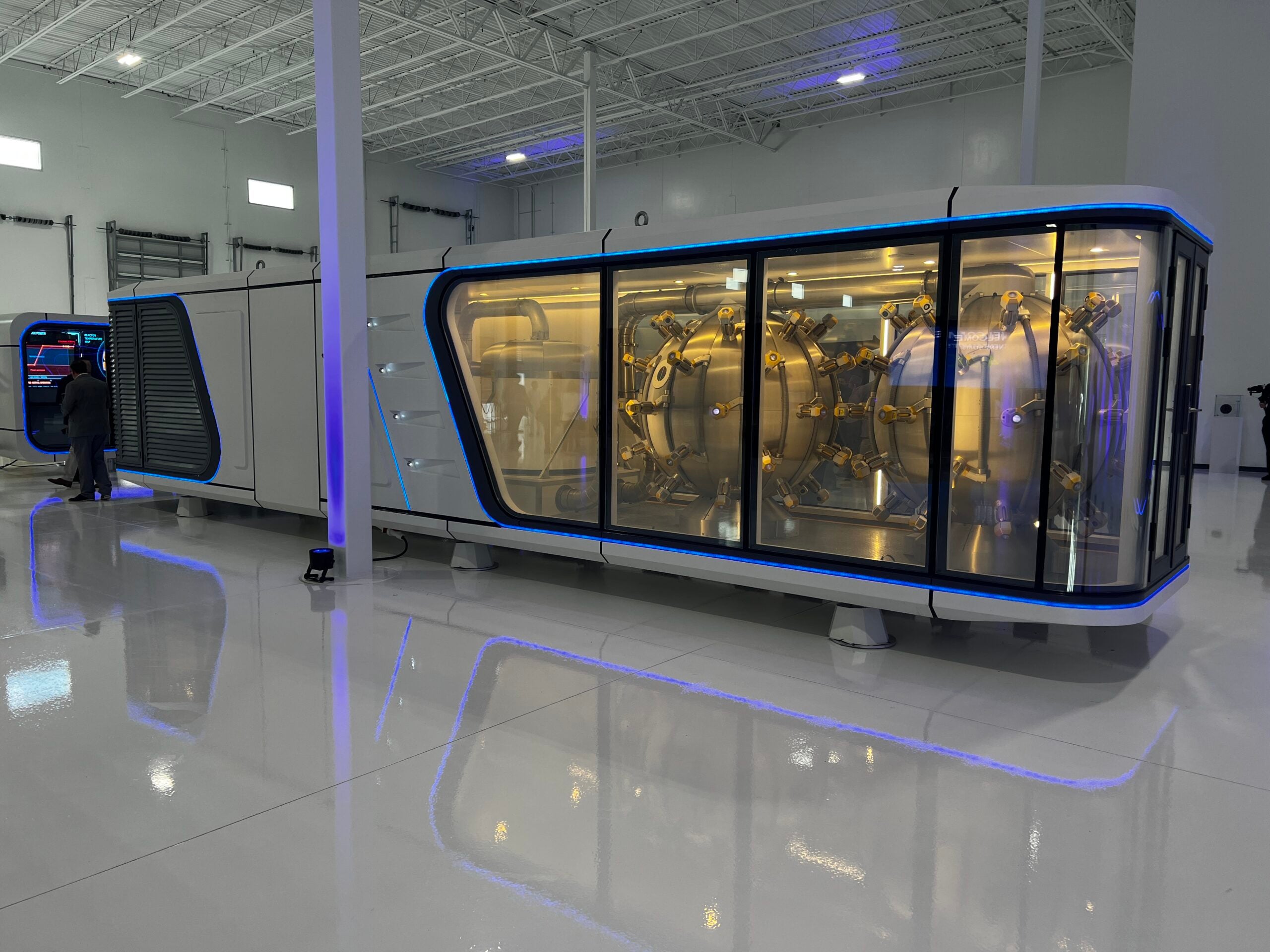
CEO 브라이언 매슈스(Brian Matthews)가 창립하고 이끄는 AMPERA는 이른바 임계 미달 토륨 증식 마이크로원자로를 개발 중이다. 이 다소 복잡한 용어에는 주류 원자력 공학으로부터의 몇 가지 의도적인 이탈이 담겨 있다. 회사는 이미 컨테이너형 원자로 시스템의 실물 크기 목업을 완성했으며(그림 1), 2026년 말까지 연료 미탑재 프로토타입을 향한 설계 작업을 활발히 진행하고 있다. 인공지능(AI), 클라우드, 데이터센터 인프라 분야의 포춘 500대 글로벌 기술 기업의 지원을 받은 AMPERA는 데이터 센터, 방산, 해운 선박을 세 가지 초기 시장으로 목표로 삼고 있다.
nuclear-thorium-reactor_1\. AMPERA는 2026년 4월 8일 지역 정부 관계자, 언론, 투자자들을 위한 오픈 하우스 행사를 열어 본사를 공개하고 원자력 시스템 목업을 전시했다. 이 컨테이너에는 두 개의 원자로가 포함되어 있으며, 최대 30MWe를 공급하도록 설계된 옵션이다. 출처: POWER_
다른 종류의 원자로
오늘날 운영 중인 대부분의 원자력 원자로는 임계 시스템으로, 핵분열 연쇄 반응이 한 번 시작되면 자립적으로 유지된다는 것을 의미합니다. AMPERA의 설계는 근본적으로 다른 접근 방식을 취합니다. 이 원자로는 미임계 영역에서 작동하며, 이는 노심이 자체적으로 연쇄 반응을 유지할 수 없다는 것을 의미합니다. 대신, 외부 중성자 발생기가 토륨을 우라늄-233으로 변환하고 노심 내 핵분열을 유지하는 데 필요한 중성자 플럭스를 지속적으로 공급합니다. 중성자 발생기를 끄면 원자로가 정지됩니다.
AMPERA의 부사장 겸 최고 지식재산 법률고문인 커티스 세인트브라이스(Curtis St.Brice)는 _POWER_와의 단독 인터뷰에서 중성자 발생기가 트리거라고 명확히 밝혔습니다. 더 많은 전력이 필요하면 중성자 출력이 증가하고, 원자로를 멈춰야 할 경우 발생기를 끄면 반응이 중단됩니다. 관리해야 할 잔여 연쇄 반응도 없고, 재가동 전에 며칠씩 기다려야 하는 과도 현상도 없습니다.
이 온-오프 기능은 AMPERA 가치 제안의 핵심입니다. 매튜스(Matthews)는 기존의 임계 원자로는 이러한 응답성을 제공할 수 없다고 강조했습니다. 일단 정지되면 제논 중독 및 기타 과도 현상으로 인해 장시간의 냉각 및 재가동 절차가 필요할 수 있습니다. 외부 중성자 원에 의해 유지되는 AMPERA의 미임계 아키텍처는 즉각적인 재가동, 안정적인 출력 증감 속도, 빠른 전력 변동을 가능하게 하도록 설계되어, 군사 야전 작전, 선박 추진, 데이터 센터 캠퍼스의 가변 부하에 매력적인 선택지가 됩니다.
토륨, TRISO, 그리고 구형 노심
연료 선택 역시 마찬가지로 파격적이다. 농축 우라늄-235 대신, AMPERA의 주요 연료는 토륨으로, 자연계에 풍부하게 존재하며 원시 상태에서 우라늄보다 방사성이 훨씬 낮고 직접적으로 핵분열이 가능한 물질이 아니다. 토륨은 중성자를 쏘아 우라늄-233으로 "증식"되어야 하며, 이 과정은 노심 내부에서 약 20일에서 30일이 소요된다. 증식이 완료되면 우라늄-233이 원자로 수명 기간 동안 에너지를 생산하는 핵분열 과정을 지속시킨다.
AMPERA는 66개의 글로벌 특허로 보호된 독자적인 액체 금속 분사 공정을 사용하여 TRISO(삼중 구조 등방성) 입자 형태로 연료를 제조할 계획이다. TRISO 연료는 핵분열 물질을 여러 겹의 세라믹 및 탄소 코팅으로 감싸, 극한 온도를 견딜 수 있는 작고 견고한 연료 커널을 만들어낸다. 이 회사는 천연 토륨을 사용하기 때문에 우라늄 농축이 필요 없으며, 이는 공급망을 단순화하고 핵 확산 우려를 줄이는 요인이 된다.
원자로 노심 자체는 구형으로, 중성자 효율과 열 성능을 극대화하기 위해 선택된 형상이다. 지름 약 2미터인 노심은 내부 자이로이드 구조를 중심으로 제작되었으며, 이는 폭 약 2밀리미터의 채널을 가진 복잡한 수학적 격자 구조다. 이는 기존 방식으로는 가공할 수 없는 구조로, 바로 여기서 AMPERA의 가장 독특한 역량 중 하나가 빛을 발한다.
대규모 적층 제조
자이로이드 코어 구조는 3D 프린팅으로 제작됩니다. AMPERA는 이미 개념 증명을 위한 플라스틱 코어와, 회사가 선호하는 구조 재료인 탄화규소(silicon carbide)로 소형 코어를 생산했습니다. 탄화규소는 약 3,000°C까지의 온도를 견딜 수 있는 특성 때문에 선택되었으며, 이는 원자로의 운전 범위 내에서 충분한 여유를 갖습니다. 실제 크기의 탄화규소 코어 프린팅은 2026년 중반을 목표로 하고 있습니다.
적층 제조 역량은 매튜스(Matthews)가 설립한 자매 회사로부터 비롯됩니다. 이 회사는 약 3m × 3m 크기의 소형 방 정도 되는 프린터를 운영하며, 이미 해운 산업 및 기타 분야의 상업 고객에게 서비스를 제공하고 있습니다. 이러한 내부 역량은 연료 제조 및 코어 프린팅부터 전력 변환 및 시스템 조립에 이르기까지 모든 공정을 아우르는 AMPERA의 수직 통합 전략의 일환입니다.
매튜스(Matthews)는 이러한 제조 우선 사고방식이 AMPERA를 더 넓은 첨단 원자력 분야와 구별 짓는 핵심 요소라고 강조해 왔습니다. 해당 분야는 지난 5년간 약 10개의 스타트업에서 100개 이상으로 급성장했습니다. 그는 원자로를 하나씩 만드는 방식으로는 경쟁에 필요한 비용 절감을 결코 달성할 수 없다고 주장했습니다. 그의 목표는 대규모 제조 시설에서 연간 약 300기, 거의 하루에 한 기씩 생산하는 것입니다. 회사는 현재 팜비치 가든스(Palm Beach Gardens) 본사 인근의 약 27,870㎡(300,000평방피트) 규모 시설을 첫 번째 생산 라인 후보지로 검토하고 있습니다.
시스템 작동 원리
각 AMPERA 유닛은 전 세계 화물 운송에 사용되는 표준 40피트 선적 컨테이너(Conex 박스)에 맞게 설계되었습니다. 이 형태 덕분에 시스템은 트럭, 철도, 선박, 또는 군용 수송기로 이동할 수 있습니다.
컨테이너 내부에는 다층 차폐재로 둘러싸인 원자로 노심, 열교환기, 터빈, 그리고 발전기가 탑재되어 있습니다. 1차 냉각재는 헬륨으로, 원자로 노심에서 열교환기로 열을 전달합니다. 그곳에서 열에너지는 초임계 이산화탄소(sCO2)로 이전되며, 이것이 폐쇄 루프 브레이턴 사이클(Brayton-cycle) 터빈을 구동해 전기를 생산합니다. 이 시스템은 냉각에 물을 전혀 사용하지 않으며, 발전 측에서 헬륨과 공냉식 응축기에 의존합니다.
단일 원자로 노심은 약 30MW의 열에너지를 생산하며, 이는 약 15MW의 전력 출력으로 변환됩니다—sCO2 사이클의 고성능 덕분에 거의 50%에 달하는 변환 효율입니다. 회사의 더 큰 30MWe 상업용 구성에서는 두 개의 원자로 노심이 직렬로 작동합니다. 시스템 전체는 약 86세제곱미터를 차지하며, 매튜스(Matthews)는 이를 이 설계의 놀라운 에너지 밀도를 보여주는 증거로 인용했습니다.
노심은 공장에서 밀봉되어 재연료 공급 없이 30년간 전출력으로 지속 운전하도록 설계되었습니다. 토륨이 장전되고 증식되면 노심을 열 수 없으며, 연료에 접근하려면 매튜스(Matthews)가 표현한 바와 같이 "정부 차원의 작전"이 필요합니다. 이 밀봉 설계는 운전 중 연료 취급을 없애고, 연료가 전용될 수 없도록 물리적으로 불가능하게 만들어 안전성과 핵 비확산 측면 모두에서 중요한 장점이 됩니다.
세인트 브라이스(St.Brice)는 AMPERA가 증식 과정을 보다 효율적으로 개시하기 위해 토륨과 소량의 우라늄 시드를 혼합하는 방안도 탐색 중이라고 언급했습니다. 우라늄은 반응을 시작하는 초기 중성자 소스를 제공하고, 이후 토륨이 수십 년간의 나머지 운전 기간 동안 역할을 이어받습니다.
자율 운영 및 임대 모델
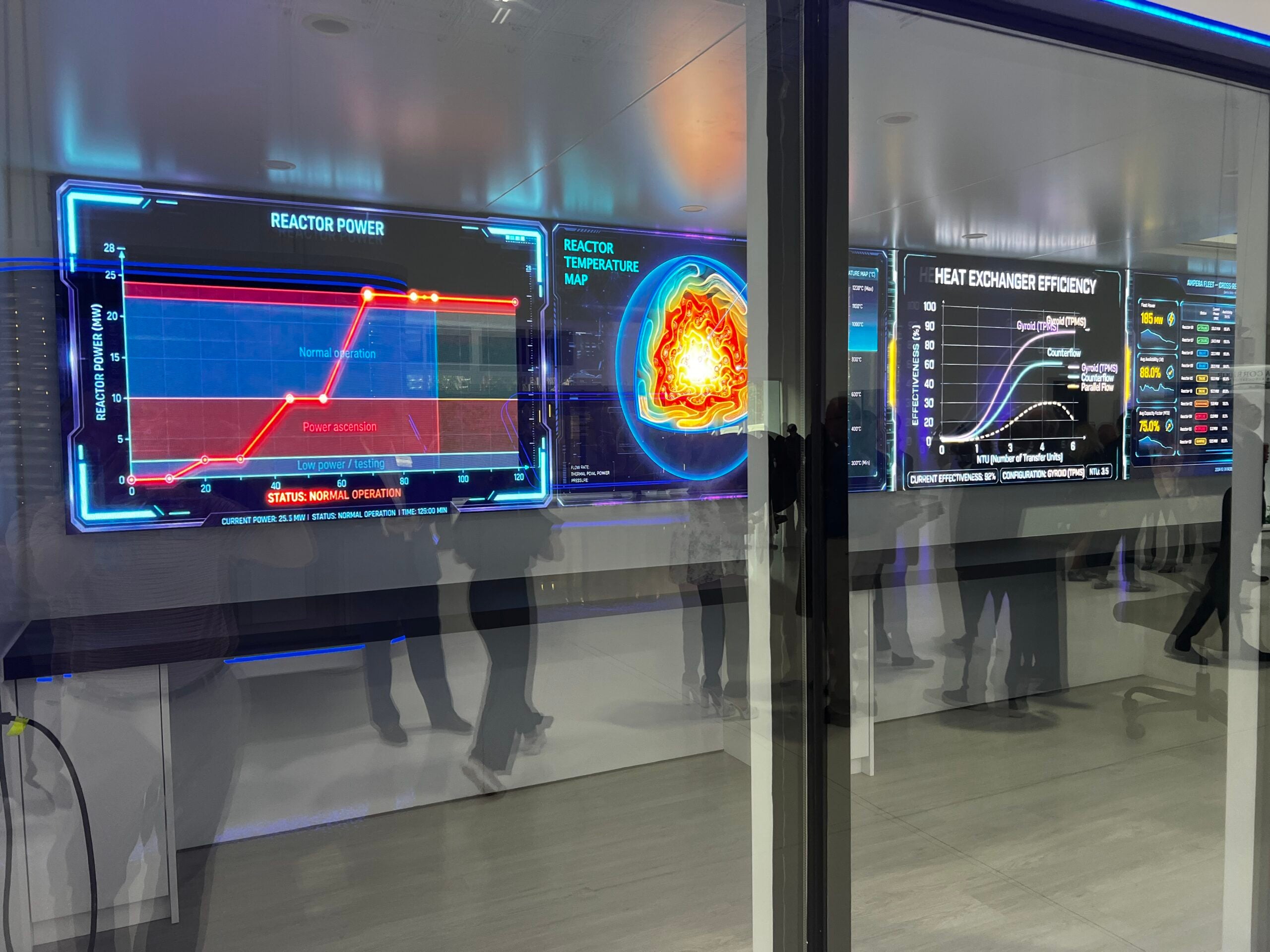
AMPERA는 자사의 원자로가 현장 운영자가 수동으로 조작하는 방식이 아닌, AI 기반 제어 시스템(그림 2)에 의해 관리되는 자율 운영 방식으로 가동되는 것을 구상하고 있습니다. 각 유닛에는 명령 및 제어 모듈이 함께 제공되며, 인터페이스는 단순하게 설계되어 있습니다. 사용자가 출력 수준을 요청하면 시스템이 중성자 발생기 출력, 열전달, 전력 변환을 이에 맞게 조정합니다.
AMPERA-nuclear-thorium-reactor-command-control-system_2\. AMPERA는 인공지능(AI)을 활용하여 시스템을 운영할 계획입니다. 출처: POWER_
이 회사는 원자로를 직접 판매할 계획이 없습니다. 대신, 전력 구매 계약 방식으로 임대하여 소유권을 유지하고 원격으로 운영을 관리할 방침입니다. 현장 명령 및 제어 센터가 현지 감독을 담당하되, 일상적인 관리는 중앙화된 시설에서 처리될 것입니다.
규제 경로 및 연구소 파트너십
암페라(AMPERA)는 원자력규제위원회(NRC)가 새롭게 확정한 10 CFR Part 53 프레임워크에 따라 인허가를 추진하고 있다. 이 규정은 첨단 원자로 기술을 위해 특별히 설계된 것으로, 기업이 기존 경수로 시스템과의 차이점을 설명하는 방식 대신 자사 설계의 장점을 근거로 안전성을 입증할 수 있도록 허용한다. 2026년 2월 23일, 암페라는 NRC의 원자력 원자로 규제실, 원자력 물질 안전 및 보호실, 연료 관리국에 공식 사전 신청서를 제출하고, 5월 말까지 초기 회의를 요청했다. 회사는 인허가 전략가로 전직 NRC 관계자인 에이프릴 스미스(Dr. April Smith) 박사를 채용했다. 세인트브리스(St.Brice)에 따르면, NRC와의 초기 협의는 긍정적으로 진행되고 있으며, 규제 당국은 특히 안전 설계 방식—임계 미달 아키텍처의 고유한 정지 특성으로 인해 연쇄 반응 폭주나 멜트다운 시나리오가 원천적으로 불가능한 점—에 대해 높은 관심을 보이고 있다.
연구 측면에서 암페라는 TRISO 연료 기술 개발 지원을 위해 로렌스 리버모어 국립연구소(Lawrence Livermore National Laboratory)와 협약을 최종화하는 단계에 있다. 또한 연료 장전 원자로 시험을 위해 아이다호 국립연구소(Idaho National Laboratory)와의 협력도 모색하고 있다. 암페라는 아직 에너지부(DOE) 자금을 확보하지 못한 상태로—육군의 프로젝트 제이너스(Project Janus)에 신청서를 제출했으나 당시 초기 단계 기업으로 분류되었다—현재 퇴역 미 해군 대령(Captain) 스콧 피셔(Scott Fisher)가 이끄는 군사 프로그램 및 참여 부문 부사장을 통해 DOE 및 전쟁부 지원을 적극적으로 추진하고 있다.
일정과 포부
AMPERA(암페라)의 개발 일정은 원자력 산업 기준으로 매우 공격적입니다. 회사는 2026년 말까지 인쇄된 코어, 차폐재, 열교환기, 터빈, 발전기를 포함한 완전한 비연료 프로토타입을 완성할 계획입니다. 토륨을 장전하고 코어에서 증식시키는 연료 탑재 프로토타입은 2027년 말을 목표로 하고 있습니다. 최초 상업 납품은 2028~2029년으로 예상되며, 2030년부터 2035년 사이에 본격적인 대량 생산 체제를 갖출 예정입니다.
회사는 이러한 목표를 달성하기 위해 빠르게 성장하고 있으며, 2026년 말까지 약 200명의 직원을 확보하고 이후 수년 내에 수천 명 규모로 확대할 계획입니다. 또한 영국과 유럽 전반에 걸친 파트너십 강화를 위해 런던에 새로운 지역 본사를 설립하는 국제 확장도 진행 중입니다.
매튜스(Matthews)는 AMPERA(암페라)의 포부를 광범위한 용어로 설명했습니다. 단순히 원자력 회사를 설립하는 것이 아니라, 모든 발전원에 걸친 "기본 에너지 플랫폼"이 되겠다는 것입니다. 그는 그 위치에 도달하는 길이 비용 경쟁력과 에너지 밀도라는 두 가지 지표에 달려 있으며, 이 두 지표에서 AMPERA(암페라)의 아키텍처는 따라오기 어려울 것이라고 주장했습니다. 기술이 그 약속을 실현할 수 있을지는 앞으로의 엔지니어링, 규제 승인, 생산 규모 확대에 달려 있습니다. 그러나 매튜스(Matthews)는 그것이 이루어질 것이며, 그것도 늦지 않게 실현될 것이라고 믿습니다. "오늘 여러분이 보시는 것은 개념이 아니고, 로드맵도 아니며, 10년 후의 일도 아닙니다"라고 그는 오픈하우스에서 말했습니다. "우리는 팜비치 가든스에서 이것을 만들고 있습니다. 지금 바로 만들고 있습니다."
AMPERA의 임계 미달 토륨 마이크로 원자로는 기존 핵발전 방식에서 근본적으로 탈피한 혁신적 설계로, 외부 중성자 발생기를 통해 핵분열 반응을 정밀하게 제어함으로써 즉각적인 가동·정지가 가능하다는 점에서 기술적 의의가 크다. 토륨 연료는 우라늄보다 자연 방사능이 낮고 핵비확산 위험이 적으며, 농축 과정이 필요 없어 공급망 안정성과 안전성 측면에서 유리하다. 컨테이너 크기로 공장 제작이 가능하고 30년간 재연료 없이 운용할 수 있다는 설계 목표는 데이터센터, 군사, 해양 분야 등 분산 에너지 수요에 효과적으로 대응할 수 있는 잠재력을 보여준다. 특히 AI 및 클라우드 인프라 관련 Fortune 500 기업의 투자 참여는 급증하는 데이터센터 전력 수요를 충족하려는 산업계의 절박한 필요를 반영하며, 소형 모듈 원자로(SMR) 시장의 경쟁 구도를 변화시킬 수 있는 신호로 해석된다. 다만 2026년 말 비연료 프로토타입 완성을 목표로 하는 초기 단계인 만큼, 상용화까지는 규제 승인, 기술 검증, 비용 실현 등 다양한 과제가 남아 있다.
※ 이 글은 해외 원자력 바로알기를 위한 정보 전달을 목적으로 제공됩니다. 특정 기업이나 종목에 대한 투자 권유가 아니며, 모든 투자 판단과 그에 따른 책임은 투자자 본인에게 있습니다.
한국어
샤인(Shine), 동위원소 시설 완공을 위해 미 에너지부로부터 2억 6,300만 달러 조건부 대출 승인
샤인(Shine), 동위원소 시설 완공을 위해 미 에너지부로부터 2억 6,300만 달러 조건부 대출 승인
2026년 4월 9일 오후 4:51 | Nuclear News
2024년 건설 중인 샤인 크리살리스(Shine Chrysalis) 동위원소 생산 시설. (이미지: 샤인(Shine))
요약
카테고리: 원자력 정책
샤인(Shine)이 미국 에너지부(DOE)로부터 위스콘신주 제인스빌(Janesville) 의료용 동위원소 생산 시설 건설을 위해 최대 2억 6,300만 달러의 조건부 대출 약정을 받았다.
완공 시 크리살리스(Chrysalis) 시설은 미국에서 하루 4만 건 이상의 의료 시술에 사용되는 핵심 방사성 의약품 전구물질인 몰리브덴-99(Mo-99)를 생산할 예정이다.
시설은 현재 약 75% 완공 상태이며, 1단계 건설이 2027년 '실질적 완료'될 예정으로 상업 생산을 시작하고, 전체 4단계는 2029년까지 완료될 계획이다.
---
핵융합 기술 기업 샤인(Shine)은 위스콘신주 제인스빌(Janesville)에 있는 의료용 동위원소 생산 시설 건설 지원을 위해 미국 에너지부(Department of Energy) 에너지 지배력 금융 사무소(Office of Energy Dominance Financing, EDF)로부터 최대 2억 6,300만 달러의 조건부 대출 약정을 받았다.
완공되면 크리살리스(Chrysalis) 생산 시설은 몰리브덴-99(Mo-99)를 생산하는 데 활용될 예정이다. 의료용 방사성 동위원소인 테크네튬-99m(technetium-99m)의 전구체인 Mo-99는 주로 방사성 진단 추적자로서 미국 내에서 하루 4만 건 이상의 의료 시술에 사용된다.
에너지부 에너지 지배력 금융 사무소(DOE-EDF) 소장 그레고리 A. 비어드(Gregory A. Beard)는 "샤인 크리살리스 프로젝트는 원자력 공급망 개선, 차세대 원자력 인력 육성, 핵심 생산의 국내화, 국가 안보 강화에 필수적"이라고 말했다.
에너지부에 따르면, DOE-EDF의 조건부 대출 약정은 재정 지원을 제공하겠다는 부처의 의향을 나타내지만, 자금이 실제로 지원되기 전에 에너지부와 샤인(Shine)이 일정한 기술적·법적·환경적·재정적 조건을 충족해야 한다.
크리살리스(Chrysalis) 배경
샤인(Shine)은 2016년 2월 원자력규제위원회(Nuclear Regulatory Commission, NRC)로부터 크리살리스 건물의 건설 허가를 받았으며, 2019년 5월에는 43,000 평방피트 규모의 시설 착공에 들어갔다. 크리살리스(Chrysalis)는 중수소-삼중수소(deuterium-tritium) 핵융합 중성자 발생기를 사용하여 주당 최대 8,200 6일 퀴리(curie)의 Mo-99를 생산할 예정이다.
샤인(Shine)은 크리살리스(Chrysalis)의 운영 가동을 위해 4단계 방식을 채택하고 있다. 1단계부터 3단계까지는 8개의 중성자 발생기(조사 장치라고 불림)를 순차적으로 가동하여 Mo-99를 생산하며, 4단계에서는 제논(xenon) 및 요오드(iodine) 생산이 추가된다. 크리살리스(Chrysalis)는 조사 및 동위원소 생산 시설 모두를 포함하며, 10 CFR 50.2조에 따라 통합 허가를 받을 예정이다.
크리살리스(Chrysalis) 건설은 원래 2022년까지 완료될 예정이었으나, 샤인(Shine)은 이 기한을 두 차례 연장했다. 가장 최근인 2025년 12월, NRC는 샤인(Shine)의 건설 허가 개정 요청을 승인하여 최종 완공 기한을 2025년 12월 31일에서 2029년 12월 31일로 연장했다. 에너지부에 따르면, 시설은 현재 약 75% 완공된 상태이다.
샤인(Shine)은 지연의 원인을 이 생산 시설이 최초 사례(first-of-a-kind)라는 특성에서 찾으며, 추가된 시간이 4단계 방식의 각 단계에 대한 건설 완료, 사전 운영 테스트, 허가 취득에 활용될 것이라고 밝혔다.
샤인(Shine)은 4개의 건설 단계 전체가 2029년까지 완료될 것으로 예상하지 않지만, 회사는 2027년에 '실질적으로 완료'될 것으로 기대하는 1단계 건설 중에 Mo-99 상업 생산을 시작할 예정이라고 밝혔다.
샤인(Shine)은 미국 핵안보국(National Nuclear Security Administration, NNSA)의 지원을 받아 기술을 개발하고 실증해왔다. NNSA는 2012년 미국 의료용 동위원소 생산법(American Medical Isotopes Production Act of 2012)에 의해 고농축 우라늄을 사용하지 않는 국내 Mo-99 공급 기반 구축을 지원하기 위한 기술 중립적 프로그램을 수립하도록 지시받았다.
에너지부에 따르면, 국립 연구소들도 NNSA 자금 지원을 통해 샤인(Shine)의 기술 개발에 핵심적인 역할을 했다. 샤인(Shine)의 조사 장치는 수용성 저농축 우라늄(19.75% 우라늄-235) 표적에서 임계 이하 핵분열 반응을 유도하는 방식으로 Mo-99를 생산한다.
인용문
"샤인(Shine)은 외국산 Mo-99 수입 의존을 종식하고 미국 환자들이 미국산 의료용 동위원소에 안정적으로 접근할 수 있도록 보장하는 핵심 열쇠입니다. DOE-EDF 조건부 대출은 이 프로젝트를 결승선(finish line, 완료 단계)까지 이끌어줄 것이며, 샤인(Shine)의 시장 진입은 미국 원자력 의학, 핵융합 기술, 원자력 비확산 리더십에 있어 큰 승리가 될 것입니다."
>
— 매슈 나폴리(Matthew Napoli), NNSA 핵비확산 방어 담당 부청장
AI 분석
이번 에너지부의 2억 6,300만 달러 조건부 대출 약정은 미국이 의료용 방사성 동위원소 공급의 국내화를 위해 전략적으로 투자하고 있음을 보여주는 중요한 사례다. Mo-99는 매일 4만 건 이상의 미국 내 의료 시술에 사용되는 핵심 물질로, 해외 의존도를 낮추는 것은 단순한 경제적 문제를 넘어 국가 보건 안보와 직결된 사안이다. 샤인(Shine)의 핵융합 기술 기반 생산 방식은 기존 원자로 기반 생산에 비해 고농축 우라늄을 사용하지 않아 핵비확산 관점에서도 긍정적으로 평가된다. 그러나 당초 2022년에서 2029년으로 7년이나 연장된 완공 일정은 최초 사례 시설(first-of-a-kind facility) 개발의 어려움을 여실히 드러내며, 향후 추가 지연 가능성도 배제할 수 없다. 이 프로젝트의 성공 여부는 미국 원자력 의학 분야의 공급망 안정성과 함께 핵융합 기술의 실질적 상업화 가능성을 가늠하는 중요한 시험대가 될 것이다.
2026년 4월 9일 오전 10:58 | 조너선 E. 스티븐스(Jonathan E. Stephens), 테미 J. 아데예예(Temi J. Adeyeye)
요약
카테고리: 현황
민간 해상 원자력 발전은 NS 사바나(NS Savannah) 등 역사적 사례 이후 50여 년간 거의 답보 상태였으나, 최근 수년간 해운 업계의 관심이 급격히 증가하고 있다.
태스크포스는 이러한 새로운 관심의 흐름을 체계적으로 정리하고, 그 배경 및 추진 요인을 분석하고 있다.
역사적 선례인 상선 NS 사바나와 부유식 발전소 USS 스터지스(USS Sturgis)를 통해 민간 해상 원자력의 가능성이 이미 입증된 바 있다.
---
.jpg)
NS 사바나(Savannah) — 가능성의 증거. (사진: 미국 국립기록원)
원자력 뉴스(Nuclear News) 독자라면 상선 NS 사바나나 부유식 발전소 USS 스터지스 같은 민간 해상 원자력 발전의 역사적 사례들을 접해봤을 것이다. 몇 가지 예외를 제외하면, 이 분야에서 50년 넘게 별다른 움직임이 없었고, 그 이유와 관련된 다양한 분석과 견해도 존재한다. 그러나 지난 수년간 해운 업계와 관련 이해관계자들의 관심이 급격히 높아진 것만은 부정하기 어렵다.
이 기사는 수십 년간 침체되었던 민간 해상 원자력 분야가 다시금 주목받고 있음을 보여주는 시의적절한 내용을 담고 있다. NS 사바나와 USS 스터지스 같은 역사적 선례는 기술적 실현 가능성을 이미 증명했으며, 현재의 관심 증가는 탄소 중립 해운에 대한 국제적 압력과 소형 원자로(SMR) 기술의 발전이 맞물린 결과로 보인다. 태스크포스의 활동은 규제 체계 마련과 업계 표준화를 위한 선제적 노력의 일환으로 해석될 수 있다. 향후 이 분야의 상업화 여부는 규제 승인, 경제성, 그리고 대중의 수용성이라는 세 가지 과제를 얼마나 효과적으로 해결하느냐에 달려 있을 것이다.
텍사스주가 첨단 원자력 에너지 개발 및 공급망 구축을 위해 3억 5천만 달러 규모의 주 재원을 공식 개방했다.
신청 마감은 2026년 5월 14일이며, 현재 NRC에 허가 신청서를 제출했거나 2026년 12월 1일까지 제출할 것으로 합리적으로 예상되는 프로젝트가 지원 대상이다.
현재 자격 요건을 충족하는 주요 프로젝트로는 다우(Dow)·X에너지(X-energy) 파트너십의 Xe-100 반응로 4기와 페르미 아메리카(Fermi America)·텍사스 공과대학교(Texas Tech University)의 AP1000 반응로 4기 배치 계획이 있다.
---
3년 전, 텍사스 공공유틸리티위원회(Texas Public Utility Commission)는 그렉 애벗(Greg Abbott) 주지사의 지시에 따라 첨단 원자력 반응로 실무 그룹(Advanced Nuclear Reactor Working Group)을 출범시켰다. 1년 후, 이 신설 그룹은 주에 새로운 원자력 프로젝트를 유치하기 위해 텍사스 주의회가 취할 수 있는 여러 조치를 담은 보고서를 발표했다.
해당 권고안에는 텍사스의 "전략적 원자력 비전"을 조율할 비규제 기관의 설립과 더불어, 개발자들이 직면하는 "프로젝트 초기 자금 조달의 계곡(funding valley, 사업 초기 단계에서 수익 창출 전까지 발생하는 자금 부족 현상)"을 극복하는 데 도움을 줄 첨단 원자력 기금 조성 방안이 포함되어 있었다.
2025년에는 H.B. 14가 서명되고 텍사스 첨단 원자력 에너지 오피스(Texas Advanced Nuclear Energy Office, TANEO)가 설립되어 첫 번째 권고안이 충족되었다. 이제 두 번째 권고안을 이행하는 차원에서, 텍사스는 TANEO 웹사이트의 텍사스 첨단 원자력 개발 기금(Texas Advanced Nuclear Development Fund, TANDF) 페이지에 명시된 바와 같이, "첨단 원자력 에너지 및 관련 기술의 개발"과 "첨단 원자력 에너지 공급망 및 관련 제조 역량의 개발"을 보장하기 위해 3억 5천만 달러의 주 자금을 개방했다.
세부 내용: TANDF를 통해 제공되는 3억 5천만 달러는 원자력 발전 배치와 폭넓은 공급망 개발 모두에 대한 주의 관심을 반영하여, 두 가지 관련 프로그램을 통해 신청할 수 있다. 바로 첨단 원자력 건설 상환 프로그램(Advanced Nuclear Construction Reimbursement Program)과 프로젝트 설계 및 공급망 상환 프로그램(Project Design and Supply Chain Reimbursement Program)이다.
신청자는 4월 23일까지 주에 사전 의향서(notice of intent)를 제출하고, 5월 14일까지 완전한 자금 지원 신청서를 제출해야 한다. TANEO에 따르면, 지원 자격이 있는 신청자는 "기업, 비영리 단체, 고등교육기관을 포함한 정부 기관"이다. 중요한 점은, 신청자가 "2026년 12월 1일 이전에 해당 프로젝트에 대해 원자력규제위원회(Nuclear Regulatory Commission, NRC)에 건설 허가 또는 면허 신청서가 공식 접수(docketed)되어 있거나, 합리적으로 그럴 것으로 예상되어야" 한다는 것이다.
현재로서는 TANEO 소장 자레드 샤퍼(Jarred Shaffer)가 밝혔듯이, "해당 공식 접수(docketed) 요건을 충족하는 주 내 적격 프로젝트는 단 두 개뿐입니다."
다우(Dow)와 X에너지(X-energy)는 파트너십을 맺어 UCC 시드리프트 오퍼레이션즈(UCC Seadrift Operations) 제조 단지에 80MWe급 Xe-100 고온 가스 냉각 반응로 4기를 배치할 계획이다. 다우(Dow)는 2025년 3월 해당 프로젝트의 건설 허가 신청서를 제출했으며, 이 프로젝트는 에너지부(Department of Energy)의 첨단 반응로 실증 프로그램(Advanced Reactor Demonstration Program)의 지원을 받고 있다.
페르미 아메리카(Fermi America)와 텍사스 공과대학교(Texas Tech University)는 아마릴로(Amarillo)의 팬텍스(Pantex) 핵무기 공장 인근에 2032년까지 AP1000 반응로 4기를 배치하기 위해 협력 중이다. 페르미 아메리카(Fermi America)는 2025년 9월 해당 프로젝트에 대한 복합 면허 신청서(combined license application)를 NRC에 제출했다. 이 프로젝트는 프로젝트 마타도르(Project Matador) 또는 첨단 에너지 및 인텔리전스 캠퍼스(Advanced Energy and Intelligence Campus)로 자주 불리며, 원자력 부문은 도널드 J. 트럼프(Donald J. Trump) 원자력 발전소로 명명되었다.
주목할 점은, 에이빌린 크리스천 대학교(Abilene Christian University) 역시 용융염 연구 반응로(Molten Salt Research Reactor)에 대한 NRC 허가를 공식 접수 받은 상태라는 것이다. 그러나 해당 프로젝트는 이미 다른 주 재원에서 1억 2천만 달러를 지원받았기 때문에, TANDF 내 건설 프로그램을 통한 추가 자금 지원 대상에서는 제외된다. 다만 기금의 프로젝트 설계 및 공급망 부문에 대한 지원 자격은 여전히 유지된다.
12월 초까지 NRC 허가를 "합리적으로 예상할 수 있는" 프로젝트로 범위를 확대하면, 현재 NRC와 사전 신청 활동을 진행 중인 두 당사자가 있다. 바로 대학 캠퍼스인 칼리지 스테이션(College Station)에 반응로를 배치하기 위해 제타줄(ZettaJoule)과 파트너십을 맺은 텍사스 A&M(Texas A&M)과, 텍사스주 해스켈 카운티(Haskell County)에 20MWe급 가압 경수로 30기를 건설하는 계획을 추진 중인 라스트 에너지(Last Energy)이다.
NRC의 관할 범위 밖에서는, 텍사스에서 현재 에너지부(DOE)의 지원을 받아 개발 중인 프로젝트가 두 개 있다. 록하트(Lockhart)에 위치한 아토믹 알케미(Atomic Alchemy)의 그로브스 동위원소 시험 반응로(Groves Isotope Test Reactor)와 오스틴(Austin)에 시설을 둔 아알로 아토믹스(Aalo Atomics)가 그것이다. 두 기업 모두 이전에 NRC와 접촉한 바 있으나, 아직 이들 프로젝트에 대한 NRC 면허 취득 절차를 공식적으로 시작하지는 않은 상태이다. 그러나 원자력 면허 취득 환경이 빠르게 변화하고 DOE와 NRC 간의 협력 관계가 강화되는 추세에 따라, TANEO 자금 지원 자격 획득 가능성은 열려 있다.
---
AI 분석
텍사스주의 3억 5천만 달러 규모 원자력 개발 기금 개방은 미국 내 주(州) 차원의 원자력 정책 중 역대 최대 규모의 단일 재정 지원 조치 중 하나로 평가된다. 이번 조치는 단순한 발전소 건설 지원을 넘어 원자력 공급망과 제조 역량 전반을 아우르는 전략적 접근이라는 점에서 의미가 크다. 특히 고온 가스 냉각로(Xe-100)와 기존 대형 경수로(AP1000)를 동시에 지원 대상에 포함함으로써, 특정 기술에 편중되지 않는 포트폴리오 방식의 원자력 정책을 취하고 있음을 알 수 있다. 12월 1일이라는 NRC 허가 신청 마감 시한은 향후 수개월 내 여러 기업들의 면허 취득 일정을 가속화하는 촉매제로 작용할 가능성이 높다. 텍사스의 이번 행보는 여타 주들의 원자력 정책 경쟁을 자극할 선례가 될 수 있으며, 미국 원자력 르네상스의 지역적 거점으로서 텍사스의 위상을 강화하는 계기가 될 것이다.
ARPA-E commits $135 million for fusion commercialization
Published: April 9, 2026
TL;DR
ARPA-E announced its largest concentrated investment in fusion technology, committing $135 million over the next 18 months to fund projects that develop and commercialize fusion technologies
The agency is focusing on overcoming technical barriers including plasma heating systems, advanced fuels, power conversion systems, and novel power plant designs
This announcement comes amid mixed federal budget signals, with the White House proposing cuts to the DOE Office of Science's fusion energy initiatives while ARPA-E increases its investment
Full Article
Yesterday, the Advanced Research Projects Agency–Energy (ARPA-E) announced its largest concentrated investment in fusion technology so far, committing $135 million over the next 18 months to fund projects that develop and commercialize fusion technologies.
The agency said it has invested approximately $134 million in commercial fusion since it began funding fusion projects with the launch of its ALPHA program in 2014, so the next year and a half will see a doubling of the agency's investment in the fusion space.
Funding will be spread over multiple programs, targeting fusion's toughest technical barriers. ARPA-E cited efficient, lower-cost plasma heating and driver systems, advanced fuels and novel fueling techniques, next-generation pulsed power and power conversion systems, and novel power plant designs and components as key focus areas, aiming to reduce plant costs, boost power output, simplify the fusion fuel cycle, decrease plant footprints, and improve the durability and economic competitiveness of power plant designs and components.
"The question is no longer whether fusion is possible. The question is how fast we get fusion-generated power on the grid and whether America leads that achievement," said ARPA-E director Conner Prochaska. "ARPA-E helped build America's fusion power industry by taking risks on radical ideas and building an innovative supply chain. Today's announcement is how we press our advantage. We are going after the hardest technical bottlenecks standing between fusion power and a commercially viable system, because that's what this moment demands."
Mixed Messages
This announcement follows the White House's fiscal year 2027 budget proposal, which requests a $50 million (6 percent) cut in the Department of Energy Office of Science's fusion energy sciences initiatives budget.
"To have one bureau increasing funding while another is cutting is no way to beat China to commercial fusion," Andrew Holland, the head of the Fusion Industry Association, told _Axios_, referencing the at least $6.5 billion China is reported to be spending on fusion.
The budget also requests a $150 million (43 percent) cut in ARPA-E's overall budget, a $151 million (9 percent) cut in the DOE Office of Nuclear Energy's budget, and $10 million for the new Office of Fusion.
Attracting Private Investment
ARPA-E aims to support the development of unproven technologies that will go on to attract private investment. According to the agency, its investments have helped build the United States' "ecosystem of technology, talent, and supply chain capacity." Zap Energy, Realta Fusion, Thea Energy, and Type One Energy are among the fusion companies to have emerged from ARPA-E–funded projects. The agency said its fusion investments have attracted more than $1.5 billion in private follow-on funding.
"Private capital scales what it can already see; ARPA-E funds what the market can't yet price or predict," Prochaska told _Latitude Media_. "Venture capital funds companies to build a product, not to solve the fundamental science challenges needed to reach those milestones."
Recent Funding
In 2024, ARPA-E launched the Creating Hardened And Durable Fusion First Wall Incorporating Centralized Knowledge (CHADWICK) program, which has awarded more than $25 million to 13 projects pursuing first-wall materials that will maintain performance over the 40-year design lifetime of a fusion power plant.
AI Analysis
This announcement represents a significant strategic commitment to fusion commercialization, with ARPA-E effectively doubling its historical investment to accelerate the path from research to grid deployment. The $135 million allocation demonstrates confidence in near-term commercialization potential, while the focus on reducing capital costs and improving reliability suggests the agency is targeting the most critical barriers to economic viability. However, the mixed budget signals—with the White House proposing substantial cuts to broader fusion research initiatives while ARPA-E increases focused commercialization funding—underscore ongoing uncertainty about sustained federal commitment to the sector, even as the US seeks to compete with China's significantly larger fusion investments.
OLKILUOTO, Finland (AP) — With the push of a button, the elevator descends hundreds of meters in seconds into the dark depths of Onkalo.
"We are now at about minus 430 meters (1,411 feet)," muttered geologist Tuomas Pere as he steered a car through a labyrinth of man-made tunnels. "We are driving through 1.9-billion year old bedrock."
After decades of construction, the world's first facility for permanently disposing spent nuclear fuel is set to begin operations in Finland, becoming a final resting place for tons of dangerous radioactive waste.
Construction of Onkalo — which means "cave" in Finnish — began on the west coast in 2004. It sits on the secluded island of Olkiluoto, in a dense wooded area. The closest town is Eurajoki, about 15 kilometers (9.3 miles) inland, which is home to about 9,000 people. Many work at the nuclear power plant or storage facility.
Olkiluoto Nuclear Power Plant seen on the island of Olkiluoto, Finland, Tuesday, Feb. 24, 2026. \(AP Photo/James Brooks\)
Olkiluoto Nuclear Power Plant seen on the island of Olkiluoto, Finland, Tuesday, Feb. 24, 2026. (AP Photo/James Brooks)
Pere said the site — near three of Finland's five nuclear reactors — was chosen for its migmatite-gneiss bedrock, which is known for its high stability and low risk of earthquakes.
"It's the isolation from civilization and mankind on the surface that's important," he said, standing in a darkened disposal tunnel, soon to be sealed from humanity. "We can dispose of the waste more safely than by storing it in facilities located on the ground."
Using unmanned machinery at a nearby encapsulation plant, radioactive rods will be sealed in copper canisters and then buried deep in tunnels over 400 meters underground, then packed in with "buffer" layers of water-absorbing bentonite clay.
Posiva, the company responsible for the long-term management of Finland's spent nuclear fuels, says Onkalo can store 6,500 tons of spent nuclear fuel.
A Posiva worker stands by vehicles inside a tunnel at the Onkalo nuclear waste repository on the island of Olkiluoto, Finland, Tuesday, Feb. 24, 2026. \(AP Photo/James Brooks\)
A Posiva worker stands by vehicles inside a tunnel at the Onkalo nuclear waste repository on the island of Olkiluoto, Finland, Tuesday, Feb. 24, 2026. (AP Photo/James Brooks)
A Posiva worker stands by vehicles inside a tunnel at the Onkalo nuclear waste repository on the island of Olkiluoto, Finland, Tuesday, Feb. 24, 2026. \(AP Photo/James Brooks\)
A Posiva worker stands by vehicles inside a tunnel at the Onkalo nuclear waste repository on the island of Olkiluoto, Finland, Tuesday, Feb. 24, 2026. (AP Photo/James Brooks)
The final disposal canisters are designed to remain sealed "long enough for the radioactivity of spent fuel to decrease to a level not harmful to the environment," it said.
"The solution that we have, it's the missing point for sustainable use of nuclear energy," said Posiva communications manager Pasi Tuohimaa.
Finnish nuclear power companies are paying for the project, he said, adding that they have saved money for decades for that purpose.
Posiva estimate it will take hundreds of thousands of years before the radioactivity falls to normal, background levels.
According to a 2022 report by the International Atomic Energy Agency, almost 400,000 tons of spent fuel have been produced globally since the 1950s, with two-thirds remaining in temporary storage and one third being recycled in a complex process.
The world's spent nuclear fuel is currently temporarily stored inside spent nuclear fuel pools at individual reactors and at dry cask storage sites above ground.
A member of the media stands in the turbine hall of Olkiluoto 3 \(OL3\), Europe's largest nuclear reactor, during a press tour on the island of Olkiluoto, Finland, Tuesday, Feb. 24, 2026. \(AP Photo/James Brooks\)
A member of the media stands in the turbine hall of Olkiluoto 3 (OL3), Europe's largest nuclear reactor, during a press tour on the island of Olkiluoto, Finland, Tuesday, Feb. 24, 2026. (AP Photo/James Brooks)
A member of the media stands in the turbine hall of Olkiluoto 3 \(OL3\), Europe's largest nuclear reactor, during a press tour on the island of Olkiluoto, Finland, Tuesday, Feb. 24, 2026. \(AP Photo/James Brooks\)
A member of the media stands in the turbine hall of Olkiluoto 3 (OL3), Europe's largest nuclear reactor, during a press tour on the island of Olkiluoto, Finland, Tuesday, Feb. 24, 2026. (AP Photo/James Brooks)
Add AP News on Google Add AP News as your preferred source to see more of our stories on Google. Share
There is currently no permanent underground disposal facility for commercial nuclear waste operational anywhere in the world. Sweden began building a repository in Forsmark — about 150 kilometers north of Stockholm — last year, but it's not expected to open until the late 2030s. France's Cigéo project is yet to begin construction and has seen opposition.
The Onkalo facility is expected to operate until the 2120s, when it will be permanently sealed.
'There are uncertainties'
But Edwin Lyman, director of nuclear power safety at the Union of Concerned Scientists, an American nonprofit organization, warned that geologic disposal of nuclear waste is still fraught with "uncertainties."
"My view of nuclear waste disposal is that there's no good option, but it's important to find the least bad option, and geologic disposal in general is going to be the least bad option among a range of, you know, bad options," he said.
Lyman said that the copper canisters that contain the spent nuclear fuel will eventually corrode, adding that there are different scientific opinions about how fast that could happen.
"The hope is that is such a slow process that most of the radioactive material will have decayed away by then. But again, there are uncertainties," he said.
Still, Lyman said that permanently storing spent nuclear fuel deep underground is better than "leaving it on the surface of the Earth forever," because nuclear material kept above ground "is vulnerable to sabotage."
"For many decades after spent fuel is discharged from a reactor, it's so radioactive that it makes transporting and reprocessing very difficult," Lyman said. But eventually the main radioactive component will decay, he added, making it less risky to handle.
"So over time the plutonium becomes more accessible either to terrorists or to a country that may want to use it," he said, adding that the only way a terrorist -- or a state -- could theoretically use the material for a nuclear bomb would be if they had "an off-site reprocessing capability."
During reprocessing, spent nuclear fuel is separated to recover uranium and plutonium to recycle it for use in new fuel. The process also carries proliferation risks because the separated plutonium could potentially be diverted to build a nuclear weapon.
Overall, the risks associated with nuclear waste repositories will mainly affect "future generations," Lyman concluded.
To deal with this challenge, an interdisciplinary field of study called nuclear semiotics has been established that looks into developing warning signs about nuclear waste repositories that can be understood by humans 10,000 years from now — or much longer given that it takes hundreds of thousands of years before nuclear waste is no longer dangerous.
For reference: the first humans lived around 300,000 years ago. The earliest writing system was developed in Mesopotamia roughly 5,200 to 5,400 years ago. Stonehenge in Britain is around 5,000 years old, while the Giza pyramids in Egypt are approximately 4,500 years old.
A trial copper casing is placed at Posiva's encapsulation plant on the island of Olkiluoto, Finland, Tuesday, Feb. 24, 2026. \(AP Photo/James Brooks\)
A trial copper casing is placed at Posiva's encapsulation plant on the island of Olkiluoto, Finland, Tuesday, Feb. 24, 2026. (AP Photo/James Brooks)
A trial copper casing is placed at Posiva's encapsulation plant on the island of Olkiluoto, Finland, Tuesday, Feb. 24, 2026. \(AP Photo/James Brooks\)
A trial copper casing is placed at Posiva's encapsulation plant on the island of Olkiluoto, Finland, Tuesday, Feb. 24, 2026. (AP Photo/James Brooks)
'Nuclear message'
Austrian artist and inventor Martin Kunze has led an expert group on long-term information preservation at the Nuclear Energy Agency of the Paris-based Organization for Economic Cooperation and Development. He has developed a system that he calls the "nuclear message" — crucial information for future generations that is printed on a solid ceramic plate below a hard glazed surface.
Kunze said that the ceramic plates are "inexpensive and very robust" and should ideally be buried "in large numbers" in the area around the repository as well as "inside the foundations" of every house in the community. The goal should be to distribute as many ceramic plates in the area as possible.
Finnish officials say the Onkalo nuclear repository reflects the country's long-term approach to nuclear energy policy.
A 1994 act required radioactive waste generated in Finland to be handled, stored and permanently disposed of within the country's borders.
"Back then… some of the waste was still exported, but we wanted to take care of it ourselves," said Sari Multala, Finland's environment minister. "We also stick to the decisions, unlike many other countries."
Multala did not rule out eventually accepting limited amounts of nuclear waste from other countries. "In the small scale there could be some kind of possibilities, as long as it is allowed by the international regulators," she said.
After decades of construction, the world's first facility for permanently disposing spent nuclear fuel is set to begin operations in Finland, becoming a final resting place for tons of dangerous radioactive waste. Construction of Onkalo — which means "cave" in Finnish — began on the west coast in 2004. It sits on the secluded island of Olkiluoto, in a dense wooded area. The closest town is Eurajoki, about 15 kilometers (9.3 miles) inland, which is home to about 9,000 people. Many work at the power plant or storage facility. (AP video by James Brooks)
___
Liechtenstein reported from Vienna.
___
The Associated Press receives support for nuclear security coverage from the Carnegie Corporation of New York and Outrider Foundation. The AP is solely responsible for all content. ___ Additional AP coverage of the nuclear landscape: https://apnews.com/projects/the-new-nuclear-landscape/
AI Analysis
Finland's opening of Onkalo marks a significant milestone in addressing one of the nuclear industry's greatest challenges—the long-term disposal of radioactive waste. By utilizing 1.9-billion-year-old bedrock as a permanent repository, the facility demonstrates that deep geological storage is geologically stable and feasible for securing hazardous materials for millennia. This breakthrough has major implications for global nuclear energy policy, potentially encouraging other nations to pursue similar permanent disposal solutions rather than continued temporary storage. The success of Onkalo could accelerate nuclear power adoption by alleviating a key public concern about safety and waste management. Additionally, the project showcases how advanced engineering and geological science can solve complex infrastructure challenges, positioning Finland as a leader in sustainable energy solutions.
Gov. Beshear Signs Bill Aiming to Lower Utility Costs Through Nuclear Energy
April 10, 2026
TL;DR
Kentucky Gov. Andy Beshear signed SB 57, creating the Nuclear Reactor Site Readiness Pilot Program to incentivize nuclear power companies to locate in the state and lower utility costs.
Converting retired coal plants to nuclear facilities could reduce construction costs by 30-35% and create over 650 permanent jobs paying 50% higher than other energy sector jobs.
The initiative aims to modernize Eastern Kentucky's economy, though state officials caution that utility cost relief will take years to materialize.
Kentucky's Nuclear Energy Initiative
On Wednesday, Kentucky Gov. Andy Beshear signed a bill into law, which is intended to lower utility costs by incentivizing nuclear power companies to locate in the state.
SB 57 creates the Nuclear Reactor Site Readiness Pilot Program, meant to advance nuclear energy development in Kentucky. Supporters say the plan will lower utility costs in the long term for Kentuckians.
Senator Wheeler's Vision
State Sen. Phillip Wheeler (R-Pike County), one of the bill's sponsors, told WSAZ he hopes to put nuclear plants on old coal plants in Eastern Kentucky, saying the project will bring both jobs and lower utility costs to the region.
"If we can replace some of those plants with nuclear plants as well, I think it would be a way to provide jobs in Eastern Kentucky, as well as cheaper, more reliable electricity," he said.
"Some coal plants with the infrastructure in place, when they come up for retirement, putting a nuclear plant in its place can possibly reduce the cost of that plant by as much as 30 percent while providing hundreds of very good paying jobs in an area that desperately needs them," Wheeler continued, citing research he's read.
Federal Support and Data
According to a report from the U.S. Department of Energy, "new nuclear power plants could save up to 35 percent on construction costs, depending on how much of the existing site assets could be repurposed from retired coal power plants."
The same report found that "employment in the region associated with an incoming nuclear plant could increase by more than 650 permanent jobs spread across the plant, supply chain, and surrounding community," and that those nuclear jobs paid 50 percent higher than jobs in other energy fields.
Nuclear Energy Advantages
Wheeler also noted that nuclear is considered more efficient than other energy sources, contributing to its lower costs, and safer to make than it used to.
"I think it's the vision of modernity in eastern Kentucky," he told WSAZ. "A lot of people like to think that Eastern Kentucky is a place that's stuck in the past. I think that the possibilities of this bill show that eastern Kentucky has not only had a bright past, but can also have a proud future, or a proud past with a bright future."
Realistic Expectations
Still, Wheeler said the potential relief for eastern Kentuckians from high utility costs is years away.
"I don't want to give anybody false hope. This is not something that's going to solve the problem overnight," he said "But what it does, it puts an infrastructure in place and it lets people who are interested in investing in nuclear know that the Commonwealth is a place ready to partner with you in doing business and developing that reliable infrastructure by stating that we're willing to put up at least one third of the cost of $25 million for site preparation and permitting to get one of these reactors and power generating plants in place."
Diversified Energy Strategy
According to Wheeler, nuclear energy is just a piece of the puzzle when it comes to lowering energy costs.
"I think the key to a successful economic strategy is having a variety of options," he said. "I'm good with solar, I'm good with wind, I'm good with coal, I'm good with gas, I'm good with nuclear, hydro. Having that all of the above strategy is really where you get to the most reliable and cheapest energy costs."
---
_Copyright 2026 WSAZ. All rights reserved._
AI Analysis
Kentucky's SB 57 represents a strategic economic diversification effort for Eastern Kentucky, leveraging the region's existing coal infrastructure to transition toward nuclear energy production. The bill's potential to reduce construction costs by 30-35% while generating 650+ high-wage jobs addresses both economic sustainability and workforce development in a region facing coal industry decline. However, Senator Wheeler's realistic timeline emphasizes that this initiative is foundational infrastructure development rather than an immediate solution to utility cost pressures, requiring patience and continued public-private partnership for successful implementation.
Office of Nuclear Energy Awards $49M to Enhance Nuclear Safety Training and Workforce
Published: April 7, 2026
TL;DR
The DOE's Office of Nuclear Energy awarded $49.7 million to 10 university-led projects for developing nuclear safety training programs and curricula
Awards support workforce development initiatives across the U.S. to address aging workforce and anticipated job growth in the nuclear energy sector over the next 25 years
Funded projects include curriculum development, safety certifications, cybersecurity education, and a floating nuclear power plant feasibility study through institutions like North Carolina State, University of Toledo, and Purdue University
Full Article
University-led projects will grow training and certification opportunities for future nuclear energy workforce.
WASHINGTON — The U.S. Department of Energy's (DOE) Office of Nuclear Energy today competitively awarded more than $49.7 million to 10 university-led projects that will grow nuclear safety training programs and curricula nationwide. Awards support President Trump's commitment to accelerating a nuclear energy renaissance that will help the nation achieve energy dominance, independence, and security.
"More nuclear energy means more nuclear energy jobs," said Acting Deputy Assistant Secretary for Strategic Crosscuts, Michelle Scott. "Today's awards help ensure that the next generation of nuclear energy workers receive robust and rigorous training that promotes the highest standards of safety."
The nuclear energy sector expects unprecedented job growth over the next 25 years. As nuclear power plants continue to extend their lifespan through the renewal of operating licenses, the industry is confronted with an aging workforce and retirements. The long-term maintenance and ongoing operation of the country's fleet of light-water reactors continues to be necessary to keep pace with the nation's growing energy demands.
To help address the rising need for skilled workers in the nuclear energy industry, DOE launched the Nuclear Reactor Safety Training and Workforce Development Program. The new program will provide up to $100 million in funding to support the development, demonstration and implementation of enhanced nuclear safety curricula and training. All selectees are responsible for a 50 percent cost share.
Today's Awards
Demonstration and Implementation
The Consortium for Reactor Safety Training (CRεST) led by North Carolina State University will develop strategies to involve local communities in discussions about nuclear energy that address concerns and highlight the economic and environmental benefits of nuclear. ($18.3 million)
The Great Lakes Partnership to Enhance the Nuclear Workforce (GLP), led by the University of Toledo, will work to enhance the existing safety training pipelines for the light-water reactor workforce, attract qualified individuals to the nuclear sector, modernize curricula for advanced reactor concepts, and establish industry recognized nuclear reactor safety certifications. ($19.2 million)
Training Needs and Curriculum Development
Pennsylvania State University will establish an educational certificate program and corresponding certification to address a critical gap in the nuclear industry workforce identified by its industrial partner. ($2 million)
University of Tennessee at Knoxville will focus on curriculum development and instruction to support industry recognized training and certification. ($2 million)
University of Illinois, Urbana-Champaign will develop a unique nuclear cybersecurity education capability to ensure a secure fleet moving into the future. ($1.5 million)
Purdue University will develop a novel academic curriculum on Nuclear Quality Assurance, System Integrity Management and Reactor Safety Analysis for students and professionals. ($1.6 million)
Washington State University will develop a Reactor Ready Training Program education initiative aimed at addressing workforce gaps within the nuclear energy sector. The program will develop a curriculum that prepares students for nuclear power plant operations, safety, and other industry needs through partnerships with Washington State University, Columbia Basin College, and other key industry players. ($1.4 million)
The RENEW partnership program led by Rensselaer Polytechnic Institute will enhance workforce training and safety education, develop and deliver innovative educational programs, and promote public awareness of the nuclear industry. ($1.1 million)
University of Nebraska-Lincoln will develop new courses in nuclear engineering and create an industry recognized certification in nuclear reactor safety, in addition to providing new learning and internship opportunities for students, as well as enhanced community outreach. ($1.4 million)
Maine Maritime Academy will establish a Center for Education and Training of the Nuclear Merchant Mariner, which will include developing a Nuclear Engineering Technology program, designing a reactor operator course approved by the International Maritime Organization, and demonstrating the feasibility of a floating nuclear power plant. ($1 million)
A second round of funding is anticipated to be announced in 2026.
This funding announcement reflects a strategic federal commitment to addressing a critical bottleneck in the U.S. nuclear energy sector: workforce development and safety training. With nuclear plants facing retirements and the industry anticipating significant growth, the DOE's $49.7 million investment across 10 diverse university projects demonstrates a multi-faceted approach to talent pipeline development. The portfolio notably includes innovative additions like nuclear cybersecurity education and floating nuclear power plant feasibility studies, alongside traditional safety curricula, positioning the U.S. academic system to support next-generation reactor technologies and operational excellence.
English
NRC proposed rule for licensing reactors authorized by DOE, DOD-Nuclear NewsWire
NRC Proposed Rule for Licensing Reactors Authorized by DOE, DOD
Published: April 6, 2026
TL;DR
The NRC has proposed a new rule that would streamline the licensing pathway for nuclear reactor designs already approved by the Department of Energy or Department of Defense, allowing them to transition to the civilian commercial sector more efficiently.
Under the proposed amendments to 10 CFR Parts 50 and 53, applicants must map their previous federal agency work to NRC requirements, but the NRC will conduct its own independent review and retain final decision-making authority.
Public comments are being accepted through May 4, 2026, via regulations.gov (Docket ID NRC–2025–1503), with a public meeting scheduled for April 14.
Full Article
Nuclear reactor designs approved by the Department of Energy or Department of Defense could get streamlined pathways through the Nuclear Regulatory Commission's commercial licensing process should applicants wish to push the technology into the civilian sector.
A proposed rule introduced April 2 by the NRC would "improve NRC licensing review efficiency, where applicable, by explicitly establishing by regulation an additional means for reactor applicants to demonstrate the safety functions of their reactor designs, and thus, would contribute to the safe and secure use and deployment of civilian nuclear energy technologies."
What It Means
The NRC has the authority to regulate commercial nuclear reactors under the Atomic Energy Act, while the DOE and DOD can regulate noncommercial initiatives like defense nuclear facilities or reactor demonstration projects. Executive Order 14300 directs the NRC to establish an expedited pathway for reactor designs that already went through DOE or DOD scrutiny and already "demonstrated the ability to function safely," according to the Federal Register notice.
The proposed rule adds amendments to 10 CFR Parts 50 and 53 that would do just that, NRC officials said.
"This proposed rule reflects effective coordination of the U.S. government to safely accelerate the deployment of new nuclear reactors," NRC Chair Ho Nieh said in a press call this morning. "If another federal agency has done the heavy lifting, the NRC will not make reactor developers start over from scratch."
Mike King, executive director for operations at the NRC, said the agency is aware some of the participants in the DOE's Reactor Pilot Program want to get a commercial license supported by interactions they have already had with the 12 NRC staffers embedded with the DOE and its reactor pilot projects.
If and when an applicant does want to come to the NRC, the proposed rule requires applicants to map out all the work they did under the other federal agency to ensure the project lines up with NRC requirements. Not only would this help out the applicant, but "that will enable [the NRC] to be able to accelerate our own review," King said.
Anticipating the need to communicate with reactor developers, the NRC already has created an outreach option through a preapplication process that is publicly available. King said this process helps developers understand how to interact with the NRC, the agency's role compared to that of the DOE or the DOD, and what to expect.
Officials said how quickly a reactor design gets expedited through this pathway will ultimately depend on a number of factors, including how broad or narrow the project is, whether a DOE pilot project addressed things like emergency preparedness, or whether the reactor is shifting to a new geographic location, to name a few.
"It's really going to depend heavily on the scope of the pilot project and what is new and different if they want to make that pilot and turn it into a commercial [reactor]," King said.
NRC's Role
The NRC's independence has been questioned throughout the agency's recent work associated with EOs that seemingly give the impression that another agency has greater oversight of nuclear reactor projects; this proposed rule prominently features the DOE and the DOD. On today's call, Nieh said the NRC will have the final say in any review that falls under this proposed rule—there will be no "rubber stamping" someone else's work under this process.
"The NRC through this process will make and own its decisions," he said. "No other federal agency is going to tell NRC what decision to make."
This also applies to the NRC's engagement with the Office of Management and Budget (OMB) and rulemaking. Nieh said as they submit their rules through the OMB process, OMB responds with comments and questions on things like regulatory analyses. But NRC officials tend to be the technical experts on this matter, and their "technical judgments tend to hold their own through the interagency review," he added.
Additional Information
Public comments on the proposed rule can be submitted through May 4, 2026, by visiting regulations.gov and searching for Docket ID NRC–2025–1503. An NRC news release adds that a public meeting on the rule will be held on April 14.
The NRC had not prepared a regulatory analysis at the time of the FR notice being posted. However, the notice says, "The NRC expects cost savings to both applicants in preparing an application and the NRC in reviewing that application. . . . These savings would depend on the applicability of the DOE/DOD reviews to NRC requirements and the ability of applicants to demonstrate that applicability, the number of applications that may reference a previous DOE/DOD authorization, as well as how any potential differences (e.g., changes to the design or site-specific factors) from the previously authorized design also meet NRC requirements."
AI Analysis
This proposed rule represents a pragmatic regulatory approach to accelerating nuclear deployment while maintaining independent NRC oversight. By leveraging prior DOE and DOD safety assessments, the NRC can reduce redundant review work and streamline the path to commercialization for proven reactor designs, potentially benefiting the broader civilian nuclear expansion agenda. The emphasis on maintaining NRC's independent decision-making authority—explicitly rejecting "rubber stamping" of previous approvals—demonstrates a commitment to regulatory independence despite interagency coordination. This balanced approach could serve as a model for how federal agencies coordinate on technology authorization while preserving individual agency expertise and accountability. The expedited pathway will likely be attractive to reactor developers currently in the DOE Pilot Program, potentially accelerating the commercialization timeline for advanced reactor designs.
English
Proposed FY 2027 DOE, NRC budgets ask for less-Nuclear NewsWire
The Trump administration's FY 2027 budget proposal requests $1.5 billion for DOE's Office of Nuclear Energy (9% less than FY 2026) and $892.3 million for the NRC (8% less than FY 2026).
Notable DOE requests include $226 million for the Advanced Reactor Demonstration Program (16% decrease), $218.5 million for fuel cycle R&D (55% decrease), and $10 million for a new Office of Fusion.
The overall DOE budget requests $53.9 billion for FY 2027 (a 10% increase), with most funding allocated to the National Nuclear Security Administration.
Full Article
The White House is requesting $1.5 billion for the Department of Energy's Office of Nuclear Energy in the fiscal year 2027 budget proposal, about 9 percent less than the previous year.
The request from the Trump administration is one of several associated with nuclear energy in the proposal, which was released Friday. Congress still must review and vote on the budget.
"The budget will allow the [DOE] to continue delivering on promises to unleash a golden era of American energy dominance, focus on scientific advancements that benefit the country, and protect the nation," according to the DOE budget brief.
The DOE
Among the notable requests in the DOE budget targeting nuclear energy are the following:
Providing $226 million to the agency's Advanced Reactor Demonstration Program, including funds for the National Reactor Innovation Center (NRIC), which is tasked with testing and demonstrating new reactors with the assistance of U.S. national laboratories. The ARDP allocation is nearly 16 percent less than the FY 2026 enacted budget.
Providing $218.5 million for fuel cycle research and development, a 55 percent decrease from the FY 2026 enacted budget. However, the DOE pointed out that the two categories cut from this R&D budget line item—Used Nuclear Fuel Disposition R&D and Integrated Waste Management System—were reassigned to a new line item: Used Nuclear Fuel and High-Level Waste Disposition.
Providing $3.5 billion to support activities to "rapidly generate and transmit additional baseload power," including upgrades for coal, natural gas, and nuclear generation. This includes $203 million for the Office of Electricity and $200 million of credit subsidies within the Office of Energy Dominance Financing for eligible baseload power projects.
A $378 million facilities maintenance and operations request for Idaho National Laboratory, an 11 percent increase from the FY 2026 enacted budget.
A request for $10 million to fund the new Office of Fusion to support activities advancing fusion. This office "will lead the Department in advancing a set of national priorities that establishes a national strategy to build, innovate, and grow a leading, competitive, and robust American-driven fusion energy industry, to close scientific and technological gaps on the critical path toward commercializing fusion energy," according to the DOE budget brief. But the budget does reduce funding for its contributions to the international ITER fusion project as it shifts focus to domestic fusion endeavors.
The NRC
The Nuclear Regulatory Commission, meanwhile, requests $892.3 million for FY 2027, just over 8 percent less than the FY 2026 enacted budget. This includes 2,606 full-time employee equivalents, a decrease of 7 percent from the FY 2026 enacted budget.
The NRC budget request includes the following:
A $460.7 million request for its nuclear reactor safety program, an 8.3 percent decrease from the previous year. "The decrease is due in part to anticipated efficiencies gained in oversight and licensing activities stemming from the ADVANCE Act, implementation of efficiencies associated with license renewal application reviews, and a reduction in reactor research activities," according to the NRC budget justification report.
A $132.4 million request for its nuclear materials and waste safety program, a 6.4 percent decrease from the FY 2026 enacted budget. According to the justification report, "the decrease is due in part to anticipated workload changes and efficiencies gained in oversight and licensing activities stemming, in part, from the ADVANCE Act."
The Bigger Picture
Overall, the DOE requested $53.9 billion for FY 2027, a nearly 10 percent increase from 2026. Among the more significant items in the DOE budget are the following:
A majority of the funding—or $32.8 billion—is allocated to the National Nuclear Security Administration, a 12 percent increase from 2026. * A $1.2 billion request to support seven AI supercomputers at Argonne and Oak Ridge National Laboratories.
This budget proposal reflects the Trump administration's strategic priorities in shifting nuclear energy funding toward advanced reactors and domestic fusion development, while constraining regulatory oversight. The significant reduction in fuel cycle R&D and NRC resources signals a move away from legacy nuclear waste programs toward commercialization of next-generation technologies. The $10 million Office of Fusion represents an emerging priority, though the modest funding suggests domestic fusion is still in early policy stages. These budgetary adjustments, pending Congressional approval, will likely accelerate deployment timelines for commercial reactors while challenging regulatory agencies to maintain safety standards with fewer resources.
China's Nuclear Authorities Report 200+ Defective Construction Cases
TL;DR
Between 2011 and 2024, Chinese authorities discovered at least 200 cases of defective construction or trouble at nuclear plants, with critical issues found in piping systems of the AP1000 reactors at Sanmen and Haiyang facilities
The defects caused significant operational delays, pushing the Sanmen plant's start date from 2013 to 2018 and Haiyang's from 2014 to 2018
Japanese nuclear experts express concerns about China's nuclear safety management capacity and suggest inadequate oversight may be enabling corners-cutting by workers to meet construction deadlines
Full Article
BEIJING - Chinese authorities found at least 200 cases of defective construction or trouble at the country's nuclear plants between 2011 and 2024, prompting them to instruct the industry to boost safety measures, according to their reports.
These cases include issues with the piping design of the AP1000, a next-generation reactor developed by major U.S. nuclear firm Westinghouse Electric Co., which has been adopted at two complexes in China.
The revelations come as China rapidly expands its atomic power generation capacity, which is expected to become the world's largest by 2030.
A Japanese nuclear power expert warned that serious accidents could have occurred if the plants were operated without the problems being noticed, saying that some issues are "beyond common sense."
According to reports by China's National Nuclear Safety Administration, defects in thickness and curvature of main piping systems were discovered at the Sanmen nuclear plant in Zhejiang Province and the Haiyang plant in Shandong Province, both of which have introduced the AP1000 pressurized water reactors.
The industry watchdog asked their operators to examine whether the main piping systems can be used, resulting in a significant delay in completing the two nuclear facilities.
The start of operations at the Sanmen plant was pushed back from 2013 to 2018, and the start of operations at the Haiyang plant was delayed from 2014 to 2018.
Hongyanhe and Ningde Defects
In February 2013, workers at the Hongyanhe nuclear plant in the northeastern Liaoning Province found an abnormal deformation of a spare tank containing reactor cooling water.
Noting that operations at the facility did not follow the blueprint, the nuclear safety body criticized its administrator, saying its "lack of safety awareness" caused the problem.
At the Ningde nuclear plant in the southeastern Fujian Province, leaks from heat transfer tubes in steam generators were detected during water pressure tests conducted between September and November in 2011.
Similar problems were later discovered at four other Chinese nuclear complexes. The regulatory body maintained the operators "lacked experience and technical ability," condemning them for "wasting massive labor force and materials" required for probes and repairs.
Additional Defects Across Facilities
The reports also revealed that the strength of concrete used for a facility in the Taishan nuclear plant in the southern Guangdong Province did not meet the standards.
At the Fuqing complex in Fujian, a foreign object was left inside a nuclear reactor, the documents said, adding workers ignored operation manuals and damaged important equipment in a separate case.
China's Nuclear Expansion and International Concerns
Following the 2011 Fukushima nuclear crisis in Japan triggered by the devastating earthquake and tsunami, the Chinese government halted the construction of new nuclear facilities and reviewed safety measures.
With the building of new plants resumed in 2012, China had 59 operational nuclear units as of late 2025. Its total power generation capacity ranked third in the world, following the United States and France.
Including those under construction and approved by the government, China will have more than 100 nuclear reactors in the future.
Hajime Matsukubo, co-head of the Japanese nonprofit organization Citizens' Nuclear Information Center, said there are concerns about whether China's nuclear plant safety management system is functioning properly, and whether the necessary knowledge and experience have been accumulated in the construction of the facilities.
"Compared with the situations in United States, Europe and Japan, nuclear plants in China are generally believed to be completed in a shorter period and at lower costs," he said.
"Thus, we can easily imagine workers cut corners to meet the deadlines," Matsukubo added, urging Beijing to offer more information about nuclear plants in the country to ensure transparency.
Yuki Kobayashi, senior research fellow at the Sasakawa Peace Foundation in Tokyo who is well-versed in nuclear energy policies, said defective nuclear plant construction in China may be related to Beijing's insufficient capacity to transfer technology from overseas.
This report underscores critical vulnerabilities in China's rapidly expanding nuclear infrastructure, where cost and speed pressures appear to be compromising construction quality and safety oversight. The identification of over 200 defect cases—ranging from design flaws in American-supplied AP1000 reactors to fundamental lapses in worker competence and safety discipline—raises legitimate concerns about whether accelerated development timelines can coexist with rigorous nuclear safety standards. The commentary from Japanese experts, particularly regarding insufficient technology transfer and knowledge gaps, suggests systemic challenges in China's ability to safely manage its projected 100+ reactor fleet by 2030. As China positions itself to lead global nuclear generation capacity, these documented defects highlight the tension between economic ambitions and the uncompromising safety requirements inherent to nuclear energy.
TVA CEO Don Moul announces retirement as Trump slashes his pay
Published: April 4, 2026 — Updated April 4, 2026, 2:57 p.m. ET
By Mariah Franklin, Knoxville News Sentinel
TL;DR
TVA CEO Don Moul, the highest-paid federal employee at ~$6 million annually, announced his retirement effective July 1, 2026 — facing a 90% pay cut under Trump's proposed $500,000 salary cap for TVA employees.
Moul's brief tenure (April 2025–July 2026) was marked by nine months of board gridlock after Trump fired Biden-appointed members, leaving TVA unable to advance its nuclear program or adjust rates during a period of growing electricity demand.
Trump, who publicly vowed to make Moul's life "miserable," cannot directly choose Moul's replacement — but four of the six TVA board members who will select the next CEO are Trump appointees.
---
The CEO of the Tennessee Valley Authority, the largest public utility in the United States, will retire July 1. Don Moul, CEO since April 9, 2025, notified the public utility's board of directors April 3, closing a turbulent chapter for the federal power provider.
Moul joined TVA in 2021 as its chief operating officer. He became the utility's fourth CEO in April 2025 after his predecessor, Jeff Lyash, retired. He retained the operations chief role in addition to his responsibilities as CEO during his tenure, the shortest of any TVA CEO in modern history.
Before joining TVA he worked for 40 years in the utility industry, in roles including NextEra Energy, First Energy Solutions, American Electric Power Company and Public Service Enterprise Group.
Moul led the utility as it embarked on an enterprise effort to cut costs and worked to advance its small modular reactor project at the Clinch River Nuclear Site in Oak Ridge.
He oversaw the utility during a historic nine-month period of gridlock, during which its board of directors lacked a quorum to operate. The lack of quorum came after President Donald Trump fired several board members appointed by former President Joe Biden.
Without a quorum, TVA could not adapt strategies or long-range plans on its nuclear program or shift rates amid a time of growing electricity demand.
Had Moul decided to stay on at TVA, he would have faced a 90% pay cut as the Trump administration seeks to cap pay for all TVA employees at $500,000. Moul, the highest paid federal employee, made about $6 million as TVA CEO in 2025.
Similarly sized utilities in the South, and TVA in the past, have paid their CEOs substantially more than Moul made. Jeff Lyash made over $10 million in his last year as TVA's chief executive. Lynn Good, a recent CEO of the private Duke Energy company, drew $21.6 million in 2024, and in the same year the CEO of Southern Company made $23.8 million.
The president, who blasted Moul over his pay and publicly vowed to make Moul's life "miserable," is not directly able to pick a replacement for Moul. TVA's board chooses who leads the utility day-to-day.
But Trump appointed four of the six men responsible for choosing TVA's next chief executive: Arthur Graham, Mitch Graves, Jeff Hagood, and Randall Jones. Two other members — Bobby Klein and Wade White — were appointed to the board following a nomination from Biden.
From the time of his hiring as CEO, Moul faced complaints from the Trump administration and allies — including Tennessee Sens. Marsha Blackburn and Bill Hagerty — over the utility's leadership and the pace of its nuclear projects' development.
TVA serves 10 million customers across a seven-state service region. It was created by federal legislation in the 1930s, amid the New Deal. Beyond power, which it sells to 153 local utilities, it's responsible for economic development in the region, flood control and aiding navigation of the Tennessee River.
Mariah Franklin reports on technology and energy for Knox News. Email: mariah.franklin@knoxnews.com. Signal: mariahfranklin.01
---
AI Analysis
Don Moul's retirement represents the collision of political pressure and executive compensation realities at a uniquely structured federal utility. The Trump administration's proposed $500,000 pay cap — a 90% reduction from Moul's ~$6 million salary — made continuation untenable and will likely complicate TVA's ability to attract experienced leadership from the competitive utility industry, where peer CEOs earn $20+ million. The nine-month board quorum crisis is particularly significant for TVA's nuclear ambitions: delays in strategic decision-making at the Clinch River Small Modular Reactor project could have lasting consequences given how capital-intensive and schedule-sensitive nuclear development is. With four Trump appointees now controlling the CEO selection process, the next TVA leader will almost certainly align more closely with the administration's pro-coal stance and salary preferences, potentially reshaping the utility's energy mix priorities. This episode illustrates the broader tension in federal energy governance — whether public power agencies can compete for top talent while remaining subject to politically driven compensation constraints.
English
NRC approves overhaul of FOF inspections, baseline security programs-Nuclear NewsWire
NRC approves overhaul of FOF inspections, baseline security programs
Published: April 9, 2026
TL;DR
The NRC is phasing out its own leadership of Force-on-Force (FOF) security drills by 2028, transitioning to licensee-led exercises with NRC observation, addressing licensee requests for greater input in security exercises.
Annual FOF inspection hours will drop from 287 to 149-170 hours, and the NRC will remove outcome labels like "effective" and "ineffective" to eliminate win-or-lose mentality and focus on learning.
The NRC is retiring 8 of 11 security inspection procedures and introducing two new consolidated IPs called "Security Operations" and "Security Performance" to streamline the baseline security program.
The Security Drill Transition
The security drills held at commercial nuclear power plants as part of the Force-on-Force (FOF) inspection program will no longer be led by the Nuclear Regulatory Commission.
The commissioners on Friday approved recommendations presented earlier in the year by NRC staff to significantly overhaul the security program. This includes phasing out NRC-led drills by 2028. Following the phaseout, drills will be led by the licensee, with the NRC observing.
The NRC has conducted FOF security inspections at power plants since 1991. These exercises simulate security threats that are in accordance with any design basis threat applicable to a facility. This program has undergone multiple revisions over its history to incorporate new inspection guidance, lessons learned, and commission direction. For instance, the inspection frequency changed from once every eight years to once every three years following the attacks of September 11, 2001.
The Changes
A February report from NRC staff recommended changes to the agency's security baseline programs, including FOF. Under the proposed revisions, the number of annualized FOF inspection hours would drop from 287 hours to anywhere from 149 to 170 hours.
According to the report, licensees wanted to have a greater say in FOF exercises. The approved changes reflect this by having licensees conduct the exercises, Jeremy Groom, acting director of the NRC's Office of Nuclear Reactor Regulation, told _Nuclear News_.
"That's not to say we are releasing all control to the licensee; we would never do that," Groom said. "We still have to be a safety and security regulator. What we are going to do is make sure they have the ability to provide input in how the exercises run. The NRC will still pick what the target is within the facility . . . but the licensee will have some input on the actual planning, some of the breaching that happens in the exercise."
He continued, "They know their facilities better than we do. This will actually add realism to the scenarios because they know how their facilities are designed."
The FOF changes will include NRC staff recommendations to remove the labels used to determine an exercise outcome—terms like "effective," "ineffective," and "indeterminate." Removing these terms should eliminate the win-or-lose mentality the FOF exercise outcomes have generated, Groom said.
"What we learned is if we remove characterization and focus on the learning . . . both sides go into it really thinking about what can we gain from the experience of the exercise, and not so much about [whether] the good guys won or maybe the adversary force was successful in the mock attack on the facility," he said. "That's going to have a really positive impact."
While the more notable changes will happen once this current triennial period ends in 2028, Groom said the transition will begin over the next few months in areas like the characterization of exercise outcomes and scoring methodology.
Other Revisions
In addition to FOF, the baseline security changes include retiring 8 of the 11 security inspection procedures (IPs) and introducing new IPs called "Security Operations" and "Security Performance" that consolidate the old IPs' risk-significant elements. The IPs being retired are:
Access Authorization
Access Control
Equipment Performance, Testing, and Maintenance
Protective Strategy Evaluation and Performance Evaluation Program
Security Training
Fitness-for-Duty Program
Security Plan Changes
Review of Power Reactor Target Sets
The revisions also include changing the frequency of the material control and accounting IPs from triennial to "as needed" and changing the frequency of cybersecurity IPs from biennial to triennial.
AI Analysis
This comprehensive overhaul represents a significant philosophical shift in how the NRC approaches security oversight at nuclear facilities, moving from a prescriptive, evaluation-focused model to a more collaborative and learning-oriented approach. By transitioning from NRC-led to licensee-led exercises, the agency acknowledges that facility operators possess superior operational knowledge while maintaining regulatory authority over security objectives and standards. The removal of outcome labels like "effective" and "ineffective" is a particularly noteworthy change designed to foster genuine safety improvements rather than performative compliance, suggesting the NRC has recognized that adversarial inspection dynamics can paradoxically hinder security preparation. Consolidating 11 separate inspection procedures into two performance-based categories should streamline compliance while maintaining comprehensive coverage of critical security elements. Overall, these changes reflect contemporary regulatory thinking that emphasizes efficiency, stakeholder collaboration, and measurable outcomes over bureaucratic complexity.
English
NRC moves forward with sunset of aircraft impact assessment rule-Nuclear NewsWire
NRC moves forward with sunset of aircraft impact assessment rule
Published: April 9, 2026
TL;DR
The NRC finalized a rule to sunset its aircraft impact assessment requirement (10 CFR 50.150) by April 8, 2027, with potential 5-year extensions if justified
The agency addressed six "significant and adverse" public comments, arguing the 2009 rule is outdated as security has improved and the nuclear landscape has shifted toward smaller, modular reactors
The rule requires applicants to demonstrate reactor cores can maintain cooling during large commercial aircraft impacts—a safety enhancement but not a necessity for adequate protection
Background
Last April, President Donald Trump signed Executive Order 14270, "Zero-Based Regulatory Budgeting to Unleash American Energy," which called for the NRC to issue a sunset rule to effectively nullify certain regulations within no more than five years. In response, the NRC inserted conditional sunset dates into several regulations it considered to be obsolete. Of these, the rule that attracted the most attention was 10 CFR 50.150, an aircraft impact assessment rule that required reactor applicants to perform a design-specific assessment to show that a reactor core would maintain cooling or containment would remain intact in the event of a large commercial aircraft impacting the facility.
The Comments
Several comments came in regarding the aircraft impact assessment rule, including six submissions that the NRC deemed significant and adverse enough to warrant additional scrutiny. In January, the NRC withdrew the amendment to add a conditional sunset date to 10 CFR 50.150; the other rules in question proceeded with sunsetting as planned.
Among the concerns deemed significant and adverse was that adequate protection would not be maintained if the rule was eliminated. NRC staff countered that 10 CFR 50.150 was never considered necessary to maintain the safety of nuclear power facilities in the event of an airborne threat.
"When that rule was promulgated [in 2009], it was viewed as a safety enhancement but not a safety necessity," Jeremy Groom, acting director of the NRC's Office of Nuclear Reactor Regulation, told _Nuclear News_. "It wasn't a requirement that had to be imposed for adequate protection."
Among the other issues raised in the public comments were concerns that the move seemingly shifted responsibility to another rule, combining potential commercial aircraft impacts and resulting fires and explosions with impacts from "natural phenomena." The NRC, however, disagreed with this comment and argued that rule covered much more than just natural events.
2009 vs. 2026
When the aircraft assessment rule was adopted in 2009, the U.S. nuclear power industry was in a different place. Most of the attention was on large light water reactor designs, and utilities were reluctant to commit to building new reactors.
But as noted by Groom and the final rule, things have changed. The NRC has received numerous construction permits and combined license applications, with additional interest from applicants and preapplicants for construction permit, operating license, and combined license applications. Furthermore, the interest in reactors has shifted toward small modular reactors and advanced non-LWRs—options that may require different safety and security needs.
"With the new landscape being a lot of vendors looking at a lot of new reactors, you have to look at the cumulative effect of that rule, and it just doesn't outweigh the cost anymore," Groom said. "The enhancement doesn't outweigh the cost."
Meanwhile, airports and aircraft have beefed up security measures to the extent that "the extreme scenarios that were envisioned as part of aircraft impact assessment rule really aren't the same as what they were 20-plus years ago," Groom said.
AI Analysis
This rule sunset reflects a pragmatic recalibration of post-9/11 nuclear security measures in light of evolved threats and technological landscapes. The NRC's decision to prioritize cost-benefit analysis over outdated threat models demonstrates regulatory maturity, particularly given enhanced airport security protocols and the emergence of new reactor designs that may face different safety considerations. However, the conditional sunset mechanism with opportunity for public input represents a balanced approach that preserves regulatory flexibility while acknowledging that nuclear safety frameworks must evolve alongside both technology and the threat environment.
A Critical Moment for the Nuclear Safety Policeman
TL;DR
Several nuclear power startups are hesitant to join INPO (Institute of Nuclear Power Operations), the industry's voluntary self-regulatory body established after Three Mile Island to ensure safety standards across the U.S. nuclear fleet.
The organization's traditional model, developed around large conventional reactors, faces questions about its applicability to new advanced reactor technologies being developed by Silicon Valley companies.
Potential fragmentation of INPO membership among new nuclear developers could undermine the unified safety culture that has prevented nuclear accidents in the U.S. for decades.
Full Article
Several nuclear power startups are balking at joining the industry's voluntary regulatory body in what could become a major shakeup to plant safety oversight.
The Institute of Nuclear Power Operations, or INPO, was created by utilities in the wake of the Three Mile Island accident in 1979 to police safety at their nuclear power plants, supplementing the work of government regulators. Today, every U.S. utility with a nuclear plant is a member and adheres to INPO's best practices, and the country hasn't had a nuclear accident since.
"The high levels of safety and performance and reliability that exist today are possible because of what INPO does," Ho Nieh, chair of the Nuclear Regulatory Commission, told POLITICO's E&E News. "They have a very intrusive process to assess all aspects of a utility's performance in operating a nuclear reactor in terms of safety and reliability, way more intrusive than anything the NRC does."
But now dozens of entities, many started by Silicon Valley tech entrepreneurs, are looking to bring novel reactor technologies online. Some of those startups have a different safety culture from the existing nuclear fleet. Of nine companies participating in the Department of Energy's pilot program for new advanced reactors, only one — Natura Resources — is in INPO's program for reactor suppliers.
That apparent lack of interest from Silicon Valley nuclear startups raises key questions about the organization's future.
"As new technologies and new companies come into existence, whether or not they are part of INPO, that's the discussion we were having," Nieh said.
The questions around safety come as the DOE pilot program for advanced reactors aims to sustain fission reactions by July 4 under a goal set by President Donald Trump. The White House hopes the program, alongside regulatory revisions, will supercharge the nuclear industry and help quadruple nuclear power by 2050.
At the direction of the White House, the NRC is making internal changes, including a rollback of oversight resources and a boost to licensing work. Nieh has justified many of the plans, including one to reduce inspections at power plants, by arguing that the industry's own safety culture is extremely robust.
"In fact, the NRC has delegated some of its regulatory authority, so to speak, to INPO, specifically in the realm of operations and maintenance training programs," said Scott Morris, an industry consultant and former NRC official. "The NRC and INPO are not duplicative; they're complementary."
But while NRC compliance is mandatory for the nuclear sector, INPO is voluntary. The organization and its extensive information-sharing were established on the premise that one accident is liable to torpedo all nuclear power companies.
Public perception about nuclear power plants has historically been influenced dramatically by single events. The 2011 Fukushima nuclear accident in Japan halted what many thought would be a nuclear renaissance in the U.S. and spurred the now-complete phase-out of nuclear power in Germany.
"The bigger picture here is the risk to the entire industry if the nuclear community doesn't come together in whole," Jeff Place, INPO's executive vice president of industry strategy, said in an interview.
Comprehensive approach to safety
Through its partnership with the World Association of Nuclear Operators, INPO collects and disseminates global operating data to provide member plants with critical lessons learned that enhance operational reliability. INPO maintains a comprehensive oversight program that uses continuous data monitoring and periodic site visits to ensure every U.S. member facility meets rigorous safety and reliability standards.
"Because we get to work with all the members across the entire industry, we identify some of those best practices, and then we share those with others so they can emulate that," Place said.
Those best practices come from a highly intrusive process.
"It's a very, very, very, very highly structured, very comprehensive approach to safety and reliability oversight that goes well beyond what the NRC does," said Morris, the nuclear consultant.
That rigor has borne fruit.
"What we find is that when we're working together, and we're helping advance each other to a level of excellence, you start seeing — it may sound counterintuitive — but actually, you see costs come down," Place continued.
Research from the Massachusetts Institute of Technology in 1998 modeled the effects of INPO on the nuclear fleet 19 years after the organization's founding. The results showed that INPO's work, even when done ostensibly for safety rather than efficiency, led to fewer unexpected shutdowns and more time operating at maximum output.
"It costs roughly $10 million to recover a plant for a very simple scram," Place said, referring to an emergency shutdown of a reactor.
If operators can keep plants from shutting down, he added, that keeps needed power on the grid.
It is too early
But not all of today's nuclear reactor developers are sold on the necessity for that level of cooperation through INPO.
"These entities are businesses, and they're trying to make money," Morris said. "Any infrastructure that you put around that entity that is not directly contributing to its bottom line, it's going to be questioned."
That philosophy is especially prevalent among newcomers, Morris added, who haven't seen efficiency and reliability benefits from INPO and are more likely to think of it as further red tape. Most of the dozens of entities exploring building nuclear reactors in the U.S. have never built one before.
INPO's current supplier program features 11 reactor vendors. That includes established companies like BWX Technologies, GE Vernova Hitachi Nuclear Energy, Rolls-Royce SMR and Westinghouse Electric Co., but also aspiring players: Holtec SMR, NuScale Power, SaskPower, TerraPower, X-energy, Natura Resources and Advanced Float Co.
"We have NDAs signed with another seven companies, along with early engagements with five other companies. In total, these represent the majority of front-running companies in the new nuclear marketplace," Place said. "The few ones we have not had conversations with include some of the reactor vendors in the DOE pilot project."
E&E News reached out to all companies participating in the DOE pilot program. Two, Antares Nuclear and Valar Atomics, did not return a request for comment. Two more, Radiant Industries and Terrestrial Energy, responded but without an answer on whether they planned to join INPO.
One, Oklo, said it hopes to join INPO's supplier program as early as this year. Oklo was founded by a pair of married MIT grads and has support from OpenAI's Sam Altman and Meta.
Neither Aalo Atomics, Deep Fission nor Last Energy committed to membership in INPO programs, but they indicated it was possible.
"Adapting INPO's model to smaller reactors brings questions that need careful consideration," Jimmy Glotfelty, an adviser for Aalo, said in a statement. "For now, it is too early for us to fully commit to following INPO's framework without a better understanding of the oversight process the NRC will create for commercial microreactors. In the meantime, we will continue using best practices from INPO and other reliable industry sources to maintain our focus on safety and operational excellence."
Place acknowledges that INPO has developed around large, conventional reactors that differ from the smaller and next-generation cooling technologies being explored today, although he notes they have helped get a next-generation reactor online in China.
"We have a New Nuclear Plant Advisory Committee, and we are inviting [newcomers] to that group. It is really set up to help shape the support they need and influence us through how we operate," he said.
One area of focus is training, something traditionally handled by utilities. But with many new reactor developers looking to own plants themselves, they're looking to INPO for assistance with operations training.
Both Place and some companies, like Last Energy, said engagement is only going to increase with time. Many would-be developers still only have designs on paper and remain years away from generating electricity.
As papers are swapped with pylons, new stakeholders may add pressure for firms to work with INPO. For example, the organization's strict best practices serve as a key reference for insurance companies deciding whether to cover a reactor and for what premium.
"The bottom line is the public's going to expect safe and reliable power coming out of these plants. There are any number of ways to get that done, and we believe we can help," Place said.
AI Analysis
This article highlights a critical tension in the nuclear industry's evolution as advanced reactor technologies emerge. While INPO has successfully maintained a perfect safety record in the U.S. nuclear fleet for decades through voluntary industry self-regulation, its traditional model designed for large conventional reactors may struggle to accommodate smaller, novel technologies from startup developers. The reluctance of Silicon Valley nuclear companies to join INPO—driven by cost concerns and different business models—threatens the unified safety culture that has proven essential for public acceptance and industry viability. The potential fragmentation of oversight standards could undermine public confidence in the emerging nuclear sector at a critical moment when policy makers are pushing for rapid deployment to meet climate and energy goals.
The Uncertain Fate of Iran's Nuclear Uranium After U.S.-Iran Cease-Fire
Published: April 8, 2026
TL;DR
The U.S. and Iran agreed to a two-week cease-fire after 40 days of conflict, but the agreement does not explicitly address Iran's 440 kilograms of highly enriched uranium.
President Trump and Secretary of Defense Pete Hegseth have suggested the U.S. could use "any means necessary" to seize the uranium, while Trump also implied the material could remain in Iranian territory under surveillance.
Former Israeli security officials are concerned the cease-fire could hold without guarantees the uranium is removed, though some believe any Trump-Iran deal would prioritize uranium removal.
Full Article
The fate of highly enriched uranium in Iran remained uncertain on Wednesday after U.S. and Iranian officials agreed to a two-week cease-fire, bringing 40 days of war to a pause.
The International Atomic Energy Agency, the U.N. nuclear watchdog, estimated in a February report that Iran had about 440 kilograms, or about 970 pounds, of highly enriched uranium as of June 2025. Experts say that material could be used to develop a small number of nuclear bombs.
While the cease-fire deal did not appear to address the uranium issue, Iran and the United States could discuss it during talks that Pakistani mediators were pressing both sides to attend in the coming days.
President Trump has vowed to stop Iran from obtaining a nuclear weapon. On Wednesday, he wrote on social media that the United States would work with Iran to dig up the "Nuclear 'Dust,'" saying it was deeply buried because of American strikes on Iranian nuclear sites. The comment was an apparent reference to the enriched uranium.
Later on Wednesday, Secretary of Defense Pete Hegseth said that Iran would give up the uranium but also suggested that the United States could send Special Operations troops to seize the material.
If we have to, we can do it in any means necessary.
Last week, Mr. Trump implied that the United States could accept some scenario in which the enriched uranium stayed in Iranian territory.
Speaking at the White House, Mr. Trump said Iran's nuclear sites had been hit so hard in war that it would take months "to get near the nuclear dust." He said that the United States had the sites under "intense satellite surveillance" and would strike them again if Iran moved to extract the material.
Some former Israeli security officials said that Israelis were concerned that the cease-fire could hold beyond two weeks without an agreement to ensure the highly enriched uranium was removed from Iran.
This fear exists.
said Brig. Gen. Eran Ortal, a former Israeli military official.
Other former Israeli security officials expressed confidence that if Mr. Trump makes a deal with Iran during the cease-fire, the agreement would ensure the removal of the uranium because that was a top priority for both the United States and Israel.
Even if Iran's leadership loses access to the material, the country could turn to allies like North Korea for help obtaining a nuclear weapon, General Ortal noted.
If the Iranians decide the only thing that will protect the regime is a nuclear weapon, especially after being incapable of defending themselves during the war, they have pathways to that beyond the 440 kilograms. The central question is, 'What will the determination of the United States and the world be to prevent them from going down that path?
Adam Rasgon is a reporter for The Times in Jerusalem, covering Israeli and Palestinian affairs.
AI Analysis
This article highlights the precarious balance between diplomatic progress and security concerns in the Iran-U.S. conflict. The cease-fire represents a critical moment where both sides could negotiate the disposition of Iran's nuclear material, yet the ambiguity in U.S. policy—ranging from potential seizure to surveillance—reveals uncertainty about the best path forward. The involvement of Palestinian mediators and the acknowledgment that alternative pathways to nuclear weapons exist underscore the complexity of denuclearization efforts that extend beyond controlling a single cache of enriched uranium.
Uranium Energy Corp's Burke Hollow in Texas is the first new in-situ recovery (ISR) uranium mining operation to start in the USA in over a decade
Burke Hollow is the largest ISR uranium discovery in the USA in the past decade, with 6.2 million pounds of measured and indicated uranium resources and significant long-term development potential
The project received final approvals from the Texas Commission on Environmental Quality after more than a decade of exploration, permitting, and development
Full Article
Production begins at US uranium project_99627.jpg)
Burke Hollow (Image: CNW Group/Uranium Energy Corp)
Uranium Energy Corp's Burke Hollow in Texas is the first new in-situ recovery operation to start up in the USA in over a decade.
In-Situ Recovery Method
In-situ recovery - or ISR - is a method of mining uranium by dissolving and recovering it via wells. It is also known as in-situ leaching. Ground water fortified with a complexing agent, and often with an oxidant (such as gaseous oxygen), is introduced into the orebody to dissolve the uranium from the sandstone host. The uranium-bearing solution is then recovered and processed into yellowcake.
UEC's Operations
Uranium Energy Corp (UEC) has two ISR hub and spoke platforms in South Texas and Wyoming, with a central processing plant as the "hub" with several ISR uranium projects providing "spokes". Production from Burke Hollow will be processed at the company's Hobson Central Processing Plant, which is licensed to produce up to 4 million pounds of uranium per year.
Project Leadership Statement
"The startup of Burke Hollow is a significant achievement for UEC, advancing the project from a grassroots discovery in 2012 to production in 2026," UEC President and CEO Amir Adnani said. "With two ISR operations now producing, and our Ludeman ISR project planned for startup in 2027, we are building a scalable, multi-faceted platform supported by the largest uranium resource base in the United States."
Burke Hollow Resource Details
According to UEC, Burke Hollow is the largest ISR uranium discovery in the USA in the past decade, with significant long-term development potential: only about half of the property, which covers some 20,000 acres (over 8,000 hectares) has been explored to date. The estimated mineral resource for the project is currently 6,155,000 pounds U₃O₈ (2,368 tU) in the measured and indicated category, plus 4,883,000 pounds U₃O₈ of inferred resources.
Regulatory Approval
Production was able to start following the receipt of final approvals from the Texas Commission on Environmental Quality (TCEQ). Craig Wall, UEC's Vice President, Environmental, Health & Safety, Texas said the commission's approval, coming after more than a decade of exploration, permitting and development, "reflects the strength of our technical and operational execution. We appreciate the collaboration and professionalism of the TCEQ throughout the process and look forward to continuing to work with them as the project advances."
Next Steps and Broader Operations
UEC's South Texas team will now focus on ramping operations and constructing additional wellfields across the project.
In addition to the largest uranium resource base in the USA, with 12 million pounds per year of uranium production capacity across its Wyoming and South Texas hub-and-spoke ISR operations, UEC also controls extensive land and resource portfolios in Canada's Athabasca Basin, including the Roughrider Project in Saskatchewan. The company is also pursuing domestic refining and conversion capabilities in the USA through its United States Uranium Refining & Conversion Corp subsidiary.
AI Analysis
This marks a significant milestone in U.S. uranium production capacity, as Burke Hollow represents the first new ISR operation to start up in over a decade—a period reflecting regulatory challenges and market conditions in the domestic uranium sector. The project's progression from a 2012 grassroots discovery to 2026 production demonstrates both the lengthy timeline required for uranium projects and UEC's operational competence in navigating complex permitting processes. With Burke Hollow now online and the Ludeman project planned for 2027, UEC is positioning itself as a major domestic uranium producer, which aligns with growing U.S. policy emphasis on energy independence and nuclear fuel security in an era of increased nuclear energy demand.
Inside AMPERA's Bet on Subcritical Thorium Microreactors
Published: April 2026
TL;DR
AMPERA, a Palm Beach Gardens-based startup, is developing sealed subcritical thorium microreactors designed to fit in shipping containers and operate for 30 years without refueling, targeting data centers, defense, and maritime markets.
The technology uses external neutron generators to sustain fission (rather than self-sustaining chain reactions), 3D-printed silicon carbide cores, and helium/supercritical CO2 cooling to achieve ~50% thermal efficiency while enabling immediate restart and rapid power changes.
The company plans to manufacture ~300 units annually from a factory, targeting a non-fueled prototype by end of 2026, fueled prototype by end of 2027, and first commercial deliveries in 2028–2029, with NRC regulatory approval under the new 10 CFR Part 53 framework.
---
Inside AMPERA's Bet on Subcritical Thorium Microreactors
#### _A Florida-based startup intends to build factory-produced nuclear systems designed to fit in shipping containers and run for 30 years without refueling. Here's how the technology works—and where it stands._
The global appetite for electricity is surging. Data centers, industrial electrification, and perhaps a coming wave of humanoid robotics are layering exponential demand onto a grid that was never designed for it. Renewables alone can't fill the gap, and conventional nuclear, with its decade-long construction timelines and ballooning budgets, moves too slowly. Into that opening steps AMPERA, a Palm Beach Gardens–headquartered company that emerged from stealth in November 2025 with a bold claim: it can manufacture compact, sealed nuclear energy systems the way factories produce industrial equipment, not the way utilities build power plants.
Founded and led by CEO Brian Matthews, AMPERA is developing what it calls a subcritical thorium breeder microreactor—a mouthful of a term that encodes several deliberate departures from mainstream nuclear engineering. The company has already built full-scale mock-ups of its containerized reactor system (Figure 1) and is actively engineering toward a non-fueled prototype by the end of 2026. Backed by a Fortune 500 global technology leader in artificial intelligence (AI), cloud, and data-center infrastructure, AMPERA is targeting three initial markets: data centers, defense, and maritime shipping.
nuclear-thorium-reactor
_1. AMPERA held an open house for local government officials, media, and investors on April 8, 2026, to showcase its headquarters and display mock-ups of its nuclear system. This container includes two reactors, which is an option designed to supply up to 30 MWe. Source: POWER_
A Different Kind of Reactor
Most nuclear reactors in operation today are critical systems, meaning the fission chain reaction is self-sustaining once initiated. AMPERA's design takes a fundamentally different approach. Its reactor operates in a subcritical regime, meaning the core cannot sustain a chain reaction on its own. Instead, external neutron generators continuously supply the neutron flux needed to breed the thorium into uranium-233 and sustain fission within the core. Turn off the neutron generators, and the reactor shuts down.
Curtis St.Brice, AMPERA's vice president and Chief Intellectual Property Counsel, put it plainly in an exclusive interview with _POWER_:
"the neutron generator is the trigger. If more power is needed, the neutron output increases. If the reactor needs to stop, the generators are switched off and the reaction ceases. There is no residual chain reaction to manage, no days-long transient to wait out before restarting."
This on-off capability is central to AMPERA's value proposition. Matthews has emphasized that conventional critical reactors cannot offer this kind of responsiveness; once shut down, they may require extended cool-down and restart procedures driven by xenon poisoning and other transient effects. AMPERA's subcritical architecture, sustained by its external neutron source, is designed to allow immediate restart, stable ramp rates, and rapid power changes, making it attractive for military field operations, shipboard propulsion, and the variable loads of data center campuses.
Thorium, TRISO, and a Spherical Core
The fuel choice is equally unconventional. Rather than enriched uranium-235, AMPERA's primary fuel is thorium, an element that is naturally abundant, far less radioactive than uranium in its raw state, and not directly fissile. Thorium must be "bred" into uranium-233 by bombarding it with neutrons, a process that takes roughly 20 to 30 days inside the core. Once bred, the uranium-233 sustains the energy-producing fission process for the life of the reactor.
AMPERA plans to manufacture its fuel as TRISO (tri-structural isotropic) particles using a proprietary liquid-metal jetting process, protected by 66 global patents. TRISO fuel encapsulates fissile material in multiple layers of ceramic and carbon coatings, creating tiny, robust fuel kernels that can withstand extreme temperatures. Because the company uses natural thorium, there is no need for uranium enrichment, a fact that simplifies the supply chain and reduces proliferation concerns.
The reactor core itself is spherical, a geometry chosen to maximize neutron efficiency and thermal performance. At roughly two meters in diameter, the core is built around an internal gyroid structure—a complex, mathematically defined lattice with channels approximately two millimeters wide. This is not something that can be machined conventionally, which is where one of AMPERA's most distinctive capabilities comes in.
Additive Manufacturing at Scale
The gyroid core structure is 3D-printed. AMPERA has already produced cores in plastic for proof of concept and in silicon carbide, the company's preferred structural material, at smaller scale. Silicon carbide was selected for its ability to withstand temperatures up to about 3,000C, which is well within the operating envelope of the reactor. A full-size silicon carbide core print is targeted for mid-2026.
The additive manufacturing capability comes from a sister company also created by Matthews. The company operates a printer roughly the size of a small room—about 10 feet by 10 feet—that already serves commercial clients in the shipping industry and other sectors. This in-house capability is part of AMPERA's vertical integration strategy, which spans everything from fuel fabrication and core printing through power conversion and system assembly.
Matthews has been emphatic that this manufacturing-first mindset is what separates AMPERA from the broader advanced nuclear field, which has swelled from roughly 10 startups to more than 100 in the last five years. Building reactors one at a time, he suggested, will never achieve the cost reductions needed to compete. His goal is to eventually produce approximately 300 units per year, almost one per day, from a large-scale manufacturing facility. The company is currently evaluating a 300,000-square-foot facility near its Palm Beach Gardens headquarters for its first production line.
How the System Works
Each AMPERA unit is designed to fit within a standard 40-foot shipping container, the same Conex boxes used in global freight transport. This form factor allows the systems to be moved by truck, rail, ship, or military cargo aircraft.
Inside the container sits the reactor core surrounded by multilayered shielding, a heat exchanger, a turbine, and a generator. The primary coolant is helium, which carries heat from the reactor core to a heat exchanger. There, the thermal energy is transferred to supercritical carbon dioxide (sCO2), which drives a closed-loop Brayton-cycle turbine to generate electricity. The system uses no water for cooling, relying instead on helium and air-cooled condensers on the power generation side.
A single reactor core produces approximately 30 MW of thermal energy, which converts to about 15 MW of electrical output—a conversion efficiency approaching 50%, enabled by the high performance of the sCO2 cycle. For the company's larger 30-MWe commercial configuration, two reactor cores operate in tandem. The entire system occupies roughly 86 cubic meters, a figure Matthews cited as evidence of the architecture's extraordinary energy density.
The core is sealed at the factory and designed to operate continuously for 30 years at full capacity without refueling. Once the thorium is loaded and bred, the core cannot be opened, accessing the fuel would require, as Matthews described it, "a government-style operation." This sealed design eliminates fuel handling during operation and makes it physically impossible for fuel to be diverted, a significant advantage from both a safety and a non-proliferation standpoint.
St.Brice noted that AMPERA is also exploring the use of a small uranium seed mixed with the thorium to help initiate the breeding process more efficiently. The uranium would provide an initial neutron source to jumpstart the reaction, after which the thorium would take over for the remaining decades of operation.
Autonomous Operation and a Leasing Model
AMPERA envisions its reactors operating autonomously, managed by AI-driven control systems (Figure 2) rather than on-site operators manually adjusting the plant. A command-and-control module accompanies each unit, but the interface is designed to be simple: a user requests a power level, and the system adjusts neutron generator output, heat transfer, and power conversion accordingly.
_2. AMPERA plans to use artificial intelligence (AI) to operate the system. Source: POWER_
The company does not plan to sell its reactors outright. Instead, it intends to lease them under power purchase agreements, retaining ownership and managing operations remotely. On-site command-and-control centers would provide local oversight, but day-to-day management would be handled from centralized facilities.
Regulatory Path and Lab Partnerships
AMPERA is pursuing licensing under the Nuclear Regulatory Commission's (NRC's) newly finalized 10 CFR Part 53 framework, a regulation designed specifically for advanced reactor technologies, which allows companies to make a safety case on the merits of their own design rather than explaining how it differs from traditional light-water systems. On Feb. 23, 2026, the company submitted a formal pre-application letter to the NRC's Office of Nuclear Reactor Regulation, Office of Nuclear Material Safety and Safeguards, and Division of Fuel Management, requesting an initial meeting by the end of May. The company has hired Dr. April Smith, a former NRC official, as its licensing strategist to navigate the process. According to St.Brice, initial NRC engagement has been positive, with regulators expressing interest in the safety-by-design approach—particularly the inherent shutdown characteristics of the subcritical architecture, which eliminate the possibility of a runaway chain reaction or meltdown scenario.
On the research side, AMPERA is finalizing an agreement with Lawrence Livermore National Laboratory to support development of its TRISO fuel technology. The company is also exploring work with Idaho National Laboratory for potential fueled reactor testing. While AMPERA has not yet secured Department of Energy (DOE) funding—an application to the Army's Project Janus was submitted but the company was too early-stage at the time—it is actively pursuing both DOE and Department of War support, led by Scott Fisher, a retired U.S. Navy Captain and AMPERA's vice president of Military Programs and Engagement.
Timeline and Ambitions
AMPERA's development schedule is aggressive by nuclear industry standards. The company expects to have a full non-fueled prototype, including printed core, shielding, heat exchanger, turbine, and generator, by the end of 2026. A fueled prototype, with thorium loaded and bred in the core, is targeted for the end of 2027. First commercial deliveries are projected in the 2028–2029 timeframe, with full-scale manufacturing ramp-up between 2030 and 2035.
The company is growing rapidly to meet these targets, planning to reach approximately 200 employees by the end of 2026 and scaling into the thousands in subsequent years. An international expansion is also underway, with a new regional headquarters planned for London to strengthen partnerships across the UK and Europe.
Matthews framed AMPERA's ambition in sweeping terms: not merely to build a nuclear company, but to become the "default energy platform" across all generation sources. The path to that position, he argued, runs through cost competitiveness and energy density, two metrics where he believes AMPERA's architecture will prove difficult to match. Whether the technology delivers on that promise will depend on the coming years of engineering, regulatory approval, and manufacturing scale-up. But Matthews believes it will happen, and sooner rather than later.
"What you see today is not a concept, and it's not a road map, and it's not something 10 years away. We're building this in Palm Beach Gardens. We're building it now."
_—Aaron Larson is POWER's executive editor._
---
AI Analysis
AMPERA's subcritical thorium microreactor design represents a genuinely innovative approach to decentralized nuclear power, combining inherent safety features (no chain reaction runaway risk), manufacturing scalability through 3D-printed cores, and the non-proliferation advantage of thorium fuel to address real grid challenges posed by AI data centers and other high-demand applications. The company's aggressive timeline and backing from a Fortune 500 AI/infrastructure leader suggest serious capital and strategic intent, though success hinges on successfully transitioning from prototype to commercial manufacturing at scale and navigating NRC approval under the novel 10 CFR Part 53 framework. The leasing model and autonomous AI-driven operation are strategically sound for capturing market share in defense and commercial sectors, but long-term viability depends on whether the promised 300-unit-per-year manufacturing rate and 30-year sealed operation actually deliver the cost competitiveness Matthews claims will differentiate AMPERA from the 100+ other advanced reactor startups.
English
Shine receives $263M conditional DOE loan to complete isotope facility-Nuclear NewsWire
Shine receives $263M conditional DOE loan to complete isotope facility
Published: April 9, 2026, 4:51PM
TL;DR
Shine receives a conditional $263 million DOE loan commitment to complete its Chrysalis medical isotope production facility in Janesville, Wisconsin
The facility will produce molybdenum-99, which is used in over 40,000 medical diagnostic procedures daily in the U.S.
The facility is 75% complete with commercial Mo-99 production expected to begin in 2027, with all four construction phases completed by 2029
Full Article
The Shine Chrysalis isotope production facility under construction in 2024. (Image: Shine)
Fusion technology company Shine has been issued a conditional commitment for a loan of up to $263 million by the Department of Energy's Office of Energy Dominance Financing (EDF) to support the construction of the company's medical isotope production facility in Janesville, Wis.
Once completed, the Chrysalis production facility will be used to produce molybdenum-99. As the precursor to the medical radioisotope technetium-99m, Mo-99 is used in more than 40,000 medical procedures in the United States each day, primarily as a radioactive diagnostic tracer.
"The Shine Chrysalis project is vital to improving the nuclear supply chain and contributing to a strong next-generation nuclear workforce while onshoring this critical production and improving national security," DOE-EDF director Gregory A. Beard said.
According to the DOE, while the conditional loan commitment from DOE-EDF indicates the department's intent to provide financial support, certain technical, legal, environmental, and financial conditions must be satisfied by the DOE and Shine before the funds are provided.
Chrysalis Background
Shine received a construction permit for the Chrysalis building from the Nuclear Regulatory Commission in February 2016, and the company broke ground on the 43,000-square-foot facility in May 2019. Chrysalis will use deuterium-tritium fusion neutron generators to produce up to 8,200 6-day curies of Mo-99 per week.
Shine is using a four-phased approach to ramping up operations at Chrysalis, with the first three phases seeing the eight neutron generators, referred to as irradiation units, being sequentially brought on line to produce Mo-99. The fourth phase will add xenon and iodine production. Chrysalis would contain both irradiation and isotope production facilities, licensed together under 10 CFR Part 50.2.
Construction of Chrysalis was originally scheduled to be completed by 2022. Shine, however, has twice extended that deadline. Most recently, in December 2025, the NRC approved a request from Shine to amend its construction permit, extending the latest date for completion from December 31, 2025, to December 31, 2029. According to the DOE, the facility is currently about 75 percent complete.
Attributing the delays to the first-of-a-kind nature of the production facility, Shine said the additional time will allow the company to complete the construction, preoperational testing, and licensing of each of the four phases of the phased approach to initial facility operations.
While Shine doesn't expect to complete all four construction phases until 2029, the company said it will begin commercial production of Mo-99 during the first phase of construction, which it expects to be "substantially complete" in 2027.
A video tour of the facility from 2024 is available here.
NNSA Involvement
Shine has developed and demonstrated its technology with support from the National Nuclear Security Administration, which was directed by the American Medical Isotopes Production Act of 2012 to establish a technology-neutral program to support the establishment of domestic supplies of Mo-99 without the use of high-enriched uranium.
According to the DOE, the national laboratories also played a key role in developing Shine's technology through NNSA funding. Shine's irradiation units produce Mo-99 by inducing a subcritical fission reaction in an aqueous low-enriched uranium target (19.75 percent uranium-235).
"Shine is the key to ending reliance on imports of foreign-produced Mo-99 and ensuring U.S. patients have reliable access to American-made medical isotopes," said Matthew Napoli, the NNSA's deputy administrator for defense nuclear nonproliferation. "The [DOE-EDF] conditional loan will get this project across the finish line, and Shine's market entry will be a major win for American nuclear medicine, fusion technology, and nuclear nonproliferation leadership."
AI Analysis
This conditional loan represents a significant milestone for domestic medical isotope production, addressing a critical vulnerability in the U.S. nuclear supply chain. The Shine Chrysalis facility exemplifies how fusion technology can be leveraged for practical medical applications beyond energy generation, demonstrating the versatility of deuterium-tritium fusion systems. By eliminating dependence on foreign Mo-99 imports, this project strengthens national security while expanding access to essential diagnostic tools for American patients. The phased construction approach reflects a pragmatic strategy to validate and scale production capacity while managing the technical complexity of this first-of-a-kind facility.
English
Task force charts growing interest in civilian maritime nuclear applications-Nuclear NewsWire
Task force charts growing interest in civilian maritime nuclear applications
Published: April 9, 2026, 10:58 AM
TL;DR
Historical civilian maritime nuclear applications like NS Savannah and USS Sturgis demonstrate the potential of nuclear power for maritime use, with little development over the past 50 years
The maritime industry and stakeholders have shown a dramatic increase in interest in civilian maritime nuclear applications in recent years
A task force is examining the growing momentum and opportunities in this sector
Article
Source: Nuclear News
Authors: Jonathan E. Stephens and Temi J. Adeyeye
NS Savannah en route to 1962 World's Fair.jpg)
NS Savannah, a reminder of what is possible. (Photo: U.S. National Archives)
Readers of Nuclear News will have heard of historical applications of civilian maritime nuclear power, like the merchant ship NS Savannah and the USS Sturgis floating power plant. With a few exceptions there has been little action in this area for over 50 years, and there are plenty of reasons and opinions as to why, but over the last few years the dramatic increase in interest from the maritime industry and its stakeholders has been undeniable.
---
Note: The full article requires authentication to view. The content above represents the publicly available portion of this article.
AI Analysis
This article highlights a significant resurgence of interest in civilian maritime nuclear applications after decades of stagnation. The historical references to NS Savannah and USS Sturgis provide context for the potential of nuclear technology in maritime settings. The task force mentioned in the title appears to be documenting this renewed momentum, suggesting that economic, environmental, or technological factors may be driving new exploration of nuclear-powered maritime solutions. This represents a notable shift in maritime industry perspectives on nuclear energy utilization.
English
Texas opens $350M in nuclear funding-Nuclear NewsWire
Texas has opened $350 million in state funding for advanced nuclear energy projects through the Texas Advanced Nuclear Development Fund (TANDF), established to support nuclear reactor development and supply chain expansion.
Applicants must submit a notice of intent by April 23 and a full funding application by May 14, and must have or reasonably expect to have a docketed NRC construction permit or license application by December 1, 2026.
Currently, only 2 projects meet the strict eligibility requirements (Dow/X-energy's Xe-100 reactors in Seadrift and Fermi America's AP1000s in Amarillo), though several other Texas nuclear projects may become eligible if they meet the December 2026 deadline.
Background and Context
Three years ago, the Texas Public Utility Commission launched the Advanced Nuclear Reactor Working Group at the direction of Gov. Greg Abbott. One year later, that new group issued a report recommending several actions to the Texas legislature that could be taken to attract new nuclear projects to the state.
Included in those recommendations were the foundation of a nonregulatory entity to coordinate Texas's "strategic nuclear vision" along with an advanced nuclear fund to help "overcome the funding valley project developers face" in the state.
Texas's Nuclear Funding Initiative
The year 2025 saw the signing of H.B. 14 and the foundation of the Texas Advanced Nuclear Energy Office (TANEO), satisfying the first recommendation. Now, meeting the second recommendation, Texas has opened $350 million in state funding to "ensure the development of advanced nuclear energy and associated technologies," along with the "development of an advanced nuclear energy supply chain and associated manufacturing capacity," per the Texas Advanced Nuclear Development Fund (TANDF) page on TANEO's website.
Funding Programs and Application Requirements
Reflecting the state's interest in both nuclear power deployment and broader supply chain development, the $350 million being made available through the TANDF can be applied for through two associated programs: the Advanced Nuclear Construction Reimbursement Program and the Project Design and Supply Chain Reimbursement Program.
Applicants must submit a notice of intent to the state by April 23 and a full funding application by May 14. According to TANEO, eligible applicants include "businesses, nonprofit organizations, and governmental entities, including institutions of higher education." Importantly, an applicant must also "have—or reasonably expect to have—a docketed construction permit or license application for the project at the Nuclear Regulatory Commission on or before December 1, 2026."
As of now, TANEO director Jarred Shaffer said:
"We've only got two eligible projects in the state that check that docketed box."
Currently Eligible Projects
Dow and X-energy PartnershipDow and X-energy have partnered to deploy four 80-MWe Xe-100 high-temperature, gas-cooled reactors at the UCC Seadrift Operations manufacturing site. Dow submitted a construction permit application for that project in March 2025, which is backed by the Department of Energy's Advanced Reactor Demonstration Program.
Fermi America and Texas Tech UniversityFermi America and Texas Tech University are collaborating to deploy four AP1000s by 2032 beside the Pantex nuclear weapons plant in Amarillo. Fermi submitted a combined license application to the NRC for that project in September 2025. This project is frequently referred to as Project Matador or the Advanced Energy and Intelligence Campus, with the nuclear portion named the Donald J. Trump nuclear power plant.
Other Texas Nuclear Projects
Abilene Christian University
Notably, Abilene Christian University also holds a docketed NRC permit for its Molten Salt Research Reactor. However, because the project has already received $120 million in other state funding sources, it is not eligible for further funding through the construction program within the TANDF. It remains eligible for the project design and supply chain portion of the funding.
Projects in Pre-application Activities
Broadening the scope to projects that could "reasonably expect" to have an NRC permit by the beginning of December, there are two parties already in preapplication activities with the NRC. Those are Texas A&M, which has partnered with ZettaJoule to deploy a reactor on the university's College Station campus, and Last Energy, which is progressing on plans to site 30 20-MWe pressurized water reactors in Haskell County, Texas.
DOE-Backed Projects
Outside of the scope of the NRC, there are two DOE-backed projects currently being developed in Texas: Atomic Alchemy's Groves Isotope Test Reactor in Lockhart and Aalo Atomics' facilities in Austin. While both of these companies have previously engaged with the NRC, they have yet to formally begin the NRC licensing process for these projects. However, as the landscape of nuclear licensing rapidly changes and ties between the DOE and NRC appear to strengthen, their eligibility for TANEO's funding remains possible.
AI Analysis
Texas is positioning itself as a competitive hub for advanced nuclear energy development through strategic financial incentives and regulatory coordination. The $350 million TANDF represents a significant state-level commitment to accelerating nuclear deployment timelines, which aligns with broader national trends favoring advanced reactor technologies. The stringent NRC docketing requirement creates a clear incentive structure for developers while simultaneously highlighting the infrastructure challenges that emerging nuclear companies face in bringing projects to commercialization. With multiple promising projects at various stages of development—from Dow's high-temperature gas reactors to Fermi America's AP1000 deployments—Texas appears well-positioned to become a testbed for diverse advanced nuclear technologies.