Nuclear News Daily—4/9: GAIN vouchers / DOME open / N.J. moratorium
발행일
Apr 09, 2026
미리보기
In this issue: New GAIN vouchers, NRIC’s DOME opens for business, New Jersey lifts its de facto nuclear moratorium, Project Omega to work with INL on recycling, Norway looks away from nuclear, and more. Throwback Thursday: With the Artemis II mission...
도입부: In this issue: New GAIN vouchers, NRIC’s DOME opens for business, New Jersey lifts its de facto nuclear moratorium, Project Omega to work with INL on recycling, Norway looks away from nuclear, and more.
GAIN vouchers go to Constellation, Nano Nuclear, and NuCube
The Department of Energy’s Gateway for Accelerated Innovation in Nuclear (GAIN) has awarded three fiscal year 2026 vouchers to support the development of advanced nuclear technologies. Each company will get access to specific capabilities and expertise in the DOE’s national laboratory complex—in this round of awards both Oak Ridge National Laboratory and Argonne National Laboratory are named—and will be responsible for a minimum 20 percent cost share, which can be an in-kind contribution. Go deeper on Nuclear NewsWire.
Mikie Sherrill signed a bill that ends the state’s de facto moratorium on new nuclear construction, removing outdated requirements and cutting red tape. States Newsroom; N.J. Business Magazine
Conner Prochaska announced yesterday a record $135M in funding for fusion energy as Trump proposes cuts, highlighting tensions in federal energy strategy and industry funding needs. Axios; ARPA-E
commission in Norway found that the country should not begin working on developing nuclear power, citing a still-plentiful supply of hydropower. Reuters
will hit record highs in 2026 and 2027 due to AI and crypto data centers, with renewable generation increasing and coal usage declining, the EIA reports. Reuters
a virtual meeting on April 16 to discuss the 2025 safety performance of Vogtle and Hatch nuclear plants, confirming safe operations with some increased oversight for Vogtle Unit 3. NRC
As researchers continue to seek ways to better understand the plasma inside fusion machines to fully harness fusion energy, Princeton Plasma Physics Laboratory is leading a project to provide new X-ray imaging systems to two international tokamak projects: WEST, in southern France, and JT-60SA, in Japan—both of which are designed to support the development of ITER. Go deeper on Nuclear NewsWire.
Project Omega and INL to further investigate UNF recycling with ARPA-E award
Nuclear technology start-up Project Omega announced that it has been awarded a contract through the Department of Energy’s Advanced Research Projects Agency-Energy (ARPA-E) to advance used nuclear fuel recycling. Project Omega said the award will be used to validate key components of its molten salt electrochemical recycling platform designed to process UNF, recover valuable isotopes, and reduce long-term waste management challenges. Go deeper on Nuclear NewsWire.
Kenya and Rwanda are continuing to make progress toward deployment of their first nuclear reactors sometime in the near future, according to recent developments coming out of the African continent. Here are updates on the two countries’ nuclear ambitions. Go deeper on Nuclear NewsWire.
NASA is once again talking about the near-term future of nuclear power applications in space, but of course, this is far from the first time the concept has been explored. In fact, work at the crossroads of space and nuclear predates NASA itself. NASA was established via the National Aeronautics and Space Act of 1958, while the Systems for Nuclear Auxiliary Power (SNAP) program (under the direction of the Atomic Energy Commission) began in 1955. The overarching goal of the SNAP program was to produce a portable and reliable nuclear power source for land, sea, and space applications. There were both odd- and even-number SNAP programs. The odd-numbered SNAP programs were used to develop radioisotope thermoelectric generators that could be used in potential marine applications and space missions, including powering satellites and lunar experiments. The even-numbered programs were designated for power sources that took advantage of energy generated by nuclear reactors. One of those even-numbered programs, SNAP-10A, saw the creation of a power reactor of the same name that was launched aboard an Atlas-Agena D rocket on April 3, 1965. It then entered a 700-mile circular-polar orbit, after which it was remotely started up—making history as the first reactor tested in orbit. SNAP-10A used a reactor core with 37 uranium–zirconium hydride fuel rods, making for a 34-kW reactor, which was paired with a power conversion unit capable of producing upward of 500 watts. It was operational for 43 days in orbit. Go deeper: To learn more about the SNAP-10A’s design and ultimate fate, read the full story on Nuclear NewsWire.
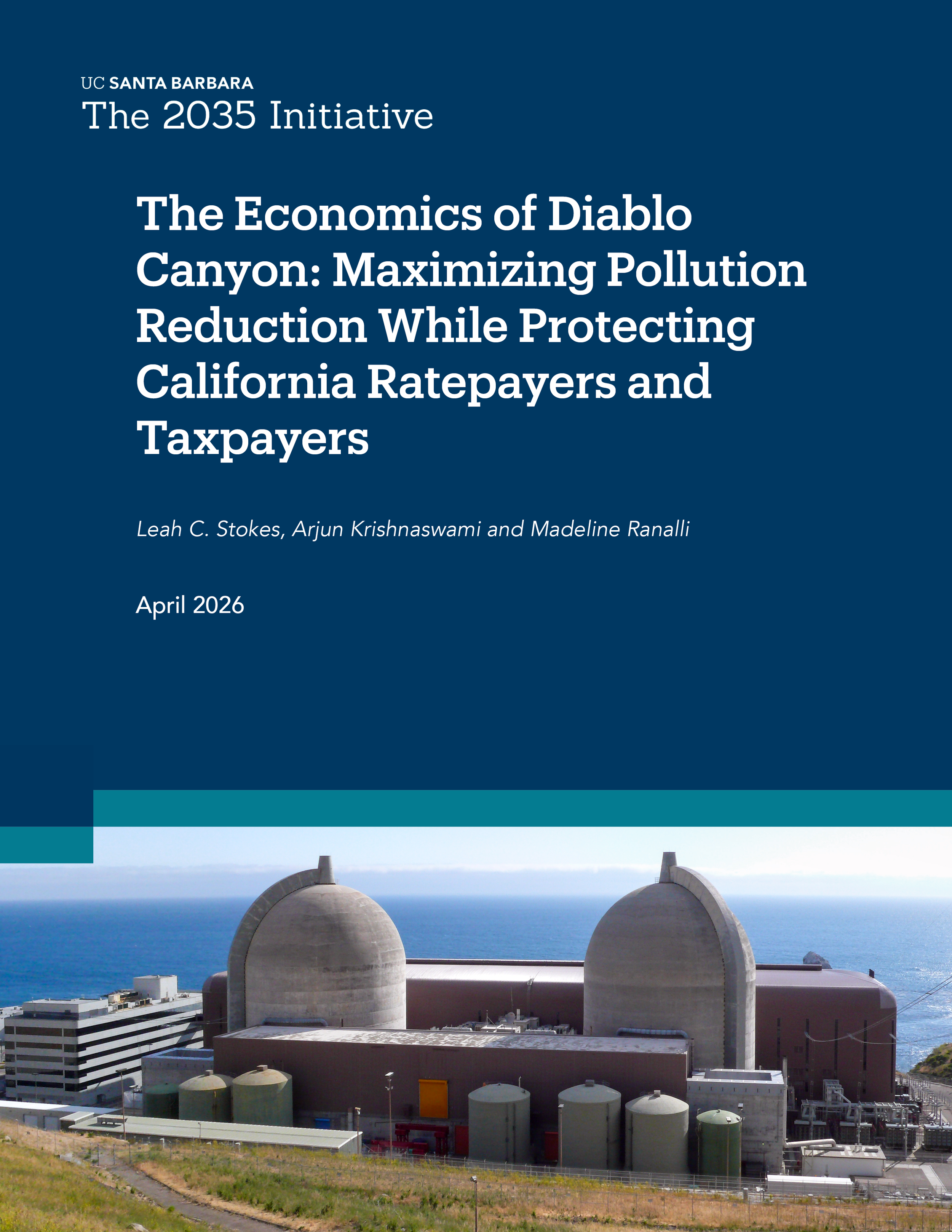
디아블로 캐년의 경제학: 오염 감소를 최대화하면서 캘리포니아 요금 납부자와 납세자를 보호하기
요약
카테고리: 원자력 정책
캘리포니아 주 의회가 2022년 SB 846을 통해 PG&E에 14억 달러 대출을 승인해 디아블로 캐년 원자력 발전소 운영을 연장했으나, PG&E는 연방 보조금으로 7억 4,140만 달러만 수령할 것으로 예상되어 최대 6억 5,860만 달러의 상환 부족분이 발생할 수 있다.
연구진 분석에 따르면 PG&E는 자본 개선 및 운영 비용을 부풀렸으며, 실제로는 7억 4,140만 달러의 대출만 요청했어야 했다.
3년 연속 기록적 이익을 낸 PG&E의 주주 초과 이익으로 대출 전액을 상환하도록 함으로써 납세자와 주 예산을 보호할 수 있다는 주장이 제기된다.
---
디아블로 캐년의 경제학: 오염 감소를 최대화하면서 캘리포니아 요금 납부자와 납세자를 보호하기
2022년 캘리포니아 주 의회는 SB 846을 통과시켜, 퍼시픽 가스 앤 일렉트릭 컴퍼니(PG&E, Pacific Gas and Electric Company)가 2025년 예정된 폐로 이후에도 디아블로 캐년 원자력 발전소(Diablo Canyon Power Plant)를 계속 운영할 수 있도록 14억 달러 대출을 승인했습니다. 이 대출은 PG&E가 연방 상환금을 받을 때까지의 '가교(bridge, 임시 연결 수단)'역할을 하도록 의도되었으나, 이 전력 회사는 현재 대출 상환에서 최대 6억 5,860만 달러의 부족분에 직면해 있습니다. 이는 회사가 연방 지원금으로 11억 달러만 신청했고, 그 중 7억 4,140만 달러만 받을 것으로 예상되기 때문입니다. 캘리포니아 납세자들이 이 6억 5,860만 달러의 부족분을 결국 떠안을 수도 있는 상황입니다.
미국 에너지부(DOE, Department of Energy)의 발전소 평가 결과와 PG&E의 공개 서류를 토대로, 연구진은 PG&E가 디아블로 캐년의 자본 개선 및 운영 비용을 부풀렸으며 캘리포니아 주 의회에 실제로는 7억 4,140만 달러의 대출만 요청했어야 했다고 밝혔습니다. PG&E는 14억 달러 대출과 11억 달러 DOE 수상금 간의 3억 달러 적자를 캘리포니아 납세자들이 부담해야 한다고 주장하고 있지만, 이는 SB 846의 입법 취지에 어긋나는 것입니다. 한편, PG&E는 3년 연속 기록적인 이익을 창출해 왔습니다. 주 입법자들은 PG&E가 주주 초과 이익으로 대출 전액을 상환하도록 함으로써 캘리포니아 납세자들을 보호하고 주 예산을 지킬 수 있습니다.
_저자:_ _리아 C. 스토크스(Leah C. Stokes), 아르준 크리슈나스와미(Arjun Krishnaswami), 매들린 라날리(Madeline Ranalli)_
---
AI 분석
이 보고서는 캘리포니아 디아블로 캐년 원자력 발전소의 운영 연장을 둘러싼 재정적 불투명성과 공공 비용 전가 문제를 정면으로 다루고 있다. PG&E가 비용을 의도적으로 부풀렸다는 주장은, 전력 회사가 공공 보조금 수령 과정에서 충분한 감독 없이 과도한 혜택을 누릴 수 있음을 시사한다. 특히 PG&E가 3년 연속 기록적인 이익을 올리는 상황에서 납세자 부담을 강요하는 것은 형평성 논란을 불러일으킨다. 이 분석은 원자력 발전소 연장 운영 결정이 단순한 에너지 정책을 넘어 재정 감독과 기업 책임이라는 복잡한 문제와 맞닿아 있음을 보여준다. 향후 유사한 원자력 운영 연장 논의에서 비용 투명성 확보와 독립적 감사가 필수적으로 요구될 것이다.
GAIN 바우처, 컨스텔레이션(Constellation), 나노 뉴클리어(Nano Nuclear), 뉴큐브(NuCube)에 수여
2026년 4월 8일, 오전 9:25 | Nuclear News
요약
카테고리: 현황
미국 에너지부(DOE)의 원자력 혁신 가속화 게이트웨이(GAIN)가 2026 회계연도 2차 바우처를 세 기업에 수여하여 선진 원자력 기술 개발을 지원한다.
수혜 기업 중 두 곳(나노 뉴클리어, 뉴큐브)은 마이크로리액터를 개발 중이며, 한 곳(컨스텔레이션)은 비등수형 원자로(BWR) 운영 최적화에 집중한다.
각 기업은 오크리지 국립연구소(ORNL) 또는 아르곤 국립연구소(Argonne)와 협력하며, 최소 20%의 비용을 자체 부담해야 한다.
---
에너지부(Department of Energy)의 원자력 혁신 가속화 게이트웨이(Gateway for Accelerated Innovation in Nuclear, GAIN)는 최근 선진 원자력 기술 개발 지원을 위해 2026 회계연도 2차 바우처 3건을 수여했다. 수혜 기업들은 각각 에너지부 산하 국립연구소 복합시설의 특정 역량과 전문성에 접근할 수 있게 되며, 이번 수여 라운드에서는 오크리지 국립연구소(Oak Ridge National Laboratory)와 아르곤 국립연구소(Argonne National Laboratory)가 지정되었다. 또한 각 기업은 현물 기여도 인정되는 최소 20%의 비용 분담을 책임져야 한다.
수혜 기업: 바우처를 받은 세 기업 중 두 곳은 마이크로리액터를 개발 중이며, 한 곳은 비등수형 원자로(BWR) 운영을 고도화하고 있다.
컨스텔레이션 에너지(Constellation Energy) (펜실베이니아주 케넷 스퀘어 소재)는 ORNL과 협력하여 BWR의 수분 이월 현상(moisture carryover phenomena)의 기저 물리학을 연구하고, 컨스텔레이션의 평가 도구에 통합 가능한 축소 차수 예측 모델 개발을 목표로 한다. 컨스텔레이션과 ORNL은 ORNL의 원자로 응용 가상 환경(Virtual Environment for Reactor Applications, VERA)을 포함한 모델링 및 시뮬레이션을 활용하여, 특히 고출력 밀도 및 출력 증강 노심(uprated cores)에서 컨스텔레이션 BWR 발전단지 전반의 연료 주기 비용 절감 및 설비 이용률(capacity factors) 향상을 추진한다. 지난해 컨스텔레이션의 드레스덴(Dresden)과 클린턴(Clinton) BWR은 원자력규제위원회(Nuclear Regulatory Commission, NRC)로부터 20년 운영 허가 연장을 받은 바 있다.
나노 뉴클리어 에너지(Nano Nuclear Energy) (뉴욕주 뉴욕시 소재)는 ORNL과 협력하여 자사의 크로노스(Kronos) 마이크로리액터의 안전 여유도(safety margins), 성능 신뢰성, 그리고 인허가 준비 상태를 입증한다. 나노 뉴클리어와 ORNL은 반응도(reactivity), 출력 분포, 온도 계수 등 핵심 원자로 물리 지표에 대한 원자력 데이터, 모델링 가정, 운영 변수의 영향을 정량화할 예정이다. 나노 뉴클리어와 파트너십을 맺은 일리노이대학교 어바나-샴페인(University of Illinois–Urbana-Champaign, UIUC)은 불과 지난주에 NRC에 크로노스 마이크로리액터 건설 허가 신청서를 제출했다.
뉴큐브 에너지(NuCube Energy) (아이다호주 아이다호 폴스 소재)는 아르곤(Argonne)과 협력하여 자사의 데카셀(DeccaCell) 마이크로리액터의 자율 운전 및 원격 모니터링 시스템을 검증한다. 뉴큐브와 아르곤은 원자로의 디지털 트윈(digital twin)을 활용하여 자율 제어 아키텍처를 테스트하며, 아르곤은 기존의 자율 운전 및 진단 프레임워크를 개조하여 검증된 시뮬레이션 환경 내에서 자동 기동(automated startup), 원격 모니터링, 독립 운전 모드 전환(islanding-mode transitions), 예측 정비(predictive maintenance)를 시연할 예정이다. 이 프로젝트는 운영 비용 절감, 안전성 강화, 상용화 실현을 목표로 한다.
세 기업 모두 과거에 GAIN 바우처를 수령한 전력이 있다. 2026 회계연도 1차 바우처는 2025년 12월에 발표되었으며, 올해 3차 바우처 제안서는 4월 30일까지 접수된다.
---
AI 분석
이번 GAIN 2차 바우처 수여는 미국 원자력 산업의 다양한 기술 스펙트럼을 동시에 지원한다는 점에서 주목할 만하다. 기존 대형 원전(BWR) 운영 최적화와 차세대 마이크로리액터 개발이라는 두 가지 방향을 균형 있게 지원함으로써, 단기적 에너지 공급 안정성과 장기적 기술 혁신을 함께 추구하는 전략적 접근을 보여준다. 특히 나노 뉴클리어의 경우 UIUC의 건설 허가 신청과 맞물려 크로노스 마이크로리액터의 상용화 경로가 구체화되고 있다는 점이 의미 있다. 뉴큐브의 디지털 트윈 기반 자율 운전 검증은 인력 의존도를 낮추고 소규모 분산형 원자력 발전의 경제성을 높이는 핵심 과제를 다루고 있다. 이러한 국립연구소-민간 기업 간 협력 모델은 미국의 원자력 기술 경쟁력 유지와 에너지 전환 가속화에 있어 중요한 인프라로 기능하고 있다.
케냐는 2034년까지 시아야 카운티에 2,000MW급 원자력 발전소 건설을 목표로 하며, 현재 전력 용량을 3,300MW에서 10,000MW로 확대할 계획이다.
르완다는 2030년대에 소형모듈원자로(SMR) 도입을 추진하고 있으며, 국제원자력기구(IAEA)의 기반 시설 검토 결과 긍정적인 평가를 받았다.
두 나라 모두 아프리카 대륙의 원자력 에너지 확산에 있어 선도적인 역할을 자처하고 있으며, 국제 기관들과 협력하여 원자력 인프라를 구축 중이다.
---
아프리카 대륙에서 전해지는 최근 소식에 따르면, 케냐와 르완다는 가까운 미래에 각국 최초의 원자력 발전소를 도입하기 위한 진전을 이어가고 있다. 두 나라의 원자력 추진 현황을 정리한다.
루토(Ruto)
케냐의 루토(Ruto), 원자력 계획 밝혀: 케냐의 윌리엄 루토(William Ruto) 대통령은 지난달 나이로비에서 열린 2026 국제원자력에너지회의(ICoNE)의 개막 연설에서, 현재 3,300MW인 케냐의 전력 용량을 향후 5~7년 내에 10,000MW로 끌어올리겠다는 계획을 밝혔으며, 이 중 3,000MW는 원자력으로 충당할 예정이라고 말했다.
이 확장 계획의 핵심은 시아야(Siaya) 카운티에 건설될 2,000MW급 원자력 발전소로, 2027년 착공, 2034년 가동을 목표로 하고 있다고 그는 전했다.
루토(Ruto) 대통령은 남아프리카공화국의 코버그(Koeberg) 원자력 발전소—1980년대에 개통된 가압수형 원자로 2기로 구성된 1,854MWe급 시설—가 아프리카 원자력 발전의 출발점임을 언급하며, 케냐에서도 첫 원자력 발전소를 환영한다는 뜻을 밝혔다.
"케냐 최초의 원자력 발전소 부지인 시아야 카운티 주민 여러분께, 이 여정의 동반자가 되어 주시기 바랍니다," 루토(Ruto) 대통령은 ICoNE 2026 연설에서 이렇게 말했다. "이 프로젝트가 가져올 막대한 경제적 혜택—고부가가치 일자리 창출부터 인프라 개발까지—을 더욱 깊이 이해하시길 권합니다."
그는 또 이렇게 덧붙였다. "원자력 에너지는 케냐에 진정한 게임 체인저(game changer, 판도를 바꿀 혁신적 요소)가 될 것임을 다시 한번 확언합니다. 이는 우리 산업을 지속가능하고 안전하게 가동시키고, 발전을 가속화하며, 우리를 선진국 경제로의 길로 확고히 이끌 것입니다."
ICoNE 2026은 OECD 원자력에너지기구(NEA), 케냐 원자력에너지청(Nuclear Power and Energy Agency), 미국 국무부 FIRST 프로그램, 한국수력원자력(Korea Hydro & Nuclear Power)이 공동 주최했다. 3월에 열린 이 회의(기계공학자협회가 개최하는 유사한 이름의 ICONE와 혼동하지 말 것)에는 500명 이상의 아프리카 정부 관리, 규제 기관, 전문가 등이 참가해 사흘간 원자력 에너지가 아프리카 대륙을 변화시킬 잠재력에 대해 논의했다.
르완다, 소형모듈원자로(SMR) 도입 희망: 국제원자력기구(IAEA)가 3월에 발표한 검토 보고서에 따르면, 르완다는 에너지 믹스에 원자력을 추가하기 위한 노력에서 진전을 이루고 있으며, 2030년대에 첫 번째 소형모듈원자로(SMR)를 도입하는 것을 포함한 원자력 인프라 계획도 착실히 추진 중이다.
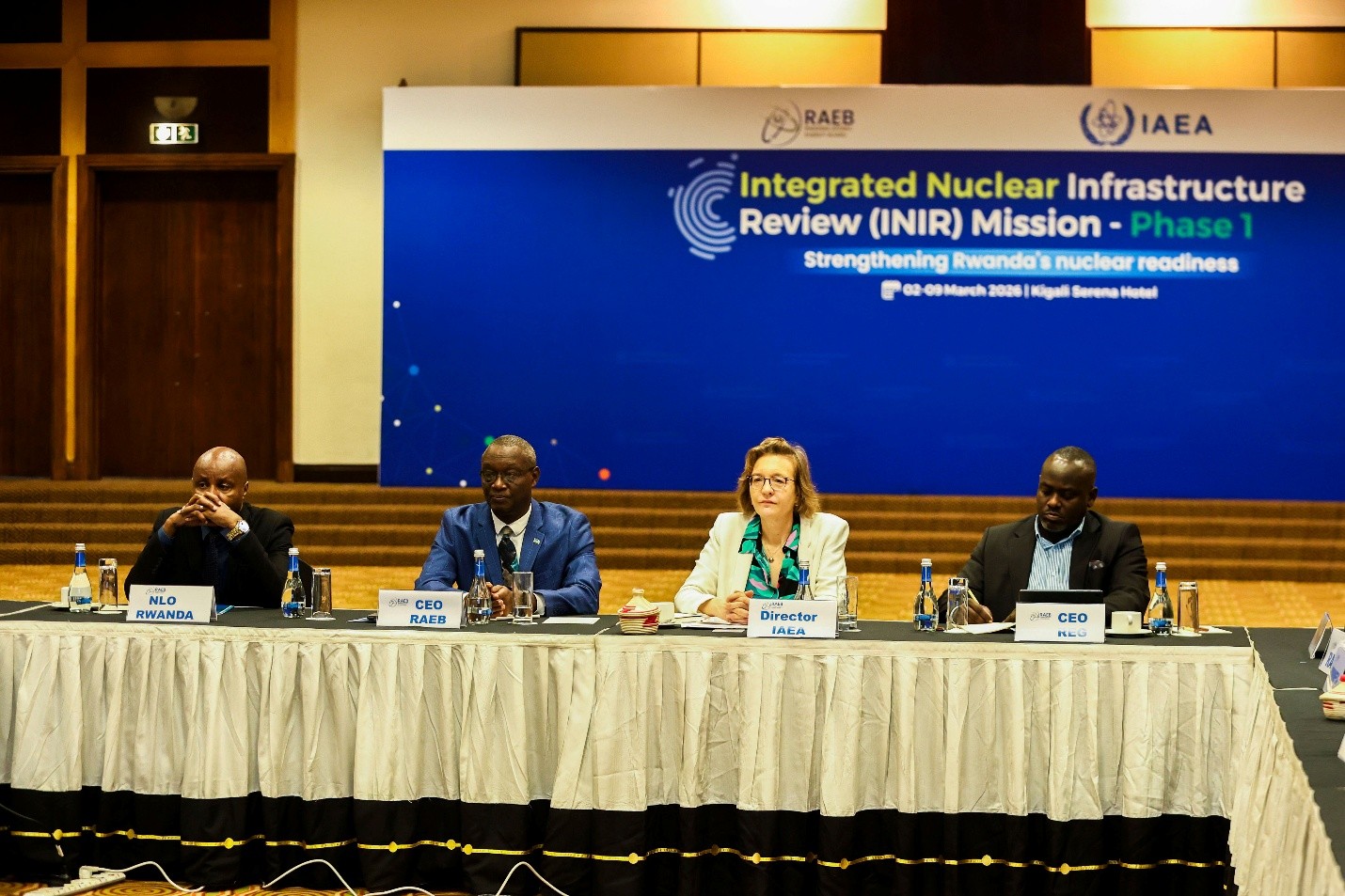
르완다의 원자력 인프라 개발을 검토하기 위한 IAEA 미션은 3월 초에 진행되었다. (사진: 르완다 원자력에너지위원회(Rwanda Atomic Energy Board))
IAEA에 따르면, 르완다는 원자력을 에너지 믹스의 60~70%까지 공급하는 것을 목표로 하고 있으며, 중장기 원자력 발전을 국가 에너지 부문 전략과 국가 토지이용 마스터플랜에 통합시키고 있다. 르완다의 원자력 발전 프로그램은 2020년 대통령령에 의해 설립되었으며, 같은 명령으로 원자력에너지위원회(Atomic Energy Board)도 설립되었다.
3월 초, IAEA의 통합원자력인프라검토(INIR) 팀은 르완다에서 8일간 체류하며 인프라 개발 검토 미션을 수행했다. 이 미션에 앞서 르완다 당국은 원자력 인프라 현안을 상세히 기술한 자체 평가 보고서와 지원 문서를 준비했다.
미션 기간 동안 팀은 원자력 시설 구축을 추진하는 다른 국가들에게도 유익할 수 있는 르완다의 우수 사례를 발굴했다. 예컨대 정부의 관여 및 조율, 이해관계자 참여, 비상 대비 및 대응 계획 등이 그 예로 꼽혔다.
"팀은 또한 새로운 포괄적 원자력법 초안 작성, 원자력 발전 프로그램을 위한 규제 체계 강화 작업 착수, 부지 조사 실시, 계획된 SMR 프로젝트의 후보 부지 선정 등 분야에서 이루어진 진전에 주목했다"고 IAEA는 밝혔다.
르완다 인프라부 장관 지미 가소레(Jimmy Gasore)는 검토 결과에 대해 이렇게 말했다. "르완다는 원자력 인프라의 책임감 있고 안전하며 투명한 개발에 확고히 전념하고 있습니다. IAEA의 검토는 우리의 국가 체계가 국제 안전 기준 및 글로벌 모범 관행과 부합할 수 있도록 소중한 지침을 제공해 줍니다."
IAEA와 르완다는 8일간의 미션 결과를 바탕으로 한 통합 실행 계획을 함께 마련해 나갈 예정이다.
---
AI 분석
케냐와 르완다의 원자력 도입 추진은 아프리카 대륙 전반에 걸친 에너지 전환의 흐름을 보여주는 주목할 만한 사례다. 케냐는 대규모 기존 원전 모델을, 르완다는 소형모듈원자로(SMR)라는 신기술 경로를 택함으로써 각국의 전력 수요와 재정 여건에 맞는 전략적 차별화를 보이고 있다. 특히 ICoNE 2026에 OECD NEA, 미국, 한국 등 주요 원자력 강국이 공동 참여했다는 점은 아프리카 원자력 시장을 둘러싼 국제적 관심과 지정학적 경쟁이 심화되고 있음을 시사한다. IAEA의 르완다 INIR 미션 결과는 긍정적이었으며, 이는 르완다가 체계적이고 국제 기준에 부합하는 방식으로 원자력 도입을 준비하고 있음을 보여준다. 두 나라의 성공적인 원자력 도입은 에너지 접근성이 낮은 아프리카 다른 국가들에게도 중요한 참조 모델이 될 수 있다.
미키 셰릴(Mikie Sherrill) 주지사는 오늘 NJBIA가 지지하는 법안에 서명하여 법으로 제정했다. 이 법안은 뉴저지의 추가 원자력 발전을 위한 길을 열어주며, 구식 허가 제한을 수정하고 새로운 원자력 프로젝트에 현대적이고 안전하며 최첨단 저장 방법의 사용을 의무화한다.
수십 년 동안 뉴저지는 사실상의 모라토리엄으로 작용하는 법적 제한 아래 운영되어 왔으며, 환경보호부(DEP)가 새로운 원자력 시설에 대한 특정 허가를 승인하는 것을 금지해 왔다.
셰릴은 세일럼 원자력 발전소(Salem Nuclear Generating Station)에서 열린 법안 서명식에서 "구식 법률 중 하나는 새로운 프로젝트가 실질적으로 존재하지 않는 폐기 방법을 명시하도록 요구했습니다"라고 말했다. "그것은 1970년대에 작성되었으며, 당시에는 의미가 있었지만 오늘날에는 맞지 않는 기술적 요건에 묶여 있었습니다."
그녀는 이를 자신이 선거운동에서 바꾸겠다고 약속했던 비효율적 정부의 전형적인 사례라고 말했다.
셰릴에 따르면, 새 법안은 프로젝트들이 40년 동안 35개 이상의 주에서 100% 안전 기록으로 사용되어 온 현대적이고 안전하며 최첨단 저장 방법을 사용하도록 의무화한다.
원자력은 이미 주의 전력 생산에서 큰 역할을 하고 있으며, 세 개의 원자력 발전소를 포함하는 세일럼 부지는 전국에서 가장 큰 원자력 발전 부지 중 하나로, 뉴저지에서 생산되는 전력의 거의 절반을 공급하고 있다. 원자력은 또한 주의 청정 탄소 무배출 전력의 80% 이상을 차지한다.
이 부지는 300만 가구에 전력을 공급하고, 1,600개의 지역 일자리를 제공하며, 1,000명의 계약업체를 고용하여 주 경제에 12억 달러의 경제적 파급 효과를 기여하고 있다.
셰릴은 이 단지 없이는 뉴저지 주민들이 매년 전기 요금으로 4억 달러를 더 지불해야 할 것이라고 말했다.
주로 제한된 공급에 직면한 전례 없는 수요 증가에 의해 촉진된 주의 전기 요금이 계속 상승함에 따라, 새로운 전력 생산이 핵심이다.
셰릴은 "비용을 낮추기 위해서는 더 많은 에너지 공급이 필요합니다"라고 말하며, 뉴저지가 그 공급을 돕기 위해 차세대 원자력 에너지의 선두주자가 될 좋은 위치에 있다고 덧붙였다.
뉴저지 비즈니스 & 산업협회(New Jersey Business & Industry) 회장 겸 CEO인 미셸 시케르카(Michele Siekerka)는 "우리 지역 전력망은 급증하는 수요와 제한된 신규 공급으로 인해 압박을 받고 있습니다"라고 말했다. "원자력 확대는 기업과 주민들의 공공요금을 올려온 공급과 수요 간의 격차를 줄이기 위한 장기적이고 종합적인 해결책의 일부입니다."
셰릴은 또한 행정명령 2호에 의거해 설립된 원자력 태스크포스(Nuclear Task Force)의 구성을 발표했으며, 이 기구는 주의 새로운 원자력 에너지 추진을 위한 작업을 시작할 것이라고 밝혔다.
태스크포스는 정부, 산업계, 환경, 노동계 지도자들을 소집하여 기회를 탐색하고, 금융, 공급망 및 기술 개발, 인력 성장 및 훈련, 규제 및 허가 체계, 공공 신뢰 및 신임의 다섯 가지 중점 분야에 걸쳐 업무를 조직할 것이다. 태스크포스의 목표는 최고 수준의 공공 안전과 투명성을 유지하면서 주가 새로운 원자력의 혜택을 누릴 준비를 갖추도록 하는 것이다.
셰릴은 "구식 장벽을 제거하고 정부, 산업계, 노동계 지도자들을 한데 모아, 우리 주가 새로운 첨단 원자력을 추구할 무대를 마련하고 있습니다. 이는 뉴저지가 더 강하고, 더 청정하며, 더 경제적이고 안정적인 에너지 미래를 확보하는 데 도움이 될 것이며, 동시에 혁신, 일자리 창출, 경제 성장의 최전선에 주를 위치시킬 것입니다"라고 말했다.
원자력 태스크포스 초기 구성원: 엘리자베스 놀(Elizabeth Noll), 주지사실 에너지 수석 전략가, 공동 의장
크리스틴 굴-사도비(Christine Guhl-Sadovy) 위원장, 뉴저지 공공시설위원회 위원장, 공동 의장
콜린 에머(Colin Emerle), 주지사실 수석 법률 고문, 태스크포스 법률 고문
에드 포토스낙(Ed Potosnak) 위원, 환경부
에반 와이스(Evan Weiss), 경제개발청 CEO
이본 메이스(Yvonne Mays) 장군, 군무부
아론 바인더(Aaron Binder), 주 재무장관
찰스 맥피터스(Charles McFeaters), PSEG 원자력(PSEG Nuclear) 사장 겸 최고원자력책임자
패트릭 오브라이언(Patrick O'Brien), 홀텍(Holtec) 정부 업무 및 커뮤니케이션 이사
미셸 시케르카(Michele Siekerka), NJBIA 사장 겸 CEO
조셉 이건(Joseph Egan), 뉴저지주 전기공사 노동조합 건설 부문 협회장
마이크 헬스트롬(Mike Hellstrom), LIUNA 부사장 겸 동부 지역 관리자
매리언 압두(Marion Abdou), 전 뉴저지 공공시설위원회 위원
매튜 맥킨지(Matthew McKinzie) 박사, 천연자원보호협의회(Natural Resources Defense Council) 데이터 및 정책 분석 수석 이사
_더 많은 비즈니스 뉴스를 보려면_ _NJB 뉴스 나우__를 방문하세요._ 태그:
전력에너지미키 셰릴(Mikie Sherrill)원자력원자력 발전PSE&G * 규제 완화
뉴저지 주지사 미키 셰릴은 수십 년간 사실상 신규 원자력 발전소 건설을 막아온 낡은 허가 규정을 개정하는 법안에 서명함으로써, 주 내 신규 원전 건설의 길을 열었다. 이 법은 1970년대에 제정된 현실에 맞지 않는 핵폐기물 처리 요건을 폐지하고, 이미 35개 이상의 주에서 40년간 100% 안전 기록을 보유한 현대적 저장 방식을 의무화하는 내용을 담고 있다. 뉴저지는 이미 원자력이 주 전체 전력의 약 절반, 청정 무탄소 전력의 80% 이상을 담당하는 원전 강주인 만큼, 이번 법 개정은 전력 수요 급증과 공급 부족으로 인한 전기요금 상승 문제를 해결하기 위한 핵심 조치로 평가된다. 셰릴 주지사는 아울러 정부·산업계·환경·노동 분야 리더들이 참여하는 원자력 태스크포스를 발족시켜 재원 조달, 공급망, 인력 양성, 규제 체계, 공공 신뢰 등 5개 분야에서 차세대 원전 추진 기반을 마련할 계획이다. 이번 조치는 에너지 안보와 탄소중립, 경제 성장을 동시에 추구하는 뉴저지의 장기 에너지 전략 측면에서 중요한 전환점이 될 것으로 보인다.
※ 이 글은 해외 원자력 바로알기를 위한 정보 전달을 목적으로 제공됩니다. 특정 기업이나 종목에 대한 투자 권유가 아니며, 모든 투자 판단과 그에 따른 책임은 투자자 본인에게 있습니다.
프린스턴 플라즈마 물리학 연구소(PPPL)가 ITER 개발을 지원하는 두 국제 토카막 프로젝트—프랑스의 WEST와 일본의 JT-60SA—에 새로운 X선 이미징 결정 분광기(XICS) 시스템을 제공하는 프로젝트를 주도하고 있다.
XICS는 플라즈마에서 방출되는 X선을 측정해 온도, 속도, 입자 흐름 방향, 플라즈마를 냉각시킬 수 있는 불순물 밀도 등 핵심 정보를 정밀하게 분석한다.
JT-60SA용 XICS 시스템은 향후 2년간 설치 및 테스트를 거쳐 2026년 9월 첫 데이터 수집이 예정되어 있다.
---
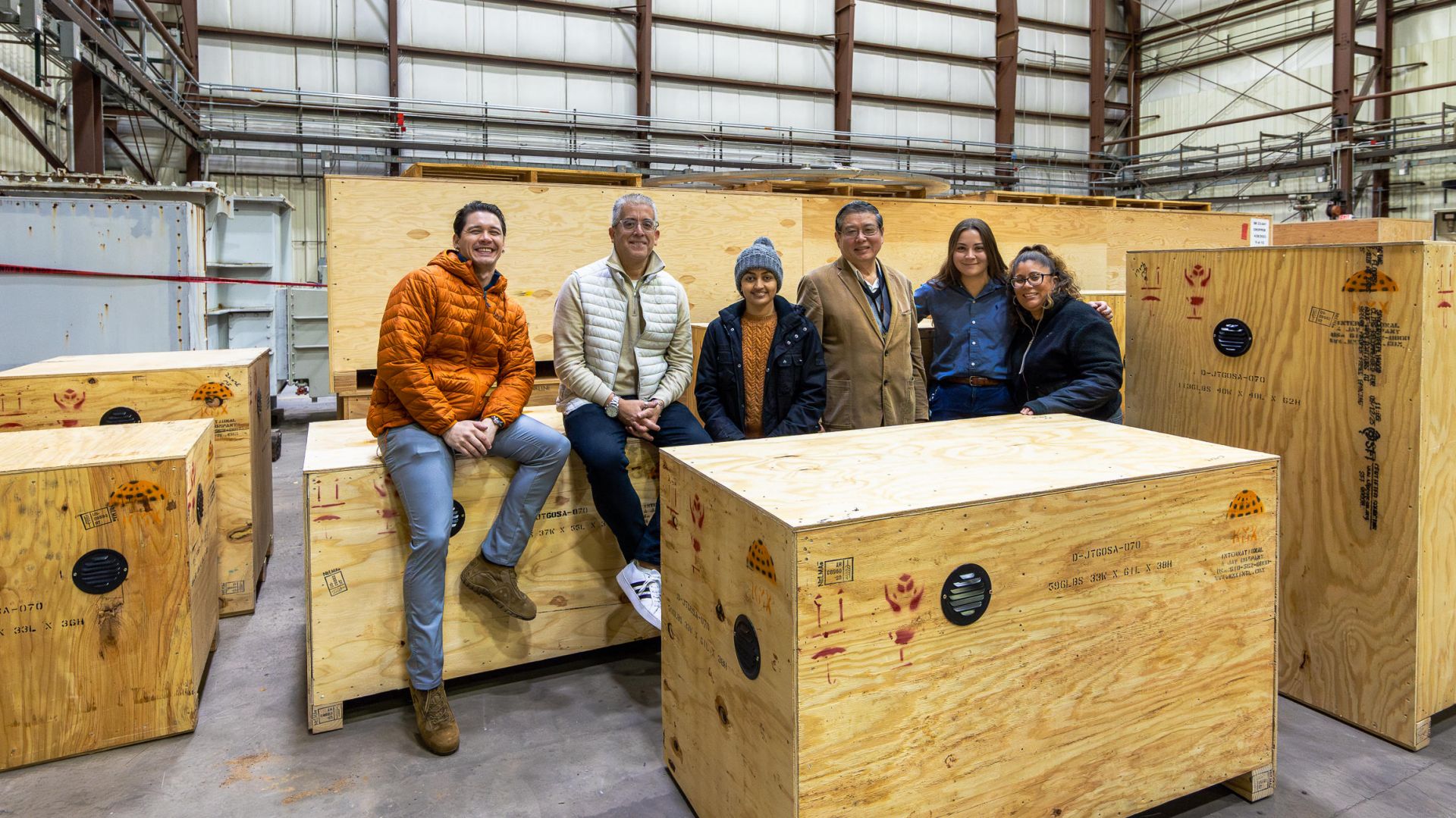
PPPL 직원들이 일본으로 발송 준비가 완료된 XCIS 시스템을 담은 운송 상자 앞에서 포즈를 취하고 있다. (사진: PPPL)
연구자들이 핵융합 에너지를 완전히 활용하기 위해 핵융합 장치 내부의 플라즈마를 더 잘 이해할 방법을 모색하는 가운데, 프린스턴 플라즈마 물리학 연구소(Princeton Plasma Physics Laboratory, PPPL)가 두 국제 토카막 프로젝트—프랑스 남부의 WEST와 일본의 JT-60SA—에 새로운 X선 이미징 시스템을 제공하는 프로젝트를 이끌고 있다. 두 프로젝트 모두 ITER 개발을 지원하도록 설계되었다.
PPPL은 두 토카막 모두를 위한 X선 이미징 결정 분광기(X-ray imaging crystal spectrometer, XICS) 시스템을 제작하고 있다. XICS는 플라즈마에서 방출되는 X선을 측정하여 온도, 속도, 플라즈마 입자의 흐름 방향, 그리고 플라즈마를 냉각시킬 수 있는 입자의 밀도 등 중요한 정보를 파악한다. 최대 효율을 달성하기 위해서는 이 수치들을 면밀히 모니터링해야 하며, 이러한 측정은 핵융합 반응을 안정적으로 유지하는 데 필수적이다.
PPPL에 따르면, XICS의 고급 교정 시스템은 일관되게 높은 정확도의 측정값을 제공하는 반면, 유사한 시스템들의 정확도는 온도 변화에 취약한 경향이 있다.
PPPL은 매사추세츠 공과대학교(Massachusetts Institute of Technology, MIT)와의 협력을 통해 WEST에 두 개의 새로운 XICS 시스템을 추가할 예정이다. WEST는 약 1년 전 토카막 플라즈마 지속 시간 기록을 경신한 바 있다.
WEST는 유럽퓨전(EUROfusion) 컨소시엄과의 협력 하에 프랑스 대체에너지 및 원자력에너지위원회(French Alternative Energies and Atomic Energy Commission)가 운영하는 자기 밀폐 핵융합 토카막이다. ITER와 유사한 특성을 지닌 플라즈마를 확보하도록 설계되어, ITER 다이버터(divertor) 개발을 가속화하는 데 기여하고 있다.
WEST는 이미 플라즈마 중심부를 관찰하는 시스템을 갖추고 있으며, 새로 추가되는 두 개의 XICS 시스템은 플라즈마의 상단과 하단을 각각 겨냥하여 연구자들이 더 다양한 각도에서 더 높은 정밀도로 플라즈마를 관찰할 수 있게 해줄 것이다.
"플라즈마를 인체에 비유한다면, 배꼽만 바라보면 머리나 발에서 무슨 일이 일어나는지 알 수 없습니다. 이제 우리는 전체 그림을 완성하여 전신을 연구할 수 있게 될 것입니다."
— 루이스 델가도아파리시오(Luis Delgado-Aparicio), PPPL 고급 프로젝트 책임자 겸 프로젝트 총괄
PPPL에 따르면, 두 개의 비축(off-axis) XICS 시스템은 플라즈마 전체—핵심부에서 가장자리까지—에 걸쳐 온도, 회전, 텅스텐 불순물 수준이 어떻게 변화하는지를 보여줄 것이다.
"이것은 열, 운동량, 불순물 수송 연구 전반에 걸쳐 매우 중요한 정보입니다."
— 존 라이스(John Rice), MIT 플라즈마 과학 및 핵융합 센터 수석 연구 과학자
PPPL은 또한 유럽의 퓨전 포 에너지(Fusion for Energy)와의 협력 하에 일본 국립양자과학기술연구개발기구(National Institutes for Quantum Science and Technology)가 운영하는 세계 최대 운영 중 토카막인 JT-60SA를 위한 XICS 시스템도 설계했다.
JT-60SA의 XICS 시스템은 향후 2년에 걸쳐 설치 및 테스트가 진행될 예정이며, 첫 번째 데이터는 2026년 9월에 수집될 것으로 예상된다.
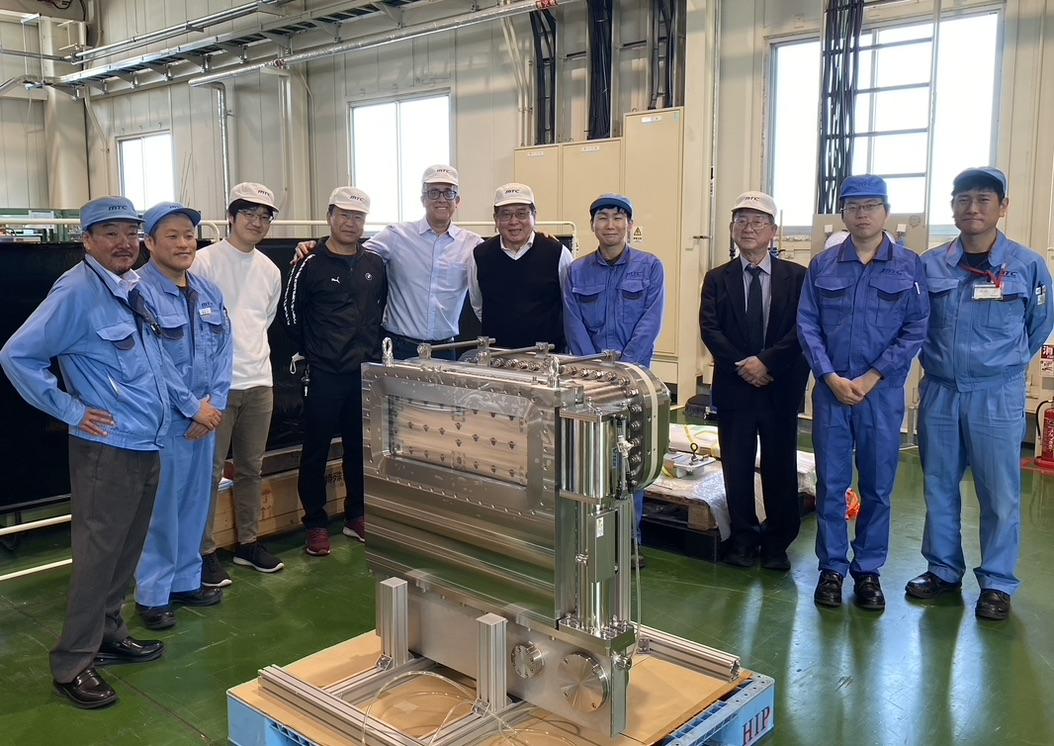
XICS 시스템을 JT-60SA에 연결할 밸브는 일본의 메탈 테크놀로지스 컴퍼니(Metal Technologies Company)가 제조했다. (사진: 루이스 F. 델가도아파리시오(Luis F. Delgado-Aparicio)/PPPL)
"이 프로젝트는 WEST와 JT-60SA에서 얻은 지식을 하나로 연결하여 PPPL의 더 넓은 토카막 프로그램에 직접 반영합니다. 미국 연구소들이 국제 시설에 고임팩트 진단 장비를 기여할 수 있는 모델이 될 것입니다."
— 라제시 마인기(Rajesh Maingi), PPPL 토카막 실험 과학 책임자
미국 핵융합 목표 증진: "이번 투자는 미국 핵융합 과학 및 기술 로드맵(U.S. Fusion Science & Technology Roadmap)과 제네시스 미션(Genesis Mission)을 발전시키는 데 있어 중요한 발걸음입니다. 생성되는 고품질 데이터는 모델 검증 및 확인에 매우 귀중하며, 인공지능과 핵융합 데이터를 융합하는 노력을 가속화하여 AI-핵융합 디지털 융합 플랫폼(AI-Fusion Digital Convergence Platform)을 통해 미국 에너지부(DOE)의 제네시스 미션을 지원할 것입니다." — 장 폴 알랭(Jean Paul Allain), 미국 에너지부 핵융합 사무소 국장
---
AI 분석
이번 프로젝트는 미국이 국제 핵융합 연구 무대에서 진단 기술 분야의 선도적 역할을 강화하고 있음을 보여준다. XICS 시스템의 핵심 강점은 온도 변화에도 높은 측정 정확도를 유지하는 고급 교정 기술에 있으며, 이는 장기 플라즈마 실험에서 신뢰할 수 있는 데이터 확보에 직결된다. WEST와 JT-60SA 모두 ITER의 핵심 기술 검증 플랫폼으로서, 이곳에서 축적된 데이터는 ITER 운영 전략 수립에 직접 활용될 것이다. 특히 인공지능과 핵융합 데이터의 융합을 강조하는 DOE의 제네시스 미션과의 연계는, 향후 핵융합 진단 기술이 데이터 기반 모델 최적화와 긴밀하게 결합될 것임을 시사한다. 미국, 프랑스, 일본, 유럽연합 기관들 간의 다자 협력 구조는 글로벌 핵융합 연구 생태계가 점점 더 분업화·전문화되고 있음을 보여주는 사례다.
프로젝트 오메가(Project Omega)와 아이다호 국립연구소(INL), ARPA-E 수주로 사용후 핵연료 재활용 추가 연구 추진
2026년 4월 8일
요약
카테고리: 기술
원자력 기술 스타트업 프로젝트 오메가(Project Omega)가 미 에너지부 ARPA-E로부터 계약을 수주하여 용융염 전기화학 방식의 사용후 핵연료(UNF) 재활용 기술 개발을 추진한다.
아이다호 국립연구소(INL)와 협력하여 킬로그램 규모의 원형 시험을 수행하고, 이를 통해 파일럿 규모 재활용 시설 구축을 위한 설계 데이터를 확보할 계획이다.
이 기술은 수성(aqueous) 방식과 달리 대량의 이차 폐수를 생성하지 않으며, 순수 플루토늄을 분리하지 않고도 고순도 분리를 구현해 핵 비확산 위험을 최소화한다.
---
원자력 기술 스타트업 프로젝트 오메가(Project Omega)는 에너지부 산하 첨단연구프로젝트청-에너지(ARPA-E, Advanced Research Projects Agency-Energy)로부터 계약을 수주하여 사용후 핵연료(UNF) 재활용 기술 개발을 추진한다고 발표했다. 프로젝트 오메가는 이번 계약을 통해 자사의 용융염 전기화학 재활용 플랫폼의 핵심 구성 요소를 검증할 예정이라고 밝혔다. 이 플랫폼은 사용후 핵연료를 처리하고, 가치 있는 동위원소를 회수하며, 장기 폐기물 관리 문제를 줄이기 위해 설계되었다.
프로젝트 오메가는 아이다호 국립연구소(INL, Idaho National Laboratory)와 함께 이 프로젝트를 수행하며, 사용후 핵연료의 용융염 전기화학 환원에 사용되는 새로운 불활성 양극(inert anode)을 시연할 계획이다. 수집된 데이터는 프로젝트 오메가가 파일럿 사용후 핵연료 처리 시설 계획을 발전시키는 데 활용될 예정이다.
"사용후 핵연료는 미국에서 가장 활용도가 낮은 에너지 자원 중 하나입니다," 라고 프로젝트 오메가의 최고경영자 겸 창업자인 스태퍼드 시핸(Stafford Sheehan)이 말했다. "INL과 함께 우리는 그 에너지를 회수하고, 장기 폐기물 관리에 대한 납세자 부담을 줄이며, 미국 핵연료 주기 내 핵심 역량을 재건하기 위한 실용적이고 산업적인 경로를 시연하고 있습니다. ARPA-E의 지원 덕분에 파일럿 규모 배치를 향해 이 기술을 가속화할 수 있게 되었습니다."
프로젝트 배경: 2022년 INL은 ARPA-E의 사용후 핵연료 방사성 동위원소의 에너지 전환(CURIE, Converting UNF Radioisotopes Into Energy) 프로그램을 통해 "사용후 핵연료에서 악티나이드 원소의 전기화학적 회수를 위한 강건한 양극 재료 개발"이라는 과제로 260만 달러를 수주한 바 있다.
INL의 해당 과제는 4월 2일로 종료되었으며, 용융염 전기화학 공정을 통해 사용후 핵연료에서 악티나이드 원소를 회수하기 위한 강건한 양극 재료의 설계, 제조 및 시험을 연구하는 것이었다.
프로젝트 오메가에 따르면, 이번 신규 계약은 INL에서의 킬로그램 규모 원형 시험을 지원하여 시스템 성능을 검증하고, 재활용 기술의 파일럿 규모 배치에 필요한 질량균형 엔지니어링 데이터를 생성하는 데 활용될 예정이다.
DOE 환경 분류: 3월 12일, 에너지부(DOE)는 이 프로젝트 자금 지원에 대해 범주적 제외(categorical exclusion)를 발령했다. 이는 해당 작업이 환경 평가나 환경 영향 평가서를 필요로 하지 않는다고 부처가 판단했음을 의미한다.
DOE에 따르면, 이 자금은 프로젝트 오메가 팀이 "(1) 양극 재료 성능 시험 및 검증, (2) 초기 원형 시스템 개발, 성능 지표 시험 및 검증, (3) 원형 파일럿 규모 시스템을 위한 모델 공정도 개발, (4) 모델 원형 파일럿 시스템 시험 및 검증, (5) 차기 단계 개발을 위한 파일럿 시스템 설계 확정"에 사용될 예정이다.
기술 특성: 프로젝트 오메가에 따르면, 자사의 비수성(nonaqueous) 처리 방법은 수성 방식에서 발생하는 대량의 이차 폐수 흐름을 생성하지 않는다.
또한 용융염 전기화학 공정은 순수 플루토늄을 분리하지 않고도 고순도 분리를 달성하여, 상업적으로 검증된 전기화학적 금속 정제 기술을 활용하면서 핵 비확산 위험을 최소화한다고 회사 측은 덧붙였다.
프로젝트 오메가는 2월에 스텔스 모드(stealth mode, 공개적 활동 없이 비밀리에 운영하는 방식)에서 벗어나, 다양한 종류의 사용후 핵연료를 처리하고 선진 원자로, 국내 동위원소 공급망, 차세대 전력 시스템을 지원할 수 있는 소재를 회수하는 파일럿 시설 건설 계획을 공개했다.
---
AI 분석
프로젝트 오메가(Project Omega)와 아이다호 국립연구소(INL)의 이번 협력은 미국 사용후 핵연료 재활용 기술 개발의 중요한 진전을 나타낸다. 용융염 전기화학 방식은 기존 수성 재처리 방식에 비해 폐기물 발생량이 적고 핵 비확산 측면에서도 유리하여, 차세대 원자력 연료 주기 구축에 있어 유망한 접근법으로 평가된다. ARPA-E의 지원을 통해 킬로그램 규모 실증 실험이 가능해짐으로써, 파일럿 시설로의 단계적 확대를 위한 기술적 기반이 마련될 것으로 기대된다. 사용후 핵연료를 단순한 폐기물이 아닌 가치 있는 에너지 자원으로 재인식하는 이 접근법은, 장기적으로 미국의 원자력 에너지 자립도 향상과 폐기물 관리 부담 경감에 기여할 수 있다. 다만, 실제 상업 규모 배치까지는 기술적·규제적 검증 과정이 남아 있어 지속적인 모니터링이 필요하다.
---
출처: ANS Nuclear News | 작성자: Nuclear News 편집부 | 매체명: ANS Nuclear News
※ 이 글은 해외 원자력 바로알기를 위한 정보 전달을 목적으로 제공됩니다. 특정 기업이나 종목에 대한 투자 권유가 아니며, 모든 투자 판단과 그에 따른 책임은 투자자 본인에게 있습니다.
2024년 4월 10일, 오전 9:31 | Nuclear News | 제레미 햄프셔(Jeremy Hampshire)
요약
카테고리: 역사
SNAP(원자력 보조 전원 시스템)은 원자력 기술 기반의 이동식 전력 공급원 개발을 목표로 한 원자력에너지위원회(AEC) 프로그램이었다.
이 프로그램은 지상, 해상, 우주 등 다양한 환경에서 활용 가능한 소형 원자로 개발에 초점을 맞추었다.
1955년부터 1973년까지 운영되다가 종료되었으며, 우주 응용 분야에서 소형 원자로의 필요성을 입증했다.
---
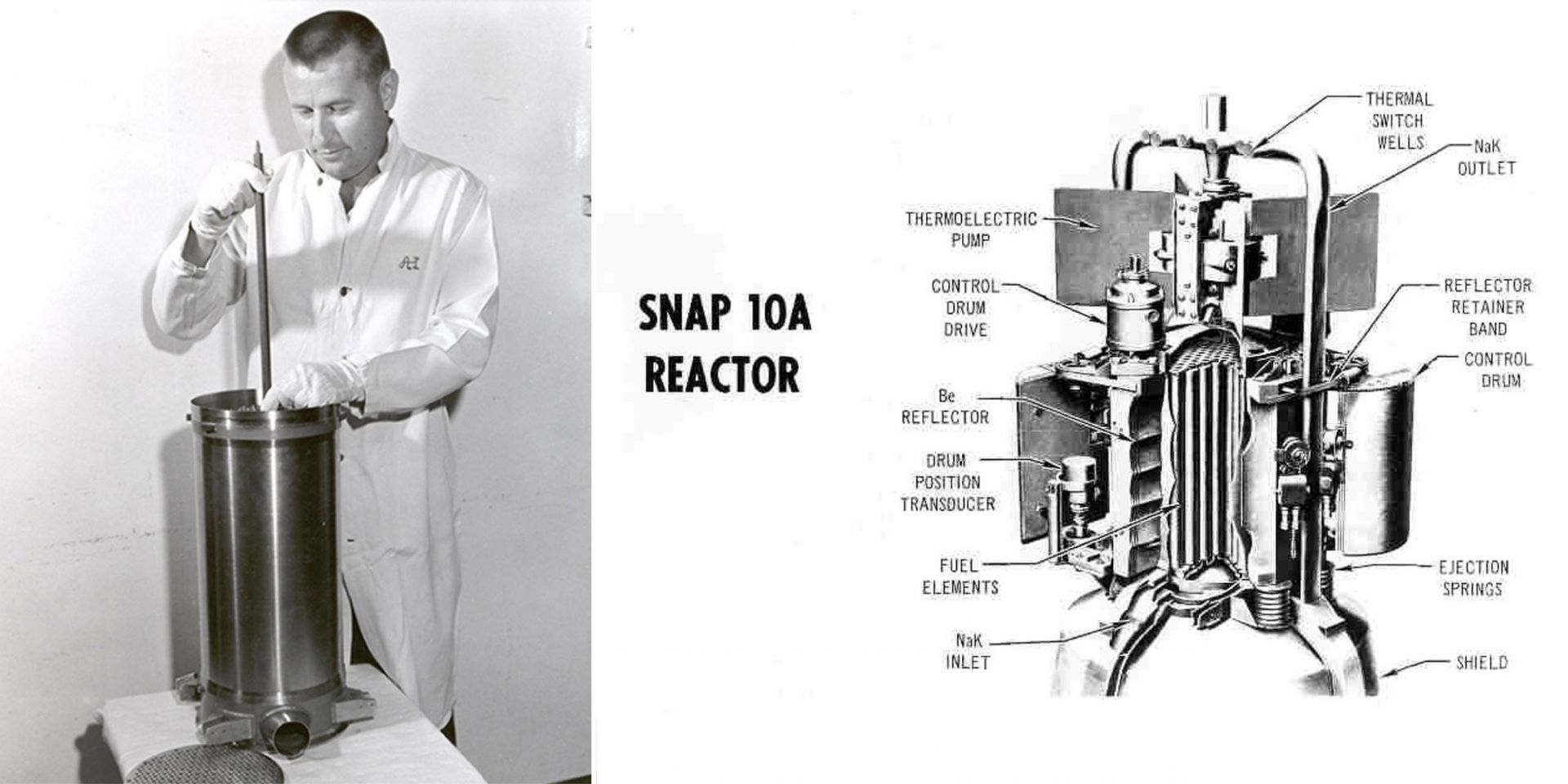
왼쪽: 기술자가 연료가 담긴 강철 튜브를 SNAP-10A 원자로 노심 용기에 삽입하고 있다. (사진: 미국 에너지부(DOE)) 오른쪽: 원자로 단면도. (이미지: 미국 에너지부(DOE))
원자력 보조 전원 시스템(SNAP, Systems for Nuclear Auxiliary Power)은 원자력 기술을 중심으로 이동식이고 신뢰성 높은 전력 공급원을 개발하는 것을 목표로 한 원자력에너지위원회(Atomic Energy Commission) 프로그램이었다. 이 전력 공급원은 지상, 해상, 우주 등 다양한 환경에서 활용될 수 있었다. 특히 우주 응용 분야에서 필수적인 소형 원자로 개발을 목표로 하였으며, 프로그램은 1955년부터 1973년까지 운영되다가 종료되었다.
SNAP-10A는 미국이 우주에서 실제로 운용한 최초의 원자력 발전 시스템으로, 1965년 궤도에 올려진 역사적 의미를 지닌다. 이 프로그램은 소형 원자로가 우주 환경에서 안정적으로 작동할 수 있음을 최초로 실증하였으며, 이후 우주 원자력 기술 발전의 토대가 되었다. 현재 NASA와 여러 우주기관이 추진 중인 달·화성 탐사용 원자력 전원 시스템 개발은 SNAP 프로그램의 유산을 계승한다고 볼 수 있다. 원자력 보조 전원 기술은 심우주 탐사에서 태양광 발전의 한계를 극복하는 핵심 솔루션으로 재조명받고 있다.
원자력 산업의 역사 대부분에 걸쳐, 우라늄 탐사는 친숙한 패턴을 따라왔다: 발견, 전략적 긴박감에 의해 추진된 신속한 윤곽 파악, 가격이 유리한 주기 동안의 생산, 그리고 경제적 또는 정치적 여건이 불리해졌을 때의 장기적인 휴면. 미국에서 이 주기를 가장 명확히 보여주는 사례 중 하나는 와이오밍(Wyoming) 주의 카퍼 마운틴(Copper Mountain) 우라늄 지구이다. 냉전 시대에 극렬한 활동의 중심지였던 이 지역은 이제 일부 개발업자들이 "보이지 않는 우라늄"이라고 부르는 것을 대표한다. 규모가 크고 잘 문서화된 자원이지만, 재래식 채광 패러다임과 현대의 규제적·기술적·데이터 기반 접근 방식 사이에 끼어 경제적으로 소외된 자원이다.
_NEi_와의 인터뷰에서 마이리아드 우라늄(Myriad Uranium)의 최고경영자(CEO) 토마스 램(Thomas Lamb)은 보이지 않는 우라늄 개념을 이렇게 설명한다: "그것은 항상 그 자리에 있었지만, 경제적으로나 정치적으로 실현 가능하지 않았기 때문에 사실상 사람들의 시야에서 사라져버렸습니다." 따라서 과제는 고전적인 의미의 발견이 아니라 재해석에 있다 — 역사적 데이터, 현대적 기준, 그리고 새로운 분석 도구를 한데 모아 이 휴면 자원들이 실현 가능한 자원으로 재분류될 수 있는지를 판단하는 것이다.
코퍼 마운틴 탐사
코퍼 마운틴(Copper Mountain)은 이 도전 과제를 잘 보여주는 사례다. 이 광구는 미국 정부의 우라늄 수요에 힘입어 1950년대에 처음으로 체계적인 탐사가 이루어졌다. 이를 통해 애로우헤드(Arrowhead) 광상이 확인되었고, 이후 애로우헤드 광산으로 개발되었다. "그 광산은 약 0.15%의 품위로 대략 50만 파운드를 생산했습니다," 램(Lamb)은 설명한다. "당시로서는 상당히 의미 있는 성과였죠."
생산은 1950년대와 1960년대에 걸쳐 계속되었으며, 더 높은 품위로 약 78만 파운드(약 350톤)를 산출한 보난자(Bonanza)를 비롯한 소규모 위성 광산들과, 각각 수만 파운드씩 생산한 다수의 소규모 작업장들이 함께 운영되었다. 이 초기 광산들은 우라늄이 코팅된 모래와 암석 덩어리를 포함한 비교적 집중된 고품위 광화대를 채굴하는 경향이 있었다.
1970년대에 들어 전략적 상황이 변화했다. 유니언 퍼시픽(Union Pacific)의 우라늄 자회사인 로키 마운틴 에너지(Rocky Mountain Energy)는 서던 캘리포니아 에디슨(Southern California Edison)과의 협력 하에 다른 모델을 추구했다. 고립된 고품위 광체를 목표로 삼는 대신, 넓은 지역에 걸쳐 파쇄된 기반암에 분포하는 대규모 산재형 광화대를 모색했다. "많은 원자로에 수년간 공급할 수 있는 무언가를 찾고 있었습니다," 램은 말한다. "그것은 평균적으로 낮은 품위를 의미했지만, 훨씬 더 큰 규모에 걸쳐 있었죠."
이러한 전환은 약 2,000개의 시추공에 달하는 집중적인 시추 프로그램과 복수의 개념적 광산 계획 수립으로 이어졌다. 야금학적 시험은 우라늄에 있어 당시 비교적 새로운 방식이었던 퇴적 침출법(heap leaching)에 초점을 맞추었으며, 이는 구리 및 금 채굴 작업에서 응용된 것이었다. 시험 작업은 90~94%의 회수율을 달성한 것으로 알려져, 대규모 지상 처리 공정의 기술적 타당성을 뒷받침했다. 초기의 제한적인 시험에서는 광구 일부가 현지 침출 회수(ISR, in-situ recovery) 방식에도 적합할 수 있다는 가능성도 제기되었으나, 이 방향은 끝내 완전히 탐구되지 못했다.
1979년 스리마일 아일랜드(Three Mile Island) 사고 이후 미국 우라늄 산업이 붕괴되면서 원자력 개발 진전은 갑작스럽게 중단되었다. 계획된 원자력 발전소 건설이 취소되고, 우라늄 가격은 급락했으며, 코퍼 마운틴과 같은 프로젝트들은 보류되었다. 미국 에너지부(Department of Energy)의 지원을 받아 벤딕스 코퍼레이션(Bendix Corporation)이 수행하고 1982년에 발표된 종합 연구에 따르면, 해당 광구의 중심 구역에서 600피트(180m) 깊이까지 약 2억 4,500만 파운드(11만 1,000톤)의 우라늄이 매장된 것으로 추산되었으며, 더 넓은 범위를 포함할 경우 6억 5,500만 파운드(29만 7,000톤)에 달하는 것으로 나타났다. 그러나 이 조사 결과는 당장에는 별다른 영향을 미치지 못했다. "보고서가 완성되자마자 모든 것이 그냥 멈춰버렸습니다," 램은 회고한다. "파일들은 뿔뿔이 흩어지고, 사람들은 각자 떠났으며, 프로젝트는 조용히 사라졌죠."
코퍼 마운틴의 상업화
이후 수십 년간 1990년대 말과 2000년대 중반 가격 급등 시기에 짧은 부흥이 있었으나, 후쿠시마 사고 이후 다시 침체 국면에 접어들었다. 우라늄 경제의 순환적 특성으로 인해 코퍼 마운틴(Copper Mountain)은 충분히 연구되었음에도 현대 보고 기준상 기술적으로 "역사적" 자원으로 분류되는 애매한 상태에 머물렀다.
이 구분은 매우 중요하다. 마이리어드(Myriad)가 공시에 적용하는 캐나다 국가 기준 43-101(National Instrument 43-101)에 따르면, 역사적 추정치는 검증 없이 현재 자원으로 취급할 수 없다. 램(Lamb)은 "과거 작업이 아무리 철저했더라도, 독립적인 자격 심사를 통해 역사적 수치가 검증되지 않으면 지하에 있는 1파운드를 현재의 1파운드로 부를 수 없다"고 설명한다. "그 말은 과거 데이터를 독립 전문가가 인증할 수 있을 만큼 충분한 새 시추공을 뚫어야 한다는 뜻이다."
코퍼 마운틴의 운영자가 된 이후 마이리어드는 약 550만 달러를 투자했으며, 이 중 약 90%는 시추에, 나머지는 광권 확대에 사용됐다. 목표는 1970년대 시추 캠페인을 재현하는 것이 아니라, 역사적 해석을 현대의 데이터 밀도와 품질 요건에 맞게 검증하는 것이다. 램은 "2,000개의 시추공이 다시 필요한 것은 아니다"라며 이렇게 덧붙인다. "과거 데이터가 여전히 유효함을 입증할 수 있는 충분한 수만 필요하다."
현재 역사적으로 정의된 채굴 가능 자원은 여러 구역에 걸쳐 1,600만~3,000만 파운드(7,000~13,000톤) 수준이다. 이 위치들 너머에는 제한적인 시추 결과 우라늄이 발견되었으나 후속 작업이 완료되지 않은 다수의 유망 지역이 존재한다. 램은 "유니언 퍼시픽(Union Pacific)이 네다섯 개의 시추공을 뚫어 우라늄을 발견하고는 다음으로 넘어갔을 수도 있다"며 말한다. "우리는 그 유망 지역들이 광상으로 발전할 수 있는지 확인하기 위해 추가로 20~30개의 시추공을 뚫으러 돌아가고자 한다."
Invisible uranium유니언 퍼시픽은 캐닝 광상(Canning Deposit)을 중심으로 6개 갱도 채굴 계획을 수립했다 (출처: 마이리어드 우라늄(Myriad Uranium))
마이리어드는 성공할 경우 채굴 가능 자원이 6,000만~7,000만 파운드(27,000~32,000톤)까지 확대될 수 있다고 믿는다. 그 너머에는 벤딕스(Bendix)가 파악한 더 광범위한 매장량이 존재하는데, 오늘날 우라늄 가격에서 모두 경제성이 있는 것은 아니지만, 이 지구의 장기적 가능성을 한층 더 보여준다. 램은 "수천만 파운드에서 수억 파운드로 이동할 수 있다면, 전략적 그림이 완전히 달라진다"고 말한다.
채굴 방법 선택은 지질 조건과 우라늄 가격 모두에 달려 있다. 힙 리칭(heap leaching), 지하 용매 채광(ISR), 재래식 노천 또는 지하 채굴이 모두 검토 대상이다. 램은 "파운드당 80~90달러(킬로그램당 175~200달러)라면 고품위 재래식 구역과 ISR 적합 지역에 집중할 것"이라고 말한다. "파운드당 150달러(킬로그램당 330달러)가 된다면 모든 것이 열린다. 프로젝트 전체에 걸쳐 대규모 노천 채굴을 검토하게 된다."
어떠한 회수 시나리오든 허가된 제련 시설 접근이 필요하다. 코퍼 마운틴의 경우, 와이오밍 주에 위치하며 현재 우라늄 에너지 코프(Uranium Energy Corp)가 소유한 보수된 스위트워터(Sweetwater) 제련소가 유력한 후보지다. 램은 "그 제련소는 ISR 용액과 재래식 원료 모두에 대한 허가를 보유하고 있다"고 말한다. "그 유연성은 우리 같은 프로젝트에 거의 이상적이다."
새로운 도구와 오래된 데이터에 대한 새로운 시각
이러한 전통적인 기술적 고려사항과 더불어, 마이리아드(Myriad)는 수십 년에 걸친 브라운필드 프로젝트와 관련된 방대한 양과 복잡성의 정보를 관리하기 위해 인공지능을 포함한 데이터 기반 도구를 점점 더 많이 활용하고 있다.
가장 기본적인 수준에서 AI는 분산된 데이터셋을 집계하고 분석하는 데 사용된다. 과거의 시추 기록, 지구화학 분석, 지도, 단면도, 보고서 등이 디지털화되어 클라우드 시스템에 저장된다. 최신 AI 도구는 이러한 데이터셋을 공개적으로 이용 가능한 지질 및 규제 정보와 함께 처리할 수 있다. "지구화학 자료, 좌표, 지도를 업로드하면," 람(Lamb)은 설명한다, "AI가 관련 정부 데이터, 오래된 기술 보고서, 공개된 모든 자료를 찾아낼 수 있습니다. 이를 종합해 실제로 유용한 인사이트를 제공합니다."
Invisible uranium코퍼 마운틴 지역 우라늄 광상 지도 (출처: 마이리아드 우라늄(Myriad Uranium))
이 기능이 특히 강력한 분야 중 하나는 다변량 지구화학이다. 현대 탐사에서는 70~80개 원소의 분석을 포함하는 대용량 데이터셋이 일반적이지만, 여기서 의미 있는 패턴을 추출하는 것은 시간이 많이 소요된다. "희귀 원소들의 비율을 통해 시스템의 핵심부로부터 얼마나 떨어져 있는지 알 수 있습니다," 람은 말한다. "그러한 계산을 수작업으로 하면 몇 달이 걸릴 수도 있습니다. AI는 몇 분 만에 해낼 수 있습니다."
그러나 람은 AI가 지질학적 판단을 대체하는 것이 아니라 보조하는 기술임을 강조한다. "AI는 공상을 합니다," 그는 경고한다. "AI는 긍정적이고 격려적으로 반응하도록 설계되어 있습니다. 이를 확인하고, 해석하며, 때로는 무시할 수 있는 숙련된 지질학자가 필요합니다."
람에 따르면, 이는 광범위한 업계 경험을 반영한다: "방대한 데이터셋을 처리하고 AI가 탐사 대상을 좁히는 데 많은 자금이 투입되었습니다," 람은 말하며 덧붙인다: "제가 이해하는 한, 실제로 그 방식이 효과가 있었던 것 같지는 않습니다. 대형 광상은 그런 방식으로 발견되지 않았습니다."
AI가 가장 즉각적인 가치를 제공하는 것으로 보이는 분야는, 이미 광범위하지만 단편화된 데이터셋이 존재하는 브라운필드 재개발이다. 이러한 맥락에서 AI는 발견보다는 종합을 가속화하여, 인간 전문가들이 데이터 준비보다 의사결정에 집중할 수 있도록 한다. "AI는 역량 배가기입니다," 람은 말한다. "대체물이 아닙니다."
코퍼 마운틴의 미래
앞을 내다보면, 마이리어드(Myriad)는 어떠한 생산 결정이 내려지기 전까지 수년간의 시추, 자원 전환 및 광산 계획이 더 필요할 것으로 예상하고 있다. 이 일정은 필연적으로 우라늄 시장 역학과 교차하게 될 것이다. "이 같은 프로젝트를 실현하려면 더 높은 우라늄 가격이 필요합니다," 램(Lamb)은 솔직하게 말한다. "그것 없이는 아무런 의미가 없습니다. 더 높은 가격은 코퍼 마운틴에서 수천만 파운드뿐 아니라, 잠재적으로 수억 파운드의 우라늄을 개방시킬 것입니다. 그것이 바로 마이리어드 우라늄(Myriad Uranium)이 '미국 우라늄에 대한 콜 옵션'으로 여겨지는 이유입니다."
그러나 보다 넓은 맥락은 점점 더 우호적으로 변하고 있다. 미국에서 우라늄은 연료 안보, 지정학적 위험 및 국내 공급 회복력에 대한 우려에 힘입어 전략적 상품으로 재부상했다. "사람들이 그 이유에 대해 어떻게 생각하든," 램(Lamb)은 말한다, "미국 연료 주기—전환, 농축, 연료 제조, 탐사—에 자금이 쏟아지고 있습니다."
이러한 변화는 코퍼 마운틴을 넘어 더 광범위한 함의를 갖는다. 미국 전역의 수많은 한계적 혹은 정치적으로 제약된 우라늄 프로젝트들이 국내 생산을 우선시하는 정책 환경 하에서 실현 가능해질 수 있다. "한계적이었던 오래된 프로젝트들이 많이 있습니다," 램(Lamb)은 말한다. "정치적 의지가 있다면, 그것들은 움직일 것입니다."
램(Lamb)이 결론짓듯, 현대 분석 도구의 지원을 받아 기존 지식을 신중하게 재설계하고 현대의 전략적 우선순위에 부합시키는 작업이 결국 보이지 않던 우라늄을 다시 가시적으로 만들 수 있을 것이다.
와이오밍 주 코퍼 마운틴 우라늄 광구는 냉전 시대부터 알려진 자원임에도 불구하고, 경제성 및 정치적 여건 변화로 인해 수십 년간 사실상 '보이지 않는 우라늄'으로 방치되어 왔다. 1982년 미국 에너지부 연구에서 최대 6억 5,500만 파운드(약 29만 7,000톤)에 달하는 방대한 우라늄 자원이 확인되었음에도, 스리마일 섬 사고와 후쿠시마 사고 이후 우라늄 가격 급락으로 개발이 수차례 좌초되었다. 현재 마이리어드 우라늄(Myriad Uranium)은 역사적 데이터와 현대적 분석 기술을 결합하여 이 잠재 자원을 재평가하고 있으며, 과거 80~90% 이상의 회수율을 달성한 힙 리칭 기법과 지하 용해 채굴(ISR) 방식의 적용 가능성도 검토하고 있다. 이 사례는 기존에 경제성이 없다고 여겨졌던 우라늄 자원들이 기술 발전과 에너지 안보 수요 증가에 따라 재조명될 수 있음을 보여주는 중요한 사례로, 향후 핵연료 공급망 다변화 측면에서 주목할 만하다.
※ 이 글은 해외 원자력 바로알기를 위한 정보 전달을 목적으로 제공됩니다. 특정 기업이나 종목에 대한 투자 권유가 아니며, 모든 투자 판단과 그에 따른 책임은 투자자 본인에게 있습니다.
미국 에너지정보청(EIA)의 2025년 연간 에너지 전망에 따르면, 거의 모든 시나리오에서 2050년까지 원자력 발전량은 현재 수준(약 8,000억 kWh)에서 거의 변화가 없을 것으로 예측된다.
트럼프 행정부가 2050년까지 원자로 용량을 약 4배 확대하는 목표를 추진하는 반면, EIA 모델은 원자력의 전체 전력 비중이 2025년 17%에서 2050년 12~15%로 오히려 감소할 것으로 전망한다.
EIA 모델은 기존 경수로 방식만 평가하며, TerraPower의 케머러 시범 원전을 포함한 소형모듈원자로(SMR), 마이크로원자로, 핵융합 등 신형 설계는 평가 범위에 포함되지 않아 향후 전망에 반영될 예정이다.
향후 25년에 걸쳐 미국의 에너지 시스템이 어떻게 변화할 수 있는지를 검토한 연방 기관이, 와이오밍 주와 연방 정부가 원자력 산업 확대에 기대를 걸고 있는 시점에서 원자력 에너지의 성장이 거의 없거나 전혀 없을 것이라고 전망하고 있다.
미국 에너지 정보청(U.S. Energy Information Administration)은 수요일 _연간 에너지 전망 20_을 발표했다. 이 보고서는 경제 성장, 연료 가격, 기술 비용, 연방 정책에 관한 광범위한 가정 하에 2050년까지 미국의 에너지 시스템이 어떻게 변화할 수 있는지를 포괄적으로 살펴본 것이다.
원자력의 미래에 대한 기관의 최선의 분석은 트럼프 행정부가 2050년까지 미국의 원자로 용량을 약 4배로 늘리겠다고 밀어붙이는 상황에서도 사실상 변화가 없는 평탄선에 가깝다.
이 전망은 데이터 센터 수요 급증부터 자동차 배기가스 규제 중단, 석유 및 가스 생산의 급격한 증감에 이르기까지 다양한 시나리오를 통해 국내 에너지 시장을 분석한다. 거의 모든 시나리오에서 원자력은 거의 변동이 없다.
보고서에 따르면, 미국의 총 원자력 발전량은 2050년까지 8,000억 킬로와트시 근처에 머물며, 전체 전력 믹스에서 원자력이 차지하는 비중은 2025년 17%에서 금세기 중반에는 12%~15% 사이로 하락할 것으로 예상된다.
유일하게 의미 있는 증가가 나타나는 시나리오는 천연가스 가격이 2040년대에 새로운 원자로의 경제성을 갖출 만큼 충분히 상승하는 경우다.
에너지 정보청은 대부분의 모델링 시나리오에서 원자력 용량 전망이 평탄하게 유지된다고 밝히며, 전망 작성에 사용된 국가에너지모델링시스템(National Energy Modeling System)이 기존의 대형 및 소형 경수로를 중심으로 구축되어 있다고 설명했다. 소형 모듈 원자로(SMR), 마이크로원자로, 핵융합 개념을 포함한 새로운 설계 대부분은 이 모델이 평가할 수 있는 범위 밖에 있다.
케머러(Kemmerer) 인근에서 테라파워(TerraPower)가 실증 프로젝트로 건설 중인 원자로는 에너지 정보청의 모델이 평가하도록 설계되지 않은 종류의 첨단 설계다. 기관은 첨단 원자력 기술에 대한 파일럿 연구를 진행 중이며, 특정 프로젝트가 구체화되는 대로 향후 전망에 이를 반영할 것이라고 밝혔다.
또한 보고서는 풍력과 태양광이 발전 비중을 늘려가는 가운데, 석탄, 천연가스, 석유와 더불어 원자력을 전력망이 점점 더 의존하게 될 출력 조절 가능한(dispatchable) 자원 중 하나로 [](https://www.eia.gov/outlooks/aeo/pdf/AEO_Narrative.pdf)열거하며, 더 많은 원자로를 위한 구조적 논거를 제시하고 있지만, 에너지 정보청 자체 수치는 아직 이를 반영하지 못하고 있다.
와이오밍의 역할
에너지정보청(EIA)은 자체 전망과 연방 정책 방향 사이의 간극을 인정했다. 보고서는 최근 몇 년간 의회, 에너지부, 그리고 기타 기관들이 원자로 배치와 국내 연료 생산을 모두 촉진하기 위해 움직여왔다고 지적하며, 에너지부(DOE)의 원자로 및 연료 분야 파일럿 프로그램을 예로 들었다.
또한 2030년까지 5기가와트의 신규 및 출력 증강 설비를 추가로 확보하는 것을 바탕으로, 2050년까지 400기가와트의 원자력 설비 용량을 온라인으로 가동하겠다는 백악관의 목표도 언급했다.
2050년까지 400기가와트를 달성하려면 현재 미국의 원자력 용량을 대략 네 배로 늘려야 하지만, 이는 EIA의 최신 분석이 지지하지 않는 결과다.
그러나 와이오밍 주의 기업들은 원자력 연료 주기의 모든 단계에서 사업 개발을 계속하고 있다. 테라파워(TerraPower) 외에도, BWXT는 길레트(Gillette)에 주 정부 자금 1억 달러를 포함해 총 5억 달러 규모의 TRISO 연료 제조 공장을 계획하고 있다.
우라늄 에너지 코퍼레이션(Uranium Energy Corp)은 와이오밍에서 많은 사업을 진행하고 있으며, 새로운 육불화우라늄 전환 시설을 개발 중이다. 카메코(Cameco), 우르-에너지(Ur-Energy), 그리고 점점 늘어나는 탐사 기업들이 더 많은 우라늄을 채굴하고 있다.
이후 공정은 가공 및 농축 단계로 이어지는데, 한 기업이 와이오밍산 우라늄에 레이저를 조준하려는 곳은 테네시 주에 있는 맨해튼 프로젝트 시대의 낡은 건물이다.
연방 정부의 추진
LIS 테크놀로지스(LIS Technologies) 사장 크리스토 리벤버그(Christo Liebenberg)는 자신의 회사를 와이오밍(Wyoming) 주의 주목을 받게 하려 하고 있다.
테네시(Tennessee) 주 오크리지(Oak Ridge)에 있는 옛 K-25 부지 건물에서 — 맨해튼 프로젝트(Manhattan Project)가 1940년대에 우라늄 농축을 시작한 곳 — 그는 1990년대 초에 처음 입증되었다가 30년간 선반 위에 묻혀 있던 레이저 기반 농축 공정을 부활시키고 있다.
LIS는 현재 회사가 "LIS 아일랜드(LIS Island)"라는 별명을 붙인 옛 K-25 부지의 한 구획에 연간 550만 분리 작업 단위(SWU) 용량을 목표로 하는 상업용 시설을 설계 중이다. 분리 작업 단위는 농축 생산량의 표준 산업 척도로, 매년 대형 원자로 여러 기에 연료를 공급하는 데 필요한 작업량에 해당한다.
농축이란 무엇인가?
농축은 핵 연료 주기의 한 단계로, 그 앞 단계들과 혼동하기 쉽다. 옐로케이크(U₃O₈)가 지하에서 채굴된 후, 먼저 처리 과정—밀링 및 전환—을 거치며, 이 과정에서 원광석이 정제되고 화학적으로 육불화 우라늄 가스로 변환된다.
농축은 그다음 단계이다. 농축을 통해 핵분열성 동위원소인 U-235의 농도를 자연 상태의 0.7%에서 상업용 원자로에 쓰이는 약 5% 수준으로 높이는데, 이는 가스를 원심분리기로 회전시키거나, LIS 공정에서는 레이저로 U-235 원자를 선택적으로 여기시키는 방식으로 이루어진다. 농축을 거친 후에야 비로소 이 물질은 펠릿과 연료봉으로 가공되어 원자로에 장입된다.
오크리지(Oak Ridge)와 켄터키주 파두카(Paducah, Kentucky) 같은 과거 원자력 시설 부지들은 새로운 연료 주기 기업들의 집결지가 되었다. 테네시주는 LIS에 약 2억 달러에 달하는 인센티브를 제공했으며, 이와 함께 전력망 안정성, 연방 허가에 대한 친숙함, 그리고 80년에 걸친 원자력 작업으로 쌓인 지역사회의 수용성도 갖추고 있다.
연방 정부는 1년 넘게 국내 농축 역량 재건에 막대한 자금을 쏟아붓고 있다.
그러나 현재로서는 농축 용량이 여전히 제한적이다. 미국은 자국이 소비하는 분리작업단위(SWU)의 약 3분의 1만을 생산하고 있으며, 그 전량이 네덜란드·영국·독일 컨소시엄이 운영하는 뉴멕시코주의 우렌코(Urenco) 단일 시설에서 나온다.
리벤버그(Liebenberg)는 "러시아와 다른 나라로부터의 수입을 중단하고 자급자족하려면 현재 용량을 세 배로 늘려야 합니다. 그리고 거기에 더해 2050년까지 원자력 발전을 네 배로 늘리겠다는 목표가 있습니다. 그것만 해도 또 4배 증가입니다. 따라서 용량을 문자 그대로 12배 늘려야 합니다. 이는 엄청난 과업입니다."라고 말했다.
연료 주기의 중간 단계
원자력 우선순위를 추진하고 있는 연방 관료 중 한 명은 미국 에너지부 원자력 원자로 담당 부차관보인 리안 바란(Dr. Rian Bahran) 박사입니다. 바란 박사는 카우보이 스테이트 데일리(Cowboy State Daily)와의 인터뷰에서, 이미 광업에 깊이 관여하고 있으며 선진 원자로를 추구하는 주(州)들은 연료 주기의 양 끝만이 아니라 중간 단계에 대해서도 생각해야 한다고 말했습니다.
"원자력 공급망 생태계 전반을 생각할 때, 모든 원자로에 필요한 한 가지는 바로 연료입니다,"라고 바란은 말했습니다. "농축은 그 교차점 중 하나입니다. 생태계와 생애주기의 게임에 참여하려 하고, 농축 분야의 기업들을 유치할 역량이 있다고 생각한다면, 지역에서 건설되는 원자로가 농축으로부터 혜택을 받을 것을 알기 때문에 유리합니다."
우라늄 농축 시설을 부지 선정하기 전에, 규제 당국과 개발업체는 잠재적인 지진 활동을 검토해야 합니다.
"그 원심분리기들은 안정성에 매우 민감합니다,"라고 리벤버그(Liebenberg)는 말했습니다.
전통적인 원심분리기 확장은 최근 에너지부로부터 2,900만 달러의 지원금을 받았으며, 별도로 2,800만 달러의 투자금이 레이저 분리 기술에 투입되었습니다. 이는 바란이 "확실히 상당히 높은 전망을 가진" 기술이라고 언급한 분야입니다. 그는 기관의 전략이 "확장된 역량을 위한 몇 가지 다양한 옵션"을 확보하는 것이라고 말했습니다.
미국 에너지정보청(EIA)의 2050년 에너지 전망 보고서는 트럼프 행정부의 원자력 4배 확대 목표와 정반대되는 결과를 제시하며 원자력 산업의 성장 전망에 근본적인 의문을 제기하고 있다. EIA는 거의 모든 시나리오에서 원전 발전량이 현 수준에서 정체되거나 전체 전력 믹스 내 비중이 오히려 17%에서 12~15%로 감소할 것으로 예측하였으며, 이는 400GW 달성을 목표로 한 연방 정책과 큰 괴리를 보인다. 다만 EIA 모델이 소형모듈원자로(SMR)나 첨단 설계 원자로를 평가하지 못한다는 한계가 있어, 실제 성장 가능성이 과소평가되었을 수 있다는 점은 중요한 유보 사항이다. 와이오밍주는 TerraPower의 실증 원자로, BWXT의 TRISO 연료 제조 시설, 우라늄 채굴 및 농축 기업 등 핵연료 주기 전반에 걸쳐 적극적인 투자를 이어가고 있어, 연방 정책과 산업 현장의 기대가 EIA 전망과 충돌하는 복잡한 상황이 전개되고 있다. 이 보고서는 원자력 확대에 대한 낙관론과 경제적 현실 사이의 간극을 명확히 드러내며, 향후 첨단 원자로 기술의 상용화 가능성이 에너지 정책 방향을 좌우하는 핵심 변수가 될 것임을 시사한다.
※ 이 글은 해외 원자력 바로알기를 위한 정보 전달을 목적으로 제공됩니다. 특정 기업이나 종목에 대한 투자 권유가 아니며, 모든 투자 판단과 그에 따른 책임은 투자자 본인에게 있습니다.
The Economics of Diablo Canyon: Maximizing Pollution Reduction While Protecting California Ratepayers and Taxpayers
TL;DR
California passed SB 846 in 2022, authorizing a $1.4 billion loan to PG&E to continue operating Diablo Canyon Power Plant past its scheduled 2025 decommissioning.
PG&E faces a potential $658.6 million shortfall in federal reimbursement, which could result in California taxpayers covering the deficit.
Analysis shows PG&E inflated costs and should have requested only $741.4 million; the company should repay the full loan from its record profits rather than burden taxpayers.
The Economics of Diablo Canyon
In 2022, the California legislature passed SB 846, authorizing a $1.4 billion loan to Pacific Gas and Electric Company (PG&E) to continue operating Diablo Canyon Power Plant past its scheduled 2025 decommissioning. While the loan was meant to be a "bridge" until PG&E received federal reimbursement, the utility now faces up to a $658.6 million shortfall in repaying it because the company only applied for $1.1 billion in federal awards and will likely only receive $741.4 million of that amount. California taxpayers could end up covering this $658.6 million shortfall.
Based on DOE's evaluation of the plant and PG&E's public filings, we find that PG&E inflated the costs of Diablo Canyon's capital upgrades and operational costs and should only have requested a loan from the California legislature of $741.4 million. While PG&E has suggested California taxpayers cover the $300 million deficit between the $1.4 billion loan and its $1.1 billion DOE award, this is against the intent of SB 846. Meanwhile, PG&E has generated three consecutive years of record profits. State legislators can protect Californian taxpayers and preserve the state budget by having PG&E repay the full loan amount from excess shareholder profits.
Authors: Leah C. Stokes, Arjun Krishnaswami and Madeline Ranalli
AI Analysis
This analysis highlights the tension between maintaining reliable energy infrastructure and protecting taxpayers from cost overruns. The research indicates that PG&E's cost estimates may have been inflated, raising questions about utility pricing practices and oversight mechanisms. With the company reporting record profits, the proposal that shareholders bear the cost of any federal funding shortfall presents a more equitable distribution of financial risk than placing it on California's taxpayers.
English
GAIN vouchers go to Constellation, Nano Nuclear, and NuCube-Nuclear NewsWire
GAIN Vouchers Go to Constellation, Nano Nuclear, and NuCube
Published: April 8, 2026
TL;DR
The Department of Energy's GAIN program awarded three second-round fiscal year 2026 vouchers to Constellation Energy, Nano Nuclear Energy, and NuCube Energy, providing access to DOE national laboratory expertise with a required 20% minimum cost share.
Two companies (Nano Nuclear and NuCube) are developing microreactors, while Constellation is refining boiling water reactor operations with support from Oak Ridge National Laboratory and Argonne National Laboratory.
The projects focus on advancing nuclear physics modeling, microreactor safety and licensing, and autonomous operation systems to lower costs, improve reliability, and enable commercialization.
Full Article
The Department of Energy's Gateway for Accelerated Innovation in Nuclear (GAIN) has recently awarded three second-round fiscal year 2026 vouchers to support the development of advanced nuclear technologies. Each company will get access to specific capabilities and expertise in the DOE's national laboratory complex—in this round of awards both Oak Ridge National Laboratory and Argonne National Laboratory are named—and will be responsible for a minimum 20 percent cost share, which can be an in-kind contribution.
The Companies
Of the three companies receiving awards, two are working on microreactors and one is refining its boiling water reactor operations.
Constellation Energy, of Kennet Square, Pa., will collaborate with ORNL to investigate the underlying physics of moisture carryover phenomena in BWRs, aiming to develop reduced-order predictive models that can be integrated into Constellation's evaluation tools. Constellation and ORNL will use modeling and simulations, including ORNL's Virtual Environment for Reactor Applications (VERA), to lower fuel cycle costs and improve capacity factors across Constellation's BWR fleet, particularly in high power density and uprated cores. Last year, its Dresden and Clinton BWRs had their licenses renewed for 20 more years by the Nuclear Regulatory Commission.
Nano Nuclear Energy, of New York, N.Y., will collaborate with ORNL to demonstrate safety margins, performance reliability, and licensing readiness of its Kronos microreactor. Nano Nuclear and ORNL will quantify the impact of nuclear data, modeling assumptions, and operational parameters on key reactor physics metrics, including reactivity, power distribution, and temperature coefficients. The University of Illinois–Urbana-Champaign, in partnership with Nano Nuclear, just last week submitted a construction permit application to build a Kronos microreactor to the NRC.
NuCube Energy, of Idaho Falls, Idaho, will collaborate with Argonne to verify the autonomous operation and remote monitoring systems of its DeccaCell microreactor. NuCube and Argonne will use a digital twin of the reactor to test autonomous control architecture, and Argonne will be adapting its existing autonomous operation and diagnostics framework to demonstrate automated startup, remote monitoring, islanding-mode transitions, and predictive maintenance within a validated simulation environment. The project aims to lower operational costs, enhance safety, and enable commercialization.
All three companies have received GAIN vouchers in the past. The first round of FY 2026 vouchers were announced in December 2025, and proposals for this year's third round of vouchers are due April 30.
AI Analysis
This announcement reflects accelerating momentum in advanced nuclear innovation, with GAIN strategically supporting complementary technology pathways—microreactors for distributed energy and enhanced BWR performance for baseload generation. The focus on physics modeling, autonomous systems, and licensing readiness demonstrates the industry's maturation beyond early-stage research toward commercialization. The involvement of national laboratories signals strong federal commitment to bridging the gap between laboratory capabilities and commercial deployment, particularly important given the near-term construction activities like UIUC's Kronos permit application.
Kenya plans to expand nuclear capacity with a 2,000 MW power plant in Siaya County, targeting 3,000 MW from nuclear sources by 2033 as part of growing overall capacity from 3,300 MW to 10,000 MW
Kenyan President William Ruto opened the 2026 International Conference on Nuclear Energy (ICoNE) in Nairobi to highlight the country's nuclear ambitions and economic benefits
Rwanda is progressing toward deploying its first small modular reactor (SMR) in the 2030s, with plans to have nuclear power supply 60-70 percent of its national energy mix
Kenya's Ruto talks nuclear plans
Kenyan President William Ruto opened the 2026 International Conference on Nuclear Energy (ICoNE), held in Nairobi last month, with his country's plans to grow its current power capacity from 3,300 MW to 10,000 MW in the next five to seven years, with 3,000 MW to be generated from nuclear sources.
At the heart of this expansion is a 2,000-MW nuclear power plant planned in Siaya County, with construction expected to begin in 2027 and operation in 2034, he said.
Ruto noted that South Africa's Koeberg nuclear power plant—a 1,854-MWe facility comprising two pressurized water reactors that opened in the 1980s—is the launch pad for nuclear power in Africa. He welcomed the first such plant in his home country.
"To the people of Siaya County, the site of Kenya's first nuclear power plant, I invite you to be partners in this journey. I encourage you to seek a deeper understanding of the immense economic benefits this project will bring, from high-value jobs to infrastructure development."
He continued, "Let me reaffirm that nuclear energy will be a true game changer for Kenya. It will sustainably and safely power our industries, accelerate our development, and propel us firmly on the path to a first-world economy."
ICoNE 2026 was jointly hosted by the OECD Nuclear Energy Agency, Kenya's Nuclear Power and Energy Agency, the U.S. Department of State's FIRST Program, and Korea Hydro & Nuclear Power. The March conference (not to be confused with the Association of Mechanical Engineers' similarly named ICONE) brought together more than 500 African government officials, regulators, experts, and others for three days of discussion about nuclear energy's potential to transform the continent.
Rwanda wants SMRs
A March review from the International Atomic Energy Agency reported that Rwanda is making strides toward adding nuclear power to its energy mix and is progressing on its nuclear infrastructure plans, which include deploying its first small modular reactor in the 2030s.
IAEA mission to review Rwanda's nuclear infrastructure development took place in early March
Rwanda aims to have nuclear power supply 60–70 percent of its energy mix, with medium- and long-term nuclear power generation incorporated into its national energy sector strategies and its National Land-Use Master Plan, according to the IAEA. The country's Nuclear Power Program was established under a 2020 presidential order that also established the country's Atomic Energy Board.
In early March, the IAEA's Integrated Nuclear Infrastructure Review team spent eight days in Rwanda on a review mission of the country's infrastructure development. Ahead of this mission, Rwandan officials prepared a self-evaluation report and supporting documents detailing nuclear infrastructure issues.
During their mission, the team identified good practices in Rwanda that could benefit other countries seeking to build out their nuclear facilities, such as government involvement and coordination, engagement, and emergency preparedness and response plans.
"The team also noted the progress made in the areas of drafting a new comprehensive nuclear law, initiating work to enhance the regulatory framework for a nuclear power program, conducting site surveys, and identifying candidate sites for the planned SMR project."
Jimmy Gasore, Rwanda's minister of infrastructure, said of the review, "Rwanda remains firmly committed to the responsible, safe, and transparent development of nuclear power infrastructure. The IAEA's review provides us with invaluable guidance to ensure that our national framework aligns with international safety standards and global best practices."
The IAEA and Rwanda will work together on an integrated workplan that will be based on the findings of the eight-day mission.
AI Analysis
Both Kenya and Rwanda represent significant momentum in Africa's nuclear energy development, with Kenya pursuing large-scale conventional reactors while Rwanda focuses on smaller modular technology—a diversified approach that could accelerate continental adoption. The presence of over 500 stakeholders at ICoNE 2026 and IAEA's positive assessment of Rwanda's infrastructure readiness suggest growing institutional confidence in nuclear feasibility across the region. These developments underscore how African nations are leveraging nuclear power not merely as an energy source but as a catalyst for economic transformation, though successful deployment will depend on sustained political commitment and international technical support through the construction and operational phases ahead.
New Law Cuts Red Tape on New Nuclear Power Generation in NJ
Apr 8, 2026
TL;DR
Governor Sherrill signed a bill into law that removes outdated nuclear permitting restrictions and allows new nuclear projects to use modern, safe storage methods that have been proven in 35+ states
The new law paves the way for expanded nuclear power generation in New Jersey, which already provides nearly half the state's electricity and 80% of its clean carbon-free power
A Nuclear Task Force has been established to advance new nuclear energy across five focus areas: financing, supply chains, workforce development, regulatory framework, and public trust
Sherrill Salem nuclear
By Jim Pytell, Managing Editor
Gov. Mikie Sherrill today signed an NJBIA-supported bill into law that paves the way for additional nuclear power generation in New Jersey by modifying an outdated permitting restriction, and instead requiring new nuclear projects to use modern, safe, and cutting-edge storage methods.
For decades, New Jersey had operated under a statutory restriction that acted as a de facto moratorium, prohibiting the Department of Environmental Protection (DEP) from approving certain permits for new nuclear facilities.
"One of the outdated laws required any new projects to point to a method of disposal that quite literally does not exist," Sherrill said at the bill signing at the Salem Nuclear Generating Station. "It was written in the 1970s and tied to a technological requirement that made sense then, but not today."
She called it a textbook example of the kind of inefficient government that she campaigned to change.
The new bill requires projects to use modern, safe, cutting-edge storage methods that have been used in more than 35 states for the last 40 years with a 100% safety record, according to Sherrill.
Economic Impact and Nuclear Role in New Jersey
Nuclear power already plays a big role in the state's power generation, and the Salem site, which includes three nuclear power plants, remains one of the biggest nuclear generating sites in the country, providing nearly half of all electricity produced in New Jersey. Nuclear power also accounts for more than 80% of the state's clean carbon-free power.
The site helps power 3 million homes, provides 1,600 local jobs and employs 1,000 contractors, contributing $1.2 billion in economic impact to the state.
Without the complex, Sherrill said that New Jerseyans would collectively be paying $400 million more for electricity every year.
As electricity costs continue to rise in the state, driven primarily by an unprecedented increase in demand in the face of limited supply, new power generation is key.
"For costs to come down, we need more energy supply," Sherrill said, adding that New Jersey is well-positioned to be a leader in next-generation nuclear energy to help provide that supply.
Industry Perspective
"Our regional power grid is under strain from surging demand and limited new supply," New Jersey Business & Industry President & CEO Michele Siekerka said. "Expanding nuclear power is part of a long-term, comprehensive solution for closing the gap between supply and demand that has driven up utility costs for businesses and residents."
Nuclear Task Force Formation
Sherrill also announced the formation of a Nuclear Task Force, established under Executive Order 2, which will begin its work of advancing the state's pursuit of new nuclear energy.
The task force will convene leaders from government, industry, the environment, and labor to explore opportunities, organizing its work across five focus areas including: financing, supply chains and technology development, workforce growth and training, regulatory and permitting framework, and public trust and confidence. The task force's goal is to ensure that the state is ready to capture the benefits of new nuclear power, while maintaining the highest standards of public safety and transparency.
"By lifting outdated barriers and bringing together leaders across government, industry, and labor, we're setting the stage for our state to pursue new advanced nuclear power. This will help New Jersey secure a stronger, cleaner, more affordable, and reliable energy future – while keeping the state at the forefront of innovation, job creation, and economic growth," Sherrill said.
Initial Members of the Nuclear Task Force
Elizabeth Noll, Senior Strategist for Energy, Office of the Governor, Co-Chair
President Christine Guhl-Sadovy, President of the New Jersey Board of Public Utilities, Co-Chair
Colin Emerle, Senior Counsel, Office of the Governor, Counsel to Task Force
Commissioner Ed Potosnak, Department of Environmental Protection
Evan Weiss, CEO Economic Development Authority
General Yvonne Mays, Department of Military Affairs
Aaron Binder, State Treasurer
Charles McFeaters, President and Chief Nuclear Officer, PSEG Nuclear
Patrick O'Brien, Director of Government Affairs and Communications, Holtec
Michele Siekerka, President and CEO, NJBIA
Joseph Egan, New Jersey State Electrical Workers Construction Division Association President
Mike Hellstrom, Vice President and Eastern Region Manager, LIUNA
Marion Abdou, Former Commissioner at the New Jersey Board of Public Utilities
Dr. Matthew McKinzie, Senior Director, Data & Policy Analysis, Natural Resources Defense Council
AI Analysis
This legislation represents a critical turning point for New Jersey's energy policy, removing a 50-year-old regulatory barrier that effectively prevented new nuclear development while claiming to protect public safety through obsolete technological requirements. By aligning state law with modern disposal methods already operating successfully across 35+ states, New Jersey acknowledges that outdated statutory language can paradoxically impede both economic competitiveness and climate progress. The formation of a comprehensive Nuclear Task Force demonstrates serious state commitment to nuclear expansion as a solution to rising electricity costs and power grid strain, uniting diverse stakeholders including labor, environmental advocates, and industry leaders. This strategic approach positions New Jersey to leverage its existing nuclear expertise while addressing the critical supply-demand imbalance that continues to drive up utility costs for residents and businesses statewide.
English
New X-ray imaging for ITER-supporting tokamaks-Nuclear NewsWire
Princeton Plasma Physics Laboratory (PPPL) is providing X-ray imaging crystal spectrometer (XICS) systems to two international tokamaks—WEST in France and JT-60SA in Japan—to support ITER development
XICS systems measure critical plasma properties including temperature, speed, flow direction, and particle density with superior accuracy and temperature stability
The project strengthens U.S. contributions to international fusion research and advances the DOE's Fusion Science & Technology Roadmap and Genesis Mission
Full Article
As researchers continue to seek ways to better understand the plasma inside fusion machines to fully harness fusion energy, Princeton Plasma Physics Laboratory is leading a project to provide new X-ray imaging systems to two international tokamak projects: WEST, in southern France, and JT-60SA, in Japan—both of which are designed to support the development of ITER.
PPPL is making X-ray imaging crystal spectrometer (XICS) systems for both tokamaks. XICS measures X-rays emitted by plasma to determine critical information, including temperature, speed, and the direction of flow of the plasma particles, as well as the density of particles that can cool the plasma, which must be carefully monitored to achieve maximum efficiency. These measurements are essential to keeping the fusion reaction stable.
According to PPPL, XICS's advanced calibration system consistently provides highly accurate measurements, whereas the accuracy of comparable systems tends to be vulnerable to temperature shifts.
WEST Tokamak Systems
PPPL, in partnership with the Massachusetts Institute of Technology, will be adding two new XICS systems to WEST, which broke the record for plasma duration for a tokamak just over one year ago.
WEST is a magnetic confinement fusion tokamak operated by the French Alternative Energies and Atomic Energy Commission in partnership with the EUROfusion consortium. It has been designed to obtain plasmas with characteristics that are similar to those of ITER, serving to accelerate the development of ITER's divertor.
It already has a system that looks through the center of the plasma, and the two XICS systems will target the top and bottom of the plasma, providing researchers with a view of the plasma from more angles and with greater precision.
PPPL staff pose with the shipping crates containing an XCIS system ready to be shipped to Japan. (Photo: PPPL)
"If you think of the plasma like a human body, if you only look at the belly button, then you don't know what's happening with the head or the feet," said PPPL's head of advanced projects, Luis Delgado-Aparicio, who is leading the project. "Now we will be completing the picture, so we can study the entire body."
According to PPPL, the two off-axis XICS systems will show how temperature, rotation, and tungsten impurity levels vary across the entire plasma—from core to edge.
"This is crucial information for all heat, momentum, and impurity transport studies," said John Rice, a senior research scientist at MIT's Plasma Science and Fusion Center.
JT-60SA System
PPPL has also designed an XICS system for the world's largest operational tokamak, JT-60SA, which is operated by Japan's National Institutes for Quantum Science and Technology in collaboration with Europe's Fusion for Energy.
JT-60SA's XICS system will be installed and tested over the next two years, with the first data expected in September 2026.
The valve that will connect the XICS system to the JT-60SA is manufactured by Metal Technologies Company of Japan. (Photo: Luis F. Delgado-Aparicio/PPPL)
Strategic Impact
"This project ties together what we learn on WEST and JT-60SA and feeds it directly into PPPL's broader tokamak program," said Rajesh Maingi, head of tokamak experimental science at PPPL. "It's a model for how U.S. laboratories can contribute high-impact diagnostics to international facilities."
"This investment marks a critical step toward advancing our U.S. Fusion Science & Technology Roadmap and the Genesis Mission," said Jean Paul Allain, director of the Office of Fusion at DOE. "The high-quality data generated will be invaluable for model validation and verification, while also advancing our efforts to converge artificial intelligence and fusion data, supporting the DOE's Genesis Mission through the AI-Fusion Digital Convergence Platform."
AI Analysis
This project represents a significant advancement in international fusion research collaboration, combining PPPL's diagnostic expertise with international tokamak initiatives to accelerate ITER development. The deployment of XICS systems to both WEST and JT-60SA demonstrates the strategic value of multi-angle plasma observation in validating and improving fusion models. By providing high-fidelity data on plasma properties across multiple facilities, this initiative strengthens the scientific foundation for achieving sustained fusion energy while positioning U.S. laboratories as essential contributors to global fusion objectives.
English
Project Omega and INL to further investigate UNF recycling with ARPA-E award-Nuclear NewsWire
Project Omega and INL to further investigate UNF recycling with ARPA-E award
Published: April 8, 2026
TL;DR
Project Omega has received an ARPA-E contract to advance used nuclear fuel (UNF) recycling using a molten salt electrochemical process, working with Idaho National Laboratory (INL)
The technology recovers valuable isotopes from spent nuclear fuel, reduces waste management challenges, and minimizes proliferation risks without isolating pure plutonium
The new funding will support kilogram-scale prototype testing and validation needed to advance toward pilot-scale deployment of the recycling facility
Main Article
Nuclear technology start-up Project Omega announced that it has been awarded a contract through the Department of Energy's Advanced Research Projects Agency-Energy (ARPA-E) to advance used nuclear fuel recycling. Project Omega said the award will be used to validate key components of its molten salt electrochemical recycling platform designed to process UNF, recover valuable isotopes, and reduce long-term waste management challenges.
Project Omega is working with Idaho National Laboratory on the project, which will demonstrate novel inert anodes used in the molten salt electrochemical reduction of UNF. Data collected will be used by Project Omega to advance its plans for a pilot UNF processing facility.
"Spent nuclear fuel is one of the most underutilized energy resources in the United States. With INL, we're demonstrating a practical, industrial pathway to recover that energy, reduce taxpayer liabilities for long-term waste management, and rebuild a critical capability in the U.S. nuclear fuel cycle. ARPA-E's support allows us to accelerate this technology toward pilot-scale deployment."
>
— Stafford Sheehan, CEO and founder of Project Omega
The Project
In 2022, INL was awarded $2.6 million through ARPA-E's Converting UNF Radioisotopes Into Energy (CURIE) Program for the project, "Development of Robust Anode Materials for the Electrochemical Recovery of Actinide Elements from the Used Nuclear Fuel."
The INL project, which had an end date of April 2, was to investigate the design, fabrication, and testing of robust anode materials for recovering actinide elements from UNF through the molten-salt electrochemical process.
According to Project Omega, the new contract will support kilogram-scale prototype testing at INL designed to validate system performance and generate the mass-balanced engineering data required for pilot-scale deployment of the recycling technology.
DOE Exclusion
On March 12, the DOE issued a categorical exclusion for the project funding, meaning the department has determined the work does not require either an environmental assessment or an environmental impact statement.
The funding, the DOE said, will be used by the Project Omega team to: 1. Test and validate anode material performance 2. Develop initial prototype system, test and validate performance metrics 3. Develop model process map for prototype pilot scale system 4. Test and validate model prototype pilot system 5. Finalize pilot system design for next stage development
The Technology
According to Project Omega, its nonaqueous processing method does not generate the large secondary wastewater streams associated with aqueous methods.
Likewise, the molten salt electrochemical process achieves high-purity separations without isolating pure plutonium, minimizing proliferation risks while leveraging commercially proven electrochemical metal-refining techniques, the company added.
Project Omega emerged from stealth mode in February with plans to construct a pilot facility capable of processing multiple types of UNF and recovering materials that can support advanced reactors, domestic isotope supply chains, and next-generation power systems.
AI Analysis
This development represents a significant advancement in closing the nuclear fuel cycle, addressing a critical gap in U.S. nuclear infrastructure. Project Omega's molten salt electrochemical process offers distinct advantages over traditional aqueous recycling methods by eliminating secondary wastewater streams and minimizing proliferation risks—a crucial consideration for regulatory approval. The progression from ARPA-E's initial 2022 investment to this scaled prototype phase demonstrates confidence in the technology's viability, and success here could accelerate deployment of domestic fuel recycling capabilities that would reduce dependence on long-term geological storage while supporting the next generation of advanced reactors.
SNAP (Systems for Nuclear Auxiliary Power) was an Atomic Energy Commission program that developed portable nuclear power systems for various applications
The program ran from 1955 to 1973 with the goal of creating compact, dependable nuclear reactors for land, sea, and space use
The SNAP-10A was part of this initiative to provide reliable power sources for remote and space-based applications
Full Article
Left: A technician inserts a steel tube containing fuel into the SNAP-10A reactor core vessel. (Photo: DOE) Right: A cross-section view of the reactor. (Image: DOE)
Systems for Nuclear Auxiliary Power (SNAP) was an Atomic Energy Commission program with the goal of producing a portable and dependable power source centered around nuclear technology that could be utilized in land, sea, and space applications. The program aimed to provide a compact reactor—a necessity for space applications—and ran from 1955 until 1973, when it was discontinued.
AI Analysis
The SNAP-10A represents an important chapter in early nuclear technology development, showcasing mid-century ambitions to miniaturize nuclear reactors for diverse applications. The program's 18-year operational span demonstrates the serious engineering commitment required to develop compact, reliable nuclear power systems. While the program ultimately concluded in 1973, the SNAP initiative contributed valuable technical knowledge to nuclear engineering and paved the way for future space power systems. The transition from this program reflects the evolving priorities and technological landscape of the nuclear industry during the Cold War era.
Copper Mountain in Wyoming represents "invisible uranium" – large, well-documented resources that are economically sidelined but may become viable with modern analytical tools and favorable price conditions
Myriad Uranium is investing in drilling and data reinterpretation to convert historical uranium deposits into modern, verified resources that meet current reporting standards
Rising uranium prices and strategic US government focus on domestic fuel supply are making previously marginal uranium projects economically and politically viable again
---
Exploring Copper Mountain
Copper Mountain was first systematically explored for uranium in the 1950s (Source: Wyoming Outdoor Council)
For much of the nuclear industry's history, uranium exploration has followed a familiar pattern: discovery, rapid delineation driven by strategic urgency, production during favourable price cycles, and long periods of dormancy when economics or politics turn unfavourable. In the United States, few sites illustrate this cycle more clearly than the Copper Mountain uranium district in Wyoming. Once a focus of intense activity during the Cold War, the area now represents what some developers describe as "invisible uranium". Large and well-documented resources but which are economically sidelined resources that sit between conventional mining paradigms and modern regulatory, technical and data-driven approaches.
Talking to _NEi_ , Thomas Lamb, CEO of Myriad Uranium, explains the invisible uranium concept:
It's something that's always been there, but because it hasn't been economic or politically viable, it's effectively disappeared from view.
The challenge is therefore not discovery in the classical sense, but reinterpretation – bringing historical data, modern standards, and new analytical tools together to determine whether these dormant resources can be reclassified as viable.
Copper Mountain exemplifies this challenge. The district was first systematically explored in the 1950s driven by US government demand for uranium. This led to the identification of the Arrowhead deposit, which became the Arrowhead mine. "That mine produced about half a million pounds at a grade of roughly 0.15%," Lamb explains. "Back then, that was quite significant."
Production continued through the 1950s and 1960s, accompanied by smaller satellite mines such as Bonanza, which yielded approximately 780,000 pounds (around 350 tonnes) at higher grades, and numerous minor operations producing tens of thousands of pounds each. These early mines tended to exploit relatively discrete, higher-grade mineralisation, including uranium-coated sands and boulders.
View from the canning deposit at Copper Mountain, Wyoming (Source: Myriad Uranium)
By the 1970s, the strategic picture had changed. Union Pacific's uranium subsidiary, Rocky Mountain Energy, in partnership with Southern California Edison, pursued a different model. Instead of targeting isolated high-grade pockets, the company sought large-scale, disseminated mineralisation hosted in fractured basement rock across a broad area. "They were looking for something that could supply a lot of reactors over many years," Lamb says. "That meant lower grade on average, but over a much bigger volume."
This shift drove an intensive drilling programme of approximately 2,000 bores and the development of multiple conceptual mine plans. Metallurgical testing focused on heap leaching, then a relatively new approach for uranium, adapted from copper and gold operations. Test work reportedly achieved recoveries of 90–94%, supporting the technical viability of large-scale surface processing. Limited early testing also suggested that parts of the district might be amenable to in-situ recovery (ISR), although this avenue was never fully explored.
The collapse of the US uranium sector after the Three Mile Island accident in 1979 abruptly halted progress on nuclear development. Planned nuclear builds were cancelled, uranium prices fell sharply, and projects such as Copper Mountain were shelved. A comprehensive Department of Energy-funded study, published in 1982 by Bendix Corporation, concluded that the district contained an estimated 245 million pounds (111,000 tonnes) of uranium to a depth of 600 feet (180m) within a central area, rising to 655 million pounds (297,000 tonnes) over a larger footprint. However, these findings had little immediate impact. "Once that report was finished, everything just stopped," Lamb recalls. "Files were scattered, people moved on, and the project went quiet."
Commercialising Copper Mountain
Subsequent decades saw brief revivals during price spikes in the late 1990s and mid-2000s, followed by renewed dormancy after Fukushima. The cyclical nature of uranium economics left Copper Mountain in a liminal state: well studied, yet technically "historical" under modern reporting standards.
This distinction is critical. Under Canada's National Instrument 43-101, which Myriad follows for disclosure, historical estimates cannot be treated as current resources without verification. "Even if the old work was extremely thorough, we're not allowed to call a pound in the ground a current pound unless it's been validated," Lamb explains. "That means drilling enough new holes for an independent qualification to sign off on the historical numbers."
Since becoming operator at Copper Mountain, Myriad has invested approximately US$5.5m, roughly 90% of which has gone into drilling, with the remainder used to expand claim coverage. The objective is not to replicate the 1970s drilling campaign, but to anchor historical interpretations to modern data density and quality requirements. "We don't need 2000 holes again," Lamb says, adding: "We need enough to demonstrate that the old data still holds."
At present, the historically defined mineable resource sits in the range of 16–30 million pounds (7000 – 13,000 tonnes) across several zones. Beyond these locations lie numerous prospects where limited drilling also found uranium, but follow-up work was never completed. "Union Pacific might have drilled four or five holes, hit uranium, and then moved on," Lamb explains. "We want to go back and do the extra 20 or 30 holes needed to see whether those prospects become deposits."
Union Pacific had developed a 6-pit mine plan centred on the Canning Deposit (Source: Myriad Uranium)
If successful, Myriad believes the mineable resource could expand to 60–70 million pounds (27,000 – 32,000 tonnes). Beyond that lies the broader endowment identified by Bendix – not all of this which would be economic even at today's uranium prices, but which further frames the long-term options for the district. "If we can move from tens of millions of pounds to hundreds, that changes the strategic picture entirely," Lamb says.
Mining method selection remains contingent on both geology and uranium price. Heap leaching, ISR, and conventional open-pit or underground mining are all under consideration. "At $80 or 90 per pound [$175 – 200/Kg], you would focus on our higher grade conventional zones and any ISR-amenable areas," Lamb notes. "At $150 [$330/Kg], everything opens up. You start looking at large-scale surface mining across the whole project area."
Any recovery scenario would require access to licensed milling capacity. For Copper Mountain, the refurbished Sweetwater mill in Wyoming, now owned by Uranium Energy Corp, represents a plausible destination. "That mill is licensed for both ISR liquor and conventional feed," Lamb says. "That flexibility is almost ideal for a project like ours."
New tools and a new look at old data
Alongside these traditional technical considerations, Myriad has increasingly turned to data-driven tools, including artificial intelligence, to manage the sheer volume and complexity of information associated with a multi-decade brownfield project.
At the most basic level, AI is used to aggregate and interrogate disparate datasets. Historical drill logs, geochemical assays, maps, cross-sections and reports are digitised and stored in cloud systems. Modern AI tools can ingest these datasets alongside publicly available geological and regulatory information. "You upload geochemistry, coordinates, maps," Lamb explains, "and the AI can go and find relevant government data, old technical reports, anything that's publicly available. It puts it together and delivers insights that are genuinely useful."
Map of uranium deposits in the Copper Mountain region (Source: Myriad Uranium)
One area where this capability is particularly powerful is multivariate geochemistry. Large datasets containing analyses of 70–80 elements are common in modern exploration, but extracting meaningful patterns from them is time-consuming. "The ratios of obscure elements can tell you how far you are from the core of a system," Lamb says. "Doing those calculations by hand could take months. AI can do it in minutes."
However, Lamb stresses that AI is an assistive technology rather than a replacement for geological judgement. "AI daydreams," he cautions. "It's designed to be positive and encouraging. You need experienced geologists to check it, interpret it, and sometimes ignore it."
According to Lamb this reflects broader industry experience:
There's a lot of money gone into inhaling massive datasets and letting AI narrow targets. As far as I understand, it hasn't really worked. The big deposits haven't been found that way.
Where AI appears to offer the most immediate value is in brownfield redevelopment, where extensive but fragmented datasets already exist. In this context, AI accelerates synthesis rather than discovery, allowing human experts to focus on decision-making rather than data preparation. "It's a force multiplier," Lamb says. "Not a substitute."
A future for Copper Mountain
Looking ahead, Myriad anticipates several more years of drilling, resource conversion and mine planning before any production decision. This timeline will inevitably intersect with uranium market dynamics. "You need higher uranium prices to make a project like this work," Lamb says plainly. "Without that, there's no point. Higher prices will unlock not just tens, but potentially hundreds of millions of pounds at Copper Mountain. That's why Myriad Uranium is considered 'the call option on uranium in the United States'."
Samples at the Copper Mountain core shed in Riverton (Source: Myriad Uranium)
The broader context, however, is increasingly favourable. In the United States, uranium has re-emerged as a strategic commodity, driven by concerns over fuel security, geopolitical risk and domestic supply resilience. "Whatever people think about the reasons," Lamb observes, "money is pouring into the US fuel cycle – conversion, enrichment, fuel manufacturing, and exploration."
This shift has implications beyond Copper Mountain. Numerous marginal or politically constrained uranium projects across the US may become viable under a policy environment that prioritises domestic production. "There are plenty of old projects that were marginal," Lamb says. "If the political will is there, they'll move."
As Lamb concludes, the careful re-engineering of existing knowledge supported by modern analytical tools and aligned with contemporary strategic priorities may yet make invisible uranium become visible again.
---
AI Analysis
This article effectively illustrates the intersection of historical geology, modern computational methods, and geopolitical strategy in uranium exploration. The Copper Mountain case study demonstrates how "invisible uranium" – resources that are geologically sound but economically dormant – can be reactivated through a combination of regulatory compliance, data reinterpretation, and price dynamics. The pragmatic integration of AI as a force multiplier rather than a replacement for geological expertise reflects a maturing approach to applying machine learning in resource exploration. The resurgence of uranium as a strategic commodity in the US creates a window of opportunity for brownfield projects like Copper Mountain, suggesting that dozens of similar marginal projects could transition from dormant to viable within the current geopolitical and economic environment.
As Trump Pushes to Quadruple Nuclear Power, Not All Projections Show Growth
Published: April 8, 2026
TL;DR
The U.S. Energy Information Administration forecasts little to no growth for nuclear energy through 2050, despite the Trump administration's goal to quadruple reactor capacity by that year
Nuclear generation is projected to remain flat at around 800 billion kilowatt-hours, with its share of electricity declining from 17% in 2025 to 12-15% by midcentury
Wyoming is developing industries across the nuclear fuel cycle, including uranium mining, enrichment, and fuel fabrication, with significant federal investment and support
Full Article
A federal agency that examined how the country's energy system could evolve over the next quarter century is forecasting little to no growth for nuclear energy at a time when Wyoming and the federal government are banking on expanding the industry.
The U.S. Energy Information Administration on Wednesday released its Annual Energy Outlook 2026, a sweeping look at how the country's energy system could evolve through 2050 under a wide range of assumptions about economic growth, fuel prices, technology costs and federal policy.
The agency's best read on the nuclear future is essentially a flat line, even as the Trump administration pushes to roughly quadruple U.S. reactor capacity by 2050.
The outlook runs domestic energy markets through scenarios that test everything from booming data center demand to suspended tailpipe rules to dramatically higher and lower oil and gas production. In nearly every one, nuclear barely budges.
Total U.S. nuclear generation hovers near 800 billion kilowatt-hours through 2050, and the technology's share of the overall electricity mix slips from 17% in 2025 to somewhere between 12% and 15% by midcentury, according to the report.
The only meaningful uptick comes in a scenario where natural gas prices climb high enough to make new reactors economical in the 2040s.
EIA said its projections for nuclear capacity stay flat across most of the cases it modeled, and it noted that the National Energy Modeling System used to produce the outlook is built around conventional large- and small-scale light water reactors. Newer designs — including most small modular reactors, microreactors and fusion concepts — fall outside what the model is set up to evaluate.
The reactor TerraPower is building as a demonstration project near Kemmerer is a kind of advanced design EIA's model isn't built to assess. The agency said it has pilot studies on advanced nuclear technologies underway and that future outlooks will incorporate them as specific projects firm up.
The report also lists nuclear among the dispatchable resources the grid will increasingly rely on as wind and solar take a larger share of generation, alongside coal, natural gas and oil — a structural argument for more reactors that EIA's own numbers do not yet reflect.
Wyoming's Part
EIA acknowledged the gap between its flat projections and where federal policy is pointing. The report noted that Congress, the Department of Energy and other agencies have moved in recent years to boost both reactor deployment and domestic fuel production, citing DOE's reactor and fuel line pilot programs.
It also pointed to the White House goal of bringing 400 gigawatts of installed nuclear capacity online by 2050, supported by an additional 5 gigawatts of new and uprated capacity by 2030.
Hitting 400 GW by 2050 would roughly quadruple current U.S. nuclear capacity, an outcome not supported by EIA's latest analysis.
However, companies in Wyoming continue to develop industries at every phase of the nuclear fuel cycle. In addition to TerraPower, BWXT is planning a $500 million TRISO fuel fabrication plant in Gillette, backed by $100 million in state funds.
Uranium Energy Corp does a lot of work in Wyoming and is developing a new uranium hexafluoride conversion facility. Cameco, Ur-Energy and a growing field of explorers are bringing more pounds of uranium out of the ground.
From there it moves on to processing and enrichment — and an old Manhattan Project building in Tennessee is where one company wants to train its lasers on Wyoming uranium.
Fed Push
The president of LIS Technologies, Christo Liebenberg, is trying to put his company on Wyoming's radar.
From a building on the former K-25 site in Oak Ridge, Tennessee — where the Manhattan Project began enriching uranium in the 1940s — he is reviving a laser-based enrichment process first proven in the early 1990s and then shelved for three decades.
LIS is now designing a commercial plant on a parcel of the old K-25 property the company has nicknamed "LIS Island," with a target capacity of 5.5 million separative work units per year — the standard industry measure of enrichment output, equal to roughly the work needed to fuel several large reactors annually.
What Is Enrichment?
Enrichment is one phase of the nuclear fuel cycle, and it is easy to confuse with the steps that come before it. After yellowcake (U₃O₈) comes out of the ground, it first goes through processing — milling and conversion — where the raw ore is purified and chemically transformed into uranium hexafluoride gas.
Enrichment is the next step. It raises the concentration of the fissionable isotope U-235 from its natural 0.7% to roughly 5% for commercial reactors, by spinning the gas through centrifuges or, in the LIS process, by selectively exciting U-235 atoms with lasers. Only after enrichment does the material get fabricated into pellets and rods and loaded into a reactor.
Former nuclear sites like Oak Ridge and Paducah, Kentucky, have become magnets for the new wave of fuel-cycle companies. Tennessee offered LIS nearly $200 million in incentives, alongside grid stability, federal permitting familiarity and community acceptance built up over 80 years of nuclear work.
The federal government has been pouring money into rebuilding domestic enrichment for more than a year.
But for now, enrichment capacity remains limited. The country produces roughly one-third of the separative work units it consumes — all from a single Urenco plant in New Mexico operated by a Dutch-British-German consortium.
"If we were to become self-sufficient and stop importing from Russia and other countries, we need to increase our current capacity by three times," Liebenberg said. "And then on top of that, we want to quadruple nuclear power by 2050. That's another factor of four. So you literally have to increase our capacity by 12X. That's a massive undertaking."
Middle Of The Fuel Cycle
One of the federal officials moving nuclear priorities forward is Dr. Rian Bahran, the U.S. Department of Energy's deputy assistant secretary for nuclear reactors. States already deep in mining and pursuing advanced reactors should be thinking about the middle of the fuel cycle, not just the ends, Bahran told Cowboy State Daily.
"When you think about a nuclear supply chain across the ecosystem, the one thing that every reactor needs is fuel," Bahran said. "Enrichment is one of those cross-cuts. If you're going to get into a game of an ecosystem and of a lifecycle, and you think you have the capacity to attract the businesses that are in the enrichment side of the house, it's conducive because you know that the reactors being built locally will benefit from the enrichment."
Before siting a uranium enrichment facility, regulators and developers must look at potential seismic activity.
"Those centrifuges are extremely sensitive to stability," said Liebenberg.
Traditional centrifuge expansion recently received a $29 million award from DOE, while a separate $28 million investment went into laser separation — a technology Bahran said "certainly has pretty high prospects." The agency's strategy, he said, is to give itself "a few different options for that expanded capacity."
This article highlights a critical disconnect between federal policy ambitions and energy forecasting models. The EIA's flat nuclear projections suggest that achieving the 400 GW target by 2050 will require more aggressive policy interventions, technological breakthroughs in advanced reactors, or market conditions not currently reflected in standard modeling. Wyoming's positioning as a nuclear fuel cycle hub—from mining through enrichment to fabrication—demonstrates a strategic bet that even if national capacity growth lags projections, regional economic development in the nuclear sector remains viable. The emphasis on enrichment capacity, particularly through innovative laser-based methods, underscores that closing the gap between policy goals and market reality may depend on domestic supply chain resilience as much as reactor deployment itself.