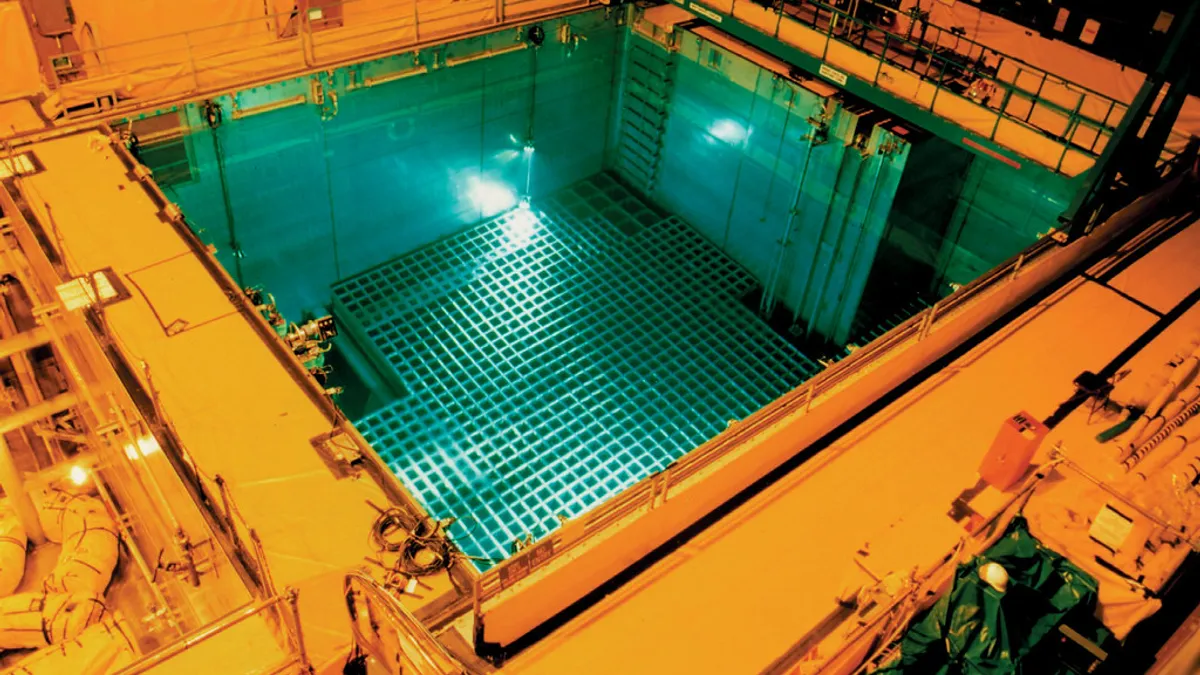
In this issue: A budget request from the White House, Westinghouse files to update the AP1000 design certification, a new report from the Energy Innovation Reform Project, the possibilities of 3D printing impact limiters, and more. Let’s dive right i...
도입부: In this issue: A budget request from the White House, Westinghouse files to update the AP1000 design certification, a new report from the Energy Innovation Reform Project, the possibilities of 3D printing impact limiters, and more.
Proposed FY 2027 DOE, NRC budgets ask for less
The White House is requesting $1.5 billion for the Department of Energy’s Office of Nuclear Energy in the fiscal year 2027 budget proposal, about 9 percent less than the previous year. The request from the Trump administration is one of several associated with nuclear energy in the proposal, which was released Friday. Congress still must review and vote on the budget. Go deeper on Nuclear NewsWire.
Reform Project released a new assessment analyzing the three obstacles blocking U.S. fuel recycling over the past 50 years: economics, waste management, and proliferation risk. Utility Dive
and the DOE-EM leadership team visited the Idaho Cleanup Project, highlighting progress in nuclear waste processing, fuel management, and facility demolition. DOE
of Engineering at UIUC has launched the Illinois Nuclear Power Institute to lead advancements in reactor technologies, safety, and workforce development, enhancing Illinois’s role in nuclear energy innovation. UIUC
six different ways it uses nuclear techniques to support global health, including expanding access to radiotherapy, supporting zoonotic disease detection, and more. IAEA
convened a roundtable with 25 experts to examine the challenges and opportunities associated with advancing U.S.-China engagement on nuclear risks. NTI
Hitachi Nuclear Energy announced its entrance into an agreement with Swedish engineering and project management company AFRY to support the deployment of BWRX-300s in Sweden. GVH
Westinghouse submits AP1000 design revision to NRC
Yesterday, the Nuclear Regulatory Commission announced that it has received an application from Westinghouse to renew and update the design certification for its AP1000 reactor. This application seeks to formally incorporate the lessons learned from the construction of Vogtle-3 and -4 into the design control document of the AP1000. Go deeper on Nuclear NewsWire.
3D printing possibilities: Additive manufacturing impact limiters for transportation casks
With the significant advances in additive manufacturing, otherwise known as 3D printing, Orano Federal Services and the University of North Carolina at Charlotte recently re-examined the capabilities to print impact limiters for transportation casks used to ship spent nuclear fuel. Impact limiters protect transportation casks (sometimes also referred to as transportation overpacks) and their contents during an accident. Go deeper on Nuclear NewsWire.
EnergySolutions to be reacquired by investment firm ECP
The investment firm Energy Capital Partners (ECP) is to reacquire nuclear services company EnergySolutions from TriArtisan Capital Advisors, it was announced yesterday. Terms of the transaction, which is expected to close in 2026, subject to customary regulatory approvals, were not disclosed. Go deeper on Nuclear NewsWire.
2026년 4월 7일, 오전 9시 27분방사성 폐기물 솔루션스벤 바더(Sven Bader), 브래드 크로츠(Brad Crotts), 마이클 스미스(Michael Smith), 돈 맥기(Don McGee), 존 맥엔타이어(John McEntire)
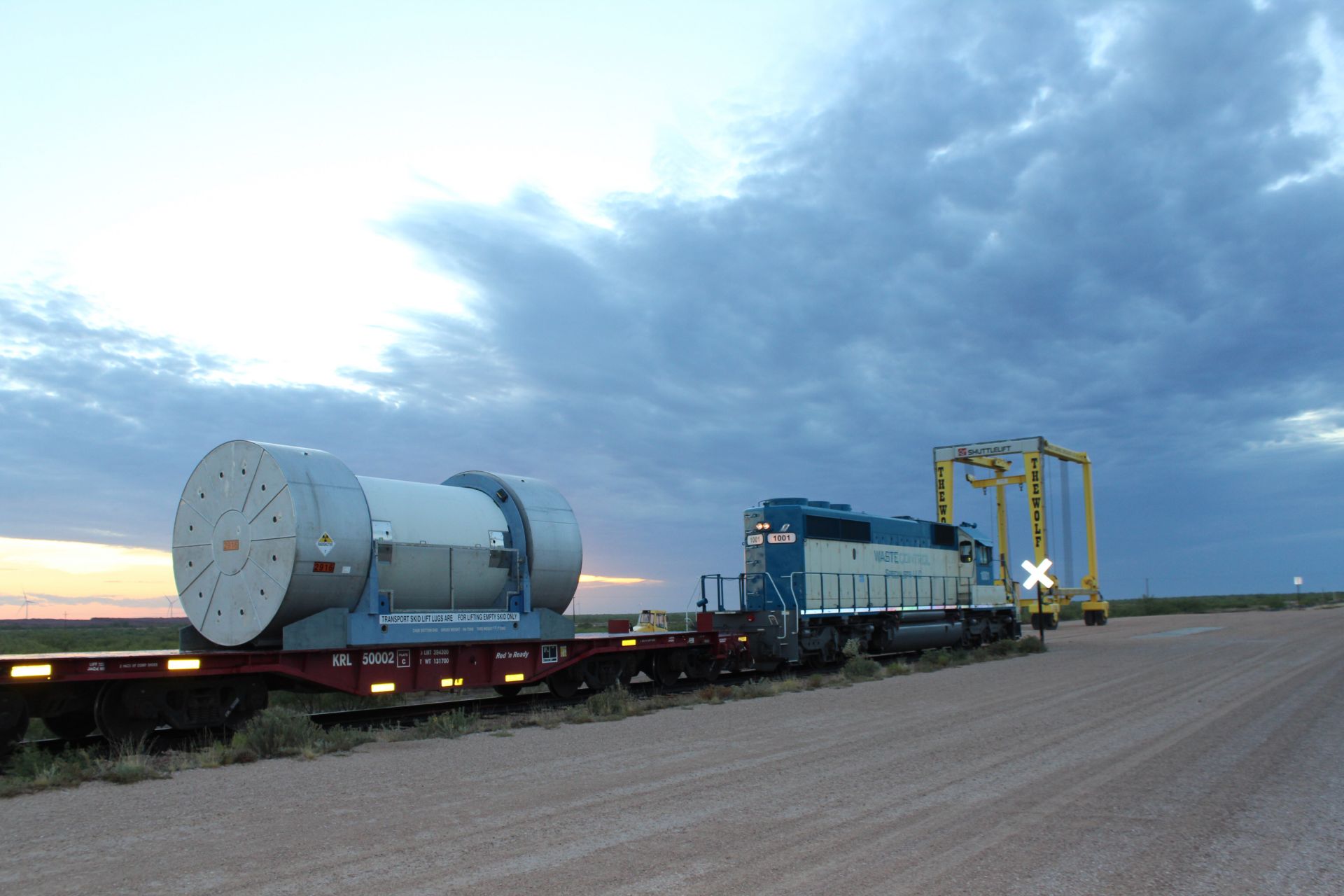
철도 화차에 적재된 오라노(Orano) MP197HB 운반 용기.
적층 제조(AM), 즉 3D 프린팅 기술의 비약적인 발전에 힘입어, 오라노 연방 서비스(Orano Federal Services)와 노스캐롤라이나 대학교 샬럿 캠퍼스(University of North Carolina at Charlotte)는 최근 사용후 핵연료 운반에 사용되는 운반 용기의 충격 완충재를 프린팅하는 역량을 재검토했다. 충격 완충재는 사고 발생 시 운반 용기(운반 외장재라고도 함)와 그 내용물을 보호한다. 충격 완충재 설계는 낙하, 압쇄, 화재, 수중 침수 등 특정 유의 수준의 가상 사고를 기반으로 한 시험을 견뎌야 한다.
현재 많은 운반 용기의 충격 완충재는 발사나무와 레드우드 또는 허니컴 알루미늄 구조물로 제작되며, 이 두 가지 모두 수백만 달러에 달하는 고비용의 제조 공정을 필요로 한다. 충격 완충재 제조를 위한 대안적 제조 공정으로 AM을 활용하는 방안에 대한 이전 연구에서는, 최대 외경이 365센티미터(144인치) 이상에 달할 수 있는 대형 부품 생산에 있어 AM 프린터의 역량이 부족하다는 결함이 확인되었다.
그러나 최신 연구에 따르면, AM 프린터가 훨씬 더 큰 물체를 제작할 수 있을 뿐만 아니라, 충격 완충재에 이점을 제공할 가능성이 있는 새로운 내부 패턴이 개발된 것으로 밝혀졌다. 또한 AM을 지원하기 위한 일부 새로운 표준이 마련되었으나(아직 원자력 표준에는 미치지 못함), 금속을 사용하여 더 큰 물체를 프린팅할 수 있게 되었지만, 실물 크기의 충격 완충재에 대해서는 여전히 비용 효율적이지 않다.
필요성
현재 미국에서는 상업용 사용후 핵연료(SNF)를 통합 임시 저장 시설이나 처분장으로 대규모 운반하는 작업이 이루어지지 않고 있으나(사고 허용 연료 및 고연소도 연료의 시험봉/집합체 일부가 운반되고 있지만, 이는 저장 또는 처분 목적이 아닌 운영 목적의 시설 검사를 위한 것임), 에너지부(Department of Energy)는 향후 10~15년 이내에 동의 기반의 연방 임시 저장 시설을 부지 선정, 허가 취득, 운영 개시할 것으로 예상하고 있다[1]. 이에 따라 상업용 사용후 핵연료의 대규모 운반이 이 기간 내에 이루어질 것으로 전망된다.
한편, 오라노의 고연소도 사용후 핵연료 시연 용기(TN-32B)에 대한 적합성 인증서(CoC)가 최근 승인되었고[2], 53개 원자력 발전소에서의 고연소도 사용후 핵연료 저장에 관해 원자력규제위원회(Nuclear Regulatory Commission)에 2028년까지 이행을 약속한 데이터 확보의 필요성에 따라, TN-32B 용기를 에너지부 시설로 운반하여 개봉 및 상세 연료 검사를 실시하는 작업이 2027년 중에 이루어질 것으로 예상된다[3].
이러한 잠재적 운반에 대비하여, 충격 완충재 제작을 포함한 운반에 필요한 모든 부품의 제작이 진행 중이다. 고연소도 사용후 핵연료 용기 충격 완충재 제작에는 제작에 필요한 재료의 고비용 구매 및 임시 보관, 그리고 수작업 조립이 요구되었다. 이에 따라 미래의 충격 완충재 제작을 위한 대안적 접근 방식이 검토되고 있다.
2019년 오라노(Orano)와 노스캐롤라이나 대학교 샬럿 캠퍼스(UNC Charlotte)는 합성 폼과 같은 대체 재료 사용을 포함한 대안적 충격 완충재 설계를 검토한 바 있다[4]. 이 활동에서 얻은 경험은 다음의 설계 및 규제 기준을 포함하는 최신 조사를 수행하기 위한 토대를 제공했다:
최대 치수 제약 조건: 폭 128인치(플레이트 E 열차 차량 치수 제한).
운반 용기 시스템의 최대 복합 중량: 360,000파운드 미만.
온도 제한: -20°F ~ 150°F.
낙하 후 충격 완충재가 용기에 부착된 상태를 유지해야 함.
자유 낙하: 단단한 표면에 9미터(30피트) 높이에서 낙하.
압쇄: 30피트 높이에서 1,100파운드 중량의 플레이트를 용기에 낙하시키는 충격.
관통: 직경 6인치의 연강 수직 실린더 위에 3피트 높이에서 낙하.
열: 1,475°F의 화염에 30분간 완전히 노출.
침수: 50피트 깊이의 수중에 침수.
위의 마지막 다섯 가지 항목은 10 CFR 제71.73조에 명시된 가상 사고 조건(HAC)과 관련되며, 당시 충격 완충재 설계에 있어 가장 큰 난제였다. 이 이전 경험에는 일부 AM 옵션 검토도 포함되었다. 그러나 당시에는 금속 프린팅 기술이 비교적 초기 단계였기 때문에, 충격 완충재 조립에 필요한 "적격" 부품을 생산하기에는 기술이 너무 미흡했다.
AM 현황
현재 이용 가능한 상업용 금속 프린터의 현황을 조사한 결과, 전체 충격 완충재를 생산할 수 있는 프린터는 현재 존재하지 않는 것으로 확인되었습니다(크기가 너무 크기 때문입니다). 그러나 충격 완충재로 조립할 수 있는 더 큰 금속 부품을 인쇄할 수 있는 두 가지 유망한 기술이 확인되었습니다: 용융 필라멘트 제조(FFF, fused filament fabrication) 및 선택적 레이저 용융(SLM, selective laser melting) 프린터입니다.
현재 이용 가능한 대형 상업용 SLM 프린터(예: NXG 6II 600)는 스테인리스강 분말을 사용하여 시간당 1,000입방 cm(61 in.³/hr)의 속도로 최대 600mm × 600mm × 600mm(23.6인치 × 23.6인치 × 23.6인치) 크기의 물체를 높은 정밀도로 인쇄할 수 있습니다. 현재 이용 가능한 대형 상업용 FFF 프린터(예: EBAM 300)는 스테인리스강 분말을 사용하여 최대 5,791mm × 1,219mm × 1,219mm(228인치 × 48인치 × 48인치) 크기의 물체를 시간당 1,170cm³(71.4 in.³/hr)의 속도로 인쇄할 수 있지만, SLM 프린터보다 정밀도는 낮습니다.
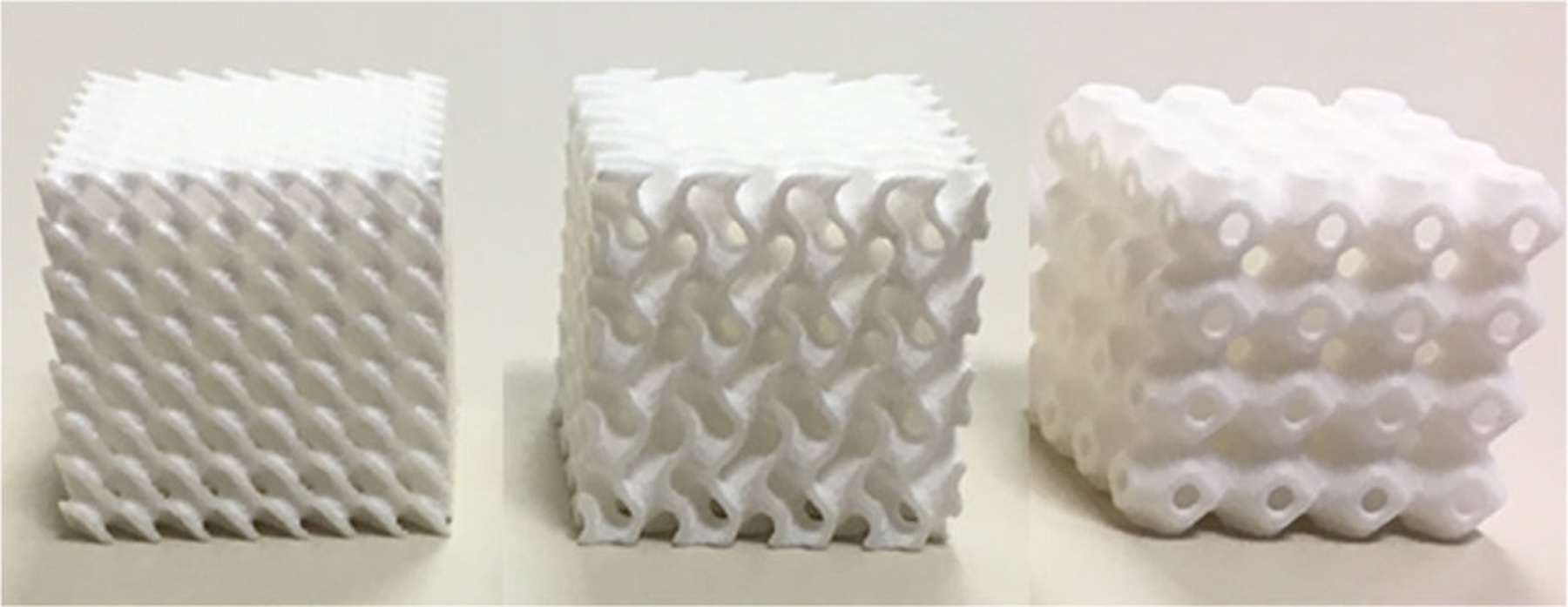
이러한 스테인리스강 외관 치수 외에도, 이 프린터들은 슈바르츠-D(Schwartz-D), 슈바르츠-P(Schwartz-P), 자이로이드(gyroid), 허니컴(honeycomb) 등 다양한 내부 채움 패턴(인필 패턴)을 인쇄할 수 있으며(그림 1 참조), 그 중 일부는 목재 미세 세포 구조에서 영감을 받은 것입니다.
그림 1. AM 인필 디자인 예시: 슈바르츠-D(왼쪽), 자이로이드(중앙), 슈바르츠-P(오른쪽) [5].
이러한 인필 패턴에 대한 구조적 평가 결과, 자이로이드가 충격 완충재 부품에 적용하기에 가장 유망한 것으로 확인되었습니다. 인필 밀도에 따라 최대 80%의 중량 절감이 가능하고, 모든 방향에서 강도를 가지며, 다른 인필보다 밀도가 낮기 때문입니다. 다양한 밀도로 스테인리스강에 이러한 패턴을 인쇄할 수 있는 이 프린터들의 능력은 중요한 발전으로, 인필 패턴 밀도를 최적화하여 운송 패키지를 보호하기 위한 충격 완충재의 필요한 에너지 흡수를 제공하는 동시에 충격 완충재 제작에 필요한 재료를 줄여 비용과 중량을 절감할 수 있습니다.
AM 장비가 발전했음에도 불구하고, 이 기술과 관련하여 여전히 몇 가지 결점이 있습니다. 현재 안전 기능을 수행하기 위한 AM 부품 제작의 유효성을 보장하기 위한 표준, 특히 원자력 등급 표준이 부족한 상황입니다. ISO/ASTM 52900 "적층 제조—일반 원칙 및 용어(Additive Manufacturing—General Principles and Terminology)"와 같은 일반 표준이 있지만, 이는 일반적인 정보만 제공할 뿐입니다. 그러나 일반적으로 컴퓨터 단층 촬영을 통해 검증되는 AM 장비의 검사를 개선하기 위한 기술을 제공하려는 노력이 진행 중입니다 [6].
현재 상업용 AM 프린터의 또 다른 결점은 실물 크기의 충격 완충재를 인쇄할 수 없다는 점입니다. 따라서 오라노(Orano)와 USC가 설계한 충격 완충재는 여러 AM 인쇄 부품으로 구성되며 실물 크기의 충격 완충재로 조립됩니다.
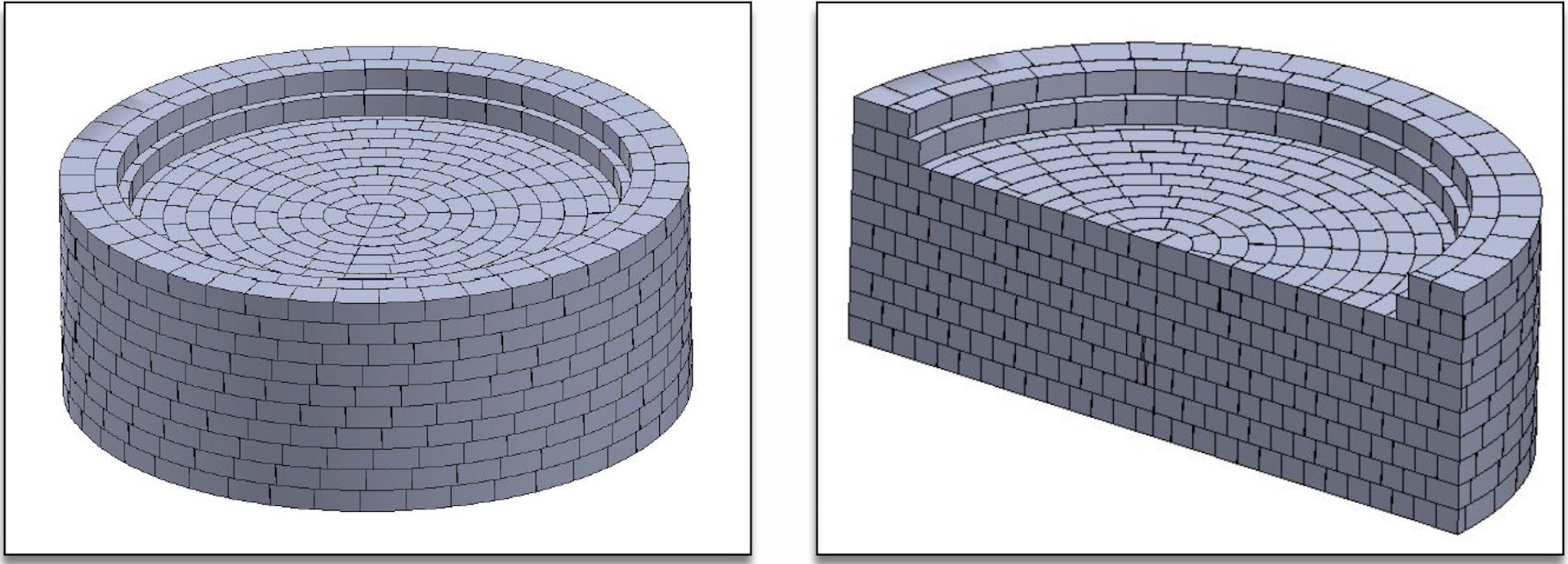
그림 2. 초기 2,700개 벽돌 충격 완충재 설계.
그림 3. SLM AM 프린터를 사용한 442개 벽돌 충격 완충재 업그레이드 설계.
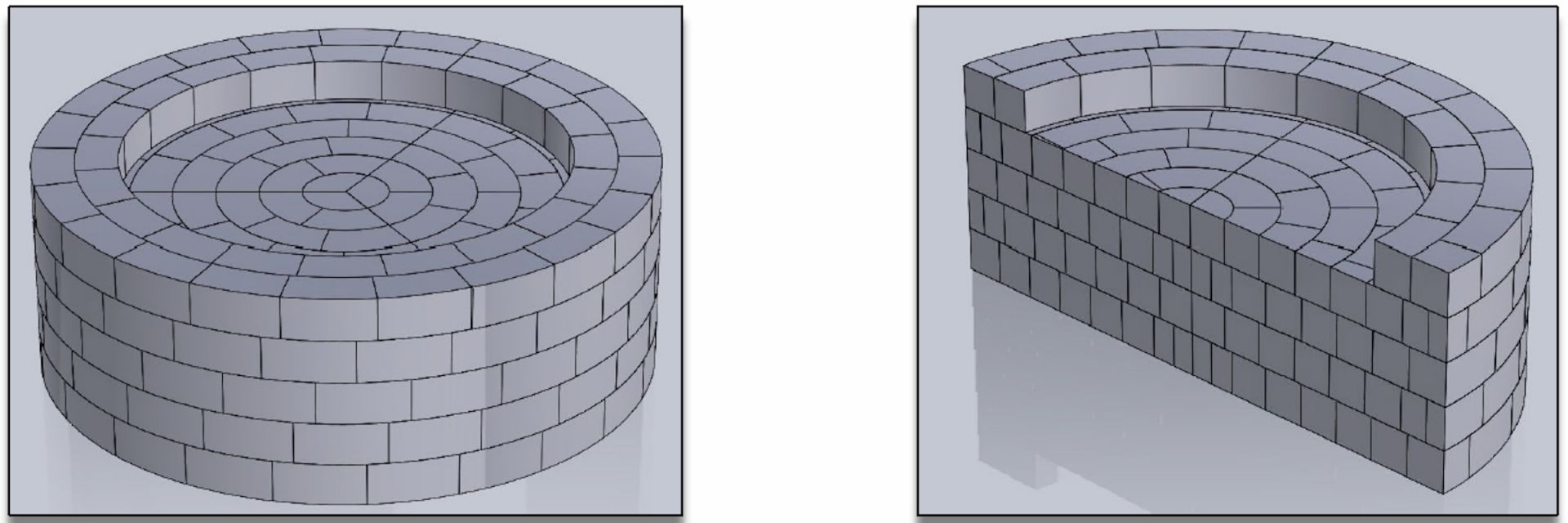
그림 4. FFF AM 프린터를 사용한 최종 36개 벽돌 충격 완충재 설계.
그림 5. 36개 벽돌(빨간색, 파란색, 금색)과 스테인리스강 클래딩(초록색)이 있는 충격 완충재(1/12 스케일)의 AM PLA 플라스틱 축소 복제품 및 전경에 있는 자이로이드 인필 패턴(분홍색).
설계 발전
AM이 충격 완충재용 부품("벽돌")만 인쇄할 수 있다는 제약으로 인해, 다양한 AM 프린터에서 생산되는 AM 벽돌의 크기를 활용할 수 있는 초기 설계들이 검토되었습니다. 첫 번째 설계는 상업적으로 이용 가능한 AM 프린터의 최대 크기에 맞춰 약 5인치 × 5인치 × 10인치 크기의 벽돌을 고려했지만, 실물 크기의 충격 완충재를 생산하기 위해 2,700개의 벽돌이 필요했습니다(그림 2 참조). 대형 상업용 SLM AM 프린터의 등장으로, 더 큰 AM 제작 벽돌(10인치 × 10인치 × 20인치)이 검토되어 실물 크기에 도달하는 데 442개의 벽돌이 사용될 예정이었습니다(그림 3 참조).
그러나 두 설계 모두 벽돌 인쇄는 비교적 단순하지만, 알루미늄 덮개 내에서 모든 벽돌을 충격 완충재 설계로 조립하는 것은 까다로운 것으로 여겨졌습니다. 또한, 수평 전단면이 모서리 낙하에 대해 제대로 작동하지 않을 수 있다는 우려도 있었습니다.
다행히 FFF AM 프린터는 계속해서 크기가 증가했으며, 36개 벽돌 배열로 20인치 × 20인치 × 40인치 벽돌을 사용하는 대안적인 충격 완충재 설계가 만들어졌습니다(그림 4). 이 설계의 결과로 수평 미끄럼면이 회피되었고, 다른 두 설계에 비해 충격 완충재의 조립이 상대적으로 간단해졌습니다.
최적으로 설계된 AM 충격 제한기의 최종 설계는 FFF 프린터로 출력된 브릭을 스테인리스강 클래딩 내부에 조립하여 배치한 36개의 브릭으로 구성됩니다. 그림 5는 이 충격 제한기의 축소 모형을 AM 방식으로 플라스틱 재질로 출력한 사진으로, 스테인리스강 클래딩(녹색)과 외부에서 내부 순서로 구성된 네 가지 유형의 브릭(노란색, 파란색, 빨간색, 중앙의 금색)을 포함한 다양한 구성 요소를 보여줍니다. 또한 브릭 내부에 사용된 자이로이드 인필 패턴의 예시가 그림 전경(분홍색)에 나타나 있습니다.
분석 및 시험
그림 6. 자이로이드(하단)와 허니콤(상단) 샘플의 압축 시험 결과.
허니콤과 자이로이드 인필 패턴이 충격에 어떻게 견디는지 살펴보기 위해 소형 AM 샘플에 대한 압축 시험을 수행하였습니다(그림 6 참조). 그림 7에서 보는 바와 같이, 시험 결과는 압축 응력과 충격 에너지 흡수 측면에서 허니콤에 비해 자이로이드 설계가 일관되게 우수한 성능을 보였으며, 허니콤 인필 패턴은 외부로 붕괴되는 반면 자이로이드 인필 패턴은 내부로 붕괴(즉, 아코디언 압괴)되는 양상을 보였습니다. 따라서 허니콤 인필 패턴을 사용할 경우, 충격 시 브릭이 전체 충격 제한기 설계 밖으로 밀려나거나 충격 제한기 구조물 내부에 변형(부풀어 오름)이 발생하여 특정 브릭에 불균일한 충격력 및 응력이 가해질 가능성이 있습니다. 반면, 자이로이드 인필 패턴 브릭이 충격을 받으면 에너지를 흡수하면서 아코디언 압괴 방식으로 찌그러집니다.
그림 7. 자이로이드(파란색)와 허니콤(주황색) 샘플의 최대 하중 시 압축 응력(왼쪽)과 충격 에너지 흡수량(오른쪽).
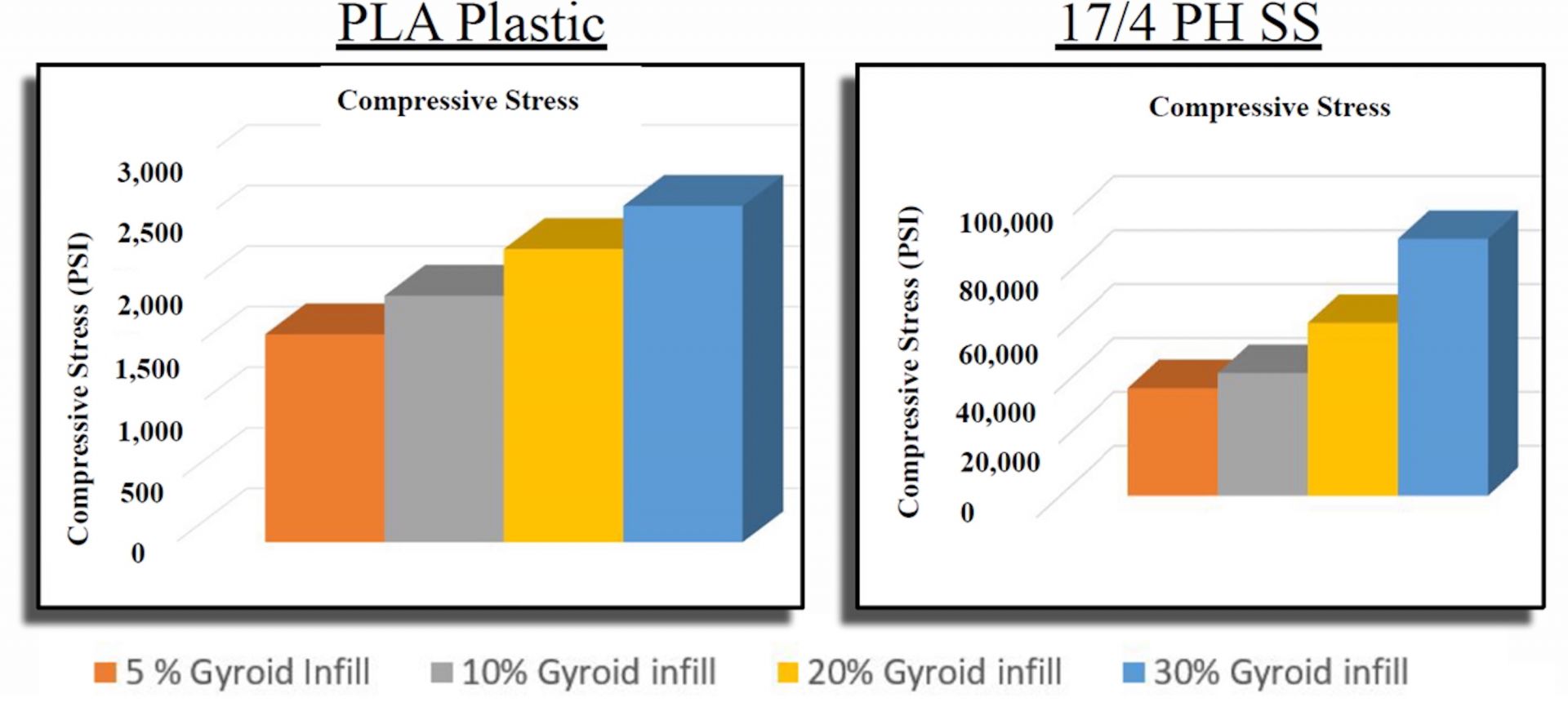
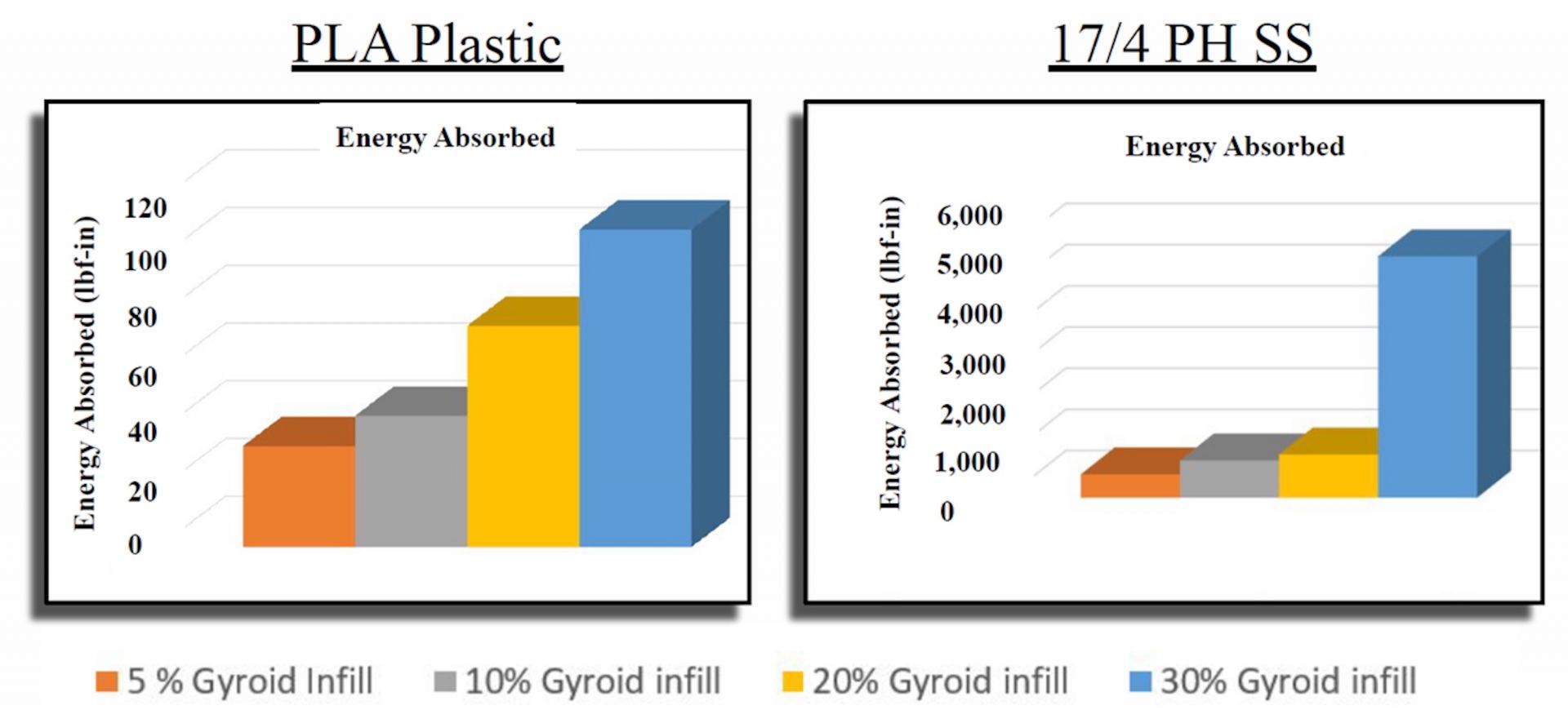
AM은 또한 인필 패턴의 밀도를 0퍼센트(인필 없음)에서 100퍼센트(완전 충전)까지 변경할 수 있는 기회를 제공합니다. 이에 따라 폴리락트산(PLA) 플라스틱과 AM 프린터에서 일반적으로 사용되는 금속인 17/4 석출 경화 스테인리스강(17/4 PH SS) 샘플에 대해 자이로이드 인필 패턴의 네 가지 인필 비율(5퍼센트, 10퍼센트, 20퍼센트, 30퍼센트)로 압축 시험을 수행하였습니다. 그림 8과 그림 9는 각각 PLA 플라스틱과 스테인리스강에 대한 이 시험의 압축 응력과 흡수된 에너지를 나타냅니다. 일반적으로 인필 밀도가 높을수록 압축 응력과 흡수 에너지가 증가하며, 대부분의 증가는 균일하게 나타났으나 스테인리스강의 경우 30퍼센트 인필 자이로이드에서 다른 인필 밀도에 비해 흡수 에너지가 현저히 증가하는 것이 특징적이었습니다.
그림 8. 다양한 밀도의 자이로이드 인필에서 PLA 플라스틱과 17/4 PH SS의 압축 응력.
그림 9. 다양한 밀도의 자이로이드 인필에서 PLA 플라스틱과 17/4 PH SS의 흡수 에너지.
압축 시험 외에도, 충격 제한기 조립체 모델을 SolidWorks로 구성하고 ANSYS 시뮬레이션으로 분석하였습니다. 이 모델은 충격 제한기 내부를 다양한 재료로 채울 수 있도록 설계되었으며, 현재 모델은 레드우드와 100퍼센트 인필된 17/4 PH SS 브릭 442개를 고려하고 있습니다.
압축 시험에서 나타난 최대 변형량은 레드우드의 경우 0.00553인치, 스테인리스강의 경우 0.00139인치였습니다. 브릭의 인필을 100퍼센트 미만으로 낮추기 위해, Ntopology를 사용하여 자이로이드 인필 패턴과 관련된 복잡한 형상을 시뮬레이션 모델에 사용할 동등한 물성치(예: 영률, 체적 탄성률, 전단 탄성률)를 가진 대표 체적 요소(RVE)로 변환하였습니다. 이를 바탕으로 ANSYS 시뮬레이션을 통해 5퍼센트 및 약 10퍼센트 인필 밀도에서의 측면 낙하 및 모서리 낙하를 포함한 다양한 낙하 시나리오를 분석하였습니다. 모든 낙하 시나리오에서 충격 제한기에 가해지는 모델링된 응력은 허용 범위 내에 있었으며, 5퍼센트 자이로이드 인필 밀도의 경우 30피트 낙하 시나리오에서 최대 응력(68킬로 파운드/제곱인치)이 레드우드(67 ksi)와 거의 동등한 수준으로 나타났습니다.
이러한 시험 및 시뮬레이션 결과에 따라, 36개 브릭으로 구성된 충격 제한기 설계는 적합한 것으로 판단되며, 각 브릭은 AM FFF 프린터를 사용하여 5퍼센트에서 30퍼센트의 자이로이드 인필 패턴으로 설계됩니다.
비용 평가
충격 완충재의 적층 제조(AM) 방식 제작을 검토하는 주요 동기 중 하나는 비용 절감입니다. 현재 인증된 충격 완충재는 재료(예: 레드우드) 및 조립 비용으로 인해 상당한 비용이 소요됩니다. 초기 비용 추정치는 충격 완충재 하나당 약 25만 달러에서 100만 달러 사이로 파악되었습니다. 충격 완충재 AM 부품의 비용 추정치는 주로 60만 달러에서 150만 달러 사이의 프린터 자체 비용, 그리고 FFF 프린터용 17/4 PS SS 스풀 1파운드당 약 50달러, SLM 프린터용 17/4 PS SS 분말 1파운드당 약 14달러의 재료비와 관련됩니다. 본 평가에서는 인건비를 시간당 50달러로 가정하였습니다.
AM 비용 평가는 FFF 프린터용 36개 블록 충격 완충재 설계와 SLM 프린터용 442개 블록 충격 완충재 설계를 고려하였습니다. 평가는 자이로이드(gyroid) 내부 충전율을 기준으로 레드우드 충격 완충재와 SLM 및 FFF 충격 완충재 설계 간의 대략적인 비용 손익분기점을 산출하였습니다. 레드우드 충격 완충재의 단가가 약 100만 달러라고 가정할 경우, 손익분기점은 SLM AM 충격 완충재의 경우 37% 내부 충전율에서, FFF AM 충격 완충재의 경우 10% 내부 충전율에서 발생합니다. 내부 충전율이 낮을수록 AM 충격 완충재 설계의 비용이 저렴해집니다.
수치 모델을 통해 5% 자이로이드 내부 충전율이 낙하 시 허용 가능한 결과를 도출하는 것으로 평가되었으므로, FFF AM 부품으로 제작된 충격 완충재는 100만 달러 이상을 절감할 수 있으며, SLM AM 부품으로 제작된 충격 완충재 세트는 이 충전율에서 170만 달러 이상을 절감할 수 있습니다.
결론
압축 시험과 ANSYS 모델링을 통해 업데이트된 AM 부품과 새로운 충격 완충재 설계의 성능에 대한 일부 통찰을 얻었으며, 현재 설계와 비교 가능한 동작도 확인되었습니다. 또한 자이로이드와 같은 독특한 내부 충전 패턴을 생성할 뿐만 아니라 이 충전율의 밀도를 변경할 수 있는 능력을 통해, 비용 및 가상의 사고에 대비하여 운반 포장재를 보호하는 능력 측면에서 충격 완충재 설계의 최적화가 가능합니다. 5% 밀도의 자이로이드 내부 충전 패턴은 이러한 요구 사항을 충족하면서도 비용을 최소화하는 것으로 보이며, 기존 충격 완충재 설계 대비 최대 100만 달러의 절감 가능성이 있습니다.
그러나 AM 부품의 사용을 지원하고 효능을 검증할 코드 및 표준의 부재로 인해, 제안된 새로운 충격 완충재 설계는 단일 부품 시험 및 복합 설계의 수치 모델링을 넘어서는 타당성 입증이 필요하며, 실제 낙하 시험 데이터가 필요할 가능성이 높습니다. 따라서 이 연구는 AM의 가능성을 보여주고 있지만, 앞으로의 방향은 AM 부품을 위한 코드 및 표준 개발에 초점을 맞추고 있으며, 이를 완성하기 위해서는 시험 데이터가 필요합니다.
_스벤 바더(Sven Bader)는 전력연구소(Electric Power Research Institute)의 기술 임원이며, 브래드 크로츠(Brad Crotts)는 오라노(Orano)의 수석 엔지니어이고, 마이클 스미스(Michael Smith)는 UNC 샬럿(UNC Charlotte)의 기계공학기술학과 조교수이며, 돈 맥기(Don McGee)와 존 맥엔타이어(John McEntire)는 오라노(Orano)의 프로젝트 관리자입니다._
참고문헌
1. 미국 에너지부(U.S. Department of Energy), "연방 통합 임시 저장을 위한 사용후핵연료의 동의 기반 부지 선정 절차(Consent-Based Siting Process for Federal Consolidated Interim Storage of Spent Nuclear Fuel)," (2023년 4월). 2. 미국 원자력규제위원회(U.S. Nuclear Regulatory Commission), "모델 번호 TN-32B 패키지에 대한 준수 인증서 제9377호, 개정 제0호(Certificate of Compliance No. 9377, Revision No. 0, for the Model No. TN-32B Package)," ML21231A189, (2024년 7월 1일). 3. 트루(True), 더글라스(Douglas), 원자력에너지연구소(Nuclear Energy Institute) 수석 부사장 겸 최고원자력책임자, 카트린 허프(Kathryn Huff) 원자력에너지국 차관보 앞 서한, 제목 "고연소도 사용후핵연료 시연 캐스크 프로젝트(The High Burnup Used Nuclear Fuel Demonstration Cask Project)," (2024년 3월 15일). 4. 바더(Bader), S. 및 스미스(Smith), M., "사용/사용후핵연료 운반 캐스크를 위한 대체 충격 완충재 설계(Alternative Impact Limiter Designs for Used/Spent Nuclear Fuel Transportation Casks)" (19496), 2019 폐기물 관리 학술대회(2019 Waste Management Conference), 피닉스(Phoenix), 애리조나주(AZ), (2019년 3월 3-7일). 5. 카스트로(Castro), A. 외, "TPMS 스캐폴드에서의 투과성 대 설계(Permeability versus Design in TPMS Scaffolds)," 재료(Materials), DOI:10.3390/ma12081313, (2019). 6. 에너지부 원자력에너지국(DOE Office of Nuclear Energy), "새로운 국립연구소 알고리즘이 원자력 물질의 더 빠르고 안전한 검사를 가능하게 하다(New National Lab Algorithm Enables Faster, Safer Inspection of Nuclear Materials)," (2024년 11월 1일).
오라노 페더럴 서비스와 노스캐롤라이나 대학교 샬럿 캠퍼스가 공동으로 수행한 이번 연구는 사용후핵연료 운반 용기의 충격 완충재 제조에 3D 프린팅(적층 제조) 기술을 적용하는 가능성을 재검토한 것으로, 기존의 발사나무·허니콤 알루미늄 방식에 비해 비용 절감 가능성을 탐색한다는 점에서 의미가 있다. 현재 충격 완충재는 수백만 달러에 달하는 고비용 수작업 공정으로 제작되고 있으며, 9m 낙하, 화염(800°C, 30분), 15m 수중 침수 등 극한의 가상 사고 조건을 충족해야 하는 까다로운 규제 요건을 갖추어야 한다. 최신 연구 결과에 따르면 적층 제조 기술의 발전으로 대형 부품 출력이 가능해졌고 새로운 내부 구조 패턴이 개발되었지만, 아직 금속 소재의 전체 규모 생산이 비용 효율적이지 않다는 한계도 함께 확인되었다. 미국이 향후 10~15년 내 연방 임시 저장 시설 가동을 목표로 하고 있어 상업용 사용후핵연료 대규모 운반이 본격화될 것으로 예상되는 시점에서, 이 연구는 차세대 운반 인프라의 제조 방식 혁신을 위한 중요한 기술적 기반을 마련하는 데 기여하고 있다. 특히 2027년 예정된 고연소도 사용후핵연료 시범 용기(TN-32B) 운반을 앞두고 대안적 충격 완충재 제조법 연구가 가속화되고 있어, 향후 핵연료 운반 안전성 및 경제성 향상에 실질적인 영향을 미칠 것으로 기대된다.
※ 이 글은 해외 원자력 바로알기를 위한 정보 전달을 목적으로 제공됩니다. 특정 기업이나 종목에 대한 투자 권유가 아니며, 모든 투자 판단과 그에 따른 책임은 투자자 본인에게 있습니다.
어밸런치 에너지(Avalanche Energy)가 DARPA로부터 520만 달러 계약을 수주해, 방사선을 전기로 변환하는 신소재인 '방사전압소자(radiovoltaics)' 개발에 나선다.
원자력 배터리와 핵융합 반응 모두에서 발생하는 알파 입자를 활용하면, 핵융합 발전의 에너지 효율을 높이고 상업적 핵융합 발전의 '손익분기점(breakeven)' 달성이 앞당겨질 수 있다.
소형 핵융합 로봇을 개발 중인 어밸런치는 방사전압소자 기술을 핵융합로 부품에도 적용해, 자사뿐 아니라 업계 전체에 공급하는 역할로 성장할 가능성이 있다.
---
핵융합 발전은 언제나 다소 모순적인 분야였다. 핵융합 자체는 사실 그리 어렵지 않다 — 예를 들어 한 학부생이 최근 자신의 침실에서 간단한 핵융합 장치를 직접 만들었다 — 하지만 그 반응에서 전기를 뽑아내는 것은 전혀 다른 문제다.
"전력을 만드는 핵융합 로봇은 — 이미 많이 있고, 실제로 존재한다"고 어밸런치 에너지(Avalanche Energy)의 재료과학 책임자 다니엘 벨라스케스(Daniel Velázquez)가 테크크런치(TechCrunch)에 말했다. "하지만 전기를 만드는 핵융합 로봇은 더 낫다." 바로 그 지점에서 신생 산업은 여전히 막혀 있다.
핵융합 반응은 두 개의 가벼운 원자를 하나의 무거운 원자로 융합함으로써 엄청난 양의 에너지를 방출한다. 하지만 그 에너지를 수확하는 일은 쉽지 않다는 것이 증명되어 왔다. 가장 일반적인 접근법은 물을 가열해 증기 터빈을 돌리는 방식이지만, 이 방법은 그리 효율적이지 않아 최대 약 60% 정도의 전력만 얻을 수 있다.
어밸런치 에너지는 '방사전압소자(radiovoltaics)'라고 불리는 새로운 소재를 개발함으로써 더 많은 에너지를 포집할 수 있다고 믿는다. 방사전압소자는 광전지(photovoltaics) — 즉 일반 태양광 패널 — 와 유사하게, 반도체를 이용해 방사선을 전기로 변환한다. 이 기술은 오래전부터 존재해 왔지만, 효율성이 낮다. 기존 방사전압소자는 자신이 활용하는 바로 그 방사선에 의해 쉽게 손상되며, 전기 생산량도 많지 않다.
오늘, 어밸런치는 새로운 방사전압소자 개발을 위해 DARPA로부터 520만 달러 계약을 수주했다고 회사 측이 테크크런치에 단독으로 전했다.
국방부 산하 연구기관인 DARPA는 이 소재를 새로운 종류의 원자력 배터리에 활용하는 데 관심을 보이고 있다. 원자력 배터리는 폴로늄(polonium) 같은 물질의 방사성 붕괴를 이용해 전기를 생성한다. 이러한 장치는 우주선이나 위성에 수년간 전력을 공급하는 데 활용될 수 있다. 또한 며칠씩 지속되는 보다 에너지 집약적인 지상 군사 임무에도 사용될 수 있다 — "특히 군수 지원이 다소 불가능한(logistics are a little bit impermissible, 즉 보급 경로가 차단되거나 제한되는) 자율 시스템 또는 임무에서," 벨라스케스가 말했다.
이것이 어밸런치가 기업으로서 정확히 추구하는 방향은 아니지만, DARPA 수주는 회사의 야망과 겹치는 부분이 있다.
핵융합 반응과 원자력 배터리 모두 알파 입자라는 방사선을 생성한다는 점이 첫 번째 공통점이다. 알파 입자는 에너지가 매우 강해 원자력 반응로 벽을 포함한 각종 장비를 손상시킬 수 있다. 두 번째로, 어밸런치는 오지의 군사 기지에서 디젤 발전기를 대체할 수 있는 탁상 규모의 핵융합 로봇을 개발 중이다.
회사가 원자력 배터리용 새로운 방사전압소자를 개발할 수 있다면, 그 지식을 새로운 반응로 부품에도 적용할 수 있다. 이러한 피복재(sheathing)는 알파 입자를 포집해 반응로를 보호하는 동시에 생산 전력량을 높이는 역할을 할 것이다. 어밸런치는 또한 계산 기술의 발전을 활용해 소재 개발을 가속하기 위해 미 공군의 에이에프웍스(AFWERX) 연구소로부터 125만 달러 지원금도 수상했다.
핵융합 스타트업들은 모두 '손익분기점(breakeven)'이라고 불리는 이정표 달성을 향해 경쟁하고 있다. 과학계에서는 이를 Q>1이라고 부르며, Q는 핵융합 반응이 생산하는 전력과 반응을 유지하는 데 필요한 전력의 비율이다. 알파 입자를 전기 생산에 활용한다면, 상업적 핵융합 발전의 실현이 더 쉬워질 수 있다.
알파 입자를 생성하는 반응로 설계를 가진 회사는 어밸런치만이 아니다. 개발에 성공한다면, 어밸런치는 다른 핵융합 기업들에 해당 기술을 공급하는 역할을 하게 될 수도 있다. 이는 업계 내에서 떠오르는 트렌드이기도 하다.
---
AI 분석
이 기사는 핵융합 발전의 고질적 난제인 에너지 수확 효율 문제를 방사전압소자라는 신소재 접근법으로 해결하려는 시도를 조명한다. 어밸런치 에너지의 전략은 군사용 원자력 배터리 개발이라는 단기 수익원과 핵융합 반응로 기술이라는 장기 목표를 동시에 추구하는 독특한 이중 구조를 취하고 있다는 점이 주목할 만하다. DARPA와 AFWERX로부터 동시에 지원을 받은 것은 미국 국방부가 소형·고효율 원자력 에너지원 개발에 전략적 관심을 기울이고 있음을 시사한다. 알파 입자를 포집해 전기로 전환하는 기술이 상용화된다면, Q>1 달성 경쟁에서 유리한 위치를 점하는 것은 물론, 산업 전반에 기술을 공급하는 부품 공급사로 성장하는 길도 열릴 수 있다. 다만 방사전압소자의 내방사선성과 변환 효율이 실제로 기존 기술을 얼마나 능가할 수 있는지에 대한 구체적인 수치는 아직 공개되지 않아, 향후 검증이 필요한 부분이다.
투자 회사 에너지 캐피털 파트너스(ECP, Energy Capital Partners)가 트라이아티산 캐피털 어드바이저스(TriArtisan Capital Advisors)로부터 원자력 서비스 기업 에너지솔루션스(EnergySolutions)를 재인수할 예정이라고 발표했다.
ECP는 2013년부터 에너지솔루션스의 대주주였으나 2018년 트라이아티산에 소수 지분을 매각하고, 2022년에는 트라이아티산이 ECP로부터 지분을 추가 매입했다.
이번 거래는 원자력 부문의 급격한 변화와 안정적인 기저 부하 전력에 대한 수요 증가를 배경으로 이루어지며, 2026년 내 규제 당국의 통상적인 승인을 거쳐 완료될 예정이다.
---
투자 회사 에너지 캐피털 파트너스(ECP, Energy Capital Partners)가 트라이아티산 캐피털 어드바이저스(TriArtisan Capital Advisors)로부터 원자력 서비스 기업 에너지솔루션스(EnergySolutions)를 재인수할 예정이라고 어제 발표되었다. 통상적인 규제 당국의 승인을 조건으로 2026년 내 거래가 완료될 것으로 예상되며, 거래 조건은 공개되지 않았다.
뉴욕에 본사를 둔 중견 기업 사모펀드 투자 회사 트라이아티산은 2022년 ECP로부터 에너지솔루션스의 소유 지분을 매입한 바 있다. ECP는 2013년 에너지솔루션스의 대주주가 되었으며, 2018년 트라이아티산에 소수 지분을 매각했다.
시장 성장: ECP는 원자력 부문에 변혁적인 변화가 일어나고 있으며 안정적인 기저 부하 전력에 대한 수요가 증가하는 시점에 에너지솔루션스를 재인수하기로 결정했다고 밝혔다.
ECP의 파트너 드류 브라운(Drew Brown)은 "이전 투자에서 손을 뗀 이후에도 에너지솔루션스 및 그 경영진과 지속적으로 교류해 왔으며, 해당 팀이 계속해서 이루어 온 성과에 깊은 인상을 받았습니다"라고 말했다.
유타주 솔트레이크시티와 노스캐롤라이나주 샬럿에 본사를 둔 에너지솔루션스(EnergySolutions)는 방사성 물질의 운반, 처리, 재활용, 폐기 등 원자력 연료 생애주기 전반에 걸친 서비스를 제공한다. 에너지솔루션스에 따르면, 트라이아티산의 소유 하에 회사는 상당한 성장을 이루었다고 한다.
인용: 에너지솔루션스의 사장 겸 최고경영자 켄 로벅(Ken Robuck)은 "지난 수년간 원자력 부문 전반에 걸쳐 서비스 제공 범위를 확대하고, 고객에게 통합 솔루션을 제공하는 역량을 강화해 왔습니다. 이번 거래가 당사의 장기 전략과 성장을 가속화할 것으로 기대합니다"라고 말했다.
---
AI 분석
이번 ECP의 에너지솔루션스 재인수는 원자력 서비스 시장에 대한 투자 업계의 높은 관심을 반영한다. 데이터센터 및 AI 산업의 전력 수요 급증으로 안정적인 기저 부하 전원인 원자력에 대한 기대가 커지는 상황에서, 방사성 폐기물 처리 및 원자력 연료 주기 서비스 기업의 전략적 가치가 재조명되고 있다. ECP가 한 차례 투자·매각한 기업을 재인수한다는 점은 에너지솔루션스의 사업 모델과 성장 잠재력에 대한 강한 확신을 보여준다. 트라이아티산 소유 기간 동안의 성장 실적이 이번 거래의 주요 동인으로 작용한 것으로 보이며, 향후 원자력 산업 확장에 따른 서비스 수요 증가의 수혜가 기대된다.
GE Vernova Hitachi Nuclear Energy와 AFRY, BWRX-300 소형모듈원자로 배치 협력 협약 체결
2026년 4월 7일
요약
카테고리: 현황
GE Vernova Hitachi Nuclear Energy(GVH)와 스웨덴 엔지니어링 기업 AFRY가 BWRX-300 SMR 배치를 위한 주요 서비스 협약(MSA)을 체결하였으며, AFRY는 엔지니어링·자문 서비스를 제공할 예정
AFRY는 스웨덴 방사선안전청(SSM)에 대한 BWRX-300 인허가 신청서 개발도 지원하며, 스웨덴을 유럽 SMR 공급망의 핵심 거점으로 육성하는 것을 목표로 함
BWRX-300은 캐나다 온타리오 파워 제너레이션의 달링턴 부지에서 첫 건설이 진행 중이며, 미국 TVA의 클린치 리버 부지에 대한 건설 허가 심사도 진행 중
보도자료
전력
GE Vernova Hitachi Nuclear Energy와 AFRY, BWRX-300 소형모듈원자로 배치 협력
5분 분량
스톡홀름 (2026년 4월 7일) – GE Vernova Hitachi Nuclear Energy(GVH)는 오늘 스웨덴의 선도적인 엔지니어링, 프로젝트 관리 및 자문 기업인 AFRY와 BWRX-300 소형모듈원자로(SMR) 기술의 배치를 지원하기 위한 주요 서비스 계약(MSA)을 체결했다고 발표했습니다.
이번 비독점적 협력을 통해 AFRY는 심층적인 분야 지식, 지역 전문성 및 유럽 전역에 걸친 광범위한 존재감을 활용하여 엔지니어링 및 자문 서비스를 제공할 예정입니다. 이번 협력은 스웨덴 산업계가 성장하는 유럽 및 글로벌 SMR 시장과 연계된 고부가가치 기회에 참여할 수 있도록 할 것으로 기대됩니다.
GE Vernova Hitachi Nuclear Energy CEO 제이슨 쿠퍼(Jason Cooper)는 "이번 계약은 원자로 기술을 넘어 장기적인 협력, 지역 역량 개발, 지역 가치 창출을 가능하게 하는 강력한 스웨덴 및 유럽 산업 생태계 구축에 대한 우리의 의지를 반영합니다"라고 말했습니다. "스웨덴은 강력한 산업 기반과 세계적 수준의 엔지니어링 역량을 보유하고 있으며, AFRY와의 협력을 통해 BWRX-300 납품 능력을 강화하는 동시에 지역 산업계가 유럽의 에너지 전환에서 의미 있는 역할을 할 수 있도록 하겠습니다"라고 밝혔습니다.
AFRY EVP 겸 글로벌 에너지 부문 총괄 엘론 해그(Elon Hägg)는 "GE Vernova Hitachi와의 협력을 통해 스웨덴이 미래 SMR 가치 사슬의 핵심 거점으로 자리매김하는 동시에 스웨덴의 원자력 발전 프로그램을 발전시키는 데 기여하고자 합니다"라고 말했습니다. "이번 협력은 지역 전문성과 국제적 영향력을 연결하며 신뢰할 수 있는 저탄소 에너지 솔루션의 제공을 지원합니다"라고 덧붙였습니다.
GVH의 검증된 BWRX-300 기술과 글로벌 프로젝트 경험을 AFRY의 분야별 엔지니어링 역량과 결합함으로써, 이번 협력은 유럽 내 다수의 프로젝트에 걸쳐 효율적이고 반복 가능하며 확장 가능한 배치를 지원하도록 설계되었습니다. 엔지니어링 업무 외에도 AFRY는 스웨덴 방사선안전청(SSM)에 제출할 BWRX-300 허가 신청서 개발에서도 GVH를 지원할 예정입니다.
BWRX-300을 둘러싼 글로벌 모멘텀은 계속해서 강화되고 있습니다. 첫 번째 BWRX-300은 캐나다 온타리오 파워 제너레이션(Ontario Power Generation)의 달링턴(Darlington) 부지에서 건설 중이며, 이 10년 말 완공 예정으로 서방 세계 최초의 소형모듈원자로가 될 것입니다. 원자로 압력 용기와 같은 핵심 부품이 제조되고 있으며 부지 건설은 계획대로 진행되고 있습니다. 미국 원자력규제위원회(NRC)는 테네시밸리공사(TVA, Tennessee Valley Authority)가 테네시주 오크리지의 클린치 리버(Clinch River) 부지에 미국 최초의 BWRX-300을 건설하기 위해 제출한 신청서를 접수하고 검토 중입니다. 이러한 발전들은 GVH가 전 세계 고객에게 SMR을 상업적으로 확대 및 배치하는 데 있어 진전과 리더십을 지원하고 있습니다.
GE Vernova Hitachi Nuclear Energy 소개
GE Vernova의 원자력 사업은 히타치 주식회사(Hitachi Ltd.)와의 글로벌 동맹을 통해 원자력 서비스 및 첨단 원자로 설계 분야의 세계적 선도 기업입니다. 기술에는 비등수형 원자로와 BWRX-300과 같은 소형모듈원자로가 포함되며, BWRX-300은 가장 단순하면서도 가장 혁신적인 비등수형 원자로 설계 중 하나입니다. GE Vernova의 원자력 연료 사업부인 글로벌 원자력 연료(GNF, Global Nuclear Fuel)는 비등수형 원자로 연료 및 연료 관련 엔지니어링 서비스 분야의 세계적 선도 공급업체입니다. GNF는 히타치 주식회사와의 GE Vernova 주도 합작 투자 기업으로, 주로 노스캐롤라이나주 윌밍턴의 글로벌 원자력 연료-아메리카스(Global Nuclear Fuel-Americas, LLC)와 일본 구리하마의 글로벌 원자력 연료-재팬(Global Nuclear Fuel-Japan Co., Ltd.)을 통해 운영됩니다. HITACHI는 히타치 주식회사의 상표로 상표 사용 허가 하에 사용됩니다. GE는 제너럴 일렉트릭(General Electric Company)의 상표로 상표 사용 허가 하에 사용됩니다.
미래예측 진술
이 문서에는 미래 예측 진술이 포함되어 있습니다. 즉, 본질적으로 다양한 수준의 불확실성을 내포하는 미래 사건에 관한 진술입니다. 이러한 미래 예측 진술은 GE 버노바(GE Vernova)의 예상 미래 사업 및 재무 성과와 재무 상태, 제품의 예상 성능, 서비스의 영향 및 이를 통해 창출하거나 생산할 수 있는 결과와 관련되는 경우가 많으며, "예상한다," "기대한다," "의도한다," "계획한다," "믿는다," "추구한다," "보다," "할 것이다," "할 것으로 본다," "추정한다," "예측한다," "목표로 한다," "예비적인," 또는 "범위"와 같은 표현을 자주 사용합니다. 미래 예측 진술은 본질적으로 다양한 수준의 불확실성을 가진 사안을 다루며, 계획된 및 잠재적 거래, 투자 또는 프로젝트와 그 예상 결과, 거시경제 및 시장 상황과 변동성이 회사의 사업 운영, 재무 결과 및 재무 상태, 글로벌 공급망 및 세계 경제에 미치는 영향에 관한 진술이 이에 해당합니다.
###### 왼쪽부터 오른쪽: 프레드릭 비타백(Fredrik Vitaback), GE 버노바 히타치(GE Vernova Hitachi) 영업 담당 임원; 린다 팔손(Linda Pålsson), AFRY 대표이사; 제이슨 쿠퍼(Jason Cooper), GE 버노바 히타치(GE Vernova Hitachi) CEO; 엘론 헤그(Elon Hägg), AFRY 글로벌 에너지 부문 EVP 겸 총괄
GE Vernova Hitachi Nuclear Energy(GVH)와 스웨덴의 엔지니어링 회사 AFRY 간의 협력 협약은 유럽 내 소형모듈원자로(SMR) 시장 확대를 향한 중요한 전략적 행보를 나타낸다. 이번 협약을 통해 AFRY는 BWRX-300 기술의 스웨덴 인허가 신청 지원을 포함한 엔지니어링 및 자문 서비스를 제공하며, 스웨덴이 유럽 SMR 공급망의 핵심 거점으로 자리매김할 수 있도록 역할을 한다. BWRX-300은 현재 캐나다 온타리오 파워 제너레이션의 달링턴 부지에서 건설 중이며, 미국 TVA의 클린치 리버 부지에 대한 건설 허가 신청도 진행 중으로 글로벌 상용화 모멘텀이 가속화되고 있다. 이번 협력은 단순한 기술 수출을 넘어 현지 산업 역량 개발과 지역 가치 창출을 목표로 하며, 유럽의 에너지 전환과 탈탄소화 목표 달성에 기여할 것으로 기대된다. 이는 소형모듈원자로가 실질적인 에너지 해법으로 주목받으며 국제 협력이 본격화되는 흐름을 잘 보여주는 사례이다.
※ 이 글은 해외 원자력 바로알기를 위한 정보 전달을 목적으로 제공됩니다. 특정 기업이나 종목에 대한 투자 권유가 아니며, 모든 투자 판단과 그에 따른 책임은 투자자 본인에게 있습니다.
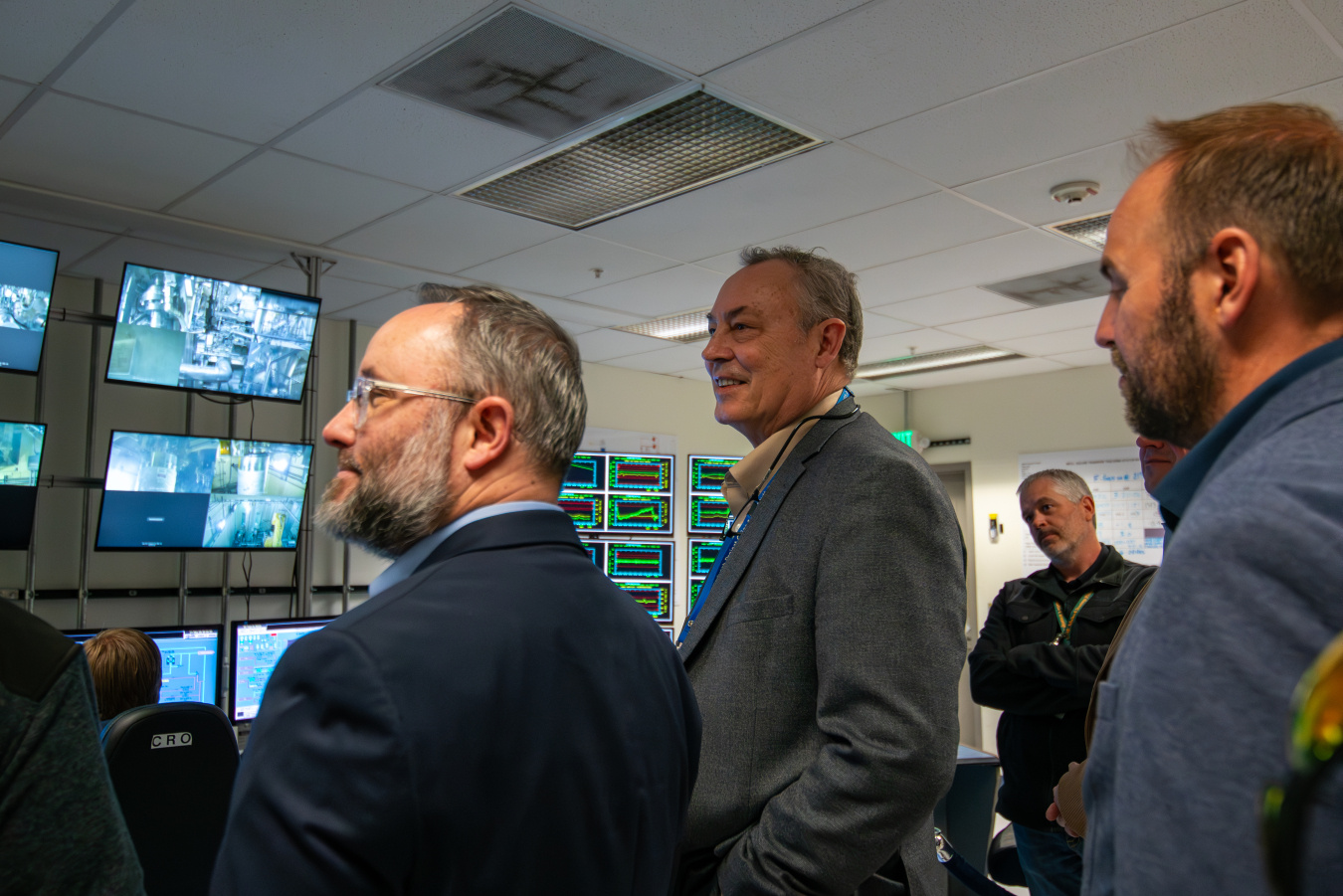
_미국 에너지부 환경관리국(EM) 조엘 브래드번(Joel Bradburne) 직무대행 수석 부차관보(가운데)가 통합 폐기물 처리 장치(Integrated Waste Treatment Unit) 통제실을 방문하고 있다. 이 시설은 현재까지 30만 갤런 이상의 나트륨 함유 폐기물을 처리했다. 닉 발스마이어(Nick Balsmeier) 아이다호 정화 프로젝트 직무대행 관리자가 오른쪽 전경에, EM 부비서실장 존 하워드(John Howard)가 왼쪽에 위치해 있다._
아이다호주 아이다호폴스 — 조엘 브래드번(Joel Bradburne)을 비롯한 미국 에너지부(DOE) 환경관리국 리더십 팀이 지난주 아이다호 정화 프로젝트를 방문하여 주요 정화 사업들을 살펴보고, 정화 이정표 달성이 아이다호 국립 연구소(INL)에서 어떤 기회를 창출하고 있는지 확인했다.
브래드번(Bradburne) EM 직무대행 수석 부차관보 및 다른 관계자들은 통합 폐기물 처리 시설 (IWTU)에서의 액체 폐기물 처리 진행 상황을 직접 확인하였으며; 아이다호 원자력 기술 및 엔지니어링 센터 (INTEC)의 사용후 원자력 연료 저장 및 기타 시설; 첨단 혼합 폐기물 처리 프로젝트(AMWTP)에서의 초우라늄 폐기물 인증 및 선적 작업; 그리고 해군 원자로 시설 (NRF)에서의 노후 원형로 해체 작업을 직접 살펴보았다.
현재까지 IWTU는 부지 내에 저장된 액체 나트륨 함유 폐기물의 3분의 1에 해당하는 30만 갤런 이상을 처리하였으며, 최근에는 폐기물이 담긴 세 개의 현장 탱크 중 하나의 사용을 중단하는 진전을 이루었다. 브래드번(Bradburne)은 IWTU 인력을 칭찬하며, 이러한 성과들이 작업자, 일반 대중 및 환경에 대한 위험을 줄이는 동시에 아이다호 주에 대한 정화 의무를 이행하겠다는 EM의 의지를 보여준다고 강조했다.
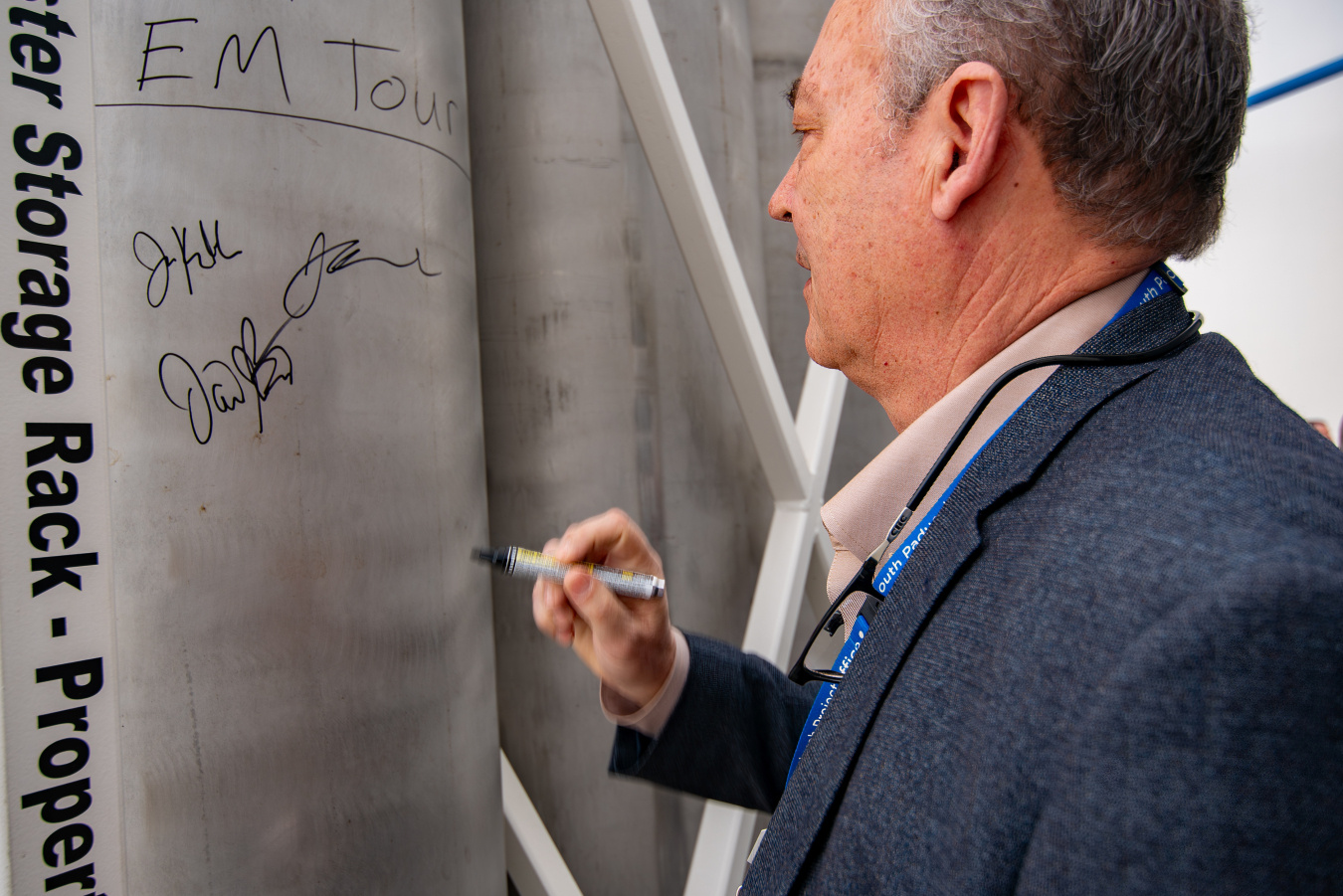
아이다호 현장에서 금속 캐스크에 서명하는 EM 지도부 구성원
_미국 에너지부 환경관리국(DOE Office of Environmental Management) 직무대행 수석 부차관보 조엘 브래드번(Joel Bradburne)이 통합 폐기물 처리 시설에서 나트륨 함유 폐기물 처리에 사용되는 캐스크에 서명하고 있다._
1950년대부터 INTEC는 INL 부지 전역과 전 세계에서 가져온 200종 이상의 사용 후 핵연료를 안전하게 관리해 왔습니다. 견학 중에는 ICP가 고급 시험 원자로에서 발생한 사용 후 핵연료를 안전하게 관리하고, 연구 시연을 지원하며, 대학교 및 기타 연구용 핵연료 선적물을 수령·보관·취급할 준비를 갖추는 방식으로 그 임무를 이어가고 있음을 현장 인력이 시연을 통해 보여주었습니다. 이는 정화 성과로 가능해진 INL의 중요한 연구 기회입니다.
NRF의 인력은 효율성 향상에서 성과를 거두고 있습니다. 이들은 해군 원자력 추진 프로그램의 노후 시제품 세 기를 해체하면서 혁신적인 관행과 장비 재사용 및 재활용을 통해 비용을 절감하고 있습니다. 최근 첫 번째 시제품 해체를 일정보다 앞당겨 완료하고 예산보다 1,600만 달러를 절감했으며, 현재까지 약 3,000톤에 달하는 금속을 재활용했습니다.
방문 소감을 밝히며, 브래드번(Bradburne)은 EM의 쇄신된 비전을 추진하는 ICP 인력의 노력을 높이 평가했습니다.
"아이다호 정화 프로젝트(Idaho Cleanup Project)는 미국의 에너지 미래를 강화하려는 부처의 전략에서 중요한 역할을 계속해서 담당하고 있습니다"라고 브래드번(Bradburne)은 말했습니다. "오늘 그들이 달성하는 이정표는 내일의 안전을 보장할 뿐만 아니라, 아이다호 정화 프로젝트가 원자력 르네상스를 이끌어 나갈 수 있는 많은 새로운 기회의 문을 열어줍니다."
-기고: 레슬리 달 라고(Leslie Dal Lago), 카터 해리슨(Carter Harrison)
이메일 업데이트
환경 관리국(Office of Environmental Management)의 최신 뉴스와 업데이트를 받아보시려면 이메일 주소를 등록하세요.
이메일 *[]: 필수 항목
AI 분석
미국 에너지부 환경관리국(EM) 리더십 팀이 아이다호 정화 프로젝트(ICP)를 방문하여 방사성 폐기물 처리 현황을 점검했으며, 이는 핵 르네상스 시대를 앞두고 환경 정화와 원자력 시설 현대화의 중요성을 재확인하는 계기가 되었다. 통합폐기물처리시설(IWTU)에서 이미 30만 갤런 이상의 나트륨 함유 폐기물을 처리하는 등 구체적인 성과를 거두고 있으며, 이는 아이다호 국립연구소(INL)의 미래 원자력 연구 기반 마련에 직접적으로 기여하고 있다. 이번 방문은 단순한 시찰을 넘어 환경 정화 마일스톤 달성이 새로운 원자력 기회 창출로 이어진다는 전략적 연계성을 강조한다는 점에서 중요한 의미를 갖는다. 특히 초우라늄 폐기물 인증·운송, 노후 원형로 해체 등 다양한 정화 활동이 동시에 진행되고 있어, 미국의 핵 폐기물 관리 역량이 종합적으로 강화되고 있음을 보여준다. 이 같은 정화 사업의 성공적 추진은 향후 소형모듈원자로(SMR) 등 차세대 원자력 기술 도입을 위한 부지 및 규제 환경 조성에도 긍정적인 영향을 미칠 것으로 전망된다.
※ 이 글은 해외 원자력 바로알기를 위한 정보 전달을 목적으로 제공됩니다. 특정 기업이나 종목에 대한 투자 권유가 아니며, 모든 투자 판단과 그에 따른 책임은 투자자 본인에게 있습니다.
백악관은 DOE 원자력에너지국(Office of Nuclear Energy)에 FY 2027 예산으로 15억 달러를 요청했으며, 이는 전년 대비 약 9% 감소한 수치다.
NRC는 FY 2027 예산으로 8억 9,230만 달러를 요청했으며, 이는 FY 2026 확정 예산 대비 약 8% 감소한 수치로 인력도 7% 줄인다.
DOE 전체 예산은 539억 달러로 전년 대비 약 10% 증가했으며, 이 중 328억 달러가 국가핵안보국(NNSA)에 배정되어 원자력 안보 분야에 집중 투자된다.
---
백악관은 FY 2027 예산안에서 에너지부(Department of Energy, DOE) 원자력에너지국(Office of Nuclear Energy)에 15억 달러를 요청했으며, 이는 전년 대비 약 9% 감소한 수치다.
트럼프(Trump) 행정부의 이번 요청은 지난 금요일 공개된 예산안에 포함된 원자력 에너지 관련 여러 항목 중 하나다. 예산안은 아직 의회의 검토와 표결을 거쳐야 한다.
"이 예산안은 [DOE]가 미국 에너지 패권의 황금시대(golden era)를 열겠다는 약속을 이행하고, 국가에 이익이 되는 과학적 발전에 집중하며, 국가를 보호할 수 있도록 할 것입니다." — DOE 예산 개요 중에서
DOE: DOE 예산에서 원자력 에너지와 관련하여 주목할 만한 요청 사항은 다음과 같다:
국립원자로혁신센터(National Reactor Innovation Center, NRIC)를 포함한 선진원자로실증프로그램(Advanced Reactor Demonstration Program, ARDP)에 2억 2,600만 달러 배정. NRIC는 미국 국립연구소의 지원을 받아 신형 원자로를 시험·실증하는 임무를 맡고 있다. ARDP 배정액은 FY 2026 확정 예산 대비 약 16% 감소한 수치다.
연료주기 연구개발(R&D)에 2억 1,850만 달러 배정으로, FY 2026 확정 예산 대비 55% 감소한 수치다. 단, DOE는 이 R&D 예산 항목에서 삭감된 두 세부 항목—사용후핵연료처분 R&D 및 통합폐기물관리시스템—이 '사용후핵연료 및 고준위폐기물 처분'이라는 새 항목으로 재배정되었다고 설명했다.
석탄, 천연가스, 원자력 발전 설비 업그레이드를 포함한 "기저부하 전력(baseload power)의 신속한 생산 및 송전 지원" 활동에 35억 달러 배정. 이 중 전력국(Office of Electricity)에 2억 300만 달러, 적격 기저부하 발전 프로젝트를 위한 에너지패권금융국(Office of Energy Dominance Financing) 내 신용보조금으로 2억 달러가 포함된다.
아이다호 국립연구소(Idaho National Laboratory, INL) 시설 유지·운영에 3억 7,800만 달러 요청으로, FY 2026 확정 예산 대비 11% 증가한 수치다.
핵융합 분야 발전을 지원하는 신설 핵융합국(Office of Fusion) 운영을 위해 1,000만 달러 요청. DOE 예산 개요에 따르면, 이 기관은 "미국 주도의 선도적이고 경쟁력 있으며 강건한 핵융합 에너지 산업을 건설·혁신·성장시키고, 핵융합 에너지 상용화로 나아가는 핵심 경로상의 과학적·기술적 격차를 해소하기 위한 국가 전략을 수립하는 일련의 국가 우선과제를 부처 차원에서 선도할 것"이라고 밝혔다. 다만 이 예산안은 국내 핵융합 사업에 집중하기 위해 국제 핵융합 프로젝트인 ITER에 대한 기여금은 삭감했다.
NRC: 원자력규제위원회(Nuclear Regulatory Commission, NRC)는 FY 2027 예산으로 8억 9,230만 달러를 요청했으며, 이는 FY 2026 확정 예산 대비 약 8% 감소한 수치다. 상근직 환산 인원(full-time employee equivalents)은 2,606명으로 FY 2026 확정 예산 대비 7% 감소한다.
NRC 예산 요청 내역은 다음과 같다:
원자력 원자로 안전 프로그램에 4억 6,070만 달러 요청으로, 전년 대비 8.3% 감소한 수치다. NRC 예산 정당화 보고서에 따르면, "감소분은 일부 ADVANCE법(ADVANCE Act) 시행으로 인한 감독·인허가 활동의 효율화, 운영허가 갱신 신청 심사 관련 효율화 이행, 원자로 연구 활동 감축 등에 기인한다."
원자력 물질 및 폐기물 안전 프로그램에 1억 3,240만 달러 요청으로, FY 2026 확정 예산 대비 6.4% 감소한 수치다. 정당화 보고서에 따르면, "감소분은 일부 예상 업무량 변화 및 ADVANCE법 시행에서 비롯된 감독·인허가 활동의 효율화 등에 기인한다."
큰 그림: DOE의 FY 2027 전체 요청 예산은 539억 달러로 2026년 대비 약 10% 증가했다. DOE 예산의 주요 항목은 다음과 같다:
예산의 대부분인 328억 달러가 국가핵안보국(National Nuclear Security Administration, NNSA)에 배정되며, 이는 2026년 대비 12% 증가한 수치다.
아르곤(Argonne) 국립연구소 및 오크리지(Oak Ridge) 국립연구소에 AI 슈퍼컴퓨터 7대를 지원하기 위해 12억 달러 요청.
트럼프 행정부의 FY 2027 예산안은 DOE 원자력에너지국과 NRC 예산을 각각 약 9%, 8% 삭감하는 한편, DOE 전체 예산은 약 10% 증가시키는 양면적 성격을 띠고 있다. 특히 예산의 60% 이상이 국가핵안보국(NNSA)에 집중 배정된 점은 민간 원자력보다 핵 안보·방위 분야를 우선시하는 정책 기조를 반영한다. 선진원자로실증프로그램(ARDP) 예산 감축과 연료주기 R&D 대폭 삭감은 단기적으로 신형 원자로 개발 및 핵연료 기술 혁신에 영향을 줄 수 있으며, 국제 핵융합 프로젝트 ITER 기여금 삭감은 다자 협력에서 자국 중심 에너지 전략으로의 전환을 시사한다. 반면 신설 핵융합국 출범과 AI 슈퍼컴퓨터 투자는 첨단 기술 경쟁력 강화를 겨냥한 전략적 선택으로 해석된다.
워싱턴 — 미국 에너지부(DOE) 원자력 에너지 사무소는 오늘 전국 원자력 안전 교육 프로그램 및 교육과정을 확대할 10개 대학 주도 프로젝트에 4,970만 달러 이상을 경쟁 방식으로 지원했습니다. 이번 지원은 국가 에너지 패권(energy dominance), 독립, 안보 달성을 위한 원자력 에너지 르네상스 가속화에 대한 트럼프(Trump) 대통령의 의지를 뒷받침합니다.
"원자력 에너지가 늘어난다는 것은 원자력 에너지 일자리가 늘어난다는 의미입니다," 라고 전략적 교차 현안 담당 대리 부차관보 미셸 스콧(Michelle Scott)이 말했습니다. "오늘의 지원은 차세대 원자력 에너지 종사자들이 최고 수준의 안전 기준을 증진하는 견고하고 엄격한 교육을 받을 수 있도록 보장하는 데 도움이 됩니다."
원자력 에너지 분야는 향후 25년간 전례 없는 일자리 성장이 예상됩니다. 원자력 발전소가 운영 면허 갱신을 통해 수명을 연장하는 가운데, 업계는 고령화 인력과 은퇴 문제에 직면해 있습니다. 국가의 증가하는 에너지 수요에 발맞추기 위해서는 경수로(light-water reactor) 함대의 장기적인 유지보수와 지속적인 운영이 계속해서 필요합니다.
원자력 에너지 산업의 숙련된 인력 수요 증가에 대응하기 위해, 에너지부(DOE)는 원자력 원자로 안전 교육 및 인력 개발 프로그램을 출범시켰습니다. 이 새로운 프로그램은 강화된 원자력 안전 교육과정 및 훈련의 개발, 시연 및 실행을 지원하기 위해 최대 1억 달러의 자금을 제공할 예정입니다. 모든 수혜자는 50%의 비용을 분담할 책임이 있습니다.
오늘의 지원 내역은 다음과 같습니다:
시연 및 실행
원자로 안전 교육 컨소시엄(CRεST, The Consortium for Reactor Safety Training)은 노스캐롤라이나 주립대학교(North Carolina State University)가 주도하며, 원자력에 대한 우려를 해소하고 경제적·환경적 이점을 부각하는 방식으로 지역사회를 원자력 에너지 논의에 참여시키는 전략을 개발할 예정입니다. (1,830만 달러)
원자력 인력 강화를 위한 오대호 파트너십(GLP, The Great Lakes Partnership to Enhance the Nuclear Workforce)은 톨레도 대학교(University of Toledo)가 주도하며, 경수로 인력을 위한 기존 안전 교육 파이프라인(pipeline, 체계적인 인력 공급 경로)을 강화하고, 원자력 분야에 자격을 갖춘 인재를 유치하며, 선진 원자로 개념에 맞는 교육과정을 현대화하고, 업계 공인 원자력 원자로 안전 자격증을 신설할 예정입니다. (1,920만 달러)
교육 수요 파악 및 교육과정 개발
펜실베이니아 주립대학교(Pennsylvania State University)는 산업 파트너가 식별한 원자력 업계 인력의 중요한 공백을 해소하기 위한 교육 수료 프로그램과 이에 상응하는 자격증 제도를 수립할 예정입니다. (200만 달러)
녹스빌 소재 테네시 대학교(University of Tennessee at Knoxville)는 업계 공인 교육 및 자격증을 지원하기 위한 교육과정 개발과 수업에 집중할 예정입니다. (200만 달러)
어바나-샴페인 소재 일리노이 대학교(University of Illinois, Urbana-Champaign)는 미래에 안전한 함대 운영을 보장하기 위한 독보적인 원자력 사이버 보안 교육 역량을 개발할 예정입니다. (150만 달러)
퍼듀 대학교(Purdue University)는 학생 및 전문가를 대상으로 원자력 품질 보증, 시스템 무결성 관리 및 원자로 안전 분석에 관한 새로운 학술 교육과정을 개발할 예정입니다. (160만 달러)
워싱턴 주립대학교(Washington State University)는 원자력 에너지 분야의 인력 공백 해소를 목표로 하는 '원자로 준비 교육 프로그램(Reactor Ready Training Program)' 교육 이니셔티브를 개발할 예정입니다. 이 프로그램은 워싱턴 주립대학교, 컬럼비아 베이신 칼리지(Columbia Basin College), 그리고 기타 주요 업계 관계자들과의 파트너십을 통해 원자력 발전소 운영, 안전 및 기타 산업 수요에 학생들을 준비시키는 교육과정을 개발할 것입니다. (140만 달러)
렌슬리어 폴리테크닉 인스티튜트(Rensselaer Polytechnic Institute)가 주도하는 RENEW 파트너십 프로그램(The RENEW partnership program)은 인력 교육 및 안전 교육을 강화하고, 혁신적인 교육 프로그램을 개발·제공하며, 원자력 산업에 대한 대중 인식을 제고할 예정입니다. (110만 달러)
네브래스카-링컨 대학교(University of Nebraska-Lincoln)는 원자력 공학 분야의 새로운 강좌를 개발하고 원자력 원자로 안전 분야의 업계 공인 자격증을 신설하는 것 외에도, 학생들에게 새로운 학습 및 인턴십 기회와 강화된 지역사회 봉사 활동을 제공할 예정입니다. (140만 달러)
메인 해양 아카데미(Maine Maritime Academy)는 '원자력 상선 선원 교육 훈련 센터(Center for Education and Training of the Nuclear Merchant Mariner)'를 설립할 예정이며, 여기에는 원자력 공학 기술 프로그램 개발, 국제해사기구(International Maritime Organization)가 승인하는 원자로 운영자 과정 설계, 그리고 부유식 원자력 발전소의 타당성 시연이 포함됩니다. (100만 달러)
이번 에너지부의 4,970만 달러 지원은 원자력 에너지 분야의 구조적 인력 위기에 대한 직접적인 정책적 대응으로 해석된다. 경수로의 수명 연장과 소형모듈원자로(SMR) 등 선진 원자로 기술 도입이 가속화되는 가운데, 기존 인력의 은퇴와 신규 인력 부족이라는 이중 과제를 해결하기 위해 대학 교육 생태계 전반에 걸친 체계적인 투자가 이루어지고 있다. 특히 사이버 보안, 부유식 원자력 발전, 지역사회 참여 전략 등 미래 지향적 분야를 포함함으로써, 단순한 운영 인력 양성을 넘어 원자력 산업의 다양한 수요에 대응하는 폭넓은 인재 파이프라인 구축을 목표로 하고 있다. 총 1억 달러 규모로 예정된 이 프로그램의 2차 지원 발표가 예고된 만큼, 미국의 원자력 인력 개발 정책은 향후 더욱 본격화될 전망이다.
미국 에너지혁신개혁프로젝트(EIRP)는 증가하는 사용후핵연료(UNF)를 관리하고 지속 가능한 연료 공급망을 지원하기 위해 포괄적인 상업용 핵연료 재활용 프로그램이 필요하다고 발표했다.
미국은 핵 시대가 시작된 이래 약 9만 4,000미터톤의 사용후핵연료를 축적했으며, 매년 약 2,000미터톤이 추가되고 있으나 영구 저장 시설은 여전히 부재한 상태다.
강력한 재활용 프로그램은 장수명 방사성 폐기물의 양과 방사성 독성을 크게 줄이고 추가적인 우라늄 채굴 필요성도 감소시킬 수 있다고 보고서는 강조했다.
site logo
Dive Brief
상업용 원자력 연료 재활용, 지속 가능한 공급의 핵심: 보고서
에너지 혁신 개혁 프로젝트(Energy Innovation Reform Project)에 따르면, 강력한 재활용 프로그램은 폐기물의 양과 방사성 독성을 크게 줄이고 추가적인 우라늄 채굴의 필요성을 감소시킬 수 있다.
2026년 4월 7일 게재
브라이언 마르투치(Brian Martucci) 기자
Nuclear reactor spent fuel pool
원자력 발전소 사용후 핵연료 저장 수조. 에너지 혁신 개혁 프로젝트는 2026년 4월 6일 발표한 보고서에서 연방 정부가 재활용을 포함하는 통합적인 원자력 폐기물 전략을 수립해야 한다고 밝혔다. 미국 원자력규제위원회(The U.S. Nuclear Regulatory Commission)의 이 이미지는 CC BY-ND 2.0 라이선스 하에 사용되었습니다.
에너지 혁신 개혁 프로젝트는 월요일 발표한 보고서에서, 더 많은 원자로가 가동됨에 따라 증가하는 사용후 핵연료(UNF)를 관리하고 보다 효율적이고 지속 가능한 연료 공급망을 지원하기 위해 미국 정부가 포괄적이고 강력한 사용후 핵연료 재활용 프로그램을 필요로 한다고 밝혔다. _사용후 핵연료의 상업적 재활용을 위한 논거(The Case for Commercial Recycling of Used Nuclear Fuel)_ 는 연방 정부가 재활용을 포함하는 통합적인 원자력 폐기물 전략을 수립하고, 미국 에너지부(U.S. Department of Energy)와 민관 합동 UNF 재활용 이니셔티브를 확대하며, 상업용 UNF 재활용 산업을 강화하는 법률을 제정할 것을 촉구하고 있다. 이 보고서는 연료 제조, 농축, UNF 재처리 및 원자력 폐기물 처분 역량을 갖춘 "원자력 생애주기 혁신 캠퍼스" 유치에 관심 있는 주(州)를 대상으로 한 에너지부의 정보 요청에 뒤이어 발표되었다. 에너지부는 이 공모에서 첫 번째 캠퍼스가 이르면 내년에 가동될 수 있다고 밝혔다.
Dive Insight:
에너지 혁신 개혁 프로젝트(EIRP) 보고서에 따르면, 미국은 원자력 시대가 시작된 이래 약 94,000 미터톤의 UNF를 축적했으며, 매년 약 2,000 미터톤이 추가되고 있다. 이 물질에는 여러 핵분열 부산물이 포함되어 있으며, 그 중 일부는 수천 년 동안 위험한 방사성을 유지한다.
상업용 발전에서 나오는 UNF 대부분은 가동 중이거나 폐쇄된 원자력 발전소의 냉각수 수조 또는 콘크리트 저장고 내 스테인리스 스틸 용기에 보관되어 있다. 의회는 1987년 네바다주 유카 마운틴(Yucca Mountain)을 약 77,000 미터톤의 사용후 핵연료를 위한 영구 심층 지질 처분장으로 지정하는 법률을 통과시켰으나, 수십 년간 법적·정치적 난관에 부딪힌 끝에 의회는 2011년 예산을 삭감했다.
텍사스주에 민간 소유의 임시 UNF 저장소 건설이 진행 중이고, 적어도 한 스타트업 기업이 역시 텍사스주에서 시연 프로젝트를 건설 중인 심층 분산 시추공에 물질을 보관할 계획을 갖고 있지만, 미국은 대부분의 국가와 마찬가지로 민간 원자력 폐기물을 위한 중앙 장기 저장 시설을 갖추지 못한 상태다. 핀란드는 2025년 세계 최초의 정부 감독 영구 처분장으로 기대되는 시설의 시운전을 시작했다.
EIRP 보고서는 "단일 [심층 지질 처분장] 건설은 미국이 지금까지 해결하지 못한 수십 년에 걸친 난제였다"고 밝히고 있다.
보고서에 따르면, 강력한 UNF 재활용 프로그램은 궁극적으로 저장이 필요한 장수명 방사성 폐기물의 양을 크게 줄일 수 있다. 경제협력개발기구(OECD) 원자력에너지기구(Nuclear Energy Agency)의 2021년 연구에 따르면, 사용후 핵연료로 운전할 수 있는 고속로와 결합된 다단계 재활용 프로그램은 폐기물의 양과 방사성 독성을 크게 줄이고 추가적인 우라늄 채굴의 필요성을 감소시킬 수 있는 것으로 나타났다.
이 보고서는 EIRP의 설립자 겸 회장 사무엘 서른스트롬(Samuel Thernstrom), 이사회 멤버 겸 선임 고문 폴 손더스(Paul Saunders), 그리고 사용된 원자력 연료로 운영될 수 있는 유형의 원자로를 개발 중인 선진 원자력 스타트업 옥로(Oklo)의 연료 주기 기술 이사 크리스티나 레겟(Christina Leggett)이 공동 집필했습니다.
옥로(Oklo)와 다른 고속 원자로 개발업체들은 EIRP가 "폐쇄형 연료 주기"라고 부르는 방식으로부터 혜택을 받게 될 것입니다. 지난 9월, 옥로는 향후 몇 년간 배치할 계획인 고속 원자로 함대에 공급할 연료를 생산하기 위해 테네시 주에 최대 17억 달러 규모의 사용후핵연료(UNF) 재처리 시설을 건설하겠다고 발표했습니다. 같은 달, 옥로는 아이다호 주에 첫 상업용 원자로인 오로라-INL(Aurora-INL)의 착공식을 진행했으며, 2027년 말 또는 2028년 초에 상업 운전을 시작할 것으로 기대하고 있습니다.
EIRP 보고서는 대규모 원자력 연료 재처리를 위한 몇 가지 순풍 요인을 지적했습니다.
러시아로부터의 우라늄 수입을 금지하는 연방 법령이 2028년에 발효되면, 주요 공급국이었던 러시아산 우라늄의 부재로 인해 미국 기반 원자로 운영업체들에게 상당한 공급 부족이 발생할 수 있습니다. EIRP 보고서에 따르면, 폐쇄형 연료 주기로의 전환은 핵심 광물의 국내 공급을 강화하고, 미국이 사용후핵연료 재처리 및 원자로 건설 계약 수주에서 러시아 및 프랑스와 경쟁하는 데 도움이 될 것입니다.
또한 보고서는 폐쇄형 연료 주기가 전 세계 확인 매장량인 약 90년치를 넘어 우라늄 공급을 연장하는 데 기여할 것이라고 밝혔습니다. EIRP는 전 세계 원자력 발전 함대가 성장함에 따라 경제적으로 회수 가능한 우라늄 매장량이 더 빠르게 고갈될 수 있다고 경고했습니다.
한편, EIRP는 파이로프로세싱(pyroprocessing)과 같은 선진 원자력 연료 재처리 기술이 대규모로는 기존 공정보다 비용 효율적일 수 있으며, 의료용 세슘 및 스트론튬 동위원소와 같은 가치 있는 재처리 부산물의 회수가 경제성을 더욱 향상시킬 수 있다고 밝혔습니다.
미국은 핵 시대가 시작된 이후 약 94,000 메트릭톤의 사용후핵연료(UNF)를 축적했으며, 더 많은 원자로가 가동됨에 따라 매년 약 2,000 메트릭톤이 추가되고 있어 지속 가능한 처리 전략이 시급한 상황이다. 에너지혁신개혁프로젝트(EIRP)의 보고서는 상업적 UNF 재활용 프로그램이 방사성 폐기물의 양과 독성을 크게 줄이고 추가적인 우라늄 채굴 필요성을 낮출 수 있다고 강조하며, 연방 정부 차원의 통합적 핵폐기물 전략 수립을 촉구하고 있다. 수십 년째 해결되지 않은 영구 처분장 문제(야카 마운틴 프로젝트 실패 등)는 재활용이 단순한 대안이 아닌 필수적인 해결책으로 떠오르게 하는 배경이 되고 있다. 미 에너지부(DOE)가 핵연료 제조, 농축, 재처리, 핵폐기물 처분 기능을 갖춘 '핵 생애주기 혁신 캠퍼스' 유치 주(州)를 모집하고 있다는 점은 정책적 전환의 신호로 볼 수 있으며, 이른 시일 내 가시적인 성과로 이어질 수 있다. 이 보고서는 에너지 안보, 환경 지속 가능성, 핵비확산 등 다차원적 이슈가 얽힌 UNF 재활용 논의를 본격화하는 중요한 계기가 될 것으로 평가된다.
※ 이 글은 해외 원자력 바로알기를 위한 정보 전달을 목적으로 제공됩니다. 특정 기업이나 종목에 대한 투자 권유가 아니며, 모든 투자 판단과 그에 따른 책임은 투자자 본인에게 있습니다.
그레인저 공과대학(Grainger College of Engineering)이 일리노이 원자력 연구소(Illinois Nuclear Power Institute, INPI)를 설립하여 차세대 원자력 에너지 기술 개발을 주도한다.
INPI는 상업용 마이크로 원자로 실증 시설을 포함한 세계 수준의 연구 플랫폼을 구축하고, 첨단 원자로 기술 배치의 핵심 과제 해결에 집중한다.
일리노이 대학교는 오랜 원자력 연구 전통을 바탕으로 민간 기업, 학계, 국립 연구소와의 협력을 통해 글로벌 원자력 혁신을 이끌어 나갈 계획이다.
---
그레인저 공과대학(Grainger College of Engineering)이 일리노이 원자력 연구소(Illinois Nuclear Power Institute, INPI)를 새롭게 소개합니다. INPI는 첨단 원자로 기술, 통합 에너지 시스템, 안전, 인허가, 그리고 인력 개발에 집중하기 위해 설립되었습니다.
브루스 애덤스(Bruce Adams) 기자
안전하고 탄소 배출이 없는 에너지에 대한 수요가 기하급수적으로 증가하고 있습니다. 원자력 에너지는 이 수요를 충족하는 데 핵심적인 역할을 담당하게 될 것입니다. 어바나-샴페인 소재 일리노이 대학교(University of Illinois Urbana-Champaign) 그레인저 공과대학의 연구자들은 원자력의 운영, 활용, 배치 분야에서 혁신을 추구하고 있습니다.
이를 효과적으로 추진하기 위해 그레인저 공과대학은 새로운 연구 기관인 일리노이 원자력 연구소(Illinois Nuclear Power Institute) (INPI)를 설립했습니다. INPI는 배치상의 핵심 과제를 해결하는 데 전념하는 혁신적인 연구개발(R&D) 허브 역할을 수행합니다. 연구 허가 하에 운영될 예정인 상업용 마이크로 원자로를 포함한 세계 수준의 시설에 대한 접근성을 제공함으로써, INPI는 이해관계자들이 현실적인 환경에서 운영, 활용, 배치 분야의 혁신을 이룰 수 있는 종합 플랫폼을 제공합니다.
칼렙 브룩스INPI 소장이자 원자력·플라즈마·방사선 공학 교수인 칼렙 브룩스(Caleb Brooks)는 INPI가 "원자력 산업계, 규제 기관, 그리고 전 세계에 다양한 프로젝트를 위한 기회와 유연한 연구 환경을 제공한다"고 말했습니다. 그는 "학제 간 협력은 혁신을 가속화하고 원자력 에너지가 탄력적이고 저탄소적인 에너지 미래의 초석으로 남아 있도록 보장할 수 있다"고 덧붙였습니다.
일리노이주는 원자력 기술의 여명기(黎明期, 기술이 처음 시작되던 초창기)부터 원자력 에너지 분야의 주요 선도자였습니다. INPI는 이러한 리더십의 전통을 이어받아 새로운 세대의 첨단 원자로 기술로 나아가게 될 것입니다.
일리노이 대학교 연구·혁신 담당 수석 부총장인 수전 A. 마르타니스(Susan A. Martinis)는 "우리 대학은 원자력 발전 연구 및 운영 분야에서 자랑스러운 유산을 보유하고 있습니다. INPI는 기술 발전이 사회의 증가하는 에너지, 환경, 안보 수요를 충족하는 데 매우 중요한 이 시기에 일리노이를 원자력 혁신 및 배치 분야의 글로벌 리더로 자리매김시킵니다. INPI는 교수진과 학생, 학술 및 기업 파트너, 그리고 학술·연구 커뮤니티의 많은 구성원들에게 새로운 연구 기회를 제공할 것입니다"라고 밝혔습니다.
라시드 바시르 프로필 사진그레인저 공과대학 학장인 라시드 바시르(Rashid Bashir)는 "INPI는 우리 대학의 원자력 에너지 분야 리더십이라는 풍부한 전통을 더욱 확장합니다"라고 말했습니다. "일리노이 그레인저의 엔지니어들은 원자력 에너지 혁신의 최전선에 서 있으며, INPI는 원자로 실증 프로젝트가 차세대 원자력 기술을 선도할 수 있도록 보장하는 연구 플랫폼을 개발하는 데 핵심적인 역할을 담당할 것입니다. INPI는 일리노이주와 미국 전체에 영향을 미칠 첨단 원자로와 원자력 전문가를 양성함으로써 이를 실현할 것입니다."
첨단 원자로 기술은 원자로의 배치 및 새로운 응용 분야와의 통합 방식, 그리고 원자로의 운영 및 유지보수 방식에 있어 패러다임의 전환(paradigm shift, 기존의 사고·방식·틀 자체를 근본적으로 바꾸는 변화)을 요구할 것입니다. INPI 부소장이자 수석 연구 과학자인 팀 그룬로(Tim Grunloh)는 "INPI는 이미 첨단 원자로의 인허가 및 배치에 관한 '현장 경험(boots on the ground experience, 실제 현장에서 직접 뛰며 쌓는 경험)'을 축적해 나가고 있습니다"라고 말했습니다.
INPI는 첨단 원자로, 새로운 배치 방식, 그리고 이를 가능하게 하는 기술들을 아우르는 다양한 응용 분야에서 민간 기업, 학계, 국립 연구소의 협력자를 모색하고 있습니다. 여기에는 계측 및 제어, 운영, 유지보수, 사이버 보안, 모델링 및 시뮬레이션 등 수많은 분야가 포함됩니다.
---
_이 기사는 2026년 4월 6일에 게재되었습니다._
AI 분석
일리노이 원자력 연구소(INPI)의 설립은 미국 원자력 에너지 분야에서 학계가 주도하는 연구개발 역량을 대폭 강화하려는 전략적 행보로 풀이됩니다. 특히 상업용 마이크로 원자로를 연구 허가 하에 실증 운영하려는 계획은 소형 원자로(SMR) 기술의 상용화를 앞당기는 데 중요한 선례가 될 수 있습니다. INPI가 인허가, 사이버 보안, 계측·제어 등 실질적인 배치 장벽 해소에 집중한다는 점은, 기술 개발을 넘어 규제와 산업 현실 사이의 간극을 메우려는 실용적 접근임을 시사합니다. 또한 민간 기업·학계·국립 연구소를 잇는 협력 생태계 구축을 목표로 한다는 점에서, INPI는 미국 원자력 산업의 인력 기반 확충과 기술 생태계 강화에도 중요한 기여를 할 것으로 기대됩니다. 이러한 움직임은 탄소중립 에너지 전환이라는 글로벌 과제 속에서 원자력의 역할을 재조명하는 국제적 흐름과도 궤를 같이합니다.
암 치료부터 심장 질환, 영양, 인수공통감염병 감시까지, IAEA가 세계 보건에 기여하는 여섯 가지 핵심 분야를 소개합니다.
2026년 4월 7일
엠마 미드글리(Emma Midgley), IAEA 공보·커뮤니케이션실
체성분 평가를 위한 아동 타액 채취 훈련. (사진: V. Owino/IAEA)
IAEA는 각국이 원자력 기술을 질병 진단, 치료, 예방에 활용할 수 있도록 지원함으로써 전 세계 공중 보건 증진에 기여하고 있습니다. 암 치료부터 심장 질환, 영양, 인수공통감염병 감시까지, IAEA가 세계 보건에 기여하는 여섯 가지 핵심 분야를 소개합니다.
생명을 구하는 암 치료에 대한 접근성을 확대하기 위해, 특히 필요가 가장 큰 저·중소득국(LMIC)을 중심으로, IAEA 사무총장 라파엘 마리아노 그로시(Rafael Mariano Grossi)는 2022년 2월 '희망의 빛(Rays of Hope)' 이니셔티브를 출범시켰습니다. (사진: IAEA)
##
1\. 전 세계 방사선 치료 서비스 접근성 확대
100개국 이상이 국제원자력기구(IAEA)의 희망의 빛: 모두를 위한 암 치료 이니셔티브에 참여하고 있으며, 이 이니셔티브는 저소득 및 중소득 국가에서 방사선 치료 접근성을 높이기 위해 각국 정부, 국제 금융 기관 및 민간 부문과 협력하고 있습니다. 방사선 치료는 암 치료의 필수적인 구성 요소입니다.
이 이니셔티브를 통해 저소득 및 중소득 국가의 암 치료 지원을 위한 예산 외 기금 9,000만 유로 이상이 조성되었으며, 선형 가속기 10대와 유방촬영기 55대가 조달되었고, 4개 지역에 걸쳐 20개의 앵커 센터가 설립되었습니다.
희망의 빛 앵커 센터는 임상 치료, 품질 관리, 교육, 연구 및 혁신 분야에서 탁월함을 인정받은 선도적인 암 전문 기관입니다. 이 글로벌 네트워크는 방사선 의학 활용에 관한 교육을 700명 이상의 전문가에게 제공하여 안전하고 고품질의 암 치료 접근성을 확대했습니다.
국제원자력기구(IAEA)는 또한 세계보건기구(WHO) 및 국제암연구소(IARC)와 협력하여 국가의 암 관리 역량과 필요를 종합적으로 평가하는 imPACT 검토를 실시합니다. imPACT 검토 권고사항은 기술 협력 프로젝트, 국가 암 관리 계획 및 전략적 자금 조달 문서를 수립하는 데 도움이 됩니다.
국제원자력기구(IAEA)는 원자력 의학 분야에서 교육 및 훈련 자료를 제작해 온 오랜 역사를 가지고 있습니다. (사진: IAEA)
##
2\. 더 나은 진단과 치료를 위한 원자력 의학 강화
원자력 의학은 방사성 의약품을 체내에 투여하는 것을 포함하며, 이는 소량의 방사성 물질을 함유한 화합물입니다. 이러한 물질은 암의 조기 발견을 포함한 광범위한 질병의 진단과 치료를 가능하게 하여, 치료 결과를 크게 향상시키고 사망률을 줄입니다. 또한 이러한 접근법은 심혈관 질환과 갑상선, 뇌, 뼈에 영향을 미치는 만성 질환을 식별하는 데 핵심적인 역할을 합니다.
국제원자력기구(IAEA)는 국가들이 원자력 의학 및 방사선학 부서를 설립할 수 있도록 지원하며, 모든 이를 위한 안전하고 효과적이며 고품질의 의료 영상 및 표적 치료를 실현할 수 있도록 기술 전문 지식과 경험을 제공합니다.
전 세계 암 센터의 품질 보증 역량 강화를 위해 선량 측정 연구소에서 훈련 세션을 진행하는 국제원자력기구(IAEA) 선량 측정사. (사진: G. Velez/IAEA)
##
3\. 선량측정 및 품질 보증을 통한 정밀도 향상
의료 X선 및 CT 스캔은 전리 방사선을 사용하여 신체 내부 이미지를 생성함으로써 의사들이 골절이나 암 종양을 확인할 수 있게 해줍니다. 방사선 치료는 고용량의 방사선을 사용하여 암을 치료하는데, 주변의 건강한 장기와 조직에 대한 방사선량을 최소화하면서 종양을 효과적으로 표적 치료합니다.
국제원자력기구(IAEA)의 선량측정 연구소는 교정 및 감사 서비스라는 두 가지 서비스를 통해 방사선 치료 및 의료 영상에서 환자 안전성과 효과를 향상시키는 데 기여합니다. 교정은 의료 시설이 방사선 치료 선량을 정확하게 측정할 수 있도록 보장합니다. 감사는 선량이 정확하게 계산되고 전달되는지 검증합니다.
국제원자력기구(IAEA)는 방사선 치료, 핵의학, 진단 방사선학 분야의 의학 물리학자 및 방사선 계측학자를 위한 품질 보증 및 선량측정에 관한 지침을 발간합니다. 또한 파트너 기관들과 협력하여 품질 보증 및 선량측정 관련 주제에 대해 의학 물리학자 및 방사선 계측학자를 대상으로 지역 및 국가 수준의 교육 과정과 전문 워크숍을 제공합니다.
수의과학자들이 자이베르스도르프(Seibersdorf) 연구소에서 분자 진단 분석법의 검사 검증 및 유효성 확인에 관한 실습 훈련을 받고 있습니다. (사진: IAEA)
##
4\. 인수공통 감염병 감지 및 통제 지원
인수공통 감염병 — 동물에서 인간으로 전파되는 병원체 — 은 현대 사회가 직면한 가장 큰 위협 중 하나입니다. 이 질병들은 알려진 감염병의 60%, 새롭게 출현하는 감염병의 75%를 차지합니다.
이 질병들은 인체 건강에 영향을 미쳐 급성 질환과 장기적인 합병증을 유발하며, 매년 약 26억 건의 감염 사례와 270만 명의 사망자를 초래하는 것으로 추산됩니다.
국제원자력기구(IAEA)의 인수공통 감염병 통합 대응(ZODIAC) 이니셔티브는 동물에서 기원하여 인간에게 전파될 수 있는 병원체 — 세균, 기생충, 곰팡이, 바이러스 — 로 인한 팬데믹 예방을 지원하기 위해 설립되었습니다. 원자력 및 원자력 파생 기술을 활용하여 ZODIAC은 각국의 감염병 발생을 신속하게 감지, 식별 및 대응할 수 있는 대비 역량과 능력을 강화합니다. 발생이 감지되고 특성이 파악되면, 신속하고 데이터 기반의 대응 조치를 취할 수 있습니다.
비만은 현재 저소득 및 중간 소득 국가에서 가장 빠르게 증가하고 있으며, 전 세계 과체중 또는 비만 인구의 약 70%가 이들 국가에 거주하고 있습니다. (이미지: Adobe Stock).
##
5\. 영양 과학을 통한 건강 증진
전 세계는 영양결핍과 비만이 비전염성 질환의 증가를 이끄는 이중 영양 부담에 직면해 있습니다. 원자력 및 관련 기술을 개발하고 이전함으로써, 국제원자력기구(IAEA)는 에너지 소비량, 신체 구성, 모유 수유 방식, 영양소 흡수, 골격 건강에 관한 정밀한 데이터를 생성하기 위한 영양 과학의 활용을 지원함으로써 세계 보건을 증진하고 있습니다.
국제원자력기구(IAEA)는 또한 임상의사와 공중보건 전문가들이 원자력 및 관련 기술을 활용하여 영양 상태를 평가하고, 생애 전반에 걸쳐 모든 형태의 영양 불량을 예방 및 관리하기 위한 효과적인 조치를 설계할 수 있도록 지원합니다.
이러한 기술에는 안정 동위원소 방법과 영상 기술이 포함됩니다. 국제원자력기구(IAEA)는 또한 에너지 소비량, 인체 모유 섭취량, 신체 구성에 관한 글로벌 데이터베이스를 편집하고 운영합니다. 이 데이터베이스들은 예를 들어 에너지 대사에 관한 오랫동안 지속되어 온 통념을 불식시키는 등의 출판물에 기초 자료를 제공해 왔습니다.
선량측정법은 전문 의사들이 암 치료를 위한 정밀한 방사선 치료를 시행할 수 있도록 돕습니다. (사진: 딘 칼마(Dean Calma) / IAEA)
##
6\. 인간 건강 프로그램을 통한 글로벌 지식 구축
인간 건강(Human Health) 프로그램은 인간 건강 분야의 모든 국제원자력기구(IAEA) 활동을 지원합니다.
방사선 치료 및 진단 영상에서부터 방사성 의약품, 영양학, 인수공통 질병 관리에 이르기까지, 국제원자력기구(IAEA)는 각국이 원자력 과학 및 기술을 활용하여 글로벌 보건 과제에 대응할 수 있도록 지원합니다. 지식 이전, 역량 구축, 그리고 필수적인 교정 및 감사 서비스 제공을 통해 이 기구는 각국이 보다 안전하고, 보다 효과적이며, 보다 접근 가능한 방사선 의학 및 공중 보건 서비스를 제공할 수 있도록 지원합니다.
이 기사는 IAEA(국제원자력기구)가 핵과학 기술을 활용하여 세계 보건에 기여하는 여섯 가지 핵심 분야를 소개하고 있으며, 특히 저·중소득 국가들에서 암 치료 접근성을 높이는 데 중점을 두고 있다. 'Rays of Hope' 이니셔티브를 통해 100개국 이상이 참여하고 9천만 유로 이상의 자금이 조성되는 등, 원자력 기술이 단순한 에너지원을 넘어 글로벌 공중보건 인프라의 핵심 요소로 자리매김하고 있음을 보여준다. 핵의학은 방사성의약품을 이용한 암 조기 진단·치료뿐만 아니라 심혈관 질환 및 만성 질환 관리에도 활용되어, 의료 자원이 부족한 국가들에 실질적인 혜택을 제공하고 있다. 또한 선량측정(Dosimetry) 및 품질 보증 시스템을 통해 방사선 치료의 정밀도와 환자 안전성을 높이는 노력은, 원자력 기술의 평화적 활용 가능성과 국제 협력의 중요성을 새롭게 조명한다. 이 기사는 원자력 기술에 대한 부정적 인식을 넘어, 인류 건강 증진에 직접 기여하는 IAEA의 역할을 재확인시켜 주는 중요한 사례로 평가된다.
※ 이 글은 해외 원자력 바로알기를 위한 정보 전달을 목적으로 제공됩니다. 특정 기업이나 종목에 대한 투자 권유가 아니며, 모든 투자 판단과 그에 따른 책임은 투자자 본인에게 있습니다.
한국어
웨스팅하우스(Westinghouse), AP1000 설계 개정안을 원자력규제위원회(NRC)에 제출
웨스팅하우스(Westinghouse), AP1000 설계 개정안을 원자력규제위원회(NRC)에 제출
2026년 4월 7일, 오후 12:55 | Nuclear News
요약
카테고리: 원자력 정책
웨스팅하우스(Westinghouse)가 AP1000 원자로의 설계 인증(DC) 갱신 및 업데이트를 위한 신청서를 원자력규제위원회(NRC)에 제출하였으며, 보글(Vogtle) 3·4호기 건설에서 얻은 교훈을 설계 제어 문서(DCD)에 공식 반영하는 것을 목표로 한다.
웨스팅하우스(Westinghouse)는 보글(Vogtle)-4호기를 미국 내 AP1000 표준 기준 원전으로 지정하고, 이를 통해 신규 AP1000 건설허가 신청 절차를 가속화하여 2030년까지 10기의 AP1000을 착공하겠다는 계획이다.
원자력규제위원회(NRC)는 이번 제출을 대형 경수로(LWR)의 근시일 내 배치를 촉진하기 위한 폭넓은 정책 노력의 일환으로 보고 있으며, 향후 대형 원자력 분야의 역량을 신규 AP1000 배치에 집중할 방침이다.
---
어제(4월 6일), 원자력규제위원회(NRC)는 웨스팅하우스(Westinghouse)로부터 AP1000 원자로의 설계 인증(DC) 갱신 및 업데이트 신청서를 접수했다고 발표했다. 이 신청은 보글(Vogtle) 3·4호기 건설 과정에서 얻은 교훈들을 AP1000의 설계 제어 문서(DCD)에 공식적으로 반영하기 위한 것이다.
오래전부터 예고된 이번 제출은 미국 내 기가와트급 경수로(LWR) 배치의 미래를 위해 원자력규제위원회(NRC)와 웨스팅하우스(Westinghouse) 양측이 세워온 기존 계획을 기반으로 한다.
세부 내용: 웨스팅하우스(Westinghouse)가 이번 신청에서 제안한 개정안은 보글(Vogtle)-4호기를 미국 내 AP1000 표준 기준 원전으로 확립하는 것을 골자로 한다. 웨스팅하우스(Westinghouse)에 따르면, 이 변경을 통해 신규 AP1000 건설·운영허가(combined license) 신청이 가속화되고, 신속한 대량 배치(fleet deployment)가 가능해지며, 미국 내 두 번째 성공적인 AP1000 배치에서 달성한 시간 및 비용 절감 효과를 전반적으로 활용할 수 있을 것이라고 한다.
구체적으로, 웨스팅하우스(Westinghouse)는 AP1000 DCD 개정을 목표로 하고 있다. 웨스팅하우스(Westinghouse)는 DCD를 "표준 원자로 설계가 모든 규제 및 안전 요건을 충족함을 보증하는 기술적 세부 사항을 담은 문서 집합"이자 "신규 호기 허가의 주요 참고 자료"로 정의한다. 수천 페이지에 달하는 DCD는 원전 설계의 모든 측면을 기록하며, 이번 DCD 개정에는 보글(Vogtle)의 허가, 건설 및 시운전 과정에서 얻은 교훈이 반영된다.
이러한 개정과 함께, 웨스팅하우스(Westinghouse)는 AP1000 설계 인증(DC)의 갱신도 신청하고 있다. AP1000 설계 인증은 2006년 최초 인증, 2011년 개정을 거쳤으며, 2025년에는 현재 유효한 모든 설계 인증과 함께 유효 기간이 연장되어 현재 2046년까지 유효하다. 웨스팅하우스(Westinghouse)의 이번 신청은 40년 갱신을 요청하고 있다.
주목할 발언: "고객의 입장에서, 한 번도 건설된 적 없는 최초 설계(first of a kind)에 수반되는 기술적 위험 없이, 실제로 건설되어 운전 중인 호기를 기준으로 한 표준 원전을 배치할 수 있다는 것은 대량 배치(fleet-scale deployment)의 문을 여는 판도를 바꾸는 일(game changer)입니다(기존의 불확실성을 제거하는 획기적인 변화)"이라고 댄 섬너(Dan Sumner) 웨스팅하우스(Westinghouse) 임시 최고경영자(CEO)가 밝혔다.
주요 배경: 이번 제출에 대한 각자의 발표에서, 원자력규제위원회(NRC)와 웨스팅하우스(Westinghouse) 양측 모두 이번 조치가 각 기관이 기존에 수립한 계획 위에 구축된 것임을 강조했다.
원자력규제위원회(NRC)의 입장에서, 이번 제출은 "승인된 설계를 참조하는 원자로의 설계 인증 업데이트 및 건설·운영허가 심사를 간소화하여 규제 예측 가능성을 높이는 동시에 기관의 높은 안전 기준을 유지하기 위한 광범위한 노력"의 일환이라고 발표문에 명시되어 있다.
지난 3월 말, 원자력규제위원회(NRC)는 근시일 내 기가와트급 대형 경수로(LWR) 원전 배치를 촉진하기 위한 정책 이슈 문서를 발표하였으며, 이번에 제출된 DCD가 곧 제출될 것으로 예상한다고 밝힌 바 있다. 당시 원자력규제위원회(NRC)는 DCD 개정이 "보글(Vogtle) 호기의 실제 건설 상태를 반영하는 것이 목적이므로, AP1000 설계에 신규 변경 사항은 거의 없거나 전혀 없을 것"이라고 언급했다.
보다 넓은 관점에서, 해당 정책 이슈 문서에서 원자력규제위원회(NRC)는 향후 대형 원자력 분야에서의 역량을, 기존에 제출된 건설·운영허가 신청의 재개이든 완전히 새로운 부지에서의 신청이든, 신규 AP1000 배치에 집중할 것임을 명확히 밝혔다.
---
AI 분석
이번 웨스팅하우스(Westinghouse)의 AP1000 설계 인증 갱신 및 개정 신청은 미국 원자력 산업의 대규모 재도약을 위한 핵심적인 제도적 기반 마련 작업으로 평가된다. 보글(Vogtle) 3·4호기 건설 경험을 표준 설계에 공식 반영함으로써, 향후 신규 원전 건설 시 반복적인 인허가 지연과 비용 초과를 최소화할 수 있는 발판이 마련된다. 원자력규제위원회(NRC)가 이를 대형 경수로 배치 간소화 정책과 연계하고 있다는 점은, 미국 정부 차원에서 원자력의 전략적 가치를 재확인하는 신호로 볼 수 있다. 2030년까지 10기 착공이라는 목표는 단순한 기업 계획을 넘어, 미국의 에너지 안보와 탄소중립 목표 달성을 위한 구체적인 로드맵으로 기능할 가능성이 높다. 이러한 일련의 움직임은 수십 년간 침체되었던 미국 원자력 산업의 부흥을 알리는 중요한 전환점이 될 수 있다.
3D printing possibilities: Additive manufacturing impact limiters for transportation casks
April 7, 2026
TL;DR
Orano and UNC Charlotte are exploring advanced 3D printing technology (SLM and FFF printers) as a cost-effective alternative to traditional methods for manufacturing impact limiters for nuclear transportation casks, which currently costs millions of dollars
New internal printing patterns like gyroid designs offer up to 80% weight savings while maintaining strength in all directions, potentially reducing both fabrication costs and transportation weight
While commercial metal printers have advanced significantly, full-scale impact limiters still cannot be printed as single components and require assembly from multiple printed parts; current deficiencies include lack of nuclear-grade standards and precision limitations
April 7, 2026, 9:27AMRadwaste SolutionsSven Bader, Brad Crotts, Michael Smith, Don McGee, and John McEntire
An Orano MP197HB transport cask loaded onto a railcar.
With the significant advances in additive manufacturing (AM), otherwise known as 3D printing, Orano Federal Services and the University of North Carolina at Charlotte recently re-examined the capabilities to print impact limiters for transportation casks used to ship spent nuclear fuel. Impact limiters protect transportation casks (sometimes also referred to as transportation overpacks) and their contents during an accident. Impact limiter designs must withstand testing based on a certain significance level of hypothetical accidents, including drops, crushing, fires, and immersion in water.
Currently, many transportation casks include impact limiters made of balsawood and redwood or honeycomb aluminum structures, both of which require expensive fabrication processes (on the order of millions of dollars). Previous studies into using AM as an alternative manufacturing process for the fabrication of impact limiters identified a deficiency in the capabilities of AM printers to produce such large components, which can reach outer diameters of more than 365 centimeters (144 inches).
An updated study, however, has revealed that not only can AM printers produce substantially larger objects, but new internal patterns have been created that have the potential to provide advantages for impact limiters. In addition, some new standards have been produced to support AM (though not to nuclear standards yet), and these larger objects can be printed using metals, though still not cost-effectively for a full-scale impact limiter.
The need
Although no significant transport of commercial SNF is currently taking place in the United States to a consolidated interim storage facility or repository (there is some transport of lead test rods/assemblies of accident-tolerant fuels and higher burnup fuels, but only to facilities to be examined for operational purposes and not for storage or disposal purposes), the Department of Energy is expecting to site, license, and begin operation of a consent-based federal interim storage facility within the next 10 to 15 years [1]. As a result, the large-scale transport of commercial SNF can be expected to occur in this time frame.
In the meantime, with the recent approval of the certificate of compliance (CoC) for Orano's high-burnup SNF demonstration cask (TN-32B) [2], and with industry's data needs to meet commitments made to the Nuclear Regulatory Commission by 2028 for the storage of high-burnup SNF at 53 nuclear sites, the shipment of the TN-32B cask to a DOE facility for opening and detailed fuel examination is expected to occur sometime in 2027 [3].
In preparation for this potential shipment, the fabrication of all the necessary components for transport is being performed, including the fabrication of the impact limiters. Fabrication of the high-burnup SNF cask impact limiters has required the expensive purchase and interim storage of the materials needed to build them, as well as their hand assembly. As a result, alternative approaches to fabricating future impact limiters are being examined.
Alternative impact limiter designs were considered in 2019 by Orano and UNC Charlotte that included the use of alternative materials such as syntactic foams [4]. Experience from this activity provided the basis for performing this latest investigation, which included the following design and regulatory criteria:
A maximum dimensional constraint of 128 in. in width (Plate E train car dimensional limit).
A maximum composite transportation cask system weight of less than 360,000 pounds.
Temperature limits between -20°F and 150°F.
The impact limiter must remain attached to its cask after a drop.
Free drop: 9-meter (30-foot) drop onto an unyielding surface.
Crush: a crushing impact from a plate weighing 1,100 lbs. dropped from 30 ft onto the cask.
Puncture: a 3-ft drop onto a 6-in. diameter mild steel vertical cylinder.
Thermal: a fully engulfing flame of 1,475°F for 30 minutes.
Immersion: a submersion of 50 ft into water.
The last five items above are tied to hypothetical accident conditions (HAC) that are identified in 10 CFR Part 71.73 and posed the largest challenge in the designing of impact limiters at the time. This previous experience included examining some AM options. At that time, however, the technology was too limited to produce the "qualified" components needed to assemble impact limiters, as metal printing was relatively new.
AM status
An investigation of the status of available commercial metal printers found that no printer is currently capable of producing an entire impact limiter (too large). However, two promising technologies capable of printing larger metal components that could be assembled into an impact limiter were identified: fused filament fabrication (FFF) and selective laser melting (SLM) printers.
The larger commercial SLM printers available (e.g., the NXG 6II 600) can print objects as large as 600 millimeters × 600 mm × 600 mm (23.6 in. × 23.6 in. × 23.6 in.) with high precision and at a rate of 1,000 cubic cm per hour (61 in.3/hr) using a stainless steel powder. The larger commercial FFF printers available (e.g., EBAM 300) can print objects as large as 5,791 mm × 1,219 mm × 1,219 mm (228 in. × 48 in. × 48 in.) at a print rate of 1,170 cm3/hr (71.4 in.3/hr) also using a stainless steel powder, but with less precision than the SLM printers.
In addition to these stainless steel outer dimensions, these printers can also print various infill patterns such as Schwartz-D, Schwartz-P, gyroid, and honeycomb (see Fig. 1), some of which are inspired by wood microcell structure.
Fig. 1. Example AM infill designs: Schwartz-D (left), gyroid (center), and Schwartz-P (right) [5].
A structural assessment of these infill patterns established the gyroid as the most promising to be applied to impact limiter components, as it can have up to an 80 percent weight savings (depending on the density of the infill), it has strength in all directions, and it is less dense than other infills. The ability of these printers to print these patterns in stainless steel at various densities is a significant development, as the infill pattern density can be optimized to provide the necessary energy absorption of the impact limiter to protect the transportation package while at the same time reducing the material necessary to fabricate the impact limiter, saving on both cost and weight.
Although AM equipment has advanced, there are still some deficiencies associated with this technology. Currently, there is a lack of standards, specifically nuclear-grade standards, associated with the fabrication of AM components to ensure the efficacy of such equipment to perform safety functions. There are general standards such as ISO/ASTM 52900, "Additive Manufacturing—General Principles and Terminology," but they just provide general information. There are efforts, however, underway to provide techniques to improve the inspection of AM equipment, which are typically verified through computed tomography [6].
Another deficiency with the current commercial AM printers is that they are not able to print full-scale impact limiters. Therefore, the impact limiters designed by Orano and USC are made up of multiple AM printed components and assembled into full-scale impact limiters.
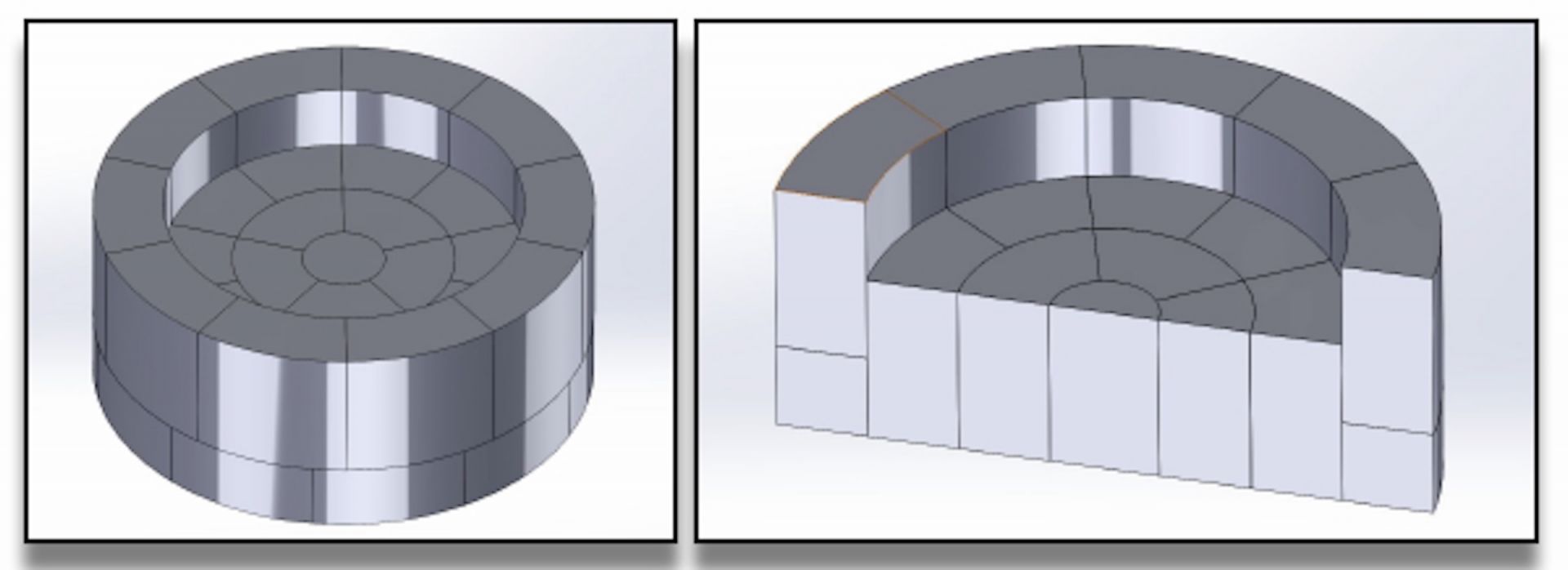
Fig. 2. The initial 2,700-brick impact limiter design.
Fig. 3. The upgraded 442-brick impact limiter design using an SLM AM printer.
Fig. 4. The final 36-brick impact limiter design using an FFF AM printer.
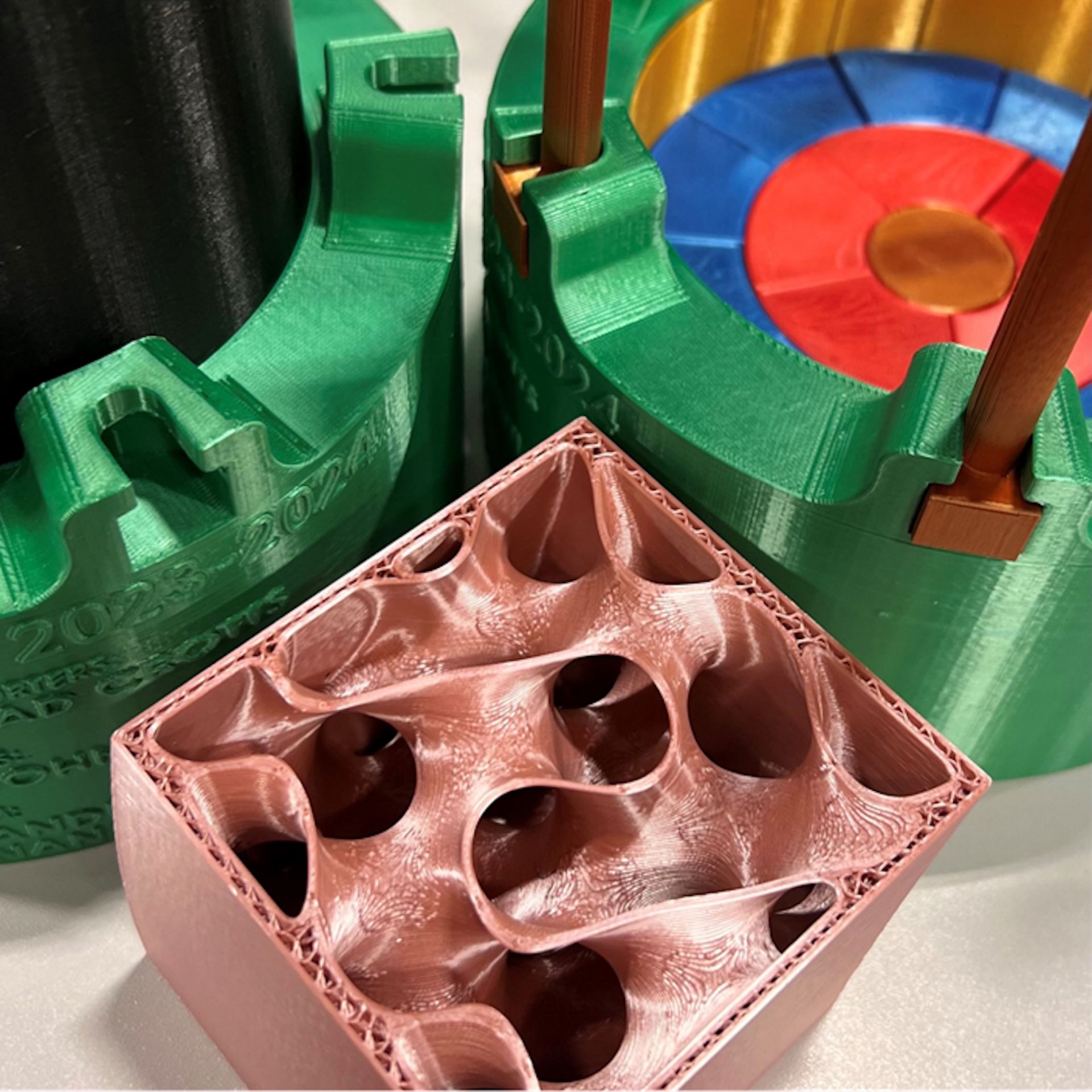
Fig. 5. AM PLA plastic scaled replica of an impact limiter (1/12 scale) with 36 bricks (red, blue, and gold) and stainless steel cladding (green) and gyroid infill pattern in foreground (pink).
Design advancements
As a result of AM only being able to print components ("bricks") for an impact limiter, some initial designs were considered that could take advantage of the size of the AM bricks produced by the various AM printers. The first design considered bricks sized about 5 in. × 5 in. × 10 in. that aligned with the maximum size produced by a commercially available AM printer, but which required 2,700 bricks to produce a full-scale impact limiter (see Fig. 2). With the advent of larger commercially available SLM AM printers, a larger AM-fabricated brick (10 in. × 10 in. × 20 in.) was considered that would use 442 bricks to reach full-scale (see Fig. 3).
For both designs, however, although the bricks are relatively simple to print, the assembly of all the bricks into an impact limiter design within an aluminum cover was considered challenging. In addition, it was thought that the horizontal shear planes may not perform well for corner drops.
Fortunately, FFF AM printers continued to increase in size and an alternative impact limiter design was created using 20-in. × 20-in. × 40-in. bricks in a 36-brick arrangement (Fig. 4). As a result of this design, horizontal slip planes were avoided and the assembly of the impact limiter is relatively simple, especially compared to the other two designs.
The resulting design of an optimally designed AM impact limiter uses 36 bricks assembled and placed within stainless steel cladding with the bricks printed using an FFF printer. Figure 5 is a picture of a scaled mockup of this impact limiter that has been AM printed out of plastic to show the different components that make up this design, including the stainless steel cladding (green), and the four types of bricks (yellow, blue, red, and gold at center) built from the outside in. In addition, an example of the gyroid infill pattern found inside the bricks is shown in the foreground (pink) in the figure.
Analyses and testing
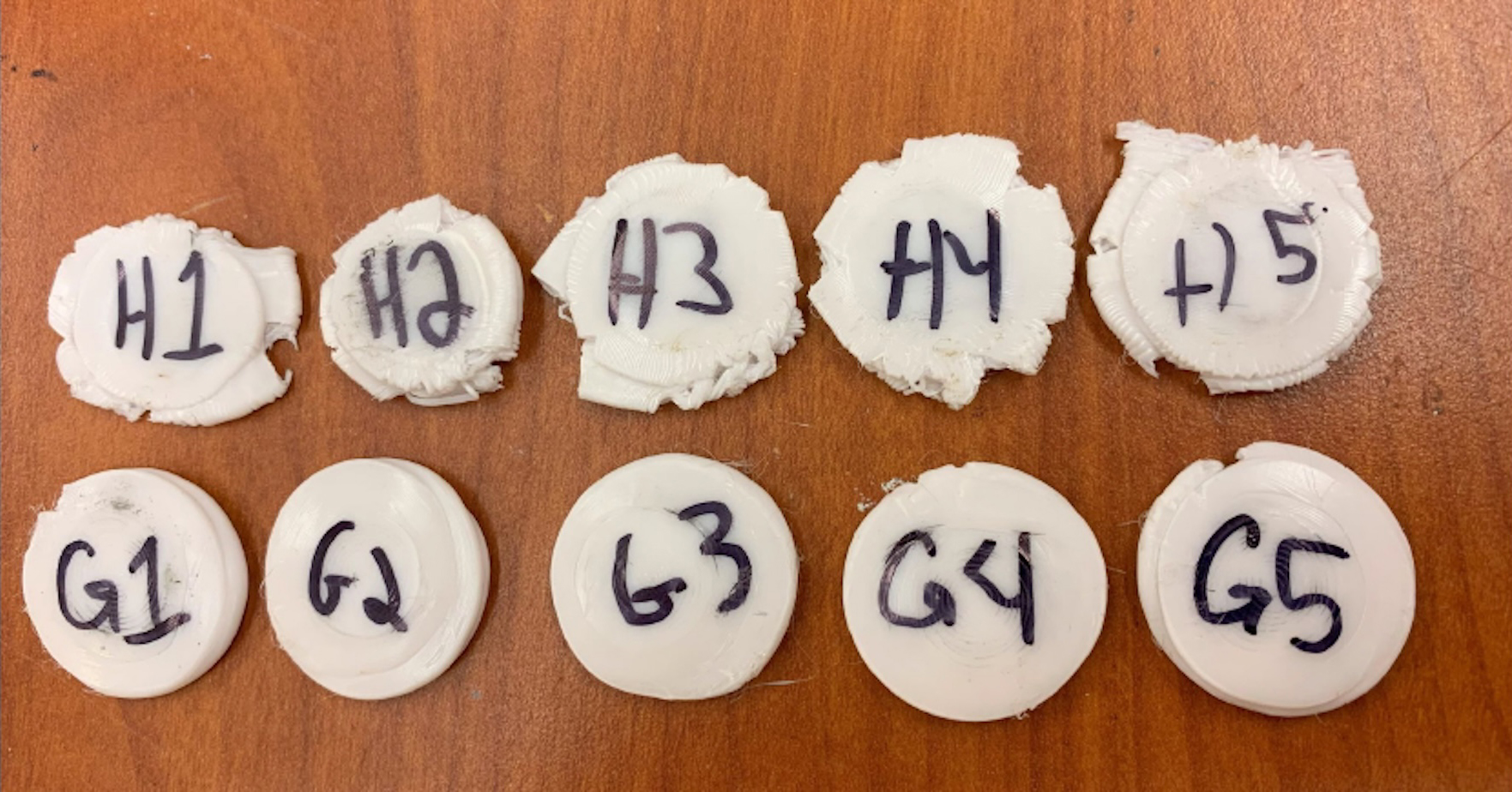
Fig. 6. Compression results for gyroid (bottom) and honeycomb (top) samples.
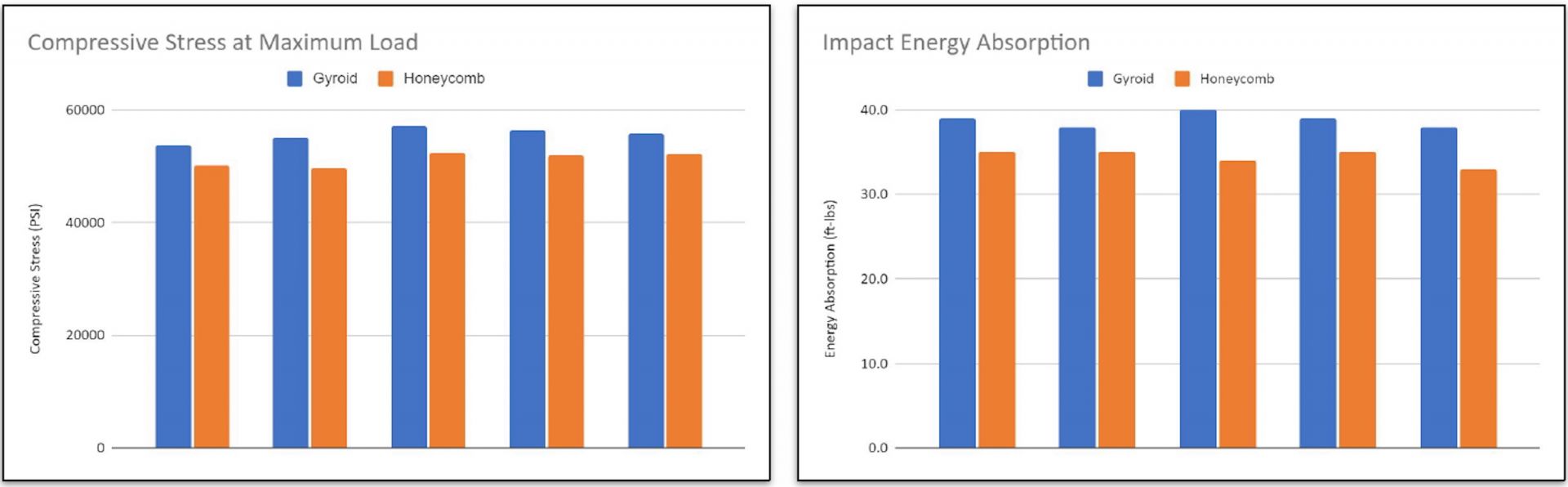
To examine the way honeycomb and gyroid infill patterns withstand impacts, compression tests were performed on small AM samples of the patterns (see Fig. 6). The results consistently showed better performance of the gyroid design over the honeycomb for compressive stresses and impact energy absorption, as shown in Fig. 7, with the honeycomb infill pattern outwardly collapsing and the gyroid infill pattern inwardly collapsing (i.e., accordion crushing). Hence, using a honeycomb infill pattern could either cause bricks to be forced out of the overall impact limiter design or cause distortion within the impact limiter structure (bubbling up) and potentially create uneven impact forces/stresses to select bricks in an impact. On the other hand, if a gyroid infill pattern brick were subject to an impact, then the brick would accordion crush as it absorbs the energy.
Fig. 7. Compressive stresses at maximum load (left) and impact energy absorption (right) for gyroid (blue) and honeycomb (orange) samples.
AM also provides the opportunity to change the density of the infill patterns from 0 percent (no infill) to 100 percent (solid infill). So compressive tests were also performed on samples of polylactic acid (PLA) plastic and 17/4 precipitation-hardened stainless steel (17/4 PH SS)—a commonly used metal in AM printers—containing four different infill percentages of the gyroid infill pattern: 5 percent, 10 percent, 20 percent, and 30 percent. Figures 8 and 9 illustrate the compressive stresses and the energy absorbed, respectively for the PLA plastic and stainless steel from these tests. In general, the greater the infill density, the greater the compressive stress and energy absorbed, with most of the increases uniform except for a significant increase in the energy absorbed for the stainless steel, 30 percent infilled gyroid over the other infill densities.
Fig. 8. Compressive stresses for PLA plastic and 17/4 PH SS for gyroid infills of different densities.
Fig. 9. Energy absorbed for PLA plastic and 17/4 PH SS for gyroid infills of different densities.
In addition to the compression tests, a model of an impact limiter assembly was constructed using SolidWorks and then analyzed using ANSYS simulations. The model was designed to allow for different materials to infill the impact limiter, with the current model considering redwood and 442 100 percent infilled bricks of 17/4 PH SS.
The resulting maximum deformations for a compression test were 0.00553 in. for the redwood and 0.00139 in. for the stainless steel. To reduce the infill in the bricks to a value less than 100 percent, Ntopology was used to turn the complex geometry associated with the gyroid infill pattern into a representative volume element (RVE) with equal properties (e.g., Young's Modulus, Bulk Modulus, Shear Modulus) for use in the simulation model. As a result, ANSYS simulations were then produced for different drop scenarios, including side and corner drops with 5 percent and roughly 10 percent infill densities. The resulting modeled stresses on the impact limiters were acceptable for all the drop scenarios, and the 5 percent gyroid infill density produced a maximum stress (68 kilos per square inch) approximately equivalent to redwood (67 ksi) for the 30-ft drop scenario.
As a result of these tests and simulations, the 36-brick impact limiter design is considered acceptable, with each of the bricks designed with a 5 percent to 30 percent gyroid infill pattern using AM FFF printers.
Cost assessment
One of the main drivers for examining the AM fabrication of impact limiters is to reduce costs, which for currently certified impact limiters is significant due to materials (e.g., redwood) and assembly costs. Some initial cost estimates have been identified as approximately between $250,000 and $1 million per impact limiter. The cost estimate for AM components of an impact limiter is primarily associated with the cost of the printer itself, which ranges between $600,000 and $1.5 million, and the materials used by the printer, which cost approximately $50 per pound per spool of 17/4 PS SS for FFF printers and approximately $14 per pound of powder 17/4 PS SS for SLM printers. This assessment assumed the cost of labor to be $50 per hour.
The AM cost assessment considered the 36-brick impact limiter design for FFF printers and the 442-brick impact limiter design for SLM printers. The assessment established the approximate cost breakeven point between redwood impact limiters and the SLM and FFF impact limiter designs based on the percentage of gyroid infill. Assuming the redwood impact limiters cost approximately $1 million per unit, then the breakeven cost occurs for an infill of 37 percent for the SLM AM impact limiter and an infill of 10 percent for the FFF AM impact limiter. Infills at lower percentages result in cheaper AM impact limiter designs.
Since a 5 percent gyroid infill was assessed to produce acceptable results for drop events through the numerical models, impact limiters produced by FFF AM components could save over $1 million, and a set produced by SLM AM components could save over $1.7 million at this infill.
Conclusions
Compression testing and ANSYS modeling has provided some insights into the performance of the updated AM components and the new impact limiter design, including behavior comparable to current designs. Furthermore, with the ability to not only produce unique infill patterns, such as the gyroid, but also to change the density of this infill, optimization of the impact limiter design for cost and for the ability to protect the transport package against hypothetical accidents can be performed. The gyroid infill pattern with a density of 5 percent appears to meet these requirements while also minimizing the cost, with a potential savings of $1 million over the existing impact limiter design.
However, the lack of codes and standards to support the use and verify the efficacy of AM components makes the proposed new impact limiter design an exercise in need of justification, likely beyond single component testing and numerical modeling of the composite design and most likely in need of actual drop testing data. Therefore, although this work shows the promise of AM, the path forward is focused on the development of codes and standards for AM components, which will require test data to complete.
_Sven Bader is a technical executive at the Electric Power Research Institute; Brad Crotts is a principal engineer at Orano; Michael Smith is an assistant professor of mechanical engineering technology at UNC Charlotte; and Don McGee and John McEntire are project managers at Orano._
References
1. U.S. Department of Energy, "Consent-Based Siting Process for Federal Consolidated Interim Storage of Spent Nuclear Fuel," (April 2023). 2. U.S. Nuclear Regulatory Commission, "Certificate of Compliance No. 9377, Revision No. 0, for the Model No. TN-32B Package," ML21231A189, (July 1, 2024). 3. True, Douglas, senior vice president and chief nuclear officer of Nuclear Energy Institute, letter to Kathryn Huff, assistant secretary, Office of Nuclear Energy, subject "The High Burnup Used Nuclear Fuel Demonstration Cask Project," (March 15, 2024). 4. Bader, S., and M. Smith, "Alternative Impact Limiter Designs for Used/Spent Nuclear Fuel Transportation Casks" (19496), 2019 Waste Management Conference, Phoenix, AZ, (March 3-7, 2019). 5. Castro, A., et al., "Permeability versus Design in TPMS Scaffolds," Materials, DOI:10.3390/ma12081313, (2019). 6. DOE Office of Nuclear Energy, "New National Lab Algorithm Enables Faster, Safer Inspection of Nuclear Materials," (Nov. 1, 2024).
Additive manufacturing represents a significant breakthrough in nuclear transportation safety by offering a cost-effective alternative to traditional impact limiter fabrication, which currently requires millions of dollars in expensive processes using balsawood and aluminum structures. The advancement of 3D printing technology now enables the production of large-scale components (up to 365+ centimeters) with innovative internal patterns that could enhance impact limiter performance while reducing both cost and manufacturing complexity. With the anticipated large-scale transport of spent nuclear fuel within the next 10-15 years and regulatory deadlines approaching in 2028, this technology becomes critically important for preparing the infrastructure needed for a federal interim storage facility. However, the transition faces practical hurdles, as metal 3D printing remains cost-prohibitive for full-scale components, suggesting that hybrid approaches or continued technological refinement will be necessary before widespread industrial implementation. This development underscores how advanced manufacturing can address long-standing challenges in nuclear logistics while supporting the safe, efficient management of high-burnup spent fuel in the coming decade.
How Nuclear Batteries Could Speed the Race to Fusion Power
Published: April 8, 2026
TL;DR
Avalanche Energy received a $5.2 million DARPA contract to develop radiovoltaics—advanced semiconductor materials that convert radiation into electricity—for next-generation nuclear batteries.
Traditional fusion reactors struggle to convert energy efficiently (around 60% at best), but new radiovoltaic materials could capture more energy from alpha particles produced during fusion reactions.
The technology could enable compact, long-lasting power solutions for military spacecraft, satellites, and remote bases, while helping fusion companies achieve commercial viability by improving their power output ratios.
Full Article
Fusion power has always been a bit of a contradiction. The fusion part is actually kind of easy — an undergrad recently built a simple fusion device in his bedroom, for example — but getting electricity out of the reaction isn't.
"A fusion reactor that makes power — and there's plenty of those, they already exist," Daniel Velázquez, materials science lead at Avalanche Energy, told TechCrunch. "A fusion reactor that makes electricity is better." That's where the nascent industry remains stuck.
Fusion reactions release tremendous amounts of energy by fusing two lighter atoms into a heavier one. But harvesting that energy has proven challenging. The most common approach is to heat water and spin a steam turbine, but that approach isn't terribly efficient, harnessing at best around 60% of the power.
Avalanche Energy thinks it can capture more of that energy by developing new materials known as radiovoltaics. Radiovoltaics are similar to photovoltaics — traditional solar panels — in that they use semiconductors to transform radiation into electricity. They've been around for a while, but they're not very effective. Existing radiovoltaics are easily damaged by the very radiation they harness and don't produce that much electricity.
Today, Avalanche was awarded a $5.2 million contract from DARPA to develop new radiovoltaics, the company exclusively told TechCrunch.
The Pentagon research agency is interested in using the materials in a new class of nuclear batteries, which use radioactive decay from materials like polonium to generate electricity. Such devices could help power spacecraft and satellites for several years. They could also be used in more energy-intensive terrestrial military applications for days on end — "in particular for autonomous systems or missions where logistics are a little bit impermissible," Velázquez said.
That's not exactly what Avalanche is building toward as a company, but the DARPA award does overlap with its ambitions.
Commercial Applications and Industry Impact
For one, fusion reactions and nuclear batteries both produce alpha particles, a type of radiation that's so energetic it can damage all kinds of equipment, including the wall of a nuclear reactor. Second, Avalanche is developing a desktop-scale fusion reactor that could replace diesel generators at remote military bases.
If the company can develop a new radiovoltaic for a nuclear battery, it could apply that knowledge to a new reactor part. Such a sheathing would help capture the alpha particles, protecting the reactor while boosting the amount of electricity it produces. Avalanche also won a $1.25 million award from the U.S. Air Force's AFWERX research lab to use computational advances to speed materials discovery.
Fusion startups are all racing to achieve a milestone known as breakeven, which in the scientific world is known as Q>1, where Q is the ratio of power produced by the fusion reaction to the power required to sustain it. Putting those alpha particles to work generating electricity would potentially make commercial fusion power easier to attain.
Avalanche isn't the only company with a reactor design that will produce alpha particles. If it succeeds, the company could find itself supplying other fusion companies with the technology, a trend that's emerging within the industry.
AI Analysis
Avalanche Energy's approach represents a significant convergence of two complementary technologies: advanced radiovoltaics and compact fusion reactors. By addressing the alpha particle problem—which has been a persistent engineering challenge—the company could unlock substantial efficiency gains that make fusion commercialization more feasible. The dual DARPA and Air Force funding signals government recognition that this materials science breakthrough could be foundational to both military power applications and civilian fusion energy goals. If successful, the ability to harvest energy from alpha particles could accelerate the entire industry's path to achieving Q>1 and moving fusion from laboratory curiosity to practical power source.
English
EnergySolutions to be reacquired by investment firm ECP-Nuclear NewsWire
EnergySolutions to be reacquired by investment firm ECP
April 7, 2026
TL;DR
Energy Capital Partners (ECP) is reacquiring nuclear services company EnergySolutions from TriArtisan Capital Advisors, with the transaction expected to close in 2026.
ECP cited transformational changes in the nuclear sector and growing demand for reliable baseload power as drivers for the reacquisition.
EnergySolutions provides services across the nuclear fuel lifecycle, including transportation, processing, recycling, and disposal of radiological materials.
Overview
The investment firm Energy Capital Partners (ECP) is to reacquire nuclear services company EnergySolutions from TriArtisan Capital Advisors, it was announced yesterday. Terms of the transaction, which is expected to close in 2026, subject to customary regulatory approvals, were not disclosed.
TriArtisan, a New York–based middle-market private equity investing firm, purchased ownership interest in EnergySolutions from ECP in 2022. ECP became the majority owner of EnergySolutions in 2013, and sold minority ownership interest to TriArtisan in 2018.
Market Growth
ECP said its decision to acquire EnergySolutions again comes at a time of transformational change for the nuclear sector, with growing demand for reliable baseload power.
We've stayed connected with EnergySolutions and its leadership since we exited our previous investment, and we've been impressed by what the team has continued to accomplish.
>
— Drew Brown, partner at ECP
With headquarters in Salt Lake City, Utah, and Charlotte, N.C., EnergySolutions provides services across the nuclear fuel life cycle, including the transportation, processing, recycling, and disposal of radiological material. According to EnergySolutions, the company has seen significant growth under TriArtisan's ownership.
Executive Statement
Over the past several years, we have broadened our offerings across the nuclear sector and strengthened our ability to deliver integrated solutions for customers. We believe this transaction will accelerate our long-term strategy and growth.
>
— Ken Robuck, president and CEO at EnergySolutions
AI Analysis
This reacquisition reflects the strengthening market fundamentals for nuclear energy, with growing recognition of its role in meeting baseload power demands. The transaction demonstrates confidence from major investors in the nuclear services sector and validates EnergySolutions' strategic positioning and operational performance. The involvement of experienced players like ECP returning to the space suggests sustained optimism about nuclear industry growth trajectories, particularly as energy decarbonization accelerates globally.
GE Vernova Hitachi Nuclear Energy and AFRY to collaborate in the deployment of the BWRX-300 small modular reactor
Publish Date: April 7, 2026
TL;DR
GE Vernova Hitachi Nuclear Energy and AFRY have signed a Main Services Agreement to support BWRX-300 small modular reactor deployment across Europe, combining advanced reactor technology with Swedish engineering expertise.
AFRY will provide engineering and advisory services while supporting the development of a license application to Sweden's Radiation Safety Authority, positioning Sweden as a key hub in the SMR value chain.
The BWRX-300 is advancing globally with the first unit under construction at Ontario Power Generation's Darlington site in Canada and the U.S. Nuclear Regulatory Commission reviewing TVA's application for a Tennessee deployment.
Main Content
STOCKHOLM (April 7, 2026) – GE Vernova Hitachi Nuclear Energy (GVH) today announced that it has entered into a Main Services Agreement (MSA) with AFRY, a leading Swedish engineering, project management and advisory company, to support the deployment of its BWRX-300 small modular reactor (SMR) technology.
Through this non-exclusive collaboration, AFRY will deliver engineering and advisory services that leverage its deep sector knowledge, regional expertise and extensive presence across Europe. The collaboration is expected to enable Swedish industries to participate in high-value opportunities linked to the growing European and global SMR market.
"This agreement reflects our commitment to building a strong Swedish and European industrial ecosystem around the BWRX-300, going beyond reactor technology to enable long-term collaboration, local capability development and regional value creation," said Jason Cooper, CEO, GE Vernova Hitachi Nuclear Energy. "Sweden has a strong industrial base and world-class engineering capabilities, and by working with AFRY we are reinforcing our ability to deliver the BWRX-300 while enabling local industry to play a meaningful role in Europe's energy transition."
"Through the collaboration with GE Vernova Hitachi, we aim to help position Sweden as a key hub in the future SMR value chain as well as advancing Sweden's nuclear power program," said Elon Hägg, EVP and Head of Global Division Energy at AFRY. "This collaboration connects local expertise with international reach and supports the delivery of reliable, low-carbon energy solutions."
By combining GVH's proven BWRX-300 technology and global project experience with AFRY's sector-engineering strength, the collaboration is designed to support efficient, repeatable, and scalable deployment across multiple projects in Europe. In addition to engineering work, AFRY will also support GVH in the development of a license application for the BWRX-300 to the Swedish Radiation Safety Authority (SSM).
BWRX-300 Global Progress
Momentum around the BWRX-300 continues to build globally. The first BWRX-300 is under construction at Ontario Power Generation's Darlington site in Canada, with completion expected by the end of the decade, which will make it the first small modular reactor in the Western world. Key components like the reactor pressure vessel are being manufactured, and site construction is progressing according to plan. The U.S. Nuclear Regulatory Commission has accepted and is reviewing Tennessee Valley Authority's (TVA) application to construct the first BWRX-300 in the U.S. at the utility's Clinch River site in Oak Ridge, Tennessee. These developments, and others, support GVH's progress and leadership in scaling and deploying SMRs commercially to customers around the globe.
About GE Vernova Hitachi Nuclear Energy
GE Vernova's Nuclear energy business, through its global alliance with Hitachi Ltd., is a world-leading provider of nuclear services and advanced nuclear reactor designs. Technologies include boiling water reactors and small modular reactors, such as the BWRX-300, which is one of the simplest, yet most innovative boiling water reactor designs. GE Vernova's Nuclear fuel business, Global Nuclear Fuel (GNF), is a world-leading supplier of boiling water reactor fuel and fuel-related engineering services. GNF is a GE Vernova-led joint venture with Hitachi, Ltd. and operates primarily through Global Nuclear Fuel-Americas, LLC in Wilmington, N.C., and Global Nuclear Fuel-Japan Co., Ltd. in Kurihama, Japan. HITACHI is a trademark of Hitachi, Ltd. used under trademark license. GE is a trademark of General Electric Company used under trademark license.
Forward-Looking Statements
This document contains forward-looking statements – that is, statements related to future events that by their nature address matters that are, to different degrees, uncertain. These forward-looking statements often address GE Vernova's expected future business and financial performance and financial condition, and the expected performance of its products, the impact of its services and the results they may generate or produce, and often contain words such as "expect," "anticipate," "intend," "plan," "believe," "seek," "see," "will," "would," "estimate," "forecast," "target," "preliminary," or "range." Forward-looking statements by their nature address matters that are, to different degrees, uncertain, such as statements about planned and potential transactions, investments or projects and their expected results and the impacts of macroeconomic and market conditions and volatility on the Company's business operations, financial results and financial position and on the global supply chain and world economy.
Press Resources
vernova imageLinda Pålsson, President and CEO, AFRY; and Jason Cooper, CEO, GE Vernova HitachiImage credit: GE Vernova Hitachivernova imageFrom left to right: Fredrik Vitaback, Sales Executive, GE Vernova Hitachi; Linda Pålsson, President and CEO, AFRY; Jason Cooper, CEO, GE Vernova Hitachi; and Elon Hägg, EVP and Head of Global Division Energy, AFRYImage credit: GE Vernova Hitachi
Media Contact
Jon Allen GE Vernova | Communications, Nuclear Power Email: jonathan.allen1@gevernova.us Phone: +1 910 819 2581
---
AI Analysis
This strategic partnership between GE Vernova Hitachi and AFRY represents a significant acceleration in the commercialization of small modular reactor technology, particularly for the European market. By leveraging AFRY's deep regional expertise and engineering capabilities, GE Vernova is building a robust supply chain ecosystem that could position Sweden as a crucial manufacturing and services hub for SMRs across Europe. The combination of proven BWRX-300 technology with regulatory support for Swedish licensing demonstrates a pragmatic approach to de-risking the deployment pathway and building confidence among stakeholders in next-generation nuclear power solutions.
EM Leaders See Idaho Cleanups' Contributions to Nuclear Renaissance
April 7, 2026
TL;DR
DOE's Office of Environmental Management leadership visited the Idaho Cleanup Project to assess progress on major remediation milestones that are opening new opportunities at Idaho National Laboratory
The Integrated Waste Treatment Unit has processed over 300,000 gallons of liquid sodium-bearing waste, and the Advanced Mixed Waste Treatment Project saved $20 million through innovative ultrasonic testing technology
Cleanup accomplishments are enabling critical research opportunities, including used nuclear fuel management from the Advanced Test Reactor and preparation for university research fuel shipments
EM Leadership Visit to Idaho Cleanup Project
IDAHO FALLS, Idaho — Joel Bradburne and other members of the U.S. Department of Energy's (DOE) Office of Environmental Management (EM) leadership team visited the Idaho Cleanup Project (ICP) last week, where they surveyed major remediation projects and saw how meeting cleanup milestones is creating opportunities at the Idaho National Laboratory (INL).
Bradburne, EM acting principal deputy assistant secretary, and the others saw firsthand the progress of liquid waste processing at the Integrated Waste Treatment Unit (IWTU); used nuclear fuel storage and other capabilities of the Idaho Nuclear Technology and Engineering Center (INTEC); transuranic waste certification and shipping operations at the Advanced Mixed Waste Treatment Project (AMWTP); and legacy prototype demolition at the Naval Reactors Facility (NRF).
EM Leadership standing in a control room at the Idaho site
_U.S. Department of Energy Office of Environmental Management (EM) Acting Principal Deputy Assistant Secretary Joel Bradburne, center, visits the control room at the Integrated Waste Treatment Unit, which has processed over 300,000 gallons of sodium-bearing waste to date. Acting Idaho Cleanup Project Manager Nick Balsmeier is at right, foreground, and EM Deputy Chief of Staff John Howard is at left._
Progress at the Integrated Waste Treatment Unit
To date, the IWTU has processed over 300,000 gallons, or a third of the liquid sodium-bearing waste stored onsite, and recently ceased use of one of three onsite tanks containing the waste — a marker of progress. Bradburne praised the IWTU workforce, recognizing that these accomplishments reduce risk to workers, the public and the environment while demonstrating EM's commitment to meeting cleanup obligations to the state of Idaho.
An EM leadership member signing his name on a metal cask at the Idaho Site
_U.S. Department of Energy Office of Environmental Management Acting Principal Deputy Assistant Secretary Joel Bradburne signs a cask used to process sodium-bearing waste at the Integrated Waste Treatment Unit._
Used Nuclear Fuel Management and Research Opportunities
Since the 1950s, INTEC has safely managed over 200 types of used nuclear fuel from across the INL Site and the world. During the tour, crews demonstrated how ICP continues that mission by safely managing used nuclear fuel from the Advanced Test Reactor, enabling its research demonstrations, and preparing to receive, store, and handle university and other research fuel shipments. These are critical INL research opportunities made possible by cleanup accomplishments.
A highly skilled workforce and specialized equipment at AMWTP are driving taxpayer savings and advancing DOE's transuranic waste mission. By using ultrasonic technology to certify transuranic waste containers, AMWTP crews saved about $20 million. The facility's remote waste-handling equipment recently processed large items for Los Alamos National Laboratory, showcasing its unique capabilities and potential to help other DOE sites process waste for disposal at the Waste Isolation Pilot Plant.
Legacy Prototype Demolition Successes
Crews at NRF are finding success in efficiency. They rely on innovative practices, equipment reuse and recycling to deliver savings as they demolish three Navy Nuclear Propulsion Program legacy prototypes. They recently finished demolishing the first prototype ahead of schedule and $16 million under budget, and have recycled nearly 3,000 tons of metals to date.
Bradburne's Vision for the Future
Reflecting on his visit, Bradburne noted the ICP workforce's efforts to advance EM's renewed vision.
"The Idaho Cleanup Project continues to be an important part of the Department's strategy to strengthen America's energy future. The milestones they achieve today not only ensure protection tomorrow but open the door to many new opportunities at the Idaho Cleanup Project to advance the nuclear renaissance."
_Contributors: Leslie Dal Lago, Carter Harrison_
AI Analysis
This article highlights how environmental remediation efforts at the Idaho Cleanup Project are directly enabling new scientific and research capabilities at Idaho National Laboratory, transforming the site from a legacy cleanup location into a hub for nuclear research and innovation. The DOE's emphasis on meeting cleanup milestones demonstrates a strategic shift toward viewing environmental management not just as a compliance obligation but as a foundation for advancing the broader nuclear renaissance agenda. The documented cost savings through innovative technologies like ultrasonic waste certification and efficient demolition practices underscore how focusing on operational excellence in cleanup work can yield both environmental and economic benefits while supporting the agency's goals for strengthened energy security.
English
Proposed FY 2027 DOE, NRC budgets ask for less-Nuclear NewsWire
The Trump administration's FY 2027 budget proposal requests $1.5 billion for DOE's Office of Nuclear Energy (9% less than FY 2026) and $892.3 million for the NRC (8% less than FY 2026).
Notable DOE requests include $226 million for the Advanced Reactor Demonstration Program (16% decrease), $218.5 million for fuel cycle R&D (55% decrease), and $10 million for a new Office of Fusion.
The overall DOE budget requests $53.9 billion for FY 2027 (a 10% increase), with most funding allocated to the National Nuclear Security Administration.
Full Article
The White House is requesting $1.5 billion for the Department of Energy's Office of Nuclear Energy in the fiscal year 2027 budget proposal, about 9 percent less than the previous year.
The request from the Trump administration is one of several associated with nuclear energy in the proposal, which was released Friday. Congress still must review and vote on the budget.
"The budget will allow the [DOE] to continue delivering on promises to unleash a golden era of American energy dominance, focus on scientific advancements that benefit the country, and protect the nation," according to the DOE budget brief.
The DOE
Among the notable requests in the DOE budget targeting nuclear energy are the following:
Providing $226 million to the agency's Advanced Reactor Demonstration Program, including funds for the National Reactor Innovation Center (NRIC), which is tasked with testing and demonstrating new reactors with the assistance of U.S. national laboratories. The ARDP allocation is nearly 16 percent less than the FY 2026 enacted budget.
Providing $218.5 million for fuel cycle research and development, a 55 percent decrease from the FY 2026 enacted budget. However, the DOE pointed out that the two categories cut from this R&D budget line item—Used Nuclear Fuel Disposition R&D and Integrated Waste Management System—were reassigned to a new line item: Used Nuclear Fuel and High-Level Waste Disposition.
Providing $3.5 billion to support activities to "rapidly generate and transmit additional baseload power," including upgrades for coal, natural gas, and nuclear generation. This includes $203 million for the Office of Electricity and $200 million of credit subsidies within the Office of Energy Dominance Financing for eligible baseload power projects.
A $378 million facilities maintenance and operations request for Idaho National Laboratory, an 11 percent increase from the FY 2026 enacted budget.
A request for $10 million to fund the new Office of Fusion to support activities advancing fusion. This office "will lead the Department in advancing a set of national priorities that establishes a national strategy to build, innovate, and grow a leading, competitive, and robust American-driven fusion energy industry, to close scientific and technological gaps on the critical path toward commercializing fusion energy," according to the DOE budget brief. But the budget does reduce funding for its contributions to the international ITER fusion project as it shifts focus to domestic fusion endeavors.
The NRC
The Nuclear Regulatory Commission, meanwhile, requests $892.3 million for FY 2027, just over 8 percent less than the FY 2026 enacted budget. This includes 2,606 full-time employee equivalents, a decrease of 7 percent from the FY 2026 enacted budget.
The NRC budget request includes the following:
A $460.7 million request for its nuclear reactor safety program, an 8.3 percent decrease from the previous year. "The decrease is due in part to anticipated efficiencies gained in oversight and licensing activities stemming from the ADVANCE Act, implementation of efficiencies associated with license renewal application reviews, and a reduction in reactor research activities," according to the NRC budget justification report.
A $132.4 million request for its nuclear materials and waste safety program, a 6.4 percent decrease from the FY 2026 enacted budget. According to the justification report, "the decrease is due in part to anticipated workload changes and efficiencies gained in oversight and licensing activities stemming, in part, from the ADVANCE Act."
The Bigger Picture
Overall, the DOE requested $53.9 billion for FY 2027, a nearly 10 percent increase from 2026. Among the more significant items in the DOE budget are the following:
A majority of the funding—or $32.8 billion—is allocated to the National Nuclear Security Administration, a 12 percent increase from 2026. * A $1.2 billion request to support seven AI supercomputers at Argonne and Oak Ridge National Laboratories.
This budget proposal reflects the Trump administration's strategic priorities in shifting nuclear energy funding toward advanced reactors and domestic fusion development, while constraining regulatory oversight. The significant reduction in fuel cycle R&D and NRC resources signals a move away from legacy nuclear waste programs toward commercialization of next-generation technologies. The $10 million Office of Fusion represents an emerging priority, though the modest funding suggests domestic fusion is still in early policy stages. These budgetary adjustments, pending Congressional approval, will likely accelerate deployment timelines for commercial reactors while challenging regulatory agencies to maintain safety standards with fewer resources.
Office of Nuclear Energy Awards $49M to Enhance Nuclear Safety Training and Workforce
Published: April 7, 2026
TL;DR
The DOE's Office of Nuclear Energy awarded $49.7 million to 10 university-led projects for developing nuclear safety training programs and curricula
Awards support workforce development initiatives across the U.S. to address aging workforce and anticipated job growth in the nuclear energy sector over the next 25 years
Funded projects include curriculum development, safety certifications, cybersecurity education, and a floating nuclear power plant feasibility study through institutions like North Carolina State, University of Toledo, and Purdue University
Full Article
University-led projects will grow training and certification opportunities for future nuclear energy workforce.
WASHINGTON — The U.S. Department of Energy's (DOE) Office of Nuclear Energy today competitively awarded more than $49.7 million to 10 university-led projects that will grow nuclear safety training programs and curricula nationwide. Awards support President Trump's commitment to accelerating a nuclear energy renaissance that will help the nation achieve energy dominance, independence, and security.
"More nuclear energy means more nuclear energy jobs," said Acting Deputy Assistant Secretary for Strategic Crosscuts, Michelle Scott. "Today's awards help ensure that the next generation of nuclear energy workers receive robust and rigorous training that promotes the highest standards of safety."
The nuclear energy sector expects unprecedented job growth over the next 25 years. As nuclear power plants continue to extend their lifespan through the renewal of operating licenses, the industry is confronted with an aging workforce and retirements. The long-term maintenance and ongoing operation of the country's fleet of light-water reactors continues to be necessary to keep pace with the nation's growing energy demands.
To help address the rising need for skilled workers in the nuclear energy industry, DOE launched the Nuclear Reactor Safety Training and Workforce Development Program. The new program will provide up to $100 million in funding to support the development, demonstration and implementation of enhanced nuclear safety curricula and training. All selectees are responsible for a 50 percent cost share.
Today's Awards
Demonstration and Implementation
The Consortium for Reactor Safety Training (CRεST) led by North Carolina State University will develop strategies to involve local communities in discussions about nuclear energy that address concerns and highlight the economic and environmental benefits of nuclear. ($18.3 million)
The Great Lakes Partnership to Enhance the Nuclear Workforce (GLP), led by the University of Toledo, will work to enhance the existing safety training pipelines for the light-water reactor workforce, attract qualified individuals to the nuclear sector, modernize curricula for advanced reactor concepts, and establish industry recognized nuclear reactor safety certifications. ($19.2 million)
Training Needs and Curriculum Development
Pennsylvania State University will establish an educational certificate program and corresponding certification to address a critical gap in the nuclear industry workforce identified by its industrial partner. ($2 million)
University of Tennessee at Knoxville will focus on curriculum development and instruction to support industry recognized training and certification. ($2 million)
University of Illinois, Urbana-Champaign will develop a unique nuclear cybersecurity education capability to ensure a secure fleet moving into the future. ($1.5 million)
Purdue University will develop a novel academic curriculum on Nuclear Quality Assurance, System Integrity Management and Reactor Safety Analysis for students and professionals. ($1.6 million)
Washington State University will develop a Reactor Ready Training Program education initiative aimed at addressing workforce gaps within the nuclear energy sector. The program will develop a curriculum that prepares students for nuclear power plant operations, safety, and other industry needs through partnerships with Washington State University, Columbia Basin College, and other key industry players. ($1.4 million)
The RENEW partnership program led by Rensselaer Polytechnic Institute will enhance workforce training and safety education, develop and deliver innovative educational programs, and promote public awareness of the nuclear industry. ($1.1 million)
University of Nebraska-Lincoln will develop new courses in nuclear engineering and create an industry recognized certification in nuclear reactor safety, in addition to providing new learning and internship opportunities for students, as well as enhanced community outreach. ($1.4 million)
Maine Maritime Academy will establish a Center for Education and Training of the Nuclear Merchant Mariner, which will include developing a Nuclear Engineering Technology program, designing a reactor operator course approved by the International Maritime Organization, and demonstrating the feasibility of a floating nuclear power plant. ($1 million)
A second round of funding is anticipated to be announced in 2026.
This funding announcement reflects a strategic federal commitment to addressing a critical bottleneck in the U.S. nuclear energy sector: workforce development and safety training. With nuclear plants facing retirements and the industry anticipating significant growth, the DOE's $49.7 million investment across 10 diverse university projects demonstrates a multi-faceted approach to talent pipeline development. The portfolio notably includes innovative additions like nuclear cybersecurity education and floating nuclear power plant feasibility studies, alongside traditional safety curricula, positioning the U.S. academic system to support next-generation reactor technologies and operational excellence.
Illinois research to power the next generation of nuclear energy systems
Published: April 6, 2026
TL;DR
The Grainger College of Engineering at the University of Illinois Urbana-Champaign established the Illinois Nuclear Power Institute (INPI) to advance nuclear energy research, safety, and workforce development.
INPI will provide world-class research facilities including a planned commercial microreactor operating under a research license to help solve critical nuclear deployment challenges.
The institute is seeking collaborators from private enterprise, academia, and national laboratories to work on advanced reactor technologies, deployments, and enabling technologies.
Full Article
The need for safe, carbon-free energy is growing exponentially. Nuclear energy will play a key role in meeting that need. Grainger College of Engineering researchers from the University of Illinois Urbana-Champaign are pursuing innovation in its operation, utilization, and deployment.
To do so effectively, Grainger Engineering has established a new research unit: the Illinois Nuclear Power Institute (INPI). INPI will serve as a transformational R&D hub dedicated to solving critical deployment challenges. By offering access to world-class facilities — including a planned commercial microreactor operating under a research license — INPI provides a comprehensive platform for stakeholders to innovate in operation, utilization, and deployment within a realistic environment.
Illinois Nuclear Power InstituteCaleb Brooks
Caleb Brooks, INPI director and nuclear, plasma & radiological engineering professor, said INPI "offers the nuclear industry, regulators, and world opportunities and flexible research settings for a wide range of projects. Interdisciplinary collaboration can accelerate innovation and ensure that nuclear energy remains a cornerstone of a resilient, low-carbon energy future."
Illinois has been a major leader in nuclear energy since the dawn of the technology. INPI will continue that tradition of leadership, moving into a new generation of advanced reactor technology.
Susan A. Martinis, senior vice chancellor for research & innovation with the U. of I., said "Our university has a proud legacy in nuclear power research and operation. INPI positions Illinois as a global leader in nuclear innovation and deployment at a time when advancing the technology is crucial to meeting society's growing energy, environmental, and security needs. It will provide new research opportunities for our faculty and students, academic and enterprise partners and many others in the scholarly and research community."
Profile photo of Rashid Bashir
Rashid Bashir, dean of The Grainger College of Engineering, said "INPI extends the rich tradition of leadership in nuclear energy at our college. Illinois Grainger engineers are at the forefront of nuclear energy innovation, and INPI will play a key role in developing research platforms to ensure that the reactor demonstration project ushers in the next generation of nuclear technologies. INPI will do so by developing the advanced nuclear reactors and nuclear professionals that will impact the state of Illinois and the nation at large."
Advanced reactor technologies will require a paradigm shift in the way reactors are deployed and integrated with new applications and in how reactors are operated and maintained. Tim Grunloh, INPI associate director and principal research scientist, said, "INPI is already developing 'boots on the ground' experience licensing and deploying advanced reactors."
INPI is seeking collaborators from private enterprise, academia, and national laboratories across a range of applications around advanced reactors, novel deployments, and enabling technologies. This will include, among many others, instrumentation and control, operations, maintenance, cybersecurity, modeling and simulation and more.
AI Analysis
The establishment of the Illinois Nuclear Power Institute represents a strategic response to growing global energy demands and the critical role of nuclear energy in achieving carbon-free power generation. By creating a dedicated research hub with state-of-the-art facilities, including a commercial microreactor, the university positions itself at the forefront of advanced reactor innovation and positions Illinois to lead the next generation of nuclear technology development. The institute's emphasis on interdisciplinary collaboration and comprehensive workforce development addresses not only technical challenges but also regulatory and operational hurdles that have historically slowed advanced reactor deployment, potentially accelerating the transition to next-generation nuclear systems.
Six Ways the IAEA Supports Global Health Through Nuclear Science
Published: 7 April 2026
TL;DR
The IAEA advances global health through six key areas: expanding radiotherapy access, strengthening nuclear medicine, improving dosimetry and quality assurance, supporting zoonotic disease detection, enhancing nutrition science, and building global knowledge through its Human Health Programme.
Initiatives like Rays of Hope have raised over 90 million euros, established 20 Anchor Centres, and trained more than 700 professionals in radiation medicine across low- and middle-income countries.
Nuclear and nuclear-derived technologies enable countries to rapidly detect and respond to disease outbreaks, improve cancer treatment precision, and generate precise data on nutrition and health outcomes.
---
From cancer therapy to heart disease, nutrition and zoonotic disease surveillance, here are six key areas where the IAEA makes a difference to global health.
Emma Midgley, IAEA Office of Public Information and Communication
Saliva sampling exercise with a child for body composition assessment. (Photo: V. Owino/IAEA)
The IAEA advances public health around the world by helping countries apply nuclear techniques to diagnose, treat, and prevent diseases. From cancer therapy to heart disease, nutrition and zoonotic disease surveillance, here are six key areas where the IAEA makes a difference to global health.
To expand access to lifesaving cancer treatment, particularly in LMICs where the need is greatest, IAEA Director General Rafael Mariano Grossi launched the Rays of Hope initiative in February 2022. (Photo: IAEA)
1. Expanding Access to Radiotherapy Services Worldwide
More than 100 countries have joined the IAEA's Rays of Hope: Cancer Care for All initiative, which works with governments, international financial institutions and the private sector to help increase radiotherapy access in low- and middle-income countries. Radiotherapy is an essential component of cancer treatment.
Under the initiative: more than 90 million euros in extrabudgetary funds has been raised to support cancer care in low- and middle-income countries, ten linear accelerators and 55 mammography machines have been procured, and 20 Anchor Centres established across four regions.
Rays of Hope Anchor Centres are leading cancer institutions recognized for excellence in clinical care, quality management, training, research and innovation. This global network has provided training to more than 700 professionals in the use of radiation medicine, expanding access to safe, high-quality cancer care.
The IAEA also works with the World Health Organization (WHO) and the International Agency for Research on Cancer (IARC) to conduct imPACT reviews – comprehensive assessments of a country's cancer control capacities and needs. ImPACT Review recommendations help to inform technical cooperation projects, national cancer control plans and strategic funding documents.
The IAEA has a long history of producing teaching and training materials in nuclear medicine. (Photo: IAEA)
2. Strengthening Nuclear Medicine for Better Diagnostics and Treatment
Nuclear medicine involves the administration into the body of radiopharmaceuticals, which are compounds containing small amounts of radioactive material. These agents enable diagnosis and treatment of a wide range of diseases, including early detection of cancer, significantly improving treatment outcomes and reducing mortality. These approaches also play a key role in identifying cardiovascular diseases and chronic conditions affecting the thyroid, brain and bones.
The IAEA supports countries in setting up nuclear medicine and radiology departments, providing technical expertise and experience to support countries in realizing safe, effective and high-quality medical imaging and targeted treatment for all.
An IAEA dosimetrist conducting a training session at the Dosimetry Laboratory to strengthen the quality assurance capabilities of cancer centres across the globe. (Photo: G. Velez/IAEA)
3. Improving Precision Through Dosimetry and Quality Assurance
Medical X-rays and CT scans use ionizing radiation to generate images from inside the body, enabling doctors to see broken bones or cancer tumours. Radiation therapy uses high doses of radiation to treat cancer, targeting tumours effectively while limiting the dose to nearby healthy organs and tissues.
The IAEA's Dosimetry Laboratory helps improve patient safety and effectiveness in radiotherapy and medical imaging through two services: calibration and audit services. Calibration ensures that medical facilities can measure radiotherapy doses accurately. Audits verify that doses and calculated and delivered accurately.
The IAEA publishes guidance on quality assurance and dosimetry for medical physicists in radiation therapy, nuclear medicine, diagnostic radiology and radiation metrologists. It also works with partners to provide regional and national training courses and specialized workshops for medical physicists and radiation metrologists on topics related to quality assurance and dosimetry.
Veterinary scientists receive hands-on training on test verification and validation for molecular diagnostic assays at the Seibersdorf laboratory. (Photo: IAEA)
4. Supporting Zoonotic Disease Detection and Control
Zoonotic diseases — pathogens that jump from animals to humans — represent one of the greatest threats to modern society. They account for 60% of known infectious diseases and 75% of all emerging ones.
These diseases affect human health, causing acute illness and long-term complications, resulting in an estimated 2.6 billion cases and 2.7 million deaths annually.
The IAEA's Zoonotic Disease Integrated Action (ZODIAC) initiative was established to help prevent pandemics caused by pathogens — bacteria, parasites, fungi, or viruses — that originate in animals and can be transmitted to humans. By leveraging nuclear and nuclear-derived technologies, ZODIAC strengthens countries' preparedness and capabilities to rapidly detect, identify, and respond to infectious disease outbreaks. Once an outbreak is detected and characterized, then quick and data-driven responses can be taken.
Obesity is now rising the fastest in lower- and middle-income countries, with around 70 per cent of globally overweight or obese people living in these countries. (Image: Adobe Stock)
5. Enhancing Health Through Nutrition Science
The world is facing a double burden of malnutrition, with undernutrition and obesity driving rising rates of non-communicable diseases. By developing and transferring nuclear and related techniques, the IAEA advances global health by supporting the use of nutrition science to generate precise data on energy expenditure, body composition, breastfeeding practices, nutrient absorption, and skeletal health.
The IAEA also supports clinicians and public health professionals in using nuclear and related techniques to assess nutritional status and design effective actions to prevent and manage all forms of malnutrition across the life course.
These techniques include stable isotope methods and imaging. The IAEA also compiles and hosts global databases on energy expenditure, human milk intake and body composition. These have informed publications that have for example dispelled longstanding beliefs about energy metabolism.
Dosimetry helps specialized doctors deliver precise radiation treatment for cancer treatment. (Photo: Dean Calma / IAEA)
6. Building Global Knowledge Through the Human Health Programme
The Human Health programme supports all IAEA activities in human health.
The IAEA's Human Health Series and Human Health Reports provide training materials, research findings, and technical guidance on radiation therapy, radiology and nuclear medicine, quality assurance and dosimetry, medical physics, and nutrition. These publications support health professionals in improving diagnostics, therapy, and health outcomes worldwide.
From radiotherapy and diagnostic imaging to radiopharmaceuticals, nutrition, and zoonotic disease control, the IAEA helps countries use nuclear science and technology to tackle global health challenges. By knowledge transfer, building capacity, and providing essential calibration and audit services, the Agency supports countries in delivering safer, more effective, and more accessible radiation medicine and public health services.
---
AI Analysis
The IAEA's comprehensive approach to global health demonstrates how nuclear technology extends far beyond traditional energy production into critical medical applications. The organization's initiatives address both immediate healthcare delivery challenges—such as expanding cancer treatment access to underserved regions—and emerging threats like pandemic preparedness through zoonotic disease surveillance. The emphasis on capacity building and knowledge transfer, exemplified by training over 700 professionals and establishing 20 regional centers, reflects a sustainable model for improving health outcomes in low- and middle-income countries. The integration of precise nutrition science and quality assurance protocols shows how nuclear-derived technologies can provide evidence-based solutions to complex global health problems. Overall, the article illustrates how the IAEA leverages specialized scientific expertise to address interconnected health challenges while building local institutional capacity.
English
Westinghouse submits AP1000 design revision to NRC-Nuclear NewsWire
Westinghouse Submits AP1000 Design Revision to NRC
Published: April 7, 2026
TL;DR
Westinghouse submitted an application to the NRC to update and renew the AP1000 reactor design certification, incorporating lessons learned from the Vogtle-3 and -4 construction
The revision establishes Vogtle-4 as the standard reference plant for U.S. deployment, aiming to accelerate new combined license applications and enable rapid fleet deployment
This move supports Westinghouse's goal to have 10 new AP1000s under construction by 2030, building on previously established NRC plans to streamline design certification and licensing reviews
Westinghouse Submits AP1000 Design Revision to NRC
Yesterday, the Nuclear Regulatory Commission announced that it has received an application from Westinghouse to renew and update the design certification (DC) for its AP1000 reactor. This application seeks to formally incorporate the lessons learned from the construction of Vogtle-3 and -4 into the design control document (DCD) of the AP1000.
This long-expected submittal builds on previous plans at both the NRC and Westinghouse for the future of gigawatt-scale light water reactor deployments in the United States.
The Details
The revisions proposed by Westinghouse in this new submittal establish Vogtle-4 as the standard AP1000 reference plant for U.S. deployment. According to Westinghouse, this change will accelerate new AP1000 combined license applications, enable a rapid fleet deployment, and generally leverage the time and cost savings achieved in Westinghouse's second successful U.S. deployment of the design.
Specifically, Westinghouse is aiming to revise the AP1000 DCD, which it defines as the set of documents that lays out "the technical details of a standard reactor design to ensure it meets all regulatory and safety requirements" and serves as "the primary reference for licensing new units." A DCD, which numbers in the thousands of pages, chronicles each aspect of a plant's design. Revisions to the DCD will incorporate lessons learned from the licensing, construction, and startup of Vogtle.
Along with these revisions, Westinghouse is also seeking to renew the AP1000 DC, which was first certified in 2006, revised in 2011, and extended (along with every other currently valid design certification) in 2025. It is currently valid through 2046. Westinghouse's new application requests a 40-year renewal.
Quotable
"For our customers, the ability to deploy a standard plant based on an as-built and operating unit without the technology risk associated with a first of a kind, never-built design is a game changer for unlocking fleet-scale deployment," said Dan Sumner, interim CEO of Westinghouse.
Key Background
In their respective announcements of this submittal, both the NRC and Westinghouse emphasized how this move builds on each party's previously established plans.
For Westinghouse, this move will enable its ambitions to have 10 new AP1000s under construction by 2030. This plan, which seeks to achieve nth-of-a-kind efficiencies for the reactor, was announced and endorsed by President Trump at last year's inaugural Pennsylvania Energy and Innovation Summit.
For the NRC, this submittal slots into its "broader effort to streamline design certification updates and combined license application reviews for reactors referencing approved designs, enhancing regulatory predictability while maintaining the agency's high safety standards," per its announcement.
At the end of March, the NRC released a policy issue detailing its plans to spur near-term, gigawatt-scale LWR reactor deployment. There, the regulator said that it anticipated this now-submitted DCD to be coming soon. At the time, the NRC said the DCD revisions would likely incorporate "few, if any, new changes [to the AP1000 design] because the purpose of the amendment is to reflect the as-built condition of the Vogtle units."
More broadly, in that policy issue, the NRC clearly indicated that, moving forward, its efforts in large-scale nuclear will be focused on new AP1000 deployments, whether that be through the revival of previously submitted combined license application or applications at wholly new sites.
AI Analysis
This submission represents a strategic milestone in accelerating commercial nuclear deployment in the United States. By standardizing on Vogtle-4 as the reference plant, Westinghouse removes significant uncertainty and cost overruns that historically plagued first-of-a-kind reactor deployments, making the AP1000 an increasingly competitive option. The NRC's complementary streamlining efforts signal strong regulatory support for expedited licensing, creating favorable conditions for Westinghouse's ambitious goal of 10 new units under construction by 2030. This aligned industry-regulator approach could establish a template for scaling advanced reactor technology and meeting growing U.S. energy demands in the coming decade.