In this issue: Kairos Power finalizes a HALEU contract, Type One pursues a new project with ORNL and UTK, General Fusion moves to go public, and more. Feature Friday: Jeff Place talks everything INPO with Nuclear News editor-in-chief Susan Gallier. T...
도입부: In this issue: Kairos Power finalizes a HALEU contract, Type One pursues a new project with ORNL and UTK, General Fusion moves to go public, and more.
Jeff Place on INPO’s strategy for industry growth
From its headquarters in Atlanta, Ga., the Institute of Nuclear Power Operations engages with nuclear power plants in the U.S. and around the world. The organization has been responding to the needs of the industry since 1979. INPO’s contributions to the industry’s success are sometimes not well understood outside the nuclear utilities it serves. However, the organization is now eager to show how decades of focus on safety and reliability have enabled member utilities—and new entrants to the nuclear industry—to capitalize on today’s growth opportunities. To that end, Jeff Place, the executive vice president for industry strategy at INPO recently sat down for an interview with Nuclear News editor-in-chief Susan Gallier to talk about the organization’s role, value, and importance of the organization. Read more: For an overview on INPO’s data collection work, its differences from the NRC, and more on how the World Association of Nuclear Operators fits into the picture, read the full interview on Nuclear NewsWire.
writes on the 3.6 million pounds of SNF stored at San Onofre and the broader landscape of U.S. waste management, the implications of pursuing waste reprocessing, and more in the San Diego Union-Tribune.
for New York’s nuclear plants to ensure grid reliability and reduce emissions, maintaining four plants’ operation until 2049 while supporting energy independence and carbon reduction goals. Times Union (subscription required)
will build a 1.2-GW nuclear power campus in Ohio, boosting local employment and supporting Meta’s data centers. Safety and environmental guidelines will ensure community and regional development. The Post
nuclear power exploration due to cost and nascent technology. Reports show advanced nuclear tech needs further development before being viable. Hawaiʻi Public Radio
the launch of a resettlement and site clearance project for the Ninh Thuan-1 NPP, plans for which initially began in 2009 but were suspended in 2016. NEI Magazine
, a Canada-based uranium development company, pulled out of a project in Kazakhstan, citing alleged recent changes in the country’s subsoil laws. World Nuclear News
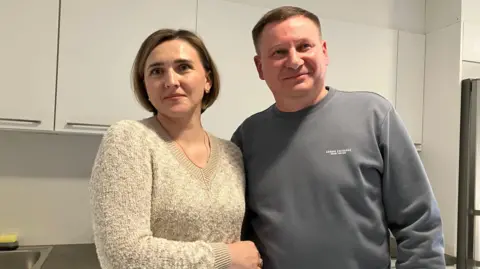
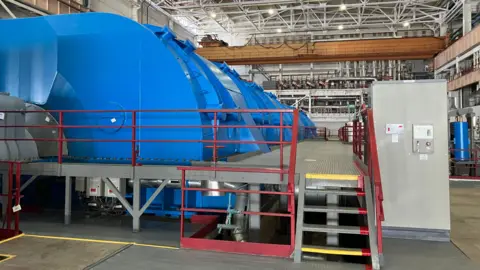
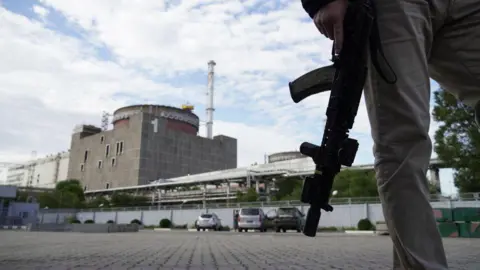
are facing threats from Russian attacks. Ukraine is accusing Russia of exploiting winter conditions to disrupt power, risking a crisis similar to Chernobyl. BBC
Kairos Power finalizes contract on HALEU for Hermes
Kairos Power has finalized a contract with the Department of Energy to receive high-assay low-enriched uranium (HALEU) from the agency for the company’s Hermes low-power demonstration reactor, currently under construction in Oak Ridge, Tenn. Go deeper on Nuclear NewsWire.
DOE looks to streamline worker safety and health regs
The Department of Energy is considering revisions to its regulations covering worker safety and health to help expedite the development of new nuclear reactors under its Reactor Pilot Program. According to the DOE, the proposed changes to 10 CFR Part 851, “Worker Safety and Health Program,” have the benefit of “increased flexibility, streamlined processes, cost savings, enhanced agility, and improved worker engagement.” Go deeper on Nuclear NewsWire.
ORNL to partner with Type One, UTK on fusion facility
Oak Ridge National Laboratory announced earlier this week that it is in the process of partnering with Type One Energy and the University of Tennessee–Knoxville. That partnership will have one primary goal: to establish a high-heat flux facility (HHF) at the Tennessee Valley Authority’s Bull Run Energy Complex in Clinton, Tenn. Go deeper on Nuclear NewsWire.
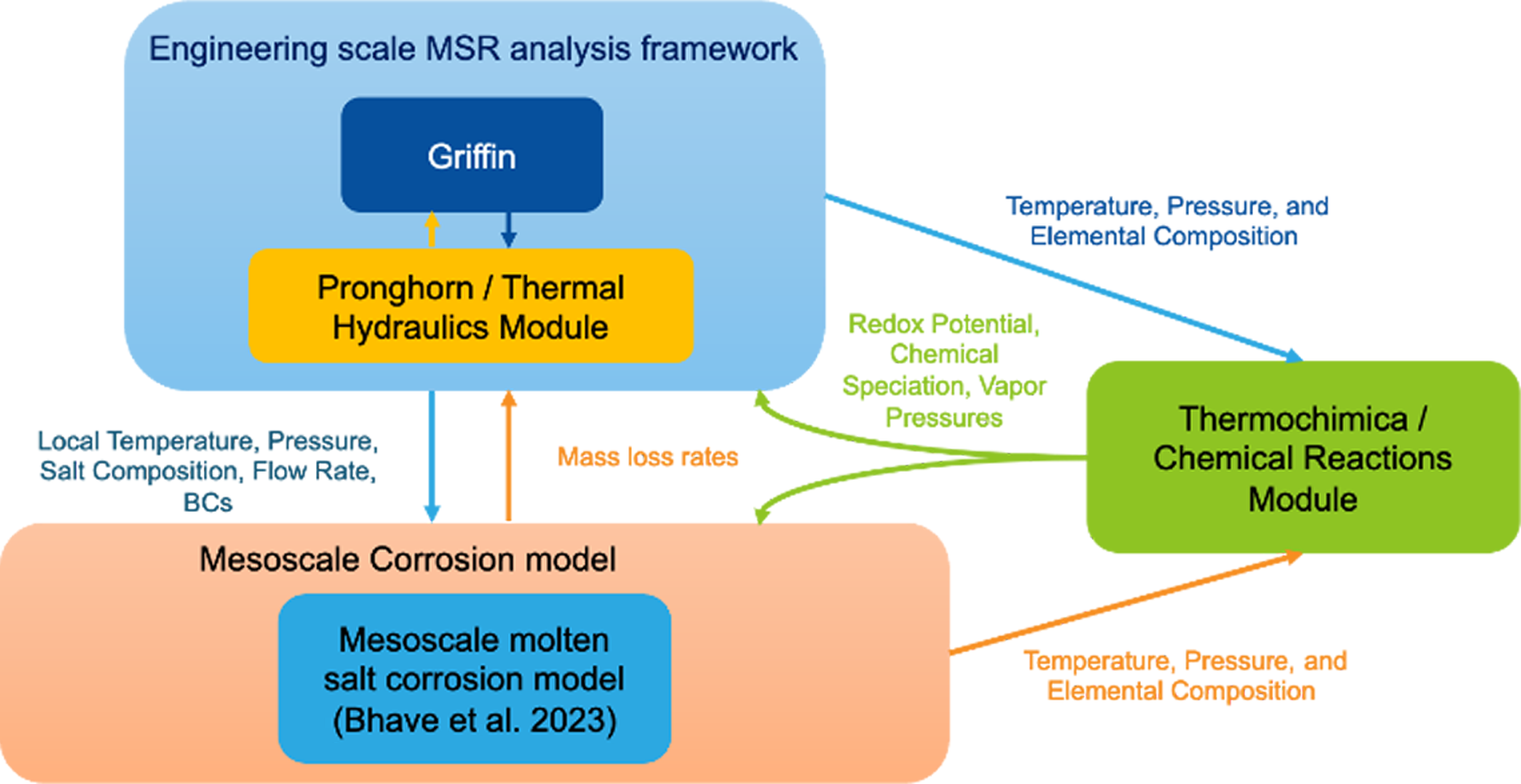
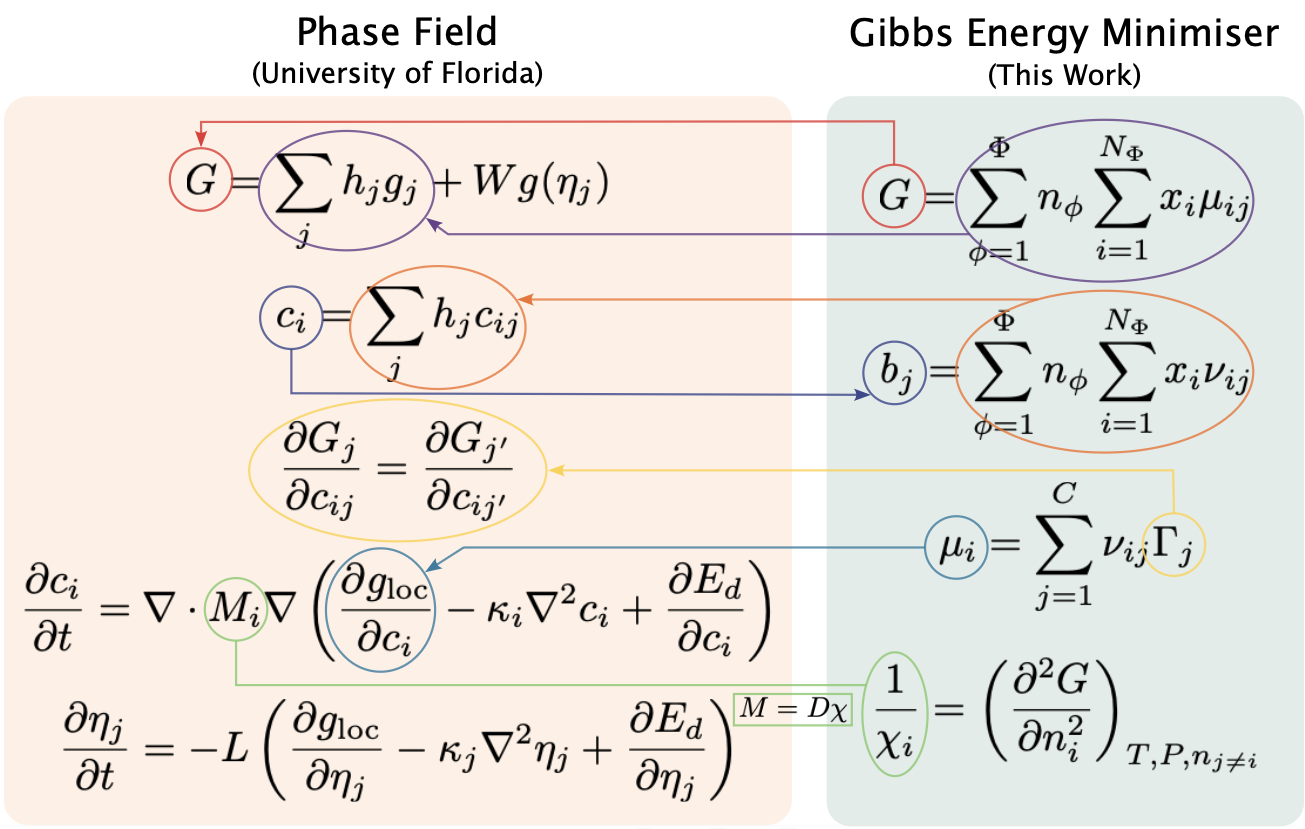
Thompson Igunma’s UF-INL research is creating unique models for molten salt reactors
American Nuclear Society member Thompson Odion Igunma is a doctoral candidate in materials science and engineering at the University of Florida conducting research in collaboration with the Computational Mechanics and Materials Group at Idaho National Laboratory. His work focuses on advanced modeling of the complex interplay between molten salt corrosion, irradiation, and changes in alloy microstructure. Go deeper on Nuclear NewsWire.
Congress passes new nuclear funding—Nuclear NewsWire Radiation safety on Congress’s mind—E&E News Argonne model improves nuclear plant maintenance planning—Nuclear NewsWire Former LPO head discusses Meta’s nuclear deals—Latitude Media Duke Energy considers Piedmont Triad for nuclear development—Fox 8
2025년 5월에 발령된 이 명령은 또한 국립연구소 외부에서 원자로를 건설·운영하는 파일럿 프로그램 수립을 위해 DOE가 취해야 할 조치를 명시하고 있으며, 2026년 7월 4일까지 임계(criticality) 달성을 목표로 하고 있다.
변경 내용: DOE는 원자력 에너지 사무국(Office of Nuclear Energy, DOE-NE) 소관 시설 및 활동에 대한 근로자 안전·보건 프로그램을 최신화하는 몇 가지 변경 사항을 확인했다고 밝혔다. 부처에 따르면, 이번 변경은 "DOE 원자력 시설에서의 수십 년에 걸친 운영 경험을 반영하고, DOE 계약업체가 널리 인정된 산업 또는 정부 기준을 활용할 수 있는 유연성을 부여"하게 된다.
주요 변경 사항은 다음과 같다:
"DOE 부지(DOE site)"의 정의를 개정하여, Part 851 근로자 안전·보건 요건이 DOE가 소유하거나 임차하지 않은 부지에 위치한 경우에도 DOE가 승인한 모든 운영에 적용됨을 명확히 한다.
"근로자(worker)"의 현행 정의를 명확히 하여, 적용 대상 사업장에서 DOE 임무 수행을 위해 근무하는 DOE 계약업체 직원을 지칭하도록 한다.
DOE-NE 산하 계약업체에 대한 구체적인 지침을 제공하고, 근로자 안전·보건 프로그램과 관련한 "지나치게 규범적이고 개별적인 승인 요건"을 제거하며, 지나치게 보수적으로 간주되는 특정 산업 기준을 삭제하는 새로운 조항(Part 851.46)을 추가한다.
행정적 부담을 줄이고 효율성을 개선하기 위해 승인 및 집행 절차를 수정한다.
의견 제출: DOE는 2월 20일까지 10 CFR Part 851 제안된 변경 사항에 관한 의견, 자료 및 정보를 수렴하고 있다.
이번 DOE의 규정 개정 추진은 트럼프 행정부의 원자력 산업 규제 완화 기조를 반영하는 것으로, 첨단 원자로의 신속한 상용화를 위한 제도적 기반 마련에 초점이 맞춰져 있다. 특히 2026년 7월 4일이라는 임계 달성 목표 시한은 단순한 행정 절차 간소화를 넘어, 원자력 분야에서의 구체적인 성과 도출에 대한 강한 정치적 의지를 보여준다. 근로자 안전 규정 완화가 실질적인 안전 수준 저하로 이어지지 않도록 업계와 규제 당국 간의 균형 있는 협의가 필요하다는 지적도 있을 수 있다. 이번 조치는 미국 내 원자력 르네상스를 가속화하려는 폭넓은 정책 패키지의 일환으로, 관련 기업 및 국립연구소에 실질적인 운영 유연성을 제공할 것으로 기대된다. 향후 의견 수렴 결과 및 최종 규칙 확정 여부가 원자력 산업계의 주요 관심사로 남을 것이다.
제너럴 퓨전(General Fusion)이 스프링 밸리 애퀴지션 코프 III(Spring Valley Acquisition Corp. III)(나스닥: SVAC)와 SPAC 합병에 합의하며, 약 10억 달러의 사전 형성 지분 가치(pro-forma equity value)로 공개 시장 진입을 추진
합병 자금은 자기 표적 핵융합 시스템 개발에 활용될 예정이며, 2030년대 중반 상용 발전소 건설을 장기 목표로 설정
엔비디아(Nvidia), 알파벳(Alphabet) 등 대형 기술 기업들의 핵융합 에너지 투자 관심이 고조되는 가운데 상장이 추진되나, 상업적으로 실용 가능한 핵융합 시스템은 아직 구현된 바 없음
제너럴 퓨전 인크.(General Fusion Inc.)는 스프링 밸리 애퀴지션 코프 III(Spring Valley Acquisition Corp. III)(나스닥: SVAC)와의 합병에 합의했으며, 이를 통해 원자력 핵융합 기술 개발사 중 최초로 공개 시장에 진입하는 기업 중 하나가 될 수 있는 위치를 확보할 것으로 기대된다. 블룸버그(Bloomberg) 뉴스가 검토한 발표문에 따르면, 이번 거래는 약 10억 달러의 사전 형성 지분 가치(pro-forma equity value, 합병 완료 시 예상 주식 총가치)를 전제로 하며, 올해 중반쯤 거래가 완료될 것으로 예상된다. 경영진은 이번 거래에서 확보한 수익금이 회사의 자기 표적 핵융합 시스템 개발을 지원하는 데 사용될 것이라고 밝혔으며, 2030년대 중반 상용 발전소 건설을 장기 목표로 설정해 실험적 성과를 실질적인 에너지 생산으로 전환하려는 회사의 의지를 강조했다.
합병 구조에는 상환이 없다는 가정하에 SPAC 신탁에 보유된 약 2억 3천만 달러와 함께 1억 달러 규모의 상장 전 사모투자(PIPE, Private Investment in Public Equity)가 포함된다. 스프링 밸리(Spring Valley)의 스폰서들은 2021년 뉴스케일 파워(NuScale Power)를 공개 시장에 상장시킨 거래를 이전에 지원한 바 있으며, 뉴스케일은 이후 투자자들의 열의와 증가하는 전력 수요에 힘입어 지난 1년간 강한 가치 상승을 보인 소수의 상장 원자력 에너지 기업 중 하나로 부상했다. 이러한 배경에서 제너럴 퓨전의 최고경영자(CEO) 그렉 트위니(Greg Twinney)는 거래 완료 후 GFUZ 티커로 거래가 시작되면 유사한 역학 관계가 회사 주식에 대한 관심을 이끌 수도 있다고 시사했다.
데이터 센터의 미래 전력 수요를 내다보는 대형 기술 기업들의 핵융합 에너지에 대한 투자자 관심이 고조되고 있다. 엔비디아(Nvidia)(나스닥: NVDA)와 알파벳(Alphabet)(나스닥: GOOG)은 지난해 코먼웰스 퓨전 시스템즈(Commonwealth Fusion Systems)에 대한 투자를 각각 공개했으며, 마이크로소프트(Microsoft)는 2023년 헬리온 에너지(Helion Energy)와 전력구매계약(PPA)을 체결했다. 헬리온은 2028년까지 첫 핵융합 발전소를 가동할 계획이었다. 트럼프(Trump) 행정부의 지지 신호와 트럼프 미디어 & 테크놀로지 그룹(Trump Media & Technology Group)(나스닥: DJT)이 TAE 테크놀로지스(TAE Technologies)와의 합병에 합의하는 등 최근의 고-프로파일(high-profile, 사회적 주목도가 높은) 거래에도 불구하고, 핵융합은 상업적 배치까지 아직 수년이 남아 있으며, 2022년 연구자들이 핵융합 반응을 일으키는 데 투입된 에너지보다 더 많은 에너지를 순간적으로 생성하는 핵심 과학적 이정표를 달성했음에도 불구하고, 상업적으로 실용 가능한 시스템은 아직 구현된 바 없다.
AI 분석
제너럴 퓨전(General Fusion)의 SPAC 합병 추진은 원자력 핵융합 에너지 분야에서 민간 자본을 유치하려는 중요한 시도로, 핵융합 기술 기업이 공개 주식 시장에 진입하는 선례를 만들 수 있는 사건이다. 약 10억 달러의 기업가치 평가와 3억 3천만 달러에 달하는 자금 조달 계획은 야심찬 행보를 보여주지만, 실제 상용 발전소 건설 목표 시점이 2030년대 중반이라는 점에서 투자자들에게 장기적 관점이 요구된다. 엔비디아(Nvidia), 알파벳(Alphabet), 마이크로소프트(Microsoft) 등 빅테크 기업들의 핵융합 분야 참여는 데이터 센터 전력 수요 급증을 배경으로 이 기술에 대한 산업계의 기대감이 실질적으로 높아지고 있음을 보여준다. 뉴스케일 파워(NuScale Power)의 상장 성공 사례는 원자력 에너지 관련 기업들이 현재 우호적인 시장 환경에 있음을 시사하며, 제너럴 퓨전이 이러한 흐름을 활용하려는 전략적 타이밍을 잘 포착한 것으로 평가할 수 있다. 그러나 상업적으로 실증된 핵융합 시스템이 아직 존재하지 않는다는 근본적인 기술적 불확실성은 투자자들이 반드시 고려해야 할 핵심 리스크로 남아 있다.
하와이 퍼블릭 라디오(Hawaiʻi Public Radio) | 사바나 해리먼-포테(Savannah Harriman-Pote) 기자
요약
카테고리: 원자력 정책
하와이 주 에너지청이 소형 모듈 원자로 및 마이크로 원자로 등 첨단 원자력 기술이 현시점에서 하와이에 적합하지 않다고 결론 내렸다.
비용 경쟁력 부족과 기술 성숙도 미달이 주요 이유로 제시되었으며, 태평양 지역의 방사능 오염 역사가 공공 인식에도 영향을 미치고 있다.
하와이 의원들은 국가적 원자력 논의의 변화에 주목하면서도, 비용 절감이 현실화될 때까지 원자력 논의를 보류하기로 했다.
---
수십 년간 하와이는 원자력 발전에 반대 입장을 취해왔다. 그러나 원자력 기술의 발전과 비용이 많이 드는 석유에서 탈피해야 한다는 압박이 커지면서, 일부 의원들이 원자력 문제를 재검토하게 되었다.
지난 입법 회기에서 하와이 주 의회는 하와이 주 에너지청에 소형 모듈 원자로와 마이크로 원자로 같은 새로운 형태의 원자력 에너지 생산이 하와이에 적합한지 검토하는 워킹그룹을 소집하도록 지시했다.
이러한 새로운 기술들은 펜실베이니아 주의 스리마일 섬(Three Mile Island)과 같은 기존 원자력 시설에 비해 훨씬 작은 공간을 차지한다. 소형 모듈 원자로는 기존 원자로의 3분의 1 미만 크기일 수 있으며, 새로운 마이크로 원자로는 컨테이너 안에 들어갈 수 있도록 개발되고 있다.
원자력 발전소는 또한 풍력이나 태양광 발전소와 달리 날씨에 관계없이 하루 24시간 전력을 생산할 수 있으며, 운영 중 탄소 배출이 전혀 없다.
FILE — Last Energy's demonstration unit, a "nuclear island" that contains a prototype reactor, is shown Jan. 17, 2023, in Brookshire, Texas.
이러한 장점에도 불구하고, 하와이 주 에너지청은 현시점에서 첨단 원자력 기술이 하와이에 적합하지 않다고 판단했다.
에너지청의 모니크 잔페스(Monique Zanfes)가 워킹그룹을 이끌며 최종 보고서를 작성했다. 잔페스는 HPR에 이러한 신기술들이 기존 원자력보다 더 많은 가능성을 보여주지만, 가치 있는 투자로 보기에는 아직 너무 초기 단계라고 밝혔다.
전 세계적으로 가동 중인 소형 모듈 원자로는 소수에 불과하며, 미국에는 단 하나도 없다. 잔페스는 워킹그룹 내에서 하와이의 미래에 원자력이 역할을 할 수 있다고 보는 구성원들조차도 하와이가 새로운 원자력 기술의 "실험 대상(guinea pig)"이 되는 것을 원하지 않는다고 말했다.
그리고 현재 첨단 원자력 기술로 생산되는 전력 비용은 석유 발전보다 결코 저렴하지 않다.
"우리는 분명히 전력 소비자들에게 더 많은 비용을 부담시킬 새로운 기술을 도입하고 싶지 않습니다," 잔페스가 말했다.
워킹그룹의 우려 사항 검토
워킹그룹에는 주 기관 대표, 업계 전문가, 환경 옹호자들이 포함되었다.
잔페스는 첨단 원자력 기술이 하와이의 비용 효율적인 에너지 솔루션이 되기 위해서는 더 발전이 필요하다는 데 그룹 내 공감대가 형성되어 있다고 말했다.
그러나 일부 구성원들은 원자력 폐기물이 가져오는 위협과 같은 세부 사항에 대해 의견이 엇갈렸다.
미국에는 사용 후 핵연료를 영구적으로 장기 보관할 장소가 없으며, 사용 후 핵연료는 사용 후에도 극도로 높은 방사능을 유지한다.
현지 원자력 시설에서 발생하는 원자력 폐기물은 냉각 후 현장 또는 주 내 어딘가에 보관해야 할 수도 있다.
FILE - California's last operating nuclear power plant, the Diablo Canyon Nuclear Power Plant, south of Los Osos, Calif., is viewed Sept. 20, 2005.
잔페스는 그룹의 일부 구성원들이 섬 내 원자력 폐기물의 장기 보관이 환경에 심각한 오염 위험을 초래할 수 있다는 우려를 표명했다고 말했다.
"방사선이 토양이나 대기로 유입될 경우, 식물이 이를 흡수하고 먹이사슬을 통해 전달될 가능성이 있습니다. 대수층으로 유입되면 지하 지질을 통해 퍼져나갈 수 있습니다," 그녀가 말했다.
다른 구성원들은 원자력 폐기물이 미국 내 여러 곳에서 안전하게 보관되고 있다고 반박했다.
워킹그룹 구성원 잭 슈라이버(Jack Shriver)는 미 해군에서 20년 이상 원자력 잠수함 장교로 복무하며 그 기간 동안 해군 원자력 시설을 운영했다. 그는 원자력 폐기물의 저장 및 운반을 둘러싼 장애물들이 "충분히 관리 가능하다(very manageable)"고 생각한다.
"모든 원자력 폐기물은 봉인되어 있으며, 저 컨테이너 안에 폐기물이 있다고 손가락으로 가리켜 말할 수 있습니다," 그가 말했다. "다른 어떤 에너지원, 특히 화석 연료와 비교해보면 그렇게 할 수 없습니다. 화석 연료의 폐기물은 이미 환경 속에 있으니까요, 그렇지 않습니까?"
하지만 태평양에는 원자력 오염의 사례가 한 가지 이상 있다.
미국은 1946년부터 1958년까지 마샬 군도 공화국에서 67차례의 핵무기 실험을 실시했다. 에너지청 보고서는 마샬 군도가 오늘날까지도 방사선 피해를 겪고 있음을 언급하고 있다. 타히티(Tahiti), 괌(Guam), 그리고 다른 태평양 국가들에서도 유사한 피해가 나타났다.
"태평양 지역에서는 특히, 방사성 폐기물을 직접 경험한 사람들이 있습니다," 잔페스가 말했다.
잔페스는 "에너지의 평화적 생산은 국방 관련 실험과는 매우 다르다"고 언급하면서도, 그러한 경험들이 원자력에 대한 대중 인식에 영향을 미친 것은 당연한 일이며 무시해서는 안 된다고 말했다.
의원들의 다음 행보
지난 15년간 의원들은 원자력 위원회 설립이나 원자력 발전 타당성 조사를 위한 법안을 반복적으로 발의해왔으나, 그러한 법안들은 좀처럼 탄력을 받지 못했다.
그러한 법안들 중 많은 것이 하원 에너지·환경보호 위원회 의장 니콜 로웬(Nicole Lowen) 하원의원의 책상을 거쳤다.
로웬은 현시점에서 원자력 에너지가 하와이에 적합하지 않다는 에너지청의 결론에 동의한다고 말했다. 그러나 그녀는 원자력 에너지를 둘러싼 국가적 논의가 변화하고 있다고 생각한다고 덧붙였다.
"화석 연료에서 벗어나는 것에 전국적으로 훨씬 더 많은 관심이 집중되고 있습니다. 원자력이 그 과정에서 역할을 할 수 있다고 생각합니다," 그녀가 말했다.
트럼프(Trump) 행정부는 화석 연료 사용 제한에 관심을 보이지 않고 있지만, 백악관은 원자력 에너지 생산 확대를 지지하고 있다.
미국 에너지부는 화요일에 "미국의 차세대 원자력 르네상스"를 위한 계획을 담은 메모를 발표했다.
그러나 로웬은 원자력 에너지가 비용 면에서 효율적이라는 증거를 확인하기 전까지는 이 논의에 동참하기 어렵다고 말했다.
"이에 대한 실질적인 논의는 비용이 낮아지는 것이 전제되어야 합니다. 그 전까지는 굳이 판도라의 상자를 열 이유가 없지요(why open the can of worms — 불필요한 문제를 야기할 필요가 없다는 관용구)," 그녀가 말했다.
현재 하와이 주법은 원자력 발전소 건설과 하와이 내 원자력 폐기물 처분을 제한하고 있다. 에너지청은 현시점에서 이러한 법률에 대한 개정을 권고하지 않고 있다.
하와이 주 상원의원 글렌 와카이(Glenn Wakai)는 지난 회기에서 에너지청이 워킹그룹을 소집하도록 촉구하는 데 앞장섰다. 그는 여전히 원자력이 하와이 전력망의 일부가 될 가능성이 있다고 생각하며, 소형 모듈 원자로가 가까운 미래에 상업적으로 실용화되기를 기대한다고 말했다.
"앞으로 3~5년 내에 발전이 이루어지길 바라며, 그때 이 문제를 재검토할 수 있을 것입니다," 그가 말했다.
그때까지 와카이는 이 문제를 당분간 보류(put the issue on the back burner — 우선순위에서 뒤로 미루다)할 계획이다. 그는 HPR에 이번 입법 회기에는 전력망 안정성, 에너지 비용 절감, 지열 탐사에 집중할 것이라고 밝혔다.
---
하와이 퍼블릭 라디오는 하와이 전체를 위해 존재하며, 하와이 사람들이 우리를 독립적이고 강하게 유지시켜 줍니다. 미래에도 여러분을 위한 서비스를 유지할 수 있도록 오늘 후원해 주세요.
---
AI 분석
이 보고서는 하와이가 수십 년간 유지해온 원자력 반대 입장을 재검토하는 과정에서 기술적·경제적·사회적 복잡성이 얼마나 긴밀하게 얽혀 있는지를 잘 보여준다. 소형 모듈 원자로와 마이크로 원자로는 기술적으로 흥미롭지만, 현재 상용화 수준은 하와이가 선도적 투자를 결정하기엔 아직 이른 단계임이 분명하다. 특히 태평양 지역은 미국 핵무기 실험의 직접적 피해를 입은 역사적 경험이 있어, 원자력에 대한 공공 인식이 본토와는 다를 수밖에 없다는 점이 정책 결정에 중요한 변수로 작용한다. 트럼프 행정부의 원자력 확대 지지라는 연방 차원의 기조 변화가 하와이 주 정책에 장기적으로 어떤 영향을 미칠지도 주목할 필요가 있다. 결국 하와이의 원자력 도입 여부는 비용 경쟁력 확보와 함께 지역 사회의 신뢰 구축이 동시에 이루어져야 가능할 것으로 보인다.
2026년 1월 23일, 오후 3시 28분 | 원자력 뉴스 | 수전 갈리어(Susan Gallier)
원자력발전운전협회(Institute of Nuclear Power Operations, INPO)의 산업 전략 담당 부사장으로서, 제프 플레이스(Jeff Place)는 INPO의 대외 업무를 이끌며 최고 원자력 책임자들과 직접 소통하고 있다.
조지아주 애틀랜타에 위치한 INPO 본부에서 INPO와 세계원자력발전사업자협회(World Association of Nuclear Operators, WANO) 애틀랜타 센터는 미국, 캐나다, 멕시코, 루마니아, 남아프리카공화국, 아랍에미리트의 원자력 발전소들과 협력하고 있으며, 중국의 일부 발전소들도 포함되어 있다. 이 모든 것이 플레이스의 업무 범위에 해당한다. 업무 수행을 위해 INPO는 300명의 직원과 업계에서 파견된 약 60명의 추가 인력을 보유하고 있다.
플레이스는 INPO에서 26년을 근무하는 동안 거의 8년간 이 역할을 맡아왔으며, 이전에는 운영 및 기술 지원 담당 부사장을 역임했다. (또한 파견 근무 기간 동안 엑셀 에너지(Xcel Energy)의 원자력 함대 운영 담당 부사장을 맡기도 했다.) 수석 평가자로 INPO에 합류하기 전, 플레이스는 세 개의 유틸리티 기업에서 네 개의 원자력 발전소에 걸쳐 리더십 역할을 수행했으며, 그는 41년 전 미국 해군 원자력 잠수함 부대(U.S. Navy's Nuclear Submarine Force)에 사병 기계사로 복무하면서 원자력 산업과의 인연이 시작되었다고 말한다.
INPO가 산업 성공에 기여하는 바는 때때로 INPO가 서비스를 제공하는 원자력 유틸리티 기업들 외부에서는 잘 알려지지 않는 경우가 있다. 그러나 플레이스가 _원자력 뉴스_ 편집장 수전 갈리어(Susan Gallier)에게 설명했듯이, 이 조직은 이제 수십 년간의 안전과 신뢰성에 대한 집중이 어떻게 회원 유틸리티 기업들과 원자력 산업의 신규 진입자들이 오늘날의 성장 기회를 활용할 수 있도록 했는지를 보여주고자 한다.
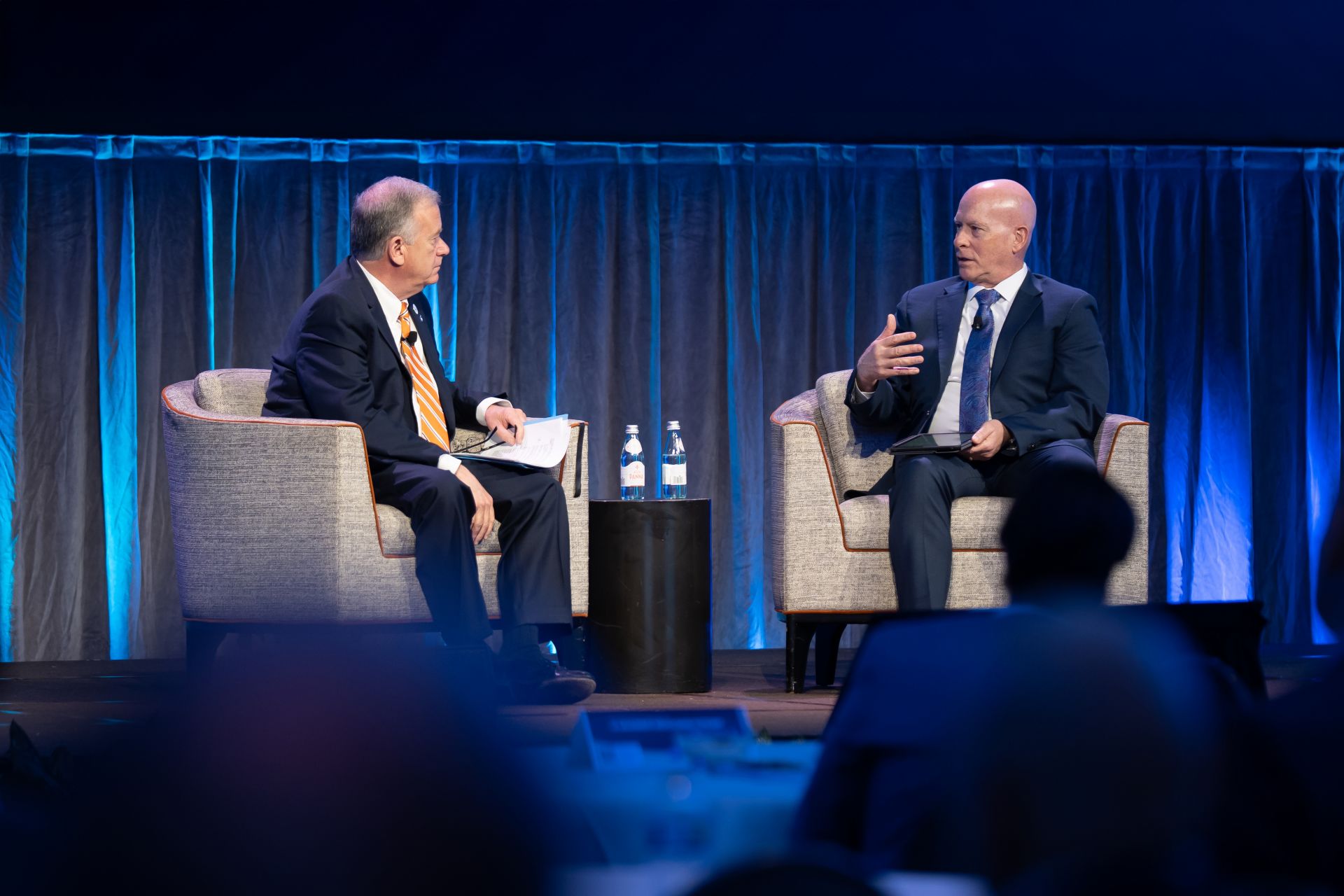
원자력규제위원회(Nuclear Regulatory Commission) 위원장 데이비드 라이트(David Wright)(왼쪽)가 2025년 11월 INPO CEO 컨퍼런스에서 플레이스와 함께 대담을 가졌다. (사진: INPO)
INPO가 원자력 발전 산업에 제공하는 가치는 무엇입니까?
INPO는 안전과 신뢰성에서의 탁월성을 증진하는 사명을 가지고 있으며, 우리는 이를 매우 진지하게 받아들입니다. INPO는 스리마일섬(Three Mile Island) 사고 이후 설립되었고, WANO는 체르노빌(Chernobyl) 사고 이후 산업계가 지속적인 개선을 도모하기 위해 모범 사례와 교훈을 공유하는 방식으로 설립되었습니다.
지난 40년간 우리 산업에서의 성과 향상은 정말 놀라운 수준입니다. 산업으로서 우리는 신뢰할 수 있고 회복 탄력성이 있습니다. 개선의 공은 대부분 유틸리티 팀들에게 돌려야 하지만, INPO는 전력연구소(Electric Power Research Institute), 원자력에너지협회(Nuclear Energy Institute), 원자력전기보험유한회사(Nuclear Electric Insurance Limited) 등과 함께 산업이 운영되는 방식의 중요한 구성 요소입니다.
INPO의 산업 전략은 무엇이며, 그 성공을 어떻게 측정합니까?
우리가 하는 모든 일, 즉 감독이든 지원이든 간에, 산업을 지속적으로 개선하는 데 초점을 맞추고 있습니다. 우리의 산업 전략은 완전히 통합되어 있어, 남아프리카공화국의 코에베르그(Koeberg)에서 하는 일이 일리노이주의 바이런(Byron)에서 하는 일과 정확히 같습니다.
우리가 추진하고 있는 네 가지 과제 영역이 있습니다: 산업 성과, 산업 지속 가능성, 교육과 학습, 그리고 데이터 과학과 분석입니다. 우리는 지속적 모니터링 프로그램, 인증 활동, 다양한 과정과 세미나를 포함하는 운영 모델을 통해 이 업무를 수행합니다.
우리는 회원사로부터 방대한 양의 데이터를 수집합니다. 약 3년 전부터 WANO-애틀랜타 센터에서 담당하는 해외 발전소를 포함한 모든 발전소들이 동일한 데이터를 보고하기 시작했습니다. 이 사과 대 사과 비교는 우리가 발전 상황을 입증하고 아직 개선이 필요한 부분을 파악하는 데 매우 중요한 역할을 해왔습니다.
지속적 모니터링에는 네 가지 별도의 범주가 있습니다. 우리는 2030년까지 발전소의 90퍼센트를 가장 낮은 수준의 관여에 해당하는 "모니터링" 범주에 포함시키고자 노력하고 있습니다. 현재 발전소의 약 70퍼센트에 약간 못 미치는 수준이 해당 범주에 속해 있습니다.
2020년에 시작된 10개년 전략에서, 우리는 발전소의 중대한 사건—더 심각한 사건의 전조로 여기는—을 절반으로 줄이려 하고 있으며, 매우 좋은 진전을 이루고 있습니다. 실제로, 산업계는 이 분야에서 매년 우리의 연간 목표를 초과 달성해왔습니다.
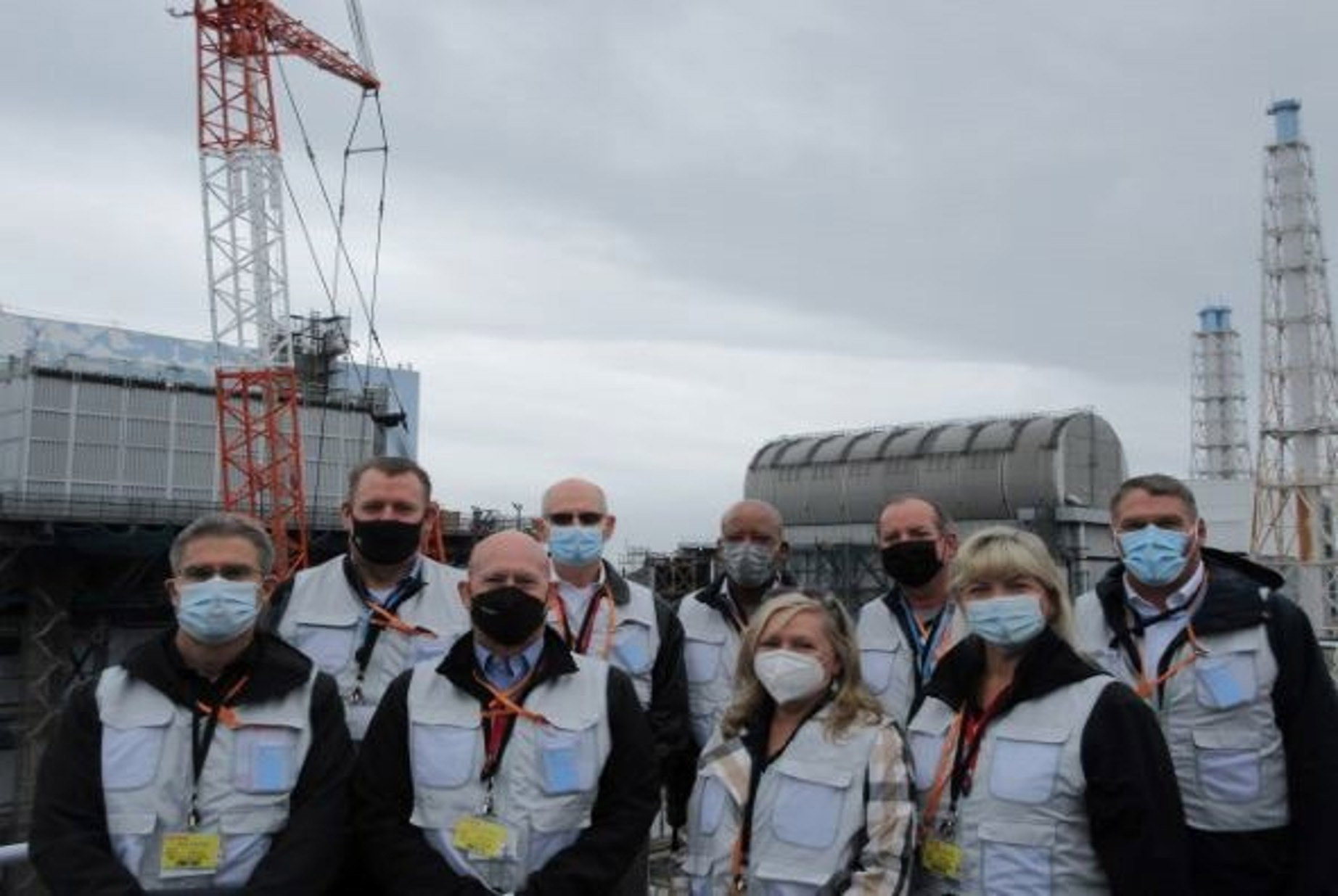
미국과 캐나다의 최고 원자력 책임자들이 INPO-일본 원자력 안전 연구소(Japan Nuclear Safety Institute, JANSI) 최고 원자력 책임자(CNO) 포럼의 일환으로 2022년 후쿠시마 다이이치(Fukushima Daiichi)를 방문했다. (사진: 도쿄전력홀딩스(Tokyo Electric Power Company Holdings, Inc.))
INPO는 기존 유틸리티 기업들 외부에서는 상대적으로 알려져 있지 않습니다. INPO의 역할을 이해하지 못할 수 있는 원자력 신규 진입자들과는 어떻게 소통하고 있습니까?
상당수의 신규 진입자들이 실제로 우리의 공급업체 프로그램에 참여하고 있습니다. 그렇지 않은 업체들도 여럿 있지만, 우리는 여전히 그들과 소통하고 있습니다. 우리의 신규 발전소 자문위원회(New Plant Advisory Committee)는 원자력 신규 진입자들의 우려와 필요를 경청하고, 과거에 해왔던 일들을 어떻게 수정하여 그들을 지원할 수 있을지를 논의하기 위해 존재합니다. 우리가 많은 소통을 나누지 못한 신규 원자로 업체들의 하위 그룹이 있으며, 그 중 많은 업체들이 마이크로원자로 분야에 속해 있습니다.
우리는 신규 원자력 진입자들이 각 유틸리티 기업이 이러한 발전소를 운영하는 데 필요한 사회적 허가를 이해하는 것이 중요하다고 생각합니다. 또한 신규 진입자를 포함한 어떤 원자력 발전소에서든 중대한 사건이 발생한다면 전체 산업에 도전이 된다는 점도 중요합니다. 다른 산업과 비교했을 때 원자력 발전소에 대한 대중의 인식을 고려해야 합니다.
비영리 단체로서, 우리는 회원사를 섬기고 업계 전체가 높은 수준의 안전성과 신뢰성을 유지할 수 있도록 지원하는 방법을 모색합니다. 신규 진입자들이 설계 승인과 건설을 추진하는 과정에 있다면, 우리는 그 발전소가 성공적으로, 그리고 안전하게 건설되고 운영될 수 있도록 최대한 지원하고자 합니다.
INPO는 회원 유틸리티 기업들로부터 어떤 종류의 데이터를 수집합니까?
우리는 업계와 협력하여 수집할 가장 관련성 높은 데이터를 파악합니다. 개별 부품과 시스템의 성능부터 한 달 동안의 발전소 전력 이력, 발생한 사건의 수에 이르기까지 다양한 데이터가 포함됩니다. 우리는 운영 및 유지보수와 같은 특정 영역에 초점을 맞춘 다양한 지표, 인덱스, 모델을 개발합니다.
세 개의 호기를 보유한 오코니(Oconee)와 같은 발전소는 우리의 디지털 플랫폼인 INPOrtal을 통해 발전소 수준의 데이터를 확인할 수 있을 뿐만 아니라, 1호기, 2호기, 3호기가 어떻게 비교되는지도 볼 수 있습니다. 본사의 직원들은 같은 지표를 통해 자신들의 함대를 파악할 수 있으며, 발전소 정보 센터(Plant Information Center)를 통해 산업 전체의 성과와 비교할 수도 있습니다.
발전소에서 문제가 발견되었을 때, INPO는 무엇을 합니까?
동료 검토나 지속적 모니터링 프로세스를 수행할 때 충분한 격차가 발견되면, 우리는 "개선 영역"이라고 부르는 것을 작성합니다. 이는 격차와 그 원인에 대한 공식 문서화입니다. 우리는 발전소와 협력하여 그 격차를 해소하기 위해 적절한 조치가 취해지도록 합니다.
또한 사건에 관한 보고서도 작성합니다. 하나의 발전소에서 발생한 단일 사건이든 업계 전반에 걸쳐 발생한 사건이든, 추세를 공유하거나 공통된 운영 요인에 대해 발전소에 경보를 보내기 위해서입니다. 또한 발전소가 실행할 수 있는 권고사항도 포함합니다. 이 목적은 업계 전반 또는 특정 유틸리티 기업에서 향후 사건을 예방하는 것입니다.
원자력규제위원회도 원자로 성과를 추적합니다. INPO의 역할을 NRC의 역할과 어떻게 구별하시겠습니까?
자율 규제 기관으로서, 우리는 NRC와 독립적이지만 다소 협력적인 관계를 유지하고 있습니다. 또한 우리는 NRC가 일반적으로 관여하지 않는 기업 성과와 같은 영역에서도 활동할 수 있습니다.
INPO의 역할은 업계가 스스로 설정한 성과 우수성 기준을 충족할 수 있도록 지원하는 것이며, 법률이나 규정이 요구하는 것 이상으로 성과를 개선하는 것을 목표로 합니다. 우리는 비영리 회원제 회사로서 이러한 노력을 지원합니다. 전력 회사들이 우리의 서비스 비용을 지불하며, 이사회는 자신들의 성과에 대해 우리가 엄격한 기준을 적용하기를 기대하는 전력 회사 CEO들로 구성되어 있습니다.
INPO와 WANO 간의 협력은 미국과 전 세계 원자력 산업에 어떤 영향을 미칩니까?
스티브 멍(Steve Meng)이 관리하는 INPO의 국제 부서는 우리가 WANO와 글로벌 산업의 성과 향상을 지원하기 위해 무엇을 하고 있는지에 초점을 맞추고 있습니다. 우리는 이를 통해 전 세계의 어떤 부실한 성과가 다른 발전소에 미칠 수 있는 영향—특히 WANO-애틀랜타 센터에서 우리가 책임지는 발전소들에 미치는 영향—을 최소화합니다.
INPO는 WANO에서 수행되는 많은 활동의 선두에 있습니다. 우리는 WANO보다 10년 앞서 설립되었기 때문에 우리의 운영 모델과 역량은 다른 속도로 성숙해 왔습니다. 또한 인력과 자원 배치 방식이 달라 추가적인 역량을 제공합니다. 예를 들어, 앞서 언급했듯이 애틀랜타 센터 내 각 발전소의 지속적인 모니터링을 통해 객관적인 지표로 성과가 향상되었음을 발전소들이 확인할 수 있습니다. 지난 몇 년간 우리는 WANO가 "향상된 성과 모니터링"이라고 부르는 유사한 방식을 도입할 수 있도록 지원해 왔습니다.
우리는 전 세계 발전소들을 지원하는 인력을 배치하고 있습니다. 예를 들어, 현재 WANO-런던 사무소에 여러 명이 배치되어 WANO의 특정 프로그램을 운영하고 있으며, WANO-파리 센터를 지원하는 인력도 있습니다. 파리 센터는 러시아-우크라이나 전쟁으로 인해 WANO-모스크바 센터에 소속되어 있던 여러 전력 회사들이 파리 센터로 재편되면서 많은 새로운 발전소를 맡게 되었습니다. 상하이에는 현재 새로운 WANO 지역 센터가 개발 중이며, 그곳에도 담당자를 배치했습니다.
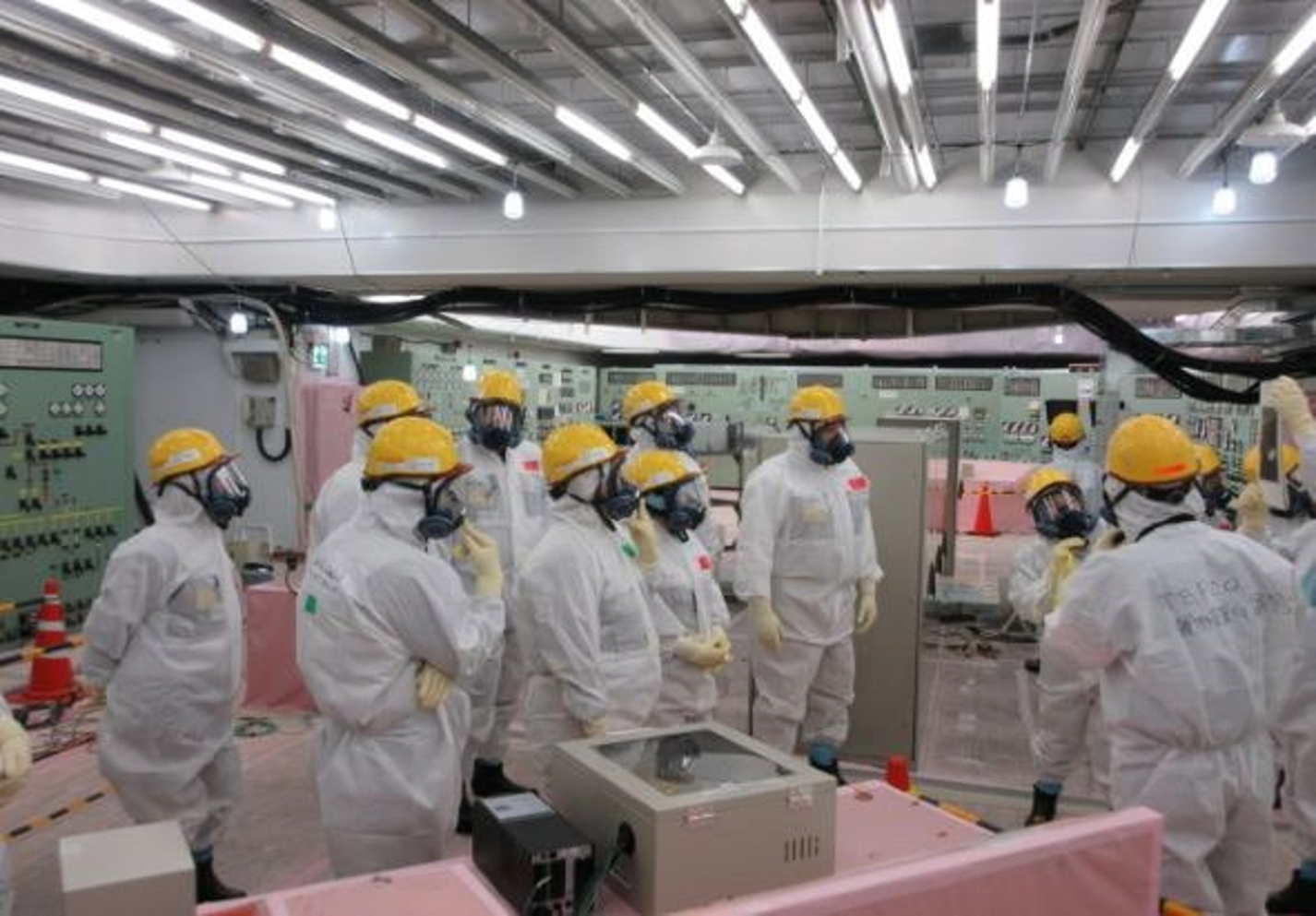
2022년 INPO-JANSI 최고원자력책임자(CNO) 포럼의 일환으로 후쿠시마 다이이치 발전소 1호기 제어실을 방문한 모습. (사진: 도쿄전력 홀딩스 주식회사)
오늘날 원자력 발전 단지가 직면한 가장 큰 과제는 무엇이라고 생각하십니까?
먼저, 발전 단지에는 많은 기회가 있다고 말하고 싶습니다. 그 기회들 중 일부는 동시에 도전 과제이기도 합니다. 성장은 기회이지만, 기존 발전소와 신규 원자로 공급업체 모두에서 더 많은 인력이 필요하기 때문에 도전 과제이기도 합니다. 신규 건설에는 전체 스펙트럼—기능직 근로자, 배관공, 전기 기술자, 엔지니어, 운전원—에 걸쳐 고도로 자격을 갖춘 인력이 필요합니다.
현재 발전소의 수명 연장과 신규 발전소 건설 사이에서 업계는 유능한 직원에 대한 수요가 크게 증가할 것으로 예상합니다. 또한 많은 신규 자본 프로젝트가 예상되어 리더십 팀에 주의 분산이라는 또 다른 위험 요소가 추가됩니다. 이러한 기회들을 잘 처리하지 못하면 기존의 높은 성과 수준에 도전이 될 수 있습니다.
그 성장은 업계에 새로운 원자력 사업자들을 유입시키고 있습니다. INPO는 어떻게 대응하고 있습니까?
우리가 한 가장 중요한 일은 몇 년 전에 이 성장을 인식한 것입니다. 우리는 꽤 오랫동안 신규 원자력 분야에 관여해 왔습니다. UAE의 바라카 4개 호기 모두에 대해 건설부터 운영 전환까지 참여했으며, 보그틀(Vogtle) 3호기와 4호기, 중국의 일부 발전소에도 관여했습니다.
우리는 최근 밥 갬브릴(Bob Gambrill)이 이끄는 INPO의 신규 원자력 성장 전략을 수립했으며, 업무는 두 가지 주요 영역으로 나뉩니다. 하나는 신규 사업자들과 우리가 어떻게 협력하고 지원하는지에 초점을 맞추고, 다른 하나는 출력 증강, 운영 허가 갱신, 운전 주기 기간 변경, 신규 원자력 건설을 포함한 현재 발전 단지의 주요 자본 프로젝트에 관한 것입니다.
INPO는 인력 준비 상태를 해결하고 성장을 지원하기 위해 업계 이해관계자들과 어떻게 협력하고 있습니까?
INPO의 원자력 훈련 국립 아카데미(National Academy for Nuclear Training)를 통해 우리는 업계의 인력과 리더들이 올바른 문화, 기술, 행동을 갖추도록 준비시키고 있습니다. 서던 뉴클리어(Southern Nuclear)의 최고원자력책임자(CNO) 릭 리브라(Rick Libra)가 의장을 맡은 아카데미 위원회는 업계 훈련 리더 및 경영진, 공급업체, EPRI 및 NEI 리더들로 구성되어 있습니다.
우리는 일선 감독자, 중간 관리자, 선임 원자력 관리자, 고위 경영진을 대상으로 수년간 가르쳐 온 리더십 과정에 대한 엄청난 수요를 보았습니다. 우리는 매사추세츠 공과대학교(MIT)와 협력하여 비원자력 전력 회사 경영진을 위한 4주 집중 원자로 기술 과정을 가르칩니다. 또한 에모리 대학교(Emory University)의 고이주에타 경영대학원(Goizueta Business School)을 통해 기업 이사회 구성원들을 교육합니다. 따라서 우리는 일선 근로자부터 이사진까지 거의 모든 사람들과 접촉하며 우리 업계를 이끄는 리더들을 형성하고 영향을 미치는 데 도움을 줍니다.
우리는 또한 NEI 및 업계와 협력하여 수년 전 업계와 함께 시작한 원자력 통합 교육과정(Nuclear Uniform Curriculum) 프로그램을 재활성화했습니다. NEI가 현재 그 노력을 이끌고 있지만, 우리는 해당 분야의 기준을 확립하는 아카데미 문서를 유지합니다. 이를 통해 전력 회사들이 지역 전문대학 및 대학교와 직접 협력하여 교육 과정을 구성하는 데 도움을 줄 수 있습니다. 예를 들어, 전문대학을 졸업한 개인은 전력 회사의 방사선 방호 업무에 바로 취업할 수 있는 자격증을 취득할 수 있습니다.
INPO는 훈련 프로그램을 어떻게 인증합니까?
인증은 INPO에서 우리가 하는 일 중 NRC 규정에 직접 연결된 유일한 것입니다. 수십 년 전, INPO를 통해 업계가 그 책임을 맡았습니다. NRC는 이 프로세스가 훈련 규칙의 의도에 부합하는지 확인하기 위해 연간 감독을 제공합니다.
국립 원자력 인증 위원회(National Nuclear Accrediting Board)는 원자력 산업계, 학계, 비원자력 산업 훈련 분야, NRC가 추천한 개인을 포함한 16~24명의 대표자로 구성됩니다. 각 위원회에서는 원자력 전력 회사 소속이 아닌 3명을 포함한 5명의 위원이 선정되어 6년 주기로 전력 회사 훈련 프로그램의 인증 갱신에 대한 독립적인 결정을 내립니다.
인증은 우리가 새로운 원자력 사업자들과 상당히 많이 협력해 온 분야 중 하나입니다. 왜냐하면 그들 중 많은 수가—발전소 허가 방식에 따라—훈련 규칙을 충족해야 하기 때문입니다. 10 CFR 52부 또는 52부 규정을 사용하려는 모든 신규 원자력 사업자는 훈련 규칙을 충족해야 합니다. 우리는 훈련 규칙과의 일관성을 유지하면서 그들의 필요에 맞게 인증 프로세스를 조정하기 위해 협력하고 있습니다.
2025년 5월의 네 가지 원자력 행정명령은 INPO의 업무와 전망을 어떻게 변화시켰습니까?
우리 경영진은 행정명령(EO)이 발표된 후 우리의 전략을 다시 검토했으며, 우리 방향에 큰 변화가 있다고 생각하지 않았습니다. 행정명령은 변화가 다가오는 속도에 대한 에너지를 더했다고 생각합니다.
많은 주요 이해관계자들은 잠재적인 혼란과 주의 분산을 고려할 때 우리가 하는 일의 중요성을 강조할 필요성을 인식하고 있습니다. 그들은 우리 업계를 재자본화할 수 있는 새로운 기회에 도전이 될 수 있는 모든 것에 계속 집중하도록 요청하고 있습니다. 어떤 의미에서 행정명령은 우리가 매일 하는 일의 중요성을 높였을 것입니다.
행정명령 이후 INPO의 NRC와의 협력에 변화가 있었습니까?
변화가 없었습니다. 우리는 NRC 경영진과 정기적으로 소통하며 운영 담당 상임이사와 지속적인 대화를 유지하고 있습니다. INPO 사장 겸 CEO 밥 윌라드(Bob Willard)와 저는 주기적으로 위원들과 교류합니다. 현재 협력하는 일부 담당자들이 달라졌지만, 이러한 협력 방식은 변하지 않을 것이라고 생각합니다.
NRC가 INPO가 특정 분야에서 업계에 관여하고 있으며 성과 추세를 파악할 수 있다는 것을 이해할 때, 이는 규제 기관이 올바른 일들이 이루어질 것이라는 확신을 갖는 데 도움이 됩니다.
INPO는 오랫동안 원자력 발전소의 방사선 피폭량을 추적해왔습니다. 행정명령들은 합리적으로 달성 가능한 한 낮게 선량을 유지하는 ALARA 원칙의 재평가를 요구했으며, 아이다호 국립연구소(INL)는 2025년 7월 더 높은 선량 한도를 제안하는 보고서를 발표했습니다. INPO의 역할은 무엇입니까?
무엇보다 먼저, 우리는 정책 수립에 관여하지 않는다고 말씀드리겠습니다. 이 분야에서는 현재의 과학 및 산업 정책 전문가들이 우리를 이끌어 주도록 해야 합니다.
현재 산업에서 확립된 선량 한도를 충족하는 것은 문제가 되지 않습니다. 원자력의 방사선 관련 측면이 애초에 그렇게 많은 규칙과 규정이 존재하는 이유입니다. 일반적인 원자력 발전소는 실제 기준이 허용하는 것과 비교했을 때 믿을 수 없을 정도로 낮은 수준의 방사선을 방출합니다. 개인 피폭량은 매우 낮고, 집단 방사선 피폭량도 낮기 때문에, 이것은 현재 산업이 충족하는 데 어려움을 겪고 있는 사안이 아닙니다.
ALARA가 평가되거나 개발되는 방식을 변경할 수 있는 새로운 기준이 개발된다면, 우리는 산업이 새로운 기준을 지원하는 데 어떻게 도움을 줄 수 있는지 살펴볼 것입니다.
ALARA가 발전소의 안전 및 신뢰성과 유사한 역할을 한다고 보십니까?
과학이 우리에게 말해주는 바에 따르면, 방사선은 특정 수준에서 위험 요소이며, 우리는 위험이 심각한 상황에서 발전소를 운영하거나 직원들을 그러한 상황에 두지 않습니다.
방사선은 전력망에 전기를 공급하거나 열을 생산하는 원자력 발전 사업에서 다른 모든 발전원과 차별화되는 유일한 측면이므로, 이를 고려해야 합니다. 다른 위험 요소와 마찬가지로 안전 관점에서 어느 정도의 통제가 필요합니다. 그 수준은 논의될 수 있으며, 현재 ALARA에 대한 검토가 바로 그것에 관한 것이라고 생각합니다.
발전소는 일반적으로 일반 대중과 근로자에 대한 특정 방사선 기준을 충족하도록 설계됩니다. 공급업체들은 자신들의 설계를 광범위하게 판매하고자 할 것이므로, 이 분야에서 세계 나머지 국가들과 너무 동떨어진 방향으로 나아가지는 않을 것이라고 생각합니다. 역효과를 낳을 수 있기 때문입니다.
조지아주 애틀랜타에 있는 INPO 본부. (사진: INPO)
기존 원자로의 출력 증강을 통해 더 많은 전력을 얻으려는 유틸리티 계획에 대해 언급하셨습니다. INPO는 어떻게 관여하고 있습니까?
산업계는 과거에도 출력 증강 기간을 거쳐왔으며, 우리는 과거 프로젝트에서 얻은 많은 데이터와 모범 사례를 보유하고 있어 이를 유틸리티 및 공급업체 회원들과 공유하여 이러한 프로젝트들이 성공할 수 있도록 합니다. 우리의 대형 공급업체 프로그램에는 설계, 건설, 실행 분야에서 이 작업을 지원할 주요 공급업체 대부분이 포함되어 있습니다.
신규 원자력 프로젝트 그룹의 담당 부서장은 최근 2030년까지 기존 발전 설비에서 5GW의 신규 전력을 요구한 행정명령 중 하나와 관련하여 INL의 그룹을 지원했습니다. 우리는 그들과 협력하여 안전하고 신뢰할 수 있는 방식으로 그 목표를 달성하는 데 어떻게 도움을 줄 수 있는지 파악하고 있습니다.
INPO는 유틸리티가 기술 기반의 효율성 향상과 안전 및 신뢰성이라는 핵심 목표 사이에서 균형을 유지하도록 어떻게 돕고 있습니까?
유틸리티 회원들은 이를 협상 불가능한 사항으로 봅니다: 안전과 신뢰성이 최우선입니다. 그들은 예를 들어 검사에 드론을 도입하거나 AI를 사용하는 새로운 방법을 개발하는 등 혁신을 추구하면서도 안전을 저해하는 일은 절대 하지 않을 것입니다. 우리는 "그렇게 하면 안 됩니다"라고 개입하지 않습니다. 우리는 벤치마킹을 통해 그러한 혁신들을 공유하여 좋은 정보를 나머지 유틸리티들에게 전달함으로써 모두가 혜택을 받을 수 있도록 하고 싶습니다.
앞으로 몇 년 안에, 작업 관리 프로세스는 AI가 지원하게 될 것입니다—물론 사람이 관여하는 상태에서—그리고 예를 들어 급수 펌프를 정지시킬 때마다 수행해야 할 작업에 대해 모든 유틸리티가 보유한 방대한 데이터를 활용하게 될 것입니다.
AI는 또한 모든 유틸리티가 비정상적인 사건을 분석하기 위해 보유해야 하는 시정 조치 프로그램(CAP)에도 활용되고 있습니다. CAP 분석기는 이제 사람들이 데이터를 일일이 뒤져 확인하다 보면 발견하지 못할 수도 있는 것들을 식별하는 데 사용되고 있습니다.
INPO는 AI 및 머신러닝 도구를 활용하고 있습니까?
우리는 전략의 일환으로 데이터 과학 로드맵을 보유하고 있으며, 여러 방면에서 AI를 활용하기 시작했습니다. 예를 들어, 장비 고장이든 인적 오류든 유틸리티에서 사건이 들어오면, AI가 사건과 관련된 키워드를 기반으로 개별 태그를 부여하여 추세를 추적하고 보고하는 데 도움을 줍니다.
우리는 원자력 산업 대형 언어 모델을 구축하기 위해 전력연구원(EPRI) 및 원자력에너지협회(NEI)와 협력하고 있습니다. 이 모델은 INPO의 40년 이상의 데이터—그리고 EPRI와 NEI의 연구 및 정보, ADAMS의 원자력규제위원회(NRC) 데이터—를 활용할 것입니다. 이 모델을 미국 산업 전체와 애틀랜타 센터에 공개하겠다는 비전을 가지고 있습니다. 우리는 이것이 지식 이전과 성능 향상을 지원하는 잠재적인 게임 체인저가 될 것이라고 믿습니다.
INPO와 미국 원자력 유틸리티들은 경수로 운영 전문가입니다. 이것이 새로운 유형과 크기의 원자로에도 적용될 것이라고 보십니까?
네, 왜냐하면 검토되고 고려되고 있는 설계들 중 일부—예를 들어 온타리오 파워 제너레이션(Ontario Power Generation)과 테네시 계곡청(Tennessee Valley Authority)의 BWRX-300—은 경수로이기 때문입니다.
가동에 들어가는 모든 원자력 원자로에 대해, 원자력 안전 문화 측면에서 우리가 발전소를 운영하면서 배운 것들이 있으며 새로운 진입자들이 이로부터 혜택을 받을 수 있습니다. 어떤 발전소든 사람이 관여하게 되며, 사람은 오류를 범할 가능성이 있습니다. 따라서 대부분의 운영 측면들은 계속해서 관련성을 유지할 것이라고 생각합니다.
우리가 대체로 공통적이라고 보는 또 다른 영역은 신규 발전소의 2차 계통입니다. 원자로는 다를 수 있지만, 2차 계통의 부품과 시스템은 종종 매우 유사합니다. 우리는 산업이 이러한 시스템과 부품의 신뢰성을 향상시키는 데 도움을 준 풍부한 경험을 보유하고 있습니다.
우리의 신규 원자력 전략은 우리가 지원하는 모든 새로운 기술에 대해 INPO 직원을 개발하는 것을 포함합니다. 우리는 이미 이를 여러 차례 실행에 옮겼습니다. 예를 들어, 애틀랜타 센터를 통해 고온 가스로—중국 스다오만(Shidao Bay)의 페블베드 원자로—에 대한 경험을 보유하고 있습니다. 우리는 운영, 유지보수, 엔지니어링, 조직 효율성 분야의 경험을 가진 인력들과 함께 연간 여러 차례 그 현장을 방문하고, 해당 발전소가 건설에서 운영으로 전환하는 데 도움을 주었습니다.
일부 원자로 개발업체들은 원자로 파일럿 프로그램(Reactor Pilot Program)에 따라 에너지부(DOE) 승인을 선택하고 있습니다. 그 원자로들 중 일부는 군사 시설에 배치될 수 있습니다. INPO의 역할은 무엇입니까?
현재로서는 우리가 그 분야에서 무엇을 할지가 덜 명확합니다. 우리가 일부 에너지부 시설과 관계를 맺고 있는 반면, 역사적으로 그들의 시설에 있는 원자로의 설계 및 운영에 깊이 관여하지는 않았습니다.
우리는 내부적으로 그리고 국립 연구소들과 대화를 나누고 있습니다. 승인들은 파일럿의 일부입니다. 어느 시점에 상업화될 것이며, 그러면 우리는 소유자 및 운영자들과 추가 대화를 나누게 될 것입니다. 우리는 운영 모델이나 제공할 특정 지원에 대해 아직 결정을 내리지 않았지만, 계속 관여할 것입니다.
미국 해군이 특정 한 분야에 대한 아이디어를 얻기 위해 우리에게 연락해왔습니다. 현재 우리가 이해하는 바로는—그리고 이것은 빠르게 변화하는 분야이기 때문에 다시 변할 수 있지만—군은 우리가 알고 있는 군사 기지에 배치되는 원자로를 직접 운영하려 하지 않습니다. 그들은 우리 유틸리티 회원 일부를 포함할 수 있는 다른 운영자들을 찾고 있습니다. 만약 그렇다면, INPO는 관여할 의향이 있으며, 이는 우리가 유틸리티 회원들과 새로운 진입자들을 지원할 수 있는 또 다른 방법이 될 것입니다.
원자로 개발업체들 간의 경쟁—그리고 자본을 제공하는 투자자들—이 INPO와의 신규 진입자 협력을 복잡하게 만들고 있습니까?
고려해야 할 지적 재산이 많이 있습니다. 그들이 지적 재산을 보호하고 싶어하는 것은 이해할 수 있습니다—그들은 특정 수요를 충족할 것이라고 믿는 특정 설계를 보유하고 있습니다. 우리는 일부 이 개발업체들과 대화를 나눌 수 있도록 비밀유지 협약을 체결하고 있습니다.
저는 산업의 성공이 모든 발전소가 최고 수준으로 운영될 수 있도록 운영 모범 사례와 도전 과제를 공유하는 데서 비롯된다고 생각합니다. 우리는 설계, 건설, 운영 단계로 진행해 나가는 과정에서 운영 및 건설 경험을 공유하는 것의 이점에 대해 신규 참여자들과 지속적으로 대화를 이어가고 있습니다. 우리의 목표는 더 넓은 원자력 산업의 지속적이고 안전한 운영을 지원하기 위해 적절한 수준의 공유에 도달하는 것입니다.
INPO의 역할이 향후 몇 년간 어떻게 변화할 것으로 보십니까?
우리는 산업의 이익을 위해 봉사하므로, 산업의 필요가 변화함에 따라 개별 기업과 유틸리티 회사들이 무엇을 하고 있는지, 그리고 상황이 어떻게 전개될 것인지를 이해하기 위해 지속적으로 참여하고 지적 호기심을 유지해야 합니다. 우리는 전체 산업의 필요를 계속해서 충족시킬 수 있을 만큼 충분히 유연하고 적응력 있게 행동해야 합니다.
INPO(원자력 발전 운영 연구소)는 스리마일 아일랜드 사고 이후 설립된 기관으로, 40년간 원자력 산업의 안전성과 신뢰성 향상에 핵심적인 역할을 담당해왔으며, 그 결과 산업 전반의 운영 성과가 눈에 띄게 개선되었다. INPO는 현재 미국, 캐나다, 남아프리카공화국, UAE 등 국제 원전까지 포괄하는 통합 전략을 추진하며, 2030년까지 전체 회원 발전소의 90%를 최저 수준의 모니터링 등급으로 끌어올리는 목표를 향해 순조롭게 나아가고 있다. 특히 2020년에 수립된 10개년 전략에서 '중대 사건 전조(consequential events)'를 절반으로 줄이겠다는 목표를 세웠으며, 매년 연간 목표를 초과 달성하고 있어 산업의 안전 문화가 실질적으로 강화되고 있음을 보여준다. 데이터 과학·분석, 교육, 업계 지속 가능성 등 네 가지 핵심 도전 분야를 중심으로 통합적 운영 모델을 구축하고 있으며, 이는 기존 유틸리티뿐 아니라 소형 모듈 원자로(SMR) 등 신규 진입자들에게도 중요한 기준점이 될 것으로 평가된다. 원자력 산업이 에너지 전환의 핵심 축으로 부상하는 현시점에서 INPO의 역할 확대는 글로벌 원전 르네상스의 안전한 실현을 위한 제도적 기반으로서 그 중요성이 더욱 커지고 있다.
※ 이 글은 해외 원자력 바로알기를 위한 정보 전달을 목적으로 제공됩니다. 특정 기업이나 종목에 대한 투자 권유가 아니며, 모든 투자 판단과 그에 따른 책임은 투자자 본인에게 있습니다.
한국어
카이로스 파워(Kairos Power), 허미스(Hermes) 원자로용 고수준 저농축 우라늄(HALEU) 계약 최종 체결
카이로스 파워(Kairos Power), 허미스(Hermes) 원자로용 고수준 저농축 우라늄(HALEU) 계약 최종 체결
2026년 1월 22일, 오전 7시 18분 | Nuclear News
테네시주 오크리지에서 건설 중인 허미스(Hermes) 원자로
요약
카테고리: 현황
카이로스 파워(Kairos Power)가 미국 에너지부(DOE)와 고수준 저농축 우라늄(HALEU) 공급 계약을 최종 체결하여 테네시주 오크리지에서 건설 중인 저출력 실증 원자로 허미스(Hermes)에 연료를 공급받게 됐다.
로스앨러모스 국립연구소(Los Alamos National Laboratory)와의 협력을 통해 고수준 저농축 우라늄(HALEU) TRISO 연료 펠릿을 생산할 예정이며, 이는 향후 상업용 불화염 냉각 고온 원자로 개발의 핵심 단계다.
카이로스 파워(Kairos Power)는 에너지부 선진 원자로 실증 프로그램(ARDP)으로부터 최대 3억 300만 달러의 자금을 지원받고 있으며, 향후 허미스 2(Hermes 2)를 통해 최대 50MW의 전력을 테네시 계곡 개발청(TVA) 전력망에 공급할 계획이다.
본문
카이로스 파워(Kairos Power)는 현재 테네시주 오크리지에서 건설 중인 저출력 실증 원자로 허미스(Hermes)를 위해 에너지부(Department of Energy, DOE)로부터 고수준 저농축 우라늄(HALEU)을 공급받는 계약을 최종 체결했다.
로스앨러모스 국립연구소(Los Alamos National Laboratory)와의 협력을 통해, 카이로스 파워(Kairos Power)는 에너지부가 제공하는 물질을 사용하여 허미스(Hermes)용 고수준 저농축 우라늄(HALEU) TRISO 연료 펠릿을 생산할 계획이다. 카이로스 파워(Kairos Power)는 허미스(Hermes) 시험 원자로와 연료 제조 프로그램이, 역시 오크리지에 건설될 예정인 발전용 허미스 2(Hermes 2) 실증 플랜트와 미래의 상업용 불화염 냉각 고온 원자로의 성공을 위해 핵심적인 역할을 한다고 본다.
고수준 저농축 우라늄(HALEU) 공급 현황: 카이로스 파워(Kairos Power)는 지난 4월 에너지부(DOE)로부터 우라늄-235 핵분열성 동위원소 농도 최대 19.75%의 고수준 저농축 우라늄(HALEU)을 공급받도록 조건부로 선정된 5개 미국 원자로 개발사 중 하나다. 고수준 저농축 우라늄(HALEU)은 일부 신형 원자로 설계에 필수적이지만, 미국은 국내 고수준 저농축 우라늄(HALEU) 농축 능력이 부족한 실정이다. 에너지부(DOE)는 민간 연구·개발·실증 및 상업적 목적의 고수준 저농축 우라늄(HALEU) 배분을 촉진하기 위해 2020년 고수준 저농축 우라늄(HALEU) 공급 가용성 프로그램(HALEU Availability Program)을 수립했다. 지난 4월 에너지부 공급 대상으로 지정된 나머지 네 개 기업은 트리소-엑스(TRISO-X), 래디언트 인더스트리즈(Radiant Industries), 웨스팅하우스 일렉트릭 컴퍼니(Westinghouse Electric Company), 테라파워(TerraPower)이며, 8월에는 앤태리스(Antares), 스탠다드 뉴클리어(Standard Nuclear), 에이빌린 크리스천 유니버시티/나투라(Abilene Christian University/Natura)에도 추가 공급 약정이 이루어졌다.
카이로스 파워(Kairos Power)의 공동창업자 겸 최고경영자(CEO) 마이크 라우퍼(Mike Laufer)는 에너지부(DOE)의 고수준 저농축 우라늄(HALEU) 공급 가용성 프로그램을 높이 평가하며, 에너지부의 지원이 "선진 원자력 에너지의 잠재력을 열고 미국의 원자로 배치를 가속화하는 공동 목표를 향해 나아가는 과정에서 우리의 추진력을 유지할 수 있게 해준다"고 밝혔다. 그는 또한 "에너지부가 우리의 반복적 개발 프로세스에 지속적으로 헌신하여 단기 연료 수요를 충족할 안정적인 고수준 저농축 우라늄(HALEU) 공급원을 확보하도록 도와준 것에 감사드린다"고 덧붙였다.
원자력 연료 사이클 담당 부차관보 플로렌스 크나우프(Florence Knauf)는 에너지부가 "카이로스 파워(Kairos Power)가 고수준 저농축 우라늄(HALEU) 수령 계약을 최종 체결한 것을 기쁘게 생각하며, 허미스 1(Hermes 1)용 TRISO 연료 제조를 향해 전진하는 모습을 기대한다"고 말했다.
주요 이정표 및 향후 계획: 카이로스 파워(Kairos Power)는 성과 기반 이정표 계약 형태로 허미스(Hermes) 프로젝트에 대해 에너지부의 선진 원자로 실증 프로그램(Advanced Reactor Demonstration Program, ARDP)으로부터 최대 3억 300만 달러의 자금을 지원받고 있다. 카이로스 파워(Kairos Power)는 지난해 두 건의 비원자력 하드웨어 실증용 원자로 용기를 설치함으로써 선진 원자로 실증 프로그램(ARDP) 이정표 두 가지를 달성했다.
허미스(Hermes) 건설 작업이 진행되는 가운데, 카이로스 파워(Kairos Power)는 지난 한 해 동안 허미스 2(Hermes 2) 관련 계획으로도 분주히 움직였다. 8월에는 테네시 계곡 개발청(Tennessee Valley Authority, TVA)과 전력 구매 계약을 체결하여 허미스 2(Hermes 2)를 통해 최대 50MW의 전력을 테네시 계곡 개발청(TVA) 전력망에 공급하기로 했으며, 해당 전력망은 구글(Google) 소유의 데이터 센터 두 곳에 전력을 공급한다. 9월에는 카이로스 파워(Kairos Power)와 BWX 테크놀로지스(BWX Technologies)가 허미스 2(Hermes 2)를 포함한 미래 원자로용 고수준 저농축 우라늄(HALEU) TRISO 연료의 상업적 생산 최적화를 "협력하여 모색(collaboratively explore)"하겠다는 계획을 발표했다.
AI 분석
카이로스 파워(Kairos Power)의 이번 고수준 저농축 우라늄(HALEU) 계약 체결은 미국 선진 원자력 생태계 구축을 위한 중요한 이정표로 평가된다. 에너지부(DOE)가 복수의 기업에 고수준 저농축 우라늄(HALEU)을 공급하는 방식은 국내 원자력 산업 전반의 공급망 안정화를 위한 전략적 투자로 볼 수 있다. 허미스(Hermes)와 허미스 2(Hermes 2)로 이어지는 단계적 개발 전략은 기술 실증과 상업화 사이의 위험을 분산하는 합리적인 접근법이다. 특히 테네시 계곡 개발청(TVA)·구글(Google)과의 전력 구매 협약 체결은 선진 원자력 발전의 상업적 수요가 실재함을 보여주며, 민간 자본과 공공 지원이 결합된 이 모델이 향후 소형 모듈 원자로(SMR) 산업 전반에 확산될 가능성이 있다. 고수준 저농축 우라늄(HALEU) 국내 농축 능력의 부재라는 구조적 취약점이 여전히 잠재적 리스크로 남아 있으나, 이번 프로그램을 통해 단기적 수요는 일정 부분 해소될 전망이다.
캐나다 우라늄 탐사 기업 라라미드 리소시즈(Laramide Resources Ltd)가 카자흐스탄 지하자원 이용 법률 개정을 이유로 Chu-Sarysu 프로젝트 옵션 계약을 즉각 해지했다.
카자흐스탄 상원이 승인한 개정안은 카자토프롬(Kazatomprom)이 지하자원 이용 계약을 이전하는 법인의 지분 75%를 의무 보유하도록 규정하여 외국 기업의 참여를 사실상 봉쇄했다.
카자토프롬(Kazatomprom)은 라라미드(Laramide)나 아랄 리소시즈(Aral Resources)와 어떠한 계약 관계도 없으며, 제3자 우라늄 탐사에 대한 규제 한계는 역사적으로 이미 존재했던 사항이라고 반박했다.
Share on socials
라라미드 리소시즈(Laramide Resources Ltd)는 최근 카자흐스탄의 지하자원 이용 법률 변경으로 인해 카자흐 프로젝트에 대한 제3자 참여 범위가 제한되었다며 카자흐스탄 그린필드 우라늄 프로젝트에 관한 계약을 해지했다. 그러나 카자흐스탄 원자력 국영 기업은 지하자원 이용자에 대한 규제 제한은 새로운 것이 아니라고 반박했다.
라라미드, 법률 변경 이유로 카자흐스탄 프로젝트 철수_12223.jpg) 탐사는 카자토프롬(Kazatomprom)의 전략에서 여전히 핵심 부분으로 남아 있다 (이미지: 카자토프롬(Kazatomprom))
캐나다에 본사를 둔 우라늄 탐사·개발 기업 라라미드(Laramide)는 카자흐스탄에 등록된 아랄 리소시즈(Aral Resources)와 체결한 Chu-Sarysu 프로젝트 옵션 계약을 즉각적으로 해지했다고 밝혔다. 2024년에 체결된 3년 계약은 라라미드(Laramide)에게 광물 자원이 풍부한 Chu-Sarysu 분지 5,500 평방킬로미터 이상에 대한 탐사 접근권을 부여하였으며, 라라미드는 그 이후 우라늄 광화 작용의 초기 굴착 최우선 대상지를 파악하기 위한 그린필드 탐사 프로그램에 자금을 지원해 왔다고 밝혔다.
지난 9월, 현지 지질 계약업체의 지원을 받아 카자흐스탄 국립 지질 서비스(National Geological Services)의 방대한 데이터셋을 수집한 이후, 이 회사는 15,000미터 규모의 굴착 프로그램을 시작할 계획이었다. 굴착은 연말 분기에 시작될 예정이었으나, 지역 정부로부터 필요한 작업 허가를 받는 과정에서 예상치 못한 지연이 발생하면서 굴착은 결국 시작되지 못했다.
초기 프로그램에 필요한 최종 허가는 12월 24일에 접수되었다. 그러나 이틀 뒤, 카자흐스탄 지하자원 이용 법률에 대한 일련의 개정안이 대통령에 의해 공식화되었다. 라라미드(Laramide)는 이 변경 사항이 카자흐스탄 원자력 국영 기업 카자토프롬(Kazatomprom) 이외의 기업들이 그린필드 우라늄 탐사에 참여할 가능성을 "극적으로" 줄였다고 밝혔다.
"2025년 초 연간 재산세에 대한 현금 보유 비용이 약 두 배로 증가한 데 이어, 잠재적 지하자원 이용 계약에 대한 이러한 광범위한 변경의 결과로, 라라미드는 카자흐스탄에서 우라늄 탐사를 위한 외국인 직접 투자의 경제적 근거가 더 이상 존재하지 않는다고 판단합니다," 회사 측은 밝혔다. "따라서 라라미드는 옵션 계약을 즉각 해지하고 추가 탐사 활동에 대한 자금 지원을 중단하였습니다."
이 회사는 미국 뉴멕시코주의 Churchrock-Crownpoint와 호주 퀸즐랜드주의 Westmoreland에 있는 두 개의 대형 개발 단계 우라늄 자산 개발에 집중할 것이라고 밝혔다.
법률 변경
카자흐스탄은 세계 우라늄의 40% 이상을 생산하며, 모두 현장 채굴 방법(현장 침출, ISL, 또는 현장 회수, ISR이라고도 함)을 사용한다. 이 방법은 우라늄 함유 광물을 용해하여 우물을 통해 회수하는 방식이다. 우라늄 자원 기반의 보충 및 효율적인 활용은 카자토프롬(Kazatomprom)의 장기 개발 전략의 핵심 과제이다.
지하자원 이용 계약은 ISL 방법을 통한 우라늄 생산을 다루는 카자흐스탄 정부와의 협약이다. 작년 말 상원이 승인한 카자흐스탄 지하자원 및 지하자원 이용 법전(Subsoil and Subsoil Use Code) 개정안에는 카자토프롬(Kazatomprom)이 지하자원 이용 계약을 이전하는 모든 법인의 지분 75%를 확보하도록 보장하는 제한 규정이 포함되어 있다.
라라미드(Laramide) 사장 겸 최고경영자 마크 헨더슨(Marc Henderson)은 이 개정안이 "카자토프롬(Kazatomprom)의 자원 기반에서 명백하고 심각한 감소를 해결하고 이상적으로는 반전시키려는 노력"에 의해 추진되었다고 밝히며, 이는 "사실상 국가 내 미래 우라늄 탐사의 국유화"에 해당한다고 표현했다. 그는 이 결정을 두고 "자책골(spectacular own goal: 의도치 않게 스스로에게 치명적인 피해를 주는 행위)"이라고 일갈했다.
"카자토프롬(Kazatomprom)은 막대한 자원 갱신 과제에 직면해 있지만, 전체 산업도 마찬가지입니다. 이것이 이 불행한 지정학적 발전에서 진정으로 시사하는 바입니다," 그는 말했다. 이어서 우라늄 부문의 그린필드 탐사가 "심각하게 과소 투자"되고 있는 것으로 보이며, 명백히 필요한 대규모 공급 부족을 해결하기 위해 요구되는 매장량 교체 활동을 장려하고 촉진하기 위해 우라늄 가격이 "더 높아질 필요가 있을 수 있다 — 어쩌면 우리 견해로는 훨씬 더 높아질 필요가 있을 수 있다"고 덧붙였다.
라라미드(Laramide)의 발표에 대한 언론 보도에 대응하여, 카자토프롬(Kazatomprom)은 "라라미드 리소시즈(Laramide Resources Ltd)나 아랄 리소시즈(Aral Resources Ltd)와 어떠한 합작 투자, 계약 관계, 또는 프로젝트도 없으며, 과거에도 전혀 없었다"고 밝혔다.
"카자토프롬(Kazatomprom)은 해당 자료에 언급된 우라늄 탐사 프로젝트에 참여하지 않으며, 파트너십 또는 계약 관계가 없는 기업들의 상업적 결정이나 성명에 대해서는 논평하지 않습니다," 라고 밝혔다.
아랄 리소시즈(Aral Resources)가 보유한 탐사 허가는 고체 광물을 위해 발급된 것으로 잠재적 우라늄 자원에 대한 독점적 권리를 부여하지 않는다고 언급하며, 역사적으로 카자토프롬(Kazatomprom)은 "카자흐스탄 공화국에서 우라늄 생산에 대한 우선권을 보유해 왔습니다. 따라서 제3자가 우라늄 탐사 활동을 시작할 때, 그러한 지하자원 이용자들은 우라늄 채굴로의 잠재적 전환과 관련된 규제 한계를 인지하고 있습니다"라고 밝혔다.
"카자흐스탄에서의 우라늄 탐사는 고급 기술 전문 지식과 카자흐스탄 공화국 법률의 엄격한 준수를 요구하는 복잡한 다단계 과정입니다."
카자토프롬(Kazatomprom)은 "우라늄 자원 기반을 지속적으로 보충하면서 우라늄 매장량의 지속 가능한 성장을 보여주고 탐사 대상 지역을 확대"하고 있으며, 지난 3년간 "완료 시 수십 년간 충분한 규모의 추가 우라늄 자원 및 매장량 파악이 기대되는 신규 지질 탐사 프로젝트 포트폴리오를 크게 확장했습니다. 이러한 잠재 지역에 대한 지하자원 이용권은 카자토프롬(Kazatomprom)에만 배타적으로 귀속됩니다"라고 밝혔다.
---
AI 분석
이번 사태는 카자흐스탄이 세계 우라늄 시장에서 차지하는 압도적 비중(40% 이상)을 배경으로, 자국 자원에 대한 통제권을 강화하려는 명확한 정책 신호를 보낸 것으로 해석된다. 라라미드(Laramide)의 CEO가 언급한 "자책골"이라는 표현은 외국 자본의 탐사 기술과 투자 없이는 고갈되어 가는 자원 기반을 효율적으로 갱신하기 어렵다는 업계의 우려를 반영한다. 카자토프롬(Kazatomprom)과 라라미드(Laramide) 측의 상반된 입장은 규제의 명확성 부재와 외국 투자자의 법적 리스크 인식 간의 간극을 보여주며, 이는 향후 카자흐스탄 내 외국인 우라늄 탐사 투자 환경에 부정적 선례로 작용할 가능성이 높다. 장기적으로 전 세계적인 우라늄 공급 부족이 심화될 경우, 이러한 자원 민족주의적 움직임은 우라늄 가격 상승 압력을 가중시키는 요인으로 작용할 수 있다.
아르곤 국립연구소(Argonne National Laboratory) 연구팀이 원자력 발전소의 급수 가열기(FWH) 튜브 열화를 예측하는 다중물리 시뮬레이션 모델을 개발했다.
이 모델과 프레임워크를 통해 FWH 튜브의 예상 수명이 약 29년임을 확인하고, 응력 집중 부위를 특정할 수 있게 되었다.
해당 기술은 예측적 유지보수 일정 수립, 비용 절감, 차세대 열교환기 설계에도 적용 가능하다는 점에서 업계의 주목을 받고 있다.
---
아르곤 국립연구소(Argonne National Laboratory)의 연구자들이 원자력 발전소 내 급수 가열기(FWH, feedwater heater) 튜브의 시간 경과에 따른 열화를 예측하는 다중물리 시뮬레이션 모델링 도구를 개발했다. 원자력 시설의 유지보수 일정 개선 및 운영 비용 절감 가능성을 지닌 이 모델은, _Engineering Failure Analysis_의 최신호에 게재된 "급수 가열기 내 튜브 피로 파손의 실험적 검증을 포함한 수치 해석(Numerical Analysis with Experimental Validation of Tube Fatigue Failure in Feedwater Heaters)"이라는 논문에서 상세히 기술되어 있다.
일반적인 원자력 발전용 원자로에는 약 10개의 급수 가열기(FWH)가 있으며, 이곳에서 물은 원자로에 투입되기 전 예열된다. 가열기에 공급되는 튜브는 반복적인 냉각 및 완전 가동 사이클로 인해 점진적으로 변형 징후가 나타나며, 운영자는 수리 필요 여부를 판단하기 위해 튜브를 수동으로 점검해야 한다. 이러한 점검은 비용이 많이 들고 노동 집약적이며, 초기 열화 징후나 특정 열화 부위를 감지하기에 충분한 정밀도를 갖추지 못하고 있다.
다중물리 모델과 프레임워크
아르곤의 연구자들은 이 복잡한 문제를 해결하기 위해 먼저 유체역학, 응축, 고체역학, 누적 손상 이론을 결합한 다중물리 시뮬레이션 모델을 제작했다. 이 모델을 통해 FWH 튜브 유지보수의 최적 시기를 결정할 수 있었다.
이후 연구팀은 이 모델을 활용하여 운영자가 사용할 수 있는 형태의 프레임워크를 개발했다. 시뮬레이션 결과와 실제 점검 데이터를 결합한 이 프레임워크는 FWH 튜브의 예상 기능적 수명이 약 29년임을 밝혀냈다. 또한 주의가 필요한 튜브 내 특정 응력 집중 부위도 식별해냈다.
시뮬레이션 및 모델의 결과는 실제 운영 중인 원자력 발전소에서 수집한 현장 실험 점검 데이터 및 튜브 교체 이력을 통해 검증되었다. 해당 논문의 제1저자인 아르곤의 학자이자 원자력 공학자 예니 리(Yeni Li)는 다음과 같이 밝혔다: "복잡한 시뮬레이션에서 가장 어려운 부분은 검증입니다. 시뮬레이션 검증의 핵심은 실험 데이터에 있습니다. 아르곤에서만 이를 수행할 수 있는 기술들이 한 곳에 집중되어 있습니다."
프레임워크 및 분석의 활용
아르곤 팀이 개발한 모델링 프레임워크는 원자력 발전소에 확장 적용이 가능하여, 운영자가 예측적 유지보수 일정을 수립하고, 유지보수 우선순위를 정하며, 문제가 발생하기 전에 원자로 열화의 핵심 부위를 사전에 식별할 수 있도록 한다. 이러한 방식으로 이 프레임워크는 원자력 발전소의 신뢰성과 안전성을 높이는 데 활용될 수 있다.
나아가 연구팀은 "이 분석 방법론은 새로운 열교환기 개념을 설계하고 평가하는 데도 중요한 도구로 활용될 수 있다"고 밝혔다. 논문에는 다음과 같이 기술되어 있다:
"예를 들어, 원자로 열을 흡열성(endothermic) 산업 공정에 활용하는 것에 대한 관심이 커지면서 열교환기 설계에 새로운 도전 과제가 생겨나고 있다. … 이 연구에서 제안된 방법론은 새로운 열교환기 설계가 의도한 수명 기간 동안 겪게 될 기계적 응력을 예측하고, 설계를 인증 시험에 투입하기 전에 가동 주기 이벤트에 대한 손상 수준이 허용 한계 내에 있는지 확인함으로써 설계 프로세스를 가속화할 수 있다."
업계가 필요로 하는 것
아르곤의 시니어 원자력 엔지니어이자 논문 공동저자인 리처드 빌림(Richard Vilim)은 다음과 같이 말했다:
"이것이 바로 업계가 찾고 있던 것입니다. 발전소는 고정된 유지보수 일정에 따라 운영되며, 계획되지 않은 유지보수는 비용이 큽니다. … 이 핵심 정보를 제공하는 기존 기술은 없었습니다."
아르곤 국립연구소(ANL) 지능형 시스템 그룹 책임자이자 논문 공동저자인 악샤이 데이브(Akshay Dave)는 다음과 같이 덧붙였다:
"이 연구는 현재 설계 단계에 있는 차세대 첨단 원자로에 있어 상당한 가능성을 가지고 있으며, 우리의 통찰이 매우 귀중하게 활용될 수 있을 것입니다."
---
AI 분석
아르곤 국립연구소의 이번 연구는 원자력 발전소 운영의 고질적 난제였던 급수 가열기 튜브의 예측 불가능한 열화 문제를 데이터 기반 다중물리 시뮬레이션으로 해결했다는 점에서 기술적 의의가 크다. 특히 기존의 주기적·수동 점검 방식에서 벗어나 예측적 유지보수(predictive maintenance) 패러다임으로의 전환을 가능하게 한다는 점이 주목할 만하다. 프레임워크가 실증 데이터로 검증되었다는 점은 현장 적용 가능성을 높이며, 이는 원자력 발전소의 운영 비용 절감과 안전성 향상에 직접적으로 기여할 수 있다. 나아가 이 방법론이 차세대 원자로 설계 및 산업용 열교환기 개발에도 확장 적용될 수 있다는 점은 에너지 산업 전반에 걸친 파급 효과를 시사한다. 원자력의 경제성과 신뢰성 제고가 에너지 전환의 핵심 과제로 부상한 현 시점에서, 이러한 유지보수 최적화 기술의 발전은 원자력의 장기적 경쟁력을 강화하는 데 중요한 역할을 할 것으로 기대된다.
메타(Meta)가 방금 역대 최대 규모의 기업 원자력 전력 계약을 공개했습니다. 기존 발전소와 차세대 원자로 모두를 포함하는 방대한 계약으로, 총 6.6기가와트에 달합니다.
불과 몇 년 전만 해도 미국에서는 다음에 어떤 원자력 발전소가 폐쇄될지에 대한 논의가 이루어지고 있었습니다. 지금은 세계 최대 기술 기업들이 장기 계약으로 이 발전소들을 확보하고 새로운 발전소를 건설하려 하고 있습니다.
그러나 비평가들은 메타 계약의 일부가 충분히 빠른 속도로 새로운 발전 용량을 추가하지 못해 이미 공급이 빠듯한 시장에서 전기 요금을 더욱 높일 수 있다고 주장합니다.
그리고 이 우려는 갑자기 정치적인 문제가 되었습니다. 이번 주, 트럼프(Trump) 대통령은 기술 기업들이 전력 비용을 스스로 부담해야 한다고 말하며, 데이터 센터가 전기 요금 적정성을 둘러싼 국가적 논의의 핵심으로 부상했음을 시사했습니다.
이번 주, 저희는 메타의 원자력 추진 계획을 세부적으로 분석합니다. 이것이 전력 시장에 어떤 의미를 갖는지, 다른 하이퍼스케일러들의 행보와 어떻게 비교되는지, 그리고 이 순간이 실제로 차세대 원자력의 미래를 바꿀 것인지 살펴보겠습니다.
_크레딧: 스티븐 레이시(Stephen Lacey), 지가르 샤(Jigar Shah), 캐롤라인 골린(Caroline Golin) 공동 진행. 스티븐 레이시(Stephen Lacey) 제작 및 편집. 션 마르캉(Sean Marquand) 오리지널 음악 및 엔지니어링._
_회복 탄력성이 이제 전력망 투자의 주요 동인으로 부상하면서, 래티튜드 미디어(Latitude Media)와 더 애드 혹 그룹(The Ad Hoc Group)이 2026년 1월 21~23일 텍사스주 휴스턴에서_ _파워 레질리언스 포럼(Power Resilience Forum)_ _을 개최합니다. 유틸리티 기업, 규제 당국, 혁신가, 투자자들이 한자리에 모여 폭염, 산불, 폭풍이 잦아지는 새로운 시대에 전력망을 안정적으로 유지하는 방법을 논의합니다. 지금 바로_ _여기_ _에서 등록하세요!_
트랜스크립트
스티븐 레이시(Stephen Lacey): 여러분, 메타버스에서 자기 캐릭터를 만들어본 적 있나요?
캐롤라인 골린(Caroline Golin): 아니요. 그런 것 같지 않네요.
지가르 샤(Jigar Shah): 절대요. 저는 2005년에 그 세계에서의 혁신을 멈췄어요. 음, 제가 링크드인(LinkedIn)에 가입한 게 언제냐면, 아마 2006년쯤이었던 것 같아요. 그 일이 있고 나서부터 새로운 것을 시도한 적이 없는 것 같아요. 완고한 구식 인간으로 사는 게 저한테는 정말 잘 맞았거든요.
스티븐 레이시(Stephen Lacey): 래티튜드 미디어(Latitude Media)의 오픈 서킷(Open Circuit)입니다. 메타(Meta)가 방금 역대 최대 규모의 기업 원자력 전력 계약을 공개했습니다. 기존 발전소와 차세대 원자로 모두를 아우르는 방대한 계약입니다. 메타는 2035년까지 총 6.6기가와트의 원자력 전력을 확보한다고 밝혔습니다. 이는 불과 몇 년 전, 다음에 어떤 원자력 발전소가 폐쇄될지를 놓고 논의가 이루어지던 때와는 크게 달라진 모습입니다. 지금 세계 최대 기술 기업들은 기존 발전소를 장기 계약으로 묶어두고 새로운 발전소를 건설하려 하고 있습니다. 그러나 이것은 단순한 부활 이야기가 아닙니다. 비평가들은 메타 계약의 일부가 실제로는 새로운 발전 용량을 충분히 빠르게 추가하지 못하며, 이미 공급이 빠듯한 시장에서 전기 요금을 더욱 높일 수 있다고 주장합니다. 그리고 이 우려는 갑자기 정치적인 문제가 되었습니다. 이번 주, 트럼프(Trump) 대통령은 기술 기업들이 전력 비용을 스스로 부담해야 한다고 말하며, 데이터 센터가 전기 요금 적정성을 둘러싼 국가적 논의의 핵심으로 부상했음을 시사했습니다.
그래서 이번 주에는 메타의 원자력 추진 계획을 분석합니다. 이것이 전력 시장에 어떤 의미를 갖는지, 다른 하이퍼스케일러들의 행보와 어떻게 비교되는지, 그리고 이 순간이 실제로 차세대 원자력의 미래를 바꿀 것인지 살펴보겠습니다.
환영합니다. 저는 래티튜드 미디어(Latitude Media)의 편집장 스티븐 레이시(Stephen Lacey)입니다. 언제나 함께하는 공동 진행자들이 자리하고 있습니다. 지가르 샤(Jigar Shah)는 청정에너지 투자자로, 멀티플라이어(Multiplier)의 공동 운영 파트너입니다. 안녕하세요, 지가르.
지가르 샤(Jigar Shah): 안녕하세요.
스티븐 레이시(Stephen Lacey): 캐롤라인 골린(Caroline Golin)은 엔비전 에너지 어드바이저스(Envision Energy Advisors)의 CEO입니다. 그녀는 약 10년간 구글(Google)에서 글로벌 에너지 전략을 수립했습니다. 안녕하세요, 캐롤라인.
캐롤라인 골린(Caroline Golin): 안녕하세요, 여러분.
스티븐 레이시(Stephen Lacey): 시작하기 전에, 이제 유튜브(YouTube)에서 이 쇼 전체를 시청할 수 있다는 점을 알려드립니다. 풀 에피소드와 클립을 보시려면 래티튜드 미디어(Latitude Media)의 유튜브(YouTube) 채널을 구독해 주세요. 물론, 지금 많은 청취자분들이 듣고 계신 오디오 버전도 평소에 이용하시는 팟캐스트 앱 어디서든 들으실 수 있습니다.
자, 시작에 앞서, 이번 주 트럼프(Trump) 대통령이 트루스 소셜(Truth Social)에 올린 발언에 대해 먼저 이야기해야 할 것 같습니다. 특유의 어색한 어구와 대문자 표기로 작성된 성명에서 그는 데이터 센터의 전력 비용이 소비자에게 전가되지 않도록 마이크로소프트(Microsoft) 및 다른 기술 기업들과 협력하고 있다고 밝혔습니다. 그리고 트럼프(Trump)의 발표와 거의 동시에, 마이크로소프트(Microsoft) 부사장 브래드 스미스(Brad Smith)가 소비자에게 비용을 전가하지 않는 요금 구조를 확보하기 위한 방안을 포함한 블로그 게시물을 발표했습니다. 여러 가지 사안을 다룬 다방면의 계획이었습니다. 그래서 이 순간이 무엇을 의미하는지 이야기해보고 싶습니다. 먼저 지가르(Jigar), 어떻게 보시나요? 데이터 센터가 전기 요금 상승에 미치는 영향에 대한 적정성 문제에 대한 반응처럼 보입니다. 이 발표를 어떻게 읽으셨나요?
지가르 샤(Jigar Shah): 음, 저는 트럼프(Trump) 대통령이 트루스(Truths)를 팩트체크하는 데 도움을 주는 AI 도구가 있어야 한다고 생각합니다. 어쩌면요. 마이크로소프트(Microsoft)는 오랫동안 이런 말을 하고 실천해 왔다고 봅니다. 그들은 오랫동안 물 사용 긍정 목표를 세워왔습니다. 브래드 스미스(Brad Smith)는 마이크로소프트(Microsoft) 내에서 모두가 망설이고 있을 때 컨스텔레이션(Constellation)의 TMI 계약 체결에 핵심적인 역할을 했습니다. 멜라니 나카가와(Melanie Nakagawa)는 지속가능성 부문에서 정말 탁월한 성과를 거두고 있다고 생각합니다. 그래서 저는 이것이 마이크로소프트(Microsoft)가 오랫동안 밝혀온 정책의 재확인에 불과하다고 봅니다. 여기서 새로운 것이 발명된 것은 아닌 것 같습니다. 만약 메타(Meta)가 이런 발표를 했다면 충격을 받았을 겁니다. 우리 친구 네이트(Nate)가 최근 트랙트(Tract)를 떠나 메타(Meta)로 가서 에너지 부문을 맡게 됐으니, 앞으로 어떻게 되는지 지켜봐야겠죠. 그는 훌륭한 경력을 갖고 있고, 트랙트(Tract)도 정말 훌륭한 일을 많이 해왔다고 생각합니다.
제가 가장 우려하는 점은, 캐롤라인(Caroline)과 제가 이 팟캐스트에서 그녀가 게스트로 나왔을 때 이야기했던 것처럼, 데이터 센터 기업들이 자체적으로 데이터 센터를 개발하지 않는 경우가 많다는 것입니다. 그래서 그들은 전력이 공급된 토지를 구매합니다. 예를 들어, 저는 이번 주에 유타주의 주얼(Jewel) 관계자들과 이야기를 나눴습니다. 그들은 이전에 알팔파 농장이었던 곳을 데이터 센터로 전환하면서 세상에서 모든 물 권리를 확보했습니다. 물에 대해 물었을 때 그들은 "우리는 이곳에서 물을 절약하거나 물 사용을 긍정적으로 유지할 생각이 없습니다"라고 했습니다. 그런데 그곳은 2.9기가와트 규모의 전력 공급 토지입니다. 하이퍼스케일러들이 모두 그 프로젝트에 입찰하고 있다고 확신합니다. 그들이 그 프로젝트를 따낸다면, 물 사용을 긍정적으로 만들기 위해 데이터 센터 전체를 재설계하러 돌아올지는 모르겠습니다. 기억하세요, 그 프로젝트는 독립형 전력망으로, 엄청난 수의 캐터필러(Caterpillar) 가스 터빈으로 운영됩니다. 그래서 잘 모르겠어요. 처음부터 직접 개발했다면 아마 그 모든 약속을 지켰겠지만, 때로는 개발자가 이미 체결한 계약에 들어가는 경우도 있으니까요.
스티븐 레이시(Stephen Lacey): 캐롤라인, 새로운 내용에 대해 말씀해 주세요. 마이크로소프트가 "우리는 데이터 센터를 계획할 때 지나치게 유리한 요금을 협상하지 않겠습니다"라고 말하는 것 같습니다. 요금 구조 관련 내용이 새로운 것인지 잘 모르겠습니다. 그리고 신규 데이터 센터 개발을 위해 자체 용량을 확보하려는 의향이 있다는 신호도 보이는 것 같습니다. 무엇이 달라 보이시나요?
캐롤라인 골린(Caroline Golin): 네. 지가르의 의견에 동의합니다. 이것은 모두 마이크로소프트가 해오던 일들입니다. 구글도 해오던 일들이고요. 우리가 이것을 명시적으로 밝혀야 한다고 생각한 적은 없었습니다. 사실, 오히려 그 반대였죠. 주거 고객 비용 상승을 완화하기 위해 지역 사회에 참여하겠다는 의향을 밝혔을 때, 우리는 스스로에게 "우리 자랑을 늘어놓지 말자. 그러면 그냥 홍보용으로 보일 테니, 옳은 일이기 때문에 그냥 하자"고 말했습니다. 그래서 크게 떠들지 않았는데, 마이크로소프트도 이런 노력을 해왔습니다. 구글도 수년간 이런 노력을 해왔습니다. 그리고 솔직히 말씀드리면, 우리가 공정한 몫을 내겠다고 명시해야 한다는 개념은 사실 해당 주의 규제 당국이 무엇을 하고 있는가의 문제입니다.
제가 구글에서 이 업무를 이끌었을 때, 그리고 마이크로소프트에서 이 업무를 이끌었던 동료들, 심지어 메타와 아마존의 경우까지 확실히 알고 있는데, 우리 중 누구도 "데이터 센터를 짓기 위해 정말 좋은 조건을 주시고, 주거 고객 비용은 치솟게 해주세요"라고 말하러 들어간 기억이 없습니다. 그것은 우리 중 누구도 취한 태도가 아닙니다. 흔히 일어나는 일은, 충분히 빠르게 건설할 수 없어서 머리에 총을 겨눈 것처럼 ESA(에너지 서비스 계약)를 서명해야 하고, 표준 산업 요금을 그대로 서명하면서 데이터 센터가 전력화되는 향후 2년 안에 그 표준 요금을 개선할 방법을 찾아내기를 바랍니다. 그리고 그 표준 요금에 주거 고객이 산업 고객보다 비례적으로 더 많이 지불하게 되는 규제 구조가 내포되어 있다면, 그것이 그 결과입니다.
그리고 지금 목격하고 있는 것은, 하이퍼스케일러와 데이터 센터 개발업체들이 전반적으로 "우리를 위해 산업 요금을 근본적으로 재검토해 주십시오. 이것은 요금 심사를 유발할 수도 있고, 특별 의안을 유발할 수도 있습니다. 그래야 귀하의 규제 패러다임 설정 방식이 우리에게 유리하지 않도록 할 수 있습니다"라고 말해야 하는 상황이 될 것이라는 점입니다. 그리고 그것이 고객의 책임이어야 한다고는 말할 수 없습니다. 아마도 공익사업체와 규제 직원이 선제적으로 해야 할 책임일 것입니다.
스티븐 레이시(Stephen Lacey): 어느 정도는, 이것이 트럼프 행정부 하에서 정치가 행해지는 방식처럼 들립니다. 트럼프 대통령이 문제를 보고 강경하게 보이고 싶어 하면, 기업 내 누군가가 이미 하고 있던 것을 가져다가 트럼프 대통령의 아이디어처럼 보이게 만들고, 그러면 모두에게 이익이 되는 것이죠. 지금 일어나고 있는 것이 그런 것처럼 느껴지시나요?
캐롤라인 골린(Caroline Golin): 마이크로소프트가 부담 적정성 문제의 중심이 되기 위해 펄쩍펄쩍 뛰었을 것 같지는 않습니다. 아마도 이 상황에 휩쓸려서 "네, 우리는 이것을 하고 있고, 더 명확하게 해달라는 요청을 받았습니다"라고 말하게 된 것 같습니다. 지금 이 문제의 중심이 되기 위해 펄쩍펄쩍 뛰는 사람은 없다고 생각합니다.
지가르 샤(Jigar Shah): 맞습니다. 하지만 이 모든 대화의 문제는, 캐롤라인이 제안한 것처럼, 규제 당국이 게으를 때 어떤 일이 일어나는가입니다. 메릴랜드에서 마이크로소프트는 통과되는 모든 송전 비용을 부담하겠다고 제안했습니다. 그런데 메릴랜드 규제 당국이 말했습니다. "PJM 송전 업그레이드 일정을 승인하고 메릴랜드의 모든 요금 등급에 균등하게 배분하는 데 2주밖에 걸리지 않습니다. 그런데 새 의안을 만들고 당신이 제안한 것을 하는 데는 9개월이 걸립니다. 그러니 저는 게으르게 20년 동안 해온 것을 그냥 하겠습니다." 그래서 우리는 주로 메릴랜드주 프레더릭의 데이터 센터 때문에 송전을 업그레이드했는데, 데이터 센터 회사는 그 비용을 내지 않았습니다. 메릴랜드주 모든 주민이 낸 것과 같습니다. 그래서 이제 그들이 메릴랜드주로 돌아가서 "아니요, 아니요, 아니요. 우리는 실제로 9개월 절차를 거쳐야 합니다. 무어(Moore) 주지사가 그것을 원하지 않으면 어떻게 할 것입니까?"라고 말할 건지 모르겠습니다.
캐롤라인 골린(Caroline Golin): 네. 그리고 9개월 절차는 투자를 늦추는 또 다른 방법입니다. 그러니 거기에는 트레이드오프가 있습니다.
스티븐 레이시(Stephen Lacey): 하지만 책임을 조금 면제받으려는 것처럼 느껴지지 않나요, 캐롤라인? "오, 그것은 정말 규제 당국의 문제입니다. 우리의 완전한 책임은 아닙니다"라고 말하는 것처럼요.
캐롤라인 골린(Caroline Golin): 아닙니다. 들어보세요, 단 하나도 없었습니다… 그리고 저는 제 경험만 말씀드릴 수 있는데… 마이크로소프트는 더 좋은 팀 중 하나입니다. 구글 팀만큼 좋지는 않지만, 더 좋은 팀 중 하나입니다. 그리고 저는 그들의 리더십을 매우 잘 알고 있으며, 우리는 전국 각지의 규제 개입에서 함께 의안에 참여했습니다. 마이크로소프트와 구글은 전국적으로 규제 개입에서 손을 맞잡고 협력했습니다. 그리고 저는 적어도 마이크로소프트에서는 "우리는 그냥 신경 쓰지 않는다"는 식의 태도를 본 적이 없습니다. 제가 생각하는 태도는, 데이터 센터 건설을 1년 늦춰야 한다고 리더십에게 어떻게 말해야 할지 모르겠다는 것입니다. 규제 당국이 절차를 재정비해서 우리 비용이 올라가도록 확실히 하기 위해서요. 솔직히 말씀드리면, 그것은 하기 어려운 대화입니다. 정말로 어려운 대화입니다.
제가 생각하는 필요한 일, 그리고 실제로 일어나고 있고, 작년 오하이오에서 일어난 많은 일에서 볼 수 있는 것, 그리고 전반적으로 AEP의 영역이 이것을 강제했고 도미니언(Dominion)도 마찬가지인데, 공익사업체들이 이 문제를 선제적으로 대처하고 있다는 것입니다. 그들은 선제적으로 나서서 "여기에 연결하고 싶고 200메가와트 이상의 대규모 부하, 즉 기본적으로 데이터 센터라면, 최소 계약을 체결해야 합니다. 특정 위험을 감수해야 합니다"라고 말하고 있습니다. 그리고 그것은 반대편에서 착취적일 수 있으며, 언젠가 그것에 대해 이야기할 수 있지만, 공익사업체들이 이 문제를 선제적으로 대처하고 있다고 생각합니다. 그리고 공익사업체의 책임이 될 것입니다. 그리고 전력 부지 개발업체에 대한 지가르의 말처럼, 공익사업체들이 전체 시스템을 매핑하고 속도, 탄소, 신뢰성에 따라 다양한 토지 구획을 제공하는 방법을 파악하면, 전체 전력 부지 문제는 사라집니다. 하지만 공익사업체들이 이 부분에서 뒤처져 있고… 아시잖아요.
지가르 샤(Jigar Shah): 도구가 있었으면 좋겠습니다.
캐롤라인 골린(Caroline Golin): 아마 있을 겁니다.
지가르 샤(Jigar Shah): 아마도 AI로 시작해서 석유 및 가스 산업이 매일 사용하고 있지만 공익사업체는 사용하지 않는 것을 다음 주에 하는 데 사용할 수 있겠지만, 뭐 어찌 됐든.
캐롤라인 골린(Caroline Golin): 그리고 그들도 거기에 도달할 것이라고 생각합니다. 다만 하키 스틱처럼 급격히 치솟았고 아무도 준비가 되어 있지 않았다고 생각합니다. 그리고 작년에 천연가스 발전소 때문에 많은 비난을 받은 루이지애나에서의 메타 거래를 생각해봐도, 우리 모두 엔터지(Entergy)와 이야기를 나눴고, 엔터지는 우리 모두에게 같은 말을 했습니다. "빨리 온라인 상태가 되고 싶다면, 천연가스 발전소를 짓고 요금 기준에 포함시킬 것입니다. 원하는 다른 기술이 무엇이든 상관없이, 이것이 우리가 할 것입니다." 그것이 그들이 알고 있는 절차이고 그들이 편안하게 느끼는 것이었기 때문입니다. 그것이 옳은지 그른지는 우리가 도덕성을 논쟁할 수 있습니다.
지가르 샤(Jigar Shah): 아니요, 아니요, 아니요. 분명히 말씀드리겠습니다. 그것은 잘못된 것입니다.
캐롤라인 골린(Caroline Golin): 하지만 그럼 어떻게 해야 하나요?
지가르 샤(Jigar Shah): 도덕성에 대해 논쟁하는 것이 아닙니다. 가능한 가장 비싼 기술을 도입하여 요금을 최대한 올리고 현대 기술로는 아무것도 하지 않겠다는 것, 그것이 엔터지의 인생관인데, 그것은 잘못된 것입니다. 네.
캐롤라인 골린(Caroline Golin): 알겠습니다. 하지만 제가 말하려는 것은, 고객이 "잘 모르겠다"고 하는 것이 맞는 건지 틀린 건지 하는 겁니다. 만약 고객에게 첨단 기술을 개발하고 자금을 조달하라고 요청하고, 그리드 기술과 그리드 솔루션을 개발하고 자금을 조달하라고 요청하고, 또 규제 변화를 개발하고 간소화하라고 요청한다면, 우리는 이 고객들에게 엄청난 권한을 넘겨주는 겁니다. 저는 그 권한을 받아서 실행에 옮겼습니다. 재미있었지만, 그것은 엄청난 권한이고 그들에게 지우는 책임입니다.
스티븐 레이시(Stephen Lacey): 이 주제에 대해 마지막으로 한 가지만 더 묻겠습니다. 미국 기업들은 언제 자신이 표적이 될지 모두 두려워하고 있다고 생각합니다. 트럼프 대통령이 데이터 센터 확장에 대해 매우 강력하게 지지하는 입장을 보였음에도 불구하고, 현 행정부가 전기요금 부담 문제에 대응하고 데이터 센터와 거리를 두거나, 아니면 비용 상승 문제를 해결하는 것처럼 보이려 한다는 것은 분명합니다. 구글 같은 회사가 행정부가 다음에 무슨 말을 할지 고민하는 상황을 생각해보면, 다른 기업들도 마이크로소프트의 발표를 따라갈 것이라고 생각하십니까? 이것이 대형 기술 기업들 전체에 메시지 측면에서 도미노처럼 쓰러지기 시작할까요?
캐롤라인 골린(Caroline Golin): 제가 보기에 이 대화에서 책임이 실제로 무엇을 의미하는지 모르겠다는 게 문제입니다. 현 상황을 진정으로 개혁하려면… 그리고 어떤 주지사든 일어서서 "비용이 오르지 않을 것이다"라고 말하는 건 매우 불성실한 태도라고 생각합니다. 비용은 오를 겁니다. 그렇지 않다고 말하는 것은 불성실한 겁니다. 문제는, 어느 정도까지 주거용 및 상업용 고객들이 그 비용을 통제할 수 있도록 권한을 부여할 것이냐 하는 겁니다. 비용이 올라갈 때 시스템 전반에 걸쳐 장기적인 혜택도 함께 올라가도록 하고, 향후 몇 년에 걸쳐 서로 균형을 맞추고 그 위험을 완충할 수 있도록 시장과 규제 구조를 어느 정도까지 개혁할 것이냐 하는 것입니다. 저는 기업들이 이미 하고 있고 해왔던 것들에 대한 공허한 미사여구가 너무 많다는 것이 우려됩니다. 구글의 벤 타운센드(Ben Townsend)는 5년 동안 가장 강력한 탄소 중립 수자원 플랫폼 중 하나를 운영해 왔지만, 우리는 여전히 모든 것에 대해 비판을 받았습니다. 그래서 이 많은 것들이 이미 가장 큰 기업들이 하고 있는 것들이라고 생각합니다.
문제는 제3의 개발업체들이 이런 것들을 할 것이냐 하는 겁니다. 데이터 센터 건설 방식을 점점 더 좁은 기준으로 표준화하고 있는 금융 기관들이 이런 요구 사항을 요구할 것인가요? 제3자들이 디지털 인프라의 자본을 조달하고 배치하는 데 점점 더 중요한 역할을 맡게 될수록 — 실제로 그렇게 되고 있고 또 그래야 하지만 — 그들이 특정 건설 기준을 지키도록 요구받지 않는다면, 이러한 것들이 장기적으로 어떤 결과를 내기가 매우, 매우 어려워집니다.
지가르 샤(Jigar Shah): 아까 캐롤라인이 시작한 이야기를 조금 더 이어가자면, 하이퍼스케일러들이 자신들이 하고 있는 일들을 많이 자랑하지 않고 기본적으로 레이더 아래에 숨겨뒀는데, 그게 PR을 위해 하는 거라는 비난을 받고 싶지 않았기 때문이라고 생각합니다. 하지만 올해 제 예측은 그들이 어마어마한 돈을 쏟아붓을 거라는 겁니다. 도널드 트럼프 때문에 그런다고는 생각하지 않습니다.
캐롤라인 골린(Caroline Golin): 아, 저도 동의해요. 맞아요.
지가르 샤(Jigar Shah): 인디애나에서 완전히 당했기 때문이라고 생각합니다. 그래서 많은 사람들이 "우리는 오해받는 게 지겹고, 사람들이 무엇이 사실이고 무엇이 사실이 아닌지 이해할 수 있도록 마케팅과 홍보에 수십억 달러를 쓸 것이다"라고 말하는 거라 생각합니다.
캐롤라인 골린(Caroline Golin): 마케팅과 홍보에만 그치지 않을 수도 있어요. 하이퍼스케일러들이 개발한 많은 프로그램들은 좋은 프로그램들이었는데 — 저도 구글에서 많이 개발하고 이끌었지만 — 예산이 빠듯했습니다. 그 예산이 대폭 늘어나기를 바라고, 또 그래야 합니다. 그리고 주지사들이 이를 요구해야 합니다. 정말 좋은 일이라고 생각합니다. 그리고 주거용 및 상업용 비용을 실제로 절감하는 데 무엇이 최선인지에 대한 진지한 대화를 시작하게 되면, 지금 배치하고 있는 것과는 매우 다른 기술적 해법으로 이어지게 될 것이고, 그곳에 도달하기를 바랍니다. 그리고 대형 기술 기업들의 이타적인 의지를 통해 그곳에 도달해야 한다면, 그렇게 합시다.
스티븐 레이시(Stephen Lacey): 좋습니다. 원자력으로 넘어가 봅시다. 이 분야에서 지금 정말 많은 일들이 일어나고 있습니다. 지난 몇 년 동안 마이크로소프트, 구글, 아마존, 메타는 총 약 8기가와트의 원자력 전력을 공동으로 약속했습니다. 이는 노후 발전소 개선부터 폐쇄된 원자로 재가동, 완전히 새로운 세대의 기술 지원에 이르기까지 다양한 전략을 통해 이루어지고 있습니다. 이는 미국 원자력 발전 단지가 확장보다 폐쇄로 더 특징지어졌던 불과 얼마 전과는 정말 급격한 전환입니다. 그리고 이제 메타가 테이블 위에 매우 큰 숫자를 올려놓는 포트폴리오 방식으로 대대적으로 나섰습니다. 목표는 OpenAI, 오라클(Oracle), 소프트뱅크(SoftBank), 스타게이트(Stargate)에 대응하는 메타의 다기가와트 규모 프로메테우스(Prometheus) 클러스터에 전력을 공급하는 것입니다. 그럼 메타부터 시작해서 이것이 큰 그림에서 어디에 맞는지 이야기해 봅시다. 캐롤라인, 이것을 풀어서 설명해 주세요. 메타는 6.6기가와트의 원자력을 확보했다고 하지만, 그 숫자는 매우 다양한 것들을 한데 묶고 있습니다. 그렇다면 그 포트폴리오의 구성 요소는 무엇인가요?
캐롤라인 골린(Caroline Golin): 네. 기본적으로 우리는 세 가지 접근 방식을 보고 있습니다. 그 중 하나는 비스트라(Vistra)와의 재가동 및 출력 증강인데, 이것이 원자력 전력을 그리드에 올리는 가장 안전하고 깨끗한 방법이라고 생각합니다. 또한 이 발전소들이 불과 몇 년 전만 해도 폐쇄 예정이었지만 메타의 투자로 인해 이제 확장될 가능성이 높다는 점도 말씀드리겠습니다. 이것이 이번 계약의 정말 멋진 측면입니다.
한동안 진행되어 온 것 같습니다. 20년 장기 전력 구매 계약(PPA)으로 상당히 명확합니다. 대형 기술 기업들 모두가 하게 될 것이라고 생각합니다. 모두가 출력 증강을 할 것이고, 아마도 모두가 이 계약의 다음 부분인 SMR 투자도 하게 될 겁니다.
두 가지 구성 요소가 있는데, 분명히 더 자세히 이야기하게 되겠지만, 하나가 다른 하나보다 더 가치가 있다고 생각합니다. 테라파워(TerraPower)와의 계약이 있는데, 빌 게이츠(Bill Gates)의 회사이자 중간 규모의 SMR 회사로, 우여곡절을 겪으면서도 DOE(미국 에너지부)를 통해 길을 찾아왔고 이제 발판을 마련하고 있는 것 같으며, NRC(원자력규제위원회)로부터 건설 승인을 받았고 곧 건설 허가도 받을 것 같습니다. 그리고 오클로(Oklo)와의 계약도 있는데, 현 행정부에서 매우 두드러진 플레이어가 되었고 지난해 심각한 재정적 어려움을 겪었음에도 불구하고 DOE의 총아가 된 것 같습니다. 모두 PJM 지역에서 서비스를 제공할 것입니다. 두 SMR 계약은 전략적으로 설계되었는데, 하나는 프로메테우스(Prometheus)를 서비스하기 위한 것으로 오클로(Oklo)가 담당할 것으로 생각하며, 테라파워(TerraPower)는 미정 계약으로 실제로 카이로스(Kairos)와 했던 것과 매우 유사한데, 이는 공동 입지 계약을 염두에 두고 있다고 볼 수 있습니다.
메타가 새 데이터 센터를 어디에 건설해서 SMR과 공동 입지시키고 싶어할까요? 반면 오클로(Oklo) 계약과 비스트라(Vistra) 계약은 오하이오 성장을 지원하기 위한 것인데, 마지막으로 확인했을 때 프로메테우스(Prometheus)가 2기가와트였나요, 그게 맞나요?
스티븐 레이시(Stephen Lacey): 네, 맞습니다.
캐롤라인 골린(Caroline Golin): 2기가와트입니다. 저에게 프로메테우스 건설에서 흥미로운 점은… 이 부분도 잠깐 다룰 수 있는데요. 오랫동안 우리는 디지털 인프라에서 전력 접근성과 전력 접근 속도가 핵심 병목이라고 생각했습니다. 그런데 많은 경우에 더 큰 병목은 얼마나 빠르게 건물 외벽을 짓고 그 전력을 활용할 수 있느냐입니다. 그래서 메타(Meta)가 오하이오에서 한 일이 바로, 완공까지 2~4년이 걸리는 기존 방식의 건물 대신—즉 계약한 물량을 위한 램프업 일정이 3~6년이 걸리는 방식 대신—이 엄청난 텐트 구조물을 짓는 것입니다. 이렇게 하면 건설 일정이 12~24개월로 단축되고, 램프업 일정도 18개월에서 3년으로 줄어듭니다. 따라서 이전에 전력회사가 대형 데이터센터 건설을 보면서 "7년에 걸쳐 그 부하를 점진적으로 채워나가겠군, 이건 데이터센터를 서비스하는 데 큰 불만 요소가 될 수 있어"라고 했던 것과 달리, 이제는 "앞으로 2~3년 안에 실제로 이 부하를 채울 수도 있겠구나"라고 보게 됩니다. 이는 송전망을 얼마나 빨리 구축할 수 있느냐에 막대한 영향을 미치는데, 오하이오의 이 지역은 송전 용량 부족 문제를 많이 겪고 있어서, 지금 당장 필요한 해결책과 6년 후 풀가동 시점에 필요한 해결책이 무엇인지가 관건입니다.
세부 사항으로 넘어가야 할 것 같고, 지가르(Jigar)도 이 모든 것에 대해 할 말이 많겠지만, 이것은 제 생각에 세 가지를 충족하는 포트폴리오 딜입니다. 첫째, AP1000을 계속 건설하고 기존 원자력 발전소를 계속 확장하고 싶다는 현실입니다. 메타는 그 부분에서 역할을 하고 있습니다. 둘째, SMR 파트너와의 공동 입지(co-location) 전략을 모색하고 있으며, 여기에 테라파워(TerraPower)가 등장합니다. 셋째, 정치적 압력에 대응하고 행정부와 협력하는 것인데, 여기에 옥로(Oklo)가 등장합니다.
스티브 레이시(Stephen Lacey): 지가르, 어떻게 보세요? 이게 얼마나 큰 딜인가요?
지가르 샤(Jigar Shah): 음, 먼저 캐롤라인, 내 말을 알아주는 것 같아서 감사합니다.
캐롤라인 골린(Caroline Golin): 천만에요.
지가르 샤(Jigar Shah): 보세요, 비스트라(Vistra)나 다른 어떤 회사가 이게 추가 부하나 추가 발전소라고, 혹은 이 발전소들이 폐쇄될 예정이었다고 말한다면 그건 말도 안 되는 소리입니다, 그렇죠?
스티브 레이시(Stephen Lacey): 맞아요. 왜 그런 건가요? 설명해 주세요.
지가르 샤(Jigar Shah): 설명하자면요. 2018년, 2019년에 공급 과잉이 심각할 때 이 발전소들이 폐쇄될 예정이었다는 걸 기억하세요. 우크라이나 분쟁 이후로는 그런 문제가 없었습니다, 그렇죠? 도매 전력 가격이 충분히 높아서 이 원자력 발전소들은 수익성이 있습니다. 게다가 인플레이션 감축법(Inflation Reduction Act)에서 상당한 세금 공제를 통과시켰고, 이는 OBBBA에서도 유지되어 이 모든 발전소를 계속 가동하게 합니다. 그러니 이 발전소들은 엄청나게 수익성이 높습니다, 그렇죠? 분명히 말씀드리지만, 아무도 이 발전소들을 폐쇄할 생각이 없었고, 만약 그랬다면 무능한 것입니다. 그러니 지금 와서 "내 20년 계약이 당신 발전소를 살려주고 있다"고 공을 가져가겠다는 건 납득할 수 없습니다. 동의하지 않습니다.
진짜 문제는 기존 발전소에서 약 10기가와트 정도의 출력 증강(uprate)이 가능하다는 것입니다. 이것은 오늘날의 기술이 15년, 20년, 25년 전에 설치된 기술보다 훨씬 뛰어나다는 의미입니다. 기본적으로 일부 부품을 업그레이드함으로써 동일한 부지에서 10%, 12%, 14% 더 많은 전력을 얻을 수 있는 상황입니다. 일부 출력 증강은 킬로와트시당 5센트에 수익이 납니다. 이것들은 모두 실행 예정이며 2010년부터 해오고 있습니다. 많은 경우 킬로와트시당 5센트에는 수익이 나지 않고 10~11센트가 필요합니다. 이런 것들을 메타 같은 업체와의 딜로 묶는 것이 매우 중요합니다. 예를 들어 메타가 킬로와트시당 5센트 대신 7센트에 계약을 체결하면, 그 추가 2센트가 전체 킬로와트시에 지불되어 비스트라가 전체 계약 기간에 걸쳐 수익성이 없어 보이는 출력 증강을 감당할 수 있게 됩니다. 그런 의미에서 메타에게 박수를 보내는데, 20년 계약이 없었다면 그 출력 증강은 이루어지지 않았을 것이기 때문입니다.
캐롤라인 골린(Caroline Golin): 그렇죠.
지가르 샤(Jigar Shah): 그러니 출력 증강에 대해서는 메타가 전적인 공로를 인정받아야 하지만, 발전소를 계속 가동시킨 것에 대한 공로는 인정받을 수 없다고 생각합니다. 우리가 IRA와 OBBBA에서 그것을 위해 많은 일을 했으니까요.
다음 문제는 새로운 원자로 건설을 어떻게 지원하느냐입니다. 우리는 조지아주의 보그틀(Vogtle) 원자력 발전소를 건설하고 1만 명 이상의 인력을 그 건설 방법에 대해 훈련시키는 데 엄청난 어려움을 겪었습니다. 물론 다음 발전소가 가동되지 않았기 때문에 그 1만 명 전부가 지금은 데이터센터 건설, 고임금 일자리 등 각자의 길을 가고 있으며, 새 발전소를 짓고 싶은 누구에게도 더 이상 접근할 수 없습니다.
이제 문제는 어떤 원자로 회사를 지원하느냐입니다. 사람들이 원자로 회사들이 실제로 아무것도 짓지 않는다는 사실을 제대로 이해하지 못하는 것 같습니다. X에너지(X-energy)는 건설을 잘 못하고, 테라파워(TerraPower)는 건설에 형편없고, 옥로(Oklo)는 아무것도 짓지 않습니다. 웨스팅하우스(Westinghouse)는 건설을 잘 못해서 유명하게 파산했습니다. 이 회사들은 모두 기술 회사입니다. 원자력 발전소를 설계하고 NRC 승인을 받기 위한 매우 어려운 절차를 거칩니다. 미국에서 승인받은 곳은 뉴스케일(NuScale)과 AP1000 단 두 곳뿐입니다. 테라파워도, 옥로도, 레이디언트(Radiant)도, 알로(Aloe)도, X에너지도… 몇이든 상관없이, 이 중 아무도 승인받지 못했습니다. 지금 서류를 제출하고 있으며, 곧 승인받기를 바랍니다. GE히타치(GE Hitachi)의 BWRX-300도 미국에서 승인받지 못했습니다. 온타리오 파워 그룹(Ontario Power Group)을 위해 캐나다에서만 승인받았습니다. 홀텍(Holtec) 300은 4억 달러 보조금을 받았다고 발표했지만, 미국에서 승인받지 못했으며 현재 그 절차를 밟고 있습니다.
그러니 이 원자로 회사들이 무엇인지 분명히 해두고 싶습니다. 이들은 건설 주체가 아닙니다. 자신들의 원자로를 어떻게 자금 조달해야 할지 전혀 모릅니다. 멋진 것을 설계하고 NRC를 통과시키는 것 외에는 아무것도 할 줄 모릅니다. 그래서 메타가 "우리는 아무것도 할 줄 모르니까 뭔가를 해줄 파트너를 찾겠다"고 하면서 "우리 파트너는 옥로와 테라파워입니다"라고 말하면, 저는 전혀 자신감이 생기지 않습니다. 만약 벡텔(Bechtel)과 협력한다고 했다면 모를까요. 예를 들어 홀텍 300의 경우 현대(Hyundai)와 글로벌 파트너십을 맺고 있습니다. 현대는 세계에서 가장 경험 많은 원자력 발전소 건설사 중 하나입니다. 현대가 실제로 나서서 미시간에서 그 원자로를 건설하는 데 기여하고 싶다고 결정했다는 점이 저에게 어느 정도 안심이 됩니다.
그래서 원자력과 관련된 이 모든 것에서 제 문제의 일부는 아무도 원자력의 기본도 모른다는 것입니다. 대형 원자로, SMR, 마이크로 원자로의 차이가 무엇인지 전혀 모릅니다. 우리가 지금 이상한 상황에 처해 있다고 생각하는데, 모든 사람이 "트럼프(Trump) 대통령이 우리를 구하러 왔고, 우리는 원자력 원자로를 많이 건설할 것이다"라고 하면서 그다음에 제가 들어본 것 중 가장 어처구니없는 말을 합니다. 그러면 저는 "당신은 진지하지 않군요"라고 생각합니다.
스티브 레이시(Stephen Lacey): 캐롤라인, 여기서 위험 요소들을 어떻게 보세요? 지가르가 흥미로운 지적을 했는데요. 지가르가 말한 것에 더해, 숙련된 엔지니어 같은 인력 부족 문제도 있어서 이 발전소들을 실제로 실행하는 데 도움이 필요합니다. 허가 및 승인 부재, 개발 전문성 부재와 함께 주요 위험 요소는 무엇인가요?
캐롤라인 골린(Caroline Golin): 제 생각엔 한 발 물러서서 보면, 여기서 반복적인 과정이 진행되고 있어요. 행정부에 계약이 체결됐다는 걸 보여줄 수 있다면, 행정부도 허가, 인력, 건설 등 다른 장애물을 넘는 데 협력해줄 거라고 생각해요. 아마 그런 식으로 전개될 거예요.
스티븐 레이시(Stephen Lacey): 하지만 그러기엔 시간이 별로 없잖아요.
캐롤라인 골린(Caroline Golin): 시간이 많지 않죠. 하지만 NRC가 어떻게 변해가고 있는지를 보면… NRC에 대한 논평이 많다는 건 알아요. 제가 파악하기로는 전체 인력의 약 10%가 빠져나갔는데, 제가 개인적으로 알던 분들도 포함된 정말 훌륭한 인재들이에요. 하지만 이제 막 리더십 측면에서 자리를 잡아가고 있는 중이에요. 자신의 역할에 대해서도 막 발을 딛고 있는 중이고요. 제가 보는 가장 큰 위험은… 이건 메타의 계약이든 다른 누구의 계약이든, 어떤 원자력 계약에도 해당되는 말인데요. 앞으로 나아가면서 가장 큰 위험은, 지난 수십 년 동안 우리가 원자력을 배우고 개발해온 방식—혹은 그러지 못했던 방식—에서 무엇이 앞으로 NRC와 협력하는 과정에서 체계적으로 동일하게 유지되고, 무엇이 체계적으로 달라질 것이며, 그에 따른 위험은 무엇인지가 제게 불분명하다는 거예요. 많은 부분이 정치적인 문제이지만, 이 나라의 모든 산업—에너지든 아니든—이 자신들의 사업 목표를 위해 정치를 활용하지 않았다고 단 한 순간도 가장하지 말아야 해요. 태양광을 온라인으로 올리는 것의 정치적 함의는 원자력을 온라인으로 올리는 것의 함의보다 훨씬 작아요.
지가르 샤(Jigar Shah): 제가 그 부분을 풀어서 얘기해도 될까요?
캐롤라인 골린(Caroline Golin): 그리고 우리는 한 발 물러서서 그 점을 인정해야 한다고 생각해요. 제 말은, 만약 당신이 정치적 열기를 최대한 활용해 계약을 따내고, 계약 체결에 압박을 가하고, 새로운 것을 구축하려는 시도를 추진하는 기술이라면, 훌륭합니다. 이 나라에서 그런 일은 수없이 반복돼 왔어요. 하지만 우리가 원자력을 건설할 때 동일한 프로토콜과 동일한 규율을 갖추지 않는다면, 그 산업에, 그리고 정말 크게 잘못될 경우 환경과 사람들에게도 더 큰 파장이 생겨요. 그래서 제 생각엔 여기서 중요한 문제는… 어느 방향으로 흘러갈 거라고 단정 짓는 게 아니라, 우리가 인식해야 할 것은 지금 우리가 계약 성사를 원하는 행정부 하에 있다는 거예요. 그게 그들이 원하는 거죠.
그들은 정책이나 제도적 일관성에는 덜 신경 써요. 그리고 그게 안전과 환경적 영향에 대한 우려로 번질 수 있을까요? 이건 모두가 생각해야 할 문제예요. 무엇보다도, 이런 일이 실현되기를 간절히 바라는 유틸리티 회사들이 먼저요. 대형 발전소 하나가 크게 실패하면 업계 전체가 흔들릴 수 있거든요. 그리고 이건 제가—그리고 우리 중 많은 사람이—성장하기를 바라는 산업이에요. 그게 어떤 계약이든, 이 모든 것에 걸린 거시적 위험이에요. SMR 측면에서 메타의 더 큰 위험은 그냥… 최악의 시나리오는 실질적인 실패가 일어나고 환경적 영향이 발생해서 그것을 피하고 싶었을 텐데, 아니면 결국 건설도 못 되는 무언가에 막대한 자금을 쏟아부어서 그 자본을 실제로 건설될 수 있는 것에 투자했어야 했다는 결론에 이르는 거죠.
스티븐 레이시(Stephen Lacey): 메타버스(Metaverse)가 생각나네요.
캐롤라인 골린(Caroline Golin): 그게 위험이죠. 그게 위험이에요. 네. 하지만 그게 위험인 거죠. 비스트라(Vistra)에 대해서는 위험이 덜 보이지만, SMR 계약에서는 그런 위험들이 있어요. 하지만 새로운 기술을 촉진하려 할 때 그런 일이 생기는 거예요. 그게 재정적 위험이고요. 저는 그리고 이 부분에 대한 논평으로 이어질 것 같은데요. 메타는 자신들이 들은 대로 하려고 하고 있어요. 전력 부족이 생기지 않으려면 미래의 해법에 투자해야 한다는 말을 들었고, 그래서 미래의 해법에 투자하고 있는 거죠. 그런데 내일 당장 공급될 수 있는 설비에 투자하지 않았다고 욕을 먹고 있어요. 제 생각엔 메타는 내일 공급될 설비에도 투자하려 하고 있어요. 그래서 지금 오하이오에서 많은 미드스트림 가스 개발사들과 협력하고 있는데, 그 설비에 투자했다는 이유로도 욕을 먹을 가능성이 높아요. 그래서 우리는 좀 더 신중해야 한다고 생각해요. 저는 제가 투자하지 않았을 SMR에 투자했다고 메타를 공격하고 싶지 않아요. 그들은 무언가를 하고 있어요. 그들의 돈이에요. 요금 납부자의 돈도, 납세자의 돈도 쓰지 않아요. 그게 행정부의 전체 의제였고요.
스티븐 레이시(Stephen Lacey): 물론이죠. 하지만 이런 종류의 정치적 거래를 실행할 때의 위험과 제한된 시간 창에 대해 지적하는 건 타당하다고 생각해요. 하지만 요점은 받아들일게요. 지가르(Jigar), 아까 캐롤라인(Caroline)의 말에 끼어들고 싶으셨던 것 같던데요.
지가르 샤(Jigar Shah): 캐롤라인, 말씀 다 들었어요. 정치 쪽에서는 완전히 동의해요. 옥로(Oklo)는 무엇보다도 정치적인 동물이에요. 제가 불편한 건, 실제로 15가지 다른 원자로 설계를 직접 파고들어야 했던 사람으로서—당신도 저도 그 15가지 중 많은 설계에 대해 이야기했잖아요—우리가 절대로 안 될 것이라고 가장 확신했던 두 가지가 바로 옥로(Oklo)와 테라파워(TerraPower)였어요, 그렇죠?
캐롤라인 골린(Caroline Golin): 네.
지가르 샤(Jigar Shah): 테라파워(TerraPower)는, 빌 게이츠(Bill Gates)가 그들의 편이 아니고 한 번도 편이었던 적이 없기 때문이에요. 로키 마운틴(Rocky Mountain) 계약은 잘해줘야 허술했어요. 로키 마운틴(Rocky Mountain)은 기본적으로 "당신이 짓고 비용 초과 위험을 전부 떠안으면, 마지막에 이 가격에 사줄게. 만약 그게 40센트라면 참아. 40센트 줄게"라고 했어요. 그게 로키 마운틴 파워(Rocky Mountain Power)가 동의한 계약이었어요. 그랬더니 빌 게이츠(Bill Gates)는 "그 위험은 떠안지 않겠다"고 했죠. 그래서 그가 패를 드러낸 거예요. 옥로(Oklo)는 NRC 절차를 진지하게 받아들인 적이 없었으니까요. 서류를 작성하고, 뭔가를 하고, 이것저것 하는 척하죠.
NRC는 실제로 그들을 거부하는 역사적인 조치를 취했는데, 일반적으로는 그런 일이 생길 걸 알면 그냥 신청서를 철회하거든요. 옥로(Oklo)는 NRC가 그렇게 해주기를 바랐어요. 그들은 이제 정치적 총아가 되는 방법을 터득했고, 자신들의 친구 크리스 라이트(Chris Wright)를 통해 에너지부의 공공 이익 원자로 권한을 이용해서 통과시켜 달라고 필사적으로 노력하고 있어요. 그건 사실 국립 연구소의 테스트용 원자로를 위한 것이지 상업용 원자로를 위한 게 아닌데 말이죠. 그래서 명단에서 쉽게 지울 수 있는 두 주체가 있는 이 이상한 상황에 처하게 됐어요. 라디언트(Radiant)가 옥로(Oklo)보다 낫고, 카이로스(Kairos)가 옥로(Oklo)보다 낫고, 알로에(Aloe)도 옥로(Oklo)보다 나아요. 하지만 아니, 옥로(Oklo)를 선택했죠.
그리고 테라파워(TerraPower)의 경우, 다우(Dow)가 이미 약속을 했고 아마존(Amazon)도 이미 약속을 한 엑스-에너지(X-energy)가 훨씬 나아요. 온타리오 파워 그룹(Ontario Power Group) 관할 지역에서 이미 4기 주문을 받은 GE 히타치(GE Hitachi) BWRX-300도 쉽게 선택할 수 있어요. 홀텍 300(Holtec 300)도, 이미 현대(Hyundai)를 선택했기 때문에 실제로 원자로를 건설할 수 있는 검증된 그룹이 있다는 걸 알 수 있어요. 그러니 제가 분명히 실패할 걸 아는 두 곳을 선택했다는 사실에서 제가 무엇을 읽어야 할까요?
캐롤라인 골린(Caroline Golin): 음, 저는 우리가 실사를 진행하고 투자할 SMR 회사를 선택했을 때의 이야기밖에 할 수 없어요. 우리가 선택한 건 카이로스(Kairos)였는데, 몇 가지 이유가 있었어요. 첫 번째는 원자력 발전소의 건설과 해체, 그리고 원자력 건설의 학습 측면에서 그들의 전략을 정말 확신했기 때문이에요. 카이로스(Kairos)의 접근 방식을 전부 설명할 시간은 없지만, 모듈식 접근법과 첫 번째 원자로를 실제로 건설할 때쯤에는 약 12번을 건설해본 셈이 되는 방식이 있어요. 공급망에 대한 투자와 그곳 사람들의 문화는, 오랫동안 함께 사업을 해야 한다면 정말 중요한 요소예요. 그리고 지역 사회에 대한 그들의 헌신도요. 제가 제프 라이시(Jeff Lyash)와 함께 테네시(Tennessee)에 얼마나 많이 갔는지 몰라요. 그 지역 사회 앞에 서서 SMR의 이점에 대해 이야기했고, 그들은 지역 사회를 설득했어요.
스티븐 레이시(Stephen Lacey): 그리고 제프(Jeff)는 세상에서 가장 똑똑한 사람이에요.
캐롤라인 골린(Caroline Golin): 그것이 우리가 카이로스(Kairos)를 선택한 이유였습니다.
지가르 샤(Jigar Shah): 테네시 계곡 관리청(Tennessee Valley Authority)을 운영했던 분이죠.
캐롤라인 골린(Caroline Golin): 맞아요. 테네시 계곡 관리청을 운영했던 제프 라이어쉬(Jeff Lyash). 정말 좋은 분이에요. 그것이 우리가 카이로스를 선택한 이유 중 하나였습니다. 메타가 같은 실사를 했는지는 말할 수 없어요. 다만 메타가 세 가지 이유 중 하나로 결정을 내렸을 거라고 생각합니다. 비용, 정치적 압력, 또는 소유권 유연성. 결국 이런 요소들이 이 거래와 모든 거래에서 영향을 미치는 부분이 될 것입니다. 기억하셔야 할 것은, 구글이 카이로스 거래를 했을 때는 이 모든 정치적 압력이 들어오기 훨씬 전이었다는 점입니다. 우리는 24시간 7일 연속 공급 약속 때문에 그 일을 하고 있었어요. 우리는 2020년에 원자력에 투자하겠다고 밝혔고, 어떻게 그것을 실현할지 방법을 찾아야 했습니다. 그러니 우리는 극심한 정치적 압력이나 극심한 설비 부족 압력이라는 프리즘을 통해 접근한 게 아니었어요. 사실, 우리가 카이로스와 처음 협력한 이유는 설비 필요와는 전혀 무관했습니다. 두 번째 반복 작업을 할 때가 되어서야 "아, 이걸 포트폴리오 규모로 확장하고 공동 입지에 대해 생각해봐야겠다"는 것을 깨달았습니다. 그건 처음의 목표가 아니었어요.
그래서 우리는 순전히 어떤 기술이 좋은지라는 관점에서 접근했습니다... 아마도 에너지부(DOE)가 접근하는 방식과 매우 유사하게. 어떤 기술이 가장 자금 조달 가능하고, 투자할 만하며, 전력망에 가장 좋은가, 그렇죠? 그리고 거기에는 기업 문화도 고려됐고, 그들이 지역 사회를 대하는 방식도 고려됐습니다. 이제 우리에게는 원자력에 투자하라는 엄청난 새 압력들이 쏟아지고 있습니다. 전력회사의 압력도 있고요. AEP는 미국 내 어떤 전력회사보다 원자력을 더 하고 싶어합니다. 이런 것들이 처음 팀을 꾸리고 실사를 시작하며 이 문제를 생각하기 시작했을 때 구글이 다루지 않아도 됐던 추가적인 변수들입니다. 그리고 그 결정을 처음으로 내리는 것이 당시보다 더 쉬울 것 같지는 않습니다.
그리고 저는... 이건 누구에 대한 비난이 아니에요. 메타 내부에는 어쩌면 마이크로소프트나... 마이크로소프트는 원자력 전문가들을 처음으로 투자하고 고용했는데, 어쩌면 마이크로소프트나 구글이 투자한 만큼의 인력이 없다고 생각합니다. 그래서 그들은 외부 압력에 더 의존하고 있습니다. 그들이 실패한다면, 그건 그들의 돈이고 그들이 실패한 것입니다. 지가르, 에너지부가 그 돈을 줄 필요는 없었어요. 그리고 그 문제들이 있다는 걸 알고 있습니다. 다른 데 돈을 쓸 수 있다는 문제도요. 그럴 수 있습니다. 하지만 이유가 있습니다.
지가르 샤(Jigar Shah): 저는 돈에는 관심 없어요. 저는 진정으로 이기고 싶습니다. 미국이 다시 큰일을 할 수 있기를 바랍니다. 원자력 발전소를 지을 수 있기를 바랍니다. 그런데 실패할 것이 분명한 두 개의 원자로를 선택하는 것은 그 수준에 도달하는 데 도움이 되지 않습니다. 당신도 알고 저도 알듯이, AEP는 테라파워(TerraPower) 오클로(Oklo)를 짓고 싶어하지 않습니다. AEP는 AP 1000을 짓고 싶어합니다. 미국 대통령은 행정명령에서 AP 1000 10기를 원한다고 밝혔습니다. 그들이 진정으로 협조하고 있었다면, "우리는 AEP와 AP 1000 2기 건설 계약을 체결했고, 우리가 전량 구매 계약을 맺을 것"이라고 말했을 겁니다.
스티븐 레이시(Stephen Lacey): AP-1000을 더 많이 짓는 문제로 넘어가고 싶지만, 먼저 메타 거래와 관련해 한 가지를 더 다루고 싶습니다. 프린스턴 대학교(Princeton University)의 제시 젠킨스(Jesse Jenkins) 같은 사람들의 비판인데요. 그가 가장 목소리 높은 비판자 중 하나였는데, 기본적으로 "이 거래의 상당 부분이 기존 원자력 발전 계약이고 이는 문제가 있다. 도시 규모의 수요를 끌어들이지만 새로운 공급은 별로 추가하지 않는다. PJM 같은 공급이 빡빡한 시장에서 가격이 오를 것이다"라고 말했습니다. 그 비판을 어떻게 생각하시나요? 공정한 평가인가요?
지가르 샤(Jigar Shah): 저는 제시를 좋아합니다, 정말로요. 하지만 그의 학문적 배경이 상업적 거래에 대한 논평으로 이어지지는 않습니다. 그가 상업적 거래 대신 학문적 모델링 작업을 대입하는 경우가 많다고 느끼는데, 그게 문제라고 생각합니다. 학문적인 측면에서 말한다면-
스티븐 레이시(Stephen Lacey): 음, 이해가 되죠, 그렇죠? 그 공급을 독점하면 더 많은 설비가 필요해지고, 아마 가스 발전이 될 가능성이 높습니다.
지가르 샤(Jigar Shah): 캐롤라인이 지난번에 말한 것에 주목할 필요가 있다고 생각합니다. 비스트라(Vistra)와 체결한 거래는 아마존이 탈렌(Talen)과 맺은 거래와는 다릅니다. 비스트라는 해당 설비를 시장에 판매하고, 그러면 메타가 시장에서 구매하는 방식인데, 이것이 올바른 방식입니다. 학문적으로는 어쩌면 우리가 기준을 높여야 한다고 말할 수 있습니다. 설비 용량의 15%만이 신규인 현재 상황(업레이트 부분) 대신, 데이터센터 용량의 100%가 시간이 지남에 따라 점진적으로 신규 공급이 되어야 한다고요. 그렇다면 볼투스(Voltus)의 다나 거니시(Dana Guernsey)와 일부 BYOC 계약을 맺어야 하고, 리와이어링 아메리카(Rewiring America)와 계약을 맺어 사람들의 낡은 에어컨 시스템을 히트펌프로 교체해야 합니다. 학문적으로 무엇을 말하고 싶든, 학문적인 대화를 나눌 수 있습니다.
하지만 지금 이 순간 제가 가진 문제 중 하나는, 그가 사람들에게 정확히 무엇을 믿게 하려는 건지 이해할 수 없다는 점입니다. 그의 새 영리 기업인 피르마(Firma)는 설비가 배터리에서 나오고, 순증분 에너지는 새로운 태양광 및 풍력 발전소에서 나온다고 말하는 것 같습니다. 그렇죠, 아마도. 그러면 그것들은 24시간 7일 연속으로... 아니요, 매칭되지 않겠죠. 1년 365일 기준으로 상계 처리되고, 배터리에서 설비가 나오고, 이것이 가능하다는 것을 보여주는 전력 흐름 모델링이 있을 것입니다.
하지만 여기서 비판이 저를 괴롭히는 점은, PJM에 살고 일하는 사람들이 연간 160억 달러의 새로운 설비 비용을 내고 있다는 사실에 대한 해결책으로 이어지지 않는다는 것입니다. 이 비판은 미키 셰릴(Mikey Sheryl)과 에비게일 스팬버거(Abigail Spanberger)가 내놓을 수 있는, 뉴저지와 버지니아 주지사들이 설비 경매 비용을 절반으로 줄일 수 있는 확실한 계획과는 동떨어져 있습니다.
스티븐 레이시(Stephen Lacey): 네. 캐롤라인, 반응을 듣고 싶은데요. 기본적으로 지가르가 말하는 것은 메타가 자신들이 하고 있는 일에 더 많은 신규 설비를 도입해야 하고, 그렇지 않으면 결국 가격이 오를 것이라는 거잖아요. 지가르가 말한 것과 그 기본 주장에 대해 어떻게 생각하시나요?
캐롤라인 골린(Caroline Golin): 모두가 지가르의 사고방식을 따르고 더 강력하고 분산된 설비 해결책 포트폴리오를 개발하려고 노력해야 한다고 생각합니다. 메타의 투자는 장기적인 관점에서 생각하고 있으며, 2기가와트 이상의 필요가 될 것이라고 그들이 믿는 것에 대한 훨씬 더 포트폴리오 중심의 전략입니다. 일부 표현은 아마도 그들의 홍보 부서가 조금 더 명확하게 할 수 있었을 것 같습니다. 그들이 단기 설비에 대해 작업하고 있다고 생각합니다. 다만 홍보를 안 하는 것인데, 윌리엄스(Williams)와 협력해 새 파이프라인을 깔고 있기 때문입니다. 현장에 천연가스를 건설하겠다는 사실은 홍보하지 않을 겁니다. 아무도 그걸 좋아하지 않을 테니까요. 그래서 그들은 자신들이 정말 자랑스러워하고, 사람들이 좋아하고, 시장에 좋을 것이라고 생각하는 것들을 홍보할 겁니다. 지가르가 말하는 것에 전혀 동의하지 않는 것이 아닙니다. 문제는 이 회사들이 매우 짧은 시간 안에 매우 제한된 선택지로 결정을 내리고 있다는 점입니다. 3년 안에 오하이오로 연결되는 송전망 설비 가용성(주요 문제입니다)과 함께 청정 에너지 2기가와트를 공급해줄 수 있다는 사람을 저는 알지 못합니다. 지금 그걸 할 수 있는 사람을 모릅니다.
지가르 샤(Jigar Shah): 제가 아는 사람이 있어요.
캐럴라인 골린(Caroline Golin): 맞아요. 저는 오하이오 성장 전략을 살펴보면서 문제의 상당 부분이 PJM에서 발전 접근성보다는 송전 용량 문제였다는 걸 기억합니다. 이는 오히려 지가르가 말하는 것에 더 신빙성을 부여하는데, 즉 배전 시스템에 더 많은 분산형 기회를 배치함으로써 송전 용량을 개선하자는 거죠. 물론이죠. 저도 오래전부터 그런 입장이었습니다. 하지만 저는 이렇게 말해야 한다고 생각해요. 이 문제로 메타(Meta)를 비판할 수 있지만, 그러기 전에 그들이 하는 모든 것을 살펴봐야 할 것 같아요. 그리고 현장 가스 발전소 건설로 메타를 비판하고 싶다면, 그렇게 하세요. 하지만 저는 그게 조금 불성실한 접근이라고 생각합니다. 이건 "이게 첫날부터 나타나서 프로메테우스(Prometheus)로 우리가 하는 모든 걸 서비스할 것이다"라고 말하려는 투자가 아니었어요. 이건 미래를 위한 투자입니다. 이건 SMR과 잠재적으로 공동 입지를 선정할 경우를 위한 유연성 확보를 위한 투자입니다. 그리고 우리는 이것이 미래 성장을 담당해 주길 기대합니다.
저는 이게 다른 문제를 다루고 있다고 생각합니다. 그리고 저는 동의하는 편인데, 우리는 학문적인 논쟁을 많이 합니다. 그리고 이런 지속가능성 목표를 둘러싼 우리 모두의 지속가능성 목표와 플랫폼의 일부는 모두 학문적입니다. 구글의 것을 포함해서 실제로 전력 배분(dispatch)과 연결된 지속가능성 목표는 단 하나도 없습니다. 그것은 우리 자신의 부하 프로파일에 연결되어 있으며, 그것은 전력 배분이 아닙니다. 그래서 저는 우리가 많은 학문적 논쟁을 취하고, 지금 이 나라에서 전력을 구축하는 상당히 엄격한 과정에 그것을 덧씌운다고 생각합니다. 그리고 이 나라에서 전력을 구축하는 방법을 아는 사람이 많지 않으며, 상업적 환경에서 전력을 구축하려는 사람은 아무도 없습니다. 그래서 컴퓨터 프로그램에 그냥 연결해서 텀시트로 뽑아낼 수는 없습니다. 그런 식으로는 되지 않아요.
지가르 샤(Jigar Shah): 그건 다음 주 얘기죠. 다음 주에.
캐럴라인 골린(Caroline Golin): 다음 주에요. 그때 알아내겠죠.
지가르 샤(Jigar Shah): 오픈AI(OpenAI).
캐럴라인 골린(Caroline Golin): 맞아요.
스티븐 레이시(Stephen Lacey): 시청자와 청취자 여러분을 위해 이걸 깔끔하게 정리하고, 지금 업계에서 일어나고 있는 모든 일의 맥락에서 이것을 살펴보겠습니다. 모든 하이퍼스케일러들이 원자력을 주시하고 있습니다. 마이크로소프트(Microsoft)가 쓰리마일 아일랜드(Three Mile Island)를 재가동하기 위한 컨스텔레이션(Constellation) 파트너십으로 먼저 나섰습니다. 그런 다음 아마존(Amazon)이 펜실베이니아의 탈렌(Talen) 데이터센터 캠퍼스를 인수하면서 주목받았죠. 지난 주에 그것과 원자력 및 계량기 뒤 자원에 관한 논란에 대해 이야기했습니다. 구글(Google)은 이 다각적인 접근 방식을 취했고, 앞서 언급하신 카이로스(Kairos)와의 파트너십, 그리고 이후 아이오와주 드웨인 아놀드(Dwayne Arnold) 원자력 발전소의 재가동이 있었습니다. 저는 그냥 이해하려고 노력 중입니다… 그리고 이제 갑자기 이 대규모 메타(Meta) 일련의 거래들이 나왔습니다. 이것이 전체적으로 무엇을 의미하는지 이해하고 싶습니다. 이런 파트너십들이 실제로 그렇지 않았을 경우보다 더 빠르게 일정을 앞당기고 있는 건가요? 실제로 시장을 움직이는 어떤 시장 신호를 보고 있는 건가요?
지가르 샤(Jigar Shah): 의견 불일치가 있다는 점을 지적하는 게 중요하다고 생각합니다. 그리고 저는 우리가 명확하게 이해하길 바랍니다. 수십 년간 원자력 발전 분야에서 일해온 사람들에게 있어, 자신 있게 앞으로 나아갈 수 있는 유일한 방법은 AP 1000과 경수로입니다. 그래서 그것이 홀텍(Holtec) 300이고, GE 히타치(GE Hitachi) BWRX 300입니다. 단순하고 직관적이며, 이전에도 구축한 바 있는 것들이죠. 우리는 어떻게 일반 우라늄을 공급하는지 알고 있습니다. 고수준 저농축 우라늄(HALEU)이 아닌, 우리가 아직 만들지는 않지만 만들기를 희망하는 고농축 우라늄 말이 아니라요. 그래서 저는 진지한 사람들에게 있어, 기본적으로 경수로를 더 많이 건설하는 게 맞다고 생각합니다. 그런 다음 주로 실리콘밸리, 하지만 시애틀에도 기본적으로 "우리는 고급 원자로를 하고 싶다. 멋진 것을 하고 싶다"라는 식의 사람들이 있습니다. 테라파워(TerraPower) 원자로처럼 나트륨을 사용하는 경우, 기억하세요, 이건 액체 나트륨입니다. 이건 다루기 쉬운 것이 아닙니다. 역사상 장기간 성공적으로 배치된 적이 없습니다. 테라파워(TerraPower) 사람들이 대단하다고 생각하냐고요? 네. 그들의 기술이 잘 설계되고 잘 검토되었다고 생각하냐고요? 네. 하지만 바이든(Biden) 행정부가 우리 원자력 발전소 전체를 세 배로 늘리겠다며 내세운 전체 전략을 이 기술에 의존하고 싶냐고요? 절대 안 되죠. 안 돼요. 물론이죠, 그렇죠?
캐럴라인 골린(Caroline Golin): 글쎄요, 그렇다면 트럼프(Trump)에게 전화해서 본인이 원자력에 투자하라고 말씀하세요.
지가르 샤(Jigar Shah): 세상에, 그 사람은 방금 트루소셜(True Social)을 핵융합 회사에 합병시켰잖아요.
스티븐 레이시(Stephen Lacey): 네, 맞아요.
캐럴라인 골린(Caroline Golin): 맞아요. 우리가 그 얘기도 못 했네요.
지가르 샤(Jigar Shah): 그 사람 요즘 정말 많이 하고 있어요. 모든 걸 다 할 순 없잖아요.
캐럴라인 골린(Caroline Golin): 그리고 우리는 핵융합 얘기도 전혀 못 했네요. 구글도 핵융합 거래가 있어요.
지가르 샤(Jigar Shah): 알아요. 알아요. 마이크로소프트(Microsoft)도 그렇고요. 하지만 저는 진지하게 중국을 따라 하고 싶다면, 지금 30개의 원자로를 건설하고 있는 중국처럼, 경수로를 건설하면 된다는 사실을 명확히 하고 싶습니다. 한국의 AP 1400이든 웨스팅하우스(Westinghouse)의 1000메가와트 원자로든요. 그리고 SMR 선택지가 있는데, 일반적으로 경수로이고 그것들은 완성될 것입니다. 홀텍(Holtec)은 히운다이(Hyundai)와 함께 전 세계적으로 그들의 것을 완성하는 궤도에 있다고 생각하며, 그들이 이미 공개적으로 발표한 대로 올해 중 상장할 것입니다. GE 히타치(GE Hitachi)는 온타리오(Ontario)에서 4개의 원자로를 건설하고 있습니다. 그 외 모든 것은 고급 원자로입니다. 그리고 저는 우리가 많이 투자하고 더 많이 배워야 한다고 생각하지만, USNC는 일리노이 대학교(University of Illinois) 캠퍼스에 1메가와트 원자로를 건설하고 있습니다. 저는 그게 훌륭하다고 생각합니다. 이 모든 것이 훌륭합니다. 하지만 만약 우리가 심각하게 전력이 필요하고 중국이 건설하는 속도로 건설하고 싶다면, 지금 당장 30개의 원자로가 건설 중인 것처럼요, 작동하는 기술 세트는 하나이고 그 외 모든 것은 2035년 이후의 고려 사항입니다.
캐럴라인 골린(Caroline Golin): 네. 거기에는 훨씬 더 많은 복잡성이 있어요. 알겠어요, AP 1000 건설을 꺼리는 이유가 있다는 사실부터 시작합시다. 그것은 이 나라에서 그 위험을 감수할 수 있는 재무제표를 가진 회사가 두 곳뿐이기 때문입니다. 하나는 사우던 컴퍼니(Southern Company)인데, 보글(Vogtle)을 계속 건설하기로 한 선택 때문에 수년간 주가가 억압되었고 그것을 다시 하기를 꺼리고 있습니다. 그리고 현재 시점에서 다른 하나는 잠재적으로 웨스팅하우스(Westinghouse)이며, 두고 봐야겠죠. 그에 대한 별도의 대화를 나눠야 할 것 같습니다.
지가르 샤(Jigar Shah): 아, 브룩필드(Brookfield) 2단계에 대해서요?
캐럴라인 골린(Caroline Golin): 네. 네. 하지만 AP 1000 건설 비용이 너무 높습니다. 자본을 어디에 배치할 것인가에 대한 역량의 문제입니다. 우리는 유연성의 개념으로 이것을 간략하게 나눴습니다. 만약 여러분이 구글(Google), 메타(Meta), 오라클(Oracle)이라면… 봐요, 제가 언급했네요.
지가르 샤(Jigar Shah): 아, 그런 일은 절대 일어나지 않을 것 같습니다. 저는 오라클(Oracle)이 트럼프가 요구한 원칙들에 관해 흥미로운 무언가를 할 것이라고 생각하지 않아요.
캐롤라인 골린(Caroline Golin): 하지만 이들 중 어느 쪽이든, 자본의 최고이자 최선의 활용은 AI 경쟁에서 이기기 위해 칩을 배치하고 훈련하는 데 쓰는 것입니다. 그리고 이에 반대할 합리적인 행위자는 단 한 명도 없습니다. 자본의 두 번째로 높고 최선의 활용은 운영상의 장애물을 제거하는 것입니다. 그 중 하나가 에너지인데, 좋습니다. 하지만 그것은 이 나라의 원자력 산업을 고치거나 점화하는 것이 자신들의 책임이라고, 어떤 하이퍼스케일러도 그렇게 생각하지 않습니다. 그들은 기꺼이 프리미엄을 지불하는 파트너가 되고자 합니다. 그들은 자본 배치에서 자신의 공정한 몫을 기꺼이 담당합니다. 첫째, 지가르가 맞기 때문입니다. 그들은 그것이 멋지다고 생각하고 그것이 이루어져야 한다고 생각합니다. 그들은 물리학을 이해하고 기후 혜택을 이해하며 이를 지지합니다. 하지만 또한 그들이 미래를 바라보기 때문이기도 합니다. 파이프라인을 많이 깔 것인가? 갑자기 분산 에너지가 인정받고 집계되며 유연성이 생기고 공동 배치 방법을 찾고 하이브리드 기술을 어떻게 할지 알아내는 규제 구조의 대대적인 변화에 베팅할 것인가? 그것에 베팅할 수 있습니다. 그래야 합니다. 그리고 전체 산업으로서 성장에 그 선택지를 주는 것이 우리의 책임입니다.
하지만 2024년을 바라볼 때, 그것은 불명확한 선택지입니다. 그러면 선택지는, 파이프라인을 깔고 천연가스에 투자하거나, 대안을 구축해서 더 이상 한두 가지 선택지 사이에서 고르지 않아도 되도록 하는 것입니다. 하지만 나는 내 대차대조표를 희생해서 그것을 하지 않을 것이고, 내가 최후의 대출자가 되어야 한다고 생각해서 하지도 않을 것입니다. 그래서 행정부가 거래를 원한다면, 우리는 도매 시장에서 지불할 수 있는 것보다 두 배를 지불할 것입니다. 하지만 우리는 최후의 대출자가 되지 않을 것입니다. 그것이 AP 1000 주변에서 많은 모멘텀을 얻기 어려운 이유입니다. 기술적 관점에서는 동의하지 않는 것이 아닙니다만, 재정적 관점에서 그것이 실현되지 않을 이유입니다.
그러면 SMR로 가게 되고, SMR로 할 수 있는 것은 원하는 곳에 배치할 수 있다는 것입니다. 그리고 지난주 제가 왜 구글이 인터섹트(Intersect)를 인수했는지에 대한 말로 돌아갑니다. 그것은 그들이 전력을 어디에 놓을지에 대해 포트폴리오 전반에 걸쳐 대체 가능성을 원하기 때문입니다. 그들은 더 이상 송전 용량을 원하지 않고, 시장 신호나 실제로 필요할 때 발전하고 있다는 것을 알고 있음에도 이에 대한 용량 가치를 가질 수 없다고 말하는 규제 구조가 데이터 센터를 구축하는 데 방해가 되는 것을 원하지 않습니다. 그것이 무엇보다도 SMR을 위한 전략입니다. 그리고 우리는 그 모두가 필요합니다. 결국 핵융합을 얻게 된다면, 우리는 아무것도 필요 없게 됩니다.
스티븐 레이시(Stephen Lacey): 음, 우리는 AP 1000에 대한 트럼프 행정부의 정책이라는 이 질문을 빙빙 돌아왔습니다. 지난 가을, 그들은 800억 달러와 몇 개의 AP 1000 건설을 지원하기 위해 웨스팅하우스(Westinghouse)를 중심으로 한 발표를 했습니다. 그것은 연방 정부가 이 원자로들의 개발을 시작하기 위해 개입하는 것처럼 보였지만, 그 거래는 정말 불명확하고 이해하기 어려우며 비확정적이었습니다. 행정부가 정확히 무엇을 발표했는지, 무엇을 시도하려 했는지, 그리고 왜 답보다 더 많은 의문을 제기했는지 요약해 주실 수 있나요?
캐롤라인 골린(Caroline Golin): 지가르, 먼저 하세요. 이건 당신에게 맡길게요.
지가르 샤(Jigar Shah): 제 생각을 말씀드릴 수 있지만, 저는 깊이 V.C. 서머(V.C. Summer) 재가동에 관여되어 있기 때문에 이에 대해 20명 이상의 사람들과 이야기했고, 명확히 말씀드리면 아무도 모릅니다. 아무도 모릅니다. 그래서 모두가-
스티븐 레이시(Stephen Lacey): 계획은 10개의 새 원자로를 짓는 것이었습니다. 그게 그들이 하려 했던 것입니다.
지가르 샤(Jigar Shah): 음, 그것이 행정 명령입니다. 행정 명령은 10개의 새 원자로입니다. 그런 다음 미국 정부에 의한 일본과 한국에 대한 노골적인 협박이 있습니다. 그 일환으로, 한국인들은 미국에 2,000억 달러를 실제로 투자하고 있습니다. 제가 직접 그 사람들과 이야기했습니다. 그래서 그들은 그 약속을 위해 미국 프로젝트에 투자하기 위해 워싱턴 DC에 전체 투자 그룹을 설립했습니다. 그리고 일본도 같은 말을 했습니다. 그런 다음 루트닉(Lutnick)이 나와서 말합니다… 상무장관입니다. 그 돈이 공짜 돈이라고요. 그러자 일본 회사는, "아니요, 아닙니다. 그건 시장 금리의 돈입니다"라고 합니다. 그래서 이제 상무장관은 이 850억 달러 펀드를 성사시키는 것에 자신의 모든 미래를 걸었고, 아무도 그것이 어떻게 작동할지 모릅니다. 그것은 주로 일본이 앵커를 맡고, 브룩필드(Brookfield)가 관리합니다. 한편 브룩필드는 기본적으로 우리는 그냥 웨스팅하우스를 IPO하고 싶다는 식입니다. 거래를 성사시키고 싶고, 이것이 진행될 것임을 보여주고 싶고, 옥로(Oklo)의 시가총액이 어디 있는지 보기 때문에 웨스팅하우스를 IPO해서 엄청난 돈을 벌고 싶다는 것입니다. 그래서 브룩필드는 그냥 V.C. 서머가 발표되도록 밀어붙이고 있습니다.
이제 그들은 V.C. 서머 재가동에 얼마나 들지 파악하기 위해 많은 작업을 하고 있습니다. 명확히 말씀드리면 아무도 모릅니다. 그래서 그들은 생각할 것입니다… 아마도 여름까지는 알게 되길 바랍니다. 그러면 그것이 진짜 거래가 되어 루트닉에게 보내지고 루트닉은 "좋습니다. 이 거래를 성사시키겠습니다"라고 말합니다. 그가 거래를 성사시키지 못하면, 두고 봐야 합니다. 하지만 제가 물어볼 때, "음, 비용 초과가 발생하면 누가 부담합니까?"라고 하면, 일본인들은 "우리는 부담하지 않겠습니다"라고 합니다. 그래서 저는 그것이 미국 재무부가 부담한다는 의미라고 생각하지만, 미국 재무부가 어떤 규칙에 따라 무언가를 부담할 수 있는지 정확히 모릅니다. 그래서 전체적인 것이 저에게는 매우 혼란스럽습니다만, 저는 일반적으로 브룩필드 사람들이 영리하다고 생각합니다. 일반적으로 웨스팅하우스 사람들은 어떻든, 영리해지려고 노력하는 중간 어딘가에 있다고 생각합니다. 그리고 카마코(Camaco) 사람들은 제가 만난 가장 용기 있고 덕망 있는 사람들이라고 생각하며, 그들은 웨스팅하우스의 나머지 50%를 소유하고 있고, 불투명해 보이는 것의 일부가 되고 싶지 않습니다. 그래서 팝콘을 튀겨놓고 이것을 파악하려고 하고 있습니다.
스티븐 레이시(Stephen Lacey): 캐롤라인, 당신이 보는 적신호는 무엇인가요? 그리고 하이퍼스케일러들이 이 발전소들의 전력 구매자가 되도록 압박을 받고 있나요?
캐롤라인 골린(Caroline Golin): 네, 맞습니다. 하지만 하이퍼스케일러들은 말 그대로 모든 기술의 전력 구매자가 되도록 압박을 받고 있습니다.
스티븐 레이시(Stephen Lacey): 그러면 이 웨스팅하우스 발표의 적신호는 무엇인가요?
캐롤라인 골린(Caroline Golin): 적신호는 FID(최종 투자 결정) 이전과 이후, 비용 초과에 대해 누가 책임자인지 아무도 정말 모른다는 것이라고 생각합니다. 이것이 하이퍼스케일러에게 천문학적인 전력 구매 계약(PPA)이 있는 순수 환형 자산이 될 것인가요? 어떻게든 이 정부 토지에서 어딘가 시장으로 보낼 수 있도록 엄청난 송전 용량을 구축할 것인가요? 행정부가 우리가 지으면 그들이 올 것이라고, 또는 우리가 지으면 그들이 거기 가도록 확실히 하겠다고 베팅하는 것인가요? 그리고 더 큰 문제는, 앞서 말씀하신 것처럼, 이것은 10년 과정이고, 아마도 최선의 경우 7년입니다. 그리고 3년, 2년 반 후 행정부의 계획은 무엇인가요? 적신호가 정말 많다고 생각합니다. 저는 또한 이것을 올해 백만 번 말할 것 같은데, 저는 이 행정부의 방식에 반드시 동의하지는 않지만, 일이 되고 있습니다. 그래서 우리는 그 패러다임 속에서 살아가야 하고, 아마도 무질서하고 거칠지만 무언가를 하려는 열렬한 욕구와 함께 해야 한다고 생각합니다.
그리고 저는 모든 하이퍼스케일러가 전력 구매에 압박을 받고 있다고 장담합니다. 그 중 일부는 아마도 원하겠지만, 나머지는… 제가 우리라고 합니다. 이제 그 그룹의 일원이 아닙니다. 하지만 나머지는 아마도 같은 문제들, 즉 물, 송전, 인력 등이 모두 정부 토지에서의 문제라는 것에 대해 머리를 긁적이고 있을 것입니다.
스티븐 레이시(Stephen Lacey): 음, 많은 분들이 궁금해하실 가장 일반적인 질문으로 마무리하고 싶습니다. 우리가 정말로 원자력 부흥의 한가운데에 있는 건가요? 어떻게 생각하시나요?
캐롤라인 골린(Caroline Golin): 네.
스티븐 레이시(Stephen Lacey): 얼마나 강력한가요?
캐롤라인 골린(Caroline Golin): 제 생각에, 이 SMR 기업들 중 두 곳이 실제로 전력을 생산하는 것을 보게 된다면 우리는 본격적인 궤도에 오르게 될 것입니다. 하지만 모두 실패한다면, 우리는 중국에 너무 뒤처져서 따라잡으려는 시도조차 하지 못하게 될 것입니다.
스티븐 레이시(Stephen Lacey): 지가르, 어떻게 생각하세요? 얼마나 될 것 같나요?
지가르 샤(Jigar Shah): 네. 맞습니다. 우리는 분명히 원자력 르네상스의 한가운데에 있으며, 캐롤라인이 방금 설명한 바로 그 이유 때문에 반드시 실현될 것입니다. 하지만 제가 어려움을 느끼는 부분은 이 모든 소음을 얼마나 오래 감내해야 하느냐는 것입니다. 우리가 경수로를 사용하게 될 것은 매우 분명하며, 이 첨단 원자로들은 오랫동안 해답이 되지 못할 것입니다. 제 생각에는 세 가지 플레이어가 있습니다. 먼저 웨스팅하우스(Westinghouse)의 AP 1000이 있고, 캐롤라인이 그 도전 과제들을 매우 정확하게 설명했습니다. 그다음에는 GE 히타치(GE Hitachi)가 있습니다. 그들의 도전 과제는 다루지 않았지만, 문제는 OPG가 짓고 싶어 하는 원자로가 GE 히타치가 실제로 판매하고자 하는 최종 원자로가 아니라는 점인데, 이것은 보그틀(Vogtle)에서 우리가 했어서는 안 됐던 바로 그것입니다. GE 히타치와 왜 또다시 이러는지 모르겠지만, 그들이 저보다는 더 영리하겠죠.
그리고 홀텍 300(Holtec 300)이 있습니다. 홀텍 300이 경쟁에 남아있는 유일한 이유는 크리스 싱(Kris Singh)이 역사상 단연코 가장 성공한 원자력 사업가이고, 그의 회사가 올해 상장하며, 그는 80세이고, "에이, 모르겠다. 이것을 성사시키는 데 전 재산을 걸겠다"라고 말하기 때문입니다. 그리고 그는 현대(Hyundai) 같은 1등급 기업들과만 협력하고 있습니다. 그는 이 일을 제대로 해낼 반 개의 뇌세포와 끝까지 버텨낼 배짱을 실제로 갖춘 유일한 사람입니다. 결과가 어디로 흘러갈지, 누가 승자가 될지 정확히는 모르겠지만, 앞으로 10년 동안 경수로를 앞지를 첨단 원자로는 분명 아닐 것입니다.
스티븐 레이시(Stephen Lacey): 정말 흥미로운 시대입니다. 이 분야에 너무나 많은 일이 벌어지고 있습니다. 저는 청중 여러분께 우리가 단순히 데이터 센터 팟캐스트에 그치지 않겠다고 약속했지만, 정말 흥미로운 일들이 너무 많이 일어나고 있습니다. 많이 배웠습니다. 이 거래들의 세부 사항들을 명확히 설명해 주셔서 감사합니다. 캐롤라인 골린(Caroline Golin)과 지가르 샤(Jigar Shah)는 저의 공동 진행자입니다. 정말 훌륭했습니다. 캐롤라인, 만나서 반가웠습니다.
캐롤라인 골린(Caroline Golin): 저도요. 저도요. 언제나 그렇죠.
스티븐 레이시(Stephen Lacey): 지가르, 다음 주에 봐요.
지가르 샤(Jigar Shah): 제 사무실이 다음 주까지 페인트칠이 끝나서 더 보기 좋아지길 바라지만, 두고 봐야겠죠.
캐롤라인 골린(Caroline Golin): 무지개와 요정과 유니콘과 별들로 가득하게요.
지가르 샤(Jigar Shah): 뭐든 하겠습니다.
스티븐 레이시(Stephen Lacey): 네. 그리고 매 에피소드마다 느리지만 점진적인 발전을 보게 될 것입니다.
지가르 샤(Jigar Shah): 바로 그렇죠.
스티븐 레이시(Stephen Lacey): 배경에 있는 공사 현장이 어떻게 변하는지 보고 싶습니다.
지가르 샤(Jigar Shah): 읽지 않은 책들. 온갖 것들이요.
스티븐 레이시(Stephen Lacey): 저는 공동 진행자이자 편집장 스티븐 레이시(Stephen Lacey)입니다. 이 프로그램은 저와 숀 마퀀드(Sean Marquand), 앤 베일리(Anne Bailey)가 편집합니다. YouTube를 방문하여 저희 채널을 구독하시면 오픈 서킷(Open Circuit)의 새 에피소드를 받아보실 수 있습니다. 물론 팟캐스트를 들으시는 어디서나 오디오 버전을 찾으실 수 있으며, 모든 에피소드의 녹취록은 latitudemedia.com에서 이용하실 수 있습니다. 그곳에서 오늘 다루는 내용 상당 부분을 다루는 AI 에너지 넥서스(AI Energy Nexus) 뉴스레터를 비롯한 저희 뉴스레터를 구독하실 수 있습니다. 함께해 주셔서 감사합니다. 다음 주에 뵙겠습니다.
AI 분석
메타(Meta)가 기존 원전과 차세대 소형모듈원자로(SMR)를 포함한 총 6.6기가와트 규모의 역대 최대 기업 원자력 계약을 체결했으며, 이는 AI 데이터센터의 폭발적인 전력 수요를 충족하기 위한 전략적 움직임이다. 불과 몇 년 전까지 폐쇄 수순을 밟던 미국 원전들이 이제 빅테크 기업들의 장기 계약 대상으로 떠오른 것은 에너지 시장의 패러다임 전환을 상징한다. 그러나 비판론자들은 메타의 계약 중 일부가 실질적인 신규 발전 용량을 충분히 빠르게 추가하지 못해 이미 공급이 빠듯한 전력 시장에서 전기료를 더욱 끌어올릴 수 있다고 우려한다. 트럼프 대통령이 빅테크 기업들이 전력 비용을 자체 부담해야 한다고 발언한 것은 데이터센터 확장이 국가적 전력 수급 및 요금 문제와 직결된 정치적 쟁점임을 보여준다. 이번 메타의 행보는 빅테크 기업들이 차세대 원전 기술 상용화를 실질적으로 앞당길 수 있는 '게임 체인저'가 될지, 아니면 기존 전력망에 부담만 가중시키는 결과를 낳을지에 대한 중요한 시험대가 될 것이다.
※ 이 글은 해외 원자력 바로알기를 위한 정보 전달을 목적으로 제공됩니다. 특정 기업이나 종목에 대한 투자 권유가 아니며, 모든 투자 판단과 그에 따른 책임은 투자자 본인에게 있습니다.
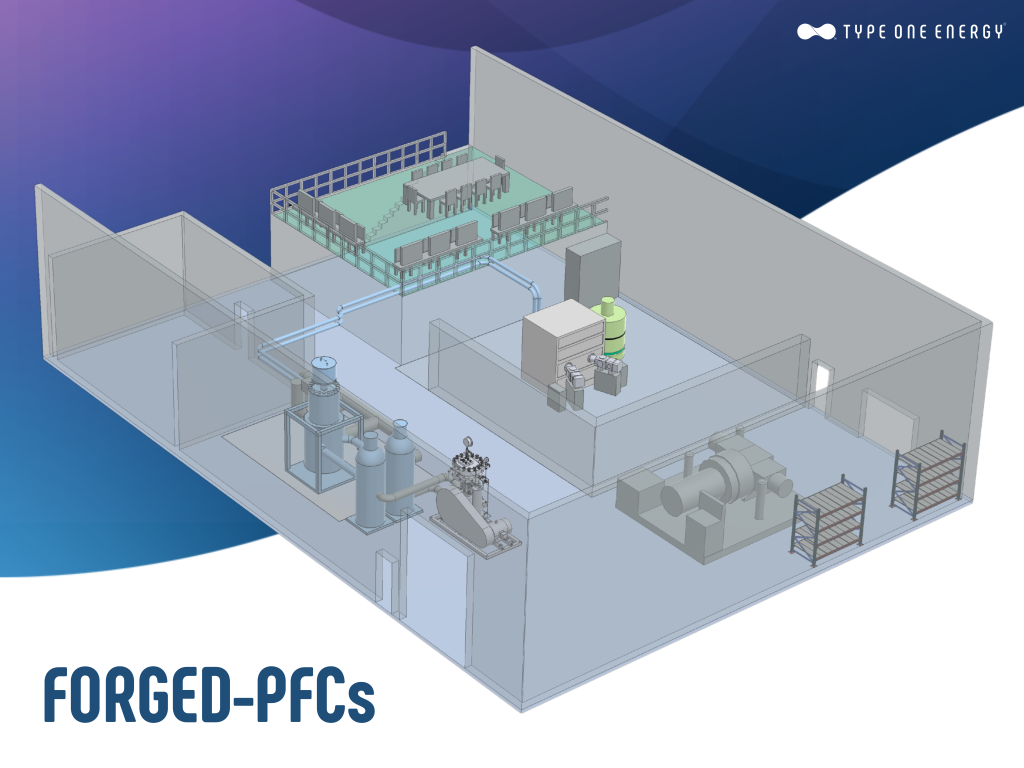
타입 원 에너지(Type One Energy)의 고열속 시설(HHF) 렌더링 이미지로, 고온 헬륨 루프(왼쪽)와 진공 용기(중앙)를 묘사하고 있다. (출처: 타입 원 에너지(Type One Energy))
요약
카테고리: 기술
오크리지 국립연구소(ORNL)가 타입 원 에너지(Type One Energy) 및 테네시 대학교 녹스빌 캠퍼스(UTK)와 파트너십을 체결하여 테네시주 클린턴(Clinton, Tenn.)에 고열속 시설(HHF)을 구축할 예정이다.
이 시설은 미국에서 동종 최강의 시설로, 핵융합 장치 내 극한 조건에서 재료가 어떻게 반응하는지 평가하여 플라즈마 접촉 부품 개발을 가속화하는 것을 목표로 한다.
이번 파트너십은 TVA 불런 에너지 단지(Bull Run Energy Complex)에서 진행 중인 '프로젝트 인피니티(Project Infinity)'—스텔라레이터(stellarator) 원형로 '인피니티 원(Infinity One)'과 350MWe급 핵융합 발전 실증 플랜트 '인피니티 투(Infinity Two)'—를 직접 지원하게 된다.
---
어제 오크리지 국립연구소(Oak Ridge National Laboratory, ORNL)는 타입 원 에너지(Type One Energy) 및 테네시 대학교 녹스빌 캠퍼스(University of Tennessee–Knoxville, UTK)와 파트너십을 추진 중이라고 발표했다. 이 파트너십의 주요 목표는 테네시주 클린턴(Clinton, Tenn.) 소재 테네시 밸리 오소리티(Tennessee Valley Authority, TVA)의 불런 에너지 단지(Bull Run Energy Complex)에 고열속 시설(high-heat flux facility, HHF)을 설립하는 것이다.
세부 내용: 연구소에 따르면, HHF의 목적은 "미국의 혁신을 이끌고 핵융합 에너지를 현실에 한 발 더 가깝게 하는 것"이다. 이를 위해 핵융합 장치 내 극한 조건에서 재료가 어떻게 반응하는지 평가함으로써, 해당 장치의 플라즈마 접촉 부품 개발을 가속화한다.
민간 및 공공 기관 모두 HHF에서 핵융합 파일럿 플랜트 설계에 사용되는 재료를 검증하고 인증할 수 있을 것이다. HHF는 미국 내 동종 시설 중 두 번째이자 압도적으로 강력한 시험 시설이 될 예정이다. ORNL은 또한 HHF가 미국 내 동종 시설 중 유일하게 가압 헬륨 가스 냉각 방식을 사용하는 시설이 될 것이라고 밝혔다.
이 시설은 핵융합 재료 설계 분야에서의 UTK의 전문성과 ORNL의 핵융합 재료 개발 프로그램을 활용하게 된다. 궁극적으로, HHF는 관련 파트너들 각각의 프로젝트를 위한 핵융합 개발 캠퍼스로 구상되어 있다. 파트너들은 동부 테네시 지역을 미래 핵융합 연구 및 제조의 허브(hub, 중심지)로 더욱 확고히 굳히기를 희망하고 있다.
중요한 배경: UTK와 ORNL의 자원 활용에 더해, 불런(Bull Run)에 HHF를 입지시키는 것은 타입 원 에너지(Type One Energy)가 현재 진행 중인 프로젝트와도 맥을 같이 한다. 2024년 2월, 해당 회사는 본사를 위스콘신주 매디슨(Madison, Wis.)에서 불런으로 이전할 계획을 발표한 바 있다.
이 같은 이전은 부분적으로 2023년 TVA, ORNL, 타입 원(Type One)이 핵융합 협력을 위해 체결한 양해각서(memorandum of understanding)에 의해 촉발되었다. 해당 협력은 '프로젝트 인피니티(Project Infinity)'로 발전하였으며, 이는 두 대의 핵융합 장치 배치를 포함한다: 인피니티 원(Infinity One)과 인피니티 투(Infinity Two). 인피니티 원은 스텔라레이터(stellarator) 핵융합 원형로이며, 인피니티 투는 350MWe급 핵융합 발전 실증 플랜트다. 2025년 9월, TVA는 인피니티 투와 관련하여 타입 원(Type One)에 의향서(letter of intent)를 발행하였다.
프로젝트 인피니티(Project Infinity)는 ORNL의 이번 최신 발표에 명시적으로 언급되지는 않았지만, 이번 파트너십은 두 인피니티 프로젝트 모두를 직접 지원하며, 동일한 당사자들이 참여하고 있다(UTK가 추가됨).
최근 자금 조달: HHF는 미국 에너지부(Department of Energy)의 과학국(Office of Science) 산하 핵융합 에너지 과학 프로그램(Fusion Energy Sciences program), 테네시주, 그리고 타입 원 에너지(Type One Energy)의 자금 지원을 받게 된다. 이 소식은 타입 원(Type One)이 8,700만 달러를 조달하여 총 벤처 투자액이 1억 6,000만 달러를 넘어섰다는 보도가 나온 지 일주일도 채 되지 않아 전해졌다.
AI 분석
이번 ORNL, 타입 원 에너지(Type One Energy), UTK 간 파트너십은 미국이 핵융합 에너지 상용화를 향해 민관 협력 모델을 강화하고 있음을 보여주는 중요한 사례다. 미국 내 동종 최강의 고열속 시설(HHF) 구축은 핵융합 장치의 핵심 과제인 플라즈마 접촉 재료 개발을 크게 앞당길 수 있는 인프라를 제공한다. 특히, 가압 헬륨 가스 냉각 방식은 기존 시설과의 차별점으로, 향후 미국이 이 분야에서 독보적인 기술 우위를 확보하는 데 기여할 전망이다. 프로젝트 인피니티(Project Infinity)와의 연계는 이 파트너십이 단순한 연구 협력을 넘어 실제 핵융합 발전소 건설을 위한 구체적인 로드맵의 일부임을 시사한다. 타입 원 에너지(Type One Energy)의 최근 1억 6,000만 달러 이상의 벤처 투자 유치는 민간 투자자들의 핵융합 산업에 대한 높은 신뢰를 반영하며, 이 지역이 미국 핵융합 산업의 중심지로 부상할 가능성을 높여 준다.
Courtesy of Christopher Bowns, CC BY-SA 2.0, via Wikimedia Commons
요약
카테고리: 현황
오클로(Oklo Inc.)와 메타 플랫폼스(Meta Platforms, Inc.)가 오하이오주 파이크 카운티의 포츠머스 기체 확산 플랜트(PORTS) 부지에 1.2GW 규모의 전력 캠퍼스를 건설하기 위해 협력 협약을 체결했다.
206에이커 부지에 원자력 발전 시설 네트워크로 구성될 이 캠퍼스는 메타의 데이터 센터를 지원하기 위한 것으로, 2030년 첫 단계 완공 후 2034년 완전 가동을 목표로 한다.
냉전 시대에 설립된 PORTS 부지는 농축 우라늄 생산 및 환경 정화 과정을 거쳐, 이번 프로젝트를 통해 지역 사회에 수천 개의 일자리를 창출할 것으로 기대된다.
---
첨단 핵분열 에너지 기업 오클로(Oklo Inc.)와 다국적 기술 기업 메타 플랫폼스(Meta Platforms, Inc.)가 파이크 카운티에 위치한 포츠머스 기체 확산 플랜트(Portsmouth Gaseous Diffusion Plant), 일명 PORTS에 1.2GW 규모의 전력 캠퍼스를 구축하기 위해 협력하고 있다.
이 전력 캠퍼스는 원자력을 생산하는 시설 네트워크로 구성되며, 206에이커에 걸쳐 조성될 예정이고 해당 지역의 메타 데이터 센터를 지원하기 위해 건설될 것이라고 오클로의 보도 자료는 밝혔다. 파이크턴(Piketon)에서의 착공 전 준비 및 부지 특성 조사는 올해 시작될 예정이다.
2030년에 완료될 것으로 예상되는 프로젝트 1단계에서는 두 개의 발전소를 건설한 후, 2034년경 1.2GW 목표치에 도달할 때까지 생산량을 단계적으로 늘려나갈 계획이다.
오클로는 파이크 카운티 부동산 기록에 따르면, 미국 국도 23호선(U.S. Highway 23) 인근에 위치한 해당 토지를 약 515만 달러에 매입했다.
오클로의 홍보 및 미디어 책임자 보니타 체스터(Bonita Chester)는 빠르게 움직이는 중성자를 활용해 원자력 연료를 보다 효율적으로 사용하는 고속 원자로(fast reactor) 기술의 상용화라는 새로운 특징에 대해 설명했다.
각 발전소에는 약 35개의 상시 일자리가 필요하며, 일상적인 행정 및 기술 엔지니어링을 위해 유닛당 16개의 추가 일자리가 필요하다. 체스터에 따르면, 프로젝트가 완성되면 궁극적으로 지역 사회에 수천 개의 일자리를 제공할 것으로 기대된다.
체스터는 파이크턴 입지의 중요성과 이 프로젝트가 지역 사회에 미치는 이점에 대해 언급했다.
"그곳의 작업 때문입니다," 체스터는 말했다. "인력과 인프라가 그곳에 있습니다. 그래서 우리는 새로운 일자리, 새로운 에너지 인프라를 가져오고, 이 부지를 진정으로 다시 활성화하는 것을 기대하고 있습니다."
남부 오하이오 다각화 이니셔티브(Southern Ohio Diversification Initiative, SODI)의 법률 고문 케빈 슈메이커(Kevin Shoemaker)는 많은 주민들이 원자력 생산의 안전성에 대해 공통적으로 우려하고 있다고 말했다. 그는 오클로, 메타, SODI가 우라늄의 농축 및 사용을 어떻게 안전하게 보장할 것인지에 대해 설명했다.
"폐기물이 관리될 수 있도록 계획이 마련될 것입니다," 체스터는 말했다. "그것은 또한 폐기물 처리 계획을 갖춰야 한다는 미국 원자력규제위원회(U.S. Nuclear Regulatory Commission)의 절차 중 일부이기도 합니다. 그래서 우리는 이 모든 것이 갖춰질 수 있도록 할 것입니다."
슈메이커는 또한 이 지역에서 개발되고 있는 새로운 프로젝트들이 지역 및 미래 발전에 중요할 것이라고 설명했다.
"우리는 이것이 과거의 원자력 활동과 다르다는 것을 인식하고 있습니다. 또한 오하이오주가 원자력규제위원회와 함께 이러한 사안들을 규제해야 할 것임을 인식하고 있습니다. 그래서 우리는 실제로 해당 부지에서 운영을 시작하기 전에 그들이 따라야 할 엄격한 지침이 있을 것이라는 점에서 상당히 안심하고 있습니다," 슈메이커는 말했다.
현재의 에너지 프로젝트에 앞서, PORTS는 미국 정부의 핵심적인 원자력 에너지 공급원이었다.
PORTS는 1952년에 생산을 시작했다. 냉전을 배경으로, 원자력에너지위원회(Atomic Energy Commission)는 전국적으로 농축 우라늄 생산을 확대하기 위해 3,700에이커가 넘는 이 부지를 설립했다.
1960년대에 PORTS는 미국 에너지부(U.S. Department of Energy)에 따르면 원자력 발전소에서 상업적으로 사용하기 위한 우라늄 농축에 주력했다. 이 과정은 1993년 센트러스 에너지(Centrus Energy)에 이관되었으며, 2001년까지 저농축 우라늄을 생산했다.
센트러스는 PORTS 부지의 오염 제거 및 폐로를 위해 미국 에너지부(DOE)에 반환했다. 이 부지는 이후 미래 프로젝트를 준비하기 위한 환경 정화 과정을 거쳐 오고 있다.
2011년, DOE는 오하이오 대학교 보이노비치 리더십 공공정책대학원(Ohio University Voinovich School of Leadership and Public Affairs)과 남부 오하이오 다각화 이니셔티브(Southern Ohio Diversification Initiative, SODI)와 협력하여, SODI에 따르면 PORTS의 미래 활용에 대해 주민들이 원하는 바가 무엇인지 분석했다.
15개월간의 과정에는 파이크 카운티, 사이오토 카운티(Scioto County), 로스 카운티(Ross County), 잭슨 카운티(Jackson County) 내 주민, 기업, 비영리 단체, 정부 관계자 등과의 대화가 포함되었다.
---
AI 분석
이 기사는 오하이오주 파이크 카운티의 PORTS 부지가 냉전 시대의 유산에서 첨단 원자력 에너지 거점으로 탈바꿈하고 있음을 보여준다. 오클로와 메타의 협력은 빅테크 기업들이 급증하는 AI 및 데이터 센터 전력 수요를 충족시키기 위해 원자력 에너지에 주목하고 있다는 광범위한 흐름을 반영한다. 오클로가 상용화하려는 고속 원자로 기술은 기존 경수로 대비 연료 효율을 높이고 폐기물을 줄일 수 있어 차세대 원자력의 핵심 기술로 주목받고 있다. 지역 주민과 법률 고문의 발언에서 드러나듯, 원자력의 역사적 오명을 극복하고 지역 사회의 신뢰를 구축하는 것이 프로젝트 성공의 중요한 과제가 될 것이다. 이 프로젝트는 2030년대 미국 원자력 르네상스의 상징적인 사례로 자리매김할 가능성이 있다.
---
출처: The Post Athens
URL: https://www.thepostathens.com/article/2026/01/news-ports-nuclear-power-oklo-meta-data-center-pike-county
작성자: Finn Smith (@finnsmith06 / fs227223@ohio.edu)
매체명: The Post (thepostathens.com)
※ 이 글은 해외 원자력 바로알기를 위한 정보 전달을 목적으로 제공됩니다. 특정 기업이나 종목에 대한 투자 권유가 아니며, 모든 투자 판단과 그에 따른 책임은 투자자 본인에게 있습니다.
뉴욕주 공공서비스위원회가 원자력 발전소 4곳에 대한 보조금을 2049년까지 연장하는 방안을 만장일치로 승인했다.
2016년부터 시행된 보조금 없이는 낮은 천연가스 가격으로 인해 원자력 발전소들이 경제적으로 존속하기 어려운 상황이다.
인디언 포인트(Indian Point) 원자력 발전소의 2021년 조기 폐쇄를 반면교사로 삼아, 뉴욕주는 기존 원자력 발전소 보전과 신규 건설을 동시에 추진하고 있다.
---
R.E. 긴나(R.E. Ginna) 원자력 발전소는 뉴욕주에 남아 있는 4개 원자력 발전소 중 하나다.
몰리 버크(Molly Burke)/타임스 유니온(Times Union)
뉴욕주 공공서비스위원회 의장 겸 CEO인 로리 크리스천(Rory Christian)은 원자력 시설 보조금 연장을 지지했다.
윌 월드런(Will Waldron)/타임스 유니온(Times Union)
캐시 호쿨(Kathy Hochul) 주지사는 신규 원자력 발전소 건설을 자신의 에너지 비전의 핵심 요소로 삼아 왔다.
대런 맥기(Darren McGee)/뉴욕주지사실(Office of Governor Kathy Hochul)
올버니(ALBANY) — 주 공공서비스위원회가 목요일 만장일치로 보조금 연장을 의결하여 뉴욕주의 원자력 발전소 4곳이 수십 년간 계속 운영될 수 있게 됐다.
"원자력 에너지는 우리 에너지 믹스(다양한 에너지원의 조합)에서 중요한 부분을 차지합니다… 지금은 발전량을 줄일 때가 아니라 늘려야 할 때입니다"라고 공공서비스위원회 위원 우체나 S. 브라이트(Uchenna S. Bright)가 말했다.
2016년부터 뉴욕 주민들은 원자력 발전소가 경제적으로 유지될 수 있도록 보조금을 지원해 왔다. 2010년대 중반 천연가스 가격이 낮아지면서 발전소들이 전력 판매만으로는 손익분기점을 맞추기 어려워졌기 때문이다.
"뉴욕주 원자력 산업에 투자함으로써 우리는 더 깨끗하고 안정적이며 저렴한 전력망을 구축해 수십 년간 모든 뉴욕 주민들에게 혜택을 줄 것입니다"라고 캐시 호쿨(Kathy Hochul) 주지사 대변인 켄 러벳(Ken Lovett)이 말했다.
천연가스 발전소와 달리 원자력 발전기는 수요가 많을 때만 가동량을 쉽게 늘리거나 줄이기 어렵다. 이는 안정적인 에너지가 필요한 전력망 입장에서는 이상적이지만, 수요가 낮아 전력 가격이 낮은 시간에도 계속 가동해야 하는 발전 사업자 입장에서는 부담이 된다.
이러한 경제적 이중성과 주정부의 탄소 배출 감축 의지가 맞물려 공공서비스위원회는 10년 전 이 인센티브 프로그램을 만들게 되었다.
내셔널 그리드(National Grid) 고객들은 지난 한 해 동안 해당 시설들을 지원하기 위해 약 6,100만 달러를 납부했다. 재생에너지 사업자들도 개발 촉진을 위해 유사한 지원금을 받고 있다.
이 발전소들은 현재 뉴욕주 전력 수요의 약 20%를 충당하고 있으며, 향후 수십 년간 전력 수요가 급격히 증가할 것으로 예상되는 시점에서 핵심적인 역할을 하고 있다. 또한 주정부의 청정에너지 의무 이행 과정에서 이산화탄소 배출 감축에도 필수적인 역할을 담당하고 있다. 공공서비스위원회의 명령에 따라 이 시설들은 2049년까지 지원을 받게 된다.
"뉴욕주 원자력 발전소 운영은 뉴욕 주민들을 현저히 높은 배출 수준, 높은 전기 요금, 요금 변동성, 그리고 잠재적인 서비스 중단으로부터 보호하는 데 분명히 필요합니다"라고 원자력 시설 운영사인 컨스텔레이션(Constellation)이 보조금 연장 지지 메모에 적었다.
컨스텔레이션(Constellation)은 또한 인플레이션 감축법(Inflation Reduction Act)에 따라 승인된 세액 공제가 원자력 발전기 지원에서 소비자의 부담을 줄여준다고 언급했다.
8개 재생에너지 및 환경보호 옹호단체 연합은 이 계획에 이의를 제기했다. 이 단체들은 처음에 이 인센티브 제도가 태양광·풍력 같은 재생에너지가 성장할 수 있도록 단계적으로 폐지하는 것을 전제로 설계되었다고 주장했다. 공공서비스위원회가 시간이 지남에 따라 이 프로그램을 단계적으로 폐지하는 방안을 포함시켜야 한다고 제안했다.
그러나 일부에서는 주정부가 청정하고 충분히 활용 가능한 에너지원을 조기에 폐쇄하는 동일한 실수를 반복해서는 안 된다고 주장한다.
"뉴욕주의 전력망을 탈탄소화하려는 진지한 계획이라면 우리가 보유한 가장 큰 청정에너지 자산을 반드시 보전해야 합니다"라고 뉴욕보전유권자연맹(The New York League of Conservation Voters)이 공공서비스위원회 직원에게 보낸 의견서에 적었다.
웨스트체스터 카운티(Westchester County)에 위치했던 구 원자력 발전소인 인디언 포인트(Indian Point)가 2021년 폐쇄되었을 때, 이는 이산화탄소 배출의 현저한 증가를 초래했고 뉴욕시 전력 공급망에 큰 구멍을 뚫었다. 그 이후로 뉴욕독립시스템운영자(New York Independent System Operator)는 노후화된 화석연료 발전소들을 부족분을 메우기 위해 계속 가동하는 상황에서 전력망에서 나오는 에너지가 들어오는 에너지보다 지속적으로 많다고 경고해 왔다.
원자력 시설을 계속 가동하면 향후 25년간 전력 요금 납부자들이 500억 달러를 절감할 수 있다고 경제 및 규제 연구 기관인 브래틀 그룹(The Brattle Group)이 밝혔다.
자금 지원 프로그램을 연장하면 발전소들이 경제적으로 유지될 수 있지만, 여전히 계속 운영하려면 원자력규제위원회(Nuclear Regulatory Commission)의 승인이 필요하다.
지난 6월, 호쿨(Hochul) 주지사는 뉴욕전력청(New York Power Authority)에 "뉴욕주 북부에 무탄소 첨단 원자력 발전소를 개발하고 건설하라"고 지시했다.
주지사의 지시는 주정부가 2019년 기후법(Climate Act)의 의무 사항을 이행하는 데 어려움을 겪는 가운데, 시러큐스(Syracuse)에서 에너지 정상회의를 개최하고 10개월 후에 나왔다. 해당 의무 사항에는 2030년까지 전력원의 70%를 재생에너지로 전환하고, 2040년까지 순배출 제로를 달성하는 목표가 포함되어 있는데, 많은 경제계 인사와 전력 생산 전문가들은 이 목표가 달성 불가능하다고 오래전부터 경고해 왔다.
"뉴욕주가 경제의 전기화를 추진하고, 노후 화석연료 발전 설비를 폐기하며, 양질의 일자리를 창출하는 대형 제조업체를 계속 유치함에 따라, 우리는 에너지 독립성과 공급망 안보를 중심으로 하는 풍요로운 에너지 정책을 수용해 뉴욕이 에너지 미래를 주도할 수 있도록 해야 합니다"라고 호쿨(Hochul)은 말하며, 전력청에 "모든 뉴욕 주민들의 이익을 위해 안전하고 신속하게 청정하고 신뢰할 수 있는 원자력 발전을 보급해 달라"고 요청했다고 덧붙였다.
그녀는 이후 공공서비스부(Department of Public Service) 산하에 원자력 신뢰성 기반 프로세스(Nuclear Reliability Backbone process) 신설을 제안하여, 지난해 요청한 1기가와트 발전소 건설에 더해 4기가와트의 원자력 에너지 개발을 검토·심사·촉진하는 방안을 고려하고 있다. 이러한 프로젝트들은 수년의 시간과 수십억 달러의 비용이 소요되겠지만, 뉴욕주의 원자력 발전 생산량을 8기가와트 이상으로 끌어올릴 것이다. 그러나 이 개략적인 계획에는 한 가지 핵심 요소가 빠져 있었다: 발전소가 건설될 가능성이 높은 뉴욕주 북부에서 뉴욕시 광역 지역으로 전력을 어떻게 송전할 것인가 하는 문제다.
---
AI 분석
뉴욕주의 원자력 보조금 2049년 연장 결정은 탈탄소화와 에너지 안보라는 두 마리 토끼를 잡으려는 현실적인 선택으로 볼 수 있다. 인디언 포인트(Indian Point) 폐쇄 이후 전력 공급 부족과 탄소 배출 증가라는 뼈아픈 교훈을 거울삼아, 뉴욕주는 성급한 원자력 퇴출 정책의 위험성을 직접 체감했다. 재생에너지 단체들의 반대에도 불구하고, 원자력의 기저 부하(baseload) 특성은 변동성이 큰 풍력·태양광만으로는 채울 수 없는 안정성을 제공한다는 점에서 정책적 판단의 핵심 근거가 되었다. 한편, 신규 4기가와트 원자력 발전 계획은 야심 차지만 송전 인프라 문제를 해결하지 못한 채 발표된 점이 향후 정책 실현의 가장 큰 장애물이 될 것으로 보인다. 이번 결정은 미국 내 다른 주들의 원자력 정책 방향에도 참고가 될 수 있는 중요한 선례로 평가된다.
This photo from November 2025 shows the vertical storage units containing spent nuclear fuel at the shuttered San Onofre nuclear power plant. \(Nelvin C. Cepeda / The San Diego Union-Tribune\)
2025년 11월 촬영된 이 사진은 폐쇄된 산 오노프레 원자력 발전소의 사용후 핵연료를 담은 수직 저장 장치를 보여줍니다. (넬빈 C. 세페다(Nelvin C. Cepeda) / 샌디에이고 유니언-트리뷴(The San Diego Union-Tribune))
Author
마이크 레빈(Mike Levin) 작성
요약
카테고리: 원자력 정책
산 오노프레 원자력 발전소(SONGS)에 저장된 360만 파운드의 사용후 핵연료는 미국 전역 80개 이상의 부지에 원자력 폐기물이 방치된 국가적 실패의 산물이며, 영구 처리장이 없는 것이 근본 문제다.
저자는 초당적 협력을 통해 폐기물 이전을 위한 재원 2억 달러 이상을 확보했으나, 재처리는 SONGS 연료의 특성상 비용·물류·이점 면에서 우선 후보가 되지 않는다고 전문가들이 판단한다.
진정한 해결책은 재처리라는 '만능 기술'이 아닌, 명확한 연방 정책·안정적 재원·지역사회 동의를 바탕으로 한 국가적 차원의 접근임을 강조한다.
---
산 오노프레 원자력 발전소(SONGS, San Onofre Nuclear Generating Station)에 저장된 360만 파운드의 사용후 핵연료는, 전국 80개 이상의 부지에 원자력 폐기물이 방치된 국가적 실패의 증거입니다. 원자력 폐기물은 원래 SONGS에 장기 보관될 계획이 아니었습니다. 그러나 미국이 여전히 사용후 핵연료를 위한 영구 처리장을 갖추지 못했기 때문에, 다른 선택의 여지가 없게 되었습니다.
2018년 의회에 선출된 후 제가 처음 취한 행동 중 하나는 과학자, 규제 당국, 부족 지도자 및 지역 사회 구성원들로 구성된 SONGS 태스크포스를 소집하여, 실질적으로 위험을 줄이고 핵연료를 이전할 수 있는 방안에 대한 전문가 합의를 도출한 것이었습니다.
그 노력은 초당적인 사용후 핵연료 해결책 코커스(Spent Nuclear Fuel Solutions Caucus)의 창설로 이어졌으며, 저는 공화당 소속 텍사스 주 대표 척 플라이슈만(Chuck Fleischmann) 의원과 함께 이를 공동 주재하고 있습니다. 우리는 함께 수년간 교착 상태에 빠져 있던 초당적 국가 논의를 재개했습니다.
저는 트럼프(Trump) 전 대통령과 바이든(Biden) 전 대통령 재임 시절의 에너지부와 협력하여 원자력 폐기물 이전을 위한 협력 프로그램을 재가동했습니다. 이 접근 방식은 과거 제안된 해결책들이 지역사회 반발로 실패했던 만큼, 지속 가능한 해결책에는 투명성, 신뢰, 그리고 자발적인 지역사회 참여가 필요하다는 원칙을 따릅니다. 저는 이 작업을 추진하기 위해 1억 4,800만 달러 이상을 확보했으며, 다음 정부 재원 법안에서 추가로 5,500만 달러가 책정될 예정입니다. 최근 완성된 사용후 핵연료 안전 운송용 아틀라스(Atlas) 철도 화차와 함께, 미국은 수십 년 만에 이 문제 해결에 가장 근접한 상황에 있습니다.
그렇긴 하지만, 저는 샌디에이고(San Diego) 카운티가 SONGS의 사용후 핵연료 이전에 역외 재처리 연구 및 개발이 역할을 할 수 있는지 탐색하도록 카운티 직원에게 지시하는 결의안을 통해 이 문제에 새롭게 관심을 기울이는 것을 환영합니다.
그러나 현실은, 우리가 이미 수년간 재처리를 탐색해 왔다는 것입니다. 재처리는 제가 2020년 발의하고 통과시킨 초당적 연구개발 법안에 포함되어 있었습니다. 전문가들은 재처리가 언제, 어떤 연료에, 얼마의 비용으로, 어떤 안전 조치 하에 유효한지를 연구해 왔습니다.
저는 SONGS의 해결책으로서 재처리에 대해 다소 신중한 입장을 촉구하고자 합니다. 이는 수년간 원자력 공학자, 핵 연료 주기 전문가, 학자, 그리고 바이든 및 트럼프 행정부 관리들로부터 들어온 의견을 반영한 것입니다.
좁은 기술적 의미에서, SONGS의 연료는 재처리가 가능할 것으로 보입니다. 그러나 전문가들이 상업적 재처리의 유력 후보를 고려할 때, 다른 옵션과 비교하여 비용, 물류, 이점을 따져봅니다. 그 기준에서 보면, SONGS의 연료는 전국의 다른 사용후 핵연료에 비해 유력 후보가 아니라는 말을 반복적으로 들어왔습니다. 연료의 노화 정도, 물리적 구조, 연소 특성, 그리고 화학적 분리가 아닌 보관 및 운송용으로 설계된 용기에 이미 밀봉되어 있다는 사실 등 여러 요소가 모두 중요하게 작용합니다.
재처리에는 그 밖에도 여러 도전 과제가 있습니다. 오늘날 미국에는 상업용 재처리 산업이 없으며, 사용후 핵연료가 재처리된 후에도 방사성 폐기물이 남아 영구 처리장에 처분되어야 합니다. 또한 제대로 다루지 않으면, 재처리는 안보 위협과 핵무기 확산 위험을 초래할 수 있습니다.
그렇다고 재처리를 완전히 배제해야 한다는 뜻은 아닙니다. 현 행정부는 재처리를 지지하며, 재처리 연구가 해안에서 멀리 떨어진 폐기물 새 부지를 찾는 데 도움이 된다면 그것도 좋습니다. 저에게 중요한 것은 결과입니다.
그러나 재처리를 SONGS의 단기적 해결책으로 다루는 것은 전문가들이 불가피하다고 동의하는 작업으로부터 주의를 분산시킵니다.
그렇기 때문에 공화당 소속 텍사스 주 오거스트 플루거(August Pfluger) 의원과 저는 원자력 폐기물을 관리할 새로운 단일 목적의 독립 기관을 만들기 위한 초당적 원자력 폐기물 관리법(Nuclear Waste Administration Act)을 공동 발의했습니다. 전문가 권고사항에 따라, 이 법안은 지역사회 주도 프로세스를 확립하고 SONGS와 같은 폐쇄된 원자로 부지에서의 사용후 핵연료 제거를 우선시합니다. 이것이 지속적인 연방 리더십의 모습입니다.
SONGS의 사용후 핵연료는 한 카운티가 결의안을 통과시킨다고 해서, 또는 한 기술이 만능 해결책(silver bullet, 어떤 복잡한 문제도 단번에 해결하는 마법 같은 해법)으로 포장된다고 해서 이전되지 않습니다. 연방 정부가 명확하고 일관된 정책, 안정적인 재원, 지역사회의 동의를 갖출 때 비로소 이전될 것입니다. 이것이 제가 의회 첫 임기부터 우선시해 온 작업입니다.
우리는 SONGS에서 실질적으로 위험을 줄일 방법에 대해 대중에게 솔직해야 할 의무가 있습니다. 국가적 문제는 오직 국가적 해결책만이 풀 수 있습니다. 그리고 수십 년 만에 처음으로, 우리는 그것을 향한 신뢰할 만한 경로 위에 있습니다.
_레빈(Levin)은 민주당 소속으로, 샌디에이고 북부 카운티와 오렌지 카운티(Orange County) 남부 일부를 포함하는 캘리포니아(California) 49선거구 하원의원입니다._
AI 분석
이 기고문은 샌디에이고 지역구 하원의원 마이크 레빈(Mike Levin)이 SONGS 사용후 핵연료 문제에 대한 재처리 논의가 과열되는 상황에 경종을 울리기 위해 작성한 정책 의견서다. 저자는 재처리의 기술적 가능성을 부인하지 않으면서도, SONGS 연료의 물리적·구조적 특성상 상업적 재처리의 우선 후보가 아님을 전문가 의견을 근거로 제시한다. 특히 미국에 상업용 재처리 인프라 자체가 부재하고, 재처리 후에도 여전히 영구 처리장이 필요하다는 점은 재처리를 '단기 해결책'으로 볼 수 없는 근거로 설득력 있게 제시된다. 저자는 초당적 입법 활동과 연방 재원 확보 등 구체적인 성과를 열거함으로써 자신의 주장에 실질적 신뢰성을 더하고 있으며, 지역사회 주도의 자발적 참여가 지속 가능한 해결의 핵심임을 일관되게 강조한다. 궁극적으로 이 글은 정치적 상징성보다 실질적 해결을 위한 연방 차원의 통합적 접근이 시급함을 역설하는 정책 옹호 글쓰기의 좋은 사례다.
톰슨 이군마(Thompson Igunma)의 UF-INL 연구, 용융염 원자로를 위한 독자적 모델 개발
2026년 1월 22일 오전 9:36 | Nuclear News
이군마(Igunma)
요약
카테고리: 기술
플로리다 대학교(UF) 박사 과정생 톰슨 오디온 이군마(Thompson Odion Igunma)가 아이다호 국립연구소(INL)와의 협력을 통해 용융염 원자로(MSR)의 부식 및 방사선 조사 영향을 동시에 모델링하는 세계 최초의 결합 계산 프레임워크를 개발하고 있다.
고속 푸리에 변환(FFT) 기반 CALPHAD 정보 모델을 통해 대규모 미세구조 영역에서 철-니켈-크롬 삼원 합금의 용융염 환경 내 부식 시뮬레이션이 가능해졌으며, 이는 기존 소규모 영역 모델의 한계를 극복한 성과이다.
이 연구는 DOE의 핵에너지 고급 모델링 및 시뮬레이션(NEAMS) 프로그램의 지원을 받아 진행되며, 향후 MSR 설계, 재료 선정, 유지보수 일정 및 안전 기준 수립에 직접 기여할 것으로 기대된다.
---
미국 원자력학회(ANS) 회원인 톰슨 오디온 이군마(Thompson Odion Igunma)는 플로리다 대학교(UF)에서 재료과학 및 공학 분야 박사 과정을 밟고 있으며, 아이다호 국립연구소(Idaho National Laboratory, INL)의 계산역학 및 재료 그룹(Computational Mechanics and Materials Group)과 협력하여 연구를 수행하고 있다. 그의 연구는 용융염 부식, 방사선 조사, 합금 미세구조 변화 간의 복잡한 상호작용에 대한 고급 모델링에 초점을 맞추고 있다.
"저는 용융염 원자로를 차세대 원자력 에너지의 핵심 축으로 보고 있습니다," 이군마는 말했다. "안전성, 효율성, 연료 유연성의 독특한 조합 덕분에 저탄소 에너지 믹스에서 재생에너지를 보완하기에 이상적입니다."
그는 이렇게 덧붙였다. "제 견해로는, 원자력의 미래는 용융염, 소듐 고속로, 소형 모듈 원자로(SMR)를 포함한 첨단 설계들로 이루어질 것이며, 이 모든 것은 재료과학 및 공학의 혁신에 의해 뒷받침될 것입니다. 부식에 대한 고급 계산 모델링을 통한 저의 기여는 이 더 큰 비전의 한 조각입니다. 재료 및 원자력 공학의 중요한 공백을 채움으로써, 이 연구는 MSR의 구조용 합금이 수십 년간의 운전 기간 동안 안정적으로 성능을 발휘할 수 있도록 보장하는 데 기여합니다."
그런 의미에서, 이군마는 "원자력 에너지의 미래는 비전 있는 설계뿐만 아니라, 정책 입안자, 산업계, 그리고 대중에게 배치에 대한 신뢰를 부여하는 엄밀하고 예측적인 과학에도 달려 있을 것"이라고 설명했다.
걸어온 길
이군마는 나이지리아에서 경력을 시작했으며, 에크포마(Ekpoma) 시에 위치한 암브로즈 알리 대학교(Ambrose Alli University)에서 2010년에 기계공학 학사 학위를 취득했다. 이후 10년 이상에 걸쳐 GZ 매뉴팩처링 인더스트리즈(GZ Manufacturing Industries)와 기네스 나이지리아(Guinness Nigeria)에서 리더십 역할을 포함한 제조 공학 분야의 산업 경험을 쌓았다. 그는 이러한 경험 덕분에 "계산 모델링과 실제 공학 실무를 효과적으로 연결할 수 있게 되었다"고 말했다.
이군마는 이후 미국으로 건너와 UF에서 고등 교육을 이어갔으며, 계산 모델링 및 극한 환경을 전공하여 2024년에 재료과학 및 공학 석사 학위를 취득했다. 현재 그는 박사 과정을 마무리하는 동시에 UF에서 연구 조교로 일하고 있다.
왜 MSR인가?
이군마가 첨단 원자로 공학에 관심을 가지게 된 것은 재료 공학 및 계산 재료에 대한 관심에서 비롯되었다. 그는 "계산 재료 공학 연구자로서, 저는 구조용 합금이 방사선 조사 및 응력 등 다른 현상들과 결합되어 용융염과 어떻게 상호작용하는지를 이해하는 기술적 복잡성에 이끌렸습니다. 이것은 단순한 학문적 질문이 아닙니다. 왜냐하면 이는 차세대 원자로의 신뢰성과 수명에 직접적인 영향을 미치기 때문입니다. MSR은 재료 설계, 부식 모델링, 다중 물리 시뮬레이션 분야의 혁신을 위한 비옥한 토대를 제공하며, 이 분야에서 저의 연구는 예측적 페이즈 필드(phase-field) 방법을 발전시키는 데 집중해 왔습니다"라고 말했다.
그는 또한 MSR이 저압 운전 및 수동형 붕괴열 제거(passive decay-heat removal)와 같은 본질적인 안전 특성을 제공하여 원자력 기술의 패러다임 전환을 대표하기 때문에 MSR 연구에 끌리게 되었다고 했다. 이러한 특성들은 사고와 관련된 위험을 줄여준다. "고온에서 운전할 수 있는 MSR의 능력은 열 효율을 향상시키고 수소 생산 및 산업용 공정열과 같은 더 광범위한 응용을 가능하게 합니다"라고 그는 덧붙이면서, MSR의 지속가능성에 대한 기여를 강조했다. MSR은 토륨이나 재처리된 원자력 폐기물을 연료로 사용할 수 있어, 원자력 연료 주기를 완성하고 장수명 방사성 폐기물을 줄이는 데 기여한다. "지구적 탈탄소화의 맥락에서, MSR은 재생에너지를 보완하는 신뢰할 수 있는 저탄소 기저 에너지원을 제공합니다"라고 그는 말했다.
INL과의 협력
왼쪽부터: 다니엘 슈벤(Daniel Schwen), 차이타냐 바베(Chaitanya Bhave), 파릭시트 바즈파이(Parikshit Bajpai), INL 계산역학 및 재료 그룹 연구원들. (사진: INL)
이군마의 연구는 핵에너지 고급 모델링 및 시뮬레이션(Nuclear Energy Advanced Modeling and Simulation, NEAMS) 프로그램 하에 에너지부(Department of Energy)의 지원을 받아 UF-INL 협력을 통해 수행되고 있다. INL에서 이군마는 계산역학 및 재료 그룹의 저명한 물리학자인 다니엘 슈벤(Daniel Schwen)은 물론, 같은 그룹의 계산과학자인 차이타냐 바베(Chaitanya Bhave)와 파릭시트 바즈파이(Parikshit Bajpai)와도 긴밀히 협력하고 있다. 이들은 공동으로 용융염 환경에서 철-니켈-크롬 삼원 합금의 부식을 시뮬레이션하기 위한 고속 푸리에 변환(fast Fourier transform, FFT) CALPHAD 정보 모델의 첫 번째 단계를 개발했다. CALPHAD(Computer Coupling of Phase Diagrams and Thermochemistry, 상평형도 및 열화학의 컴퓨터 결합)는 상평형도 및 열역학적 특성을 예측하기 위한 계산 프레임워크이다.
이군마는 "FFT 기반 프레임워크는 매우 큰 미세구조 영역의 시뮬레이션을 높은 계산 효율로 가능하게 하기 때문에 중요한 발전을 나타냅니다. 이는 부식 및 방사선 조사 조건 하에서 합금 열화를 현실적으로 모델링하는 경로를 제공합니다—기존의 소규모 영역 모델로는 달성할 수 없었던 것입니다. INL의 저명한 과학자들과의 협력은 INL의 계산역학 전문 지식과 저의 부식 모델링 초점을 통합하여 우리의 연구가 차세대 용융염 원자로가 직면한 중요한 재료 과제를 직접적으로 해결할 수 있도록 해주었기 때문에 매우 귀중했습니다"라고 설명했다.
보다 광범위하게 보면, 그는 FFT 접근법이 "예측 모델링에서의 돌파구를 가능하게 한다"고 덧붙였다. "이는 지배 방정식을 수치적으로 풀어 새로운 합금, 방사선 효과, 또는 염 화학의 성능을 테스트할 수 있게 해주며, 실험을 안내하고 차세대 원자로를 위한 더 안전하고 내구성 있는 재료의 개발을 가속화하는 통찰력을 제공합니다. 이는 고급 재료 계산이 실제 공학적 발전을 이끌 수 있는 방법의 명확한 예입니다."
옐로우 재킷(Yellow Jacket)
이 연구는 극한 조건에서 용융염에 노출되었을 때 재료가 어떻게 열화되는지를 이해하고 예측하는 데 초점을 맞춘 NEAMS 옐로우 재킷(Yellow Jacket) 프로젝트의 일부이다. 이군마에 따르면, 옐로우 재킷은 네 가지 주요 구성 요소를 포함한다. 첫 번째는 다중 스케일/다중 물리 모델링으로, "구조 재료의 미세구조—예를 들어 결정립, 결정립 경계, 또는 기공—를 명시적으로 표현하는 메소 스케일 수준에서의" 작동을 포함한다고 그는 말했다. "이를 통해 모델링은 미세구조 특성이 용융염과 접촉할 때 부식 및 재료 소모를 어떻게 가속하거나 영향을 미치는지 파악할 수 있습니다."
또 다른 구성 요소는 다른 소프트웨어 코드와의 결합을 포함한다.
용융염 화학 모델링 및 부식 관련 조건 예측에서 깁스 에너지 최소화 도구(Gibbs energy minimizer, GEM)의 역할을 설명하는 다이어그램. GEM은 자유 에너지 최소화라는 기본 열역학 원리를 적용하여 가장 안정적인 화학적 구성을 계산한다. (이미지: 이군마)
세 번째 구성 요소는 깁스 에너지 최소화 도구(Gibbs energy minimizer, GEM) 및 열화학 평형 계산 방법과 관련이 있다. "모델링을 추진하기 위해, 옐로우 재킷은 열화학 프레임워크(GEM)를 사용하여 화학 포텐셜, 상 평형, 그리고 부식의 구동력을 계산합니다—예를 들어, 어떤 원소가 염으로 침출되는 경향이 있는지, 어디에서 공극이 형성되는지를 밝힙니다"라고 이군마는 설명했다. "이 구성 요소는 용융염 열역학 데이터베이스(Molten Salt Thermodynamic Database)와 같은 열역학 데이터베이스와의 더 나은 통합을 가능하게 합니다."
네 번째 구성 요소는 실험과의 검증에 관한 것이다. "이 프로젝트는 단순히 이론이나 시뮬레이션만이 아닙니다"라고 이군마는 말했다. "모델 예측을 검증하기 위해 실험 데이터를 통합합니다. 이는 특히 용융염 조건에서 응력이나 방사선 조사를 받는 스테인리스강과 같은 염과 접촉하는 구조 재료에 특히 관련이 있습니다."
이군마에 따르면, 옐로우 재킷 프로젝트에서 그의 연구 목표는 MSR 및 관련 첨단 원자로 설계에서 부식 및 재료 열화에 대한 예측 능력을 향상시키고, 이를 통해 원자로의 설계, 재료 선정, 유지보수 일정, 안전 기준에 대한 정보를 제공하는 것이다.
MOOSE 프레임워크
MSR의 광범위한 공학 규모 분석에 부식 모델링이 어떻게 통합되는지를 강조하는 개략도. 공학 규모의 원자로 물리학과 메소 스케일 부식 과학을 연결함으로써, 연구자들은 현실적인 MSR 조건 하에서 구조용 합금의 수명, 안전 기준, 성능을 더 안정적으로 예측할 수 있다. (이미지: 이군마)
MSR에서 방사선 조사 및 부식의 영향을 시뮬레이션하기 위한 페이즈 필드 모델을 개발하는 이군마의 연구는 INL의 MOOSE(Multiphysics Object-Oriented Simulation Environment, 다중 물리 객체 지향 시뮬레이션 환경) 계산 프레임워크에 의존하고 있다. 이 프레임워크는 "여러 프로세스 또는 물리 현상이 동시에 상호작용하는 다중 물리 문제를 풀기 위해 설계되었습니다. 저의 연구에서는 화학 반응, 확산, 기계적 응력, 방사선 효과, 열 전달이 모두 동시에 작동합니다. MOOSE는 이러한 복잡한 물리 문제들을 결합하고 효율적으로 풀 수 있게 하는 확장 가능한 고성능 컴퓨팅 인프라를 제공합니다."
이군마에 따르면, MOOSE 프레임워크 내에서 고급 페이즈 필드 모델링을 통합한 결과로 MSR과 같은 차세대 원자로에 대한 신뢰도가 높아질 것이라고 한다.
전 세계적으로 MSR에서 구조용 합금의 부식 및 방사선 조사를 연구하기 위한 계산 모델링 접근법으로 MOOSE를 사용하는 연구자는 극소수에 불과하다. 이군마가 설명했듯이, "용융염 원자로는 구조용 합금을 상상할 수 있는 가장 가혹한 조건에 노출시킵니다. 부식성 용융염이 고에너지 플럭스로부터의 방사선 조사와 결합되기 때문입니다. 이러한 복합적인 효과를 실험적으로 연구하는 것은 비용이 많이 들 뿐만 아니라 범위도 제한적입니다. 이는 특수 시설과 극한 조건에서의 장기 테스트가 필요하기 때문입니다. 그런 이유로, 대부분의 연구 그룹은 부식이나 방사선 조사를 별도로 연구하는 것을 선택하여, 두 현상을 함께 모델링하는 추가적인 복잡성을 피하고 있습니다."
결합 접근법
MOOSE 계산 프레임워크에서 페이즈 필드 모델링과 깁스 에너지 최소화의 결합을 설명하는 다이어그램으로, MSR에서 부식 과정의 예측 시뮬레이션을 가능하게 한다. 이 통합을 통해 연구자들은 경험적 상관관계를 넘어 MSR에서 합금 열화에 대한 물리 및 열역학 기반의 예측으로 나아갈 수 있다. (이미지: 이군마)
이군마는 "부식과 방사선 조사 효과를 직접적으로 또는 동시에 결합하는" 계산 페이즈 필드 프레임워크를 개발하고 있다고 말했다. "현재의 지식 범위 내에서, 이 두 현상을 단일 예측 모델로 통합하려는 시도를 한 다른 연구 그룹은 없습니다. 이는 방사선이 재료 열화 방식을 근본적으로 변화시키기 때문에 중요합니다. 방사선은 결함을 생성하고, 원자 이동을 강화하며, 결정립 경계 약화를 가속시킵니다. 부식은 다시 방사선으로 인한 변화와 상호작용합니다. 이러한 과정들이 별도로 처리되면, 용융염 원자로에서 재료 실패를 이끄는 실제 메커니즘은 숨겨진 채로 남게 됩니다."
부식과 방사선 조사의 실제 시너지 효과를 밝힘으로써, 이군마의 연구는 다른 어떤 연구에서도 존재하지 않는 MSR에 관한 통찰력을 제공하고 있다고 그는 말했다. 그는 자신의 연구 결과가 "수십 년간의 운전 기간 동안 원자로 합금이 어떻게 성능을 발휘할지를 예측하는 실용적인 도구를 제공하여, 더 안전하고 효율적이며 오래 지속되는 원자력 에너지 시스템을 직접적으로 지원할 것"이라고 덧붙였다.
이 통합 접근법은 학계, 산업계, 정부 등 원자력 재료 공동체의 다양한 분야에 걸쳐 응용될 수 있다. 이군마는 학계의 경우, "최초의 결합 모델이 다중 스케일 이론 실험을 위한 새로운 기회와 최첨단 계산 방법 훈련을 위한 기회를 창출한다"고 언급한다. 산업계의 경우, 그의 접근법은 "합금을 선별하고, 열화 위치/타임라인을 예측하며, 비용이 많이 드는 시제품을 제작하기 전에 재료 선정의 위험을 줄이는 가상 실험실"을 가능하게 하여, MSR 구성 요소의 설계 주기를 단축시킨다. 정부 기관 및 국립 연구소의 경우, 이군마는 자신의 연구 결과가 "청정 에너지 배치 목표에 부합하고 느리고 비용이 많이 드는 고온 방사선 조사 테스트 캠페인에 대한 의존도를 줄이면서, 허가, 안전 기준, 장기 신뢰성에 대한 정보를 제공하는 과학 기반 증거를 제공하고 있다"고 언급한다.
이군마는 자신의 경력 다음 단계로 INL의 계산역학 및 재료 그룹에 합류하여 부식 및 MSR 연구를 계속하는 것이라고 말했다.
---
AI 분석
톰슨 이군마(Thompson Igunma)의 연구는 용융염 원자로(MSR) 기술 상용화를 앞당기는 데 있어 핵심적인 기술적 병목을 해소하려는 중요한 시도이다. 부식과 방사선 조사를 별도가 아닌 동시에 모델링하는 세계 최초의 결합 프레임워크를 개발함으로써, 그는 기존 연구의 공백을 채우고 MSR 재료 거동에 대한 보다 현실적인 예측을 가능하게 하고 있다. DOE NEAMS 프로그램 및 INL과의 협력 구조는 이 연구가 학문적 탐구에 그치지 않고 실제 원자로 설계 및 규제 기준 수립에 직접 활용될 수 있음을 시사한다. 특히 MOOSE 프레임워크와 FFT 기반 CALPHAD 모델의 결합은 대규모 미세구조 시뮬레이션의 계산 효율을 획기적으로 높여, 향후 다양한 합금 재료의 신속한 스크리닝과 설계 최적화에 기여할 것으로 보인다. 이 연구는 재료 과학의 발전이 원자력 에너지의 안전성과 경제성 향상에 얼마나 직결될 수 있는지를 잘 보여주는 사례이다.
우크라이나는 러시아의 지속적인 인프라 공격으로 심각한 에너지 위기에 처해 있으며, 흐멜니츠키(Khmelnytsky) 등 원자력 발전소가 전력의 60% 이상을 공급하고 있다.
러시아가 점령한 자포리자(Zaporizhzhia) 원자력 발전소는 현재 가동이 중단된 상태이나 냉각 시스템 유지 문제로 체르노빌(Chernobyl)보다 심각한 사고 가능성이 제기되고 있다.
자포리자 발전소의 귀속 문제는 우크라이나-러시아 평화 협상에서 가장 핵심적인 쟁점 중 하나로 부상하고 있다.
---
흐멜니츠키 원자력 발전소의 제어실에서 몇 명의 기술자들이 화면과 계기판으로 가득 찬 벽을 면밀히 모니터링하고 있다. 우크라이나 서부에 위치한 이 거대한 시설은 현재 우크라이나의 전력망과 전쟁 수행에 있어 필수불가결한 존재가 됐다.
우크라이나는 수개월에 걸친 러시아의 끊임없는 인프라 공격으로 극심한 에너지 위기에 직면해 있다. 우크라이나 전체 전력의 60% 이상이 흐멜니츠키와 다른 두 곳의 원자력 발전소에 있는 거대한 터빈 홀에서 생산된다.
안내를 맡은 사람은 우크라이나 국립 원자력 에너지 회사인 에너고아톰(Energoatom)의 대표 파블로 코브토뉴크(Pavlo Kovtonyuk)다. 그는 이 모든 시설들이 러시아의 공격이라는 매우 현실적인 위협 아래 놓여 있다고 말한다.
"현재 러시아는 원자력 발전소를 전력망과 연결하는 변전소를 공격하여 원자력 에너지를 차단하려 하고 있습니다," 그가 말했다.
"이것은 원자력 테러입니다. 왜냐하면 전력 시스템과 원자력 발전소 사이의 연결이 바로 안전하고 신뢰할 수 있는 운영을 보장하는 것이기 때문입니다."
원자력 발전소는 안전하고 민감한 시설로, 운영에 직접 관여하지 않는 외부인의 접근은 엄격히 제한된다. BBC는 러시아의 강도 높은 공격에 우크라이나가 어떻게 대처하고 있는지 취재하기 위해 이 발전소에 드물게 접근 허가를 받았다.
매일 밤 수백 발의 미사일과 드론 공격을 받으며, 우크라이나는 러시아가 핵심 에너지 인프라를 의도적으로 표적으로 삼고 있다고 비난한다. 볼로디미르 젤렌스키(Volodymyr Zelensky) 대통령은 모스크바가 혹독하게 추운 겨울을 의도적으로 이용하여 우크라이나 전역에서 수만 명의 사람들을 전기, 난방, 수돗물도 없는 상태로 내몰고 있다고 말했다.
우크라이나의 재래식 발전소 대부분이 러시아의 공습으로 피격되거나 손상됐으며, 바로 그렇기 때문에 흐멜니츠키와 같은 원자력 발전소들이 현재 우크라이나의 에너지 수요 대부분을 충당하고 있다.
그러나 드니프로(Dnipro) 강 남쪽 구간 자포리자 인근에 위치한 우크라이나 최대의 발전소는 전쟁 발발 초기부터 러시아의 통제 하에 놓여 있다.
이 발전소는 우크라이나에서 가장 클 뿐만 아니라, 포르투갈 규모의 나라에 전력을 공급할 수 있는 유럽 최대의 원자력 발전소이기도 하다. 그러나 자포리자는 현재 '휴면' 상태로, 전력을 생산하지 않으며 러시아 기술자와 군대가 발전소를 관리하고 있다.
바로 그렇기 때문에 자포리자 부지의 미래는 우크라이나와 러시아 간의 가능한 미래 평화 협정에서 가장 핵심적인 쟁점 중 하나다. 최근 보도에 따르면 우크라이나는 미국과 50 대 50으로 발전소를 공동 관리하고, 생산된 전력의 절반은 우크라이나가, 나머지 절반은 미국이 적절하다고 판단하는 방식으로—심지어 러시아에도—배분하기를 원하는 것으로 알려졌다.
흐멜니츠키 단지 견학 중에 우리는 2022년 3월 3일 밤 러시아가 공격했을 당시 자포리자에서 근무했다가 현재 이곳에 고용된 직원 몇 명을 만났다. 그 중에는 발전소 기술자 다리아 주르바(Dariia Zhurba)와 그녀의 엔지니어 남편 이호르(Ihor)도 있었다.
"무서웠어요. 점령됐을 때 정말 공포스러웠습니다. 그날 밤 저희는 집에 있었어요," 다리아가 내게 말했다.
다리아는 자포리자 발전소의 기술자였고, 남편 이호르는 엔지니어였다
"폭발음과 총성이 들렸어요… 그래서 저희는 총격과 폭발이 계속되는 동안 복도에 숨었습니다," 그녀의 남편이 말했다. "아침이 되어서야 우리가 점령됐다는 걸 알았죠."
이 부부는 러시아가 서서히 발전소 운영을 장악해가는 상황이 "견딜 수 없을" 정도가 될 때까지 몇 주간 발전소에서 계속 일했다.
결국 그들은 점령된 우크라이나, 러시아, 벨라루스, 폴란드를 거치는 여정을 통해 탈출할 수 있었다. 그 여정에서 그들의 휴대폰과 모든 소지품은 먼저 러시아 억류자들에 의해 샅샅이 조사를 받았다.
"그들은 우리 전화기의 모든 것을 확인했고, 특수 장치에 연결해 연락처, 모든 소셜 미디어, 심지어 우리가 '좋아요'를 누른 것들까지 검색했습니다," 스웨덴 정부가 제공한 소형 조립식 주택에서 새 직장 옆에 살게 된 것에 만족해하며 다리아가 말했다.
"그들은 우리 친척이 누구인지, 우크라이나 군에 복무했는지 안 했는지까지 심문했어요."
그들은 자포리자를 탈출했다. 덜 운이 좋은 다른 이들은 그러지 못했다.
"우리는 사람들이 심문을 받는 '지하실'로 끌려간 사례들을 알고 있습니다," 이호르가 말했다.
"지하실"은 점령 지역에서 사람들이 고문을 받던 장소를 종종 가리키는 말이다.
이 발전소는 러시아의 끊임없는 공습 이후 우크라이나 전력망에 필수적인 시설이 됐다
"끌려간 후 실종된 사람들의 사례도 있었습니다," 이호르가 어깨를 으쓱하며 내게 말했다. "그들 중 몇몇은 알던 사이였습니다—가까운 친구는 아니었지만 같은 발전소에서 일했죠."
우리는 또한 현재 러시아의 지시와 통제 하에 자포리자 발전소에서 계속 근무 중인 우크라이나 직원들과도 연락을 취했다.
암호화된 소셜 미디어를 통해 그들은 "장비 유지보수 작업이 사실상 이루어지지 않고 있는" 혼란스러운 환경을 묘사했다. 우리 취재원들에 따르면, 러시아 군인들이 상주하고 있으며 군사 장비도 자포리자 단지에 보관되고 있다.
발전소 직원들, 에너고아톰 관리자들, 그리고 궁극적으로 더 넓은 세계가 가장 우려하는 것은, 모스크바의 주장대로 휴전 협정이 체결되더라도 자포리자 원자력 발전소가 러시아 통제 하에 남아 있을 경우 어떤 일이 벌어질 것인가 하는 점이다.
현재 발전소가 가동되지 않고 있지만, 원자로는 과열과 방사선 수치 상승을 막기 위해 여전히 유지 관리와 냉각이 필요하다.
그러나 냉각을 위한 전력을 발전소에 공급하는 전기 변전소들이 전쟁으로 인해 손상됐다. 또한 에너고아톰 관계자들은 냉각 과정에 물을 공급하는 연못들이 때때로 러시아 측에 의해 위험할 정도로 수위가 낮아지도록 방치됐다고 말한다.
더욱이 자포리자의 에너지 블록 4개는 우크라이나가 이전 몇 년에 걸쳐 전환을 시작한 미국산 연료 시스템을 사용하고 있다. 그러나 우크라이나 관리들은 러시아 기술자들이 이 시스템을 운용하도록 훈련받지 않았으며, 발전소가 재가동될 경우 이를 운용할 수 없을 것이라고 말한다.
AFP via Getty Images — 러시아는 전면 침공 초기에 자포리자 원자력 발전소를 점령했다
러시아 원자력 기관 로사톰(Rosatom)의 수장 알렉세이 리하초프(Alexei Likhachev)는 러시아가 발전소를 유지 관리하고 있다고 주장하며, 러시아 법상 다른 운영 주체는 이를 운영할 자격이 없다고 덧붙였다. "현재 가장 어려운 전투 상황에서도 발전소의 안전한 운영을 보장하고 있습니다."
중요한 점은, 국제원자력기구(IAEA) 관계자들이 때때로 러시아 점령 지역에 들어가 자포리자 발전소를 시찰한다는 사실이다. 임시 휴전의 보호 아래 IAEA는 손상된 송전선 복구 작업과 핵심 냉각 시스템 유지보수를 감독하기도 한다고 밝혔다.
지난주 발표된 성명에서 IAEA는 최신 복구 작업 점검을 위해 빈(Vienna)에서 현장으로 팀을 파견했다고 밝혔다.
"지속적인 군사 활동으로 인한 우크라이나 전력망의 악화는 원자력 시설의 원자력 안전에 직접적인 영향을 미칩니다," 라파엘 그로시(Rafael Grossi) 사무총장이 성명에서 말했다. "IAEA는 최우선 과제로 이 핵심 변전소들의 기능 상태를 계속 평가해 나갈 것입니다."
그러나 우크라이나 관리들은 러시아가 부지를 위험할 정도로 방치하고 있다며 체르노빌 원자력 재난의 재현이 실제로 일어날 수 있는 위협이라고 말한다.
1986년 4월 26일, 우크라이나 북부 체르노빌 원자력 발전소의 한 원자로가 실험 도중 오류로 폭발했다. 이 재난은 방사성 오염 물질을 유럽 전역에 퍼뜨렸으며, 당국은 이후 방사성 물질을 가두기 위해 거대한 돔을 건설했다.
"제 생각에는 체르노빌보다 훨씬 더 심각한 사태가 될 수 있습니다. 왜냐하면 체르노빌은 연료가 들어 있는 단 하나의 원자로 유닛이 폭발한 것이기 때문입니다," 에너고아톰 대표 파블로 코브토뉴크가 말한다.
대표는 이것이 두려운 가능성이기 때문에 신중하게 말을 고르며 덧붙였다. "만약 러시아가 노심 용융과 사용 후 핵연료 저장조의 연료 용융으로 이어지는 상황을 만들어낸다면, 오염은 [체르노빌보다] 더 클 수 있습니다."
"폭발적이지는 않을 것이고 시간이 지남에 따라 서서히 진행될 수 있지만, 오염은 더 클 수 있습니다!"
이는 흐멜니츠키 방문을 마치며 되새기게 되는 무거운 생각이며, 자포리자 원자력 단지의 당면 및 장기적 미래가 왜 그토록 첨예한 쟁점인지는 명백히 알 수 있다.
러시아가 발전소를 재가동하여 모스크바의 통제 하에 전력을 생산할 경우를 대비해, 이미 자포리자에서 점령 지역과 러시아 본토 방향으로 송전선을 건설하기 시작했다는 증거가 있다.
우크라이나 지도자들과 원자력 관계자들은 그런 일은 결코 허용될 수 없다고 말한다.
우크라이나 자체의 에너지 구조와 수요가 자포리자 발전소에 의존하고 있을 뿐만 아니라, 일부 전문가들이 예측하는 수준의 원자력 사고가 발생할 경우 그 영향과 파장은 이 국경을 훨씬 넘어서는 것이 될 것이다.
추가 취재: 피를 데이비스(Firle Davies), 아나스타시아 레브첸코(Anastasia Levchenko)
이 기사는 우크라이나 에너지 위기의 핵심에 자포리자 원자력 발전소 문제가 있음을 생생하게 보여준다. 러시아의 지속적인 인프라 공격으로 재래식 발전소가 대부분 무력화된 상황에서, 흐멜니츠키를 비롯한 원자력 발전소들이 우크라이나 전력 공급의 마지막 보루가 되고 있다는 점은 향후 에너지 안보 논의에서 원자력의 전략적 중요성을 새롭게 조명한다. 자포리자 발전소의 냉각 시스템 관리 부실과 미국산 연료 시스템의 러시아 기술자 운용 불가 문제는 단순한 군사적 분쟁을 넘어 잠재적인 국제적 원자력 재난으로 이어질 수 있는 위험성을 내포하고 있다. 에너고아톰 대표가 체르노빌 이상의 오염 가능성을 경고한 것은 국제 사회의 즉각적인 관심과 개입이 필요한 사안임을 시사한다. 자포리자 발전소의 귀속 문제가 평화 협상의 핵심 의제로 부상한 것은, 원자력 시설이 단순한 에너지 인프라를 넘어 지정학적 협상의 핵심 카드가 되는 새로운 전쟁 양상을 보여주는 사례라 할 수 있다.
베트남 원자력 발전소 부지 정리 관련 기사는 아시아 지역 원자력 에너지 개발의 재개 흐름을 반영한다. 베트남은 과거 원자력 발전소 건설 계획을 보류한 바 있으나, 최근 에너지 안보 및 탄소 중립 목표 달성을 위해 원자력 에너지에 다시 관심을 보이고 있다. 인근 한국에서도 고리(Kori) 2호기가 재가동되는 등 아시아 전반에 걸쳐 원자력 에너지 활용이 확대되는 추세다. 이러한 움직임은 기후 변화 대응과 안정적 전력 공급이라는 두 가지 과제를 동시에 해결하려는 각국 정부의 의지를 보여준다. 베트남의 원자력 발전소 부지 정리 작업은 향후 본격적인 건설 및 운영 단계로의 진입을 위한 중요한 첫걸음으로 평가된다.
DOE looks to streamline worker safety and health regs
January 22, 2026
TL;DR
The DOE is proposing revisions to 10 CFR Part 851 (Worker Safety and Health Program) to expedite advanced nuclear reactor development under its Reactor Pilot Program.
Key changes include clarifying definitions, adding a new section for DOE-NE contractors, and reducing administrative burdens by removing overly prescriptive requirements.
Comments on the proposed rulemaking are accepted until February 20 via the federal rulemaking portal (document ID DOE_FRDOC_0001-5304).
---
The Department of Energy is considering revisions to its regulations covering worker safety and health to help expedite the development of new nuclear reactors under its Reactor Pilot Program.
According to the DOE, the proposed changes to 10 CFR Part 851, "Worker Safety and Health Program," have the benefit of "increased flexibility, streamlined processes, cost savings, enhanced agility, and improved worker engagement."
Notice of the proposed rulemaking was published in the January 21 _Federal Register_ with a request for comments.
"to revise the regulations, guidance, and procedures, and practices of the department, the national laboratories, and any other entity under the department's jurisdiction to significantly expedite the review, approval, and deployment of advanced reactors under the department's jurisdiction."
The order, issued in May 2025, also identifies actions the DOE is to take to establish a pilot program to construct and operate reactors outside the national laboratories, with a target to achieve criticality by July 4, 2026.
The Changes
The DOE said it has identified several changes that would update the worker safety and health program for facilities and activities under the responsibility of the DOE's Office of Nuclear Energy. According to the department, the changes would incorporate "decades of operational experience at DOE nuclear facilities and affording DOE contractors the flexibility to utilize widely accepted industry or government standards."
Key changes include the following:
Revising the definition of "DOE site" to clarify that Part 851 worker safety and health requirements apply to any operations authorized by the DOE, even if an activity is located on sites not owned or leased by the department.
Clarifying the current definition of "worker" as referring to an employee of a DOE contractor who performs work in furtherance of a DOE mission at a covered workplace.
Adding a new section (Part 851.46) that would provide specific direction to contractors under DOE-NE, removing "overly prescriptive, individualized approval requirements" concerning worker safety and health programs, and removing certain industry standards that are deemed overly conservative.
Modifying approval and enforcement processes to reduce administrative burdens and improve efficiency.
Comments
The DOE is accepting comments, data, and information regarding the proposed changes to 10 CFR Part 851 until February 20.
Submissions can be made through the federal rulemaking portal using document ID DOE_FRDOC_0001-5304.
AI Analysis
This rulemaking represents a significant policy shift, using EO 14301 as a lever to reduce regulatory friction specifically for advanced reactor development — a clear prioritization of deployment speed alongside worker protection. The July 4, 2026 criticality target embedded in the executive order is notably aggressive and signals strong political motivation to demonstrate tangible nuclear progress on a symbolic date. The expansion of "DOE site" coverage to non-DOE-owned locations is a quietly important move, as it extends federal worker safety jurisdiction to a broader range of private and contractor sites that may host Reactor Pilot Program activities. Removing "overly conservative" industry standards is a double-edged change: it could reduce unnecessary compliance burdens, but critics may argue it weakens hard-won safety margins. The tight 30-day comment window (January 21 to February 20) is relatively short for a rulemaking of this scope, which may limit the depth of public input received.
General Fusion Agrees to SPAC Merger, Targeting Public Market Debut
January 23, 2026
TL;DR
General Fusion agreed to merge with Spring Valley Acquisition Corp. III (NASDAQ:SVAC) in a deal implying ~$1 billion pro-forma equity value, expected to close mid-2026.
The merger includes ~$230 million in SPAC trust funds and a $100 million PIPE, with proceeds aimed at advancing General Fusion's magnetized target fusion system toward a commercial power plant in the mid-2030s.
Investor interest in fusion is growing amid big tech demand for future data center power, though no commercially viable fusion system has yet been demonstrated.
---
GuruFocus.comKhac Phu Nguyen | January 23, 2026 · 2 min read
This article first appeared on GuruFocus.
General Fusion Inc. has agreed to merge with Spring Valley Acquisition Corp. III (NASDAQ:SVAC), a move that could position it among the first nuclear fusion technology developers to access public markets. The transaction implies a pro-forma equity value of about $1 billion and is expected to close around the middle of this year, according to a statement reviewed by Bloomberg News. Management indicated that proceeds from the deal are intended to support development of the company's magnetized target fusion system, with the longer-term objective of delivering a commercial power plant in the mid-2030s, underscoring the company's focus on translating experimental progress into practical energy generation.
The merger structure includes approximately $230 million held in the SPAC's trust, assuming no redemptions, alongside a $100 million private investment in public equity. Spring Valley's sponsors previously backed the 2021 transaction that brought NuScale Power public, and NuScale has since emerged as one of a limited number of listed nuclear energy companies that have seen strong valuation gains over the past year, supported by investor enthusiasm and rising electricity demand. Against that backdrop, General Fusion's chief executive Greg Twinney suggested that similar dynamics could possibly drive interest in the company's shares once trading begins under the GFUZ ticker following completion of the deal.
Investor attention toward fusion has been building as large technology companies look ahead to future power needs for data centers. Nvidia (NASDAQ:NVDA) and Alphabet (NASDAQ:GOOG) both disclosed investments last year in Commonwealth Fusion Systems, while Microsoft entered a power purchase agreement in 2023 with Helion Energy, which had been planning to bring its first fusion plant online in 2028. Despite supportive signals from the Trump administration and recent high-profile transactions such as Trump Media & Technology Group's (NASDAQ:DJT) agreement to merge with TAE Technologies, fusion remains years from commercial deployment, with no commercially viable system yet demonstrated, even after researchers achieved a key scientific milestone in 2022 by producing a brief fusion reaction that released more energy than was required to initiate it.
---
AI Analysis
General Fusion's SPAC merger represents a significant moment for the fusion energy sector, signaling that private fusion companies are increasingly seeking public capital as a path to scale. The $1 billion valuation, while ambitious given fusion's pre-commercial status, reflects the current investor enthusiasm for clean energy and the precedent set by NuScale's successful public listing. The involvement of Spring Valley's sponsors—who also backed NuScale—lends credibility to the deal structure and may attract nuclear-focused institutional investors. However, the mid-2030s commercial plant timeline is highly speculative; fusion has historically faced repeated delays, and no company has yet demonstrated a net-energy-positive system at commercially relevant scale. The broader trend of big tech (Nvidia, Alphabet, Microsoft) backing fusion ventures suggests the sector is maturing, but investors should weigh the long development horizon and capital intensity against the potential upside of being early in what could become a transformative energy technology.
New report puts questions about nuclear power in Hawaiʻi on the back burner
Published January 21, 2026 | By Savannah Harriman-Pote | Hawaiʻi Public Radio
TL;DR
The Hawaiʻi State Energy Office concluded that advanced nuclear technologies (small modular reactors, microreactors) are not yet appropriate for Hawaiʻi due to high costs and technological immaturity.
A working group found broad consensus that nuclear tech must develop further, though members disagreed on the risks of nuclear waste storage in the islands.
Lawmakers are putting the nuclear question on hold for now, with Sen. Wakai hoping to revisit it in 3–5 years once small modular reactors become commercially viable.
---
For decades, Hawaiʻi has said no to nuclear power. But advancements in nuclear technology and pressures to shift Hawaiʻi away from costly oil have prompted some lawmakers to revisit the nuclear question.
Last session, the state Legislature directed the Hawaiʻi State Energy Office to convene a working group to explore whether new forms of nuclear energy production, like small modular reactors and microreactors, could be a good fit for Hawaiʻi.
These new technologies take up a significantly smaller footprint than conventional nuclear facilities like Three Mile Island in Pennsylvania. Small modular reactors can be less than a third the size of a conventional reactor, and new microreactors are being developed to fit inside shipping containers.
A nuclear plant can also produce power 24 hours a day regardless of weather conditions, unlike wind or solar farms, and emits zero carbon emissions during operation.
FILE — Last Energy's demonstration unit, a "nuclear island" that contains a prototype reactor, is shown Jan. 17, 2023, in Brookshire, Texas.
Despite these advantages, the Hawaiʻi State Energy Office determined advanced nuclear technologies are not appropriate for Hawaiʻi at this time.
The Energy Office's Monique Zanfes led the working group and produced its final report. Zanfes told HPR that these new technologies show more promise than conventional nuclear power, but they are still too nascent to be a worthwhile investment.
Only a handful of small modular reactors are in operation in the world, and none of them are in the U.S. Zanfes said even working group members who see a potential role for nuclear power in Hawaiʻi's future don't want the state to be "the guinea pig" for new nuclear technology.
And right now, the electricity produced by advanced nuclear technologies isn't any cheaper than oil generation.
"We certainly do not want to introduce a new technology that is going to cost more for ratepayers," Zanfes said.
Working group weighs concerns
The working group included state agency representatives, industry experts, and environmental advocates.
Zanfes said there was consensus among the group that advanced nuclear technologies need to develop further before they can be a cost-effective energy solution for Hawaiʻi.
But some group members disagreed on some of the finer points, like the threat posed by nuclear waste.
The U.S. has no permanent, long-term place to store spent nuclear fuel, which remains extremely radioactive after use.
Any nuclear waste produced by a local nuclear facility may need to be cooled and stored onsite or somewhere in the state.
FILE - California's last operating nuclear power plant, the Diablo Canyon Nuclear Power Plant, south of Los Osos, Calif., is viewed Sept. 20, 2005.
Zanfes said some members of the group expressed concerns that long-term storage of nuclear waste in the islands could pose a serious contamination risk to our environment.
"If radiation gets into soils or the atmosphere, there's a chance that plants could take it and then it gets transferred up through the food chain. If it gets into our aquifers, it can dissipate across underground geology," she said.
Others in the group countered by pointing out that nuclear waste is safely stored at a number of sites across the U.S.
Working group member Jack Shriver spent over 20 years in the U.S. Navy as a nuclear submarine officer and operated naval nuclear plants during that time. He thinks the hurdles around the storage and transport of nuclear waste are "very manageable."
"All of the nuclear waste is contained, and you can point to it and say, that is the waste right there in that container," he said. "If you compare that to any other energy source, in particular fossil fuels, you can't point to it. It's out there in the environment, right?"
But the Pacific is home to more than one example of nuclear contamination.
The U.S. conducted 67 nuclear weapon tests in the Republic of the Marshall Islands between 1946 and 1958. The Energy Office's report notes that the Marshall Islands still experience radiation impacts to this day. Similar impacts have been felt in Tahiti, Guam, and other Pacific nations.
"In the Pacific in particular, we have people who have direct experience with radioactive waste," Zanfes said.
While Zanfes noted that "the peaceful production of energy is very different then defense related testing," she said those experiences have understandably shaped public perception of nuclear power and should not be disregarded.
Lawmakers' next move
Over the last 15 years, lawmakers have repeatedly introduced bills to create nuclear commissions or conduct feasibility studies on nuclear power, but those measures have rarely gained traction.
Many of those bills have come across the desk of state Rep. Nicole Lowen, who chairs the House Energy and Environmental Protection Committee.
Lowen said she agrees with the Energy Office's conclusion that nuclear energy doesn't make sense for Hawaiʻi right now. But she added that she thinks the national conversation around nuclear energy is changing.
"There's just been a lot more focus nationally in getting off of fossil fuels. I think that nuclear has a role to play in that," she said.
While the Trump administration has shown no interest in limiting fossil fuel use, the White House has been supportive of expanding nuclear energy production.
The U.S. Department of Energy released a memo on Tuesday that lays out plans for "America's next nuclear renaissance."
But Lowen said she needs to see evidence that nuclear energy is cost-effective before she buys into the conversation.
"Any real discussion of it is pending the cost coming down, because until that is something that makes sense, it's sort of like, why open the can of worms?" she said.
State law currently limits the construction of nuclear power plants and the disposal of nuclear waste within Hawaiʻi. The Energy Office is not recommending any amendments to those laws at this time.
Hawaiʻi Sen. Glenn Wakai led calls last session for the Energy Office to convene the working group. He said he still thinks nuclear power has potential to be a part of Hawaiʻi's grid and hopes that small modular reactors become commercially viable in the near future.
"Hopefully, in the next three to five years, that will develop, and then we can revisit this issue," he said.
Until then, Wakai plans to put the issue on the back burner. He told HPR that this legislative session, he's focusing on grid reliability, reducing energy costs, and geothermal exploration.
AI Analysis
Hawaiʻi's cautious approach to nuclear energy reflects a pragmatic calculation: the technology is not yet cost-competitive, and the state has little appetite to serve as an early adopter for unproven reactors. The Pacific context adds a layer of complexity that mainland discussions often ignore — the living memory of nuclear testing in the Marshall Islands and other Pacific communities creates a culturally significant barrier to public acceptance that purely technical arguments cannot easily overcome. The working group's split on nuclear waste risk highlights a genuine policy dilemma, as the U.S. still lacks a permanent repository for spent fuel, making any island-based storage solution particularly fraught. Nationally, bipartisan momentum for advanced nuclear is growing, and the DOE's "nuclear renaissance" framing suggests federal support and investment could accelerate commercialization of small modular reactors sooner than expected, which may reopen the Hawaii debate within the 3–5 year window Sen. Wakai mentioned. The article ultimately illustrates that energy policy in isolated island grids involves trade-offs — reliability, cost, waste, and community trust — that won't be resolved by technology alone.
English
Jeff Place on INPO’s strategy for industry growth-Nuclear NewsWire
INPO promotes excellence in safety and reliability across nuclear utilities globally, with a mission rooted in the industry's response to Three Mile Island and continuous improvement over 40 years
The organization implements a four-part strategy focused on industry performance, sustainability, teaching/learning, and data science—aiming to get 90% of stations into the monitoring category by 2030
INPO is engaging new nuclear entrants through advisory committees and supplier programs to ensure they understand industry safety standards and social license requirements
As executive vice president for industry strategy at the Institute of Nuclear Power Operations, Jeff Place leads INPO's industry-facing work, engaging directly with chief nuclear officers.
From INPO headquarters in Atlanta, Ga., INPO and the World Association of Nuclear Operators' Atlanta Center engage with nuclear power plants in the U.S., Canada, Mexico, Romania, South Africa, and the United Arab Emirates, as well as some plants in China, and all are part of Place's remit. To carry out its work, INPO has 300 people on staff and about 60 additional people on loan from the industry.
Place has held the role for nearly eight years out of his 26 at INPO, where he previously was vice president of operations and technical support. (He also was vice president of nuclear fleet operations at Xcel Energy during a loaned assignment.) Before joining INPO as a senior evaluator, Place worked at four nuclear stations for three utilities in leadership roles, and he dates his start in the nuclear industry to his service as an enlisted machinist mate in the U.S. Navy's Nuclear Submarine Force 41 years ago.
INPO's contributions to the industry's success are sometimes not well understood outside the nuclear utilities it serves. However, as Place explained to _Nuclear News_ editor-in-chief Susan Gallier, the organization is now eager to show how decades of focus on safety and reliability have enabled member utilities—and new entrants to the nuclear industry—to capitalize on today's growth opportunities.
Nuclear Regulatory Commission Chair David Wright (left) joined Place for a fireside chat at the INPO CEO Conference in November 2025. (Photo: INPO)
What is INPO's value to the nuclear power industry?
INPO has a mission to promote excellence in safety and reliability, and we take that very seriously. It was formed after the accident at Three Mile Island, and WANO was formed after the accident at Chernobyl as a way for the industry to facilitate the sharing of best practices and lessons learned to drive continuous improvement.
Performance improvement in our industry over the last 40 years is pretty remarkable. As an industry, we're reliable and resilient. And while the utility teams deserve the bulk of the credit for improvement, INPO—along with the Electric Power Research Institute, Nuclear Energy Institute, Nuclear Electric Insurance Limited, and others—is an important part of the fabric of how the industry works.
What is INPO's industry strategy, and how do you measure its success?
Everything we do, whether it's in oversight or assistance, is focused on continuously improving the industry. Our industry strategy is fully integrated, meaning what we're doing at Koeberg in South Africa is exactly what we're doing at Byron in Illinois.
We have four challenge areas that we are working toward: industry performance, industry sustainability, teaching and learning, and data science and analytics. We implement that work through our operating model that includes our continuous monitoring program, accreditation activities, and various courses and seminars.
We collect a tremendous amount of data from our members. As of about three years ago, all of our stations, including the international stations that we're responsible for at WANO–Atlanta Center, began reporting the same data. That apples-to-apples comparison has been incredibly important for us to demonstrate progress and identify where we still have work to do.
We have four separate categories of continuous monitoring. We are trying to get 90 percent of our stations into our "monitoring" category—the lowest level of engagement—by 2030. Today, just shy of about 70 percent of our stations are in that category.
In our 10-year strategy, launched in 2020, we're trying to reduce consequential events—which we consider to be precursors to more significant events—at stations by half, and we're making very good progress. In fact, the industry has beaten our annual targets in this area every year.
U.S. and Canadian chief nuclear officers visited Fukushima Daiichi in 2022 as part of an INPO-Japan Nuclear Safety Institute (JANSI) CNO Forum. (Photo: Tokyo Electric Power Company Holdings, Inc.)
INPO is relatively unknown outside existing utilities. How are you communicating with nuclear newcomers who may not understand INPO's role?
A fair number of the new entrants are actually in our supplier program. There are a number of others that are not, but we are still engaging with them. Our New Plant Advisory Committee is there to listen to new nuclear entrants' concerns and needs, and how we might modify what we've done in the past to support them. There is a subset of new reactor vendors that we haven't really had much communication with, and many of those are in the microreactor realm.
We believe it is important for new nuclear entrants to understand the social license that each of our utilities has to run these plants and that if something significant happens at any nuclear plant—new entrants included—it creates challenges for the entire industry. The public perception of a nuclear power plant, compared with other industries, must be taken into account.
As a not-for-profit, we serve our members and look at how we can support the collective industry to maintain its high level of safety and reliability. If new entrants are going down the path of getting their design approved and constructed, we want to do what we can to help them see that plant built and operated successfully and safely.
What kind of data does INPO collect from its member utilities?
We work with the industry to identify the most relevant data to collect—anything from the performance of individual components and systems to a plant's power history over the month to the number of events that have happened. We create various indicators, indexes, and models, some of which are focused on specific areas like operations and maintenance.
A station like Oconee that has three units can look at its station-level data through INPOrtal, our digital platform, but they can also look at it to see how Units 1, 2, and 3 compare. The people in the corporate office can see their fleet through that same set of indicators, as well as compare performance across the entire industry through the Plant Information Center.
When an issue is identified at a plant, what does INPO do?
If we see sufficient gaps when we do our peer review or continuous monitoring processes, we'll write what we call an "area for improvement," with formal documentation of the gap and its causes. We will work with the station to make sure that the right actions are being taken to close that gap.
We also write reports on events—whether it's a single event at a station or events that happened across the industry—to share trends or alert stations to common operational drivers. We also include recommendations for stations to act on. The intent is to prevent future events across the industry or at a utility.
The Nuclear Regulatory Commission also tracks reactor performance. How would you differentiate INPO's role from that of the NRC?
As a self-regulator, we have an independent but somewhat collaborative relationship with the NRC. We also are able to work in areas that the NRC doesn't typically get into, such as corporate performance.
The role of INPO is to help industry meet standards of performance excellence that it has set for itself, with the goal of improving performance beyond what laws or regulations require. We provide support for that effort as a not-for-profit membership company. Utilities pay for our services, and our board is made up of utility CEOs who expect us to be demanding of their performance.
How does collaboration between INPO and WANO impact the nuclear industry in the United States and around the world?
INPO's International Division, managed by Steve Meng, focuses outward on what we are doing to help WANO and the global industry improve their performance. We do that in large part to de-risk any poor performance around the globe that could impact any other station—in particular, the stations we're responsible for here at WANO–Atlanta Center.
INPO is at the forefront of a lot of the things that get done in WANO. We were formed 10 years prior to WANO, so our operating model and capabilities have matured at a different rate. We are also staffed and resourced differently, which provides additional capabilities. For example, I mentioned before that through continuous monitoring of each of the stations in the Atlanta Center, stations can see through objective measures that performance has improved. Over the last few years, we've been helping WANO adopt something similar that they call "enhanced performance monitoring."
We've got people out supporting plants around the globe. For example, we have multiple people right now in the WANO–London Office running certain programs for WANO, and we have individuals assisting WANO–Paris Center, which took on a lot of new plants when several utilities that were with the WANO–Moscow Center realigned with the Paris Center because of the Russia-Ukraine war. A new WANO regional center is currently being developed in Shanghai, and we have somebody assigned there.
A visit to the control room of Unit 1 at the Fukushima Daiichi plant in 2022, as part of an INPO-JANSI CNO Forum. (Photo: Tokyo Electric Power Company Holdings, Inc.)
INPO has long tracked radiation exposures at nuclear plants. The EOs pressed for a reassessment of the ALARA principle of keeping dose as low as reasonably achievable, and INL released a report proposing higher dose limits in July 2025. What is INPO's role?
First and foremost, I'd say we're not involved in policymaking. We need to let the prevailing scientific and industry policy experts inform us in this area.
In the current industry, meeting the established dose limits is not a problem. The radiological aspects of nuclear are the reason why we have so many rules and regulations to begin with. The typical nuclear station releases incredibly low levels of radiation, compared with what the actual standard allows. Individual exposures are very low, collective radiation exposures are low, so this isn't something that the industry is currently having trouble meeting.
If any new standards are developed that may change the way ALARA is evaluated or developed, we'll take a look at how we can assist the industry in supporting the new standards.
Do you see ALARA serving as an analog to safety and reliability at power plants?
Based on what science tells us, radiation is a hazard at certain levels, and we don't operate our plants or put our people in situations where the hazard is acute.
Radiation is the one aspect of nuclear generation—the business of putting electricity on the grid or producing heat—that is different from all other generation sources, so it needs to be taken into consideration. You want to have some level of control over that from a safety standpoint just like you would other hazards. That level can be debated, and I believe that is what the current review of ALARA is about.
Plants are typically designed to meet a certain radiation standard for the public and workers. Vendors are going to want to sell their designs widely, so I'm not sure we're going to get too far away from the rest of the world in this space because it may be counterproductive.
INPO headquarters in Atlanta, Ga. (Photo: INPO)
You touched on utilities' plans to get more power from their existing reactors through uprates. How is INPO involved?
The industry has been through periods of power uprates in the past, and we have a lot of data and best practices from past projects that we share with our utility and supplier members to make sure that these projects will be successful. Our large supplier program includes most of the major suppliers that will support this work in design, construction, and execution.
Our division director over the new nuclear projects group recently supported a group at INL on one of the EOs that called for 5 GW of new electricity from the existing fleet by 2030. We're working with them to understand how we can help make that goal in a safe and reliable way.
How is INPO helping utilities balance tech-enabled efficiency gains with the core goals of safety and reliability?
Our utility members see it as nonnegotiable: safety and reliability are paramount. They're not going to do anything that's going to impede safety as they innovate by, for example, bringing in drones to do inspections or coming up with new ways to use AI. We don't step in and say, "You can't do that." We want to share those innovations through benchmarking to get good information out in front of the rest of the utilities so we can all gain from it.
In the next few years, the work management process is going to be AI-enabled—obviously with a human involved—and using the reams of data every utility has about what needs to get done whenever you take a feedwater pump out of service, for example.
AI is also being used in the corrective action programs (CAPs) that all utilities are required to have to analyze off-normal events. CAP analyzers are now being used to identify things that people may not be able to see if they're hunting and pecking through data.
Is INPO using AI and machine learning tools?
We have a data science road map as part of our strategy and are beginning to use AI in several ways. For example, when an event comes in from a utility, whether it's an equipment failure or human error, AI assigns individual tags based on keywords associated with the events to help us track and report on trends.
We are working with EPRI and NEI to stand up a nuclear industry large language model. It will take the 40-plus years of data at INPO—as well as research and information from EPRI and NEI, and NRC data from ADAMS. The vision is to roll that out to the entire U.S. industry and then also to the Atlanta Center. We believe it is going to be a potential game-changer that will help support knowledge transfer and performance improvement.
INPO and U.S. nuclear utilities are experts in light water reactor operations. Will that prove relevant to new reactor types and sizes?
Yes, because some of the designs that are being looked at and considered—take Ontario Power Generation and the Tennessee Valley Authority with the BWRX-300, for example—are LWRs.
For any nuclear reactor that comes on line, there are things we learned in operating our plants from a nuclear safety culture standpoint that new entrants would benefit from. Any plant will have people involved, and people have the potential to make errors, if you will. So I think most of the operational aspects will continue to be relevant.
Another area that we see as largely common is the secondary side of the new plants. While the reactors may be different, often the components and systems on the secondary side are very similar. We have lots of experience with helping the industry improve the reliability of those systems and components.
Our new nuclear strategy has us developing INPO's staff on all the new technologies that we support. We have already put that into practice multiple times. For example, through the Atlanta Center, we have experience with a high-temperature gas reactor—the pebble bed reactors at China's Shidao Bay. We are on that site multiple times a year with people who have experience in operations, maintenance, engineering, and organizational effectiveness, and helped transition that plant from construction to operation.
Some reactor developers are opting for DOE authorization under the Reactor Pilot Program. A subset of those reactors may be deployed at military facilities. What is INPO's role?
Right now, it's less clear what we're going to do in that space. While we have relationships with some Department of Energy sites, we have historically not been deeply involved with the design and operation of reactors at their facilities.
We are having conversations internally and with the national labs. The authorizations are part of a pilot. At some point they would go commercial, and we would then have additional conversations with the owners and operators. We haven't settled on an operating model or any specific support that we're going to provide, but we will stay engaged.
The U.S. Navy reached out to us for some ideas in one specific area. From what we understand now—and again this may change because this is a fast-changing area—the military is not looking to operate the reactors being deployed on military bases that have come to our attention. They're looking for other operators, which may include some of our utility members. If so, INPO intends to be engaged and that would be another way we could help support our utility members and new entrants.
Is competition between reactor developers—and the investors providing capital—complicating new entrant collaboration with INPO?
There's a lot of intellectual property to consider. It's understandable that they want to protect their intellectual property—they have a specific design they believe is going to meet a need. We are developing nondisclosure agreements with some of these developers so we can have conversations with them.
I think industry success comes from sharing operational best practices and challenges to make sure that all plants operate at the highest levels. We are continuing the dialogue with new entrants on the benefits of sharing operating and construction experience as they progress through their design, construction, and into the operational phases of their projects. Our goal is to get to the right level of sharing to support the continued safe operation of the larger nuclear industry.
How do you see INPO's role evolving over the next few years?
We serve to benefit the industry, so as its needs change, we need to stay engaged and intellectually curious to understand what individual companies and utilities are doing and how things are going to evolve. We need to be flexible enough and adaptable enough to continue to meet the needs of the entire industry.
INPO's strategic focus on safety and reliability through standardized monitoring has established the nuclear industry as demonstrably safer and more resilient over the past 40 years, positioning it to capitalize on current growth opportunities. By implementing a unified industry strategy across all member plants globally—whether in South Africa or Illinois—INPO creates consistent benchmarking capabilities that drive continuous improvement and identify performance gaps. The organization's measurable progress toward its 2030 goal of having 90 percent of stations in its lowest engagement monitoring category reflects effective risk reduction, with the industry exceeding annual targets for reducing consequential events by half. As new nuclear entrants emerge, INPO's established governance model and institutional knowledge become increasingly valuable for maintaining safety standards while enabling rapid industry expansion. This positions INPO as critical infrastructure for both sustaining current fleet performance and enabling the next generation of nuclear facilities.
English
Kairos Power finalizes contract on HALEU for Hermes-Nuclear NewsWire
Kairos Power finalizes contract on HALEU for Hermes
January 22, 2026
TL;DR
Kairos Power has finalized a contract with the DOE to receive HALEU for its Hermes low-power demonstration reactor under construction in Oak Ridge, Tenn.
In partnership with Los Alamos National Laboratory, Kairos will use the material to produce HALEU TRISO fuel pebbles, critical for both Hermes and future fluoride salt–cooled high-temperature reactors.
Kairos is also progressing on Hermes 2, including a power purchase agreement with TVA to supply up to 50 MW of electricity powering Google data centers.
---
Hermes under construction in Oak Ridge, Tenn.
Kairos Power has finalized a contract with the Department of Energy to receive high-assay low-enriched uranium (HALEU) from the agency for the company's Hermes low-power demonstration reactor, currently under construction in Oak Ridge, Tenn.
In partnership with Los Alamos National Laboratory, Kairos intends to use the DOE-provided material to produce HALEU TRISO fuel pebbles for Hermes. The company views the Hermes test reactor and the fuel fabrication program as crucial to the eventual success of its power-producing Hermes 2 demonstration plant, also to be sited in Oak Ridge, and future commercial fluoride salt–cooled high-temperature reactors.
HALEU Availability
Kairos Power was one of five U.S. reactor developers conditionally selected by the DOE last April to receive HALEU enriched up to 19.75 percent fissile uranium-235. While HALEU is essential for some new reactor designs, the U.S. lacks domestic HALEU enrichment capacity, and the DOE established the HALEU Availability Program in 2020 in part to facilitate the allocation of HALEU for civilian research, development, demonstration, and commercial purposes. The other four companies slated to receive DOE-sourced HALEU in April are TRISO-X, Radiant Industries, Westinghouse Electric Company, and TerraPower; in August additional commitments went to Antares, Standard Nuclear, and Abilene Christian University/Natura.
"allows us to keep up our momentum, as we drive toward a shared goal of unlocking advanced nuclear energy's potential and accelerating U.S. reactor deployment. We appreciate DOE's continued commitment to our iterative development process, helping us secure a reliable source of HALEU to meet our near-term fuel needs."
— Mike Laufer, cofounder and CEO of Kairos Power
"excited to see Kairos Power finalize their contract to receive HALEU and look[s] forward to seeing them move forward with the fabrication of TRISO fuel for Hermes 1."
— Florence Knauf, Deputy Assistant Secretary for Nuclear Fuel Cycle, DOE
Milestones and Future Plans
Kairos is also receiving as much as $303 million in funding from the DOE's Advanced Reactor Demonstration Program (ARDP) for the Hermes project under a performance-based milestone contract. Two of the ARDP milestones were met by Kairos last year when reactor vessels for two nonnuclear hardware demonstrations were installed.
Even as work on Hermes progresses, Kairos has been busy during the past year with plans related to Hermes 2. In August, the company signed a power purchase agreement with the Tennessee Valley Authority to use Hermes 2 to supply as much as 50 MW of electricity to the TVA grid, which powers two data centers owned by Google. In September, Kairos Power and BWX Technologies announced plans to "collaboratively explore" optimizing commercial production of HALEU TRISO fuel for future reactors, including Hermes 2.
AI Analysis
Kairos Power's finalization of this HALEU contract represents a meaningful step forward for advanced nuclear in the U.S., as it directly addresses one of the most pressing near-term bottlenecks: domestic fuel availability. The dual-track approach — developing both the test reactor (Hermes) and the commercial demonstration plant (Hermes 2) simultaneously — reflects a mature iterative development strategy that reduces risk while compressing timelines. The partnership with Los Alamos National Laboratory for TRISO fuel pebble fabrication is particularly significant, as it leverages existing national lab expertise to bridge the gap until commercial fuel production scales up. The Google/TVA power purchase agreement signals that tech-sector demand for clean, reliable baseload power is actively pulling advanced nuclear toward commercialization, not just pushing it from the supply side. Overall, this confluence of government support, private partnerships, and commercial offtake agreements positions Kairos as one of the more credibly advanced developers in the U.S. advanced reactor landscape.
Laramide pulls out of Kazakh project citing law change
Thursday, 22 January 2026
TL;DR
Laramide Resources terminated its option agreement for uranium exploration in Kazakhstan's Chu-Sarysu Basin after new amendments to the country's Subsoil Use legislation effectively excluded foreign companies from greenfield uranium projects.
The law changes, signed by Kazakhstan's president on 26 December 2025, require Kazatomprom to hold a 75% interest in any entity receiving a subsoil use contract, which Laramide's CEO called a "de facto nationalisation of future uranium exploration."
Kazatomprom responded by noting it had no relationship with Laramide or Aral Resources, and that regulatory limitations for subsoil users are not new, adding it continues to expand its own exploration portfolio.
---
Laramide pulls out of Kazakh project citing law change_12223.jpg) Exploration remains part of Kazatomprom's strategy (Image: Kazatomprom)
Laramide Resources Ltd has terminated an agreement for a greenfield uranium project in Kazakhstan saying recent changes to the country's subsoil use laws have limited the scope for third-party participation in Kazakh projects, but Kazakhstan's national atomic company says that regulatory limitations for subsoil users are not new.
Canada-based uranium exploration and development company Laramide said it has terminated its option agreement with Kazakhstan-registered Aral Resources for the Chu-Sarysu Project with immediate effect. The three-year agreement, signed in 2024, had given Laramide exploration access to over 5,500 square kilometres of the prolific Chu-Sarysu Basin, and Laramide said it has been funding greenfield exploration programmes to identify the highest priority initial drilling targets for uranium mineralisation since then.
Last September - having compiled a large dataset from Kazakhstan's state National Geological Services with assistance from local geological contractors - the company was planning to begin a 15,000 metre drilling programme. Drilling had been slated to begin in the final quarter of the year, but unexpected delays in receiving necessary work permits from the regional government meant that no drilling commenced.
The final permits needed for the initial programme were received on 24 December. However, two days later, a series of amendments to Kazakhstan's Subsoil Use legislation were formalised by the country's president - changes which Laramide said have "dramatically" reduced the potential for companies other than Kazakhstan's national atomic company Kazatomprom to participate in greenfield uranium exploration.
"As a result of these sweeping changes to prospective Subsoil Use Agreements, which also followed an approximate doubling of cash holding costs for annual property taxes earlier in 2025, Laramide believes an economic case for foreign direct investment in uranium exploration no longer exists in Kazakhstan. Accordingly, Laramide has terminated the Option Agreement with immediate effect and has ceased funding any further exploration activities."
The company said it will focus on developing its two large development-stage uranium assets at Churchrock-Crownpoint in New Mexico, USA and Westmoreland in Queensland, Australia.
Legal Changes
Kazakhstan produces more than 40% of the world's uranium, all using in-situ mining methods (known as in-situ leach, ISL, or in-situ recovery, ISR), with uranium-bearing minerals being dissolved and recovered via wells. The replenishment and efficient use of the uranium resource base is a key focus of Kazatomprom's long-term development strategy.
Subsoil use contracts are agreements with the Kazakh government covering the production of uranium by ISL methods. The amendments to the country's Subsoil and Subsoil Use Code approved by the Senate late last year include restrictions ensuring Kazatomprom takes a 75% interest in any legal entity to which it transfers a subsoil use contract.
Laramide President and CEO Marc Henderson said the amendments had been "motivated by an effort to address, and ideally reverse, the obvious and severe decline in the resource base of Kazatomprom" that amounted to a "de facto nationalisation of future uranium exploration in country", a move he said was a "spectacular own goal".
"Kazatomprom faces a huge resource renewal challenge but so does the entire industry, which is really the read through from this unfortunate geopolitical development. Greenfield exploration in the uranium sector appears to be woefully under invested, and uranium prices may need to go higher - perhaps much higher in our view - to incentivise and catalyse the reserve replacement activity that is clearly required to resolve the large and growing supply deficit."
Responding to media coverage of Laramide's announcement, Kazatomprom said it "does not have, and has never had, any joint ventures, contractual relationships, or projects neither with Laramide Resources Ltd nor Aral Resources Ltd".
"Kazatomprom is not a participant in the uranium exploration projects mentioned in the material and does not comment on commercial decisions or statements made by companies with which it has no partnership or contractual relations."
The exploration licences held by Aral Resources were issued for solid minerals and did not confer exclusive rights to potential uranium resources, it noted, adding that historically, Kazatomprom "has held a priority right to uranium production in the Republic of Kazakhstan. Accordingly, when third parties initiate uranium exploration activities, such subsoil users are aware of the regulatory limitations related to any potential transition to uranium mining."
"Uranium exploration in Kazakhstan is a complex, multi-stage process that requires advanced technological expertise and strict compliance with legislation of the Republic of Kazakhstan."
Kazatomprom "continuously works to replenish its uranium resource base, demonstrating sustainable growth in uranium reserves and expanding the areas under exploration" and has over the past three years "significantly expanded its portfolio of new geological exploration projects, upon the completion of which the identification of additional uranium resources and reserves is expected in substantial quantities sufficient for decades to come. Subsoil use rights to these prospective sites belong exclusively to Kazatomprom."
AI Analysis
Laramide's exit illustrates how quickly sovereign resource nationalism can upend foreign investment timelines — the company spent roughly two years building a dataset and permitting pipeline, only to have the legal framework shift days before meaningful work could begin. Kazatomprom's measured, arm's-length response (noting it had no relationship with either Laramide or Aral Resources) is diplomatically shrewd, deflecting criticism without directly engaging Henderson's "spectacular own goal" characterisation. The 75% mandatory stake requirement is a significant structural barrier: it effectively converts any foreign exploration success into a gift to Kazatomprom, removing financial incentive for the risk capital that greenfield exploration demands. Henderson's warning that uranium prices may need to go "much higher" to incentivise reserve replacement globally is worth noting given Kazakhstan's outsized 40%+ share of world supply — tightening access there has industry-wide implications. The episode also underscores a recurring tension in critical minerals: governments want the benefits of foreign exploration expertise and capital, but increasingly seek to capture upside through ownership requirements that deter the very investment they need.
English
Most popular stories-Argonne model improves nuclear plant maintenance planning
Argonne model improves nuclear plant maintenance planning
January 16, 2026 | Nuclear News
TL;DR
Argonne National Laboratory developed a multiphysics simulation model to predict feedwater heater (FWH) tube degradation in nuclear power plants, enabling smarter maintenance scheduling.
The model, validated with real-world inspection data, found FWH tubes have an expected functional lifetime of ~29 years and can identify specific stress sites before they become critical.
The framework is scalable across nuclear plants and also applicable to novel heat exchanger design for next-generation reactors and industrial applications.
---
Researchers at Argonne National Laboratory have developed a multiphysics simulation modeling tool to predict how feedwater heater (FWH) tubes in a nuclear power plant break down over time. The model, which has the potential to improve maintenance schedules and save operating costs at nuclear facilities, is described in a paper titled "Numerical Analysis with Experimental Validation of Tube Fatigue Failure in Feedwater Heaters," published in a recent issue of Engineering Failure Analysis.
A typical nuclear power reactor has about 10 FWHs, in which water is preheated before it enters the reactor. The tubes that feed the heaters gradually develop signs of strain from repeated cycles of cooldown and full operation, and operators must manually inspect tubes to determine if repair is required. Such inspections are costly and labor intensive, and lack the precision to detect early signs or specific sites of degradation.
Multiphysics Model and Framework
To address this complex problem, researchers at Argonne first created a multiphysics simulation model that combined aspects of fluid mechanics, condensation, solid mechanics, and cumulative damage theory. The model allowed them to determine the optimal time for FWH tube maintenance.
They then used the model to develop a type of framework that could be used by operators. The framework, which combined the simulation findings with actual inspection data, revealed that the expected functional lifetime of a FWH tube is approximately 29 years. The framework also identified specific sites of stress along the tube that would need attention.
The findings of the simulation and model were validated with real-world experimental inspection data and tube replacement history from an operating nuclear power plant. According to Yeni Li, an Argonne scholar and nuclear engineer who is the lead author of the published paper:
"The most difficult part of complex simulations is validating it. The key to validating simulations is with experimental data. Only at Argonne can we find the concentration of skills in one area to be able to do that."
Applications of Framework and Analysis
The modeling framework developed by the Argonne team is scalable for application in nuclear power plants, enabling operators to create predictive maintenance schedules, prioritize maintenance actions, and identify critical areas of reactor degradation before those areas become problematic. In these ways, the framework could be used to improve the reliability and safety of nuclear power plants.
Furthermore, they found that:
"the analysis methodology can also serve as an important tool for designing and evaluating novel heat exchanger concepts. For example, the growing interest in utilizing nuclear reactor heat to power endothermic industrial processes presents new challenges for heat exchanger design. . . . The methodology proposed in this work can expedite the design process by predicting the mechanical stress a novel heat exchanger design will encounter throughout its intended service life and confirm that damage levels for duty cycle events are within allowable limits before committing the design to qualification tests."
What the Industry Needs
Argonne senior nuclear engineer and paper coauthor Richard Vilim said:
"This is exactly what the industry was looking for. Power plants operate on a fixed maintenance schedule, and unplanned maintenance is costly. . . . There's no existing technology that provides this critical information."
Akshay Dave, manager of ANL's intelligent systems group and paper coauthor, added:
"This effort holds significant promise for next-generation advanced reactors currently in the design phase, where our insights could be invaluable."
AI Analysis
This research represents a meaningful advancement in predictive maintenance for nuclear power, addressing a gap that has long forced plant operators to rely on costly, imprecise manual inspections. The ~29-year lifetime prediction for FWH tubes gives operators a concrete planning horizon that fixed schedules cannot provide, potentially yielding significant cost savings across a fleet. The emphasis on experimental validation is notable — it lends the model credibility that purely theoretical simulations often lack, and Argonne's unique ability to co-locate the required expertise was clearly essential to that effort. The extension of the methodology to novel heat exchanger design is a smart demonstration of dual-use value, particularly as nuclear heat is being considered for industrial decarbonization. Broader adoption of this framework could meaningfully improve both the economics and safety margins of existing and next-generation nuclear facilities.
English
Most popular stories-Former LPO head discusses Meta’s nuclear deals
Meta's Nuclear Push: The Biggest Corporate Deal Ever
TL;DR
Meta unveiled its largest-ever corporate nuclear power deal totaling 6.6 gigawatts by 2035, combining contracts for existing plants and next-generation reactors
Critics argue the deal doesn't add new capacity fast enough, potentially raising electricity prices in an already tight power market
President Trump signaled tech companies must pay their own way for electricity, making data center power costs a central national affordability issue
Meta just unveiled the biggest-ever corporate deal for nuclear power. It's a sprawling set of contracts for both existing plants and next-generation reactors that totals 6.6 gigawatts.
Just a few years ago, the conversation in the U.S. was about which nuclear plants were going to shut down next. Now, some of the world's largest technology companies are trying to lock them up under long-term contracts, while building new ones.
But critics argue that parts of Meta's deal don't add new capacity fast enough — possibly pushing electricity prices even higher in an already-tight market.
And that concern is suddenly political. This week, President Trump said tech companies need to pay their own way when it comes to electricity, signaling just how central data centers are to the national debate over affordability.
This week, we have a breakdown of Meta's nuclear push. We'll look at what it means for power markets, how it compares to what the rest of the hyperscalers are doing, and whether this moment actually changes the future of advanced nuclear.
_Credits: Co-hosted by Stephen Lacey, Jigar Shah, and Caroline Golin. Produced and edited by Stephen Lacey. Original music and engineering by Sean Marquand._
_With resilience now a leading driver of grid investments, Latitude Media and The Ad Hoc Group are hosting the_ _Power Resilience Forum_ _in Houston, Texas on January 21-23, 2026. Utilities, regulators, innovators, and investors will all be in the room — talking about how to keep the grid running in this new era of heatwaves, wildfires, and storms. Register today_ _here_ _!_
Transcript
Stephen Lacey: Did you guys ever make characters for yourself in the metaverse?
Caroline Golin: No. I don't believe so.
Jigar Shah: Hell no. I stopped innovating in that whole universe in 2005. Well, whenever I joined LinkedIn, which I think maybe was like 2006. So as soon as that happened, I don't think I did anything new ever again. It really served me well to be a curmudgeon.
Stephen Lacey: From Latitude Media, this is Open Circuit. Meta just unveiled the biggest ever corporate deal for nuclear power. It's this sprawling set of contracts for both existing plants and next generation reactors. In total, Meta says it's lining up 6.6 gigawatts of nuclear by 2035. And it's a big change from just a few years ago when the conversation was about which nuclear plants were going to shut down next. Now some of the world's largest tech companies are trying to lock them up and build new ones. But this isn't a simple comeback story. Critics argue that parts of Meta's deal don't actually add up to new capacity fast enough and could push electricity prices even higher in an already tight market. And that concern is suddenly political. This week, President Trump said tech companies need to pay their own way when it comes to electricity, signaling just how central data centers are to the national debate over affordability.
So this week, a breakdown of Meta's nuclear push, what it means for power markets, how it compares to what the rest of the hyperscalers are doing, and whether this moment actually changes the future of advanced nuclear.
Welcome to the show. I'm Stephen Lacey, the executive editor at Latitude Media. With me are my co-host as always. Jigar Shah is a clean energy investor. He's co-managing partner of Multiplier, Hey Jigar.
Jigar Shah: Hello.
Stephen Lacey: Caroline Golin is the CEO of Envision Energy Advisors. She worked at Google for nearly a decade shaping global energy strategy. Hey, Caroline.
Caroline Golin: Good morning all.
Stephen Lacey : Before we get started, a reminder that you can now watch this show in full on YouTube. Make sure to subscribe to Latitude Media's channel on YouTube for full episodes and clips. And of course, you can get the audio version, which many of our listeners are listening to right now anywhere you get your regular podcasts.
Okay. Before we jump in, I think we need to start with a piece of news this week about what President Trump said on Truth Social. In a statement with characteristically odd phrasing and capitalizations, he said he is now working with Microsoft and other tech companies to make sure that the power costs of data centers don't get passed on to consumers. And right around Trump made that announcement, Microsoft VP Brad Smith released a blog post outlining the ways that the company is going to secure rate structures that don't pass costs onto consumers among other things. And it was a multi-point plan. So I just want to talk about what this represents in this moment. Firstly, Jigar, what's your read on this? It feels very much a reaction to the affordability question about the impact of data centers on rising prices. How do you read this announcement?
Jigar Shah : Well, I think that there should be an AI tool to help President Trump fact check his Truths. But maybe. I'd say Microsoft has been saying and doing this for a long time. They had positive water goals for a long time. Brad Smith was integral to getting the Constellation TMI contract signed when everyone was getting cold feed over at Microsoft. Melanie Nakagawa, I think has been doing an extraordinary job on her side and the sustainability side. So I think this is just a restatement of what Microsoft has long said that its policies are. So I don't know that anything new was invented here. Now, if Meta came out with this, I would be shocked. And so we'll see whether Meta says the same things. And our good friend Nate just left Tract and went over to Meta to run energy there. So he's got great credentials and Tract, I think did a lot of great work.
I think the big thing that concerns me, which Caroline and I, like I had talked about on this podcast when she was a guest, is that the data center companies don't often develop their own data centers. So they buy powered land. So for instance, I talked to the Jewel folks in Utah this week. They have all the water rights in the world from an alfalfa farm that that used to be before it turned into a data center. And so when I asked them about water, they said, "We have no intention of saving water and being water positive at this place." But it's 2.9 gigawatts of powered land. I'm pretty sure every one of the hyperscalers is bidding on that project. And if they win that project, I don't know that they go back and redesign the entire data center to make it water positive to figure out … Remember that project is off grid. It's running on gargantuan numbers of cat solar turbines and so I don't know. If they were doing it all themselves, they probably would honor all those promises, but sometimes you go into a deal that the developer has already cut.
Stephen Lacey: Caroline, onto you about what's new here. It does seem like Microsoft is saying, "Hey, we won't negotiate overly favorable rates when we come in and plan a data center." I don't know if the rate structure stuff seems new to you. And then there seems to be an indication that they will attempt to bring their own capacity for new data center developments. What feels different?
Caroline Golin: Yeah. I have to agree with Jigar on this. This is all stuff Microsoft has been doing. It's all stuff Google was doing. I don't think we ever thought we needed to be explicit about it. In fact, quite the opposite. I think when we made an intention to engage in the community to mitigate rising residential customer costs, we said to ourselves, "Let's not toot our own horn because then it will just look like a PR play and let's just do this because it's the right thing to do." And so we didn't make a big deal about it, but Microsoft has been doing these types of efforts. Google's been doing these types of efforts for years. And I have to say, the concept that we have to be explicit about we're going to go in and pay our fair share is actually a question of what are the regulators doing in that state?
Because I know for a fact, at least when I was leading this work at Google, and I know the colleagues that were leading this work at Microsoft. And even to degree to Meta and Amazon, I don't ever remember us going in and saying, "All right, how can you give us a really good deal and make sure that residential customer costs go through the roof so that we can build a data center here?" That's just not the posture any of us took. I think what often happens is you have a gun to your head to sign an ESA because you can't build fast enough and you sign whatever the standard industrial tariff is and hope that in the next two years while you're energizing your data center, you're going to figure out a way to improve that standard tariff. And if embedded in that standard tariff is a regulatory structure that says residential customers are going to pay more proportionately than industrial customers are, then that's the product of it.
And I think what you're seeing now is that hyperscalers and data center developers in general are going to have to go in and say, "Please fundamentally redo your industrial tariff for us, which could cause rate cases, could cause special dockets so that we can be sure that the way you set up your regulatory paradigm doesn't favor us." And I can't really say that that should be the responsibility of a customer. It should probably be the responsibility of a utility and a regulatory staff to do that preeminently.
Stephen Lacey: Well, to some degree, this sounds like just the way politics are done now under the Trump administration. So President Trump sees a problem, wants to look tough on it, someone within a company takes what they're already doing, makes it look like it was President Trump's idea, and then it's a win for everybody. Does it feel like that's what's happening here?
Caroline Golin: I just can't imagine that Microsoft was jumping up and down to be the center of the affordability question. I think they probably got swept up in this and they were like, "Yeah, well, this is what we're doing and were asked to make that more explicit." I don't think anyone is jumping up and down to be the center of this right now.
Jigar Shah: Right. But the problem with this entire conversation is what happens, as Caroline suggested, when the regulator is lazy. In Maryland, Microsoft offered to pay for all of the transmission costs that were coming through. And the Maryland regulator said, "It takes two weeks for me just to approve the PJM transmission upgrade schedule and peanut butter it across all of the rate classes in Maryland. It takes me nine months to create a new docket and to do what you just suggested. So I'm going to be lazy and just do the thing that I've done for 20 years." So we upgraded the transmission largely because of data centers in Frederick, Maryland, and the data center company didn't pay for it. It was like everybody in the state of Maryland that paid for it. So like, I don't know, are they going to go back to the state of Maryland and now say, "No, no, no. We actually need to go through the nine-month process and what if Governor Moore doesn't want to do it?"
Caroline Golin: Yeah. And the nine-month process is another way of slowing down investment. So there are trade-offs there.
Stephen Lacey: Does it feel like you're absolving responsibility a little bit though, Caroline? Like to say, "Oh, it's really the regulators. It's not fully our responsibility."
Caroline Golin: No. Listen, there wasn't a single … And I can only speak … Microsoft's one of the better teams. Not as good as the Google team, but one of the better teams. And I know their leadership really well and we would go into dockets together. Microsoft and Google worked together hand in hand on regulatory intervention all over the country. And I never saw a posture, at least out of Microsoft, that was like, "We just don't care." I think the posture is, I don't know how to go back and tell my leadership, we have to slow down building this data center for a year in order for regulators to redo a process so that we can ensure that our costs go up to build that data center. To be honest, that's a hard conversation to have. It's just a hard conversation to have.
What I think needs to happen, and I think it is happening, and you're seeing this in a lot of what happened in Ohio last year, and throughout AEP's territory in general forced this and Dominion for that matter, is the utilities are getting ahead of this. They're getting ahead of it and saying, "If you want to connect here and you're a large load over 200 megawatts, basically meaning you're a data center, then you have to take a minimum contract. You have to take certain risk." And that can be exploitive on the other side, and we can talk about that one day, but I think the utilities are getting ahead of this. And it is going to be the utility's responsibility. And to Jigar's point about powered land developers, once utilities figure out how to map their entire system and figure out how to offer different parcels of land based on speed or carbon or reliability, that whole powered land issue goes away. But the utilities are behind on this and … You know.
Jigar Shah: I wish there was a tool.
Caroline Golin: There probably is.
Jigar Shah: Maybe it started with AI that they could use to do this next week instead of the oil and gas industry using it every day, but the utility is not using it, but whatever.
Caroline Golin: And I think they'll get there. I just think that it hockey sticked and no one was prepared. And thinking even about Meta's deal in Louisiana last year that got a ton of flack for the natural gas plant, all of us were talking to Entergy and Entergy was saying the same thing to all of us, which is like, if you want to get online quickly, we're going to build a natural gas plant and we're going to rate base it. And it doesn't matter what other types of technologies you want to do, this is what we're going to do because that's the process they knew and that's what they felt comfortable with. Is that right or wrong? We can debate the morality of that.
Jigar Shah: No, no, no. I will say that is wrong to be clear.
Caroline Golin: But then what do you do?
Jigar Shah: I'm not debating any morality of it. The fact that they would put in the most expensive technology they could possibly do that increases rates the most possible and not do anything with modern technology, which is Entergy's point of view in life, is wrong. Yes.
Caroline Golin: Okay. But what I'm saying is that is it right or wrong for the customer to then go, okay, I don't know. How much expertise, if you're asking the customer to develop and finance advanced technologies, if you're asking them to develop and finance grid technologies and grid solutions, and then you're asking them to develop and streamline regulatory changes. We're seeding a lot of power to these customers. I took it. I ran with it. It was fun, but it's a lot of power and a responsibility you're placing on them.
Stephen Lacey: I just have one final question on this. I think everybody in corporate America is afraid of when they will get a target on their back. And while President Trump has been extraordinarily bullish on the expansion of data centers, it's very clear that the administration is trying to react to affordability concerns and put some distance between him and data centers or look like he's doing something about rising costs. If you think about a company like Google thinking about what is the administration going to say next, do you think other companies are going to follow Microsoft's announcements? Is this a domino that is going to start to fall for all the other large tech companies in terms of messaging?
Caroline Golin: I think the issue that I see is that I don't know what the accountability actually means in this conversation. To really reform what's going on … And I think it's very disingenuous for any governor to stand up and say, costs aren't going to go up. Costs are going to go up. And I think it's disingenuous to say that it's not. I think the question is, to what degree are we going to empower residential and commercial customers against controlling those costs? To what degree are we going to reform markets and regulatory structures to ensure that as costs go up, long-term benefits also go up across the system and they can balance themselves out over the next couple of years and insulate that risk. My fear is that there's a lot of platitudes about things that companies are already doing and have already been doing. Ben Townsend over at Google has had one of the strongest climate neutral water platforms for five years, and we still got grief over everything. And so I think a lot of this is stuff that the biggest names are already doing.
The question is, are all those third party developers going to do this? Are the financing houses that are standardizing the way we build data centers increasingly to a needle point, are they going to require these types of things? The more and more that third parties become a critical part in raising and deploying the capital of digital infrastructure, which they are at a clip as they should be, if they aren't held to a certain standard of build, it becomes very, very difficult for these to have any types of consequences long term.
Jigar Shah: I think maybe just to pull a thread that you started, Caroline, earlier in the conversation, I think that the hyperscalers were not bragging about a lot of the stuff that they were doing and they were basically keeping a lot of it under the radar screen because they didn't want to get accused of whatever, doing it just for the PR. But my prediction for this year is they're going to spend a crap load of money. I don't think it's in response to Donald Trump.
Caroline Golin: Oh, I agree. Yeah.
Jigar Shah: I think it's in response to the fact that they got their ass handed to them in Indiana. And so I think a lot of people are saying like, "We are tired of being misunderstood and we're going to spend a billion dollars in marketing and comms to make sure that people understand what's true and what's not true." Well,
Caroline Golin: Maybe not even just in marketing and comms. My hope is that a lot of these programs that the hyperscalers developed, which were good programs, many of which I developed and led at Google, they had a meager budget. I'm hoping that that budget gets juiced and it should. And the governors should require it. And I think that that's a great thing. And I think that once we start actually having a real conversation about, well, what's actually best for reducing residential and commercial costs? We're going to lead to a technology solution that looks very different from what we're deploying right now, and I'm hoping we get there. And if we have to get there through the altruistic whims of large tech companies, then let's do it.
Stephen Lacey: All right. Let's move on to nuclear. There's so much happening in this space right now. Over the last couple of years, Microsoft, Google, Amazon, and Meta have collectively committed to around eight gigawatts of nuclear power. This is coming through a mix of strategies that range from refurbishing aging plants to restarting shuttered reactors, to backing an entirely new generation of technology. That marks a really sharp turn from where things stood not long ago when the US nuclear fleet was defined more by retirements than expansion. And now Meta has stepped up in a big way with a portfolio approach that puts a very large number on the table. The goal is to power Meta's multi-gigawatt Prometheus cluster, which is the company's answer to the OpenAI, Oracle, SoftBank, Stargate. So let's start with Meta and then talk about where this fits into the bigger picture. Caroline, disentangle this for us. Meta says it's lined up 6.6 gigawatts of nuclear, but that number bundles together a lot of very different things. So what are the components of that portfolio?
Caroline Golin: Yeah. So we're basically looking at three approaches here. One of which is a restart and an upright with Vistra, which I would say is the safest and cleanest way of getting nuclear power on the grid. I'll also say that these were plants that I think just a couple of years ago were slated for retirement and now because of Meta's investment will likely go on towards expansion, which is a really cool aspect of this deal.
I think it's been in the works for a while. It's a 20 year PPA. It's pretty cut and dry. It's something that I think … Generally every one of the big tech companies is going to do. Everyone's going to do an uprate. Everyone's probably going to do the next part of this deal, which is an investment in SMR.
Two components, which I'm sure we'll get into. I think one probably has more merit than the other. So we've got to deal with TerraPower, which, it's been Bill Gates' company and a middle of the road SMR company that has found its way through the DOE with fits and starts, but it looks like it's gaining its feet and I think is bound to get its … It's got its construction approval. And I think it's about to get build approval from the NRC. And then you have another deal with Oklo who has been a very prominent player with the administration and has seemingly become the darling of the DOE despite having some real financial struggles last year. Both of them, all of it will service in PJM. The two SMR deals are designed strategically, I think, to one serve Prometheus, which I believe is the Oklo. And then TerraPower is a TBD deal, which is actually very similar to what we did with Kairos, which you're led to believe that that's about a co-location deal.
Where is Meta going to build new data centers and want to co-locate with an SMR? Whereas the Oklo deal and the Vistra deal are to service Ohio growth, which last I checked, Prometheus is, what would you say, two gigawatt, is that right?
Stephen Lacey: Yeah. Yep.
Caroline Golin: Two gigawatt. The interesting thing about the Prometheus build for me … And we can touch on this a little bit. Is that for such a long time, we thought the long pole in the tent was access to power and the speed of which we could access power in digital infrastructure. In many cases, the longer pole in the tent is how quickly you can build a shell and utilize that power. So what Meta has done in Ohio, instead of building a traditional shell, which takes two to four years, which means the ramp schedule takes three to six years for whatever you've contracted for, we're going to build these crazy tents, which cuts down the build schedule to 12 to 24 months, which cuts the ramp schedule down from 18 months to three years. So where a utility was historically looking at a large data center build and saying, "Okay, you're going to grow into that load over seven years, which can be a major frustrating factor of servicing a data center." Now they're looking at this going, "You may really grow into this load over the next two to three years," which has massive implications for how quickly can you build the transmission, which this is an area of Ohio, which suffers a lot from transmission capacity and what are the solutions that we'll need both today and in the six years when you're at full speed?
So we should get into the details and I'm sure Jigar has a lot of opinions on all of it, but this is a portfolio deal that, in my opinion, services three things. One, the reality that we want to keep building AP 1000s, we want to continue to build out the existing nuclear fleet that we have. And so Meta's doing their part on that. Two, they're looking for a co-location play with an SMR partner, and that's where TerraPower comes in. And three, they are responding to political pressures and working with the administration, and that's where Oklo comes in.
Stephen Lacey: Jigar, what's your read? How big of a deal is this?
Jigar Shah: Well, I think just Caroline first, I feel seen, so thank you.
Caroline Golin: You're welcome.
Jigar Shah: Look, I think the notion that Vistra or anybody else would say that this is additional load or additional power plants, that these power plants were going to get shut down is ridiculous, right?
Stephen Lacey: Yeah. Why is that? Explain.
Jigar Shah: Explain. Remember that these plants were going to get shut down when we had rampant overcapacity in the 2018, 2019 timeframe. Ever since the Ukraine conflict, we haven't had that issue, right? Wholesale power prices are high enough that these nuclear power plants are in the money, but on top of that, we passed a bunch of tax credits in the Inflation Reduction Act, which were maintained in the OBBBA that keeps all of these plants online. So these are ridiculously profitable plants, right? Just to be crystal clear, no one was shutting these plants down and if they were, it's because they were incompetent. And so the notion that you're now going to go back to them and say, "I'm going to take credit for the fact that my 20-year contract is keeping your plant open." No, not buying it.
Now the real question is that you do have 10 gigawatts or so of uprates that we can do to existing power plants. And what that means is that the technology today is way better than the technology that was installed like 15, 20, 25 years ago. So basically you're in a place where you can get 10, 12, 14% more power out of the same footprint by upgrading some of the components. A few of those uprates are in the money at five cents a kilowatt-hour. Those are all slated to get done and they have been doing those since 2010. Many of them don't pencil at five cents a kilowatt-hour and need more like 10 or 11 cents a kilowatt-hour. Those are very important to get wrapped up into a deal with someone like Meta. So like Meta signs a contract at seven cents a kilowatt-hour instead of five cents a kilowatt-hour, right? That extra two cents a kilowatt-hour is being paid on all kilowatt-hours and can then allow Vistra to afford an uprate that's seemingly out of the money across the entire contract. So kudos to Meta to doing that because I don't think those uprates would have happened, but for the 20-year contract.
Caroline Golin: No.
Jigar Shah: So they should get full credit for the uprates, but I don't think they should get credit for keeping the plants running because we did a lot of stuff in the IRA and the OBBBA to do that.
The next piece of this now is what do you do to support new reactors. So we went through an extraordinary struggle to build the Vogtle nuclear plants in Georgia and train 10,000 plus people on how to build those plants. Obviously we didn't have the next plants operating, so all 10,000 of those people are three sheets to the wind, like building data centers, making a lot of money, doing whatever it is they do, and they are no longer accessible to anybody who wants to build a new plant.
So now the question becomes, which of the reactor companies do you support. I think people don't really understand that reactor companies don't build anything. So like X-energy is not good at building anything, TerraPower's terrible at building stuff, Oklo's not building anything. Westinghouse famously went bankrupt because they're not good at building anything. So all of these companies are technology companies. They design nuclear plants and they go through a very daunting NRC process, et cetera, to get approved. And the only two people who've gotten approved are New Scale and the AP 1000. No one else is approved in the United States, not TerraPower, not Oklo, not Radiant, not Aloe, not like … Pick a number. X-energy. None of these people have been approved. Right now they have filed documents. Hopefully they will be approved soon. GE Hitachi, BWRX‑300, not approved in the United States. They're only approved in Canada for the Ontario Power Group. So Holtec 300, they announced that they got a $400 million grant, not approved in the United States. They're going through that process now.
So I just want to make sure that we're crystal clear on what these reactor companies are. They are not construction agents. They have no idea how to finance their reactors. They don't know how to do anything except design a cool thing and get it through the NRC. And so when Meta says, "I don't know how to do anything, and so I'm going to find a partner to do something," and then they say, "My partner is Oklo TerraPower." That gives me no confidence whatsoever. Now, if they had said that we're working with Bechtel, maybe. For instance, the Holtec 300, they have a global partnership with Hyundai. Hyundai is one of the most experienced builders of nuclear power plants in the world. That gives me some comfort that Hyundai has actually decided to step up and wants to support building those reactors in Michigan.
So I think part of my problem with all of this stuff in nuclear is that no one knows the ABCs of nuclear. They have no idea what the difference between a large reactor, an SMR and a microreactor are. I just think that we're in this weird spot where everybody is like, "President Trump has come to save us and we are going to build a bunch of nuclear reactors." And then they say the dumbest thing I've ever heard out of their mouth. And I'm like, "Okay, you're not serious."
Stephen Lacey: Caroline, what do you make of the risks here? Those are some interesting points. And on top of what Jigar said, you also have a lack of a workforce, like the skilled engineers to help execute these plants. So what are the big risks along with the lack of permitting and approvals and the lack of development expertise?
Caroline Golin: So I think I'd step back and say, there's an iterative process here that's going on. Which is if you can show the administration that you have a deal, then I think the administration will work with you on getting you past other humps in the process, permitting, workforce, construction. And that's probably how this is going to play out.
Stephen Lacey: Not much time left to do that though.
Caroline Golin: Not much time, but I think the way the NRC is evolving … And I know there's been a lot of commentary on the NRC. As far as I can tell, it's lost about 10% of its workforce, a lot of really great people, some of which I knew. But it's just getting its footing on leadership. It's just getting its footing on its role. I think the biggest risk I see … And this would go for any nuclear deal done, doesn't matter if it's Metas or anyone. Is that the biggest risk I see moving forward is that it's unclear to me what is going to be systematically the same in the way we learned and developed nuclear or didn't for the last several decades and systematically different working with the NRC moving forward and what risk comes along with that. A lot of this is politics, but let's not pretend for one second that every single industry in this country, energy or not, hasn't played politics to advance its business goals. There are less implications with the politics of getting solar online than there are with getting nuclear online.
Jigar Shah: Can I unpack that?
Caroline Golin: And I think we just have to step back and say that. I'm saying that if you are a technology that is optimizing your political fervor to get yourself a deal, to get pressure to get a deal, to move forward on trying to build something new, great. That's happened time and time again in this country. If we don't have the same protocols and we don't have the same discipline around building nuclear, there are bigger ramifications for that industry and also for the environment and for people if it's really messed up. And so I think the question here … And I'm not saying it's going to go one way or the other, but I think what we have to recognize is we're in an administration that wants to see deals done. That's what they want to see.
They care less about policy or institutional consistency. And could that bleed into some concerns around safety and around environmental impacts? And that's something that everyone needs to be thinking about. First and foremost, the utilities who desperately want to see this stuff happen. Because you have one big failed plant and that could undermine the entire industry. And this is an industry that I want to see and many of us want to see grow. And so that is the macro risk here with anything, with any of these deals. I think the bigger risk for Meta on the SMR side is that it just … The worst case scenario is there's some real failures at it and you have environmental impacts and that you would hopefully avoid, or you've just thrown a lot of money at something that never gets built and you could have used that capital towards investing in something that could have been built.
Stephen Lacey: Sounds like the Metaverse.
Caroline Golin: That's a risk. That's a risk. Yeah. But that's the risk. I think I see less risks clearly with Vistra, but with the SMR deal, those are risks. But that's what happens when you are trying to spur a new technology, but that is the financial risk. I think on a … And I know we'll get into the commentary around this. Meta's trying to do what it's been told to do, which is you need to invest in the solutions of the future so we don't run out of power. So they're investing in the solutions of the future and then they're getting raked over the coals because they didn't invest in capacity that would show up tomorrow. I think they are trying to invest in capacity that would show up tomorrow, and that's why they're working with a lot of midstream gas developers in Ohio right now, but they'll likely get raked over the coals for investing in that capacity as well. So I think we have to be … I don't want to attack Meta for saying you invested in an SMR that maybe I wouldn't have invested in. They're doing something. It's their money. They're not using rate payers money and they're not using taxpayer's money and that was the administration's entire agenda.
Stephen Lacey: For sure. But I think it's fair to point out that the risks and the limited time window for executing these kinds of political deals as well, but point taken. Jigar, you sounded like you wanted to jump in there a bit ago on Caroline's point.
Jigar Shah: Look, I hear you, Caroline. I totally agree on the politics side. Oklo is a political animal if nothing else. The thing that bothers me is as somebody whose job it was to actually get into the weeds on 15 different reactor designs, and you and I talked about many of those 15 different reactor designs, the two that we were most confident would never work were Oklo and TerraPower, right?
Caroline Golin: Yeah.
Jigar Shah: TerraPower, because Bill Gates does not have their back and has never had their back. And the Rocky Mountain deal was flimsy at best. Rocky Mountain basically said, "If you build it and you take all the cost over on risk, we'll pay this price for it at the end of the process. And if that's 40 cents on the dollar, then suck it. We'll pay 40 cents on the dollar." That was the deal that Rocky Mountain Power agreed to. And Bill Gates was like, "Well, I'm not going to take that risk." So clearly he showed his hand. Because Oklo's never taken the NRC process seriously. So they fill out paperwork, they do stuff, they do this, they do that.
NRC took a historic step of actually rejecting them because generally speaking, you just pull your application when you know that that's going to happen, and Oklo wanted them to do that. They have now figured out how to be a political darling, and they're trying desperately to get their friend Chris Wright, to actually just give them a pass through the Department of Energy's abilities to do a public good reactor on … Which is really for test reactors at National Labs. It's not for commercial use reactors. And so you're in this weird spot where the two actors that are easily crossed off the list … You would easily pick Radiant over Oklo. You'd easily pick Kairos over Oklo. You'd easily pick Aloe over Oklo. But no, let's pick Oklo.
And then on TerraPower, you would easily pick X-energy where Dow has already made a commitment and Amazon's already made a commitment. You'd easily pick the GE Hitachi, BWRX‑300 because they've already got an order for four of them in Ontario Power Group's territory. You'd easily pick Holtec 300 because they've already chosen Hyundai. And so you know that they actually have a proven group that could build the reactor. So what am I supposed to glean from the fact that they picked the two people that I know for sure are going to fail?
Caroline Golin: Well, I can only speak from when we did our due diligence and we ended up picking a company as to SMR company to invest and it was Kairos for a couple of factors. The first was that we really were confident in their strategy in construction and deconstruction and the learning of building nuclear power. And we don't have time to go into all of Kairos approach, but their modular approach and the way that by the time they had really built their first reactor, they had built it about 12 times. Their investment in supply chain and the culture of the people there, that goes a long way if you're going to be in business with people for a long time. And their commitment to the community. I don't know how many times I went to Tennessee with Jeff Lyash and we stood there in front of the community and talked about the benefits of SMRs and they got the community on board.
Stephen Lacey: And Jeff is the smartest guy on the planet.
Caroline Golin: Those were the reasons why we went with Kairos.
Jigar Shah: That used to run the Tennessee Valley Authority.
Caroline Golin: Oh yeah. Jeff Lyash, who used to run the Tennessee Valley Authority. Great guy. That's the reason why we went with Kairos amongst many other things. I can't say if Meta did that same due diligence. I can just say that I think that Meta made their decision for one of three reasons. Cost, political pressure, or flexibility in ownership. Those are, at the end of the day, are probably going to be the parts of this deal, parts of every deal that impact this. You have to remember when Google did the Kairos deal, it was way before all this political pressure came in. We were working on that because of our twenty-four seven commitment. We were working on that because we had said in 2020, we will invest in nuclear and we had to figure out how the hell we were going to do that. So we weren't coming at it from a prism of extreme political pressure, extreme capacity crunch pressure. In fact, the first reason why we did Kairos was completely divorced from any capacity need. It wasn't until our second iteration with them did we figure out, "Oh, we should scale this to a portfolio and think about co-location." That wasn't the initial goal.
So we were coming at it strictly from what technology do we think … Very similar to probably the way DOE was coming at it. What technology do we think is the most bankable, bettable, best for the grid, right? And culture came into that and the way that they handled the community came into that. Now, we have an insane amount of new pressures coming at us to invest in nuclear, not to mention utility pressure. AEP wants to do nuclear more than any other utility in the country. And so these are additional variables that Google didn't have to deal with in the beginning when we first set up our team and started doing the due diligence and started thinking about this. And I cannot imagine that making that decision for the first time is any easier than it was.
And I don't think … And this isn't a knock on anyone. I don't think that Meta internally has the workforce that maybe Microsoft … Microsoft was the first to invest and hire a bunch of nuclear experts that maybe Microsoft or Google invested in. And so they are relying on more of external pressure. If they fail, it's their money and they failed. Jigar, the DOE didn't have to give the money. And I know that there's issues with that. And I know that there's issues with like, well, they could spend their money on other things. Yes, they could, but there's reasons why.
Jigar Shah: I don't care about the money. I actually want to win. I actually want the United States to be able to do big things again. I want us to be able to build nuclear power. And like picking two reactors that you know are going to fail is not helpful in getting us to that level. And you know and I know that AAP does not want to build TerraPower Oklo. AP wants to build AP 1000s. the President of the United States said in his executive order that I want 10 AP 1000s. If they were really playing ball, they would have just said, "We signed a deal with AAP to build two AP 1000s and we're going to be the full off-take agreement on those."
Stephen Lacey: I want to get to the question of how we build more AP-1000s, but I first just want to tackle one last thing related to the meta deal, which was the criticism from people like Jesse Jenkins of Princeton University, who I think was one of the most vocal critics who basically said, "Look, a huge part of this is contracting for existing nuclear power and this is problematic because you bring in city scale demand, but don't add a bunch of new supply. Prices are going to rise in a tight market like PJM." What do you make of that critique? Is it a fair characterization?
Jigar Shah: Look, I love Jesse, I do, but his academic background doesn't lead him to comment on commercial deals. I find that he often will substitute his academic modeling work for commercial deals, and I find that problematic. I think if we're talking about an academic-
Stephen Lacey: Well, it makes sense, right? Like that you lock up that supply, you're going to need to bring in more capacity. It's likely going to be gas generation.
Jigar Shah: So I think it's important to note to what Caroline said last time, the deal that they signed with Vistra is not the same deal that Amazon put forward with Talen. So like Vistra is going to sell that capacity into the market and then like Meta's going to buy it from the market, which is the right way to do it. Now, you can say academically that maybe what we need to raise the bar to is that instead of only 15% of this capacity being new, which is the uprates, that 100% of all the data center capacity over time needs to be incrementally new. And so then they should sign contracts with Dana Guernsey at Voltus to do some BYOC contracts. They should sign a contract with this group over here, with Rewiring America to replace a bunch of people's old air conditioning systems with heat pumps. Whatever it is that you want to say academically, we can have an academic conversation.
But I think that like one of my problems in this moment is that I don't understand exactly what he is leading folks to believe. Because I think, his new for-profit company, Firma, is saying the capacity is going to come from batteries and then the net incremental energy is going to come from new solar and wind farms, right, assuming. So those will be 24 by seven … No, they won't be matched. There'll be 365 days a year like netted out, and then there'll be capacity I think that comes from batteries. And then there's a bunch of power flow modeling to show that this is possible and whatever.
But the thing that bothers me about the criticisms here is that it doesn't lead to a solution to the fact that people who work and live in the PJM are paying $16 billion a year in new capacity payments. And that part of it's divorced, this criticism is divorced from like a foolproof plan that Mikey Sheryl and Abigail Spanberger can put forward. The governors of New Jersey and Virginia to cut the cost of the capacity auction in half.
Stephen Lacey: Yeah. I guess, Caroline, I want to get your reaction, but like essentially what he's saying is Meta needs to bring more new capacity to what they're doing here and if they don't, inevitably prices are going to rise. What do you think about what Jigar said and just like that basic argument?
Caroline Golin: I think that everyone should be following Jigar's line of thinking and trying to develop a stronger, more decentralized portfolio of capacity solutions. I think Meta's investment here is thinking long term and it's a much more portfolio play for what they believe will be more than a two gigawatt need. I think some of the wording is probably their comms department could have been maybe a little clearer on it. I think they are working on near term capacity. I think they're just not promoting it because they're working with Williams to lay new pipeline. They're not going to promote the fact that they're going to build onsite natural gas because then no one's going to like that. So what they're going to promote are the things that they're really proud of and think people will like and think will be good for the market. I don't disagree at all with what Jigar is saying. I think the problem is that these companies are making decisions in a very short timeline with very limited options. I don't know anyone out there who says, "I can get you two gigs of clean energy with the transmission capacity availability into Ohio, which is a major issue in three years." I don't know anyone who can do that right now.
Jigar Shah: I got a guy.
Caroline Golin: You got a guy. Well, I remember looking at our Ohio growth strategy and a lot of the problem was transmission capacity more so than it was being able to access generation in PJM, which even lends more credence to what Jigar is talking about, which is like, great, improve transmission capacity by putting more distributed opportunities on the distribution system. Absolutely. And I've been on that train for a very long time. But I think we just have to say, you can rake Meta over the coals for this, but you should probably look at everything they're doing before you do that. And then if you want to rake them over the coals for building onsite gas, okay, go ahead and do that. But I think it's a little disingenuous approach. This was not an investment to say, this is going to show up on day one and this is going to service everything we're doing with Prometheus. This is an investment in the future. This is an investment in fungibility for where we're going to co-locate potentially with SMRs. And we're hoping that it takes care of future growth.
I just think it's tackling a different problem. And I tend to agree, we have a lot of academic arguments and part of all of our sustainability goals and our platforms around these sustainability goals is they're all academic. There's not a single sustainability goal out there, including Google's that was actually tied to dispatch. It's tied to our own load profile, which is not dispatch. So I think we take a lot of academic arguments and we superimpose them on what is a fairly stringent process to build power in this country right now. And there's not a lot of people who know how to build power in this country and there's no one who wants to build power in a merchant setting. So you can't just plug it into a computer program and spit it out in a term sheet. It just doesn't happen that way.
Jigar Shah: That's next week. That's the next week.
Caroline Golin: That's next week. We'll figure that out.
Jigar Shah: OpenAI.
Caroline Golin: Yeah.
Stephen Lacey: I want to tie this in a little bow for our viewers and listeners and just put this in the context of everything that's happening in the industry right now. So all the hyperscalers are circling nuclear. Microsoft came out of the gate with the Constellation partnership to restart Three Mile Island. Then Amazon made ways by acquiring the Talen data center campus in Pennsylvania. We talked about that last week and the kerfuffle it started about nuclear and behind the meter resources. Google had this multi-pronged approach, this partnership with Kairos you mentioned, and later the restart of the Dwayne Arnold nuclear plant in Iowa. I'm just trying to figure out … And now all of a sudden this large meta series of deals. I want to understand what this means on balance. Are these partnerships really accelerating timelines faster than they otherwise would have? What kind of market signal are we seeing that is truly moving the market?
Jigar Shah: I think it's important to note that there's a disagreement. And I just want to make sure that we're just crystal clear. For those people who have worked in nuclear power for decades, the only confident way of moving forward are AP 1000s and lightwater reactors. So that's the Holtec 300, that's a GE Hitachi, BWRX 300. Like simple, straightforward, built it before. We know how to provide regular uranium, not HALEU, like high assay, like enriched uranium, which we don't make yet, but we're hoping to. And so I just think it's important for people who are serious, you basically just build a bunch more lightwater reactors. Then you've got a bunch of people in mostly Silicon Valley, but also Seattle who basically are like, "We want to do advanced reactors. We want to do cool stuff." And like the TerraPower reactor, for instance, with sodium, remember this is liquid sodium. This is not like simple stuff to play with. Never been successfully deployed in the history of the world for an extended period of time. Do I think that the TerraPower people are amazing? Yes. Do I think that their stuff is like well engineered and well thought through? Yes. But do I want to set up the entire strategy that the Biden administration put forward on tripling our entire nuclear fleet on this technology? Hells no. No. Of course not. Right?
Caroline Golin: Well, then you should call Trump and tell him to start investing in nuclear himself.
Jigar Shah: Lord Almighty, he just merged True Social into a fusion company girl.
Stephen Lacey: Yes, that's true.
Caroline Golin: That's true. We didn't even talk about that.
Jigar Shah: The brother's been doing a lot. You can't expect him to do everything.
Caroline Golin: And we also didn't talk about fusion at all. Google has a fusion deal too.
Jigar Shah: I know. I know. And so does Microsoft. But I want to make sure that we're just crystal clear on the fact that if you're serious and you want to copy China, which is building 30 nuclear reactors right now, you build lightwater reactors, whether it's the AP 1400 from Korea or the 1000 megawatt reactor from like Westinghouse. Then you've got the SMR play, which are generally lightwater reactors and those will get done. Holtec is on track, I think, to getting theirs done with like Hyundai globally and they'll go public sometime this year. They've already publicly announced that and GE Hitachi has got their four reactors getting built in Ontario. Everything else is an advanced reactor. And while I think we should be investing heavily and learning more about it, USNC is building their one megawatt reactor at the University of Illinois campus. I think it's awesome. All of this stuff is awesome. But if we need serious power and we want to build at the rate that China's building, just like 30 reactors under construction right now. There's one technologies set that works and everything else is like a 2035 consideration.
Caroline Golin: Okay. There is so much more complexity to that. And okay, let's start with the fact that the reason why there's reticence to build AP 1000 is because there is only two companies in the country who have the balance sheet to take on that risk, Southern Company being one of them, Southern Company who saw its stock depressed for many years because of its choice to continue and build Vogtle and is reticent to do that again. And the other one at this point, potentially being Westinghouse, and we'll see. We'll have to have a whole nother conversation about that.
Jigar Shah: Oh, about the Brookfield two-step?
Caroline Golin: Yes. Yes. But the cost to build AP 1000 is so high. It is a question of competency around where you're going to place your capital. We had this conversation briefly in the concept of flexibility. If you are a Google, a Meta, an Oracle … Look, I named them.
Jigar Shah: Oh, that is never going to happen. I don't think Oracle's going to do anything interesting on these principles that Trump has demanded they're going to do.
Caroline Golin: But if you're any of these, the highest and best use of your capital is going to be to deploy chips to train them to win the AI race. And there is not a single rational actor who would say otherwise. The second highest and best use of your capital is to get rid of operational hurdles. One of them being energy, fine. But it is not, and I don't think any hyperscaler thinks this, their responsibility to fix or to ignite the nuclear industry in this country. They are happy to be a premium paying partner. They are happy to do their fair share in capital deployment. One, because Jigar's right, they think it's cool and they think it should happen. They understand the physics and they understand the climate benefits and they're behind it but also because they see the future of, do we lay a bunch of pipelines? Do we bet on a massive change in the regulatory structure where all of a sudden distributed energy gets accredited and aggregated and flexibility becomes a thing and we figure out how to co-locate and we figure out how to do hybrid technologies? You could bet on that. And we should. And it is our responsibility as the entire industry to give growth that option.
But if you are looking in 2024, that is an unclear option. So your options are, I'm laying pipeline and I'm investing in natural gas or I'm building an alternative so I'm no longer choosing between one or two options anymore. But I'm not doing it at the cost of my balance sheet and I'm not doing it because I think I should be the lender of last resort. So if the administration wants deals done, we'll pay more, we'll pay twice what we could pay on the wholesale market for a deal, but we're not going to be the lender of last resort. And that's the reason why it is going to be hard to get a lot of momentum around AP 1000s. I do not disagree in terms of the technology perspective, but from a financial perspective, that's the reason why it's not going to happen.
So then you go to SMRs and the thing you can do with SMRs is you can place them where you want them. And we go back to my comment last week around why did Google acquire Intersect? It's because they want fungibility across their portfolio of where to put power. They no longer want transmission capacity, they no longer want market signals or regulatory structures that says, actually you can't have capacity value for this, even though we know it's generating when you need it to be in their way on why they can't build a data center. That's the play for the SMRs more than anything. And we need all of it. And eventually if we get fusion, we don't need anything.
Stephen Lacey: Well, we've been dancing around this question of the Trump administration's policies on AP 1000s. And last fall, they made this announcement centered on Westinghouse to support the construction of $80 billion and a handful of AP 1000s. And it looked like the federal government stepping in to jumpstart the development of these reactors, but the deal was really murky and hard to understand and non-committal. Can you guys summarize like what exactly the administration announced, what they were attempting to do and why it raised more questions than answers?
Caroline Golin: Go ahead, Jigar. I'll let you take this one.
Jigar Shah: I can tell you what I think, but I have talked to over 20 people about this because I'm deeply involved in the V.C. Summer restart and nobody knows to be clear. Nobody knows, so like everyone-
Stephen Lacey: So the plan was to build 10 new reactors, that's what they said they wanted to do.
Jigar Shah: Well, so that's the executive order. So the executive order is 10 new reactors. Then you have the blatant blackmailing of the Japanese and the Koreans by the US government. So as part of that, the Koreans are putting $200 billion for real, like I talked to the guys into the United States. So they've got an entire investment group that they've set up in DC to invest in projects and United States for that commitment. And the Japanese have said the same. Then Lutnick comes out and says … The commerce secretary. That that money is like free money. And then the Japanese company is like, "No, no, no, that's not free money. That's market rate money." So now like the commerce secretary has bet his entire future on getting this $85 billion fund to work, and no one knows how it's going to work. It's largely anchored by the Japanese, Brookfield would manage. Brookfield, on the other hand, is basically like, we just want to IPO Westinghouse. We want to get a deal done. We want to show that this thing is going to happen, and we want to IPO Westinghouse and make a crap load of money because we see where Oklo's market cap is. And so Brookfield is just pushing to get V.C. Summer announced.
Now, they're doing a bunch of work to figure out what it's going to cost to restart V.C. Summer. They have no idea to be clear. So they're going to think about … Hopefully they'll know by the summer. That then becomes a real transaction that they then send to Lutnik and Lutnik says, "Okay. I'm going to get this deal done." If he doesn't get the deal done, we'll see. But when I ask, I'm like, "Well, when there's a cost overrun, who eats it?" The Japanese are like, "We're not eating it." So I think that that means the US Treasury is eating it, but I don't exactly know under what rule the US Treasury could eat something. So the whole thing is very confusing to me, but I generally think the Brookfield people are smart. I generally think that the Westinghouse people are whatever, somewhere in the middle trying to get smart. And then I think the Camaco people are the most courageous and virtuous people I've ever met, and they own the other 50% of Westinghouse, and they don't want to be a part of anything that looks like shenanigans, right? And so popcorn has been popped and I'm trying to figure this out.
Stephen Lacey: What are the red flags for you, Caroline? And are the hyperscalers getting pushed into being off takers for these plants?
Caroline Golin: Yeah. Yeah. But the hyperscalers are being pushed into being off takers of everything, literally every technology.
Stephen Lacey: So what are the red flags of this Westinghouse announcement?
Caroline Golin: I think the red flag is that no one really understands who's in charge of pre FID, post FID, cost overrun. Is this going to be a straight ring-fenced asset to hyperscaler with an astronomical PPA? Are they somehow going to build a ton of transmission capacity out of these government lands so that they can get it to some market somewhere? Is this something where the administration is banking on if we build it, they will come, or if we build it, we will make sure they go there? And I think the bigger issue is that, to your point earlier, this is a 10-year process, seven at best probably. And what's the administration's plan in three years, two and a half years? I think there are a ton of red flags. I will also say, and I'll probably say this a million times over this year, I don't necessarily agree with the methods of this administration, but shit's getting done. So I think we have to live in that paradigm and work with maybe an undisciplined and unruly, but fervent desire to do something.
And I guarantee every hyperscaler is getting pressured into off take. Some of them probably want it, but the rest of us … I say us. I'm not part of this group anymore. But the rest of them are probably scratching their heads on the same issues, which is like, well water, transmission, workforce, these are all issues on government land.
Stephen Lacey: Well, let me close out with the most generic question that I think a lot of people watching this have, which is, are we truly in the middle of a nuclear revival? What do you think?
Caroline Golin: Yeah.
Stephen Lacey: How strong?
Caroline Golin: I think if we see two of these SMR companies generate electrons, then we're off to the races. I think if they all fail, then we will be so far behind China that we won't attempt to catch up.
Stephen Lacey: Jigar, what do you think? How much?
Jigar Shah: Yeah. No. We're definitely in the middle of a nuclear renaissance and it's definitely going to happen for precisely the reason that Caroline just outlined. But I think that the part that I struggle with is how long we have to deal with all of the noise. It's very clear that we're going to use light water reactors, that these advanced reactors are not really going to be the answer for a long time. My sense is that you've got three players. You've got the AP 1000s with Westinghouse and Caroline described very accurately what the challenges are there. Then you've got the GE Hitachi one. We didn't go through their challenges, but their challenges is that the reactor that OPG wants to build is not the actual final reactor that GE Hitachi wants to sell, which is exactly what we shouldn't have done at Vogtel. I'm not sure why we're doing it again with GE Hitachi, but they're smarter than me, I guess.
And then the Holtec 300. And the only reason the Holtec 300 is in the running is because Kris Singh is by far the most successful nuclear entrepreneur in history and his company is going public this year and he's 80 and he's like, "Screw it. I'm going to bet my entire fortune on getting this done." And he's only working with tier one people like Hyundai. So he's the only person who actually has half a brain cell to do this properly and the guts to see it through. I don't exactly know where this is going to go and who's going to be the winner, but it is most certainly not going to be an advanced reactor that overtakes the light water reactor during this next 10 years.
Stephen Lacey: Fascinating times. There's so much going on in this space. I pledged to our audience that we are not just going to be a data center podcast, but my God, there's so much interesting stuff happening. I learned a bunch. Thanks for clarifying some of the details of these deals. And Caroline Golin and Jigar Shah are my co-host. This was great. Caroline, good to see you.
Caroline Golin: Same. Same. Always.
Stephen Lacey: Jigar, we'll see you next week.
Jigar Shah: My office will hopefully be painted and look better by next week, but we'll see.
Caroline Golin: Rainbows and fairies and unicorns and stars.
Jigar Shah: I will do whatever it takes.
Stephen Lacey: Yeah. And we're going to see slow incremental improvement with every episode.
Jigar Shah: Exactly.
Stephen Lacey: I look forward to seeing the construction project in the background.
Jigar Shah: Books I haven't read. All sorts of things.
Stephen Lacey: I am Stephen Lacey, your co-host and executive editor. The show is edited by me, Sean Marquand and Anne Bailey. Of course, go to YouTube and subscribe to our channel for fresh episodes of Open Circuit. And of course, you can find the audio version anywhere you get your podcast plus transcripts and every episode are available at latitudemedia.com. And there you can subscribe to our newsletters, including our AI Energy Nexus newsletter, which runs through a lot of the stuff that we are talking about today. Thanks a lot for being here. We'll catch you next week.
AI Analysis
Meta's 6.6 gigawatt nuclear commitment represents a fundamental shift in U.S. energy policy, transforming nuclear power from a declining industry facing plant closures into a strategically valuable asset for AI infrastructure. The deal signals that hyperscale data centers have become so energy-intensive that they're now reshaping electricity markets and national energy policy, with implications for both grid affordability and the viability of advanced nuclear technologies. However, critics raise valid concerns that relying heavily on long-term contracts for existing plants rather than new capacity additions may exacerbate current electricity shortages and price pressures. The deal's success ultimately depends on whether new nuclear capacity can be deployed quickly enough to meet demand growth, and whether the private sector's willingness to commit capital catalyzes the policy and regulatory changes necessary for advanced reactor deployment at scale. This moment reveals that tech companies' energy demands are now central to national infrastructure debates, positioning nuclear as a potential linchpin technology for both AI expansion and grid resilience.
English
ORNL to partner with Type One, UTK on fusion facility-Nuclear NewsWire
ORNL to partner with Type One, UTK on fusion facility
January 22, 2026
TL;DR
Oak Ridge National Laboratory is partnering with Type One Energy and the University of Tennessee–Knoxville to establish a high-heat flux facility (HHF) at TVA's Bull Run Energy Complex in Clinton, Tennessee.
The HHF will be the second—and most powerful—such test facility in the U.S., uniquely using pressurized helium gas cooling to evaluate materials under extreme fusion conditions.
The facility is funded by DOE's Fusion Energy Sciences program, the state of Tennessee, and Type One Energy, which recently raised $87 million in venture investment.
---
A rendering of Type One Energy's HHF facility depicting the high-temperature helium loop (left) and the vacuum vessel (center). (Source: Type One Energy)
Yesterday, Oak Ridge National Laboratory announced that it is in the process of partnering with Type One Energy and the University of Tennessee–Knoxville. That partnership will have one primary goal: to establish a high-heat flux facility (HHF) at the Tennessee Valley Authority's Bull Run Energy Complex in Clinton, Tenn.
The Details
The purpose of the HHF is to "drive American innovation and move fusion energy closer to reality," the lab said. It will achieve this by evaluating how materials react under extreme conditions in a fusion device with the aim of accelerating the development of plasma-facing components in those devices.
Both private and public entities will be able to qualify and validate the materials used in fusion pilot plant designs at the HHF, which will be the second—and by far the most powerful—test facility of its kind in the United States. ORNL also said that the HHF will be the only facility of its kind in the U.S. to use pressurized helium gas cooling.
The facility will take advantage of UTK's expertise in fusion materials design and ORNL's fusion materials development program. Ultimately, the HHF is envisioned as a fusion development campus for the projects of each of the involved partners. The partners hope to further cement the East Tennessee region as a hub for future fusion research and manufacturing.
Important Background
Beyond leveraging UTK and ORNL resources, the siting of the HFF at Bull Run aligns with Type One Energy projects currently in progress. In February 2024, the company announced its plans to relocate its headquarters from Madison, Wis., to Bull Run.
This move was in part compelled by a 2023 memorandum of understanding signed by TVA, ORNL, and Type One to collaborate on fusion. That collaboration developed into Project Infinity, which involves the deployment of two fusion machines: Infinity One and Infinity Two. Infinity One is a stellarator fusion prototype, while Infinity Two is a 350-MWe fusion power pilot plant. In September 2025, TVA issued a letter of intent to Type One regarding Infinity Two.
While Project Infinity is not explicitly mentioned in this most recent update from ORNL, the current partnership will directly support both Infinity projects and involves the same parties (along with UTK).
Recent Funding
The HHF will be funded by the Department of Energy's Fusion Energy Sciences program within the Office of Science, the state of Tennessee, and Type One Energy. This news comes less than a week after Type One reportedly raised $87 million, bringing its total venture investment to more than $160 million.
AI Analysis
This partnership represents a significant convergence of public research infrastructure, academic expertise, and private fusion investment at a single geographic hub in East Tennessee. The choice to site the HHF at Bull Run—where Type One is already relocating its headquarters—reflects a deliberate strategy to co-locate materials testing, prototype development, and eventual commercial deployment in one ecosystem. The HHF's use of pressurized helium gas cooling is a notable technical differentiator, suggesting the facility is designed with stellarator-specific plasma-facing component requirements in mind, aligning directly with Type One's Infinity One machine. Type One's rapid fundraising momentum ($87M in a single recent round, $160M+ total) signals strong investor confidence in the stellarator pathway at a time when most fusion capital has favored tokamak designs. If the East Tennessee fusion campus vision is realized, it could become one of the most integrated public-private fusion development ecosystems in the world.
Pike County nuclear site experiences cleanup, new development
Published January 2026
Courtesy of Christopher Bowns, CC BY-SA 2.0, via Wikimedia Commons
TL;DR
Oklo Inc. and Meta Platforms are partnering to build a 1.2 GW nuclear power campus on the Portsmouth Gaseous Diffusion Plant (PORTS) site in Pike County, Ohio, with full capacity expected by 2034.
The project will use fast reactor technology and is expected to generate thousands of jobs for the local community, with pre-construction beginning in 2026.
PORTS has a long history as a Cold War-era uranium enrichment site and has been undergoing environmental cleanup since the early 2000s in preparation for new development.
---
Advanced fission power company, Oklo Inc., and multinational technology company, Meta Platforms, Inc., are partnering to establish a 1.2 GW power campus on the Portsmouth Gaseous Diffusion Plant, known as PORTS, in Pike County.
The power campus will be composed of a network of facilities producing nuclear power, stretching 206 acres of land and will be built to support the region's Meta data centers, according to an Oklo press release. Pre-construction and site characterization in Piketon are expected to begin this year.
The first phase of the project, expected in 2030, will build two powerhouses and then increase production incrementally until the full 1.2 GW goal is reached around 2034.
Oklo purchased the land located off of U.S. Highway 23 for nearly $5.15 million, according to Pike County property records.
Bonita Chester, head of communications and media for Oklo, discussed a new feature, which is commercializing known as fast reactor technology, which uses fast-moving neutrons to make better use of nuclear fuel.
Each powerhouse will require around 35 permanent jobs and then an additional 16 jobs per unit for routine administration and technical engineering. The complete project is expected to eventually provide thousands of jobs for the community, according to Chester.
Chester commented on the importance of the Piketon location and why the project will benefit the local community.
"Because of the work there," Chester said. "The workforce and the infrastructure is there, and so we are excited to be bringing in the new jobs, a new energy infrastructure and really looking to re-energize this location."
Kevin Shoemaker, legal counsel for the Southern Ohio Diversification Initiative, said a concern many residents shared was the safety of nuclear production. He discussed how Oklo, Meta and SODI will ensure the enrichment and utilization of uranium is safe.
"There's going to be a plan in place to ensure that the waste is being managed," Chester said. "It's also a part of the U.S. Nuclear Regulatory Commission pathway that we have to have a waste disposal plan, so we will make sure all of that is in place."
Shoemaker also discussed the new projects being developed in the area, which will be important for the region and its future development.
"We recognize that this is not the nuclear activities of the past, and we recognize that Ohio will have to regulate these things, as well as the Nuclear Regulatory Commission, so we feel pretty comfortable that there is going to have to be some stringent guidelines that they are going to have to follow before they can actually operate there at the site," Shoemaker said.
History of PORTS
Prior to current energy projects, PORTS was a pivotal source of nuclear energy for the U.S. government.
PORTS began production in 1952. Rooted in the Cold War, the Atomic Energy Commission established the 3,700-plus acre site to expand production of enriched uranium nationwide.
During the 1960s, PORTS was focused on enriching uranium for commercial use in nuclear power plants, according to the U.S. Department of Energy. That process was given to Centrus Energy in 1993, which produced low-enriched uranium until 2001.
Centrus returned PORTS to the DOE for decontamination and decommissioning of the sites. The site has since been undergoing a process of environmental cleanup to prepare for future projects.
In 2011, the DOE partnered with the Ohio University Voinovich School of Leadership and Public Affairs and the Southern Ohio Diversification Initiative to analyze what the public wanted the future use of PORTS to be, according to SODI.
The 15-month process involved talks with residents, businesses, nonprofits, government officials and more within Pike County, Scioto County, Ross County and Jackson County.
This development represents a significant convergence of Big Tech energy demand and advanced nuclear power, as Meta's data center expansion directly funds the revival of a historically important nuclear site. The use of fast reactor technology is noteworthy — it signals a move toward more fuel-efficient nuclear generation that can also consume existing nuclear waste, addressing a long-standing public concern. The phased timeline (2030–2034) is realistic for nuclear projects but will require sustained regulatory and community engagement, particularly given the site's complex environmental cleanup history. The community benefit framing, emphasizing jobs and infrastructure reinvestment in a post-industrial region like Pike County, is strategically important for gaining local acceptance. Overall, this project could serve as a template for how legacy nuclear sites are repurposed to meet modern clean energy demands.
New York's Public Service Commission unanimously renewed subsidies for the state's four nuclear power plants, keeping them funded through 2049.
The plants supply ~20% of New York's electricity and are critical to meeting the state's clean energy mandates, with their continuation projected to save ratepayers $50 billion over 25 years.
While some renewable energy advocates called for a phase-out plan, supporters warn that premature closures — like Indian Point in 2021 — damage grid reliability and spike emissions.
---
ALBANY — The state Public Service Commission unanimously renewed subsidies Thursday that will enable New York's four nuclear power plants to remain operational for decades.
"This (nuclear power) is an important part of our energy mix … and this is at a time when we need more generation, not less," said Uchenna S. Bright, a member of the Public Service Commission.
Since 2016, New Yorkers have subsidized the state's nuclear power plants so they can remain economically viable. Low natural gas prices in the mid-2010s made it difficult for the plants to break even selling electricity.
"By investing in the nuclear power industry in New York we are creating a cleaner, more reliable and affordable electric grid that will benefit all New Yorkers for decades to come," said Ken Lovett, a spokesman for Gov. Kathy Hochul.
Unlike a natural gas plant, nuclear generators can't easily scale up and down to run only at times of high demand. That's great for the grid, which needs reliable energy, but challenging for producers who have to run during times of low demand when prices are low.
This economic dichotomy, combined with the state's desire to reduce emissions, led the Public Service Commission to create the incentive program a decade ago.
National Grid customers paid around $61 million to prop up the facilities over the past year. Renewable energy providers get similar payments to promote development.
The plants produce around 20% of New York's energy needs at a time when electricity demand is projected to steeply rise over the next several decades. They also play an essential role in reducing carbon dioxide emissions under the state's clean energy mandates. The facilities will receive assistance until 2049 under the Public Service Commission's order.
"(New York's nuclear fleet) operations indisputably remain necessary to shield New Yorkers from markedly higher emission levels, higher electric prices, price volatility, and potential service disruptions," Constellation, which operates the nuclear facilities, wrote in a memo in support of the subsidy extension.
Constellation also noted that tax credits authorized under the Inflation Reduction Act reduce consumers' role in supporting nuclear generators.
A coalition of eight renewable energy and environmental protection advocacy groups contested the plan. The incentives were initially designed to phase out so renewable energy like wind and solar can flourish, the group wrote. The Public Service Commission should include some kind of phase-out for the program over time, the group suggested.
But some don't want the state to repeat the same mistake of prematurely closing clean, readily available energy sources.
"Any serious plan to decarbonize the grid in New York going forward must preserve the largest clean energy assets we have," wrote The New York League of Conservation Voters in a comment to Public Service Commission staff.
When Indian Point — a former nuclear power plant in Westchester County — was shuttered in 2021, it led to a significant increase in carbon dioxide emissions and blew a hole in New York City's grid supply. Since then, the New York Independent System Operator has consistently warned that more energy generation is coming off the grid than coming on as many antiquated fossil fuel plants are being kept in operation to make up for shortfalls.
Keeping the nuclear facilities online will save utility ratepayers $50 billion over the next 25 years, according to The Brattle Group, an economic and regulatory research firm.
Extending the funding program will keep the plants economically viable, but they still need approvals from the Nuclear Regulatory Commission to remain in operation.
The governor's directive came 10 months after she had convened an energy summit in Syracuse as the state struggles to meet the mandates of the 2019 Climate Act. Those mandates include having 70% renewable electricity sources by 2030 and net-zero emissions by 2040 — goals that many business leaders and experts familiar with power production have long cautioned are unattainable.
"As New York state electrifies its economy, deactivates aging fossil fuel power generation and continues to attract large manufacturers that create good-paying jobs, we must embrace an energy policy of abundance that centers on energy independence and supply chain security to ensure New York controls its energy future," Hochul said, adding she had asked the power authority to "safely and rapidly deploy clean, reliable nuclear power for the benefit of all New Yorkers."
She has since proposed establishing a Nuclear Reliability Backbone process under the Department of Public Service to consider, review and facilitate the development of 4 gigawatts of nuclear energy in addition to building the 1-gigawatt plant that she called for last year. Although these projects would take years and cost billions of dollars, they would put New York's nuclear energy production at more than 8 gigawatts. But the sketch plan left out one key component of that idea: how to get the power from upstate New York, where the plants would likely be built, to the New York City metropolitan area.
AI Analysis
New York's decision to extend nuclear subsidies through 2049 reflects a pragmatic recalibration of its clean energy strategy, acknowledging that aggressive decarbonization timelines cannot rely solely on wind and solar. The Indian Point closure serves as a cautionary tale — removing a large, reliable clean energy source created grid vulnerabilities that took years to partially address with far dirtier alternatives. The $50 billion in projected ratepayer savings over 25 years makes the subsidy program look cost-effective compared to alternatives, though those figures come from a source commissioned by nuclear advocates and warrant independent scrutiny. The tension between nuclear supporters and renewable advocacy groups highlights a genuine strategic question: whether nuclear subsidies crowd out investment in renewables or whether both can coexist as complementary pillars of a low-carbon grid. Governor Hochul's ambition to add up to 5 gigawatts of new nuclear capacity is bold, but the unresolved transmission problem — moving power from upstate plants to the NYC metro area — is a massive infrastructure challenge that will need to be central to any serious planning.
English
Rep. Mike Levin (D., Calif.)-San Diego Union-Tribune
Opinion: Why Reprocessing San Onofre Nuclear Waste Is Not a Short-Term Fix
Published: January 21, 2026
This photo from November 2025 shows the vertical storage units containing spent nuclear fuel at the shuttered San Onofre nuclear power plant. \(Nelvin C. Cepeda / The San Diego Union-Tribune\)This photo from November 2025 shows the vertical storage units containing spent nuclear fuel at the shuttered San Onofre nuclear power plant. (Nelvin C. Cepeda / The San Diego Union-Tribune)
Congressman Mike Levin argues that while reprocessing spent nuclear fuel at San Onofre (SONGS) is technically possible, experts consistently rate it a poor candidate due to the fuel's age, structure, burnup characteristics, and canister design — making it a distraction from proven solutions.
The U.S. lacks a commercial reprocessing industry, reprocessing still produces waste requiring permanent disposal, and it poses nuclear proliferation risks, so it cannot serve as a near-term fix for SONGS.
Levin champions the bipartisan Nuclear Waste Administration Act and has secured over $200 million in federal funding to advance a community-driven, voluntary relocation process as the only credible national solution.
---
The 3.6 million pounds of spent nuclear fuel stored at the San Onofre Nuclear Generating Station (SONGS) are a symptom of a national failure that has left nuclear waste stranded at more than 80 sites across the country. Nuclear waste was never meant to stay at SONGS long term. But because the United States still has no permanent repository for spent fuel, we have been left with no other option.
One of my first actions after being elected to Congress in 2018 was to convene the SONGS Task Force with scientists, regulators, tribal leaders and community voices to build expert consensus around what would actually reduce risk and move fuel.
That effort led to the creation of the bipartisan Spent Nuclear Fuel Solutions Caucus, which I co-chair with Rep. Chuck Fleischmann, R-Tenn. Together, we have restarted a bipartisan national conversation that had stalled for years.
I have worked with the Department of Energy under both Presidents Trump and Biden to restart a collaborative program to relocate our nuclear waste. This approach follows the principle that durable solutions require transparency, trust and voluntary community participation because past proposed solutions have failed due to community opposition. I have helped secure more than $148 million to advance this work, with an additional $55 million coming in the next government funding bill. When paired with the recently completed Atlas railcar to safely transport spent fuel, the country is closer than it has been in decades to addressing this problem.
That said, I welcome San Diego County's renewed focus on this issue through a resolution directing county staff to explore whether off-site reprocessing research and development could play a role in relocating SONGS' spent fuel.
But the reality is we have been exploring reprocessing for many years. Reprocessing was included in bipartisan research and development legislation I sponsored and passed in 2020. Experts have studied when reprocessing makes sense, for which fuels, at what cost and under what safeguards.
I'd like to urge some caution about reprocessing as a solution for SONGS. This reflects what I have been told for years by nuclear engineers, fuel-cycle experts, academics, and Biden and Trump officials.
In the narrow technical sense, the fuel at SONGS can likely be reprocessed. But when experts consider strong candidates for commercial reprocessing, they weigh cost, logistics and benefits compared to other options. On those measures, I have repeatedly been told that SONGS' fuel is not a strong candidate compared to other spent fuel across the country. Factors like its age, physical structure, burnup characteristics and the fact that it is already sealed in canisters designed for storage and transport — not chemical separation — all matter.
There are other challenges to reprocessing, including that today, the U.S. does not have a commercial reprocessing industry; even after spent fuel is reprocessed, radioactive waste remains and must be disposed of in a permanent repository; and if not addressed, reprocessing can pose security and nuclear weapons proliferation risks.
That does not mean reprocessing should be taken off the table. The current administration supports reprocessing, and if reprocessing research helps find a new site for the waste away from our coast, so be it. What matters to me are results.
But treating reprocessing as a near-term fix for SONGS distracts from the work that experts agree is unavoidable.
That is why Rep. August Pfluger, R-Texas, and I introduced the bipartisan Nuclear Waste Administration Act to create a new, single-purpose, independent organization to manage nuclear waste. Following expert recommendations, it establishes a community-driven process and prioritizes removal of spent fuel from shutdown reactor sites like SONGS. This is what sustained federal leadership looks like.
The spent fuel at SONGS will not move because one county passes a resolution, or because one technology is framed as a silver bullet. It will move when the federal government has clear and consistent policy, reliable funding, and community buy-in. That is the work I have prioritized since my first term in Congress.
We owe the public honesty about what will actually reduce risk at SONGS. Only a national solution will solve a national problem. And for the first time in decades, we are on a credible path towards one.
Levin, a Democrat, is a representative for California's 49th Congressional District, covering north San Diego County and parts of south Orange County.
AI Analysis
This op-ed makes a measured, evidence-based case against treating reprocessing as a short-term solution for SONGS waste, grounding its skepticism in repeated expert consensus rather than ideological opposition. Levin's credibility is bolstered by his bipartisan track record — securing over $200 million in funding and co-chairing the Spent Nuclear Fuel Solutions Caucus — which distinguishes this from typical political posturing. The piece honestly acknowledges reprocessing's potential long-term role while clearly delineating why it cannot solve SONGS' immediate problem, a nuance that is often lost in public debate. Notably, the article highlights a structural gap in U.S. nuclear policy: the absence of both a permanent repository and a commercial reprocessing industry means spent fuel is essentially stranded by policy failure, not technical limitation. The Nuclear Waste Administration Act, if enacted, could represent the most significant institutional reform in U.S. nuclear waste management in decades, making its progress worth tracking closely.
English
Thompson Igunma’s UF-INL research is creating unique models for molten salt reactors-Nuclear NewsWire
Thompson Igunma's UF-INL research is creating unique models for molten salt reactors
January 22, 2026, 9:36AM — Nuclear News
TL;DR
Thompson Odion Igunma, a UF doctoral candidate, is developing the first computational model that simultaneously couples corrosion and irradiation effects in molten salt reactors (MSRs), a breakthrough no other research group has achieved.
His work uses INL's MOOSE framework and a novel FFT CALPHAD-informed phase-field model to simulate large-scale alloy microstructure degradation with high computational efficiency.
The research, funded by the DOE's NEAMS program under the Yellow Jacket Project, has applications across academia, industry, and government — supporting MSR design, materials selection, and regulatory safety margins.
---
Igunma
American Nuclear Society member Thompson Odion Igunma is a doctoral candidate in materials science and engineering at the University of Florida (UF) conducting research in collaboration with the Computational Mechanics and Materials Group at Idaho National Laboratory. His work focuses on advanced modeling of the complex interplay between molten salt corrosion, irradiation, and changes in alloy microstructure.
"I see molten salt reactors as a pivotal part of the next generation of nuclear energy. Their unique combination of safety, efficiency, and fuel flexibility makes them ideally suited to complement renewables in a low-carbon energy mix."
He added:
"The future of nuclear, in my view, will be shaped by advanced designs—including molten salt, sodium fast, and small modular reactors—all underpinned by innovations in materials science and engineering. My own contribution, through advanced computational modeling of corrosion, is one piece of this larger vision. By filling a critical gap in materials and nuclear engineering, this work helps ensure that the structural alloys in MSRs will perform reliably over decades of operation."
In that sense, Igunma explained:
"The future of nuclear energy will not only depend on visionary designs but also on rigorous, predictive science that gives policymakers, industry, and the public confidence in their deployment."
The Journey
Igunma began his career in Nigeria, receiving his bachelor's degree in mechanical engineering in 2010 from Ambrose Alli University, located in the city of Ekpoma. He then spent more than a decade gaining industrial experience in manufacturing engineering, including in leadership roles, at GZ Manufacturing Industries and Guinness Nigeria. He said that this experience has allowed him to "effectively bridge computational modeling with real-world engineering practice."
Igunma next came to the United States to pursue his higher education at UF, obtaining a master's degree in materials science and engineering in 2024 with a concentration on computational modeling and extreme environments. He is now completing his Ph.D. and working as a research assistant at UF.
Why MSRs?
Igunma's interest in the engineering of advanced nuclear reactors originated with his interest in materials engineering and computational materials. He said:
"As a researcher in computational materials engineering, I was drawn to the technical complexity of understanding how structural alloys interact with molten salts, coupled with other phenomena, including irradiation and stress. These are not just academic questions, because they directly affect the reliability and longevity of next-generation reactors. MSRs provide a fertile ground for innovation in materials design, corrosion modeling, and multiphysics simulation—areas where my work has focused on advancing predictive phase-field methods."
He was also drawn to study MSRs because they represent a paradigm shift in nuclear technology, offering intrinsic safety features such as low operating pressures and passive decay-heat removal, which reduce the risks associated with accidents.
"Their ability to operate at high temperatures also improves thermal efficiency and enables broader applications, such as hydrogen production and process heat for industrial use,"
he added, while emphasizing their contribution to sustainability. MSRs can use thorium or reprocessed nuclear waste as fuel, helping close the nuclear fuel cycle and reduce long-lived radioactive waste.
"In the context of global decarbonization, they provide a reliable, low-carbon, baseload energy source that complements renewables."
INL Collaboration
From left: Daniel Schwen, Chaitanya Bhave, and Parikshit Bajpai, researchers in the Computational Mechanics and Materials Group at INL. (Photos: INL)
Igunma's research is funded by the Department of Energy under the Nuclear Energy Advanced Modeling and Simulation (NEAMS) program and is being conducted through a UF-INL collaboration. At INL, Igunma works closely with Daniel Schwen, a distinguished physicist in the Computational Mechanics and Materials Group, as well as with Chaitanya Bhave and Parikshit Bajpai, both computational scientists in the same group. Together, they developed the first phase of a fast Fourier transform (FFT) CALPHAD-informed model to simulate the corrosion of iron-nickel-chromium ternary alloys in molten salt environments. CALPHAD (Computer Coupling of Phase Diagrams and Thermochemistry) is a computational framework for predicting phase diagrams and thermodynamic properties.
Igunma explained:
"The FFT-based framework represents a major advancement because it enables the simulation of very large microstructural domains with high computational efficiency. This provides a pathway to realistically model alloy degradation under corrosive and irradiated conditions—something traditional small-domain models could not achieve. Collaborating with such distinguished scientists at INL has been invaluable, as it integrates INL's expertise in computational mechanics with my focus on corrosion modeling, ensuring that our work directly addresses the critical materials challenges facing next-generation molten salt reactors."
More broadly, he added, the FFT approach:
"enables breakthroughs in predictive modeling. It allows us to test the performance of new alloys, radiation effects, or salt chemistries by solving their governing equations numerically, providing insights that guide experiments and accelerate the development of safer, more durable materials for next-generation nuclear reactors. It is a clear example of how advanced materials computation can drive real-world engineering progress."
Yellow Jacket
The work is part of the NEAMS Yellow Jacket Project, which focuses on understanding and predicting how materials degrade when exposed to molten salts under extreme conditions. According to Igunma, Yellow Jacket involves four main components. The first is multiscale/multiphysics modeling, involving operation:
"at a mesoscale level to explicitly represent the microstructure of structural materials—for example, grains, grain boundaries, or pores. This allows the modeling to capture how microstructural features accelerate or influence corrosion and material depletion when in contact with molten salts."
Another component involves coupling with other software codes.
A diagram illustrating the role of a Gibbs energy minimizer in modeling molten salt chemistry and predicting corrosion-relevant conditions. The GEM computes the most stable chemical configuration by applying the fundamental thermodynamic principle of free energy minimization. (Image: Igunma)
A third component has to do with the Gibbs energy minimizer (GEM) and thermochemical equilibrium computational methods. Igunma explained:
"To drive its modeling, Yellow Jacket uses a thermochemical framework (a GEM) to compute chemical potentials, phase equilibria, and driving forces for corrosion—revealing, for example, which elements tend to leach out into the salt and where voids form. This component allows for better integration with thermodynamic databases, like the Molten Salt Thermodynamic Database."
A fourth component concerns validation with experiments.
"The project isn't just theory or simulation," Igunma said. "It incorporates experimental data to validate the model predictions. This is especially relevant for salt-facing structural materials, like the . . . stainless steel that is under stress or irradiation in molten salt conditions."
According to Igunma, the goal of his Yellow Jacket Project research is to enhance predictive capabilities for corrosion and material degradation in MSRs, as well as in related advanced reactor designs, thereby informing design, material selection, maintenance schedules, and safety margins for the reactors.
MOOSE Framework
A schematic highlighting how corrosion modeling is integrated into the broader engineering-scale analysis of MSRs. By bridging engineering-scale reactor physics with mesoscale corrosion science, researchers can more reliably predict structural alloy lifetime, safety margins, and performance under realistic MSR conditions. (Image: Igunma)
Igunma's development of a phase-field model to simulate the effects of irradiation and corrosion in MSRs relies on INL's MOOSE (Multiphysics Object-Oriented Simulation Environment) computational framework, "which was designed for solving multiphysics problems, in which multiple processes or physics events interact at once. In my research, chemical reactions, diffusion, mechanical stress, radiation effects, and heat transfer all operate simultaneously. MOOSE provides the scalable, high-performance computing infrastructure that makes it possible to couple these complex physics problems and solve them efficiently."
According to Igunma, the result of integration of advanced phase-field modeling within the MOOSE framework will be greater confidence in next-generation nuclear reactors like MSRs.
Only a few researchers worldwide are using MOOSE as a computational modeling approach to study the corrosion and irradiation of structural alloys in MSRs. As Igunma explained:
"Molten salt reactors expose structural alloys to some of the harshest conditions imaginable, as the corrosive molten salts are combined with irradiation from high-energy fluxes. Experimentally studying these combined effects is not only expensive but also limited in scope, as it requires specialized facilities and long-term testing under extreme conditions. For that reason, most research groups choose to study corrosion or irradiation separately, avoiding the added complexity of modeling both together."
A Combined Approach
A diagram illustrating the coupling of phase-field modeling with Gibbs energy minimization in the MOOSE computational framework, enabling predictive simulations of corrosion processes in MSRs. This integration enables researchers to move beyond empirical correlations and toward physics- and thermodynamics-informed predictions of alloy degradation in MSRs. (Image: Igunma)
Igunma said that he is developing a computational phase-field framework:
"that directly or simultaneously couples corrosion and irradiation effects. To the best of current knowledge, no other research group has attempted to integrate these two phenomena into a single predictive model. This is important because radiation fundamentally alters how materials degrade; it produces defects, enhances atomic transport, and accelerates grain boundary weakening. Corrosion, in turn, interacts with those radiation-induced changes. If these processes are treated separately, the real mechanisms driving material failure in molten salt reactors remain hidden."
By revealing the actual synergistic effects of corrosion and irradiation, Igunma's work is providing insights about MSRs that do not exist in any other research, he said. He added that the findings of his research will "deliver a practical tool for predicting how reactor alloys will perform over decades of operation, directly supporting safer, more efficient, and longer-lasting nuclear energy systems."
This integrated approach has applications for as diverse sectors of the nuclear materials community as academia, industry, and government. Igunma notes that for academia, the "first-of-its-kind coupled model [creates] new opportunities for multiscale theory experiments and the training of students in state-of-the-art computational methods." For industry, his approach allows for a "virtual laboratory to screen alloys, forecast degradation locations/timelines, and de-risking materials selection before building costly prototypes," thereby shortening design cycles for MSR components. For government agencies and national labs, Igunma notes that his findings are providing "science-based evidence to inform licensing, safety margins, and long-term reliability—aligning with clean-energy deployment goals while reducing reliance on slow, expensive, high-temperature irradiation test campaigns."
Igunma said that the next phase of his career is to join the Computational Mechanics and Materials Group at INL to continue his work in corrosion and MSRs.
AI Analysis
Igunma's research fills a genuinely critical gap in nuclear materials science by being the first to couple corrosion and irradiation effects into a single predictive computational model — a distinction that matters enormously because these two phenomena interact synergistically in real reactor conditions, not independently. The use of the FFT-based CALPHAD-informed framework within MOOSE is a technically sophisticated choice that scales simulations to realistic microstructural domains, moving the field from idealized small-domain models toward engineering-relevant predictions. His career trajectory — from a decade of industrial experience in Nigeria to cutting-edge computational materials research at UF and INL — brings a practical engineering sensibility that likely strengthens the real-world applicability of his models. The breadth of intended beneficiaries (academia, industry, and government regulators) suggests this work is positioned not just as a research contribution but as an enabling platform for the broader MSR deployment pipeline. If validated against experimental data as planned, this framework could meaningfully accelerate the licensing and design timelines for next-generation molten salt reactors.
Ukraine is battling to keep the lights on, this nuclear plant is vital in the fight
23 January 2026
TL;DR
Ukraine relies on nuclear power plants for at least 60% of its electricity after Russian attacks decimated conventional power infrastructure, with the Khmelnytsky plant playing a critical role.
The Zaporizhzhia nuclear plant — Europe's largest — has been under Russian control since March 2022, raising serious safety concerns as maintenance is neglected and cooling systems are at risk.
Ukrainian officials warn a nuclear accident at Zaporizhzhia could be worse than Chernobyl, making control of the plant a central issue in any future peace negotiations.
---
A handful of technicians closely monitor a wall of screens and dials in the control room at the Khmelnytsky nuclear plant – a vast facility in western Ukraine that's now vital to Ukraine's energy grid and its war effort.
Ukraine is facing an acute energy crisis after months of relentless Russian attacks on its infrastructure. At least 60% of the country's electricity comes from the giant turbine halls at Khmelnytskyi and two other nuclear plants.
Showing me around is Pavlo Kovtonyuk, the head of Energoatom - Ukraine's National Nuclear Energy Company. All these installations, he says, are under the very real threat of attack from Russia.
"At present, Russia is trying to attack substations that connect nuclear power plants to the grid, to shut down nuclear energy."
"This is nuclear terrorism, because the connection between the systems and the nuclear power plant is what ensures their safe and reliable operation."
Nuclear power stations are secure and sensitive installations where access to those not directly involved in their operation is heavily restricted. The BBC was given rare access to the plant to see how Ukraine is coping with Russia's intense attacks.
Under nightly attack from hundreds of missiles and drones, Ukraine accuses Russia of targeting its critical energy infrastructure. President Volodymyr Zelensky says Moscow is deliberately exploiting the ferociously cold winter, leaving tens of thousands of people across Ukraine without power, heating or running water.
Most of the country's conventional power plants have been hit or damaged in Russian airstrikes and that is why nuclear power plants like Khmelnytskyi are now providing most of the country's energy needs.
But Ukraine's biggest power plant, on the southern stretch of the Dnipro River near Zaporizhzhia, has been controlled by Russia since the start of the war.
Not only is it the biggest in Ukraine, it is also the largest nuclear power station in Europe, able to generate enough electricity to supply a country the size of Portugal. But Zaporizhzhia is now in "dormant" mode, not generating electricity and with Russian technicians and troops in charge of the plant.
That's why the future of the Zaporizhzhia site is one of the most critical points of any possible future peace deal between Ukraine and Russia. Recent reports suggest Ukraine wants to control the plant 50/50 with the US, with half the energy coming to them and the other half distributed by the US as it sees fit – perhaps even to Russia.
On our tour of the Khmelnytskyi complex we met some staff, now employed here, who were working at Zaporizhzhia when Russia attacked on the night of 3 March 2022. Among them were Dariia Zhurba, a technician at the plant, and her engineer husband, Ihor.
"It was scary. It was really frightening when they occupied. We were at home that night," Dariia told me.
Dariia and Ihor Zhurba stand in a communal kitchen at a nuclear power plant in Kyiv, facing the camera. Dariia is wearing a beige V-neck jumper, while Ihor is wearing a grey sweatshirt.Dariia was a technician at the Zaporizhzhia plant, while her husband Ihor was an engineer
"We heard explosions, shooting… so we hid in our corridor, as the gunfire and explosions continued," said her husband. "In the morning, we realised we were occupied."
The couple continued to work at the plant for a few weeks until things became "unbearable", as the Russians gradually took control of the operation.
They were eventually able to leave, via occupied Ukraine, Russia, Belarus and Poland on a journey where everything they had, including their phones and possessions, were first of all scrutinised by their Russian captors.
"They checked everything in our phones, connected them to special devices so they could search our contacts, all social media, even the things we'd 'liked'," said Dariia, now happy to be living in a small modular home provided by the Swedish government next to her new workplace.
"They even interrogated us about who are relatives were, who had served in the Ukrainian army and who didn't."
They escaped Zaporizhzhia. Others, less fortunate, did not.
"We know cases where people were taken to the 'basement' where they were interrogated and things like that," says Ihor.
"Basement" is often a reference to where people in the occupied territories were tortured.
The turbine hall at the nuclear power plant. A giant blue turbine sits in a large hall, with steps leading up to it.The power plant is vital for Ukraine's energy grid after relentless Russian assaults
"There were also cases when other people were taken and then went missing," Ihor told me with a shrug of his shoulders. "I knew some of them - not close friends, but we worked at the same station."
We've also been in touch with Ukrainian workers, still working at the Zaporizhzhia plant under Russian direction and control.
Speaking over encrypted social media they paint a picture of a chaotic environment where "maintenance work on the equipment is practically not happening". Russian soldiers are present and military equipment is also being stored at the Zaporizhzhia complex, said our sources.
The Zaporizhzhia Safety Crisis
Of most concern to plant workers, Energoatom managers and – ultimately – the wider world, is what happens if, as Moscow insists, the Zaporizhzhia nuclear plant remains under Russian control in the event of a ceasefire agreement.
Although the plant is not currently operational, its nuclear reactors still need to be maintained and cooled to prevent overheating and radiation levels rising.
However, electrical substations that provide power to the plant, to help with cooling, have been damaged by the war. Also, Energoatom officials say, ponds that supply water for the cooling process have sometimes been allowed to run dangerously low by the Russians.
Furthermore, four of Zaporizhzhia's energy blocks use American-made fuel systems – a transition begun by Ukraine in previous years. Yet Russian technicians are not trained nor would they able to operate those systems in the event of the plant being restarted, say Ukrainian officials.
AFP via Getty Images This photo taken on September 11, 2022 shows a security person standing in front of the Zaporizhzhia Nuclear Power Plant in Enerhodar (Energodar), Zaporizhzhia Oblast, amid the ongoing Russian military action in Ukraine. The Zaporizhzhia Nuclear Power Station in southeastern Ukraine is the largest nuclear power plant in Europe and among the 10 largest in the world.Russia seized the Zaporizhzhia nuclear plant at the start of its full-scale invasion of Ukraine
The head of Russia's Rosatom nuclear agency, Alexei Likhachev, insists Russia is maintaining the plant, adding that under Russian law no other operator is entitled to run it:
"It is currently ensuring the plant's safe operation under the most difficult combat conditions."
It is important to point out that officials from the International Atomic Energy Agency (IAEA) do, on occasion, cross into Russian-occupied territory to inspect the Zaporizhzhia plant. Under the protection of temporary ceasefires, the IAEA says it also supervises repair work to damaged power lines and the maintenance of critical cooling systems.
In a statement released last week, the IAEA said it had sent a team from Vienna to the site to check on the latest repair works.
"A deterioration of Ukraine's power grid from persistent military activity has direct implications on the nuclear safety of its nuclear facilities," said Director General Rafael Grossi in the statement. "The IAEA will, as a priority, continue to assess the functionality of these critical substations."
The Chernobyl Warning
Ukrainian officials, though, say Russia is dangerously neglecting the site and say a repeat of the Chernobyl nuclear disaster is a real threat.
On 26 April 1986 a reactor at the Chernobyl nuclear plant in northern Ukraine exploded after a test went wrong. The disaster spread nuclear contaminants across Europe, and authorities have since built a giant dome to try to contain radioactive materials there.
"In my view, it could be much worse than Chernobyl, because at Chernobyl there was an explosion of a single reactor unit with fuel," says Energoatom director Pavlo Kovtonyuk.
"If Russia brings the situation to the point of core melting and melting of fuel in the spent fuel pools, the contamination could be greater [than Chernobyl]."
"It would not be explosive, and it could be stretched out over time, but the contamination could be greater!"
It is a sobering thought on which to end our visit to Khmelnytskyi and it is obvious to see why the immediate and long-term future of the Zaporizhzhia nuclear complex is such a contentious issue.
There is evidence that Russia has already begun to build power lines away from Zaporizhzhia in the direction of occupied territories and Russia itself, in the event of the plant being restarted to generate electricity, under Moscow's control.
That simply cannot be allowed to happen, say Ukrainian leaders and nuclear officials.
Not only is Ukraine's own energy matrix and needs dependent on the Zaporizhzhia plant, but a nuclear accident along the lines predicted by some experts would have implications and repercussions far beyond these borders.
Additional reporting by Firle Davies and Anastasia Levchenko.
---
AI Analysis
This article highlights the deeply precarious intersection of war, energy security, and nuclear safety in Ukraine. The Zaporizhzhia plant's occupation represents an unprecedented situation in nuclear history — a fully staffed military force controlling a dormant but still-hazardous nuclear facility — and the IAEA's limited access underscores how constrained international oversight remains. The human testimonies from displaced Zaporizhzhia workers add important texture, illustrating that beyond technical concerns, Russian occupation involved systematic surveillance and alleged torture of civilian nuclear workers. The potential for a Chernobyl-scale or worse disaster is not merely rhetorical; the degradation of cooling infrastructure and the mismatch between Russian technical training and American-built fuel systems represent genuine compounding risks. Ultimately, the article makes clear that Zaporizhzhia's fate is inseparable from any peace settlement — its control, safety, and operational future will be among the most consequential questions of the post-war order in Europe.
The article page for "Site Clearance at Vietnam NPP" was retrieved from NEI Magazine, but the scraped content contains only a related news sidebar item rather than the full article body.
The scraped fragment references a related story about South Korea's Kori Unit 2 reactor restarting, with an accompanying image.
No article text, quotes, or details about Vietnam NPP site clearance were present in the provided markdown content.
The scraped content provided does not contain the actual article about site clearance at Vietnam's nuclear power plant — only a sidebar or related-news widget linking to a story about South Korea's Kori Unit 2 reactor restarting. This likely indicates that the web scraper captured navigation or widget HTML rather than the main article body. Vietnam's renewed nuclear ambitions are a notable development in Southeast Asian energy policy, and a site clearance milestone would be a significant step toward eventual construction. To produce a properly formatted article, the full body text of the Vietnam NPP piece would need to be successfully scraped and provided.